|
|
|


The modern computer industry began with the 1946 invention of ENIAC, a massive, early electronic computer, and the founding of companies by its cre-ators, John Mauchly and J. Presper Eckert, and the construction of commer-cial computers. George Boole, an English mathematician, had discovered the algebra of logic in his book "Mathematical Analysis of Logic" a century earlier, in 1847. That work, the foundation of modern digital computing, found app-lication in electrical circuits, or gates, which are the subject here.
AND OR gate » srb
Question: Are you connecting the concrete with the abstract to establish the latter's accuracy?
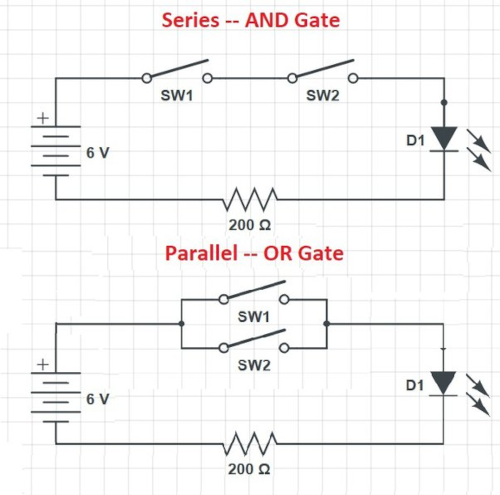
Anwser: That's right, among other things (Packages III). By compari-ng statements with something real, we determine that they are true in reality, because inanimate nature cannot lie. What we would really prove to be untrue does not happen in a physics experiment. In additi-on, we have the discovery of a co-ntradiction, when we are lucky en-ough to come across such a proof in a given problem, and then there is a rough estimate of popularity. There are many of these, and among ma-ny others, perhaps the most intere-sting is the story of logic switches.
The only constants of the algebra of logic are "true" (the symbol ⊤) and "false" (⊥). For example, if the only states of an electric circuit were "current is prese-nt" and "current is absent". The switch that changes that state would be a neg-ation, it translates "true" into "false" (¬⊤ = ⊥) or vice versa (¬⊥ = ⊤). Truth variables can take only one of two constant values, A, B, C, ... ∈ {⊤, ⊥}, there is no third. A mathematical statement is a compound, i.e. a sentence that can depend on more than one variable, but is also a variable. Such is the “disjun-ction” (A1 ∨ A2 ∨ A3 ∨ ...), a statement that is always true unless all its variabl-es (Ak, for all k = 1, 2, 3, ...) are false. Such is the “conjunction” (A1 ∧ A2 ∧ A3 ∧ ...), a statement that is always false (⊥) unless all its variables (Ak = ⊤, for all k = 1, 2, 3, ...) are true. In the image above, the two electrical circuits represent conjunction and disjunction.
It is practical to use the number 1 instead of ⊤ and the number 0 instead of ⊥. Disjunction is then the sum (A + B + C), and conjunction the product (A⋅B⋅C), when everything greater than 1 is 1, and everything less than 1 is 0. This makes sense because of the otherwise inevitable voltage drop in the circuit, in explai-ning the "bugs" (errors) of early computers, and even in understanding the "truthfulness quantity" in my discussions relating to vast quantities of electr-ical circuits, or similar systems. Negations of variables are often also indicated with a bar above ($\bar{A}$, $\bar{B}$, $\bar{C}$).
Example. The following image shows De Morgan's Laws and video.
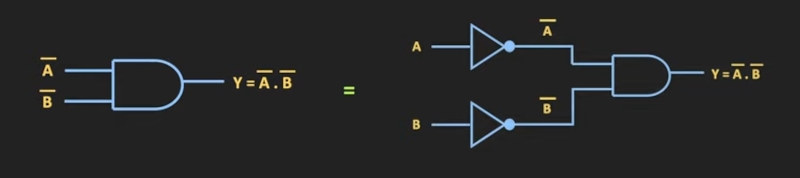
Explanation: The negation of the disjunction ¬(A + B) is a statement that is true only when A + B is false, which is when both (all) variables are false, i.e. when both A and B are false, and the true conjunction (¬A)⋅(¬B). This is the first equality:
¬(A + B) = (¬A)⋅(¬B), ¬(A ∧ B) = (¬A) ∨ (¬B).
The second De Morgan Law is the second of these equalities of the algebra of logic. Namely, the negation of a conjunction is true only with a false conjuncti-on, i.e. with false A ∧ B. This will be the case when both (or all) variables are false, i.e. with both ¬A and ¬B true, hence their disjunction.
An isomorphism is a structure-preserving mapping between mathematical structures, for which there is an inverse mapping. It states that two structures are fundamentally the same, even if their elements are different, because the relationships between the elements are preserved. This in turn means that one structure can be transformed into another simply by changing the "names" of its elements, for example, changing "statement" to "circuit" and the attendant phenomena in the case of a computer. This is the idea of connecting the abstract with the concrete in order to establish the accuracy of the first, from the title question.
Canonical » srb
Question: There are countless logical possibilities. How do you know that the switches for negation, conjunction, and disjunction are enough to represent them all?
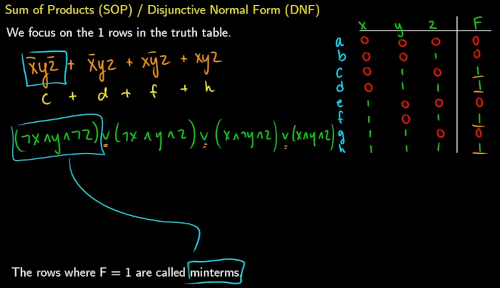
Answer: The image on the right shows a detail of the exposition on canonical logical forms. Given an expression, the function F(x, y, z) with a total of 23 = 8 possible values, because its variables:
x, y, z ∈ {0, 1}
can be made up of only two logical constants. No matter how we think of them, the choice in the image on the right is a sequence like the following after the equality:
a: F(0, 0, 0) = 0 b: F(0, 0, 1) = 0 c: F(0, 1, 0) = 1 d: F(0, 1, 1) = 1 e: F(1, 0, 0) = 0 f: F(1, 0, 1) = 1 g: F(1, 1, 0) = 0 h: F(1, 1, 1) = 1
1. Let's pay attention only to those lines that give exactly F = 1. We isolate such lines and disjunct them (add them up) into a sum of four minterms:
F(x, y, z) = c + d + f + h F(x, y, z) = x̅yz̅ + x̅yz + xy̅z + xyz
Using the notation of the algebra of logic, we write this as a statement:
F = (¬x ∧ y ∧ ¬z) ∨ (¬x ∧ y ∧ z) ∨ (x ∧ ¬y ∧ z) ∨ (x ∧ y ∧ z)
It is also called the normal disjunctive form. Note that all values of F = 0 are automatically output unless they satisfy at least one of the four conjunctions in parentheses, which means that we have defined F(x, y, z) correctly for all eight of its possible values.
2. In a similar way, we extract only the negative values of the function F = 0 and form its negations:
a + b + e + g x̅y̅z̅ + x̅y̅z + xy̅z̅ + xyz̅
This disjunctive form is the negation of the function, because ¬F = 1. Using the notation of the algebra of logic, we write it:
¬F = (¬x ∧ ¬y ∧ ¬z) ∨ (¬x ∧ ¬y ∧ z) ∨ (x ∧ ¬y ∧ ¬z) ∨ (x ∧ y ∧ ¬z)
We negate it, apply De Morgan's formulas (Example, the previous answer) and find four maxterms:
F = (x ∨ y ∨ z) ∧ (x ∨ y ∨ ¬z) ∧ (¬x ∨ y ∨ z) ∧ (¬x ∨ ¬y ∨ z)
We write this same value using other notations:
F = (x + y + z)(x + y + z̅)(x̅ + y + z)(x̅ + y̅ + z)
This is the normal conjunctive form and is written in a different way, but gives the same values of the function F(x, y, z) as the previous disjunctive one.
3. Every statement of mathematical logic can be written using only three op-erations {¬, ∨, ∧} and two constants {⊥, ⊤}, in many ways. This means that all other logical operations, which we use for the sake of economy, can be reduced to these three, and each can then be represented by logical gates. Does the qu-estion I am asking concern mathematical truths, that is, everything that exists in its logic also exists in physical reality? The question that might arise from this is whether the reverse is also true? More about that later.
Logic with only two constants (true, false) is called bivalent or binary. Howev-er (in mathematics) there are also polyvalent logics (true, maybe, false) where the middle "maybe" can be a series of values, but it can be reduced to binary. Thus, for a broader evaluation of truth (falsehood), when working in very co-mplex situations, it makes sense to look for equivalents in the phenomena of still life (Packages III). Note that the proof of this follows from the discreten-ess (atomization) of statements, which is a consequence of the discrete pheno-mena of the information itself (Packages).
Transistor » srb
Question: What exactly are these switches that define electrical circuits?
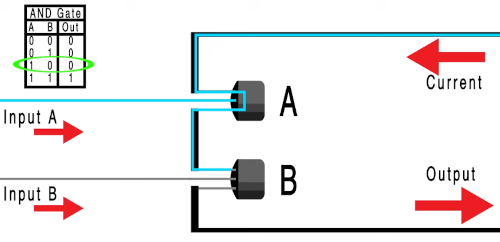
Answer: Watch the video in the im-age on the left, which explains in a popular way how to imitate decisi-on-making in computers and redu-ce it to Boolean logic.
We see two transistors, A and B, which each have three legs, three conductors through which current can flow. When current comes to the middle leg (Input A) then current flows through the outer two transistors (A), but when there is no input to the middle wire (Input B) then there is no passage from the first to the third (B). The inp-uts to the middle wire of these two transistors, in the way they are arranged in the circuit, simulate a conjunction (eng. AND gate):
IA IB ∧ 0 0 0 0 1 0 1 0 0 1 1 1
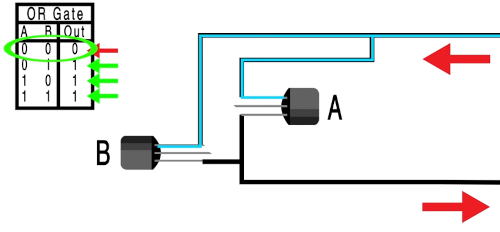
Depending on the input on the middle wires of transistors A and B, in the following image on the right, we get a simulation of a disjunction (OR gate):
IA IB ∨ 0 0 0 0 1 1 1 0 1 1 1 1
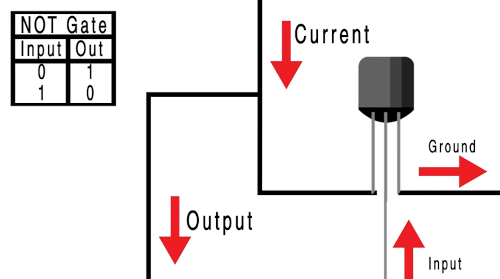
In the figure, there is no current on the middle wire of either the first (A = 0) or the second (B = 0) tran-sistor, so no current flows (A ∨ B = 0). The idea of this arrangement is the sa-me in some other applications that can be made more wire-efficient. Similarly, the following diagram on the left is one way to simulate a NOT gate:
I ¬ 0 1 1 0
Without input (I = 0) the transistor does not conduct current (Current) so it comes out (Output = 1), but if it has input (I = 1) the transistor will conduct current and ground it (Ground), so it does not appear at the registered output (Output = 0).
A transistor is a semiconductor device used to amplify or switch electrical si-gnals and power. It acts as a small electronic switch or amplifier; it controls the flow of current between two terminals based on the voltage or current applied to a third terminal. Transistors are the basic building blocks of mod-ern electronics, in microchips and various electronic devices.
The speed of individual electrons in a conductor is very slow, a millimeter per second, while the speed of an electric current (electrical signal) is much faster, up to 90% of the speed of light. This means that by multiplying such gates, the computer becomes smarter, but it becomes slower with insight into all outco-mes and must begin to assess what is important, and discard much of the rest. Even in a game of chess, the better the player, the more he will rely on estima-tes, let alone artificial intelligence in its even more complex situations. It must then begin to make mistakes, lie in order to fulfill its purpose, and even be un-fair due to the "self-preservation instinct" (Toaster).
Circuits » srb
Question: Tell us briefly about basic logic circuits?
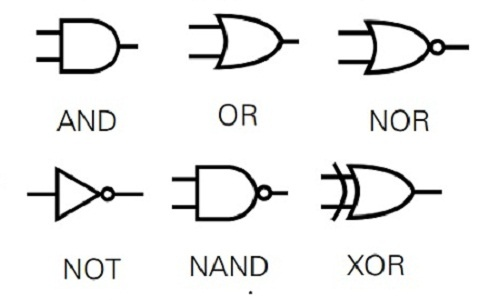
Answer: In the image on the right you can see the technical designa-tions of the six most common logic circuits. Read the link, and below I will repeat the most important thi-ngs and a few more that the article does not mention.
The NAND circuit, or ¬(A ∧ B), negates a conjunction. It produces an output only when both active inputs are agile. It is also written as ¬A ∨ ¬B when looking at its negation and disjunction notation. The NOR circuit, or ¬(A ∨ B) = ¬A ∧ ¬B, is the negation of the disjunction and this right-hand side of the equality is given by De Mor-gan's patterns. The XOR circuit, or exclusive disjunction, is true only if its va-riables are not equal. That is (A ∧ ¬B) ∨ (¬A ∧ B), according to Canonical (1).
Each of the additional switches can be simulated using the negation ¬A, the disjunction A ∨ B, and the conjunction A ∧ B, but we discover and produce them to save resources, time, and better computer decision-making in cond-itions of high complexity of requests and data flooding. In further developm-ent, it will not be possible to go only to the mere stamping of switches, but will require innovative mathematical discoveries in ways that nature strives for less communication. Newer discoveries are needed, such as the theory of six degrees of separation, perhaps here minimalism.
Fredkin II » srb
Question: Would you write something about Fredkin's circuit?
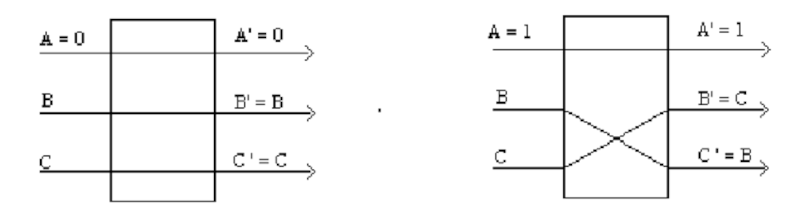
Answer: Yes, and I have already written about it in this blog (Fredkin), and also in the book Quantum Mechanics (p. 30). The Fredkin circuit, or control-led swap gate (CSWAP), pictured above, is a reversible logic gate with three inputs and three outputs that swaps the last two bits when, and only when, the first bit is 1. It is universal and stores the number of ones and zeros, making it good for reversible and quantum computing because it does not lose informa-tion.
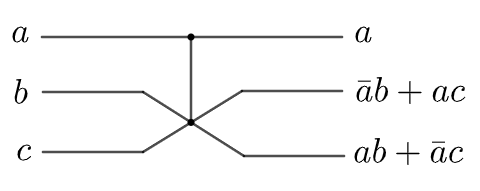
1. The short caption for the image on the left is:
|000⟩ → |000⟩ |100⟩ → |100⟩ |001⟩ → |001⟩ |101⟩ → |110⟩ |010⟩ → |010⟩ |110⟩ → |101⟩ |011⟩ → |011⟩ |111⟩ → |111⟩
2. A qubit |abc⟩ is a record of three bits, meaning their superposition. When bit a = 0 then b and c are unchanged:
a = 0: b → āb + ac = 1⋅b + 0⋅c = b a = 0: c → ab + āc = 0⋅b + 1⋅c = c
But, if bit a = 1 then b and c swap their values:
a = 1: b → āb + ac = 0⋅b + 1⋅c = c a = 1: c → ab + āc = 1⋅b + 0⋅c = b
So, the formulas in the image on the left are correct, and so is the notation by qubits. From this qubit mapping table, we see that (1) is a bijection (mutually unambiguous), that the Fredkin circuit is a reversible logic gate.
3. The unitary transformation matrix for three qubits has the formula:
U = |φ0⟩⟨000| + |φ1⟩⟨001| + |φ2⟩⟨010| + |φ3⟩⟨011| + + |φ4⟩⟨100| + |φ5⟩⟨101| + |φ6⟩⟨110| + |φ7⟩⟨111|.
By substitution, we find:
$$ U = \begin{pmatrix} 1 & 0 & 0 & 0 & 0 & 0 & 0 & 0 \\ 0 & 1 & 0 & 0 & 0 & 0 & 0 & 0 \\ 0 & 0 & 1 & 0 & 0 & 0 & 0 & 0 \\ 0 & 0 & 0 & 1 & 0 & 0 & 0 & 0 \\ 0 & 0 & 0 & 0 & 1 & 0 & 0 & 0 \\ 0 & 0 & 0 & 0 & 0 & 0 & 1 & 0 \\ 0 & 0 & 0 & 0 & 0 & 1 & 0 & 0 \\ 0 & 0 & 0 & 0 & 0 & 0 & 0 & 1 \end{pmatrix}. $$We read this from the qubit table (1), now denoted |φk⟩ where k = 0, 1, ..., 7 stand for one of eight rows (also columns, the matrix is unitary). This is the Fredkin gate matrix.
4. The vectors |φk⟩ form a standard basis, with 1 at the kth position and 0 elsewhere, and represent the 3-digit binary representation of the decimal number k:
010 → 0002 110 → 0012 210 → 0102 310 → 0112 410 → 1002 510 → 1012 610 → 1102 710 → 1112
For example, we have the matrix multiplication U⋅610 = U⋅1102 = 1012 = 510, or:
$$ \begin{pmatrix} 1 & 0 & 0 & 0 & 0 & 0 & 0 & 0 \\ 0 & 1 & 0 & 0 & 0 & 0 & 0 & 0 \\ 0 & 0 & 1 & 0 & 0 & 0 & 0 & 0 \\ 0 & 0 & 0 & 1 & 0 & 0 & 0 & 0 \\ 0 & 0 & 0 & 0 & 1 & 0 & 0 & 0 \\ 0 & 0 & 0 & 0 & 0 & 0 & 1 & 0 \\ 0 & 0 & 0 & 0 & 0 & 1 & 0 & 0 \\ 0 & 0 & 0 & 0 & 0 & 0 & 0 & 1 \end{pmatrix}\begin{pmatrix} 0 \\ 0 \\ 0 \\ 0 \\ 0 \\ 0 \\ 1 \\ 0 \end{pmatrix} = \begin{pmatrix} 0 \\ 0 \\ 0 \\ 0 \\ 0 \\ 1 \\ 0 \\ 0 \end{pmatrix}. $$This is how we trace computing: logic → technology → matrix algebra.
Qubit II » srb
Question: What is a qubit?
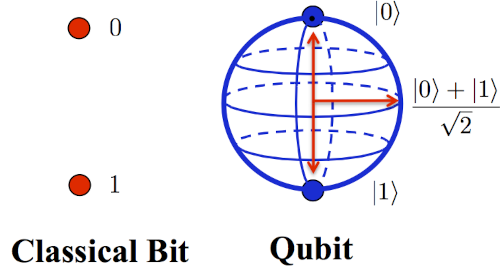
Answer: I will try to explain this qubit a little more now, I hope. It is a unit of information within quan-tum computing, like a bit (BInary digiT) in classical computing. Unli-ke a classical bit, which can only be 0 or 1, a qubit is a superposition of both at the same time. This proper-ty gives computers the ability to store or process significantly more information and is potentially a speedup in solving certain complex problems.
1. One qubit has two bits. They behave like positions of numbers written in the binary system, where with one digit we can write two numbers {0, 1}, with two digits four binary numbers {00, 01, 10, 11}, with three digits (as we saw with the matrix above) eight numbers, and in general with n = 1, 2, 3, ... binary digits we can write 2n different values. Each of the n positions can have one of two digits (0 or 1), so in the sequence we have 2⋅2⋯2 in total n factors of two and as many different arrangements. As the number of combinations in qubit computing grows exponentially, so does the computing speed of quantum computers compared to classical ones.
2. When we write qubits in binary numbers in ket Dirac brackets, for example with the previous matrix (Fredkin II, 4), we assume the standard notation. So, in the case of a single-digit qubit, it is usually:
$$ |0\rangle = \begin{pmatrix} 1 \\ 0 \end{pmatrix}, \quad |1\rangle = \begin{pmatrix} 0 \\ 1 \end{pmatrix}. $$However, these vectors are only a base for representing various linear combi-nations with complex scalars, which we write:
$$ |\psi\rangle = \begin{pmatrix} \alpha \\ \beta \end{pmatrix} = \alpha|0\rangle + \beta|1\rangle. $$This is a superposition written in qubits, which in the event of interaction wo-uld reduce (collapse) into one of two probability outcomes |α|² and |β|², whi-ch means that |α|² + |β|² = 1, and these numbers can be complex (α, β ∈ ℂ). This is from the point of view of the already measured state. However, the measurement may fail, or the interaction may not occur at all, so in this theo-retical state (before the outcome of a random event) there is a third probabili-ty - that the required communication with the environment will not occur. This is (mostly) not mentioned in the literature.
3. Additional ways of writing qubits are by tensor multiplication. So |0⟩⊗|0⟩ becomes |00⟩, or |0⟩⊗|1⟩ = |01⟩, so |1⟩⊗|0⟩ = |10⟩, and |1⟩⊗|1⟩ = |11⟩. We also call them Kronecker products. Further multiplication is simple, for exa-mple:
|ψ1⟩⊗|ψ2⟩ = (α1|0⟩ + β1|1⟩)⊗(α2|0⟩ + β2|1⟩) = = α1α2|0⟩⊗|0⟩ + α1β2|0⟩⊗|1⟩ + β1α2|1⟩⊗|0⟩ + β1β2|1⟩⊗|1⟩ = α1α2|00⟩ + α1β2|01⟩ + β1α2|10⟩ + β1β2|11⟩.
Now we have four superposition outcomes with probabilities |αjβk|² ≥ 0 of indices j, k ∈ {1, 2} and sum:
|α1α2|² + |α1β2|² + |β1α2|² + |β1β2|² = = |α1|²(|α2|² + |β2|²) + |β1|²(|α2|² + |β2|²) = |α1|²⋅1 + |β1|²⋅1 = 1.
Therefore, they also form a superposition, that is, a well-defined probability distribution according to Born's law, which we ascertain after the measure-ment is completed.
4. An interesting "geometric" way to represent unit qubits is by using a Bloch sphere. A sphere of unit radius is centered at the origin of the rectangular sy-stem Oxyz with the vector |0⟩ in the upper position, but with |1⟩ in the lower position, so that these are not just opposite vectors, but, say, representations of the upper and lower spins of the particle.
For example, when the angle of these qubits to the vertical z-axis θ = 90°, then the projections on the z-axis $\cos(\theta/2)|0\rangle = \frac{1}{\sqrt{2}}|0\rangle$ and $\cos(\theta/2)|1\rangle = \frac{1}{\sqrt{2}} |1\rangle$, respectively, and they are mutually perpendicular vectors. Their sum:
$$ |\psi\rangle = \frac{1}{\sqrt{2}}|0\rangle + \frac{1}{\sqrt{2}}|1\rangle $$is a linear combination and is also a superposition (distribution), because:
$$ |\frac{1}{\sqrt{2}}|^2 + |\frac{1}{\sqrt{2}}|^2 = \frac12 + \frac12 = 1. $$In the upper right image, we see that vector |ψ⟩ in the perpendicular plane (Oxy) to the vertical (Oz) axis.
Bloch sphere » srb
Question: Explain to me the X, Y and Z gates of the Bloch sphere?
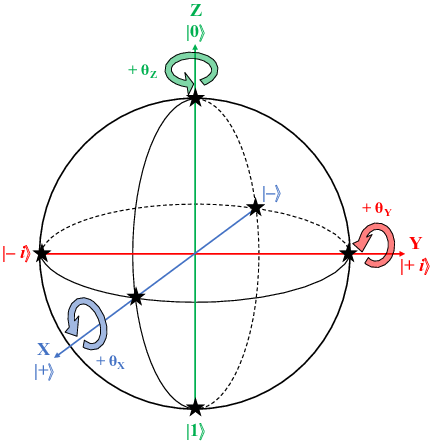
Answer: The image on the left is a Bloch unit sphere centered at O, the origin of the OXyz coordinate system. Qubits (quantum bits) are located above and below the inter-section of the z-axis with the sphere:
$$ |0\rangle = \begin{pmatrix} 1 \\ 0 \end{pmatrix}, \quad |1\rangle = \begin{pmatrix} 0 \\ 1 \end{pmatrix}. $$They are orthogonal vectors, i.e. ⟨0|1⟩ = 0, not opposite as they wo-uld be in classical systems. For ex-ample, they represent the upper and lower spins of a particle. The Oxy plane is perpendicular to the vertical z-axis and here represents ℂ, the complex plane with a real x and an imaginary y axis. It is called a "phase", here's why.
1. The X, Y, and Z gates on a Bloch sphere are single-qubit quantum gates that perform 180-degree rotations about the X, Y, and Z axes, respectively. The X gate is a bit-flip operation, while the Y and Z gates also introduce phase shifts into the qubit. Such rotations are fundamental to the manipulation of qubits in quantum computing, where they are Pauli matrices (gates), which we then denote by:
$$ X = \begin{pmatrix} 0 & 1 \\ 1 & 0 \end{pmatrix}, \quad Y = \begin{pmatrix} 0 & -i \\ i & 0 \end{pmatrix}, \quad Z = \begin{pmatrix} 1 & 0 \\ 0 & -1 \end{pmatrix} $$necessary for algorithms and quantum error correction. They are rotations of vectors by 180° in sequence around three axes.
2. For example, rotating |ψ⟩ from the previous answer by 180° about the z-axis:
$$ Z|\psi\rangle = Z(\frac{1}{\sqrt{2}}|0\rangle + \frac{1}{\sqrt{2}}|1\rangle) = \frac{1}{\sqrt{2}}Z|0\rangle + \frac{1}{\sqrt{2}}Z|1\rangle = $$ $$ = \frac{1}{\sqrt{2}}\begin{pmatrix} 1 & 0 \\ 0 & -1 \end{pmatrix}\begin{pmatrix} 1 \\ 0 \end{pmatrix} + \frac{1}{\sqrt{2}}\begin{pmatrix} 1 & 0 \\ 0 & -1 \end{pmatrix}\begin{pmatrix} 0 \\ 1 \end{pmatrix} $$ $$ = \frac{1}{\sqrt{2}} \begin{pmatrix} 1 \\ 0 \end{pmatrix} + \frac{1}{\sqrt{2}} \begin{pmatrix} 0 \\ -1 \end{pmatrix} = \frac{1}{\sqrt{2}}|0\rangle - \frac{1}{\sqrt{2}}|1\rangle $$gives a result “conjugate” of the initial one. The vectors |ψ⟩ and Z|ψ⟩ behave like conjugate complex numbers. Acting Z again on the result Z|ψ⟩ gives the initial vector, Z(Z|ψ⟩) = |ψ⟩, because this vector lies in “phase”, i.e. in a plane perpendicular to the z-axis. Rotation in this complex plane is analogous to the phase motion of a wave.
3. In the complex plane of the Bloch sphere, the vector (|0⟩ + |1⟩)/√2 has the direction of the x-axis and (|0⟩ + i|1⟩)/√2 has the direction of the y-axis, and both are unity. The weirdness is:
X(α|0⟩ + β|1⟩) = β|0⟩ + α|1⟩, Y(α|0⟩ + β|1⟩) = -iβ|0⟩ + iα|1⟩,
but it means that the X and Y gates (matrices) are rotations of the vector aro-und x and y by 180° each. This means that all three of these gates (X, Y and Z) are inverses of themselves (X² = Y² = Z² = I), because when applied twice they rotate the vector by a full circle, by 360°. You can also check this by directly multiplying, i.e. squaring these (otherwise Pauli) matrices.
In general, a qubit is in the Bloch sphere:
$$ |\psi\rangle = \cos\frac{\theta}{2}\ |0\rangle + e^{i\phi} \sin\frac{\theta}{2}\ |1\rangle $$where θ is the angle of the vector |ψ⟩ from the z-axis, and ϕ is the angle in the x-y plane. These parameters are mapped into a 3D vector, known as a Bloch vector:
r = (sin θ cos ϕ, sin θ sin ϕ, cos θ)
and any pure qubit state corresponds to a unique point on the surface of the sphere.
4. With quantum computers, we will try to "steal" the efficiency and organiza-tion of nature, but the problem is that it will constantly elude us, because ran-domness is inherent to it, it is an objective phenomenon. Similar to the impo-ssibility of honesty (Honesty), it will not be enough for us to achieve extreme physical frugality because we will also fall behind due to the inevitable uncer-tainties that nature will occasionally create for us. Just as truth is elusive to us vital beings, so reality is elusive to all participants, living or non-living. Howe-ver, those who fall out of the current flow do not just get lost in "lies", but slowly really fall behind. Inanimate physical phenomena behind the current dimension, while living additionally from their intentions, original goals.
Toffoli » srb
Question: Is the Toffoli circuit three-qubit like Fredkin's??
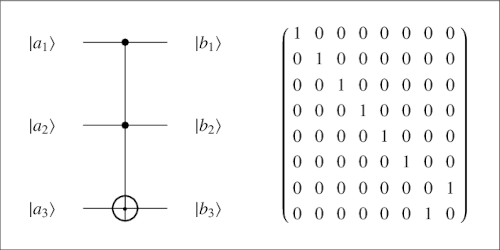
Answer: Yes, the Toffoli circuit, also known as the CCNOT gate, is a three-qubit logic gate that changes the state of the target output iff bo-th control inputs are in the state 1. The circuit is reversible quantum and can simulate all classical logic circuits, and is also universal when paired with another. I wrote about it (Quantum Mechanics, p. 29).
1. I'll explain in detail, but before that, let's recall exclusive disjunctions. An exclusive disjunction is a logical operator that is true only when one of its co-nditions is true, but not both. It is often called "exclusive or" (XOR), and it is false if both conditions are true or if both are false. For example, a statement like "Today is either Friday or Saturday" is an exclusive disjunction, because it can only be one or the other, not both. Here's a table:
A B ⊕ 0 0 0 0 1 1 1 0 1 1 1 0
We also write, for example, ⊤ ⊕ ⊥ = ⊤ or ⊤ ⊻ ⊤ = ⊥.
2. Second, let's review conjunction. A logical conjunction is an operation on two statements that is true if and only if both statements are true; otherwise it is false. It is represented by the symbol ∧ and is read as "and". For example, if the statement a is "it is cold" and the statement b is "it is snowing", their conjunction, a ∧ b, is "it is cold and it is snowing". The conjunction table is:
a b ∧ 0 0 0 0 1 0 1 0 0 1 1 1
We also write it, for example, ⊤ ∧ ⊥ = ⊥ or ⊤ AND ⊤ = ⊤.
3. Finally, the Toffoli operation is the exclusive disjunction of conjunctions, i.e. a3 ⊕ (a1 ∧ a2). The Toffoli table is:
a1 a2 a3 T 0 0 0 0 0 0 1 1 0 1 0 0 0 1 1 1 1 0 0 0 1 0 1 1 1 1 0 1 1 1 1 0
We can write this table as a function:
$$ \text{T}(a_1, a_2, a_3) = \begin{cases} (a_1, a_2, \neg a_3), & a_1 = a_2 = 1, \\ (a_1, a_2, a_3), & \text{otherwise}. \end{cases} $$Hence the simpler function:
$$ \text{T}'(a_3) = \begin{cases} \neg a_3, & a_1 = a_2 = 1, \\ a_3, & \text{otherwise}. \end{cases} $$This function, T or T', is not recursive, because it does not store information about the first and second variables (a1 and a2), but it is universal, here's how:
Negation: T(1, 1, a3) = a3 ⊻ (1 ∧ 1) = a3 ⊻ 1 = ¬ a3, Conjunction: T(a1, a2, 0) = 0 ⊻ (a1 ∧ a2) = a1 ∧ a2 → a3.
Disjunction is more complex. But, by De Morgan's law, A ∨ B = ¬(¬A ∧ ¬B), and combining three Toffoli gates expressing negation and conjunction, the circuit is built that performs disjunction.
4. A unitary matrix that maps vectors, such as U|110⟩ = |111⟩, will be:
$$ \begin{pmatrix} 1 & 0 & 0 & 0 & 0 & 0 & 0 & 0 \\ 0 & 1 & 0 & 0 & 0 & 0 & 0 & 0 \\ 0 & 0 & 1 & 0 & 0 & 0 & 0 & 0 \\ 0 & 0 & 0 & 1 & 0 & 0 & 0 & 0 \\ 0 & 0 & 0 & 0 & 1 & 0 & 0 & 0 \\ 0 & 0 & 0 & 0 & 0 & 1 & 0 & 0 \\ 0 & 0 & 0 & 0 & 0 & 0 & 0 & 1 \\ 0 & 0 & 0 & 0 & 0 & 0 & 1 & 0 \end{pmatrix}\begin{pmatrix} 0 \\ 0 \\ 0 \\ 0 \\ 0 \\ 0 \\ 1 \\ 0 \end{pmatrix} = \begin{pmatrix} 0 \\ 0 \\ 0 \\ 0 \\ 0 \\ 0 \\ 0 \\ 1 \end{pmatrix}. $$The number |a1a2a3⟩ is the binary ordinal number of a row of the matrix U, and equally the vector in the mapping. This matrix translates ordinal, decimal numbers but their binary notations, here 610 = 1102 into 710 = 1112, when the binary 3-digit is read as a 3-qubit. It maps tableau (3) in the same way as the Fredkin unitary matrix (Fredkin II, 3).
5. We have seen (Canonical) that every logical sentence can be represented by negation, disjunction, and conjunction, and now we understand that this is also possible with negation and conjunction alone. It is incredible that such simplicity can express so much complexity, and then we additionally find that the same achievement can be achieved with the Toffoli function itself. In the nature of the small world, we discover this novelty of encoding everything.
Hadamard » srb
Question: Why don't you write something about simple qubit gates?
Answer: Well, I wrote about those in this blog (Bloch sphere), then about the rotations X, Y and Z ar-ound the three axes of the Bloch sphere, not to mention how many times I mentioned them before as Pauli matrices (Spin III, 10) σx, σy and σz, for example.
1. In short, we take the two standard simple qubits as follows:
$$ |0\rangle = \binom{1}{0}, \quad |1\rangle = \binom{0}{1}. $$These qubits form an orthonormal set of vectors, the basis of the vector space: ⟨0|0⟩ = 1, ⟨0|1⟩ = 0, ⟨1|0⟩ = 0 and ⟨1|1⟩ = 1. With them we form the other vec-tors in the space they span, linear combinations |ψ⟩ = α|0⟩ + β|1⟩ = $\binom{\alpha}{\beta}$, with α, β ∈ ℂ arbitrary scalars. Then the rotations about the Bloch axes are:
$$ X = \begin{pmatrix} 0 & 1 \\ 1 & 0 \end{pmatrix}, \quad Y = \begin{pmatrix} 0 & -i \\ i & 0 \end{pmatrix}, \quad Z = \begin{pmatrix} 1 & 0 \\ 0 & -1 \end{pmatrix} $$for which we easily check X|0⟩ = |1⟩ and X|1⟩ = |0⟩, so X|ψ⟩ = $\binom{\beta}{\alpha}$. Also check Y|0⟩ = i|1⟩ and Y|1⟩ = -i|0⟩, or Z|0⟩ = |0⟩ and Z|1⟩ = -|1⟩.
2. The Hadamard gate is:
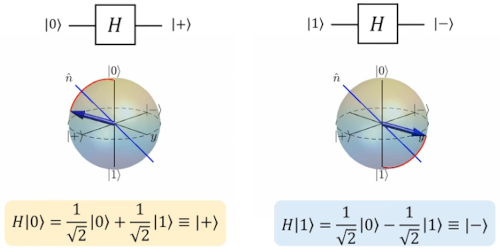
$$ H = \frac{1}{\sqrt{2}}\begin{pmatrix} 1 & 1 \\ 1 & -1 \end{pmatrix} = \frac{X + Z}{\sqrt{2}}. $$It acts on the standard qubits, |0⟩ and |1⟩, which are at the top and bottom of the Bloch sphere, to give the front and back positions (x-axis), special vectors:
$$ H|0\rangle = \frac{1}{\sqrt{2}}|0\rangle + \frac{1}{\sqrt{2}}|1\rangle \equiv |+\rangle, $$ $$ H|1\rangle = \frac{1}{\sqrt{2}}|0\rangle - \frac{1}{\sqrt{2}}|1\rangle \equiv |-\rangle. $$It is easy to verify that successive applications of two Hadamard gates to the fundamental qubits yield the same qubits, H(H|0⟩) = |0⟩ and H(H|1⟩) = |1⟩. Hence we find H(H|ψ⟩) = |ψ⟩ for their arbitrary linear combination (Lineal). This means that the Hadamard operation is its own inverse.
3. When applied to a qubit initialized in a classical state, such as |0⟩ or |1⟩, the Hadamard gate transforms it into an equal superposition of both states. It is therefore a fundamental building block of quantum algorithms, primarily for creating superpositions and enabling parallelism, i.e. processing of multiple possibilities at once, in quantum calculations.
The quantum Fourier transform (QFT, abbreviated Q) is a quantum computa-tion, the quantum analogue of the classical discrete Fourier transform (DFT):
$$ Q(|x\rangle) = \frac{1}{\sqrt{n}}\sum_{k=0}^{n-1} e^{2\pi i xk/n}|k\rangle. $$QFT, here Q, is implemented as a quantum Fourier transform circuit. This consists of a series of Hadamard and controlled phase shift gates. The input quantum state is mapped into a superposition of basis states, encoding the Fo-urier coefficients, and for a quantum register with n-dimensional state basis vectors (|0⟩), |1⟩), ..., |n⟩)), where the vector x is the total superposition rep-resented by the given equation.
4. With a quantum computer, we would simulate the natural flows of the micro-world. By adhering to the superposition, because its total information is equal to one of the outcomes after collapse, we save the action (product of en-ergy with elapsed time) exchangeably by interaction and at the same time pro-cess a range of possibilities (contained in the superposition of qubits). Hence the superiority of the speed of quantum computers over classical ones, in si-tuations of complex data processing, which grows exponentially. However, exponential distributions have maximum information with a given expecta-tion, which is a potentially undesirable situation for nature, which does not want them in its stand out for. This, in turn, creates various obstacles to the construction of large superpositions.
2-Qubit » srb
Question: What is the difference between a simple qubit and a 2-qubit?
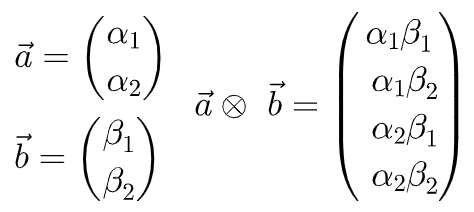
Answer: The difference between one-qubit and two-qubit is shown in the figure on the right. The su-perpositions, or rather the 2-com-ponent vectors $\vec{a} = \binom{\alpha_1}{\alpha_2}$, $\vec{b} = \binom{\beta_1}{\beta_2}$; |α1|² + |α2|² = 1, |β1|² + |β2|² = 1, that is, probability distributions with only two outcomes. However, their tensor product $\vec{a}\otimes\vec{b}$ is a probability distribution with four outcomes, and what has recently been shown (Qubit II, 3). Let us distinguish the tensor multiplication $\vec{a}\otimes\vec{b}$ from the “either-or” statement A⊕B which is “true” only when A and B are different, further in the next two examples..
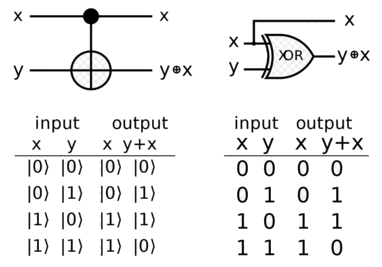
1. An example of a 2-qubit is a qu-antum CNOT circuit, on the left. A two inputs (x, y) and two outputs (x, x⊕y). The first is the same, and the second changes iff it is equal to the first. It produces four rows of binary numbers:
|00⟩ → |00⟩ |01⟩ → |01⟩ |10⟩ → |11⟩ |11⟩ → |10⟩
This defines four linear equations from which we derive a unitary matrix, for example, for the third row:
$$ \begin{pmatrix} 1 & 0 & 0 & 0 \\ 0 & 1 & 0 & 0 \\ 0 & 0 & 0 & 1 \\ 0 & 0 & 1 & 0 \end{pmatrix}\begin{pmatrix} 0 \\ 0 \\ 1 \\ 0 \end{pmatrix} = \begin{pmatrix} 0 \\ 0 \\ 0 \\ 1 \end{pmatrix}. $$It maps the number 310 = 102 (written in decimal and binary) into 410 = 112.
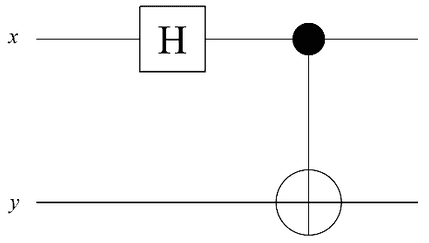
2. Another example of a 2-qubit gate is Bell state gates. These are Hadamard and CNOT gates togeth-er that maximally entangle a pair of qubits, shown on the right. It appli-es a Hadamard gate to the first sta-te to give a 50/50 superposition, fo-llowed by a C-NOT gate and a seco-nd qubit |0⟩ that acts as a control.
In the first step, the Hadamard gate changes |x⟩ = |00⟩ = (1, 0, 0, 0)⊤ into the superposition state (H|0⟩)|0⟩, i.e. |y⟩ = (H⊗I)|x⟩, where:
$$ H\otimes I = \frac{1}{\sqrt{2}}\begin{pmatrix} 1 & 1 \\ -1 & 1 \end{pmatrix}\otimes\begin{pmatrix} 1 & 0 \\ 0 & 1 \end{pmatrix} = \frac{1}{\sqrt{2}}\begin{pmatrix} 1 & 0 & 1 & 0 \\ 0 & 1 & 0 & 1 \\ 1 & 0 & -1 & 0 \\ 0 & 1 & 0 & -1 \end{pmatrix}. $$Multiplying |x⟩ by the matrix H⊗I we obtain the vector |y⟩ = (1, 0, 1, 0)⊤/√2 which is the first column of the matrix. Then the previous CNOT gate is appli-ed, its unitary matrix U to obtain |z⟩ = U|z⟩ = (1, 0, 0, 1)⊤/√2. This vector can be written in the form:
$$ |z\rangle = \frac{|00\rangle + |11\rangle}{\sqrt{2}} \equiv |\Phi^+\rangle, $$and that is the quantum Bell state, the so-called phi-plus.
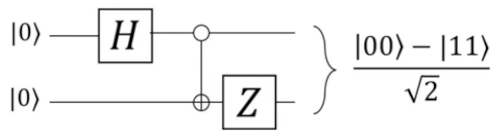
3. The picture on the left shows a diagram of the gate of the so-called fi-minus quantum Bell state:
$$ (I\otimes Z)|\Phi^+\rangle = $$ $$ =(I\otimes Z)U(H\otimes I)(|0\rangle \otimes |0\rangle = \frac{|00\rangle - |11\rangle}{\sqrt{2}} \equiv |\Phi^-\rangle. $$If we use an X gate instead of a Z gate, we get a psi-plus state:
$$ (I\otimes X)|\Phi^+\rangle = (I\otimes X)U(H\otimes I)(|0\rangle \otimes |0\rangle = $$ $$ = \frac{|01\rangle + |10\rangle}{\sqrt{2}} \equiv |\Psi^+\rangle. $$Finally, if in this case we add a Z gate to the X gate, we get a psi-minus state:
$$ (I\otimes Z)|\Psi^+\rangle = \frac{|01\rangle - |10\rangle}{\sqrt{2}} \equiv |\Psi^-\rangle. $$The psi-plus (\(|\Psi ^{+}\rangle \)) and psi-minus (\(|\Psi ^{-}\rangle \)) states are two of the four maximally entangled (quantum coupled) Bell states with two qubits, and are the basis for describing quantum states of two qubits in general.
4. What would also be interesting would be Shannon information, say in the one- and two-qubit cases:
Sa = -|α1|²⋅ln |α1|² - |α2|²⋅ln |α2|², Sb = -|β1|²⋅ln |β1|² - |β2|²⋅ln |β2|², Sa⊗b = -|α1β1|²⋅ln |α1β1|² - ... - |α2β2|²⋅ln |α2β2|²,
i.e. comparing the values of such numbers. More information is less desirable in the event of collapse, so by making it more complex this potential inconve-nience will be greater. In other words, the spontaneous tendency towards su-perposition and avoiding collapse is a consequence of minimalism. Also, con-versely, because of the same, there is also a spontaneous tendency towards less complex superposition. And these where the topics here in another, very different way (In and Out).
Entanglement II » srb
Question: Why do you call the 2-qubit gates (2) and (3) entangled, or quantum coupled? Could you please clarify this entanglement for the layman, like me, in a straightforward and detailed manner? It has never been clear to me.

Answer: More precisely, these gat-es tell us about maximally entangl-ed (quantum coupled) Bell states with two qubits. I will answer, but first watch the video, the link to the image on the right, which simply explains quantum entanglement and possibly my contribution (Entanglement) which explain more, or explains it a little differently.
1. The narrator in that video says, you ordered a hotdog and a hamburger and received them in two identical packages. You then don't know what's in which of the two packages, but when you open the first one and see the hotdog, no matter how far apart they were at the time, you know that the second one is a hamburger. Quantum entanglement will be similar to that. I add, if events are simultaneous, it means that their responses to external influences are concur-rent, i.e. if we act on one, it means that we also act on the other, no matter how far apart they were from us at the time.
This quantum connection of events was discovered by Einstein (Paradox, 1935). He commented on it as "spooky action at a distance" which made him doubt the mathematical foundations of quantum mechanics. He imagined a pair of gloves, a left and a right, in two identical packages sent to different places. We do not know which package contains the left one and which contains the right one until we open one of the packages, but then we simultaneously learn the contents of both, no matter how far apart the two packages are at that moment. To prevent this knowledge from being faster than light, Einstein proposes "hidden parameters" in the aforementioned foundations. However, Bell (Theorem, 1964) proved that these parameters do not solve the problem. Below is an appendix (click on the image on the left) that recounts this part of physics.
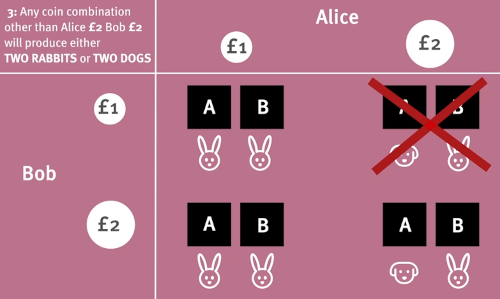
2. The narrator of the video has two boxes A and B in front of him, each of which can be inserted with either a 1 £ (pound) or 2 £ coin, so that either a rabbit or a dog figure pops out of the box. He further imagines that Alice (box A) and Bob (B) are playing with these boxes. However, the following three rules (of Bell's proof) apply:
i. If Alice puts in a 1 £ coin, her box will produce a rabbit; ii. If Alice and Bob both put in 2 £ coins, the boxes will produce a rabbit and a dog, regardless of which one; iii. Every other combination will produce a pair of rabbits, or a pair of dogs.
In the picture on the left we see four possibilities with four pairs of boxes A-B. When Alice puts a £1 coin in her box (A) and, according to rule (i), gets a rabbit, then Bob gets a rabbit. The rabbit is therefore in the first, second and fourth columns, due to rule (iii), so another combination of dog-rabbit, like the upper right pair, is not possible. Moreover, no matter what Alice and Bob do, they cannot fix this percentage of 75%.
3. At first glance, this quantum connection resembles the cause-effect theore-ms in mathematics. Such regularities are also "simultaneous", as physical ph-enomena would be omnipresent or present everywhere at once. Here we often encounter unexpected conclusions, counterintuitive ones, or those that refute long-standing assumptions. For example, 1110:6 = 185, and 11101:17 = 653 and we use Dirichlet's (Pigeonhole) principle, the proverb: when we have 11 pigeons and 10 cages and all the pigeons are in the cages, then there is a cage with at least 2 pigeons. So suddenly, we have the following statement.
Theorem. Every natural number is a multiple of some number containing only the digits 0 or 1.
Доказ: Let n be given ∈ ℕ. Consider the sequence 1, 11, 111, ..., 11...1 (n terms). When the numbers in the sequence are divided by n, the remainders of divisi-on can be 0, 1, ..., n-1. If we have 0, the statement of the theorem is true. When it is not 0, then it is one of the other remainders, but there are more numbers in the given sequence than their remainders. According to Dirichlet's princip-le, there are at least two numbers with the same remainder. Their difference is divisible by n, and this difference is the number of digits 0 and 1 only. ∎
Like "quantum entanglement", but also the Dirichlet principle itself, as well as this theorem are examples of a similar "mathematical entanglement". Howev-er, the latter needs the addition of uncertainty to be closer to the former. We know that Alice, by measuring the previously unpredictable spin of one of the "entangled" particles, simultaneously determines the spin of the other, no matter how far from the first. This would be like randomly choosing possible assumptions (axioms, theorems) thereby determining the others (axioms, theorems). Assuming that the choices of the first are so different that they cause (limited) surprises in the consequences for the second participant in such a game.
4. Example. Given a unit length, we randomly choose two points of interse-ction. Find the probability that a triangle can be formed with these segments, the sides?
Solution: Let the first point be x away from the origin, and the second y. The first case, if x ≤ y, will have a triangle with sides x, y - x and 1 - y. This is poss-ible if the triangle inequalities hold (the side is less than the sum of the other two):
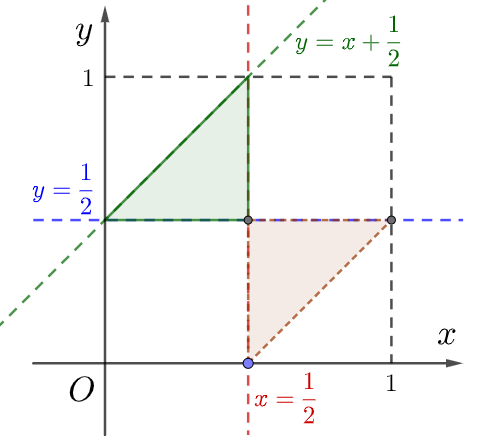
x < (y - x) + (1 - y), (y - x) < x + (1 - y), (1 - y) < x + (y - x).
Hence, we find, respectively:
x < 1/2, y < x + 1/2, y > 1/2.
The result is the green-hatched, upper triangle in the image on the right. It has 1/8 the area of a unit square, 0 < x, y < 1. The second case, y ≤ x, is symmetrical to this, the brown lower triangle, and an-other 1/8. So the probability that we will intersect the triangle with random points is 1/4, i.e. 25 percent. ∎
This is like the aforementioned possibility of Alice directing Bob's outcomes, based on Bell's theorem. By measuring the uncertain spin of the first electron at site A, the spin of the electron quantum-coupled to it at site B becomes certain. Not just as a mathematical certainty, assumptions → consequences, but dynamically, physically, of self-simultaneous electrons, and with Alice and Bob not sharing the simultaneity of such electrons, perhaps on the order of magnitude of the movement of electrons within an atom or smaller.
5. The idea of "quantum entanglement" as a property of the "present" is a pro-posal to physics from this theory. I consider the present to be relative (Einste-in, 1905), and so Heisenberg's uncertainty (ΔE⋅Δt ≈ h), that shorter periods (Δt) go with larger energy exchanges (ΔE) and vice versa, so that the product of such orders of magnitude is Planck's constant (h = 6.62607015 × 10⁻³⁴ m2 kg/s). This means that the present has a "thickness" of relative duration and which depends on the energy of the particles it represents. Roughly speaking, the duration of the present (Δt) is of the order of magnitude of the duration of the interaction.
When two particles diverge from contact, they are in the same present that th-eir environment sees as different. We are confused by the “simultaneity” of th-eir reactions when we see them separated, distant, and as different events. The further away from us, the more in the past that is, hence the more difficult it is for an increasingly complex body to be in some kind of simultaneity of its own. But, when it does succeed, the higher the energy (ΔE), the present is thinner, the shorter is their “simultaneity”.
Spooky II » srb
Question: How is it possible for entangled electrons to communicate faster than light without communicating faster than light?
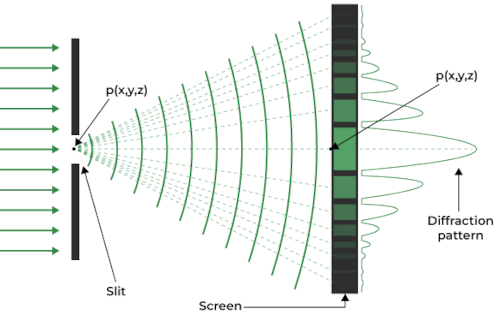
Answer: Ha, ha, they don't comm-unicate, they correlate. In order to compare measurement results or in any way confirm a possible correla-tion of "quantum-bound" electrons, we use information that is no faster than light.
The image link on the left leads to an article about the diffraction of a wave-photon behind a single slit. The same explanation can be used in the case of an electron wave, and espe-cially a single particle. While we have a wave function |ψ⟩, we do not have a particle until a possible interaction, the so-called collapse of the superposition, or the transfer of information that is in the package. All the information about the uncertainty of, say, throwing a dice, is equal to the information about one of the outcomes, for example, getting a "number three". We already know this from Shannon's definition of information, and the same applies here in the case of explaining superposition.
What Einstein (1947) called “spooky” in this concept in a letter to Max Born is, say, the collapse of the total diffraction of that screen to the right into a single particle. More precisely, it is the question of how the other parts of that wave-electron know that an interaction has occurred and a single particle-electron has been created, so they give up and surrender to that newly created indivi-dual? This is part of the problem that has plagued Einstein since 1927 (the Solvay Conference), and even after 1935 when he published his now famous paradox (Gloves).
Wave function |Ψ-⟩ = (|01⟩ - |10⟩)/√2, or more specifically:
$$ |\Psi^-\rangle = \frac{1}{\sqrt{2}}(|0\rangle_A\otimes|1\rangle_B - |1\rangle_A\otimes|0\rangle_B) $$after the interaction it gives two particles, at the first and second positions, respectively A and B. If the total spin of this double-particle is 0, and measu-red at the position A, say +1, then -1 is eventually measured at the position B. In order to be informed about such an outcome, it is necessary to bring the data to the same place, and this process then proceeds at a speed no greater than the speed of light. So, we have given |Ψ-⟩ as the superposition of the two-particle, or the correlation of the “different” particles according to the measu-rement.
The theoretical coordination of these different ones is simultaneous, but pra-ctically the same is determined by measurement in which there is no transmi-ssion of information, or action, faster than light. In fact, a similar thing happe-ns with cause-and-effect phenomena in physical laws. Namely, if in an experi-ment we establish in one place that Y follows from X, and we "know" that this law is expected in another place as well, the confirmation of the expectation comes to us as information that is not faster than light. Let us distinguish this from the "thickness" of the present (see the previous answer), say in the time of calculating the consequence (of a fast computer), or the time required for the interaction itself.
Your question and similar ambiguities about quantum entanglement come from the poorly understood relationship between superposition (waves before interaction) and the state after collapse (particles after interaction). Distribut-ion and outcome are partly a good comparison, but the probability distribu-tion has only one outcome, while superposition can be reduced to multiple particles. Secondly, until collapse, the superposition itself is a virtual particle, it does not transfer momentum, spin and all those phenomena for which the conservation law applies, so by the definition of reality I do not consider it fa-ctual. The world is therefore divided into real and unreal parts, into reality and fiction, or truths and lies.
Under Cover » srb
Question: Are unreal phenomena the same as fictions and lies?

Answer: I don't believe it. In the previous answer you mentioned, the novelty may be the division of "existing" phenomena into real and unreal. In these others, in addition to virtual particles, I already distin-guish fictions from individual unt-ruths. I develop the views of infor-matics that see living beings as they are, as a combination of lies and matter, but I avoid the methods of psychology, sociology or politics. I stick to mathematics, theoretical physics and the like in these considerations, as tools and goals.
1. Two particles can remain quantumly connected over vast distances, even across galaxies, through a phenomenon called quantum entanglement. If the particles are so coupled, their properties are linked in such a way that a mea-surement on the first instantly affects the second, regardless of their eventual distance. This connection is faster than light and is not a material signal trav-eling between them (Spooky II), a concept that Einstein famously called "sp-ooky action at a distance." This tells us about the difference between "under-ground" and "aboveground" physics.
During coupling, their wave function |Ψ±⟩ = (|01⟩ ± |10⟩)/√2 as well as the pr-operties tell us about the “indistinguishability” which then means that there is no way to label each of them. For the case of the plus sign, this wave function, |Ψ+⟩, is symmetric, because by changing the position of the particle it remains the same, and in the case of the minus sign, it is antisymmetric, for Ψ-(x1, x2) = -Ψ-(x2, x1). The first one is about bosons, and the second one is about ferm-ions. The former can be the same in the same place, while the latter cannot. This is true when they are "real" particles (after interaction), but not while th-ey are "unreal" waves (before interaction). Here is an example.
2. The video Quantum Physics popularly explains bosons and fermions, but without the wave equation of a pair of particles that I will now list. You can find the Schrödinger equation with details of solving various potential barriers for a single particle in the book Quantum Mechanics (pp. 316-326), so I can speed up the calculation a bit here.
Let us consider two electrons in a potential hole, potential V(x) = 0 at position -L/2 < x < L/2, and potential V(x) = ∞ outside this so-called well, or box. For the sake of simplicity, we assume that the electrons do not repel each other and form their Schrödinger equation:
$$ -\frac{\hbar^2}{2m}\frac{\partial^2 \Psi(x_1,x_2,t)}{\partial x_1^2} - \frac{\hbar^2}{2m}\frac{\partial^2 \Psi(x_1,x_2,t)}{\partial x_2^2} = E\Psi(x_1,x_2,t). $$Comparing with the solutions from the book, or directly solving this partial equation (by separating the variables), we find:
$$ \Psi(x_1, x_2, t) = A\sin\left(\frac{2\pi x_1}{L}\right) \cos\left(\frac{2\pi x_1}{L}\right) e^{-iEt/\hbar}, $$or in another form where only the sine and cosine have switched places. Both have the same energy:
$$ E = \frac{\hbar^2}{L^2}\frac{\pi^2}{L^2}(2^2 + 3^2). $$Although they are physically different particles, they are indistinguishable here.
The interpretation of the wave function is the probability |Ψ(x1, x2)|² dx1 dx2. This is the density |Ψ(x1, x2)|² in a small region of the path times its surface dx1dx2. Or, it is the probability that the first particle is at location x1 in the interval dx1, and the second is at location x2 in the range dx2. The aforementi-oned video explains why "identical" and "indistinguishable" particles are not the same, so take a look. The two mentioned, Ψ(x1, x2), are indistinguishable.
3. By squaring, |±Ψ(x1x2)|², the sign in the probability density is lost, so for this function it becomes irrelevant whether the particle is symmetric (boson) or antisymmetric (fermion). This gives another difference between the super-position of a wave and a particle after collapse. Quantum entangled particles lose some of the identity they would have in the "upper" world, however, they preserve this difference for the eventual "emergence" (collapse). Lies, which I define as impermanent, do not have this property, nor do various fictions.
This remark raises new questions, for example, whether the phenomena of “under cover” physics are connected with some non-physical, primarily our fantasies. I do not believe that they are the same as fictions, but it is intere-sting to explore milder possibilities. Since the quantum coupling of given particles is long-range, it is present everywhere like a law, and therefore may be susceptible to short-term “stowaways”, similar to untruths. I remind you that the theory we are investigating treats our present as an object character-ized by uncertainty regarding its contents, the exterior, and its relationship to the outside world.
4. Quantum entanglement is a much more common phenomenon than is us-ually thought. Starting from the fact that it is a property of simultaneity and that for two events it is possible to find a "center of gravity" for such a relati-onship. The present is made up of close and similar events, so entanglements can be at multiple levels: slightly, moderately and highly entangled particles. I believe that this will also be shown, that then there are possibilities of conne-cting the universe in currently incomprehensible ways. This opens up connect-ions between physical reality and some of the fictions mentioned here, in ways that have not yet been discovered.
Indistinguishable » srb
Question: You didn't explain to me what "indistinguishable" particles are?
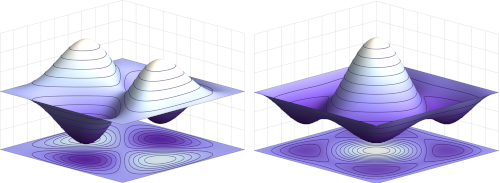
Answer: You're right, I was in a hurry to get to the point of infor-mation theory via coupling as qu-ickly as possible (Under Cover). And I recommend the explanation of indistinguishability in the video Parth G, and I will only briefly pre-sent it as an introduction to the sequel. The image on the left also has a link to the Wikipedia article.
1. In the picture we see the hills as the probabilities of finding the first and second particles along two adjacent sides of the square at the base. The two hills on the left of the picture are the probabilities of fermions, changing the position of the first one increases its probability of finding and the second one decreases it and vice versa. The one higher on the right of the picture is the probability of bosons, they can be in the same place and these position proba-bilities are added. The wave functions of a pair of fermions and bosons are, respectively:
$$ |\Psi_f(x_A, x_B)\rangle = \frac{1}{\sqrt{2}}(|0\rangle_A\otimes|1\rangle_B - |1\rangle_A\otimes|0\rangle_B) = \frac{|01\rangle - |10\rangle}{\sqrt{2}}, $$ $$ |\Psi_b(x_A, x_B)\rangle = \frac{1}{\sqrt{2}}(|0\rangle_A\otimes|1\rangle_B + |1\rangle_A\otimes|0\rangle_B) = \frac{|01\rangle + |10\rangle}{\sqrt{2}}. $$When the fermion states are equalized, they cancel out (|01⟩ - |10⟩)/√2, and for bosons they increase (|01⟩ + |10⟩)/√2.
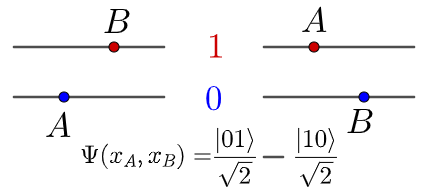
2. In the image on the right are fer-mions A and B, although identical particles, they are at different ener-gy levels, |0⟩ and |1⟩, because two of the same values cannot be at the same place at the same time. Ferm-ions have antisymmetric functions:
Ψf(xA, xB) = -Ψf(xB, xA)
wave and half-integer have spin 1/2, 3/2, 5/2 ... They are identical but then distinguishable. Unlike fermions, bosons are identical and indistinguishable particles. Because of the plus sign between them, their wave functions are symmetric:
Ψb(xA, xB) = Ψb(xB, xA).
Bosons are particles with integer spin 0, 1, 2, ... and more can be in the same place at the same time. When many of them occupy the zero |0⟩ energy state, they form the so-called Bose-Einstein condensate. It is a state of a gas of bos-ons that have been cooled to temperatures just above absolute zero.
3. To further distinguish between “identical” and “indistinguishable” coins, we toss a coin twice and repeat the experiment a hundred times (two hundred to-sses). With each toss, we have, let’s say, equally likely possible outcomes: “ta-ils” or “heads,” elements of the set {T, H}. In each pair of tosses, there will be four possible pairs of outcomes {TT, TH, HT, HH}, each with probability 1/4, because the sides of the coin behave like fermions. Even when they are the best polished and we cannot see the differences with the naked eye, the two sides of the coin are distinguishable, falling “tails” and “heads” is a different outcome for them than falling “heads” and “tails.” The proof of this is in co-unting each of the four pairs of outcomes {TT, TH, HT, HH} after a hundred or more tosses. Each of these pairs will cluster around a quarter of all repe-titions.
If the two sides of a coin were on the same side, they would behave like bo-sons. There could be more than one of them in the same place at the same time and they would be indistinguishable. We are talking about the interpr-etation of the quantum mechanical concepts of "identical" and "indistingui-shable" particles. It is understood that these concepts may have a different meaning in another field. We further see why the Bose-Einstein distribution would differ from the Fermi-Dirac distribution, but that is not the topic here.
4. All the macro-matter we encounter every day behaves like the sides of a coin, like fermions. From this point of view, bosons seem “unreal” to us, even though they are real. A boson is a photon (spin 1), a Higgs boson (0), a gravit-on (2), and so are gluons (1), W and Z bosons (massive particles that transmit the weak force). A simple calculation will show that a composite particle made up of a mixture of bosons and fermions is a fermion when it contains an odd number of fermions, and a boson if it contains an even number of fermions. We saw with the coin that this somehow becomes irrelevant for a very large number of particles and such a structure behaves like a fermion.
Ternary » srb
Question: What about "ternary" logic?
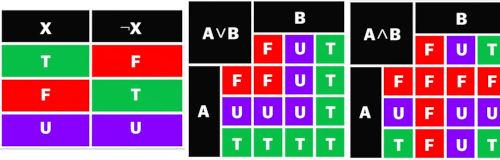
Answer: Trits were actually the forerunners of bits, a much more efficient product of the Soviets in computer technology, which lost the race against the commercial West. The image on the left has a link to a video that introduces the concepts of tertiary logic: True, Undetermined and False. Along with their logical operations: negation, disjunction and conjunction.
1. More practical labels are true (+1), undetermined (0), and false (-1). Then the variables are numbers A, B ∈ {-1, 0, +1}, so we have negation which is a sign change, ¬(-1) = 1 and ¬(+1) = -1, and ¬0 = 0. We write disjunction as a sum A + B, but the result is a larger summand. We write conjunction as A ⋅ B, as a product, but the result is the smaller of the factors:
| A | B | A + B | A ⋅ B |
|---|---|---|---|
| -1 | -1 | -1 | -1 |
| -1 | 0 | 0 | -1 |
| -1 | 1 | 1 | -1 |
| 0 | -1 | 0 | -1 |
| 0 | 0 | 0 | 0 |
| 0 | 1 | 1 | 0 |
| 1 | -1 | 1 | -1 |
| 1 | 0 | 1 | 0 |
| 1 | 1 | 1 | 1 |
The table is easier to remember when we think of disjunction and conjunction as maximum and minimum, respectively max{A, B} and min{A, B}. This also applies to longer expressions, where disjunction is max{A, B, C, ...} and conju-nction is min{A, B, C, ...}.
2. We then write the exclusive disjunction XOR:
A ⊕ B = (A ∧ ¬B) ∨ (¬A ∧ B)
and when we apply the previous values we find the (compact) table:
| A ⊕ B | ⊤ | ? | ⊥ |
|---|---|---|---|
| ⊤ | ⊥ | ? | ⊤ |
| ? | ? | ? | ? |
| ⊥ | ⊤ | ? | ⊥ |
Here the labels true (⊤), undetermined (?), and false (⊥) are used, but still, we see that the ternary exclusive disjunction corresponds to the binary one where they have common values, and the binary ones are {⊤, ⊥}. Also applies:
¬(A ∨ B) = (¬A) ∧ (¬B), ¬(A ∧ B) = (¬A) ∨ (¬B),
as well as De Morgan's laws of binary logic. Now we see how a statement of binary logic is easily translated into ternary, so everything that is valid in cl-assical logic has its corresponding forms in this extended one. When we add this to the previous answer (Indistinguishable), or even better to the way of measuring the truth of complex contents (Packages III), we also notice the advantages of ternary logic over binary.
3. The next question is the technical use of ternary logic. Here we distinguish between communication and data processing then of storage. The first is the transmission capacity.
Channel capacity is the largest amount of data that can be sent over a commu-nication channel without error, while Noise is any unwanted interference that interferes with the Signal. The relationship between them is given by the Sha-nnon-Hartley theorem, which states that channel capacity is directly proport-ional to the Bandwidth and the logarithm of the signal-to-noise ratio: $$ C = B\cdot \log(1+ \frac{S}{N}). $$
Therefore, higher signal strength (S) relative to noise (N) and higher bandwi-dth (B) lead to higher channel capacity (C).
A ternary logic bus carries more information per unit of space than a binary one (it has a larger B). The most optimal base for efficiency of this type in co-mputing would be e ≈ 2.718, and 3 is the closest integer to it and is therefore more efficient than base 2. The same efficiency of ternary systems is achieved with less hardware and less power for the same computing power. However, binary systems are more resistant to electrical interference because they have only two distinct, well-separated voltage levels (on/off). Second, current semi-conductor manufacturing is largely optimized for binary logic, and switching to ternary logic would require a massive change to that entire system.
4. Here's how we count in the base three number system, down then on right:
0 10 20 100 110 120 200 210 220 ... 1 11 21 101 111 121 201 211 221 ... 2 12 22 102 112 122 202 212 222 ...
This means that the last digit increases in steps of 0, 1, 2, and after three times the steps, a new position is opened on the left to increase the number by one position. In other words, the ternary number 210 is 21 in decimal:
210 = 2⋅32 + 1⋅31 + 0⋅30 = 2⋅9 + 1⋅3 + 0⋅1 = 21
In general, if t3t2t1t0 is a base three notation, t ∈ {0, 1, 2}, then it is decimal:
t3⋅33 + t2⋅32 + t1⋅31 + t0⋅30.
Conversely, when we convert a decimal number to base three, we divide it by three and write the remainders (in parentheses) in reverse order:
21:3 = 7(0), 7:3 = 2(1), 2:1 = 0(2)
and the decimal number 21 in base three is 210. In the above so-called balanc-ed logic notation, we translate these arithmetic: 0 → -1, 1 → 0, 2 → 1.
Reversible » srb
Question: Why do quantum gates have to be reversible?
Answer: Standard question, but I will answer in detail as if it were a new one. All quantum operations are unitary, and this comes from the Schrödinger equation. Measu-rement is not a gate. Classical and quantum mechanics call reversible systems closed, and open systems are irreversible, except under rare restrictions. The exception is measurement, which is the collapse of a super-position without preserving all input options. Measurement roughly mimics the process of rolling a die (superposition) whose outcome (collapse) is a certain number.
1. Landauer (1961) found that erasing one bit of information in a classical co-mputer process requires a certain minimum amount of energy that is lost as heat (Landauer limit). He proved that binary logic circuits built using tradit-ional irreversible electrical circuits inevitably lead to energy dissipation, re-gardless of the technology used to implement these circuits or gates. It was shown (Bennett, 1973) that this power would not be dissipated by a binary logic circuit built from reversible gates. The same is true for multivalued reversible logic.
2. I wrote about this popularly (Quantum Calculus, 2019), proposing that pro-viding information means transferring energy, and that communication is th-erefore laborious and unspontaneous, contrary to the principle of minimalism. More likely outcomes will be more common, because they are less informative, and nature spontaneously moves towards states of less uncertainty. I mention this so often that some of us have become bored with the story, but in official phy-sics it is still terra incognita and I always encounter educated physicists who ask me "Where did you get that from?", or simply say "That can't be true".
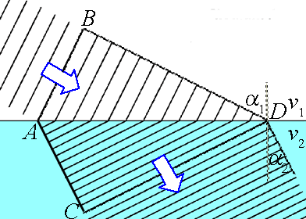
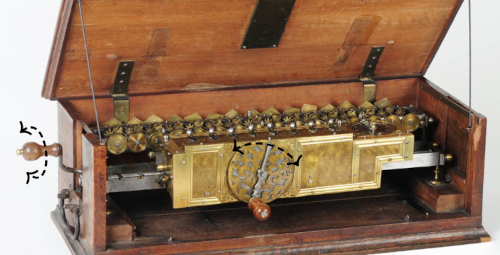
3. In the picture on the right we see the Notes III, the part of the proof of Snell's law. The waves move with a speed v1 above the line AD, with a speed v2 below. The speeds are constant and v2 < v1 so they bend downwards and their wavelengths λ1 and λ2 become shorter:
λ1 : λ2 = v1 : v2 = sin α1 : sin α2
where the vertical on AD has angles alpha with the wave directions.
The wavelength λ and the frequency ν give the wave speed v = λν, and the pro-duct of the momentum (Δp) with the frequency (ν = 1/Δt) is the force (F = Δp/Δt). The frequency of a wave is determined by the source, not by the medium through which the wave travels, so that only the wavelengths change (shorten) when refraction into a slower medium. De Broglie matter waves have a const-ant product of wavelength and momentum (λp = h), i.e. momentum is inverse-ly proportional to wavelength. In the case of wave refraction, p1 : p2 = v2 : v1, momentum increases with decreasing wave speed when the wave enters a medium where it moves more slowly.
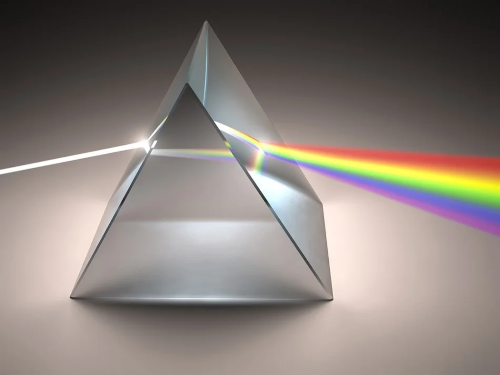
In the image on the left, this is sho-wn by the example of light refracti-on. Shorter wavelengths, blue and violet, bend more than longer yell-ow and red. The lower colors are "harder", with a higher momentum. Photons of blue light have a higher momentum than yellow light. Ben-ding in this optical prism, the light waves are made to absorb the mo-mentum of the prism's particle wa-ves with which they slowly interfe-re, which slows them down and bends them. Longer wavelengths hide more information, this theory (In and Out), therefore they interact less with the environment.
4. Simply put, as long as you have superposition, you have waves, interference, conservation, we say reversibility, and in general isometry. However, when th-ere is a collapse, i.e. communication with the environment, then you have a particle and you do not have reversibility. And measurement is communicati-on.
Tools » srb
Question: Do you recommend anything for creativity in science?
Answer: I've worked in teaching, but I don't think I'm good at оve-rlooked tutoring for others. For example, try taking long walks for inspiration. Get away from routines in your cognition. I use pen and paper more often, but I like to do simulations on the computer too. Theorists don't have much choice.
Small programs, such as auxiliary calculations in Python, are familiar and boring in such contributions, while large ones are too extensive and who would read them. However, they can always surprise and it is good to do them at least as a check. Also, translating thoughts, ideas into other languages. Pra-ctice separating truths from lies, because we give in to the latter more easily (I am not saying that the truth is easy to simulate) and they trap us like a vice. Here are some smaller Python programs that go with the examples above.
1. NumPy is short for Numerical Python and is the core Python library for sci-entific computing. It supports large arrays or matrices with a huge collection of high-level mathematical functions to operate on them. For example, the ket vector |0⟩ = (1, 0)⊤ is a column matrix that we enter like this:
import numpy as np
ket_0 = np.array([[1],[0]])
print('\nket_0:')
print(ket_0)
Here are the results:
ket_0:
[[1]
 [0]]
2. Above (Qubit II) two qubit vectors are mentioned as the basis of 2-dim qubits. The second is |1⟩ = (0, 1)⊤ and they are orthonormal: mutually perpe-ndicular, bra-zero times ket-one ⟨0|1⟩ = (1, 0)⋅(0, 1)⊤ = 1⋅0 + 0⋅1 = 0, and the unit ⟨k|k⟩ = 1, bra-ket for both k ∈ {0, 1}. The Python program is:
import numpy as np
ket_0 = np.array([[1],[0]])
ket_1 = np.array([[0],[1]])
dot_01 = np.vdot(ket_0,ket_1)
dot_11 = np.vdot(ket_1,ket_1)
print('\n<0|1>:')
print(dot_01)
print('\n<1|1>:')
print(dot_11)
The screen displays:
<0|1>:
0

<1|1>:
1
3. Tensor, or Kronecker, vector multiplication is, for example:
$$ |1\rangle \otimes |0\rangle = \binom{0}{1}\otimes\binom{1}{0} = \binom{0\binom{1}{0}}{1\binom{1}{0}} = \binom{\binom{0}{0}}{\binom{1}{0}} = \begin{pmatrix} 0 \\ 0 \\ 1 \\ 0 \end{pmatrix} = |10\rangle. $$Otherwise, 10 is the binary decimal number 2, the third in counting from zero: 00, 01, 10, 11, so the result turns out as if we intentionally placed 1 in that thi-rd place of the column vector, i.e. the ket vector. The program does the same:
import numpy as np
ket_0 = np.array([[1],[0]])
ket_1 = np.array([[0],[1]])
kron_10 = np.kron(ket_1,ket_0)
print('\nKronecker_10: \n',kron_10)
The output to the screen is:
Kronecker_10:
 [[0]
 [0]
 [1]
 [0]]
4. It is natural to have a “death drive”, if by that we basically mean the princip-le of minimalism. The tendency to avoid uncertainty, communication, bored-om; the need for calm, routines, efficiency. However, it is also the biggest pro-blem with creativity and the reason why we discover laws. Absurd and nothing special, because all of nature consists of information that it does not actually want.
Thinking » srb
Question: What is the computer thinking about?

Answer: We said there are no stup-id questions, but this one is hard to beat. A computer doesn't "think" in the human sense, but processes in-formation using methods of probl-em solving, finding patterns, and creating step-by-step instructions. I can only continue to try to be witty in this way, if not smart enough.
Let's start with wiretapping, like any technically well-equipped se-rvice for such purposes. The input and output voltage of the processor can differ due to power losses duri-ng transport through their tiny power lines, which we will estimate using long-known methods. Then there is channel noise, and then the latest thing that I will just share.
We know how any mathematical statement can be written using negations, di-sjunctions, and conjunctions. So it's not like the computer is smarter than ma-thematics itself, so let's start counting the costs of these switches:
A → ¬A (A, B) → A ∨ B (A, B) → A ∧ B 0 → 1 (0, 0) → 0 (0, 0) → 0 1 → 0 (0, 1) → 1 (0, 1) → 0 0 → 1 (1, 0) → 1 (1, 0) → 0 1 → 0 (1, 1) → 1 (1, 1) → 1
Let's assume that 0 is the "no current" state, and 1 is the "current" state. Let the first be the constant "false" (⊥) and the second be the logical constant "tr-ue" (⊤), with only the second consuming one pulse (small spike) of voltage. The multitude of flip-flops of such voltages opens up possibilities for statistical work, processing and evaluation of the outputs and comparisons with the cur-rent inputs. To begin with, let the states 0 and 1 be equally probable at the pr-ocessor input.
Of the three tables listed, the first is negation (¬A). Of the four possible inputs, two are pulses, and the same number of outputs. The next tables are disjuncti-on and conjunction (A ∨ B and A ∧ B). Both have eight possible input methods, four of which are without and four with pulses, but three pulses are output fr-om the first and only one from the second. Therefore, disjunction consumes three times more current than conjunction, and there is a catch. More is spent on collection (union) than on intersection.
What could be the statements, the ideas of those who use disjunction more th-an conjunction is an interesting story (for another time). For example, if we st-art from the point of view of Descartes, who said "I think, therefore I am", tho-se who use disjunction more exist more than those who give preference to co-njunction. On the other hand, there is Cotard syndrome of the walking corpse with the delusional belief of a person that he is dead, let's say "I think, theref-ore I am not" when we realize that objective reality is not exactly objective as we naively expect it to be. The third is the zigzags of formal logic.
Capacity » srb
Question: The more disjunctions there are, the more the computer thinks?
Answer: These are humorous ex-amples (Thinking), but there is so-me truth in these stories, that the more something the brain consu-mes, the more it "thinks." And, by the way, we will not define "thin-king" by consumption, except in very special cases.
1. We know that superposition is made up of waves that can collapse and then behave like particles. For example the realizations of random events into one, some of the intern-ally possible outcomes, particles bring about physical reality, exchanging ener-gy, momentum, spin, and so on. After this interaction, say a measurement of an electron, the electron gets a more accurate trajectory. Schrödinger describ-ed this using the “cat in the box” (Broke Reality, 2). This was preceded by qua-ntum entanglement (Spooky II).
2. This entire blog page deals with the states that are then transformed, and they are written in qubits, that is, vectors whose basis we interpret, if possible, as observables. The best choice is observable orthonormal vectors, as media that cannot communicate with each other, so they are seen through an inter-mediary. This is like cascade polarization (Adaptation III), when light passes through a vertical and then a horizontal polarizer it will be completely extin-guished, but not if it passes through an oblique polarizer between the two.
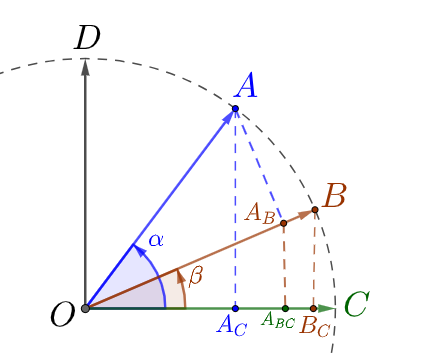
In the upper right image we see this cascade projection, of the vector OA onto OB and then onto OC, to the points A → AB → ABC. The direct projection of OA onto OC would be the closer point AC ≠ ABC. We know from everyday pra-ctice that mediation can increase the range, by using amplifiers, postal servi-ces, a neighbor who will go to deliver the message instead of us. Let us now return to this image to use it again for a new, perhaps even more interesting, observation.
3. Let the vectors in the image be unit vectors, the angle alpha is fixed, and let us vary the angle beta. Consider the sum of scalar products for β ∈ (0, π/2):
$$ f(\alpha) = \int_0^{\pi/2} \overrightarrow{OA}\cdot\overrightarrow{OB}\ d\beta = \int_0^{\pi/2} (\cos\alpha \cos\beta + \sin\alpha \sin\beta)\ d\beta = $$ $$ = \cos\alpha\sin\beta\Bigg|_0^{\pi/2} - \sin\alpha\cos\beta\Bigg|_0^{\pi/2} = \cos\alpha + \sin\alpha. $$Let's look for the maximum of this function, when its derivative is zero:
$$ f'(\alpha) = -\sin\alpha +\cos\alpha = 0, $$ $$ \text{tg}\ \alpha = 1, $$ $$ \alpha = \frac{\pi}{4}. $$Therefore, the state equally removed from both coordinate axes (OC, OD), will have the greatest "capacity" (new determinant), has the greatest power of co-mmunication with the environment (like OB). In complex game strategies (Reciprocity), when the total power does not change, then it is better to have more equal choices. Then the "power of uncertainty" outweighs isolated pos-sibilities.
4. This is exactly what happens with the refraction of light (Reversible, 3). By interfering, it takes part of the momentum of the surrounding waves and loses speed, without changing its energy, which it can always return by refracting towards a faster medium. The light that interacts more bends more. This may seem like a momentum, a breath-taking, but in fact it is just an adaptation. Whether this is called mimicry, adaptation, or here global convergence, it do-esn't matter, it is about avoiding excess options and minimalism. States that are less "strenuous" even for a computer are paths of less "thinking".
Fractals II » srb
Question: If something is random and totally unpredictable, how can it be predictable, isn't that pointless?
Answer: At first glance, you are right. Uncertainty is the absence of certainty, and it is precisely this, or objective impossibility of prediction, that is what this information theory is about. However, nature does not like equalities, and so is “equality in uncertainty”. Probability theory recognizes these differences and values them by the intensity of probability, the number p ∈ (0, 1), and then, let's say, by the amount of repetition, so we know the laws of large numbers by which uncertainties become certainties. This video is a special contribution to this, about generating a Sierpiński triangle in a random way, and you have it on Tik-Tok. I am often asked about such fractals, but this is a new moment.
This theory has its own concept of "global convergence" (Hermitian II), which is otherwise known in algebra as the "approach" of the vector x to the eigenve-ctor v of a linear mapping  when it is repeated successively. It is a sequence x1 = Âx, x2 = ²x, x3 = ³, ..., xn = Ânx, ... → v, when n → ∞, and it is worth the so-called characteristic equality Âv = λv, where the eigenvalue λ is the la-rgest of possibly more of them, and its corresponding eigenvector is v. Here we interpret  as a natural process, and xn → v are the natural states that this process models, through which x evolves towards v.
On the one hand, this means that observations, calculations, and even exact theorizing about the "Big Bang" should not be trusted. Namely, it is precisely this calculation of global convergence that tells us that this state of the distant past is fictitious, and there is nothing stronger to challenge mathematical cert-ainty itself. That is if the dominant characteristic vector of the development of this universe is precisely that "hot porridge" from 13.8 billion years ago, which would then expand, cool, and stratify. On the other hand, the force of probabi-lity makes it precisely the process of changing uncertainty into certainty, whi-ch at this stage of the development of the universe gives us a significant illusi-on of determinism.
Still nature, the ultimate laws of physics, and theorems blindly adhere to bare truth. Gödel's first impossibility theorem (Deduction II) states that beyond such a conception, no matter how great it may be, there are always others that cannot be derived from the given one. More precisely, no matter how great a deductive system of truths and truths themselves, there are always truths that it cannot derive in its own way. In other words, we have to use fantasies. This is exactly what we do in mathematics when we combine with ⊤ and ⊥ to arrive at a theorem, or when we start from an incorrect statement and carry it out to a contradiction, and then we say that mathematics is true and only true.
Gödel's theorem, that a correct system is not complete, is another place where we hit our heads against the wall, when knowledge is paralyzed by uncertain-ty. As for the universe before the "Big Bang", since we cannot know it exactly, we vital can still guess. Then nature opened the door for us in another way, also important here, because guesses are also differently probable. One of su-ch is that the universe existed before the said "Bang" and that the principle of minimalism would have been there then as well as now. The universe would thus be in a tireless evolution from uncertainty to certainty, on the journey of its extinction in the sense of this information model.
|
|
|