|
|
|


Burial » srb
Question: Does the mass of a body change in the presence of gravity?
Answer: The official answer from physics is negative. Weight is the quantity that gravity changes; the amount of gravity acting on an ob-ject (mass) is weight. This question is not, for now, of interest to infor-mation theory, but the concept of mass will change. Starting with the sense of laziness, the reluctance to change the body's motion, and then slowly towards other resistances. I am not saying that this "mass" will necessarily retain its other current meani-ngs, but how I treat it as if it were the old one is what confuses you.
1. For now, the most likely understanding of mass, in this information theory, is through the "burying" of the given in space-time. Due to the additional dimensions of time and the mass of a given property to follow them, a larger mass corresponds to a larger internal information that makes it difficult for the body to change its motion. Because particles moving at the speed of light do not have time, it stands still for them; they do not have mass, although they have momentum. However, if they have it (Mass III), it grows with movement; we say by increasing kinetic energy, but also due to the slowing down of time.
The relative time of a moving body is slowed down because events partly flow in additional dimensions of time. Now I am speaking from a new informatio-nal interpretation. The body consists of the same information that is only par-tly perceived by a relative observer, so in relation to such an observer, it seems to be “buried.”. This goes with an additional interpretation of the “twin para-dox” (Crash), when the traveler who continues moving and the one who has returned to his brother on earth are not in the same time, nor are they the same persons.
2. Time dilation in a gravitational field is:
\[ dt = \frac{dt_0}{\sqrt{1 - \frac{2GM}{rc^2}}}, \]where G is the gravitational constant, M is the mass of the gravitating body, r is the distance from the center of gravity, c is the speed of light in a vacuum, dt0 is proper time, and dt is relative time (Information Coupling, Example 115). It can also be interpreted by "burying" events in additional dimensions of ti-me, which are not visible to a relative observer outside the gravitational field.
However, equating centrifugal and gravitational forces:
\[ \frac{GMm}{r^2} = \frac{mv^2}{r}, \]a body of mass m rotating in a circle of radius r with a velocity v. Therefore, a celestial body of mass m in the gravity of a body of mass M in orbit at a dista-nce r has a velocity v² = GM/r. This velocity changes in elliptical orbits, but it does not coincide with the required time dilation above if we start only from special relativity.
3. When a body of mass m falls freely from rest into a gravitational field of mass M, at a distance r from the center of the field, we find the velocity like this:
\[ F = -\frac{GMm}{r^2}, \quad F = \frac{dE}{dr}, \] \[ d(mc^2) = - \frac{GMm}{r^2}dr, \] \[ m = m_0e^{GM/rc^2}, \]where m0 is the mass of the falling body in the absence of gravity (Example 114). Or, expanding the expression in a series and neglecting small coeffici-ents, we get:
\[ m = \frac{m_0}{1 - \frac{GM}{rc^2}} = \frac{m_0}{\sqrt{1 - \frac{2GM}{rc^2}}}. \]It is an expression for the relative mass enlarged by the free fall velocity that would correspond to the previous time dilation.
We get this from Newton's formula (weak gravity) using only Einstein's equation of energy and mass E = mc². According to special relativity, mass increases with velocity. A body moves by inertia, falling, so we cannot say that anything changes in the gravitational field except its velocity and mass. The state of rest of that body outside gravity is equivalent to this state of motion and an increased mass at a distance r from the center of the field.
4. It turns out that the relative mass of a body falling freely into a gravitational field is greater than that of an observer from a satellite orbiting the field, and this is also true in the case of the same height (r) of the orbit and the body during the fall. And the speed of fall is then twice as high as the speed along the orbit. The difference is made by the equivalent rest outside gravity and the state of motion with an increased mass in the environment of gravity. In this way, gravity changes the mass of the body.
Falling » eng
Question: The speed of a planet's motion, obtained by the equality of gravitati-onal and centrifugal forces, depends on the shape and location of the orbit?
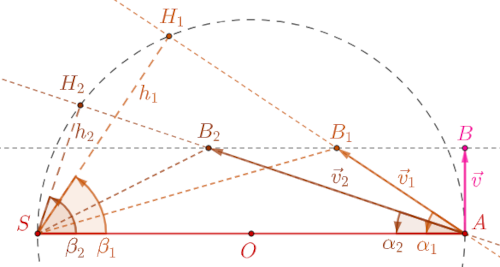
Answer: Of course, this is also what Kepler's second law says. At the aphelion (farthest point) of the ellipse, the planet's speed around the sun is the slowest, and at the perihelion (closest point), it is the fastest. You can see something else in the image on the right.
If a body falls freely from point A in the gravitational field of center S, the observed infinitesimal lengths v1 = AB1 and v2 = AB2 are the bases of elongated triangles SAB1 and SAB2 with heights h1 = SH1 and h2 respectively. We find them so that the areas of the triangles are equal: Π(SAB1) = Π(SAB2).
First of all, the acute angles from vertex A are α1 = ∠(B1AS) and α2 = ∠(B2AS). They are the angles at the vertices of the given triangles. In addition, there are β1 = ∠(ASH1) and β2 = ∠(ASH2), their complementary angles (add up to 90°). The points A, H1, H2 and S lie on a circle of radius r with center O on diameter SA, which is precisely why AH1 ⊥ SH1 and AH2 ⊥ SH2. Hence we have:
h1 = 2r⋅cos β1, h2 = 2r⋅cos β2,
h1v1 = 2rv1⋅sin α1, h2v2 = 2rv2⋅sin α2,
Π(SAB1) = Π(SAB2),
because the area of a triangle is equal to half the product of two sides and the sine of the angle between them, so v1⋅sin α1 = v2⋅sin α2. These bases are the intensities of the vectors \(\vec{v}_1\) and \(\vec{v}_2\) that are further away and the velocities of the body in free fall.
Comparing this picture with Kepler's second law, we can see that the rates of decay towards the gravitational field from the center S are higher with a sma-ller angle alpha, or more clearly stated, with an increase in the base v. With a sharper angle of the direction of movement towards the center S of gravity, the speed of the satellite increases. By equating the gravitational force with the centrifugal force mentioned above, a circle was taken that is an approximate path of the planets around the Sun, and it shows the difference in speed com-pared to direct fall precisely because of what we see in the given picture.
Aligning the lengths of the bases v with Kepler's second law (the pull from the center of force to the charge sweeps out the same areas in equal times) leads to a general law (see 1.2.3 Commutators and further from the book Information Coupling). That is, every constant central force decreases with the square of the distance that it pushes charges along conics and with the length from the cen-ter of force to the charge that sweeps out equal areas in equal times.
However, if we interpret the length of the base v as the reciprocal speed c of photons or some particles as fast as light inside the wave-planet around the Sun, it follows from the above equal surfaces:
\[ \frac{c_1}{\sin \alpha_1} = \frac{c_2}{\sin\alpha_2}. \]We have obtained, similar to Snell's law, that planets refract like waves in a gravitational field moving towards an "optically denser" medium, i.e., a smal-ler wave speed of light. The speed limit of these satellite waves is a circle with the center at the source of gravity in the plane of the orbit. Then the angles al-pha, as in the case of Snell's law, are between the normal to the boundary of speeds and the direction of motion.
This unusual result (unknown to physics) tells us about the importance of photons, i.e., particles that communicate with parts of atoms of a body and that move at the speed of light, for the motion of a body in a gravitational field. The body will freely fall faster where light (in a vacuum) moves slower. In fact, the very idea of the slower motion of light in a gravitational field is new.
Bending » srb
Question: Does this mean that gravity really slows down and bends light?
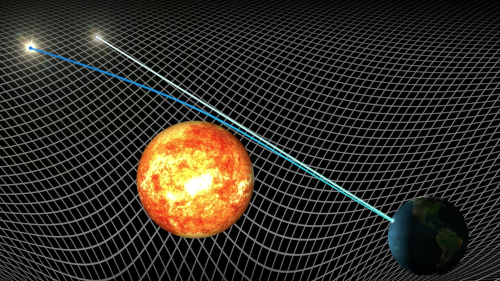
Answer: I am cautious with such an attitude until further notice. The general theory of relativity predicts the bending of the path of light itself in fields of stronger gravity. There are some supposed experi-ments that confirm the same, but there are also objections, as in the attached image on the left. Perso-nally, I am equally interested in similar theories and their objections until the truth is established, and then I am not too interested in them.
1. When we take a closer look at the previous answer (Falling) and the finding of Snell's law, we first notice that it may be a simple mathematical procedure without immediate physical meaning. For example, by subtracting sixes from the fraction 64/16, which is an incorrect procedure, we get the correct result 4/1 = 4. Mathematics itself is not short of such oversights, those more subtle cases, even among better mathematicians.
Another type of example is the use of correct procedures in places where they would not work. The most common misinterpretation of statistical significa-nce is, for example, a false positive (negative) hypothesis. Also, when we inte-rpret an unintentional occurrence as intentional (we read the shape of clouds in the sky as a message). The opposite happens when we overlook the meani-ng, for example, like Clausius with the entropy formula (1862), to which he did not attach physical meaning.
2. The appearance of Snell's law in the above calculation may be due to a real increase in the kinetic energy of a freely falling body, relative to an external fixed observer, which then actually changes the optical density of the substa-nce as it moves through the gravitational field, without any effect on the "op-tical density" of the gravitational field itself. It usually happens that a higher density of a medium is accompanied by a decrease in the speed of light in that medium. Similarly, a lower density of a medium means a lower speed of light inside.
The speed of light in a vacuum does not depend on temperature, but usually the speed of light in an optical medium is inversely proportional to the density of this medium. With higher temperature, the density decreases, and the spe-ed of light of that medium increases. However, there are exceptions to the above, but even if there are none, the resulting Snell's law shows too much regularity for the irregularities of the change in the density of a substance due to changes in its kinetic energy.
We know that the chemical composition of glass affects the refractive indices of light, and in particular the refraction depending on its wavelength. For exa-mple, crown glass illuminated by white light refracts with an index of 1.52 (the ratio of the speed in a vacuum to the speed in a given medium) approximately in the middle of the range from red to violet, while medium-grained quartz glass has a refractive index of 1.63 (the same mixture of colors). The aforeme-ntioned formula does not have such variability.
3. The derivation of the aforementioned formula does not use the general theory of relativity, and so it comes with explanations of gravity using the principle of least action (Minimalism of Information, 2.5 Einstein’s general equations), where they are derived from the Lagrangian. After that we saw a similar story using probability (Chebyshev and so on), which we can now repeat here using the "ordinary" Snell's law of refraction of light in a gravi-tational field. Of course, whatever the cause of this phenomenon is.
As we have just seen, even successfully deriving gravity from this formula is no guarantee that light will slow down and bend in the gravitational field itself. For example, if the refractive index follows the internal structure of a freely falling body, and if this follows the kinetic energy and position of the body along the trajectory.
Chaos II » srb
Question: What is the deterministic theory of chaos, and what is "objective randomness"?
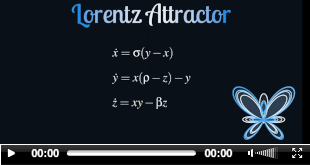
Answer: Periodicity is one of the most studied phenomena in nature. The sun rises and sets daily; winter and summer alternate annually. Various flying insects and birds flap their wings at different rates, but even less well-known historical processes can be periodic. Follo-wing this idea, the founders of deterministic chaos theory started from meteorology through mathematics.
By finding periods, from the shortest climatic flickers to its long multi-decade cycles, and then adding their amplitudes routinely as is done with known phy-sical waves, the mathematician Lorenz and other researchers interested in meteorology discovered chaos theory. Then this theory developed and expa-nded its applications.
1. For example, it has been discovered that human behavior can be conditio-ned by heredity and upbringing, then by unexpected events during life that further add their periodicities to individuals, and with everbetter computers that can add such amplitudes and calculate interferences with these given sinusoids, find regularities in behavior that even they as individuals are not aware of. Thus, the place, time, and type of crime in some large cities where the police use this theory extensively are becoming more predictable, or it is similarly used in commerce by monitoring the often unconscious habits of consumers, or tomorrow elections will “become unnecessary” with the development of ever-better artificial intelligence.
2. A double pendulum consists of two connected pendulums of lengths ℓ1 and ℓ2, at the ends of which there may be weights, say m1 and m2, respectively, so that they can make deviations from the vertical by angles θ1 and θ2. Individua-lly, when friction and air resistance are neglected, each of the two pendulums swings with its own period T1 and T2 very predictably. However, when coup-led to a double pendulum, their oscillation becomes an interference that, de-pending on the angles θ1 and θ2, can become very chaotic. It is extremely un-predictable if we do not know these two angles when they are, say, irrational.
When the phase of one periodic phenomenon repeats itself every two seconds and the other every three seconds, then six seconds (the least common multi-ple of 2 and 3) is the common phase of both. Rational periods interfere, add up, and turn into rational ones and are always some of the finite cycles. How-ever, durations written in irrational numbers, say infinite and non-periodic sequences of decimals, that is, numbers from the set ℚ, do not necessarily have finite periods. Thus, processes may arise that we cannot fully compre-hend when we begin to think about non-deterministic phenomena.
3. Determinism is the doctrine that all events, including human action, are ultimately determined by causes that we consider to be beyond the control of any individual. Philosophical determinism sometimes implies that individual human beings do not have free will and cannot be held morally responsible for their actions, but that is another story. Here I hold, first, that there are natural phenomena that we cannot fathom until we have the necessary information. Second, there are phenomena for which we cannot possibly obtain the infor-mation relevant to their elucidation, even though it exists. Third, there are those for whom the relevant information does not exist.
In the first group is the cunning of a hunter who sets a trap for his prey. In the second is some law of nature that we will not know in our lifetime. In the third are the Heisenberg uncertainty relations, or the impossibility of simultaneou-sly knowing the momentum and position of a particle with an accuracy of less than the order of Δp and Δx, such that their product is less than some magni-tude of the order of Planck's constant. The fourth would be "objective coincid-ence" without even the slightest relevant causality. I investigate this last fourth by assuming it to be true, while at the same time hoping to find some serious contradiction with which I could negate it.
4. When we consider that parallel worlds exist, we again have interesting ana-log alternatives. If a coin tossed in one comes out as “tails” and in the other as “heads,” and let’s say one of these worlds is real and the other is pseudo-real, then it’s a special story about the second one in which (we imagine that) the same laws of physics also apply as in the first. In order for the second one to then have as many elements as the first, they need to have the same cardina-lities (that there is a bijection between them). It is not then necessary to dup-licate every phenomenon; it is enough to multiply some of them.
However, if there are countably infinitely many (ℵ0) random events with two or more outcomes, then there is a continuum (𝔠) of parallel worlds. This is simply because with countably infinitely many binary or decimal digits, a continuum of real numbers can still be written. Each of these is countably infinite. Again, whatever kind of infinity it is, it can be subtracted from it and still remain the same number. As you may feel, the research into all these tasks can be very mathematically abstract but also indescribably interesting.
Commutator III » srb
Question: Where do you see external information in freefall?
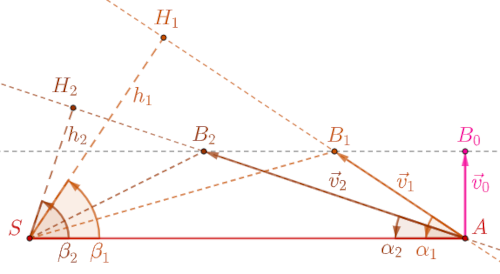
Answer: Let's start with the image used in the explanation of Kepler's second law and then free fall (Fall-ing). From A, in free fall, a body re-aches point B by taking some small steps that are exaggerated in that image for clarity. Let's imagine that A is a planet, or any celestial body, orbiting the Sun S.
1. If the orbit of body A were a circle with center S and radius r0, then the square of the velocity intensity v0² = GM/r0, mass M of the Sun, where G is the gravitational constant. The centrifugal and gravitational forces are in equilibrium. However, when the body moves to change the angle α of its velocity intensity v with respect to the radius r = SA, the product will remain constant:
v sin α = v0.
This is proven in the aforementioned explanation. Let us add here that the locus of the vertices of such velocities, points B with indices 0, 1, and 2, are all respectively on the line parallel to SA. All triangles SAB have equal areas, due to the common base SA and equal heights h = d(SA, B).
2. Let us now turn to the concept of a commutator. With this, I otherwise formalize those above "external information," in contrast to the internal, or "information coupling" of two entities that can be mutually perceived, more often called "information of perception". These names are sometimes useful but customarily redundant. The essence of information is the same in all the above cases; it is the amount of options and uncertainty. It is similar to the change of labels.
3. In the following figure, an arbitrary position of the body is taken at point T, at one of the positions of the orbit around the source of gravity F(c, 0) on whi-ch the Cartesian rectangular system Oxy is attached. The angle of the strike f which is here FT, and the velocity \(\vec{v} = (v_x, v_y)\) is θ. Angle the abscissa with the velocity is θ'. The abscissa to the thrust f is at an angle φ. The given data will only determine that the green orbit is an ellipse.
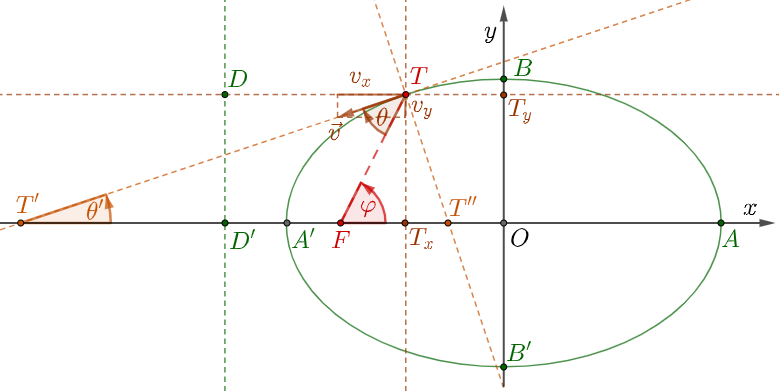
It is valid that φ = θ + θ', because it is an exterior angle of the triangle FTT' and is the sum of its non-adjacent interior angles. In the figure, the abscissa of the point T(Tx, Ty) is a negative number, Tx = x < 0; the lengths TxT = y and FTx = x - c are positive. However, both velocity components are negative, that is vx < 0 and vy < 0. Angle θ = ∠(vyv), because angles with parallel sides are equal (if not supplementary). The straight lines and normals, TT' ⊥ TT'', inte-rsect the abscissa at points T' and T''. The squared strike is f² = (x - c)² + y².
4. In particular, we calculate:
sin θ = sin(φ - θ') = sin φ cos θ' - cos φ sin θ',
\[ \sin\theta = \frac{y}{f}\frac{v_x}{v} - \frac{x-c}{f}\frac{v_y}{v} = \frac{(v_xy - v_yx) - cv_y}{vf}, \]vf⋅sin θ + cvy = vxy - vyx = [v, T].
We have obtained an expression for the velocity and position commutator.
5. We multiply it (4) by the mass m of the body T and we get:
pf⋅sin θ + pyc = [p, T]
where p = mv is the momentum of the body, and py = mvy is the ordinate of the momentum. The sine factor is the Maupertuis action (mvf, i.e. the product of the mass, velocity, and distance of the body from the source of the force) for which the conservation law holds. The conservation law also holds for the commutator of momentum and position [p, T], so this is the relation of the angle between the displacement and the velocity with the ordinate of the momentum.
6. Example. When the abscissa of the momentum is zero, px = 0, then the momentum p = ±py and in the figure the body moves perpendicular to the displacement, so θ = ∓90°. We use (5) and get:
pyf⋅sin θ + pyc = 0⋅y - pyx.
Depending on the sign of the momentum, and therefore the angle, the values of x give two points on the abscissa. According to the figure, the first is A(a, 0), and the second is A'(-a, 0), where a is the positive length AF - OF, which is ot-herwise called the semi-major axis of the ellipse. Here on the left, point A', is the perihelion, the closest point of the orbit. The right point, here A, would be the aphelion, the farthest point of the satellite's path. ∎
7 Example. When the ordinate of the momentum is zero, py = 0, then the motion is only in the abscissa direction, so the momentum p = ±px, and the angle θ = φ, or supplementary. Then φ is the angle (say) of the triangle FOB. The body moves parallel to the abscissa, the velocity is tangent to the orbit, and the normal passes through the origin O. Therefore, we put B(0, b), where b > 0, the positive number called the semi-minor axis of the ellipse.
Therefore, the tangent tan φ = ±b/c, from which is sin²φ = b²/(b² + c²), due to the drive in that case f² = b² + c². Indeed, if we insert this into (5), we find:
px⋅f⋅sin φ + 0⋅c = pxy - 0⋅x,
\[ p_x\cdot \sqrt{b^2 + c^2} \cdot \frac{\pm b}{\sqrt{b^2 + c^2]}} = p_x\cdot y, \]and hence the ordinate of the body y = ±b, as stated. ∎
***
I'm getting too long-winded, tedious, and boring, so I'll cut it short. I'll stop here to consider some more questions and topics for perhaps more interest-ing answers.
Orbits II » srb
Question: What happens (Commutator III, 3) when c = 0 of the orbit, that is, when the linear eccentricity of the ellipse is zero?
Answer: Simply substitute c = 0 into the above formula:
pf⋅sin θ + pyc = [p, T],
pf⋅sin θ = [p, T],
where f = FT is the distance of the satellite, a body of momentum p = mv with center point T(x, y), from the focus F(-c, 0) of the ellipse in which the source of gravitational force is. The angle θ = ∠(v f) is formed by the direction of the velocity v and the thrust f.
The Maupertuis action pf = mvf is constant. Such is the communicator [p, T], i.e., "external communication". Third, sin θ = [p, T]/pf, when pf ≠ 0.
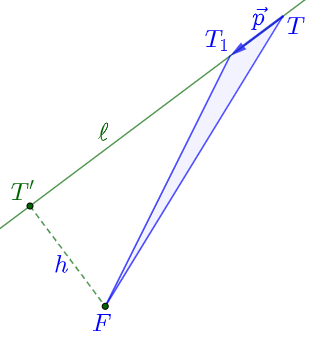
The consequence of this will be a constant, sin θ = const, sine of the angle θ = const. When θ = 90° the orbit is circular, and if it is some other also constant angle, then we have uniform rectilinear motion, that is outside of the force.
In the figure on the left, we see a uniform rectilinear motion in the direction ℓ of a body T → T1 of constant momentum \(\vec{p}\), under the "action" of zero force at point F. In this case, the triangle FTT1 will have the same area because its base TT1 and height h = FT' are consta-nt. Therefore, even in such a situ-ation (of zero force), Kepler's second law is valid, when the motion FT → FT1 sweeps out equal areas in equal times.
When the linear eccentricity of this ellipse is not zero, that is, when c ≠ 0, this means that the body falls into the gravitational field from some eccentric traj-ectory, and then there is no possibility of θ = 0, which would mean that it fre-ely falls straight to the center. Therefore, the above formula has no solutions by the shifts θ = 0 and c ≠ 0. But the reverse is possible (c = 0 and θ ≠ 0), as we have just seen.
Focus II » srb
Question: The above formulas do not contradict the laws of mechanics, so what do they actually prove?
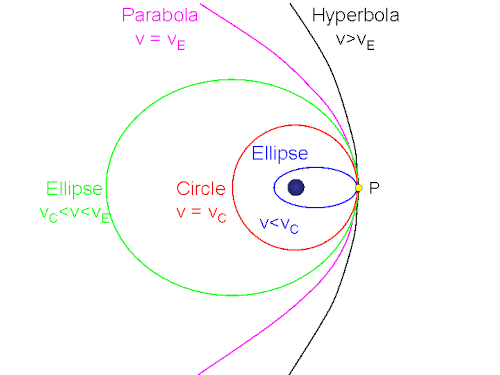
Answer:I don't need that gravity bending light, nor the opposite claim, for now, because those questions are far from the info-rmation theory and such that are currently my subject of entertai-nment. But they are there some-where, so I see these questions too. However, I don't have the quality answer that you might expect.
You could have noticed how the general theory of relativity can be obtained without "relativity," by the principle of least action (Minimalism of Information, 2.5 Einstein’s general equations), or considered through Cheby-shev inequalities of probability theory, and then as a general tendency towards less communication. I use these excursions only as tests of ideas in their extre-me situations for now.
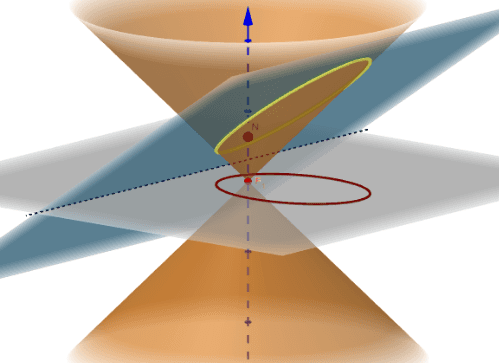
In the picture on the left are the intersections of a plane and a cone: a point, a line, a circle, or an ellipse, and then the unshown parabolas and hyperbolas. We can interpret them by the decay of the path of a celestial body (a conic) into (cone) the slowed-down flow of time of the sun when those from a distance (and thus the past) arrive down the path, at given places (the present). If it seems abstract now, try to analyze and understand such a concept gradually; see it as tomorrow's standard of physics. Until a possible contradiction.
Even if these conics, the bodies that draw them, do not slide towards the center (losing perimeter), gravity traps their time, strangling them with its past. Metaphor or not, the gaps of space run faster towards the future, and that is why there are more and more of them. Looking at it this way, the gr-avitational slowing down of time, as proven (Gravity Warps Time), is useful only as a confirmation of the principle of minimalism. Namely, the more fre-quent outcomes of more probable events, i.e. uninformative ones, together with the equivalence of information and action, make me expect nature to always strive towards less action and less information. This means towards order, i.e. a smaller amount of options. Towards a more empty universe.
The gravitational pull of a slower flow of time, together with its broader aspect in understanding the present within multiple temporal dimensions and multi-ple directions of development, inspires the idea that it is all being pulled towa-rds a slower flow of time in the future. Again, this is in accordance with the fu-ture as directed by the current past and the options reduced by it. That is, of course, not necessarily true, but just as it is difficult for me to find strong co-nfirmation, I have no refutations for now.
Until further notice, playing with such possibilities, I test both them and this concept, and it is worth adding that mixing mass with time also means the power of gravity to act through them. Therefore, if the previous one talks about "dark energy," then this one talks about "dark matter.".
Until further notice, I'm playing with such possibilities to test both them and this concept, and it's worth adding that mixing mass with time also means the power of gravity to act through them. So if the previous one speaks at least in part about "dark energy," then this one speaks about "dark matter.". I think I managed to give you a sense of what I'm talking about here.
Vibrates » srb
Question: What is more real, space or substance?
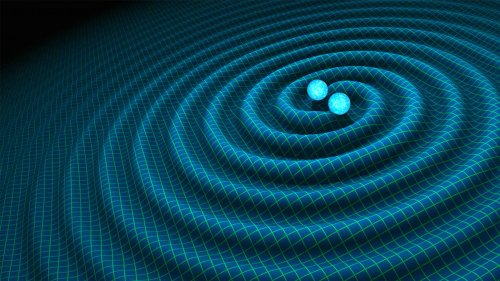
Answer: You believe there are no stupid questions without stupid answers until you get a query like this. It is an introduction to such stories that I am not happy to share, but so be it.
The image on the right shows gravitational waves. They were predicted by Einstein's general theory (1916) but were first measured on September 14, 2015, when two black holes collided 1.3 billion light-years from Earth. They would have gone unnoti-ced by normal telescopes, but they have been detected by the US's Laser Inter-ferometer Gravitational-Wave Observatory (LIGO).
This ripple of space due to gravity, or the measurement of gravity due to space waves, proves the "materiality" of independent space, that is, what is outside of substance. The gravitational attraction of slow time, mentioned above (Foc-us II), speaks of the same phenomenon. Space-time communicates (read: int-eracts) with mass. But observations of the early periods of the universe tell us that mass was created subsequently (The origin of masses).
The specificity of my interpretation of information theory is “reality,” which is a perceptible, permanent, and true phenomenon. Consequently, what lasts longer is “more real,” so we come to a completely absurd answer to the ques-tion posed, that space is more real than substance. However, absurd means unexpected given our everyday knowledge, not necessarily something inco-rrect. The discovery of so much “real” space also confuses all experts in qua-ntum mechanics in that part when we realize that there are no “particles” in the old classical materialist sense, which would be the basis of electrons, ato-ms, or solid substance in general. Instead, there are voids and vibrations.
Bosons (January 7, 2015) and fermions (January 3, 2015), particles of integer and half spin, have often been a topic for me because of this puzzle. The for-mer is the backbone of the idea of space and the latter of matter. It is possible to place all the former (bosons) in one place, at the starting point of the Big Bang, because the Pauli exclusion principle does not apply to them as it does to fermions. Since the former can produce the latter, we have a story about the expansion of something from nothing. That's why I liked the working idea that today I consider the reverse transformation, fermions into bosons, to be at lea-st a little more likely, for the sake of insight into the incomprehensibly accele-rating expansion of the universe, or the flow of the present into greater certainty.
In the beginning (13.8 billion years ago), space escaped from uniformity (high concentration of information) at different times and mixtures of substances, preserving its initial amount of information with different expansion rates of space, mass, and time. We now have everything in one: the law of conservati-on, principled minimalism, and at the same time, an explanation of that illu-sion from the “black box” of the Markov chain, that what is seen as the Big Bang represents disinformation, channel noise.
Velocities » srb
Question: What is the speed of a satellite of mass m on an elliptical orbit?
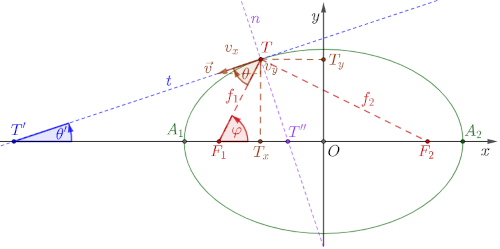
Answer: The above (Burial) is a somewhat unusual proof of the square of the velocity v² = 2GM/r of a body during free fall from out-side the gravitational field at a dis-tance r from the center of mass M. It is two times velocity v² = GM/r, in orbit of a satellite at a height r, the radius of the circle. Then we neglect the mass m of the satellite relative to the mass M of the gravitational source, or we combine them, M + m → M. That's why the convenient abbre-viation is μ = G(M + m).
1. Then we can also approximately write the law of conservation of energy:
\[ \frac{v^2}{2} - \frac{\mu}{r} = - \frac{\mu}{2a}, \]when we put approximately μ = GM. However, the correct formula comes out when we put exactly μ = G(M + m):
\[ v^2 = 2G(M+m)\left(\frac{1}{r} - \frac{1}{2a}\right). \]but the proof of the correct one is considerably longer. We use both as formu-las for the orbital velocity, depending on m/M → 0, where a is the semi-major axis of the ellipse.
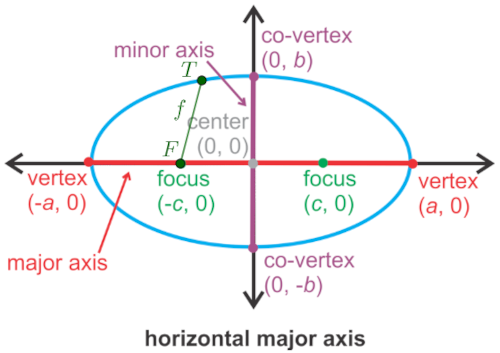
2. We use the previous image (Commutator III, larger), here above left. Let a1 is A1F1 and a2 is F1a2 the distances of the center of mass, the focus F1, from the perihelion (A1 closest) and aphelion (A2 farthest point) of the satellite's orbit. This means that a1 + a2 = 2a is the major axis of the ellipse, also the sum of the distances of the body to the focus is f1 + f2 = 2a. The book Conic sections (2014) provides some points with proofs of "2.1.2 Optics of ellipse" that would be useful for (different) more accurate derivations of the above formula.
3. For example, the tangent of an ellipse, here denoted t, makes equal angles from the point T to the foci F1 and F2 (Theorem 2.1.3). Collinear points of an ellipse: focus F1, tangent T and axisymmetric to the other focus F2 with respe-ct to the tangent (Corollary 2.1.4). The locus of points from which the ellipse is observed at right angles is a circle centered at the center of the ellipse (Theo-rem 2.1.7). A review of the basic properties of an ellipse, also with proofs, in the appendix “Curves of II order” may be more useful.
4. For example, the sum, here f1 + f2, of the lengths from the point T of the ell-ipse to the foci F1 and F2 is constant (Proposition 1). The ratio of the distances of a point of the ellipse from the focus and from the directrix ε = TF : TD < 1 is the constant eccentricity of the given ellipse, where the point D is the projecti-on of T onto the directrix of the ellipse, perpendicular to the abscissa of its po-int Dx = c/ε², where c = OF1 = OF2, the distance of the focus from the center O. The general form of the canonical equation of an ellipse is:
\[ \frac{x^2}{a^2} + \frac{y^2}{b^2} = 1, \]where the major semi-axis a = c/ε, and the square of the minor b² = a² - c². Most of it is also on Wikipedia (Ellipse).
5. When the satellite is r away from the focus, in a short time Δt it will change the angle towards the thrust by Δφ = vφΔt/r, where vφ is its instantaneous angular velocity. During this time the radius sweeps out a triangle of area ΔΠ which is rvφΔt/2. This is extremely true in the limiting case:
\[ \lim_{\Delta t \to 0} \frac{\Delta \Pi}{\Delta t} = \frac{d\Pi}{dt} = \frac{rv_\varphi}{2} = \frac12r^2\dot{\varphi}. \]Kepler's second law states that these surface changes are constant, so when the period (R) of one revolution of the satellite around the planet has passed:
\[ \frac{d\Pi}{dt} = \frac{\Pi}{R} = \frac{\pi ab}{R} = \frac12 rv_\varphi = \text{const}. \]The surface is an ellipse πab. There are two points of zero radial velocity vr of the satellite in orbit, at the closest and farthest points of the center of force, perihelion and aphelion, when the distances are respectively:
r1 = a(1 - ε), и r2 = a(1 + ε),
considering the attached image, top left. Then the angular velocities are:
\[ v_{\varphi_1} = \frac{2\pi ab}{Ra(1 - \varepsilon)}, \quad v_{\varphi_2} = \frac{2\pi ab}{Ra(1 + \varepsilon)}. \]If we use the relations between the minor b and major a semi-axes, with the distance c of the focus from the origin:
b² = a²(1 - ε²) = a² - c²,
we get:
\[ v_{\varphi_1} = \frac{2\pi a}{R}\sqrt{\frac{1 + \varepsilon}{1 - \varepsilon}}, \quad v_{\varphi_1} = \frac{2\pi a}{R}\sqrt{\frac{1 - \varepsilon}{1 + \varepsilon}} \]This is true for all weak (Newtonian) gravitational fields.
6. For example, in our solar system for Earth it is:
revolution R = 365.26 days = 3.156 × 10⁷ seconds; ε = 0.0167; a = 1 AU (Astronomic Unit) = 1.496 × 10⁸ km; vφ1 = 30.28 km/s vφ2 = 29.28 km/s.
These small differences in velocity at perihelion and aphelion are due to the small eccentricity ε of the Earth's ellipse and its nearly circular orbit. So:
gravitational constant G = 6.67430 × 10⁻¹¹ m³ kg-1 s-2; mass of planet Earth m = 5.972 × 1024 kg; mass of the Sun M = 1.9891 × 1030 kg; μ = 1.3276 × 10²⁰.
Here it doesn't matter whether we put μ = GM, or μ = G(M + m), because the differences in the masses of the Earth and the Sun are too large.
Barycenter » srb
Question: What is the speed of a planet around the sun if it has significant mass?
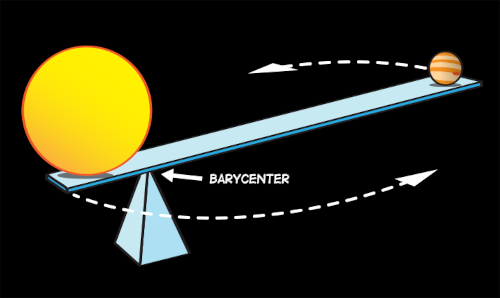
Answer: Satellites around planets and those around stars actually or-bit around their common center of mass. This is their barycenter. The-refore, the above formula (Velociti-es, 1) explained using the law of co-nservation of energy is equally valid with μ = G(M + m) as with μ = GM, when m/M → 0. When this is not the case, the smaller (mass m) as well as the larger (mass M) orbit, each in its own ellipse, around the common barycenter. Therefore, the same formula for the square of the velocity, v² = μ(2/r - 1/a), valid for both small and large bodies, where r is the distance of the body's center from the bary-center, and a is the semi-major axis of the body's orbit ellipse.
Note (Commutator III, 5) that the formula pf sin θ + pyc = [p, T] has the inco-nvenient property of using different centers, which is why I avoid it. Also, sys-tems of very large masses are not covered by the following; Einstein's relativity is suitable for them. The derivations that follow are appropriate to the needs of classical astronomy and orbits of neither too large nor too different masses.
1. The center of mass is the point of an object where we can consider all of the object's mass to be concentrated. It is the center of gravity of the system of masses m1, m2, ..., mn. Each of these masses has its own center, the vector rk, for indices k = 1, 2, ..., n, respectively, and their common center of gravity is determined by the position vector:
\[ \textbf{r} = \frac{\sum_{i=1}^n m_i\textbf{r}_i}{\sum_{j=1}^n m_j}. \]We further assume that rk = |rk| are the intensities of the individual vectors and r = |r| is the intensity of the combined, resultant vector.
2. When the center of gravity is the center of motion of only two masses present (n = 2) then they will orbit around the barycenter with the same period, the time of revolution R. They will be with individual centrifugal forces:
\[ F_k = \frac{m_kv_k^2}{r} = \frac{4\pi^2 m_k r_k}{R^2}, \quad k = 1, 2. \]Here, the velocity is v = 2πr/R. According to Newton's third law, these two forces are equal in magnitude and opposite in direction. Hence m1r1 = m2r2. This is actually proof that the center of circular motion is the center of mass, the center of gravity of this system. Let us see that the distance between the masses, a = r1 + r2, should be used to determine the period R, not, say, the distances of the individual masses, r1 and r2, from the center of mass.
3. Namely, let's start with Archimedes' law of the lever:
\[r_1 = \frac{m_1a}{m_1 + m_2}, \quad r_2 = \frac{m_1a}{m_1 + m_2}, \]then using Newton's law of gravity:
\[ F_1 = F_2 = F = G\frac{m_1m_2}{a^2}, \]and taking only F1, we find:
\[ G\frac{m_1m_2}{a^2} = \frac{4\pi^2m_1r_1}{R^2} = \frac{4\pi^2}{R^2}\frac{m_2a}{m_1 + m_2}, \] \[ R^2 = \frac{4\pi^2}{\mu}a^3, \quad \mu = G(m_1 + m_2), \]which is Kepler's third law.
4. Rotational or angular momentum is the vector L = r × p. Put differently, it is the vector, in other words the cross product of the position vector r and the (linear) momentum p. The latter is the product of the mass m and the velocity vector v of the body. The magnitude of angular momentum |L| = L = rp sin θ. In polar coordinates the perpendicular component of momentum is p⊥ = mvθ, hence L = mrvθ = mr² dθ/dt. This term is the angular momentum of a planet around the Sun.
On the other hand, the change in angular momentum with time is:
\[ \frac{d\textbf{L}}{dt} = \frac{d}{dt}(\textbf{r}\times\textbf{p}) = \dot{\textbf{r}}\times\textbf{p} + \textbf{r}\times\dot{\textbf{p}} = \textbf{v}\times\textbf{p} + \textbf{r}\times\textbf{F}, \] \[ \dot{\textbf{L}} = \textbf{r}\times\textbf{F}, \]because v × p = mv × v = 0. Newton's law F = -(GMm/r²)r gives r × F = 0. Therefore, dL/dt = 0, i.e. L = const.
5. We also use the dot above as a time derivative marker:
\[ v_r = \frac{dr}{dt} = \dot{r}, \quad v_\theta = r\frac{d\theta}{dt} = r\dot{\theta}, \]here for the velocity components in polar coordinates. The equation of an ellipse in the polar coordinate system Frθ, with the origin at one of its two foci F, with the notations of the previous answer (Velocities), is:
\[ r = \frac{a(1 - \varepsilon^2)}{1 + \varepsilon \cos\theta}. \]Then the radial component of the velocity is:
\[ v_r = \frac{dr}{dt} = \frac{a\varepsilon(1-\varepsilon^2)\sin\theta}{(1 + \varepsilon \cos\theta)^2}\frac{d\theta}{dt}. \]With angular velocity and Kepler's second law, we get:
\[ rv_\theta = r^2\frac{d\theta}{dt} = \frac{2\pi ab}{R} = \frac{2\pi a^2\sqrt{1 - \varepsilon^2}}{R}, \] \[ \frac{d\theta}{dt} = \frac{2\pi a^2\sqrt{1 - \varepsilon^2}}{Rr^2} = \frac{2\pi (1 + \varepsilon\cos\theta)^2}{R(1 - \varepsilon^2)^{3/2}}, \]where we plugged in r from the equation of the ellipse. Plug this into the radial velocity:
\[ v_r = \frac{dr}{dt} = \frac{a\varepsilon(1-\varepsilon^2)\sin\theta}{(1 + \varepsilon \cos\theta)^2}\frac{2\pi (1 + \varepsilon\cos\theta)^2}{R(1 - \varepsilon^2)^{3/2}} = \frac{2\pi a\varepsilon\sin\theta}{R\sqrt{1 - \varepsilon^2}}. \]The corresponding vertical component of the velocity is:
\[ v_\theta = r\frac{d\theta}{dt} = \frac{2\pi a^2\sqrt{1-\varepsilon^2}}{Rr} = \frac{2\pi a(1+\varepsilon\cos\theta)}{R\sqrt{1 - \varepsilon^2}}. \]6. The sum of the squares of these velocity components is the square of the velocity:
\[ v^2 = v_r^2 + v_\theta^2 = \left(\frac{2\pi a\varepsilon\sin\theta}{R\sqrt{1 - \varepsilon^2}}\right)^2 + \left(\frac{2\pi a(1+\varepsilon\cos\theta)}{R\sqrt{1 - \varepsilon^2}}\right)^2, \] \[ v^2 = \left(\frac{2\pi a}{R}\right)^2\frac{1 + 2\varepsilon\cos\theta + \varepsilon^2}{1 - \varepsilon^2}. \]From the equation of the ellipse itself we have 1 + ε cos θ = a(1 - ε²), so:
\[ v^2 = \left(\frac{2\pi a}{R}\right)^2\frac{2a(1 - \varepsilon^2)/r + \varepsilon - 1}{1 - \varepsilon^2} = \left(\frac{2\pi a}{R}\right)^2\left(\frac{2a}{r} - 1\right). \]Finally, from Kepler's third law (3) we get:
\[ v^2 = \frac{4\pi^2 a^2 \mu}{4\pi^2 a^3}\left(\frac{2a}{r} - 1\right), \] \[ v^2 = \mu\left(\frac{2}{r} - \frac{1}{a}\right), \quad \mu = G(m_1 + m_2). \]This is the desired expression for the square of the velocity (vis viva equation) of a celestial body in orbit. In the previous article I wrote μ = G(M + m), but still, there is the speed of the smaller body around the larger one. The larger body around the smaller one would move analogously and more slowly, as if it is then only interested in the masses inside the orbit.
Precession » srb
Question: Can you explain precession?
Answer: I assume that what you want is an additional explanation, an interpretation in Einstein's ge-neral theory of relativity, using my information theory.
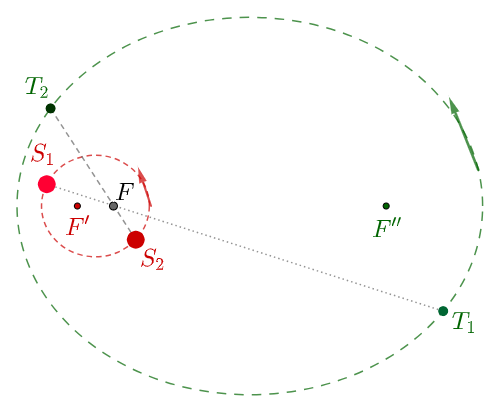
1. In the picture on the left (not to scale) are two celestial bodies, the larger S1 and the smaller T1, which orbit each other and around a com-mon point F which is the center of gravity, the barycenter of that two-body system. After almost half a re-volution (time R), this larger body has passed to point S2 and the smaller one to T2. They orbit around a common focus F of otherwise different ellipses. For the first body, the second of focuses is F' for the first body, and for the second F''. Two bodies move simultaneously at their aphelions (the farthest points from F) and in the same direction to th-eir perihelions (the closest), which are opposite the barycenter of F.
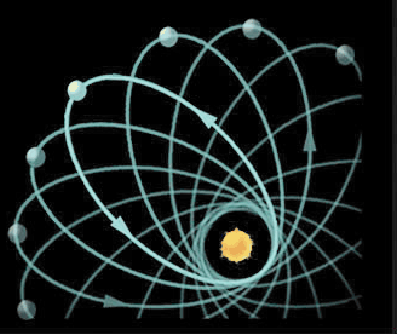
2. Astronomy encyclopedias will list as one of the interesting featu-res of our solar system that almost all revolutions or rotations have the same directions. Viewed from abo-ve the north of the solar system, the planets revolve around the Sun and rotate about their axes counterclo-ckwise. And the image on the right also sketches the rotation of the axes of the planets' ellipses in this same direction. This dragging of the perihelion behind the rotation of the planet is called precession. The precession of Mercury (43 seconds per century), Venus (8.6), Earth (3.8), Icarus (10), or other planets is well predicted by Einstein's theory of gravity, certainly better than Newton's.
3. The general theory of relativity is based on tensor calculus and Riemannian geometries and is not nearly as amenable to retelling as it is inexorable in co-mputational predictions. However, according to Einstein's theory, we can say that gravity pulls space along with it, since it also predicts the ripples (Vibra-tes) of space, which have already been measured. All the mentioned rotations, otherwise obtained computationally, thus become more intuitively clear. The exceptions become indicators of additional planetary formations.
This is supported by the idea of matter waves by de Broglie (1924), with the unexpectedly successful development of quantum mechanics by means of the Schrödinger equation (1926), which supports "material" (not in the classical sense of hard or solid) phenomena as packets of probabilities, or their distri-butions, or superpositions. It emphasizes the "emptiness" (which is anything but empty) and does not deny the aforementioned withdrawal, at least not in some intuitive sense.
4. Adding to all this that information is the structure of space, time and mat-ter, we arrive at my theorizing. Let us pay attention, (1) in the picture on the left, that two bodies pass their aphelions synchronously, that then both go to their perihelions. These phases of the massive body S1 are more on the imm-ediately following parts of the trajectory of the lighter T1 and a deeper trace owing to the past. Here "being real" implies duration and that the past can also affect the present.
Unlike particles that move at the speed of light and therefore time stands still and have their existence through the perception of others, all other phenome-na go through layers of time (albeit very shallowly). Thus, the gravity of a larg-er mass should leave a deeper trace in the past of the orbit and therefore have a greater influence on the other body — because of this asymmetry in motion. In addition to the static equilibrium around the barycenter, but precisely bec-ause of it, an asymmetry arises from the delay, that is, different distances; it leads to asymmetries in the directions of rotation of the planets.
Future » srb
Question: Is the future real?
Answer: Yes, because we have laws of nature, permanent truths that are perceptible. When these three conditions of "reality" are achieved, a part of the future actually exists (Reality IV). There are more and more of them because the universe is growing. I will explain.
1. Practice is always a force, unlike theory. Therefore, I consider light, to which time stands still, as if by universal laws, to be a concrete phenomen-on. Theories appear in unlimited copies, unlike practice, which is always uni-que, for the same reason. Skolem's theorem is one of the discoveries of logic by which I discover the infinite repetition of the abstract, and the other is Ri-esz's lemma of algebra by which I establish the uniqueness of the concrete. I often name them, and often in detail, but that is not the point here, so there is no need to repeat myself.
Reaching light from “deep space” is an act that tells us that we have a past. What we “see” in this way persists and is consistent with other true laws and is therefore “reality.” However, obtaining the present from the past is then like a Markov chain that, after a long period of copying, lies to us. What comes out, and we would like to be the original, is actually the eigenvector, the inherent state of that chain itself, which is then the “black box,” a messenger whose output information does not reveal to us the input but only an illusion too empowered by the logic of mathematics that any observation or experiment cannot destroy.
2. Celestial bodies that reach us from distant places in space are a different phenomenon. A moving object has a relatively slower flow of time, and as it approaches us, its present, which is then our future, becomes less and less different from our present, until at the moment of passing (or collision), the two align. If that body continues to move, as it departs, it falls further and further behind in our past. These are the consequences of Einstein's special relativity, time dilation.
Since the universe is getting bigger and bigger, its ends are getting further away from us. The chances for such breakthroughs are getting bigger, or, to put it more boldly, there is more and more of both the future and the past. The universe is growing, and therefore there is more and more of a "real" future in it—this follows from this upgrade of the special theory of relativity. First of all, there is more and more certainty in the future.
3. Note that the possibility of passing (or colliding with) a moving object indi-cates the consistency of what we see on it then with what is in the (coming) future of that object. Whether it is just an “illusion of reality” or not, there is nothing more true or scientifically convincing than that, and we can consider it as “actual actuality”. Similar to the “black box” of a long series of Markov chain links.
4. From the point of view of the general theory of relativity, we are lagging behind in the past the development of the universe moving towards us into the future. We live on a planet, on the surface of its mass and surrounded by a gravitational time slowing down in relation to the free space around. This vast interstellar space is moving towards the future slowly but steadily, and thanks to the long periods of time before and after our present, the gap is getting wider. There is more and more space in the universe; its galaxies are further away, and the lag of the present is accelerating.
Interpreted, this again means that there is a more and more organized future. There is also more and more past, so reducing this question to "Which is old-er, the chicken or the egg?" we come to the idea that the past conditions the future. What was defined as what will be, past events tend to reduce the opti-ons for the next, the future becomes more certain and more urgent.
Broke Reality » srb
Question: This "reality" you're talking about isn't what I expected?
Answer: I agree. It would be stra-nge if we could easily understand the "reality" of quantum mechani-cs, and on top of that, perceive the real discovery, the deeper original truth, as palpable and familiar.
On the other hand, when we are truly attracted to science, its magic, and not primarily personal rating or prestige in the circles that would express itself through it, it is difficult to resist the taste of true novelty. I assume that most of the people we chat with are like that, so it will not be a problem to agree. First of all, our perceptions are first of all physical and consist of quanta, atoms, the smallest packets of matter. And then, according to this theory, they are made up of information with uncertainty in its essence.
1. The video above the image on the right interprets the double-slit experiment in a quantum mechanical way. It has changed the understanding of light over the centuries, starting with Thomas Young (1801), who first used it to prove its wave nature and to challenge Newton, whose particle model of light was the leading model of 17th and 18th-century physics. Then came Planck's (1900) quantization of emission, then Einstein's photoelectric effect (1905) when he discovered the quantization of light absorption. Then superposition which is the theme at about the seventh minute of the video.
I continue with information theory. In the impossibility of packing a lot into the smallest perceptions, the physical micro world has superpositions. These are the placements of different but related possibilities together, which easily decompose into only one of the present realizations, achieving the necessary unexpectedness. Roughly, that is quantum superposition, with a decent expl-anation of my information theory and officially.
2. The collapse of a superposition into one of the outcomes is a painful proc-ess. Let's just think of causality, the retrospective, which then creates a prob-lem. For example, Schrödinger's cat is such a thought experiment of a situa-tion that is oversized for us, otherwise normal in the micro world. There is a cat in a box, in a state of superposition, which can be alive or dead. After op-ening the box, that state collapses into one of two possible ones; it is realized into a living or dead cat. However, the process requires the adjustment of past events of the cat's (non)dying that will result in the real one.
This effect of the present on the past has a simple explanation in this informa-tion theory. By opening the box, we obtain information and reduce uncertain-ty, so let's say measuring an electron will create its previous trajectory simply because informing reduces uncertainty. In the case of the cat, it would be the same if it were not for the law of large numbers, which turns the greater num-ber of coincidences (particles of the macro world) into non-coincidences. The micro world has a drastic effect from the present to the past because it is the root of perception, in the company of the smallest unit of action.
3. The aforementioned action of the present on the past is conditioned by the action of the past on the present. In order to achieve reality, a superposition must meet the prerequisites: observability, conservation of quantity, and con-sistency. The latter speaks of an outcome of a quantity equal to the quantity of the superposition, and this also determines the measurability of the phenome-non. The third implies such an environment that can accompany all consiste-ncy, to which the past can adapt. It is not easy for them, but superpositions manage to collapse.
Here lies the answer to the question of why the present flows towards the future, not towards the past: because there is less uncertainty in the future. We are trying to understand this because it is at the very essence of this theory of information. In short and in general, the outcome will not be realized if the preconditions are not met, but processes are rarely commutative. Second, the move towards less uncertainty is more likely, and the force of probability combined with the non-commutativity of the process will continue to dominate.
4. The essence of realization is not only in perception but also in duration. We find that "the past directs the future," whether it is true or not, but one can no-tice the presence of deductions in the processes. First, due to the conditiona-lity of the collapse of superpositions, and then their persistent strengthening over time due to the principle of minimalism. By accumulating the past, the amount of options (information) of the present is consumed and there is more and more necessity, order. We say it differently that our past determines our future.
The deeper causes of realization are perception, duration, and logic. Although we have a little of each of these three, we have too little of each, and their new discovery surprises us. There is uncertainty in the nature of knowledge as well. It is a kind of perception, the power of reason as a part of nature woven with information. So laws also fall into the category of “uncertainties,” albeit very great certainties.
Time Arrows » srb
Question: Can you comment on the latest scientific paper: "Emergence of opposing arrows of time in open quantum systems"?
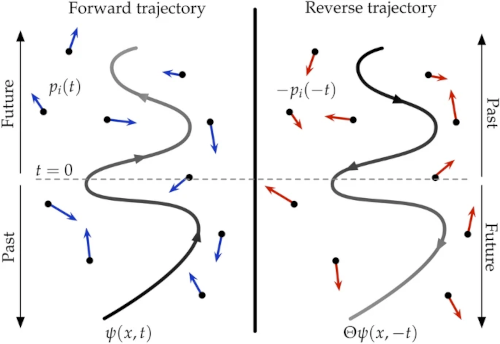
Answer: Ok, I found it (link to the image on the left). A study publish-ed in the "scientific reports" journal "Nature," published on January 29, 2025, investigated how a quantum system, the world of subatomic pa-rticles, interacted with its environ-ment, otherwise known as an "open quantum system.". I'm reading it. I'll get back to you as soon as poss-ible. I am writing this today, Febr-uary 14, 2025.
1. That study is based on a concept that I had in “information theory” (my way) until about 2016. It was the postulation of additional dimensions of time, sometime in the early 1980s, in order to find contradictions and possibly refu-te them, to confirm the determinism that I believed in at the time. But I searc-hed for it for a long time in vain and gradually became indifferent to the idea of determinism.
With the growing conviction that there are objective coincidences and real choices in the nature of things, a new theory of information began to develop, so to speak, of its own accord. It was so out of the ordinary in science at the time that I had to reply to some magazines with "my theories are too radical for you" when they asked me to write about them and "you don't understand, I write science fiction, not science" when they were too pushy, and the habit of non-cooperation holds me back to this day.
2. In the early stages of testing "objective randomness," another mistake was my equating entropy with information, which I uncritically took from my col-leagues, and they from Shannon (1948). A major one was ignoring the princi-ple of minimalism as well. They have stepped outside of that determinism so-mewhere in this study, but they are still reeling without realizing this second and third mistake.
When we accept chance as one of the drivers of physical processes, then we actually accept the "force of probability", that is, the laws according to which more probable events have more frequent outcomes. Thus, we accept that na-tural processes also tend to less informative states, among other things, to put it cautiously. This is "minimalism" as a natural tendency towards less action, within which the "principle of least action" is a special case well known to us from theoretical physics. However, then the process of spontaneous growth of entropy becomes a candidate for the "process of information decay".
3. Dr. Andrea Rocco, Associate Professor in Physics and Mathematical Biology at the University of Surrey and lead author of the study, said, "One way to exp-lain this is when you look at a process like spilled milk spreading across a tab-le, it's clear that time is moving forward. But if you were to play that in rever-se, like a movie, you'd immediately know something was wrong—it would be hard to believe milk could just gather back into a glass.” This is, in fact, a beni-gn, very gentle constraint of probability in its introduction of the present into the future.
That is why we distinguish a statistical ensemble from the statistics of a single molecule because we do not notice the necessity of probability in small quant-ities. Then often in conversations like the previous one (Broke Reality) I also mention the braking, through non-commutativity, of once-initiated processes towards one direction of time. Statistically, just as the air in a room never gat-hers into just one small pile, leaving us to die breathless, so too does time, ba-rely started in one direction, become an unstoppable element on the macro le-vel. Because for them there is no going back, but only where the rest of them are going, even if the rest of them do not know why they are going exactly where, or why they are going.
4. Let us reinforce this idea with Markov chains. They are made up of stocha-stic processes generated by a single matrix that is chained together into an ever-longer composition of signal carriers. They have the essential quality that, almost always, the initial message gradually becomes characteristic (i.e. eigenvector) of the generator matrix. Thus, the composition becomes a “black box” from which each message emerges as always the same characteristic. The chain “combs” the initial messages, giving them all the same direction, transf-orming their local chaos into global order, behaving like the law of large num-bers of probability theory.
However, different Markov chain generators are stochastic matrices with different eigenvectors, which means, at least theoretically, that not all final directions will be the same. If we consider them more closely, they all depict the distant beginning as uniform; for example, I will mention the Big Bang of the universe. This is simply because the original message is corrupted by cha-nnel noise. It adds information that misinforms the passing messages, blurr-ing everything with excess that turns the initial information into a “hot soup”.
***
So, due to the possibility of different flows (4), I remain receptive to the "diff-erent arrows of time" from the aforementioned study for the time being, with the restriction that eventual (phantom) travelers of the opposite flow of time could also see their own beginnings of the cosmos as we do ours. Regardless, I like this new flow of physics, because even as it is, it is closer to my understa-ndings, and it encourages them.
Bernoulli » srb
Question: What does Bernoulli's principle have to do with the "time arrows"?
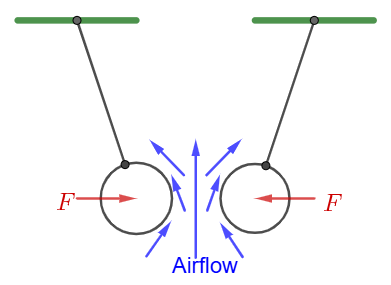
Answer: This question is part of the previous one (Time Arrows). For the sake of reader convenience and simplification, I shortened the ans-wer, which also had other details in the analysis of the Study. Part of it is my fantasizing about perhaps applying Bernoulli's principle in such a context. This is in terms of the attraction of two balls because a jet of air flows between them, as shown on the right.
Watch the interesting video Principle Visualized that explains the decrease in pressure by increasing the velocity of a fluid (liquid or gas) to understand this attempt at a similar view over time. I have long had a verification of the afore-mentioned Bernoulli principle in an unusual way that could perhaps show its broader application (Space-Time, 1.3.4 Pressure), so I will recount it here.
Two trains pass by, each with a cattle car with its doors open towards each ot-her. We imagine them as two cramped boxes sliding past each other with an opening between them. We apply special relativity. The observer in the first compartment A believes that it is at rest and the second B is moving at a con-stant speed v. The second compartment contracts lengthwise, in the direction of movement. Its volume decreases by that many times; the pressure increa-ses, but the air from B → A does not arrive because the same B → A but inve-rse should be observed by the passenger B in the second compartment in re-lation to the first.
The solution to this paradox is not to deny the principle of relativity of motion (as was once suggested to me) but to Bernoulli's principle. Air in motion (the second car relative to the first) decreases in pressure exactly by the increase in pressure due to the decrease in volume. Therefore, neither observer A nor B, nor the third person on the embankment, notices the airflow between these cars.
However, we are now interested in something else. The question is whether the aforementioned “train paradox” can be used only as a metaphor, an ana-logy, or something more to explain the contraction of time flows in one dire-ction. We have observed the same thing in the convergence of messages tow-ards an eigenstate as they pass through a Markov channel. I am checking the answer. So let us take a step further towards that goal. We imagine a body (a fluid or solid) in motion as a cattle car of the upper train composition, like the composite structure that (along with all the other forces) is brought together and described by Bernoulli’s principle.
Bernoulli's pressure reduction due to the speed of the air stream, the suction towards the higher speed of the fluid particles, is then equivalent to a pull to-wards the lower relative speed of the time flow. This takes us deep into the re-lativistic explanation of gravity, bodies moving in the direction of the slower flow of the field time, and then into (my) information theory. The slowing do-wn of events also dilutes the density of communication; it is thus attractive to the principle of minimalism.
***
As you can see, I went on in this reply, digging deep to answer the question posed. The authors themselves would be surprised by the ways in which I (theoretically) test their “deriving an arrow of time from time-reversal sym-metric microscopic dynamics,” which they say in the abstract is “fundamental open problem in many areas of physics, ranging from cosmology, to particle physics, to thermodynamics and statistical mechanics”. But the question re-mains: can that arrow be completely reversed?
Left Turn » srb
Question: Can the "time arrow" be completely reversed?
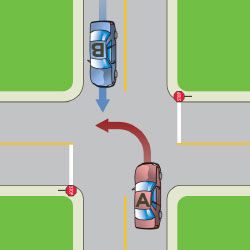
Answer: When you turn into a side street in a vehicle and then signal to turn by blinking, it is not the same as turning on the turn signal first and then turning. Whenever noncommutative processes with one order are informative, but the reverse is not, the question arises: what about the other. In the case of vehicle A turning in front of vehicle B, in the figure on the left, this is a matter of life and death.
1. First of all, we must understand that we observe processes from the position of the present and, secon-dly, that they always follow the pri-nciple of minimalism. What is then calculated using linear operators, Mx = x', are mappings of the original, the state x from the present, into copies that are the states x' in the past. Moreover, if we work with stochastic matrices (whose columns are probability distributions), we consider the following two types of mappings to be extreme.
The stochastic mapping matrix M is not regular when the input x cannot be determined from the output x', and is then called a black box. Then the deter-minant of the matrix is zero, det M = 0. The opposite of this is isometry, when the output and input have equal Shannon (mean) information. The determi-nant of such is one, det M = 1.
2. Not extreme, ordinary, for example:
\[ M = \begin{pmatrix} a & b \\ c & d \end{pmatrix} \]is a second-order stochastic matrix if and only if all its elements are nonnega-tive (a, b, c, d ≥ 0) and the sum of each column is one (a + c = 1 and b + d = 1). It acts on the distributions, some columns of such matrices, so that Mx = x', and the copy x' has greater Shannon information than the original x. The pre-sent is x. This is the state, the interpretation of the vector. The copy of the pre-sent is x', that which we have depicted as the past with it. The components of the state, these vectors x and x' are probability distributions.
3. In more detail:
\[ Mx = \begin{pmatrix} a & b \\ c & d \end{pmatrix} \begin{pmatrix} p \\ q \end{pmatrix} = \begin{pmatrix} ap + bq \\ cp + dq \end{pmatrix} = \begin{pmatrix} p' \\ q' \end{pmatrix} = x'. \]Then 0.5 < p' < p, i.e. q < q' < 0.5 whenever q < p. Namely:
q < p, bq < bp = (1 - a)p, ap + bq < p, p' < p,
there are four equivalent inequalities (equally true). Finally we have:
-p⋅ln p - q⋅ln q < -p'⋅ln p' - q'⋅ln q'
whenever 0 < q < p. Thus, the copy x' is closer to the uniform distribution than its corresponding finding x at present. The Shannon information of the copy is greater than that of the original. Similarly, we prove the converse case, if the second component of the distribution is more likely, when 0 < p < q.
4. We interpret the reconstruction of the older past using the Markov chain x(m) = Mmx, that is:
x' = Mx, x'' = Mx', ..., x(m) = Mx(m-1), ...
where Mm = M⋅M⋅...⋅M = M⋅Mm-1, is the basic matrix of the Markov chain on power m, while x(m) is some m-th variable in the sequence of copies. The noise of the channel, as a nuisance, increases the informativeness of the copies with its misinformation. This comes both from the impossibility of discovering exa-ct traces of the past, but also, to a much lesser extent, from principled minim-alism. All the same, all this is the way in which the past reveals itself to its pr-esent.
5. When, based on the present state x, it is possible to find out the past state x', then, based on the system of linear equations Mx = x', the inverse system that is x = M-1x' can be obtained, i.e. we have:
\[ \begin{cases} ap + bq = p' \\ cp + dq = q' \end{cases} \quad \begin{cases} a'p' + b'q' = p \\ c'p' + d'q' = q \end{cases} \]where the above matrix, determinant det M = ad - bc ≠ 0, becomes:
\[ M^{-1} = \begin{pmatrix} a' & b' \\ c' & d' \end{pmatrix} = \frac{1}{ad - bc} \begin{pmatrix} d & -b \\ -c & a \end{pmatrix}. \]The matrix M-1 is called the inverse of the matrix M. By direct multiplication, we verify that these two matrices are commutative and that MM-1 = M-1M = I, where I is the identity matrix of the same order, i.e.
\[ I = \begin{pmatrix} 1 & 0 \\ 0 & 1 \end{pmatrix}. \]The condition ad - bc ≠ 0, i.e. det M ≠ 0, for the existence of an inverse matrix gives:
ad - (1 - d)(1 - a) ≠ 0, a + d ≠ 1.
When this condition is not met, i.e. when a + d = 1, it will be d = 1 - a = c. Therefore b = a, so such a matrix is, let's say, the labels:
\[ M_0 = \begin{pmatrix} a & a \\ c & c \end{pmatrix}. \]It is a black box, a transformer whose output does not depend on the input, or a matrix of equal columns. There are many similar combinations of stochastic matrices, and therefore we have various black boxes. It is the first type of the above (1) extreme ones.
6. When the (Shannon) information of the past x' and the present x has the same amount, one of two things will happen:
\[ \begin{pmatrix} p' \\ q' \end{pmatrix} = \begin{pmatrix} p \\ q \end{pmatrix}, \quad \begin{pmatrix} p' \\ q' \end{pmatrix} = \begin{pmatrix} q \\ p \end{pmatrix}, \]so the transformation matrix is one of the two:
\[ M_1 = \begin{pmatrix} 1 & 0 \\ 0 & 1 \end{pmatrix}, \quad M_2 = \begin{pmatrix} 0 & 1 \\ 1 & 0 \end{pmatrix}. \]The determinant of the first is 1 and the second is -1, and both are isometries. It is announced (1) and listed as the second type of extremum.
7. The product of stochastic matrices is a stochastic matrix. For example:
\[ C = AB = \begin{pmatrix} a_{11} & a_{12} \\ a_{21} & a_{22} \end{pmatrix} \begin{pmatrix} b_{11} & b_{12} \\ b_{21} & b_{22} \end{pmatrix} = \begin{pmatrix} c_{11} & c_{12} \\ c_{21} & c_{22} \end{pmatrix}, \] \[ C = \begin{pmatrix} a_{11}b_{11} + a_{12}b_{21} & a_{11}b_{12} + a_{12}b_{22} \\ a_{21}b_{11} + a_{22}b_{21} & a_{21}b_{12} + a_{22}b_{22} \end{pmatrix}. \]All coefficients of the matrix C are non-negative numbers, cij ≥ 0, and the sum of each column is one, so it is a stochastic matrix. For example, for the first column, we find:
c11 + c21 = a11b11 + a12b21 + a21b11 + a22b21 = = (a11 + a21)b11 + (a12 + a22)b21 = b11 + b21 = 1.
Calculate similarly for the second one.
8. Matrices are not commutative in general, AB ≠ BA, and this also applies to stochastic matrices. Commutator of square matrices in general:
K = [A, B] = AB - BA
is a matrix of the same order and can be of nonzero determinant (det K ≠ 0), but in the case of stochastic matrices, it is always singular, det K = 0. Namely, the products of stochastic matrices are stochastic matrices (7). Their differe-nce, say for the second-order stochastic matrices, is as follows:
\[ K = \begin{pmatrix} a & b \\ c & d \end{pmatrix} - \begin{pmatrix} a' & b' \\ c' & d' \end{pmatrix} = \] \[ = \begin{pmatrix} a - a' & b - b' \\ c - c' & d - d' \end{pmatrix} = \begin{pmatrix} a - a' & d' - d \\ a' - a & d - d' \end{pmatrix}, \]so det K = 0, which is easy to verify further. This has a special meaning for us when the commutator represents external information, the communication of the subject with the environment. Therefore, the zero determinant of the com-municator means that there is no mutual communication, such as, for examp-le, the communication of charges with the corresponding force.
9. From all that has been said, it is not possible to communicate with a "depa-rting entity" from the present to the past. This does not tell us that such an en-tity does not exist, but only that it is not real. We perceive the past (we reme-mber it, we discover it through reason, forensics, and archaeology) and it th-ereby guides us (narrows the options), but without the possibility of full com-munication. Hence, the past is a pseudo-reality and is like additional dimensi-ons of time, except that such dimensions do not allow our direct perception.
The non-commutativity of ordinary stochastic processes, when K ≠ 0, means that once they are massively launched (by the principle of minimalism) they cannot go back, and the singularity (det K = 0) means that the former ignore our observations. Intuitively, we understand the same thing like this. The su-bject of our direction of time with the reverse direction cannot communicate, because the answer to one will come before the question of the other, and this is not given to objective uncertainty. The algebraic explanation is routinely simple.
If the determinant is zero, we have infinitely many or no solutions to the given system. This will also be the case with the commutator when its Kx = x' is dev-eloped and viewed as a system of linear equations. Such is the matrix system of equations (AB - BA)x = x', which means that the past state x' can return to the present x in countless ways, or that there is no such return at all.
10. However, the micro and macro worlds differ in this respect. The first is a group dominated by coincidences that are less and less present as the number of members increases, due to the law of large numbers. This small cosmos be-haves in a mobile manner, like an accelerated large one. Due to smaller and larger distances and the same speed of light, they live faster and slower. Thus, I believe that the first reaches the future faster than the second, or more pre-cisely, that the small world is more comfortable in walking through time than the large one. Therefore, quantum levels of magnitude have larger influences of the present on the past, which we can observe as excursions into the reverse flow of time, and quantum operators are not stochastic matrices.
Reverse » srb
Question: Explain to me the "impossibility" of going back in time to actual events.
Answer: I've edited parts of that question to make more sense for this information theory. First, here are the quotation marks, because time travel in the microworld is possible, but it's less likely with increasing occurrence due to the law of large numbers. Added is "actual" as a separate story from "existence". By the way, these are fragments of a conversation at Time Arrows here. Interesting questions about topics that are now fresh for physics, but a bit stale for me. I will repeat the definitions to highlight the differences.
1. The Markov chain is generated by the stochastic matrix P = (pij), where the number pij is the conditional probability of realizing the ith outcome after the jth outcome, which will map the distribution x = (x1, x2, ..., xn) into the distri-bution p' = (x'1, x'2, ..., x'm) by the system of equations Px = x', precisely:
\[ \begin{pmatrix} x'_1 \\ x'_2 \\ \vdots \\ x'_m \end{pmatrix} \begin{pmatrix} p_{11} & p_{12} & ... & p_{in} \\ p_{21} & p_{22} & ... & p_{2n} \\ ... \\ p_{m1} & p_{m2} & ... & p_{mn} \end{pmatrix} \begin{pmatrix} x_1 \\ x_2 \\ \vdots \\ x_n \end{pmatrix}. \]Some of the i elements of each column must occur, so the columns are some probability distributions. In the following, we assume that these are square matrices, that m = n. The product of stochastics is the stochastic matrix (Left Turn, 7), because from PQ = (pij)(qij) = (rij) = R it follows:
∑i rij = ∑i ∑k pikqkj = ∑k(∑i pik)qkj = ∑k qkj = 1, i, j, k = 1, 2, ..., n.
Therefore, the commutator C = [P, Q] = PQ - QP = A - B, can be viewed simply as the difference of the stochastic matrices A = PQ and B = QP.
2. It is common in physics to talk about mappings from the past to the future, which is incorrect here in the case of Markov chains. There are no such funct-ions (unique determinants), or, on the other hand, because the Shannon info-rmation of copied messages grows (with the channel noise), speaking of the "ordinary" channels defined above.
With the stochastic matrix Q, we map the findings in the present state x to estimate the state in the past x' = Qx. Eventually, we will use the state x' established with the stochastic matrix P to estimate the state x'' = Px' that preceded it. Going deeper into the past, estimation errors, which are channel noise, accumulate.
For example, finding the bones of a deceased person, condition x, we look for the cause of death x'. We do this based on knowledge of biology, medicine, and the like, which is a representation of conditional probabilities Q. Then, using forensics and criminalistics methods, we also find the assessment of the perp-etrator x'' = Px' = PQx. Then the reverse order of moves QPy = Qy' = y'' would be more guesswork. The forensic assessment y' = Py, it is not known which corpse is in condition y, based on which, very roughly, an illness or accident would be the cause of death.
3. From the above it follows that the commutator C = [P, Q] = PQ - QP = A - B cannot be a regular, invertible matrix. We have:
x' = Qx, y' = Py, x'' = Px' = PQx y'' = Qy' = QPy, (PQ - QP)z = z''.
Based on the above, there is no easy answer to the question of what the state z'' could be, and especially what the state z is. Let's look at it in some other way. The matrices A = PQ and B = QP are stochastic and of the same order; the sum of each of their columns is the same, and, therefore, each column of the matrix C = A - B sums to zero.
Let us not forget that stochastic matrices are linear operators of 1-norm spaces (Lp spaces) in which the metric is defined by the sums of vector components. Such vectors are the columns of the commutator matrix C and non-stochastic matrices. Moreover, the sum of each column of the matrix C is zero. It is span-ned by column vectors of zero intensity, so it cannot be regular. Its determina-nt is zero, det C = 0.
I've been looking for a proof of this statement everywhere and can't find it, so I'm betting that it's the statement that the determinant of the commutator of stochastic matrices is zero and that it has no inverse matrix (today is February 18, 2025). But let's move on.
4. Here, the commutator can represent the capacity of external information, which is a measure of the ability of a given system to communicate with its environment. This establishes that the past does not communicate or that its communication is truncated. By reconstructing events, we know them more or less accurately, but we cannot really change them. They act on us, reduce our options, govern the future, and make our next present less uncertain by supp-lementing it with themselves, but they remain pseudo-real. This does not ap-ply to the quantum world, whose operators are Hermitian.
Continuum » srb
Question: Is there a "possibility" of walking backward through unreal events?
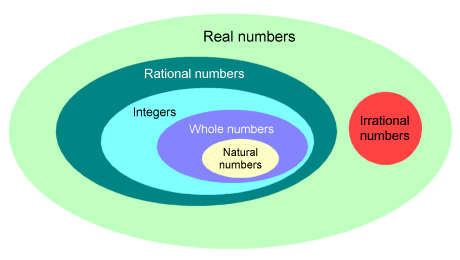
Answer: Yes, because we consider that there are phenomena that are not "real". The commutator of sto-chastic matrices C = [P, Q] is not regular. It is known that systems of linear equations Cz = z'' — either have no solutions or have infinitely many. Therefore, for a given image, state z'', there is not only one origi-nal z. This seemingly small statem-ent has so many consequences in this information theory that I have to be sel-ective. I choose the explanation of infinity, for the sake of one of the answers to the question.
1. First of all, although the ordinary stochastic matrix P has an inverse matrix P-1, it is not stochastic, and there is no real way back, although we calculate what was there (Left Turn, 5). Since the image of the past, state z'', does not allow a stochastic (ordinary) transition to the image of the present, state z, it must be due to something truncated, according to information theory. It is such a flawed description of the past that from it does not follow the real present.
Since we have the image z'', which means that such a past exists, then it is some pseudo-reality, which was established here earlier. In other words, the impossibility of its actual flow into the present shows us that z is not a full reality either. Every subject, structure, and method down to the details is not completely repeatable (Sprega Information, 2.4.2 Uniqueness)
2. Reality is infinite, but our perceptions are finite. This follows from the Borel–Cantelli lemma, which states that with probability one, only finitely many events from an infinite sequence can be realized, and especially the Riesz lemma, whose interpretation states that the information of perception is unique to the subject. We deceive ourselves with the selfish attitude that the whole world is what we know and perceive because what we cannot understa-nd we believe does not exist in order to protect ourselves from uncertainty (Unclear). Thus, infinity is all around us, and yet we are not aware of it.
3. One is the countable infinity of present moments in which we are just one part of a sequence, and the other is the uncountable infinity of possibilities of that sequence. We can compare the first, by doubly one-to-one copying, with the set of natural numbers, and the second with the set of real numbers. An infinite sequence is of cardinality ℵ0 and an uncountable one is a continuum of the label 𝔠.
By reducing the opposite assumption to a contradiction, we prove that the latter cannot be arranged in a single sequence. Namely, if from an infinite number of steps of the present we observe those that have at least two poss-ibilities, there are still an infinite number of them, like, say, even numbers in the set of all natural numbers. Let us assume that such have only two options (0 or 1), to make it easier to understand the sequences:
x1 = (0, 0, 1, 0, 1, 1, ...) → y1 = (1, 0, 1, 0, 1, 1, ...), x2 = (1, 1, 0, 0, 1, 1, ...) → y3 = (1, 0, 0, 0, 1, 1, ...), x2 = (0, 0, 1, 1, 0, 1, ...) → y3 = (0, 0, 0, 1, 0, 1, ...), x4 = (0, 1, 1, 0, 1, 0, ...) → y4 = (0, 1, 1, 1, 1, 0, ...), ...
Let us imagine that x1, x2, x3, ... is a sequence of all possible parallel realities that can arise from our eventual present. Each of such xs is countably infinite, and we assume that there are countably infinite of them in total. In each such xk, k = 1, 2, 3, ..., we replace the k-th digit (red) to obtain the sequence yk, as shown (with a new digit in blue). This gives the inequality xk ≠ yk for all corr-esponding pairs of terms listed. Then let's extract the string:
z = (1, 0, 0, 1, ...)
which contains only new members of new sequences. The sequences z ≠ x1, because they differ in the first digit. Also, z ≠ x2, because they differ in the se-cond digit. Because of that third digit, z ≠ x3, ..., and in general z ≠ xk, because they differ in the k-th digit. Therefore, the sequence z is not a member of the sequences x, which contradicts the assumption that the sequences x contains all possible distributions of zero and one.
We conclude that the countable infinity of moments of the single time stream, of which we live only a limited part, has an uncountable infinity of possibiliti-es. For this reason alone, our vision of the past cannot be perfectly copied into our present.
4. If we were to emerge from the "real" past (the one we picture as x' is imagi-nary, simplified, trivialized), we would not be able to appear in this very prese-nt. The probability of an equal choice is absolutely zero. That is a chance 1 : 𝔠. Also, the chance of finding our present among all these options, at any mome-nt of its development, is ℵ0 : 𝔠 = 0. These are the odds of a backward walk of unreal events from the question posed.
|
|
|