|
|
|


I mainly investigated the discovery of Information of Perception (2016) as the capacity of a state, say a subject a and an object b, for communication. Its fo-rm is the scalar S = a⋅b, the inner product of vectors that are both subjects and objects of interpretation. I used examples from quantum physics liberally, per-haps neglecting the property of this information coupling that it limits comm-unication with the rest of the world for the immediate participants. And the muted effect on others, outside of the pair in mutual communication, is part-icularly interesting. (Dates at the end of the answer are due to plagiarism.)
Imaginary II » srb
Question: If there are communications beyond "information of perception," how do you explain the loss of information given the law of conservation?
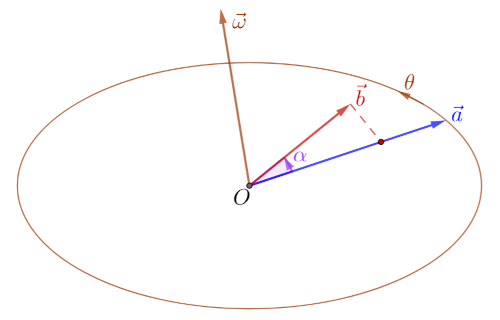
Answer: I mainly used complex numbers. I relate the internal in-formation to the inner product of vectors, and the external informa-tion to the external one:
\[ S = \vec{a}\cdot\vec{b}, \quad Q = |\vec{a}\times\vec{b}|. \]This is shown in the sketch on the right, with two vectors and an angle α that are constant, while outside there is the action of some central force. Commutators were used to describe in detail such forces (constant central, like Newton's or Coulomb's) that wea-ken with the square of the distance while moving their charges along conics. If we assume that the information is a complex number S + iQ, the imaginary unit (i² = -1) makes it so that the imaginary part (Q) of this sum is not added to the sum of the information. Namely, |S + iQ|² = |S|², which we know from the calculus of complex numbers.
1. We live on the surface of the Earth "isolated," not to say preserved from ex-ternal influences, while it rotates around its axis and actually acts on us with centrifugal and therefore Coriolis force, not to mention the Dzhanibekov effect and who knows what else. In fact, the universe acts on us in all its possible wa-ys, but many of them are hidden enough that we never notice them. It is simi-lar to the rotation of the Earth around the Sun. The solar system orbits the Mi-lky Way galaxy, and perhaps our galaxy orbits something (Universe III).
2. Gravity can be explained by principled minimalism simply by the idea that larger bodies hide their information more. They hide it from other bodies, wh-ich then fall into this trap by tending to less informative states. An important confirmation of this idea is the recently known derivation of Einstein's general equations (Minimalism of Information) not from the principle of relativity, but from the principle of least action. This is, to say the least, a strange and too "fortunate" coincidence in the detail of these extremely complex formulas of the theory of gravity to be ignored.
There is an equivalence between information and action (changes in energy over time), and the principle of minimalism speaks both of less action and of maintaining the status quo and of maintaining quantity in general. We are talking about the amount of uncertainty that is transmitted by information. Simply put, the state (vector), the process (operator), and the relationship of the found to the environment are the origin of information and tend to change less and less. This is a new point of view. It arises from the omnipresence of information and the equal aspirations of everyone.
3. The information of perception, S = ab cos α, is internal and a matter of the states a and b, say the subject and object of communication. Consequently, the eventual external action of that coupling, S' = ab sin α, is a force. It need not be the only force around the participant of the information of perception, but it is the only one of that coupling caused by the (possible) communication of the states a and b. This point of view proceeds from the principle of minim-alism, because the spontaneous course of events is inaction or even a reducti-on of action, i.e., the emission of information.
4. Not everything communicates with everything. A noisy place that disturbs us can be a pleasant oasis for the deaf. We know frogs will not try to eat insects around them if they do not move. The details of their vision are not fully unde-rstood, but it seems that frogs do not register things as either threats or food unless they move. In a frog way (Current) we can understand the attraction and repulsion of electric current, in addition to the usual. In doing so, let's go for something even more radical: that the opposite charges in rest are seen as supersaturated and as oases of peace supplemented by movement. It's a long story, and the closest to it and yet another is like Wave in Wave. I'm just me-ntioning them, but I can clarify.
Current II » srb
Question: Explain to me the attraction and repulsion of electric current that is different from the usual?
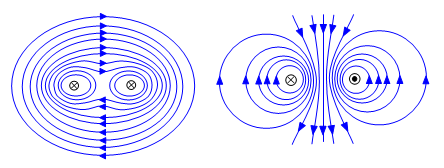
Answer: We assume that motion and momentum are information. So charges of the same name are not seen unless they are moving. As soon as they are moving, what they see are magnetic fields, as in the diagram on the left. The same flow of charge is the first, and the oppo-site is the second in these two sketches, viewed down the direction of motion. The magnetic field squeezes the charges of the first and separates the second. This is the classic description of the attraction of conductors of direct current and the repulsion of currents of the opposite direction.
1. Here we have a deepening of that explanation using the principle of minim-alism. Namely, when two electrons (charges) are at rest, they are attracted to each other because they perceive a lack of information in each other. However, when they are moved, they begin to perceive this movement as information and become repulsive to each other. Once moved, they repel each other, and then (because they are always in opposite directions) they constantly repulse each other, which is why we believe that, in principle, they always push back each other.
3. The orbits of electrons in an atom indicate the variable amounts of the afo-rementioned (non)observation of electrons and protons, but also the connec-tion between them and the amount of mutual motion. You can review the de-tails of quantum numbers, for example, in the calculations of the hydrogen atom (Quantum Mechanics), so we will not consider them here. In the case of a conductor, it is enough to mirror the perception of the magnetic field for the equality of these two interpretations, while in an atom, a change in the speed or energy of an electron changes its orbital.
In most cases, electrons in higher-energy orbitals of atoms (further from the nucleus) move more slowly than electrons in lower-energy orbitals (and closer to the nucleus). When an electron increases its orbital in an atom, it gains en-ergy. Electrons in higher energy levels are further from the nucleus with high-er potential energy. Conversely, losing energy, an electron moves to a lower energy level (closer to the nucleus). With its presence (of motion and energy), electrons seem to complement and optimize atoms. For the same we now say that motion different charges attracts, and that energy repels them.
4. The dependence of the electromotive force (voltage) on the motion of the charge can also be seen from Faraday's law: the induced emf in a conductor is proportional to the change in magnetic flux ΔΦ over time Δt. More precisely, the average ℰ induced emf is:
\[ |\mathcal{E}| = N\left|\frac{\Delta\Phi}{\Delta t}\right| \]where N is the number of turns in the conductor (circuit) if it is a coil. These oscillations will generate electromagnetic waves (light) whose speed does not depend on the speed of the source (neither the charge nor the conductor). If this speed depended on the source, we would have difficulty with the new in-terpretation in the supposed opposite observation of opposite charges.
Speed » srb
Question: How to derive the speed of light c from electromagnetism?

Answer: The speed of electromag-netic waves is usually derived from Maxwell's equations. Because not only does light travel at this speed, but it is such a wave, it is a deriva-tion of the speed of light in a vacu-um, i.e. c ≈ 300 000 km/s.
1. ρ = 0 is the charge density of the vacuum, and also the current densi-ty vector J = 0. These appear in the first and fourth Maxwell equations, which thus become:
- ∇⋅E = 0
- ∇⋅B = 0
- ∇×E = -∂tB
- ∇×B = μ0ε0∂tE
where μ0 is the magnetic permeability constant and ε0 is the electric permitti-vity constant. The electric and magnetic field vectors are E and B, and time is t. The Nabla (rotor) operator is:
\[ \nabla = \mathbf{i}\frac{\partial}{\partial x} + \mathbf{j}\frac{\partial}{\partial y} + \mathbf{k}\frac{\partial}{\partial z}, \]where i, j and k are the orthonormal vectors, the unit vectors of the coordinate axes. They are the abscissa (x), ordinate (y) and applicate (z), respectively.
2. We act with the rotor (nabla) on both sides (3) of Faraday's law:
\[ \nabla \times (\nabla\times \mathbf{E}) = \nabla \times -\frac{\partial \mathbf{B}}{\partial t}, \] \[ \nabla \times (\nabla\times \mathbf{E}) = -\frac{\partial}{\partial t}(\nabla \times \mathbf{B}), \]because here the partial derivatives (nabla and time) commute. We also use the formula ∇×(∇×E) = ∇(∇⋅E) - ∇²E for the double vector product (Dzhani-bekov, 2), so recognizing ∇⋅E = 0, we obtain in two steps:
\[ \nabla(\nabla\cdot\mathbf{E}) - \nabla^2\mathbf{E} = -\mu_0\epsilon_0\frac{\partial^2\mathbf{E}}{\partial t^2}, \] \[ \nabla^2\mathbf{E} = \mu_0 \epsilon_0 \frac{\partial^2\mathbf{E}}{\partial t^2}. \]This is the equation for electromagnetic waves in three dimensions. In just one dimension, moving along the abscissa, it would be:
\[ \frac{\partial^2 E}{\partial x^2} = \mu_0 \epsilon_0 \frac{\partial^2 E}{\partial t^2}. \]The solutions to these second-order differential equations are well known, but I will mention them for the sake of completeness.
3. The general solution of the last equation is f(x - vt) + g(x + vt), where f and g are arbitrary wave propagation functions in the positive and negative direct-ions, with speed v. In this solution set, we choose sinusoids of wavelength λ, so we have:
\[ E = E_0\sin\left(\frac{2\pi}{\lambda}(x - vt)\right). \]Taking the derivatives twice along the path x, then along the time t, we find μ0ε0v² = 1, from which the speed of electromagnetic waves:
\[ v = \sqrt{\frac{1}{\mu_0\epsilon_0}} \approx 3\times 10^8 \text{ m s}^{-1}. \]We find this number by including the known constants μ0 and ε0 for vacuum, which means that the speed of electromagnetic waves is exactly the known sp-eed of light c in vacuum.
4. The speed of light in a vacuum has a special meaning in physics. It is the sp-eed at which the fastest actions are transmitted, and information is transmitt-ed at that speed. The equation for electromagnetic waves in three dimensions (2) gives:
E = E(x, y, z, ict), dE/dt = 0, d²E/dt² = 0,
because energy depends on place and time, and the zero of the first, then the second derivative means that there is no change or acceleration of that change in energy by displacement. In particular, this second derivative is:
\[ \frac{d^2E}{dt^2} = \frac{\partial^2 E}{\partial x^2}\frac{\partial^2 x}{\partial t^2}dt^2 + \frac{\partial^2 E}{\partial y^2}\frac{\partial^2 y}{\partial t^2}dt^2 + \frac{\partial^2 E}{\partial z^2}\frac{\partial^2 z}{\partial t^2}dt^2 + \frac{\partial^2 E}{\partial (ict)^2}\frac{\partial^2 (ict)}{\partial t^2}dt^2. \]The value of that (acceleration energy) is zero. However, if we write it:
\[ \frac{\partial^2 E}{\partial x^2}v_x^2 + \frac{\partial^2 E}{\partial y^2}v_y^2 + \frac{\partial^2 E}{\partial z^2}v_z^2 - \frac{\partial^2 E}{\partial t^2} = 0, \] \[ \frac{\partial^2 E}{\partial x^2}\left(\frac{v_z}{c}\right)^2 + \frac{\partial^2 E}{\partial y^2}\left(\frac{v_y}{c}\right)^2 + \frac{\partial^2 E}{\partial z^2}\left(\frac{v_z}{c}\right)^2 - \frac{1}{c^2}\frac{\partial^2 E}{\partial t^2} = 0, \]so let's compare it with the wave equation (2), we easily find that each of the components of the speed of light vector c = (vx, vy, vz) is either c or zero. This means that light has the "speed of light" in terms of its components, or no speed at all. We understand this "strange" result, because the speed of light does not depend on the speed of its source, it cannot be less or greater than c.
This was just another way of explaining the invariance of the wave equation (2) to Lorentz transformations (Space-Time), which is proven in the attached link in example 1.4.3. of the aforementioned book.
Magnetic Field » srb
Question: In a "frog" way of understanding the force between conductors, the magnetic field can be ignored. (Imaginary II, 4)?
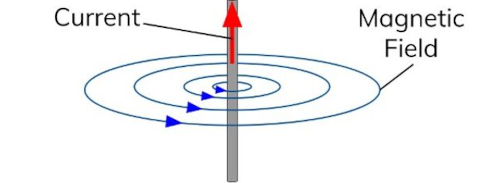
Answer: I have rarely written about it (3.1.3 Coulomb's law), although I have "understood" it that way for a long time. This is not new to physi-cs either. The magnetic field arises from the electric field, and it is just a matter of approach whether to complicate the description with the theory of relativity. We will easily arrive at the "frog" way (reacting to movement) from the position of the (well-known) relativistic way of explaining magnetism.
1. An electric conductor consists of molecules, which are atoms whose nuclei contain positively charged protons in contrast to negatively charged electrons orbiting the nuclei.
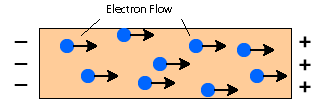
The picture on the right shows the flow of electrons and an explanat-ion (in the link) of why it happens. When there is no current flow and the conductor is neutral, there will be equal numbers of positive and negative charges. The next thing is that when moving, the number of negative charges increases due to the relati-vistic shortening of lengths along the directions of movement. In other words, the current has more electrons, but the individual charge is unchanged. And we further interpret the increase in the charge of the conductor by Coulomb's law itself or by the induced magnetic field, regardless.
2. Direct current (DC) is a flow of electrons that moves in one direction, from negative to positive electrical charge. It comes from batteries, solar panels, and types of DC generators and is used in electronic devices such as mobile phones, laptops, and electric vehicles. On an oscilloscope, DC appears as a straight, horizontal line at a constant voltage. Its disadvantages are difficulty switching at high voltages due to arcing and often larger voltage conversion devices compared to AC.
Alternating current (AC) refers to a current of periodically changing direction, flowing back and forth, and of varying voltage, often sinusoidal. Electricity de-livered to households or businesses via the power grid is generally alternating current. Direct current is practical in electronics and energy storage, while alt-ernating current is regular in the distribution of electricity (DC vs. AC).
3. At high voltages (over 110 kV), less energy is lost in the transmission of alte-rnating current. Higher voltages mean lower currents, which in turn mean less heat generated in the transmission line due to resistance. Since alternating cu-rrent is more easily converted to high voltages, it is these voltages that provide the electrical energy. On the other hand, this means that the back-and-forth oscillation of electrons in an alternating current conductor encounters less resistance than a constant push in the same direction, while both have similar relativistic length contractions and the same (1) explanation of the magnetic field.
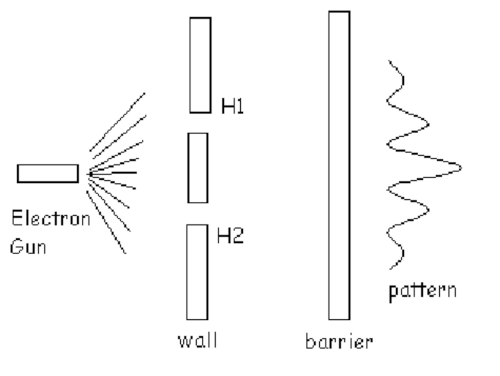
4. When electrons (left, image on the left) are fired onto a surface wi-th two slits (wall, H1 and H2), there is interference on the screen behind (barrier) even when they are fired one at a time. Such an interference pattern is a ripple characteristic th-at indicates that each electron, say a particle, is also a wave.
Two or more electrons, then, beca-use they travel in parallel, are not mutually repulsive but rather come together and show us their wave properties. This inspires us to add a new step to the previous (1) (the frog interpretation), to see like charges in mutual rest as oases of peace. In all of this, we note that this induction can also be viewed as "short-term memory", let alone in a "frog" way.
Gravity III » srb
Question: You don't mention the "frog" way of understanding force in your answers about gravity (Gravity). Why?
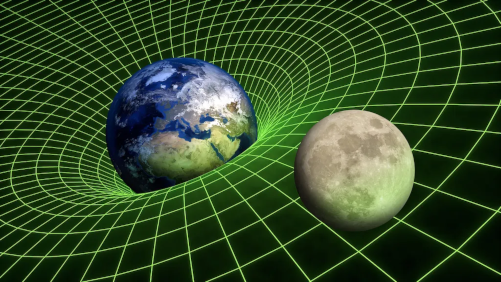
Answer: In the supposed “frog-like” (reaction to motion), the predominant force is eliminated when there is no motion. So it makes sense to view the electron wave as a packet that does not scatter but which breaks up if it does not travel together. But is there an electron that is so far at rest relative to a planet or an atom's nucleus? That is the problem; even if the “frog idea” were correct for the Coul-omb force, it is not easy to transfer it to the Newtonian force. The electric force is some 1036 times stronger than the gravitational force, which means that gr-avity is incredibly weak in such a comparison, especially at the atomic and su-batomic level. They are very different. That is not the same approach as in the Gravity II blog.
1. Time gives meaning to information, and my theory cannot exist without ti-me; it is primary. This is still the only theory that talks about more than one dimension of time (three) and explains nature on that basis. In particular, mass is a concept that "glues" us to time dimensions, which is why we become "inert." And in the previous texts there are explanations of the cited expressio-ns. In short, using the principle of minimalism, reducing (greater) information to (lesser) probability and both to (greater) effect.
Gravity in this story is a tendency towards smaller events. In stronger gravi-tational fields, time slows down, the frequency of events decreases, and the chance for participants to reduce their excess information (uncertainties) increases. With greater mass, participation in additional dimensions of time increases, from which the object does not want to exit, because this would reduce its passive and increase its active information (In and Out). This is the inertia of classical physics.
2. Slower time near masses and faster in more distant places means that the emptier ones arrive faster into the future. During the event, the faster ones leave behind the slower ones, which are increasingly rare in their surroundin-gs. Since we are in the position of the faster ones (relative to massive stars and the centers of galaxies), time makes it seem that there are fewer and fewer of these slower ones around us. Our relative observation is that the universe is expanding. Dark energy, in this sense, is the driver of the present into the future.
In this way, gravitational attraction becomes the “grounding” of faster time travelers. I heard somewhere we are floating in weightlessness, and the grou-nd jumps up and hits us. I paraphrase a drunk who came with a broken face and explained to us how he was calmly moving down the street only for the street to jump up and hit him in the head. However, this “nonsense” story is exactly how gravity “pulls” us when we “jump” from a tree and hit the ground below. This is a slightly different version from the previous one (1), which it does not contradict but rather complements.
3. If we combine the previous two interpretations, we come to the conclusion that massive particles do what they do without caring that they will "hit the ground" somewhere someday, because they float in the weightless state of some faster time stream while the slower one is inexorably approaching them. Namely, having mass (electrons and atoms), they are slower compared to their huge, massless environment, which moves away from them, leaving them ab-andoned to the "ground," their next and slower vehicle. Therefore, electrons and positrons, as well as all massive particles, fall in the gravitational field just like everyone else.
I mention positrons intentionally, because at the time of the discovery of Fey-nman's diagrams, antiparticles and even the opposite charge were considered to be perhaps travelers back in time. There were also theories of negative gra-vity like that. I seriously considered them and finally stopped that work until cracks in the principle of minimalism eventually appeared. Everything would go more likely, not the other way around, until something in the development backwards appears convinced that it goes to more likely states (more unlikely for us), or until it turns out that the principle of minimalism is not as general as it seems to me now.
4. Space is a storehouse of the past. Reality is made up of phenomena that last, and they accumulate memories of themselves in the surrounding space; the further away, the older they get. Anyway, in every vacuum it finds itself, a ma-ssive particle is more inert than its surroundings and consistently slides from that faster time to the slower one, lagging behind, not suspecting that the “gr-ound” is approaching, that is, that it is falling into the gravitational field. Th-ree different directions (length, width, and height) stretch the past into the same multiple time frames, allowing the rest to see only parts of their comp-anions.
Moreover, what has come to us from one trajectory in the past does not have to be the same as what comes to someone else (Spheres, 2). This is the multi-dimensionality of time that can be proven even within the methods of topol-ogy (Dimensions) with the assumed objectivity of uncertainty. So, from “it is incredible that gravity and the electric force are different” to “gravity and the electric force are incredibly different”, there is a big gap. There are pebbles that are sticking out here.
Time-Space » srb
Question:Prof, imagine what I found: Time Is Three-Dimensional and Space Is Just a Side Effect, Scientist Says. What do you think of that?

Answer: The article is from yes-terday, June 28, 2025, and the question to me is from June 29. Don't be fooled by the blog title (August II 2025); I write them a few months earlier.
I read the text carefully (image link on the left), but also the article fr-om June 21, 2025, to which this one refers (New theory). It says that time, not space plus time, could be the only fundamental property where all physical phenomena occur, according to a supposedly new theory by scientists at the University of Alaska in Fairbanks. I can't help but feel that the person in question was copying something from me, even though he doesn't mention me anywhere.
This is not the first time that I have been silently stolen. For example, a prof-essor from here (from BL) who needed points in his career listed himself as a co-author of my otherwise independent book "Information and Communica-tion Theory" from 1995. This was preceded by the war years here, and the bo-ok was written up to ten years earlier. I had previously explained the topolog-ical finding of time dimensions (Dimensions) to my colleagues without ment-ioning it in that book with which I primarily aimed at the classical (Hartley 1928 and Shannon 1948) information theory. Then I exclusively dealt with my theory, and the contribution sent to me seems to be a clumsily extracted detail from that new one. The authors seem to be unaware of the breadth that their "new theory" covers.
I assume that this author is not one of integrity, at least as far as science is co-ncerned, but I may be wrong. If you have read some of my other books or texts from previous decades, as well as these blogs that have been here for the past five years, you will notice that the "new science" is slowly arriving in those pl-aces, not caring about what I have been elaborating for a long time. After all, I don't care about what others write either (it would spoil my inspiration).
Catch a Light » srb
Question: Do you have anything new about light frequencies?
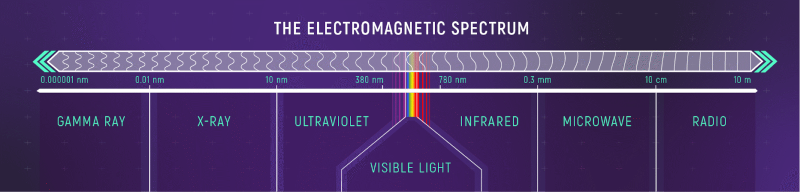
Answer: Yes. The attachment you sent me (see image link) is not a theoretical novelty, but it is the first experimental confirmation of old findings. I won't go into that; it's stale and goes along with earlier "discoveries" (Solenoid). Take a closer look at that electromagnetic spectrum, where from gamma rays through visible light to radio waves, wavelengths λ increase from 1 pm to 100 km, and frequencies ν decrease from 300 EHz to 3 kHz according to the formula λ⋅ν = c ≈ 300,000 km/s.
1. A photon has momentum p = h/λ, where h is Planck's constant, although it has no mass. It can be expressed differently as p = E/c, where E is its energy, and the circle closes with E = hν. Similarly, the wavelength of particle, λ = h/p whose momentum can be p = mv, where m is the mass and v is the wave velo-city of the particle. This is the basis for explaining the Heisenberg uncertainty relations, ΔxΔp ≈ h, with the uncertainty of the position and momentum of the particle-wave being Δx ≈ λ and Δp, respectively.
Namely, we will determine the position of a particle better when we observe (hit) it with a photon of a shorter wavelength, but this means that we use ph-otons of higher energy and greater momentum, which will introduce more uncertainty into the new momentum of the particle. Conversely, if we observe the particle with less clarity of position, i.e., with a photon of a longer wavele-ngth, we hit it with a smaller momentum, thereby accurately predicting its future momentum.
All of this is well known in now classical microphysics, but we will need to understand wavelength here as the uncertainty of the wave's position. The light waves in the image above have increasing uncertainties of position!
2. When a photon of wavelength λ strikes an electron and is deflected (Comp-ton scattering) by an angle θ, it loses energy and its wavelength increases to λ' by:
\[ \lambda' - \lambda = \frac{h}{mc}(1 - \cos\theta). \]This is a long-standing (1923) confirmation of the particle nature of radiation, and Compton received the Nobel Prize in Physics for this in 1927. However, what is new is the explanation of the Compton Effect (Space-Time, 2017), wh-ich I saw as a confirmation of the principle of minimalism. Only through exte-rnal action, by force or collision, does the photon descend onto a trajectory of greater uncertainty of position.
Thomson scattering, which describes the scattering of electromagnetic radia-tion by free charged particles of wavelengths of light that are longer than the Compton scattering, is a process of elastic scattering. Then the scattered pho-tons remain of the same wavelength (and energy) as the incident photons. The scattering occurs without any upward energy transfer between the photon and the charged particle. The new conclusion is that photons of longer wavelengt-hs, although with greater uncertainties (positions), are less strongly scattered.
3. We have seen when “less informative” can mean “more expressive” (Wave in Wave). I also mentioned the power of vitality when we have more of it to swing like a pickaxe and dig deeper (Model, 2). These are examples that em-phasize the differences between internal and external information. In light, the former is stored by wavelength, and the latter is expressed by its frequen-cy, and, as I have already explained, this is why waves with longer wavelengths are more penetrating, reaching further, while those with higher frequencies are more dispersive, refracting more.
In a way, I bring this whole spectrum under the principle of minimalism. Fr-om the desire to get rid of excess freedom, and the situation is that everyone in the environment wants the same, we surrender our vitality to society for, say, security or efficiency. Just as we consider the desire for subordination here to be much deeper than the usual explanations of psychology, we also look at the refraction of light beyond optics.
Shorter wavelengths (radiation) more easily give up their small amounts of uncertainty to the environment, like short-lived animals (many insects) that more easily give up their total personal vitality for the sake of reproduction and faster adaptation of the species. Longer wavelengths (radio waves) with large amounts of uncertainty are more difficult to give up to the environment and resemble long-lived animals that live in herds (elephants, buffalo, zebras).
4. Many will disagree, but the "redshift" that we see in light sources in a stro-nger gravitational field can be considered the immediate state of the light of the source, enlarged by wavelengths due to gravity itself. Two subjects at the same level of gravity trapped in the same level of internal information have very different perceptions than an observer from the outside. Of course, this approach does not challenge the interpretations we already know but rather complements them.
I discuss some of this in the "vertical drop" in the book Space-Time (2017), in a slightly unusual way. Incidentally, the same effect was first described by Ein-stein himself in 1907, eight years before the publication of the complete theory of relativity. It can be understood using the equivalence principle that gravita-tional phenomena are locally equivalent to inertial effects and that the redshift is caused by the Doppler effect. It can also be interpreted as a consequence of the equivalence of mass and energy, by the conservation of energy, as if the "falling" photons gain energy. In addition, the gravitational redshift can be interpreted equally successfully as gravitational time dilation at the radiation source, and this method is close to the new one presented here.
Hierarchies » srb
Question: Is it really a good idea to call the factors of information of percepti-on a hierarchy, rather than, say, a constraint?
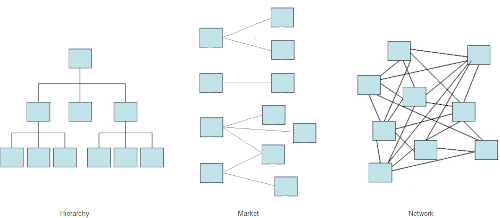
Answer: It almost doesn't matter. Both names are appropriate, but "hierarchy" is more descriptive in this new concept because it inclu-des layering, differences, and actu-ally many hierarchies. I'll explain.
The picture on the right shows thr-ee known types of organization, in that order: hierarchy, market, and network. However, network theory proves that efficiencies arise from the structure of equal links only with a small num-ber of nodes that have many links but an increasing number of nodes with fe-wer and fewer links (Importance). Nature spontaneously develops in exactly the same way, it twists every type of equality imposed on it into a multitude of other inequalities. These others are often small hierarchies, but so that the en-tire "equal network" also becomes a hierarchy. Namely, the process of transm-ission through a Markov chain shows that the local freedoms of the initial me-ssages converge to the inherent state of the chain. Free markets spontaneously develop into a small number of nodes (owners) with many connections (goo-ds, money, and services) and many, many poorer ones.
1. Originally, in the book you mentioned, freedom S = I⋅H is proportional to intelligence (ability to use options) as well as hierarchy (constraints). That seems a bit strange, I was told, because it turns out that optimal freedom is achieved when we have equal abilities and constraints (Completion). The re-ason for that formula is the simple understanding that intelligence I = S/H is directly proportional to freedoms and inversely proportional to constraints.
However, at the time of writing that book, I had in mind visibility, V = P⋅K, which is proportional to the probability of observing an object (P) and equally to the information it has, its communication power (K). The greater the info-rmation, the greater the amount of uncertainty, and in addition to this, there is the dependence K = V/P, the information about a given object increases wi-th visibility but decreases with the probability of appearance. In the same se-nse, hierarchy and probability are equivalent, or better to say, they are similar values.
2. The hierarchy is similar to probability H ∼ P, because both grow with certa-inty albeit on different scales, so in this one-dimensional case intelligence cor-responds to Hartley information I ∼ -log H. So we have freedom as Shannon information, S ∼ -H⋅log H, and the hierarchy is a number from 0 to 1. Of co-urse, these are just analogies that should help us follow the idea of informati-on perception. Analogously, we have visibility V ∼ -P⋅log P. I use it less often.
It is possible to normalize the hierarchy, to reduce it to a number from the sa-me interval (0, 1) as the probabilities. For example, from each level we take only the branch with the most branches and multiply all these fractions. Let's assume that the top one is A with subordinates A1 and A2, and that the first of them has two subordinates, A11 and A12, below it, and the second has three subordinates, A21, A22, and A23. Here, the fractions are 1, 1/2, and 1/3 on three floors, and their product, 1/6, is the value of the given hierarchy. We could obtain the same result using the average values of the branches across the different floors, but this calculation would be more complex.
3. We usually define hierarchy as the organization of society in which memb-ers are ranked according to relative status or authority. That may be enough in the descriptive sciences, but not here. The evaluation of “hierarchy” should be transferable to other systems, such as an implication graph where the cause is superior to the effect, or the like, or a process where every “tomorrow” is sub-ordinate to “today,” or to relations in general. That is what I aim for with such “hierarchies,” and given the nature of mathematics, I allow for variations in its definition initially with further consistent application.
4. Equal intelligence and hierarchy have an optimal “completion” in maximum freedom. A higher hierarchy than such an optimum, when it comes to vitals, tells us about the “spiritual exhaustion” (a term I heard on a podcast) of soci-ety, when routine and the automation of behavior become so great that intelli-gence and creativity are less and less needed. Thus, there can be a degenerati-on of democracy, as happened to reorganized civilizations before their fall. Let us recall just a few of the most famous “legislators”: Hammurabi (1792–1750 BC), Emperor Dušan (1308–1355), and Suleiman the Magnificent (1520–1566).
On the other hand, the lack of hierarchy in relation to the aforementioned optimum leads intelligence to overplay or to dullness (apathy and boredom), that is, to a stronger expression of the harmfulness of excess freedom and to its reductions. At the extreme limits, enormous intelligence and no restricti-ons, as well as zero intelligence and total restrictions, are states of equal un-freedom.
Third Wave » srb
Question: What are the ranges of uncertainty?

Answer: Greater uncertainty will have a lower chance of realization, and, in that sense, it has no limits. On the other hand, because of the same reason, it behaves in a dire-cted and limited way.
1. The first wave of freedom, for ex-ample, is the one that comes from the present. Presents are local pro-perties of physical systems, which others do not see as such but perceive as separate phenomena in different ti-mes and places. In this way, quantum coupling occurs if a system maintains a quantity of spin when it is not seen from the outside to be a matter of its local present.
Due to the different present states of bodies in mutual motion, expansions of the possible outcomes of initial states and processes arise. Freefall has almost all the examples of the diversification of the uncertainty of that first wave. Ein-stein's example with an elevator also demonstrates the acceleration of the gro-und (Gravity III, 4), which hits, and gravity picks up a particle that was previo-usly floating and, not suspecting what will happen, actually falls freely. It wit-nesses various present states in its fall.
2. Regardless of the dispersion of possibilities, in the case of constant circum-stances, they all converge to the same outcomes. This is a "black box" (based on the output of which we do not know the input) of the series of links of the Markov chain. If the circumstances are certain, the individual Markov chain permutation matrices are of the unit column, and the aforementioned conve-rgence is absent. In other words, the uncertainty of the circumstances itself generates both the dispersion of the outcomes of individual steps and the convergence of the long-run process. And this is a well-known property of stochastic Markov chain matrices.
For example, Mv = v, we have the multiplication of the stochastic matrix M by u, its eigenvector:
\[ \begin{pmatrix} 0.9 & 0.4 \\ 0.1 & 0.6 \end{pmatrix} \begin{pmatrix} 0.8 \\ 0.2 \end{pmatrix} = \begin{pmatrix} 0.8 \\ 0.2 \end{pmatrix}, \quad \det M = 0.5 \]In the 48-link chain generated by this matrix, M48u = u, there will be:
\[ \begin{pmatrix} 0.8 & 0.8 \\ 0.2 & 0.2 \end{pmatrix} \begin{pmatrix} p \\ q \end{pmatrix} = \begin{pmatrix} 0.8 \\ 0.2 \end{pmatrix}, \quad \det M^{48} = 0, \]whenever p + q = 1. It is obvious that the matrix Mn converges to a black box (whose columns are its eigenvector) when n → ∞.
3. In the case of pseudo-stochastic matrices, unit sums of columns with elem-ents that can be negative numbers, there is no convergence of the series to a black box when the determinant of the matrix is one. For example, Sv = v, wh-en multiplying a pseudo-stochastic matrix and “its” eigenvector:
\[ \begin{pmatrix} 2.5 & 1.5 \\ -1.5 & -0.5 \end{pmatrix} \begin{pmatrix} 1 \\ -1 \end{pmatrix} = \begin{pmatrix} 1 \\ -1 \end{pmatrix}, \quad \det S = 1, \]in a long series of repetitions, say S48v = v, gives:
\[ \begin{pmatrix} 73 & 72 \\ -72 & -71 \end{pmatrix} \begin{pmatrix} 1 \\ -1 \end{pmatrix} = \begin{pmatrix} 1 \\ -1 \end{pmatrix}, \quad \det S^{48} = 1. \]Obviously, the matrix Sn diverges when n → ∞, does not converge to a black box, and S is not some permutation of the columns of the identity matrix.
However, Pw = w, is also a pseudo-stochastic characteristic equation:
\[ \begin{pmatrix} 2.5 & 2 \\ -1.5 & -1 \end{pmatrix} \begin{pmatrix} 4 \\ -3 \end{pmatrix} = \begin{pmatrix} 4 \\ -3 \end{pmatrix}, \quad \det P = 0,5 \]This matrix in a long series of iterations, say P48x = w, gives:
\[ \begin{pmatrix} 4 & 4 \\ -3 & -3 \end{pmatrix} \begin{pmatrix} a \\ b \end{pmatrix} = \begin{pmatrix} 4 \\ -3 \end{pmatrix}, \quad \det P^{48} = 0 \]whenever a + b = 1.
4. These are stochastic processes that contain at least a small amount of un-certainty, and when they have a foothold in the present, they constitute a second wave of uncertainty. The third wave would be those outcomes of the second that no longer belong to our reality. They are beyond the reach of direct physical measurement but can be "perceived" by theorizing. For ex-ample, by abstract topology and with the assumption of the objectivity of chance (Dimensions), or by relativity (Crash).
Hermitian II » srb
Question: What about the uncertainty ranges in the mathematics of quantum physics?
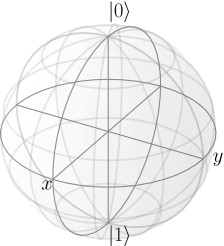
Answer: Hermitian matrices are fu-ndamental to the mathematics of quantum physics (Hermitian), with the main property that they are invariant to adjoints, i.e., conj-ugation and transposition. Therefo-re, the eigenvectors with different eigenvalues of a Hermitian matrix are orthogonal. Then, a corollary to this question is that the degrees of Hermitian matrices can converge.
If a Hermitian matrix has one dom-inant eigenvalue (with the largest magnitude) that is unique, the po-wer series will converge to the ver-sion of the associated eigenvector. The speed of convergence depends on the ratio of the magnitudes of the dominant eigenvalue to the next largest eigenvalue. This is not significantly different from the previous (Third Wave), when expressed as follows.
The Hermitian matrix A of eigenvalues λ₁, λ₂, ... whose absolute values form an ordered sequence |λ₁| > |λ₂| ≥ |λ₃| ≥ ..., with an initial vector x0 of a non-zero component in the direction of the eigenvector associated with λ₁, will yield the sequence xk+1 = Axk/∥Axk∥ which will converge to the eigenvector corresponding to λ₁.
1. For example, the following matrix is Hermitian:
\[ A = \begin{pmatrix} 2 & 1 + i \\ 1 - i & 3 \end{pmatrix}, \quad \det A = 4. \]Its characteristic equation Av = λv, i.e. (A - λI)v = 0, states that λ is an eigen-value of the matrix A, with the associated eigenvector v and that it is from the null space of the matrix A - λI. This is further: det(A - λI) = 0,
(2 - λ)(3 - λ) - (1 - i)(1 + i) = 0, λ² - 5λ + 4 = 0, λ1 = 4, λ2 = 1.
By inserting the found eigenvalues into the characteristic equation, we find their corresponding eigenvectors:
\[ v_1 = \begin{pmatrix} 1 \\ 1 - i \end{pmatrix}, \quad v_2 = \begin{pmatrix} 1 + i \\ -1 \end{pmatrix}. \]It doesn't matter that they are not normalized, they are orthogonal:
\[ \langle v_1 | v_2 \rangle = \begin{pmatrix} 1 & 1 - i \end{pmatrix}^* \begin{pmatrix} 1 + i \\ -1 \end{pmatrix} = 1\cdot (1 + i) + (1 + i)\cdot (-1) = 0. \]This shows that the matrix A is adjoint, that is, that it is Hermitian, and shows the method of finding the eigenvalues of matrices in general, and also the cor-responding eigenvectors, and the orthogonality of these vectors as well.
2. We form an auxiliary matrix of the above Hermitian, in its columns now no-rmalized by the eigenvectors u1 = v1/∥v1∥ and u2 = v2/∥v2∥, so that P[u1, u2]:
\[ P = \begin{pmatrix} \frac{1}{\sqrt{3}} & \frac{1 + i}{\sqrt{3}} \\ \frac{1 - i}{\sqrt{3}} & -\frac{1}{\sqrt{3}} \end{pmatrix}, \quad \det P = -1. \]By direct multiplication we check that it is its own inverse, i.e. if P-1P = I, then P-1 = P. Hence the diagonal matrix (D = P-1AP):
\[ D = \begin{pmatrix} \frac{1}{\sqrt{3}} & \frac{1 + i}{\sqrt{3}} \\ \frac{1 - i}{\sqrt{3}} & -\frac{1}{\sqrt{3}} \end{pmatrix} \begin{pmatrix} 2 & 1 + i \\ 1 - i & 3 \end{pmatrix} \begin{pmatrix} \frac{1}{\sqrt{3}} & \frac{1 + i}{\sqrt{3}} \\ \frac{1 - i}{\sqrt{3}} & -\frac{1}{\sqrt{3}} \end{pmatrix} = \begin{pmatrix} 4 & 0 \\ 0 & 1 \end{pmatrix}, \]which is the expected result, since the diagonal elements are λ1 and λ2. Howe-ver, we also have the equality A = PDP-1, which implies:
A² = PDP-1PDP-1 = PD²P-1, A³ = PD²P-1PDP-1 = PD³P-1, ... An = PDn-1P-1PDP-1 = PDnP-1.
In this way, matrices that can be diagonalized can be graded.
3. Using this, we find the nth, n ∈ ℕ, transformation xn = Anx0 of the given ar-bitrary vector x0 = (a0, b0)⊤, where the scalars a0, b0 ∈ ℂ are. We calculate:
\[ x_n = A^nx_0 = \begin{pmatrix} \frac{1}{\sqrt{3}} & \frac{1 + i}{\sqrt{3}} \\ \frac{1 - i}{\sqrt{3}} & -\frac{1}{\sqrt{3}} \end{pmatrix} \begin{pmatrix} 4^n & 0 \\ 0 & 1 \end{pmatrix} \begin{pmatrix} \frac{1}{\sqrt{3}} & \frac{1 + i}{\sqrt{3}} \\ \frac{1 - i}{\sqrt{3}} & -\frac{1}{\sqrt{3}} \end{pmatrix} \begin{pmatrix} a_0 \\ b_0 \end{pmatrix} = \] \[ = \begin{pmatrix} \frac{1}{\sqrt{3}} & \frac{1 + i}{\sqrt{3}} \\ \frac{1 - i}{\sqrt{3}} & -\frac{1}{\sqrt{3}} \end{pmatrix} \begin{pmatrix} 4^n & 0 \\ 0 & 1 \end{pmatrix} \begin{pmatrix} \frac{a_0 + (1 + i)b_0}{\sqrt{3}} \\ \frac{(1 - i)a_0 - b_0}{\sqrt{3}} \end{pmatrix} \] \[ = \begin{pmatrix} \frac{1}{\sqrt{3}} & \frac{1 + i}{\sqrt{3}} \\ \frac{1 - i}{\sqrt{3}} & -\frac{1}{\sqrt{3}} \end{pmatrix} \begin{pmatrix} 4^n\frac{a_0 + (1 + i)b_0}{\sqrt{3}} \\ \frac{(1 - i)a_0 - b_0}{\sqrt{3}} \end{pmatrix}, \] \[ x_n = \frac13\begin{pmatrix} (4^n+2)a_0 + (4^n-1)(1+i)b_0 \\ (4^n-1(1-i)a_0 + (2\cdot 4^n + 1)b_0 \end{pmatrix}, \] \[ x_n \approx \frac{4^n}{3}\begin{pmatrix} a_0 + (1+i)b_0 \\ (1-i)a_0 + 2b_0 \end{pmatrix}, \quad n \to \infty, \] \[ x_n \approx \frac{4^n}{3}\begin{pmatrix} 1 \\ 1 - i \end{pmatrix}, \quad x_0 = \begin{pmatrix} 1 \\ 0 \end{pmatrix}. \]In particular, this unit vector (a0 = 1 and b0 = 0) clearly takes the direction and trend of the dominant eigenvector v1 by the sequence of the mapping Anx0, when n → ∞.
4. In the way they converge to dominant eigenvectors, quantum processes are essentially stochastic Markov chains. If it looks like a duck, swims like a duck, and quacks like a duck, as the colloquial saying goes, then it probably is a du-ck. In this sense, quantum processes are stochastic even when their matrix columns do not have probability distributions. Either way, the world of quan-tum physics is full of randomness even though it does not operate with stoch-astic matrices.
In answer to the original question, we now know that the uncertainty ranges from the world of quantum physics are formally of similar limitations as the “normal” processes, those from the previous answer (Third Wave). The first wave are the processes of the current present, the second are their actual per-formances, and the third are those outcomes that are not in our reality. All of them dissipate in the short run but converge in the long run.
Global Convergence » srb
Question: Are there additional explanations for the "global convergence of events despite their local dispersion," beyond the two previously mentioned?

Answer: It is common to speak of “global convergence” as the incre-asing similarity of cultures, econo-mies, and markets of communities around the world due to technolo-gical and other advances. It is a process that leads to greater inter-connectedness or homogenization of various aspects of life, it is beli-eved, including consumer deman-ds, business practices, and even cultural norms. This is an example of the an-swer you are looking for, which I did not mention in the previous two explan-ations, nor is it the subject of the next one. It is just one of their concrete co-nsequences.
1. Here we are theorizing, and I cite such examples only for the sake of clari-fication. According to one of the divisions, phenomena consist of their parti-cular and general parts, uniqueness and abstractions that others also have. The first are concrete, while the second are topics of theory. We need to have many facts at our disposal to accurately determine the first, which I consider impossible in principle in this theory, and we need much fewer postulates for the second. For example, Kolmogorov derived the entire theory of probability from three axioms. Therefore, we can theorize with great accuracy, which is not possible in the study of concreteness. Those great accuracies, then, help us to frame and understand both sides of the phenomenon.
2. I explained the application of the diagonal matrix from the previous answer roughly and recently (Modal matrix), but I can explain it as an introduction to a better answer to the question above. Namely, the Hermitian matrix is A, im-agine it in general too, has eigenvalues λ1, λ2, ... which form a decreasing seri-es of absolute values of the first two and non-increasing ones of the others, and in the aforementioned case these numbers are only 4 and 1. The associa-ted eigenvectors v1, v2, ... are solutions of the characteristic equations Avk = λkvk, respectively for k = 1, 2, ... . In particular:
\[ \begin{pmatrix} 2 & 1 + i \\ 1 - i & 3 \end{pmatrix} \begin{pmatrix} \frac{1}{\sqrt{3}} \\ \frac{1-i}{\sqrt{3}} \end{pmatrix} = 4\begin{pmatrix} \frac{1}{\sqrt{3}} \\ \frac{1-i}{\sqrt{3}} \end{pmatrix}, \] \[ \begin{pmatrix} 2 & 1 + i \\ 1 - i & 3 \end{pmatrix} \begin{pmatrix} \frac{1+i}{\sqrt{3}} \\ -\frac{1}{\sqrt{3}} \end{pmatrix} = \begin{pmatrix} \frac{1+i}{\sqrt{3}} \\ -\frac{1}{\sqrt{3}} \end{pmatrix}. \]These are the equalities Au1 = λ1 u1 and Au2 = λ2 u2 which are easily verified by multiplication, and with the normalized eigenvectors u1 = v1/∥v1∥ and u2 = v2/∥v2∥. Such two orthonormal (eigen) vectors span the space of the matrix A in which, in general, an arbitrary vector x = (ξ1, ξ2, ...), with scalars ξ1, ξ2, ... ∈ ℂ, is represented as a linear combination x = ξ1u1 + ξ2u2 + ..., where the conve-rgence of these series is implied if they have infinite sums. I suppose this is cl-ear, so we can move on to the next one.
3. Let's apply the operator A to the given vector x multiple times:
Ax = ξ1Au1 + ξ2Au2 + ... = ξ1λ1u1 + ξ2λ2u2 + ..., A²x = ξ1λ1Au1 + ξ2λ2Au2 + ... = ξ1λ1²u1 + ξ2λ2²u2 + ..., A³x = ξ1λ²1Au1 + ξ2λ2²Au2 + ... = ξ1λ1³u1 + ξ2λ2³u2 + ..., ... Anx = ξ1λ1n-1Au1 + ξ2λ2n-1Au2 + ... = ξ1λ1nu1 + ξ2λ2nu2 + ...,
\[ A^nx = \lambda_1^n\left[\xi_1u_1 + \left(\frac{\lambda_2}{\lambda_1}\right)^nu_2 + ...\right], \]Anx ≈ λ1nξ1u1,
because (λk/λ1)n ≈ 0, for all k ≥ 2 and large n ∈ ℕ, for |λ1| > |λ2| ≥ |λ3| ≥ ..., by assumption. Hence the conclusion as in the previous explanation (Hermitian II, boxed), now derived without the diagonal matrix method (D = P-1AP).
4. This result can also be obtained in stochastic Markov chains, when we can consider it a consequence of the "law of large numbers" of probability theory. I am talking about another method of the same finding (Black Box II). Accordi-ngly, we observe reality as an ongoing process, which thus has its own tail of the past and the present, the total amount of which is maintained. The longer this "tail" of a particular present is, or the greater the number of event sampl-es, the more certain the future is.
Moreover, without mentioning probabilities, we find the same result in other processes that we do not describe as stochastic (probabilistic) processes. With the postulated uncertainty of this theory, all other such processes can be con-sidered as latently stochastic. Otherwise, we would have to view every proba-bility as latently deterministic.
Traffic » srb
Question: Is there any analogy or additional explanation to help us understa-nd the slowing down of time in a gravitational field?
Answer: Try comparing “events” to water particles. A watercourse slows down where the channel is deeper or wider. At first glance, one might think there is "no reason" for such a slowdown, because the amount of water entering the channel equals the amount exiting it. It is similar with traffic. Larger traffic jams on highways will slow down the flow of vehicles more. It is known that traffic also slows down with more lively driving in these flows, with more frequent changes of direction (lanes) or speed (unnecessary slowing down and catching up). There is more to it.
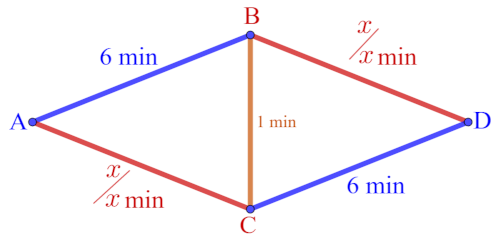
The Braess' paradox is the observa-tion that adding shortcuts to a road network can slow down the overall flow of traffic through it. The para-dox was first discovered by Arthur Pigou in 1920. Later, since 1968, it has been named after the German mathematician Braess.
For example, in Seoul, South Korea, traffic on the bypass sped up when the Cheonggye Expressway was removed as part of the Cheonggyecheon Restora-tion Project. In Stuttgart, Germany, after investments in the road network in 1969, traffic conditions did not improve until a section of the newly constru-cted road was reopened to traffic. The temporary closure of 42nd Street in Manhattan, New York City, in 1990 for Earth Day reduced traffic congestion in the area.
I will explain Brass's paradox on the simplified road network in the image ab-ove on the right. Let's imagine that four cars are driving from place A via B or C to place D. The blue sections AB and CD take 6 minutes to travel, and the red sections AC and BD respond to traffic density so that with x vehicles on that section, the journey along it takes x minutes. Someone thought of crea-ting a yellow shortcut BC that takes only 1 minute. Let's see what routes the four drivers have.
The first driver sees that he will cover the route ABD, or ACD, in 7 minutes and ACBD in 3 minutes and takes the fastest route, ACBD. Then the second driver sees that ABD, or ACD, would cover in 8 minutes, and ACBD in a total of 5 minutes, and of course, he will choose ACBD. The third driver would then cover ABD, or ACD, in 9 minutes, and ACBD in 7 minutes, and he will choose ACBD. The fourth driver now has ABD, or ACD, at his disposal, which he wou-ld cover in 10 minutes, and ACBD in 9 minutes, and he must choose ACBD if he wants the fastest route.
This is a "selfish" (Prisoner's Dilemma) choice that makes the journey of four vehicles and the shortcut seem "shortest" at 9 minutes. However, if the "shor-tcut" BC is closed, drivers are forced to take the ABD or ACD route, which co-uld take them 8 minutes. However, if the BC shortcut is closed, drivers are forced to take the ABD or ACD route, which could take them 8 minutes. Ad-ding shorter routes can slow down traffic, as everyone would arrive earlier.
Now imagine the gravitational field as a space-time of events flowing from the past through the present to the future. They are “selfish” (less smart, less coo-perative), and a stronger field corresponds to more congestion, nervousness, and a larger number of roads similar to city traffic. This is exactly why it is slower than highway transport outside cities. Despite the greater number of phenomena, or precisely because of it, the frequency of events is lower, i.e., the participants move more slowly and resemble a slow-motion flow of time.
Synergy III » srb
Question: Is collective intelligence better than the individual?
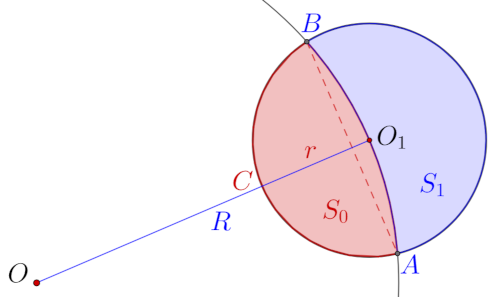
Answer: The question could just as easily have started with "When is..." because it is part of a complex and interesting conversation about de-mocracy, also about synergy, but in an abstract way of looking at the di-fferences between large and small physical bodies. Here are a few qu-otes that prove that differences of opinion improve judgments.
1. Stein's paradox, also known as Stein's example, is a counterintuitive result in statistics where multiple estimates can be more accurate (have a smaller expected mean square error) than using separate estimators in individual sa-mples. This is surprising because it highlights that considering all parameters at once (together), even when they are seemingly unrelated, can lead to better overall estimates than treating them individually.
It is explained in a simplified way by the image on the left: a plane with two circles. The larger circle has center O and radius R and passes through center O1 less radius r. It (O, R) divides the smaller (O1, r) into two unequal parts, the closer, smaller part ABC, which is shaded red, and the larger blue one. The smaller circle marks the boundary of the dispersion of random points from the point of view of a 2-dim plane of the two independent observers (abscissa and ordinate), and by moving OO1 of length R we represent the third individual.
An individual, a third observer, is biased to see the arc line AO1B as the dia-meter of a small circle. He overestimates the closer parts of the dispersion from the sample circle, that is, he underestimates the more distant parts and evaluates the phenomenon differently from the mean value of two independe-nt observers. If we work with three independent observers (abscissa, ordinate, and applicate) we have a ball (center O1, radius r) this difference in the decisi-on of the individual and them increases the ratio and means a larger error in the assessment of the individual compared to the group.
2. Another way to look at this problem is through the information of percept-ion. The intensity of communication a = (a1, ..., ak, ...) and b = (b1, ..., bk, ...) can be up to S = a⋅b = a1b1 + ... + ak⋅bk + ..., where k ∈ ℕ. These factors are st-ates with a dot product maximally their interaction. They are also opponents of the game whose highest level is expressed by S. This idea is confirmed in simulations: when we interpret it as "good," then "good" should be returned, and "bad" should be reciprocated with "bad" (Reciprocity), that is, with a po-sitive attitude to the positive and negative to the negative settings of the oppo-nent, proportional to the possibilities a1 : b1 = ... = ak : bk = ... and if possible, creatively.
The point is that the scalar product S = a⋅b is maximal when the angle betwe-en the vectors a and b is minimal, which is when the coefficients of the vectors are proportional, so that, on the other hand, the vitality of the game is greate-st. Hence:
... + 3⋅5 + ... < ... + (-1)⋅(-2) + 4⋅7 + ...
This means that by dividing the component ak = 3 into two (-1 + 4), approxi-mately as the division of bk = 5 into (-2 + 7), it increases the information of perception and raises the level (intensity, quality) of the game. Analogous to Stein's example (1), here we have differences as a contribution to the result.
3. With a little experience, or skill in abstract thinking, it is not difficult to no-tice that there is a generalization of the above two examples in forms such as the law of large numbers of probability theory. Let's put it this way. An estim-ate is better when it is more accurate, and it then encompasses more truth. I am talking about Gödel's correct theories that are always truncated because they are forbidden from falsehoods and the methods that we use in mathema-tics to arrive at truths (the method of contradiction, or statements with ⊥ and ⊤). The latter is especially present when the value of S increases.
So, by increasing the participation of subjects (living or non-living entities), the quality of perception increases, its accuracy, let's say its certainty. This is exactly what happens stochastically in repeating the experiment again and ag-ain or in taking an increasingly larger sample. On the other hand, it is also a global convergence of events despite their local dispersion, but it is not nece-ssary to understand that either, so I will skip that part.
4. Democracy is a topic of similar debates, but these conclusions do not gen-erally apply to it. Namely, a lie is attractive but not permanent (Fictitious, 2), and its initial flight can be used to manipulate voters. More often than not, the allure of lies turns into repulsion, emphasizing their instability. Whatever the case, statements are manipulated in elections so that it is irrelevant to talk ab-out an impartial mass of evaluators.
Disgusting » srb
Question: Why would a lie be repulsive, is it?

Answer: The article from the image link on the right describes our ever-yday lies, and we can use it for exa-mples, but our main intention is to give it a logical, abstract form. Con-sistent with previous treatments of the topic (Truth Power).
Lying makes people feel dirty, says Vanessa Edwards, so when people lie, they often make barely visible expressions of disgust, and they ex-pose them. In relation to the above, I consider this to be a reaction to li-es built by evolution, as in the case of rotten, polluted, and generally bad food or places. It is also a resistance against the "house of cards."
The most disgusting thing about lying is, it is believed, that it shows deep dis-respect for the person we are lying to. This, in turn, unconsciously comes from the "weak structure" of explanations based on lies, because liars are frail play-ers (Win Lose), they belong to the league of mediocre players with fragile str-uctures for the higher league. A liar, therefore, reminds many of a bringer of cheap gifts with which he belittles the recipient. What I write about below is not found in literature, except in my stories.
1. Gödel discovered that truths are like islands in a boundless sea, here we develop this further into the analogy of lies as bridges. I mean logic with lies (true and false statements, also the method of contradiction) plus science in general, with which we build knowledge often unattainable using the truths themselves. I consider measurements and physical natural phenomena to be true, because by proving that something cannot happen, it would not happen, or the "proof" itself would not be correct.
2. However, by definition, a lie is not reality, and on the other hand, not all fiction is untrue. The latter, according to this theory, is because there are pos-sible realizations that do not happen. For example, some events of a fictional character in a novel could be real even though they are not, so they remain only (true) fictions forever. What these "truths" and lies have in common is their lack of persistence, and in this domain they differ in their repulsiveness, which fictions often do not have in the way mentioned for lying.
3. Reality does not follow the "laws" of fiction; it does not see them, it does not pay attention to them, and the "manipulators" (Traits) miss the path the world is moving forward on, fall behind reality, and thus leave room for higher-leag-ue players (the name "evil") who easily defeat them. On the other hand, altho-ugh they are carried away by deception, they can bridge the gap between the islands of reality (lose-lose almost always wins win-win) and are therefore a league above the "good guys." The lie is that addition that elevates them. Bec-ause the lie is barely visible from the point of view of reality, but because it is attractive (the principle of minimalism).
The "good guys" are easily preyed upon by the "manipulators"' tricks and, in fact, the weaknesses that the "evil guys" use to win. It is precisely the advan-tages for the players of the first league (evil) when their opponents are wrap-ped in lies in the manner of the players of the second league (manipulators), and especially when the opponent is passive like inanimate nature (otherwise indestructible so it can be manipulated), which the players of the third league (good guys) would like to imitate. That is, in short, the essence of my division of strategies of complex games when there are too many options or too little time, which also reflects the attractiveness of lies. When reality encounters fiction, it aims to balance the numbers. A lie is a pale uncertainty and there-fore is attractive when it is made real.
4. There are various algebraic forms that simulate fictions, also lies, and are outside the algebra of logic. For example, non-zero matrices whose squares or higher powers are zero matrices (A ≠ 0, A² = 0), such as:
\[ \begin{pmatrix} 0 & 1 \\ 0 & 0 \end{pmatrix}^2 = \begin{pmatrix} 0 & 0 \\ 0 & 0 \end{pmatrix}. \]These are processes that are extinguished by repetition; they do not last ind-ependently, imitating the loss of fiction. There are also processes that are not extinguished by repetition alone but disappear in combination, for example:
\[ \begin{pmatrix} 1 & 0 \\ 2 & 0 \end{pmatrix} \begin{pmatrix} 0 & 0 \\ 3 & 4 \end{pmatrix} = \begin{pmatrix} 0 & 0 \\ 0 & 0 \end{pmatrix}. \]There are also states that can be affected by a nonzero process in such a way as to nullify it, for example (Ax = 0):
\[ \begin{pmatrix} 1 & 2 & 3 \\ 2 & 4 & 1 \\ 1 & 2 & 3 \end{pmatrix} \begin{pmatrix} -2 \\ 1 \\ 0 \end{pmatrix} = \begin{pmatrix} 0 \\ 0 \\ 0 \end{pmatrix}. \]For such we say that the state, or vector x, is from the null-space of the proce-ss, or matrix A. This is not the domain of Boolean algebra and is a novelty of this theory.
These forms, like the repulsion of fictions once their falsehood has been demo-nstrated, can be considered models of phenomena that flee. Otherwise, before that, fake news spreads faster than true news (Science).
Duration » srb
Question: How do you prove that without a future there is no past and vice versa?

Answer: Formally. I'm mostly inte-rested in linear operators and what they can tell. This means that a sta-te without a future is one that chan-ges to zero, and without a past it is irreversible, that there is a "today" and no "yesterday." But with such a form and with at least a little skill in applying mathematics, you can get anywhere, so to speak.
Moreover, vectors are states so that operators are processes. Incidental-ly, operators are also types of vecto-rs, so processes are also states in this algebraic way of interpretation. The proof therefore consists of the analysis AB = O, where A and B are nonzero matrices, or vectors, and O is a zero matrix or a zero vector, as the case may be.
1. The following example of multiplying second-order square matrices shows that the result is zero, AB = O, if the determinant of the first factor is zero:
\[ \begin{pmatrix} a_{11} & a_{12} \\ a_{21} & a_{22} \end{pmatrix} \begin{pmatrix} b_{11} & b_{12} \\ b_{21} & b_{22} \end{pmatrix} = \begin{pmatrix} 0 & 0 \\ 0 & 0 \end{pmatrix}, \] \[ \begin{pmatrix} a_{11} & a_{12} \\ a_{21} & a_{22} \end{pmatrix} \begin{pmatrix} b_{11} \\ b_{21} \end{pmatrix} = \begin{pmatrix} 0 \\ 0 \end{pmatrix}, \quad \begin{pmatrix} a_{11} & a_{12} \\ a_{21} & a_{22} \end{pmatrix} \begin{pmatrix} b_{12} \\ b_{22} \end{pmatrix} = \begin{pmatrix} 0 \\ 0 \end{pmatrix}, \]so det A = 0, even when the columns of the matrix B[b1, b2] are not zero vectors, because then they are from the null-space of the matrix A. Such a matrix then has no inverse and represents a process without a past. From symmetry, an analogy will follow for the matrix B. On the other hand, the processes A and B connected will extinguish all vectors x, always ABx = 0, there is no future with them.
This is a special case of the general multiplication of square matrices of order n with the first matrix of zero determinant det A = 0 and second B[b1, ..., bn] whose columns are not (need not be) zero vectors. Now it is obvious, I hope, and the application is as follows. Whatever lasts (say det B ≠ 0) combined with whatever does not last (det A = 0) will be that it does not last; shortly, det(AB) = (det A)(det B) = 0, because the determinant of the product is equal to the pr-oduct of the determinants.
2. The following example demonstrates that such matrices do indeed exist:
\[ \begin{pmatrix} 1 & 2 \\ 2 & 4 \end{pmatrix} \begin{pmatrix} -2 & 2 \\ 1 & -1 \end{pmatrix} = \begin{pmatrix} 0 & 0 \\ 0 & 0 \end{pmatrix}, \] \[ \begin{pmatrix} 1 & 2 \\ 2 & 4 \end{pmatrix} \begin{pmatrix} -2 \\ 1 \end{pmatrix} = \begin{pmatrix} 0 \\ 0 \end{pmatrix}, \quad \begin{pmatrix} 1 & 2 \\ 2 & 4 \end{pmatrix} \begin{pmatrix} 2 \\ -1 \end{pmatrix} = \begin{pmatrix} 0 \\ 0 \end{pmatrix}. \]However, we also notice something new, in addition to det A = 0, det B = 0. The Null space of matrix A contains non-zero vectors b1 and b2, columns B[b1, b2] whose determinant is also zero. In the case of multiplication of numbers, this does not have to be the case, i.e., from ab = 0 it does not follow for both factors a = 0 and b = 0. However, if the matrix product is a zero mat-rix, one whose coefficients are all zero, then the determinants of both factors are zero. Then the columns of the second factor are the zero vectors of the first space. This is not mentioned in (1), but in fact follows from the general case.
3. The following is an example of a matrix product that is not a zero matrix, but whose determinant is zero (AB = C):
\[ \begin{pmatrix} 1 & 2 \\ 2 & 4 \end{pmatrix} \begin{pmatrix} 1 & 2 \\ 3 & 4 \end{pmatrix} = \begin{pmatrix} 7 & 10 \\ 14 & 20 \end{pmatrix}. \]Here det A = 0, det B = -2, and det C = 7⋅20 - 14⋅10 = 0. Interpreting this, we find that the composition of the impermanent (A) with the permanent (B) results in an impermanent process (C = AB). However, this result does not have to disappear and can remain "existing," therefore unreal like a fiction. Let us distinguish this from (1), from the complete disappearance when fic-tions themselves are composed.
4. I will summarize. The matrix equality AB = 0 gives det A = 0 and B = 0, meaning (I paraphrase) that when there is no future, there is no past. Con-versely, from det A = 0 and B = 0 it follows det(AB) = 0, but not necessarily AB = 0, which means that processes without a past remain connected to pro-cesses without a past but do not have to disappear immediately. All the same, it remains that without a future there is no past and vice versa, if we consider that fictions (without a past) have no real duration. Fictions come from null-space, which grows by extension and will not spontaneously become realities.
Consciousness » srb
Question: Have you tried to define consciousness?

Answer: Yes, formally. "Consciou-sness" is that part of a "being" that wants to govern its whole. This def-inition only makes sense when con-sidering the principle of minimali-sm, which is not recognized by sci-ence jet, so it remains my personal interpretation of consciousness.
Compare my interpretation that follows with the currently accepted one, which states that consciousne-ss is a state of awareness and responsiveness to one's surroundings, along with one's own thoughts, feelings, and sensations. Consciousness is both wakefuln-ess and awareness and is a complex interaction of various brain systems. Esse-ntially, it is your subjective experience of being in the world, a stream of cons-ciousness that includes your perceptions, thoughts, and feelings.
1. The principle of minimalism is a desire to reduce uncertainty, but since unc-ertainty is omnipresent, and so is this principle, it easily remains a maintenan-ce of the status quo. This is the deeper meaning of Lagrangians and performa-nces. More broadly, in systems that also contain fictions, say in biological bei-ngs, the matter of least action is part of the principle of minor effect, and we have laziness as its consequence. These include needs for subordination, from surrendering personal freedoms to a team for efficiency or to the state in ex-change for security, to more intense ones like masochism. The will to power and dominance, or control in general, and even the death drive are also expre-ssions of the principle of minimalism. Similarly, the search for regularities is a kind of desire for less action.
2. The combination of reality and fiction, such as living beings, for example, forms more complex wholes than inanimate physical objects. They have gre-ater freedom of action and therefore a greater need for minimalism, and the-refore the possibility of possessing a "consciousness" (a part that wants to ma-nage the whole). This consciousness is actually the one that wants to control, to find ways to "understand" (sooner or later, artificial intelligence will also have this consciousness) itself and its environment in order to assess the paths of minimalism for its entire structure. We distinguish trees from forests and similarly individual parts from the entire structure. This is also at the heart of the understanding of the hierarchy of this theory. The complexity of the stru-cture will also imply a more difficult distinction between the path to a better one and the trap.
3. The imperial retinue is much smaller than the people it rules, for example, just as consciousness is much smaller than the unconscious. Therefore, a wea-ker chess player must "calculate" moves by considering "I here, he there, I he-re, he there..." unlike a master, who generally "knows" which move to make. This is the difference between understanding and skill, from, say, painting to mathematics. Great skill is when our subconscious also "thinks" about a given goal, and the path to that is experience, work, and learning in enormous quan-tities. We mathematics students in Belgrade at that time (the second half of the 20th century) experienced that "enlightenment" only after the third year of study. It should be known that many of us there were talented mathematici-ans and previously successful competitors, but alas, we would only get walked in mathematics at the end of our studies. Then we would no longer just think about individual theorems and formulas, trying to be aware of them, but we would see, or rather say directly feel, the solutions.
4. Complex systems achieve optimal efficiency only with local hierarchies. Th-is follows from graph theory and principled minimalism, and with the assum-ption that we are talking about communications that transmit actions. Nature "does not like" equality and spontaneously slides into differences, and prefer-ably into those with less information emissions. That is why the network of fr-ee flows of money, goods, and services spontaneously develops into a small number of large owners of these equal links (the rich) and a very large numb-er of poor link holders. Because of the same, we do not have a "consciousness" that could control all bodily processes. (Answer completed on 13.07.2025.)
Dot Product II » srb
Question: How come you have one interpretation for "scalar product" at one time and another at another?
Answer: Unlike special phenome-na, the nature of rules in general, all toward mathematical stateme-nts, is that they are universal. The step towards the ultimate singular-ity of the scalar product is the sum of products, or even better informa-tion of perception, and then various interpretations come. All these con-siderations are discoveries of such differences.
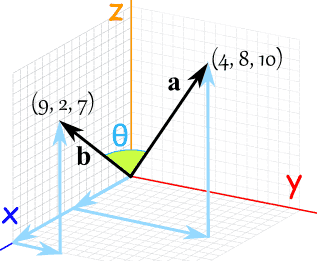
1. A smaller angle θ, as in the figure on the left between the points of the vectors a(4, 8, 10) and b(9, 2, 7), will give larger scalar product a ⋅ b = abcosθ, where a and b are the intensities, magnitude of these vectors. If we multiply the orthogonal vectors i, j and k, the unit vectors of the abscissa, ordinate, and applicate (x, y and z axes), in this way, we find i ⋅ i = j ⋅ j = k ⋅ k = 1, and i ⋅ j = j⋅ k = k ⋅ i = 0. Such multiplication is commutative and distributive, so we also have:
a ⋅ b = (4, 8, 10) ⋅ (9, 2, 7) = 4 ⋅ 9 + 8 ⋅ 2 + 10 ⋅ 7 = 122 a² = ∥a∥² = a ⋅ a = 180, b² = ∥b∥² = b ⋅ b = 134 √180 ⋅ √134 cos θ = 122 cos θ ≈ 0.785545 θr ≈ 0.667220 θ° ≈ 38.23°
First, the angle is written in radians and second in degrees (θ° = θr ⋅ 180°/π). You can find all this in more detail at the link to the given image.
2. Individual coordinates can represent observables, such as in quantum phys-ics where there can be infinitely many (Fictitious), or they can be complex nu-mbers (Pauli matrices), but they are always representations of Hermitian ope-rators. In the macro world, these would be real numbers with also "observabl-es" (measurable quantities), which are the strengths of communication. Subje-ct a = (..., ak, ...) would have k-th coordinate ak which could communicate wi-th the k-th coordinate of object b = (..., bk, ...) at the highest intensity so that they could achieve the perception information S = a ⋅ b = ... + ak⋅bk + ... . The larger S, the greater the power of communication.
3. In the case of truth-seeking (Synergy III, 2), that k-th was 3⋅5 = 15, and wh-en decomposed into opposing opinions, it would increase to (-1)⋅(-2) + 4⋅7 = 30 and increase the information of perception. However, when decomposed into agreeable opinions, as in 1⋅2 + 2⋅3 = 8, it would decrease the information of perception. This means that the assessments in the case of opposing opini-ons reach further than the assessments of agreeable ones. And this does not mean that the groups are more pleasant company or more stable.
Another example: when we work with the intensity of the game, then with S as the degree of vitality (inanimate is not played), we interpret the same calculat-ion a little differently. By breaking it down into opposites, the game becomes more intense in ways that make the level of the game higher, as in the "divide and conquer" strategy, as well as the gathering of consonants (the opposite of separation), which would strengthen the game by concentrating forces. The diversity of interpretations of these sums actually tells us that they are still a theoretical matter, unlike the extremely concrete ones that would then have no diversification.
4. Without hoping, we have now learned something else. We knew that a che-mical substance consists of molecules and atoms and also that a physical acti-on consists of quanta (products of energy change over time), or that informa-tion is in packages. Here we could notice that it is similar to abstractions wh-ose smallest units of concreteness are uniqueness, unlike abstract concepts that are repeated here and there. So the ultimate concretenesses are the "at-oms" of ideas.
Awry » srb
Question: Can you explain to me how it is that concreteness is the "atoms" of abstraction; isn't it the other way around?
Answer: Let's look at it this way. Uncertainty is like Pandora's box full of wonders, unlike certainty, and yet the law of large numbers from probability theory (we're not disputing that, are we?) says that with more of these, we get fewer and fewer of them. When there are more uncertain outcomes, there is less uncertainty; as in the micro world, the more we have it, the smaller it is and the further we are from them. The more you collect about the unknown, the more fam-iliar it becomes.
Just as a police inspector or detective who collects evidence assembles a pictu-re of the events surrounding a crime in his mind, so too does an engineer or scientist collect concrete facts in order to come up with a real idea or a new theory. Ideas and abstractions arise from a multitude of concrete phenomena, never the other way around, although that is what we usually think. Imagine a clever mind, but completely isolated from the physical world we know. Could such a mind come up with a valid physical theory? If that were possible, then we could say that we did not need physical experiments in research. This is how we know that they are.
Uncertainty is at the core of everything that exists, in this theory, and on the other hand, it is also repulsive. This makes the smallest units of uncertainty a prerequisite for the existence of reality (observable, permanent, and true phe-nomena). These "atoms" are, therefore, in turn, infinite in the sense that there are as many of each of their real parts as there are wholes (there are as many even natural numbers as there are all natural numbers), and on the outside in different structures, they are increasingly certain the more numerous they are. Nature tends to diversity and therefore tends to less uncertainty, so we find both local dispersion and global convergence.
A mind that could perceive every concreteness, countless such situations and phenomena, would have at its disposal all possibilities, abstractions, or their laws, unlike one that would never have had experience with our physical world and would therefore not be able to derive a single one of its laws. This would be roughly what the view that concreteness is the “atoms” of abstraction leads us to. The genius of the concept of such a world lies in its premise on chance, on the possibility of its uncertainties accumulating and turning into certainti-es, of its self-negation. (July 15, 2025)
Scream » srb
Question: Do you have any explanation for why the uncertainty of the smallest would be the greatest?
Answer: I am so small that I have to scream, "I exist too!" If I want to be real, to be noticed sometimes and to last in that way, to be true, then I am so small. Jokes aside.
The smallest particles are indeed subject to greater uncertainty than large structures, and at the same time they are relatively the most playful, because the uncertainty they possess is the cause of the attractive probability force, and this in turn is the cause of physical action, at least as far as this (my) theory of information is concerned.
Diversity, mystery, and sustainability are the backbone of this concept. These three seemingly contradictory conditions agree over time, behind which space extends, expanding into one of the storehouses of memory. The present shifts from the past to the future at the speed of light, following the above principles, and in doing so "has the right" to be more and more certain. Namely, the pres-ent is the backbone and uniqueness from which everything else that would be the subject of this theory is drawn. It does not have the privilege of being able to repeat itself, because the message that is (really) communicated is no longer what it was, so that even the electrons in the atom, given the huge gaps betwe-en them, are loners in their isolated present.
Any such force, even the smallest one, which is real and therefore constant and central, decreases with the square of the distance and moves its charges along conic sections. In fact, as the particle floats towards the future, a sphe-roidal momentum is stored in space around it, the chances of interaction (co-mmunication) of which decrease with the square of the distance (the distance that light travels in a given time). If there is an object on the path of such a virtual sphere that could be exchanged with the given one, and at the same time when that interaction occurs, we have the event described by the Feyn-man diagram. The chance decreases with the square of the distance, it decr-eases with with the amplitude of the wave, but the momentum that could be transmitted is constant and corresponds to the wavelength.
However, the particles are moving relative to each other, and simultaneity is relative. It is not the same “now” for the two of them. Moreover, the virtual sphere of the moment of interaction that the third observer perceives is not what is happening then (it happened before the light arrived from there), and the things that happened to the participants were not exactly the same as tho-se seen by the others. The multitude of everything slowly becomes a pseudo-reality, and what remains common is what can be compared in mutual rest (Crash). The expanding virtual sphere, although we “experience” it as real movement, is actually the growing sediment of our past. Namely, uncertainty would be absent in all the same flows of the past and, again consistently, it is most present in the smallest ones. (16.07.2025.)
Twins II » srb
Question: What did you mean at the end (Scream) having said: "once again, the greatest uncertainty lies in the smallest"?
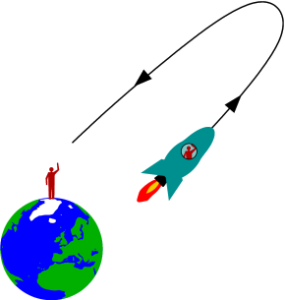
Answer: I was thinking of confirmi-ng the findings about local dispersi-on and global convergence (Global Convergence). The fastest relative motions are in the microworld, and at the same time the largest and most frequent deviations into par-allel realities. The twin paradox, in the image link on the right, I still consider unexplained in physics, so it is worth repeating my understan-ding of it. That helps to the answer.
The twin brother paradox comes with the relativity of motion and its time dilation. One of the twin bro-thers is on Earth, and the other is traveling through space. The seco-nd one will be younger than the first one when he arrives on Earth because he was moving and time passed more slowly for him. However, motion is relati-ve, so you can say, I was at rest, and my brother was flying with the planet ar-ound. So the brother on Earth should be younger. In the Twins version of this information theory, the slowing down of time comes from acceleration as well, through the action of a force, and the deficit in perceived duration also comes from the loss of time due to walking in a parallel reality.
It is known that gravity slows down time (Information Coupling, Example 115.), and then we have the equivalence of inertia and gravity, inertial and gravitational acceleration, and the slowing down of time otherwise due to acceleration. That's it in short. The second part about the loss of perceived time proves that consciousness oversees the physical system that is in the current reality.
Small particles are so swivel and very fast. Up close, they are quite different from the motion of “immobile” stars that we see from great distances. In ad-dition, we see the distant past through the stars now that the future has beco-me a little more certain and slower. In a gravitational field, time slows down because matter becomes introverted (In and Out), its information is more internal. On the other hand, the current present leaves a trace of information from the past and, over many years, has an increasing loss of uncertainty, a lack of events, and again, a slowing down of time. This gives the seemingly slow motion of very distant stars a touch of reality in the sense of their less spinning and speed.
Let us note that the circle of this logic closes, from local dispersion to global convergence, but that things look "distorted" next to known physics. For ex-ample, if the density (information) of the present is lower, how is it that time is slowed down as if gravity were stronger, or what else would the redshift of galaxies moving away from us mean? This is an interesting topic, with a perti-nent question. (July 17, 2025)
|
|
|