|
|
|


Means » srb
Question: What kind of middles are you talking about?
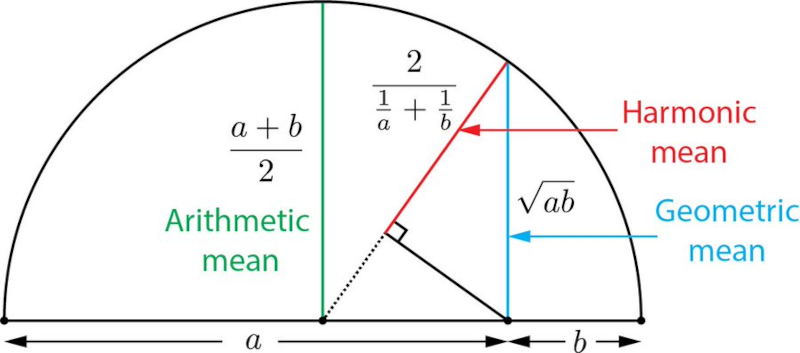
Answer: About various averages, starting with those in the picture above: ar-ithmetic, geometric, and harmonic. These “averages” (means) are not so visu-al, but the picture helps us gain insight into their diversity. The number of su-mmands is usually greater than the two shown here; only then come the inter-pretations that multiply everything they can. I will not easily cope with some questions (I already have them in advance) in which these mathematical abs-tractions should be simplified, trivialized, or, if possible, reduced to seeing, touching, and eating.
The figure shows that the harmonic mean is less than the geometric mean, this is less than the arithmetic mean, and all three are equal if and only if is a = b. When the lengths are assigned numerical values, this means that:
$$ \frac{2}{\frac1a + \frac1b} \le \sqrt{ab} \le \frac{a + b}{2}, \quad \forall a, b > 0. $$Unlike the geometric representation above, we also have an algebraic proof:
$$ (\sqrt{a} - \sqrt{b})^2 \ge 0 \iff \frac{a + b}{2} \ge \sqrt{ab}, $$which we get by squaring the otherwise correct inequality on the left and di-viding by two. From the right we find:
$$ 2\sqrt{ab} \le a + b, $$ $$ \frac{2ab}{a + b} \le \sqrt{ab}, $$ $$ \frac{2}{\frac1a + \frac1b} \le \sqrt{ab}. $$These three "middles" are equal only when a = b, and this has its own special meaning in the interpretation of the principle of minimalism, that "nature do-es not like equality". Namely, it does not like even equal details of possible wholes.
The proven consistency of the results of proofs from different areas of math-ematics, such as geometry and algebra, encourages us to look for the same in their application to reality, that is, in general, wherever truths are. Moreover, to view truths much more broadly as the places where mathematics resides.
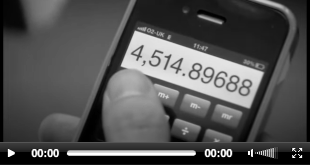
I have chosen one example, seen in the image on the left, which shows how randomly selected (160) resp-ondents individually will not come close to guessing (4510) the numb-er of jelly beans in the jar, but the average of their guesses gives an extremely close number (4515), with an error of less than 1%.
Of course, this is not mentioned in the video, but I consider this a confirmati-on of the value of probability, its mean and dispersion value, and mathematics in general in practice. It would have no practical meaning if, say, theoretical expectation and dispersion failed in similar experiments. I emphasize again, this is not the case in today's democracies — due to the wrongly chosen sam-ple, due to media preparation of voters, so-called brainwashing, and the co-rruption of true randomness.
Tetrahedron » srb
Question: What if we have multiple unequal options, what is their mean value?
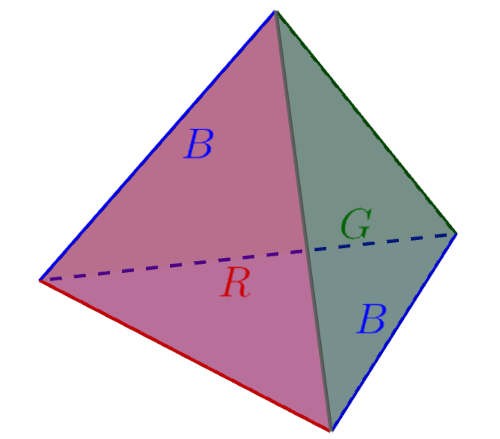
Answer: We will evaluate these un-equal options and then obtain their average values depending on the measurement method. Let's consi-der a given figure, a tetrahedron, as shown in the image on the left. Its sides are made up of equal equila-teral triangles, the front left one colored red, the right one green, and the other two blue.
1. When we throw this tetrahedron onto a flat surface, the chance that any of its four sides will land is equ-al, but the chance of blue being the color will be twice as high as red or green. We have thus defined a probability distribution:
Pr(B) = $\frac12$, Pr(R) = $\frac14$, Pr(G) = $\frac14$.
The mean value would be the number:
μ = $\frac12$B + $\frac14$R + $\frac14$G,
where it remains to number these colors as well. Depending on the assignme-nt of numbers to the colors, we will get various mean values, but the associati-ons are not entirely arbitrary if we want to have mathematical consistency in the applications of the results.
2. Independent events are, for example, rolling a die and then rolling that tet-rahedron. The probability of rolling a “red” and a “six” is then the product of the probabilities of the separate rolls, Pr(R∩6) = Pr(R)⋅Pr(6). Then disjuncti-on (separation, independence) of sets and independence of random events are very different concepts (Independence). If events are disjunctive, they are not mutually exclusive, and if they are exclusive, they are dependent — we see that it makes sense if we think a little harder. Mathematics is not for shallow thin-kers.
This concerns memory and therefore reality. Events without duration, without having an obligation to the previous ones, are not dependent on the past. The-se steps are disjunctive and mutually exclusive in the sense that the next one “avoids” connections with the previous one. It can be shown that Shannon’s information is greater than the dependent ones, which helps the connections of reality and fiction, say, to life.
3. There are also known cases of events that are independent in pairs but not independent otherwise. For example, a regular tetrahedron has the first side colored red (R), the second green (G), the third blue (B), and the fourth side colored in all three colors. The individual probabilities of their occurrence are Pr(R) = Pr(G) = Pr(B) = $\frac24 = \frac12$, while the probabilities of the pairs of colors are Pr(R∩G) = Pr(G∩B) = Pr(G∩R) = $\frac14$, but the probabilities of occurrence for all three colors are Pr(R∩G∩B) = $\frac14$ ≠ Pr(R)⋅Pr(G)⋅Pr(B) = $\frac18$. Thus, the independence of pairs of events does not guarantee the independence of triads.
4. This is reminiscent of the discussion and voting of two opposing views when they remain without an outcome (Latin tertium non datur) until another such person appears whose view will dominate. It is similar to mixing three colors into white, neutral, when we add another of those that prevail. Such a tetrah-edron model is also the basis for examples of the transition of quantity into quality, but here it does not mean quite the same concept as the classical, Hegelian one.
Shannon » srb
Question: What is Hartley information and how to calculate its mean?
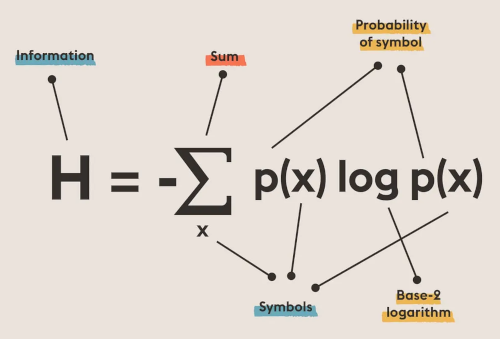
Answer: Hartley in 1928 determin-ed the information of equally prob-able n = 1, 2, 3, ... outcomes using the logarithm, I = logb n, where the base of the logarithm b > 0 defines the unit of information. We check this, for example, by binary search, in which we answer questions star-ting with "Do..." with "Yes" or "No". Then n = 2I is the number of possi-bilities, while I = log2 n is the infor-mation in bits (BInary digiT). The probability of a single is p = 1/n.
1. Given a probability (0 < p < 1), we can estimate by rolling (n ≈ 1/p) the nu-mber of equally likely events that could correspond to it, even if none exist in the given context. So, we can find the Hartley information, I = -logb p ≥ 0, for each possible probability. We use this in particular for the probability distri-butions p1, p2, p3, ..., all positive numbers that sum to one. Then Ik = -logb pk is the Hartley information of the kth, and the average information of these Hartleys is:
H = -p1 logb p1 - p2 logb p2 - p3 logb p3 - ...
This is Shannon's information. When there are many probabilities of a distri-bution, the Borel-Cantelli lemma states that only finitely many probabilities are one. However, although the sum of the probabilities of a distribution is always convergent (sums to one), Shannon information can diverge, albeit very rarely.
2. We express the odds of continuous means using the probability density fun-ction ρ. The probability density function ρ(x) describes the probability that a continuous random variable x ∈ X falls within a certain range of values. It does not give the probability of a single point but rather the probability density aro-und the position x. For example, the area under the curve ρ = ρ(x) within the interval (x - ε, x + ε), for some ε > 0, represents the probability that the variable falls within the interval. Then it is analogous to the previous floppy case:
$$ \int_X \rho(x)\ dx = 1, \quad \rho(x) \gt 0, \forall x \in X. $$Density can also be specified in regions of the vector space X, not just along the abscissa. Shannon's information is:
$$ S = -\int_X \rho(x) \log_b \rho(x)\ dx. $$For small numbers ρ > 0 the logarithm -logb ρ can be an infinitely large num-ber, so the Shannon information can diverge even though the probability de-nsities converge (the integral of all is one). For example (Divergence) has a well-defined density distribution, but its Shannon information is infinite. The opposite of this is the normal distribution ρ = exp(-x²/2)/2π whose graph be-haves approximately like the Shannon summand φ = -ρ ln ρ, as explained in a recent (Overgrowth) blog post from March 2024.
3. The mean of each of the two distributions, x1 = (ξ1, ξ2) and x2 = (ξ2, ξ11), can be calculated using the second distribution y = (η1, η2), where the coefficients of these vectors are positive numbers that sum into one. And we also have the numbers ζ1 = ξ1η1 + ξ2η2 and ζ2 = ξ2η1 + ξ1η2 which are positive and sum into one. Therefore, again z = (ζ1, ζ2) is a probability distribution.
In general, if we write all permutations of the series x = (ξ1, ξ2, ..., ξn) which is the probability sequence of some distribution, we obtain N = n! = 1⋅2⋅...⋅n seq-uences of the same length such that k-th of them (k = 1, 2, ..., N) is of the form xk = (ξ'1, ξ'2, ..., ξ'n). Each coefficient is one of the x sequences. The sequence of mean values zk = (ξ'1η1, ξ'2η2, ..., ξ'nηn) is again a probability distribution. Namely, the terms are positive numbers and:
z1 + z2 + ... + zn = = (ξ'1 + ... + ξ'n)η1 + (ξ'1 + ... + ξ'n)η2 + ... + (ξ'1 + ... + ξ'n)ηn = η1 + η2 + ... + ηn = 1.
The Shannon information of this z distribution, i.e. the mean values of y above permutations of the x distribution, is S = -z1 log z1 - ... - zn log zn.
When the probabilities y are decreasing (non-increasing), then the largest sum of the mean values ξ'1η1 + ξ'2η2 + ... + ξ'nηn of the sequence zk in which the permutations are also decreasing (non-increasing). Namely, let us consid-er two members of that permutation (i < j) and suppose that the second is gr-eater than the first, ξ'i < ξ'j. Then:
ηi > ηj (ξ'j - ξ'i)ηi > (ξ'j - ξ'i)ηj ... + ξ'jηi + ... + ξ'iηj + ... > ... + ξ'iηi + ... + ξ'jηj + ...
which means that by changing the order of the given two terms of the given permutation, the said sum increases. By changing such incorrectly arranged terms two by two, we obtain the maximum sum of the mean values. The lar-gest values when multiplying sequences are obtained when they are of the same monotonicity, both increasing or both decreasing.
4. We are now close to the principle of minimalism in two seemingly incomp-atible ways. First, when something is certain and happens, it is not news. So, what is probable is poorly informative. Nature would more often realize more probable outcomes if some external force did not interfere with its action; that is, it spontaneously develops into less informative systems, and these are tho-se that communicate less. This is its meaning of efficiency. Consequently, nat-ure does not like equality, because equally probable outcomes are more proba-ble. Specifically, a fair coin toss has more uncertainty than a biased coin toss when the outcome is known.
Second, the norm as a scalar product of the probability distribution increases as the Shannon information decreases and vice versa. For example, consider the following two distributions of length four outcomes:
x = (0.4; 0.3; 0.2; 0.1), y = (0.25; 0.25; 0.25; 0.25),
S(x) = -0.4⋅ln 0.4 - 0.3⋅ln 0.3 - 0.2⋅ln 0.2 - 0.1⋅ln 0.1 ≈ 1.28 S(y) = -0.25⋅ln 0.25 - 0.25⋅ln 0.25 - 0.25⋅ln 0.25 - 0.25⋅ln 0.25 ≈ 1.39
∥x∥² = x⋅x = 0.4⋅0.4 + 0.3⋅0.3 + 0.2⋅0.2 + 0.1⋅0.1 = 0.30 ∥y∥² = y⋅y = 0.25⋅0.25 + 0.25⋅0.25 + 0.25⋅0.25 + 0.25⋅0.25 = 0.25.
A larger Euclidean, or 2-norm, distribution corresponds to a smaller Shannon information and vice versa. Hence, for theoretical considerations, we can som-etimes only consider such probability norms, of course, when we manage to gain insight and control over other natural limitations.
Peak » srb
Question: Explain to me, as you said, the largest values when multiplying seq-uences are obtained when they are of the same monotonicity, both increasing or both decreasing?
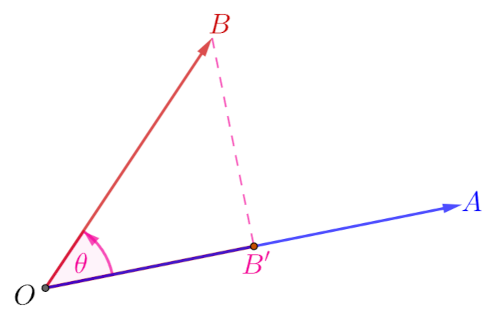
Answer: The image on the left repr-esents two sequences, two vectors $\vec{a}$ and $\vec{b}$ which are directed along a li-ne from point O to A and the other to B. The projection of the second onto the first is along OB', where the angle between the given vectors is θ. With a little knowledge of ve-ctors we find that this projection of the length is:
$$ \overline{OB'} = |\vec{b}|\cos\theta. $$1. Here is the scalar product:
$$ \vec{a}\cdot\vec{b} = |\vec{a}||\vec{b}|\cos\theta $$is equal to the product of the length of the vectors and the cosine of the angle between them. Again, the scalar product is:
$$ \vec{a}\cdot\vec{b} = a_1b_1 + a_2b_2 + ... + a_nb_n $$when these vectors are given in the n-dimensional Cartesian rectangular coor-dinate system. We know that such vectors, when started at the same point O, will look like in the picture, defined in one plane, hence a 2-dimensional coor-dinate system. The smaller the angle θ, the larger the cosine of the angle and their scalar product increases, if the vector intensities do not change. Then the coefficients of these vectors become more similar, larger ak corresponds to la-rger bk and vice versa, in order for all k = 1, 2, ..., n. That is exactly what is sta-ted in the question.
2. That proof has long been out of fashion, given how many times it has been cited, if we count my own texts alone, so here is another one, more similar to the previous one (Shannon, 3). It is the algebraic observation that the square of a real number is always non-negative:
(x - y)² ≥ 0 x² + y² ≥ 2xy.
We then insert the numbers of the two array vectors into this pattern and add them:
x⋅x + y⋅y > x⋅y + y⋅x xi⋅xi + xj⋅xj > xi⋅xj + xj⋅xj.
We get the maximum product when the multiplied equal or proportional coef-ficients in pairs of such a sum are, and that's it, what is stated in the question.
When the square of the norm ∥x∥² = x1² + x2² + ... + xn² is multiplied by an arbitrary parameter β, we obtain the scalar product of the sequences:
β∥x∥² = x1(βx1) + x2(βx2) + ... + xn(βxn) = = x1y1 + x2y2 + ... + xnyn = x⋅y
y = β(x1 + x2 + ... + xn).
This is the meaning of the "proportionality of coefficients" which gives the gre-atest value to the scalar product, when the intensity of the vectors is not chan-ged, but only their total "weight" is distributed, or the angle between the vect-ors is changed.
3. In a similar way (2) it can be proven that the scalar product x⋅y of the sequ-ences x = (x1, x2, ..., xn) and y = (y1, y2, ..., yn) is maximal when both sequenc-es are decreasing (non-growing), i.e., they are of the same monotonicity, or that it is minimal when one is decreasing and the other is increasing, i.e., they are of opposite monotonicity.
For example, in the case where we multiply the probability distributions x and y, we get the maximum value if the order of the terms of both sequences is de-creasing. This does not change when we multiply each term of the second seq-uence by the same constant. The reverse is also true: when the first sequence is decreasing and the second is increasing, then the scalar product is minimal.
I repeat this so that we can understand what follows better. When the terms of the second series are the logarithms of the terms of the first, yk = -log xk, then the first decreasing will generate the second increasing. Consequently, we ha-ve the minimum value of Shannon's information, -∑ xk log xk, precisely becau-se we have the maximum value of the probability norm ∑ xk².
4. Hartley's information is the logarithm of the number of possibilities with equal chances, or the absolute value of the logarithm of the probability. This makes the probability an exponential function of such information, and it sh-ould be sought among the differential equations solved by exponential functi-ons, that is, among the wave equations. For example, such is the Schrödinger equation, the fundamental equation of quantum mechanics; therefore, it exp-resses the probabilities of quantum states.
Quantum measurement is the process of finding the dot (inner) product in the space spanned by orthonormal vectors |ak⟩, otherwise the eigenvectors of the operator  of the measurement process, over a particle in a quantum state |ψ⟩. The particle is in a state of superposition, a kind of interference of every poss-ible state |ak⟩, where k = 1, 2, 3, ..., and the measurement will cause it to colla-pse into just one of these. What we find by measurement, in quantum mecha-nics we call inner products ψk = ⟨ak|ψ⟩ whose squares of the modulus |ψk|² are precisely the probability of measuring a particle in state |ak⟩, its choice of that state.
5. Measurement is the process of projecting a particle |ψ⟩ into one of the opt-ions |ak⟩ offered by a given measurement environment. The options are wave functions and basis vectors that represent the particle as their linear combin-ation:
$$ |\psi\rangle = \sum_k \psi_k |a_k\rangle, \quad \psi_k = \langle a_k | \psi\rangle. $$Scalar multiplication of a basis with a particle projects the particle, that is, its observable, onto one (kth) of the coordinate axes, giving us the value of the ψk coordinate. The projection process is "dissipative", which is by nature a kind of disappearance, a loss of something, usually energy. In the theory of this in-formation, measurement is a descent to a lower level of communication, then a lower level of interaction. Basis vectors as wave functions are actually (Hart-ley type) information.
System » srb
Question: What do you mean when you talk about "the system"?
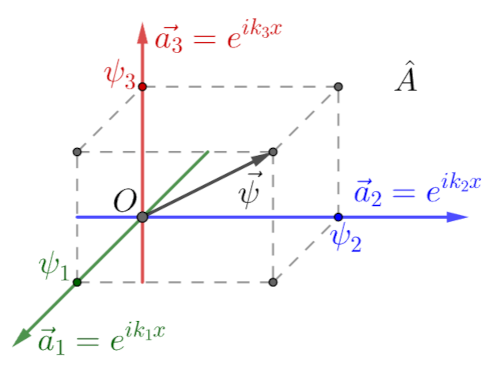
Answer: The coordinate system is usually implied and, since you read the previous answer, it is a quant-um system. The Base of a quantum coordinate system is determined by a quantum process, the operator  that corresponds to the measurem-ent set and that forms the given orthonormal basis of the quantum system.
The three orthonormal eigenvect-ors of such a  are eik1x, eik2x and eik3x, as in the sketch on the right. They form the basis vectors of this quantum system, the vector space spanned by the  operator of a specific measurement.
I cannot explain this otherwise well-known fact of quantum mechanics in a simpler way, but the point is that such basis vectors are actually information of a generalized Hartley type. The particle's state vector, otherwise a superpo-sition, is written here:
$$ \vec{\psi} = \psi_1 e^{ik_1x} + \psi_2 e^{ik_2x} + \psi_3 e^{ik_3x} $$This interpretation of the coordinate system is novel; moreover, the scalar pr-oduct is actually information about perception, i.e., the ability of a particle ψ to communicate with a certain environment Â. Here, these are orthonormal vectors that span that environment, and they are also information known as observables.
This scalar product, ψk = ⟨ak|ψ⟩, which in quantum mechanics is usually cal-led the inner product of vectors, but (only) here it is also the information of perception, gives the probability |ψk|², axis k ∈ {1, 2, 3}, that the superpositi-on will collapse exactly on the kth piece of information. When we toss a coin and it lands "tails" and therefore does not land "heads," the collapse of the superposition into one of the states of the system (basis vectors) excludes the realization of other possibilities.
Just-In-Time » srb
Question: Can you explain to me "global convergence with local divergence"?
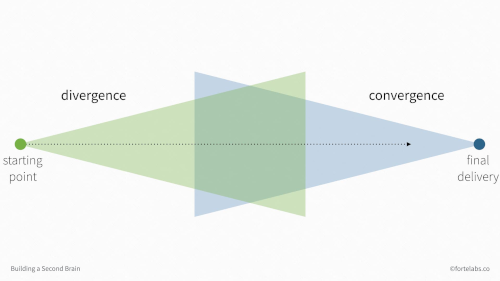
Answer: The link is to questions fr-om one of the topics that are curre-nt because they are new, not yet di-scovered in science, but seemingly understandable and "easily prova-ble" to a layperson. The aim here is that supposed ease, which for me represents a burden that does not belong to the topic.
1. In even more serious analyses of message transmission, especially from the past to the present, the Markov chain is indispensable. It copies the probabil-ity distribution as a representative of the data series through a series of condi-tional probabilities and finds increasing interference in the channel noise. Th-is converges to a certain state, a single distribution, in fact the eigenvector of a link of a given Markov chain. Whatever the original was, at one of the two en-ds of the chain, it will be copied into a special eigenvector to the other end of the chain. That is why this long series of transmitters is a "black box," because we cannot find out the input based on the output. In other words, such a long series of transmitters "grinds" the otherwise diverse local input data into one and the same global mixture. That is one of the answers to the question.
Whatever the linear operator is, and when it is not a mapping of conditional probabilities, it will behave similarly to a Markov chain. Like the world of He-rmitian operators of quantum physics, in general any process chained many times will converge to its dominant eigenvector, if it has one. That dominant one takes over all the local ones scattered everywhere and becomes their glo-bal goal. Let's try to understand this through the previous answer (System), paraphrasing or speaking metaphorically.
The collapse of superposition is a projection that occurs more often on the more probable coordinate axis. It is the "dropping" of the vector ψ into one of the values ψk ∈ ℂ, otherwise a complex number (for each k = 1, 2, 3, ...). If such a random experiment is repeated many times, the average result groups more and more tightly around the most probable one, when such a one exists, until it eventually becomes a certainty that makes us forget about the original uncertainty. The proof of this is in the link to Hermitian operators above.
2. Let's now take a different, perhaps more concrete example (Cosmos II, 4), but let's look at this phenomenon "naively" (not quite). Have you ever wond-ered how it is that images of the beginning of the universe (the Big Bang 13.8 billion years ago or a little younger) keep arriving for centuries, i.e., just as they did then, today, and many billions of years in the future? How do those early images not fade away if photons are constantly leaving them and we know that the energy we see there is also leaving?
In addition to the explanation given by the parenthetical link, this fading of the early cosmos is really happening, and the Markov chain speaks of it. Its long series of links is a unique transformation that becomes a “black box.” Through such a sequence, we look and see the increasingly long past but also the beginning (the Big Bang) that slowly moves into the future. That would be a contribution to some of the answers from earlier (Memories).
3. Does the mafia ultimately have to kill its own people? — This question was asked to me recently (Good Ruler) interestingly because of the answer that fits here as well. The answer is yes, because loyalty to crime is more important th-an ability, and further negative selection through bribery, dishonesty, and dis-respect for reality (which cannot lie) leads them to alienation from reality and then to the need for intimidation and violence. Increasing violence is for the sake of survival. For the same reason, the average fairly organized state is str-onger than the strongest mafia.
Physical nature does not know lies, does not use them, and does not see them, and when we really prove that something will not happen, it does not happen. On the other hand, we are the ones who are scheming with these fantasies that she does not care about, and when we get carried away or build the foundati-ons of any project that depends on reality, we build a house of cards that will not get far. That other, important to her, but inexorable nature will take its course. There is no support for our fantasies even when we miss the inevitable (unfortunately often unpredictable to us) global convergence in our estimates.
4. Chebyshev's inequality is one of the fundamental ones that tells us about the laws of large numbers in probability theory. When we have any random numbers from a set X, they will have some mathematical expectation μ, i.e. mean value, as well as variance σ², or mean square deviation from expectati-on, so that the probability of numbers that are more than r away from μ de-creases proportionally σ²/r², i.e. proportional to the variance and inversely proportional to the square of the distance from expectation. These random numbers behave like gravity or the Coulomb force, especially when we assu-me that there is a probability force.
However, the law of large numbers can also be seen as a generalization of "gl-obal convergence with local divergence" to cases where time is no longer imp-ortant to us. Small systems of the microworld and quantum mechanics are very free to move and violate the law of certainty, which becomes more signi-ficant in the world of larger quantities. In this case, the concepts of "quantity" or "space" are much broader than those of classical geometry, and especially than physical space.
Diluted » srb
Question: Could you please explain how a lie can be considered "semi-inform-ative"? Aren't lies typically completely uninformative?
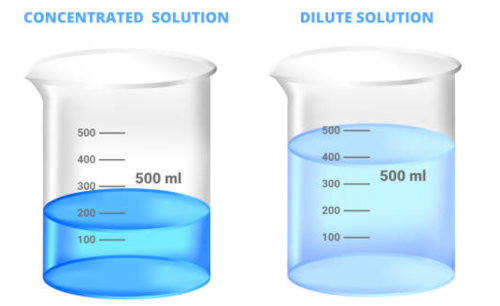
Answer: Untruth is a suppressed truth, because it can be exposed, and together with the efforts made to do so, lies are manifestations of vitality. We distinguish this from truths and only the truths of dead physical nature.
1. Many people are familiar with ri-ddles from the first grades of high school, from algebra and logic cla-sses, which could prove exactly what was said. That was not their purpose, hence the discoveries through questions like these. For example, a traveler comes across an intersection of two roads, only one of which is right for him, and then he comes across two twin brothers about whom he knows only that one always lies and the other always tells the truth. He is allowed to ask only one of them one short question to find out which road is right. What could that question be? (Solutions are on the right line.)
2. I cited another example in an online newspaper and in "Information Stori-es" (Dualism Lies, 2021). The residents of A always tell the truth, the residents of city B always lie, and each resident of city C will alternately tell the truth and a lie. The firefighter on duty received a message from one of these cities by phone: "There's a fire in our city!" one of the residents answered. "Where?" asked the firefighter on duty. "In city C," the same citizen answered him. Whi-ch city should the fire brigade go to?
3. Mathematics uses lies as tools to reach the goal, the truth. We regularly have this in "statements" (mathematical sentences that are either true ⊤ or false ⊥, there is no third), or exceptionally in the "method of contradiction" when the assumed falsehood is brought to the absurd. The manipulator also uses lies (Traits) but not with the aim of reaching reality and truth, but to remain in delusion. This is the supremacy of the vital (which can lie) over the dead physical nature (the truths themselves), which is actually (still widely unknown) at the heart of Gödel's impossibility theorem (Deduction II).
Under the broader meaning of the old term “vitality”, we can now, in a formal new sense, include nature in general, which does not imply that it is a “living being” (biological or perhaps once artificial), since it contains both reality and fiction, the former like a dead physical substance and the latter that gives us more freedom. Even in that sense, such a formal structure would have a limi-ted “consciousness”, like ours, which has no insight into, say, all the actions of erythrocytes, and therefore would have no idea that we, so tiny, exist in such a vast cosmos. This ingredient that brings vitality is at the same time volatile, easily dying out and making nature globally converge towards a greater con-centration of reality. However, the two are always of equal cardinality (see Antimatter).
4. When fantasy is presented to us as the fulfillment of some desires, we will be attracted by its simplification of reality according to the principle of mini-malism. However, over time, its impermanence becomes apparent, and if we built on that poor foundation, we got a house of cards. Reality took other paths; we were deceived. I suppose evolution, by washing away, gave us the people we are today while such failures were failing, and in addition, it gave us disgust for lies as a protection against ruin, as well as disgust for the smells of decay and dangerous germs that we knew nothing about for millennia, just as we are now discovering lies as a possible disease and danger through science.
Truth-O-Meter » srb
Question: If a lie is "semi-informative" and therefore attractive, then how is truth as a law of natural phenomena even more attractive?

Answer: A dead physical being do-es not see, does not care about lies, and does not follow them. This is the evil fate of "manipulators," pl-ayers of the second league (Traits) for whom even deception remains a goal. Falsehood is a substitute for reality for them. Such "evils" (lea-gue I players) will often win or be defeated, because lies are their means to reality.
It is similar with mathematics, wh-ere lies are only means to the targe-ted truth, unlike natural and other sciences, where the goals are concrete phenomena that we know are depende-nt on the observer (Uniqueness). Then there is the analogously repulsive atti-tude of the "good guys" (league III players) towards the "evil guys," as uninfo-rmed against theorems that need an interpreter of mathematics as an interm-ediary. This is how we understand the role of the "manipulator" in the sand-wich between the "evil guys" and the "good guys."
This was a digression on the topic as a help to understand the invisibility of lies by dead physical nature and our fate with it. We are attracted to lies as long as we see in them the truth, or a substitute for reality, a benefit, but they become disgusting to us when they are exposed and become a hindrance. Un-truth has two such extremes in its effect on us that are vital. We communicate with both reality and fiction, and for that we pay the price with our mortality and the easy confusion of reality and illusion. The other, dead physical reality, is indestructible and has no problem with “understanding,” which is not the case in the world of truth and truths themselves. Otherwise, nature is derived from information, none of which can communicate with everyone, nor can their reality not communicate with anything.
So, it is the dead physical creature that is more attracted to truth and lawfu-lness than to “half-information,” because it does not notice the latter at all. This is not quite the same as us vital beings, only one of whose physical parts follows the laws of physics, but there is also another, fictitious part that would rather not follow them, not see them. This theory itself is confusing to us, whi-ch, as far as I know, is still the only one that mathematizes reality and fiction so deeply.
Islands » srb
Question: Did you say, truths are islands that we bridge with lies?

Answer: Yes, but I'm not suggesti-ng that we often rely on deception or lies to navigate social relations-hips, even though we have import-ant truths within us. Forget about the usual meaning of the phrase, to imply the disconnect between trut-hs and the social constructs we in-vent to communicate with others. Let's focus on Gödel's impossibility theorems, or rather, their further formal, logical insight.
1. Axiom systems are like bases of vector spaces. Just as basis vectors span the space of their vectors by filling it with their linear combinations, deductions derived from axioms will complete a theory of their own. They are those "isla-nds" beyond which there is always unknown ground that cannot be reached by land. This is what Gödel's theorems talk about when talking about arithmetic and incompleteness.
Gödel's first theorem states that a consistent system (of truths alone) cannot be complete (truths exist outside of it). The second states that all these syste-ms of axioms and procedures cannot prove their own consistency. So, theories are endless islands whose validity is taken "for granted." And what connects them, let's add, in addition to some other tools of algebra, are the falsehoods that we use in proving validity, or simply extend them with new axioms (or theorems) that do not contradict previously taken ones.
2. This is the discovery of formal infinity, which, due to the (only in this theo-ry) assumed information, entails the infinity of reality. Namely, abstractions are knowable at least for some of us, and the laws of nature as we see them are permanent and true. I further theorize that there are also some actions (pro-ducts of changed energy ΔE and elapsed time Δt) in which such laws are also packaged as information. Due to the quantization of the action (ΔE⋅Δt = h) and unlimited duration (Δt → ∞) said abstractions have no energy (ΔE → 0), but they have an attraction because, I believe, the still slower flow of time attracts. The only difference between this and gravitational attraction is the impossibility of everything communicating with everything else.
3. When we have vector $\vec{u} \ne 0$, multiplying by real numbers (the scalar α ∈ ℝ) we get all the vectors of its direction ($\alpha\vec{u}$). This is the vector space ($\alpha\vec{u} \in X$) of the given direction. If we also have a vector $\vec{v}$ outside that direction, multiplyi-ng it by the scalar (β ∈ ℝ) and adding the vectors of the previous direction to them, we get all the vectors of the plane ($\alpha\vec{u} + \beta\vec{v} \in X^2$). If we have a nonzero vector $\vec{w}$ outside this plane, multiplying it by a scalar (γ ∈ ℝ) and adding the vectors of the previous direction to them, we obtain all the vectors of the space ($\alpha\vec{u} + \beta\vec{v} + \gamma\vec{w} \in X^3$). This property of vectors, that by adding one that does not belong to the given space using linear combinations we obtain the entire wider space, is similar to the extension of a theory given by axioms by new axioms.
This expansion of space with new dimensions is accompanied by a deepening of the theory by adding new axioms. Abstractions of a theory with fewer axio-ms relate to more phenomena, but in a general way. We see this in the case of absolute geometry, which is without the parallelism postulate. It will speak simultaneously about all three geometries—plane, spherical, and hyperbolic—but without details. In the first, the sum of the angles of each triangle is 180°, which opens up a huge area of that "narrow" (Euclidean) geometry that results from such a "restriction." For example, then we have proof that there are only five Platonic solids, which allows us to delve into their peculiarities and inte-resting facts.
4. This observation is all the more intriguing because we usually believe the opposite. It is said that by adding axioms we narrow the topic, and it is consi-dered that we simplify it. In one way this is true. By removing particularities we generalize and make the concept more applicable to more concrete pheno-mena (Variety), but by adding such ones we concretize and ultimately obtain an object that each of the infinitely many subjects (objects of communication of the universe) perceives in a unique way. By adding and removing axioms, we divide otherwise infinite worlds between very global and very specific ph-enomena.
Annihilation » srb
Question: What if we get down to the smallest particles? Are they also the li-mits of some infinity?
Answer: This question is an exten-sion of the previous one (Islands). Bosons are one part of this story, and fermions are the other part, but both give a positive answer to the question.
Some bosons have mass, while ot-hers, such as photons and gluons, do not. The W and Z bosons medi-ating the weak nuclear force are ex-amples of such massive bosons, and in addition to these, the Higgs boson, res-ponsible for giving mass to other particles, has mass. The photon (the carrier of electromagnetism) and the gluon (the carrier of the strong force) are two known bosons that are thought to be massless. In addition, the hypothetical graviton, which is thought to carry gravity, is also expected to be massless.
If we disregard the Weyl equation, then physics today considers that there is no such thing as massless fermions. Fermions are subatomic particles that have mass and follow Fermi-Dirac statistics, have half-integer spin (1/2, 3/2, etc.), and obey the Pauli exclusion principle. They include all quarks, leptons, and composite particles made up of an odd number of them, such as baryons and many atoms and nuclei. Fermions are thus fundamentally distinguished from bosons, which have integer spin (0, 1, 2, ...) and can exist in more than one place at the same time. They obey Bose-Einstein statistics.
In the very small particles world, Heisenberg uncertainty relations ΔE⋅Δt ≥ h play a particularly important role, namely that the product of the uncertainty of energy (ΔE) and the uncertainty of elapsed time (Δt) is of the order of Plan-ck's constant (h). Therefore, in a very short time, a certain amount of energy can jump out of the vacuum and disappear so that we cannot notice it. But we can, but from the positions of different relative observers, where from one we take slower time and from the other greater energy. These phenomena have been measured (fluctuations).
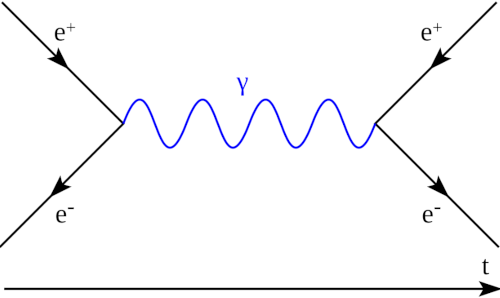
The impermanence of such particles speaks of their unreality and virtuality, but the process that re-establishes them is permanent and real, and "objective coincidence" is what I assume in this information theory. Thus, in the image to the right, an electron and a positron annihilate into a photon and then ag-ain into some previous pair. Moreover, the photon itself is thus annihilated and recreated, but these phenomena are extremely rare. Twice as rare are the phenomena that two passing photons decay and merge in such a way that it looks as if they have collided and bounced off, "impossible" for bosons because they can occupy the same space-time. But even such a rare phenomenon has already been measured (collisions).
The annihilation, separation and merging of the smallest particles tells us that they themselves are not as much reality as the processes in which they partici-pate, and we consider their possibilities to be unlimited. These processes are regulated by the law of conservation of spin, energy or momentum, as well as by the laws of probability, which we then see as a single whole with very dive-rse options. This is a kind of limit of perception, because ultimately these pa-rticles are virtual, and besides, the bottom of this concept is uncertainty.
Reaction » srb
Question: I've always been confused by Newton's law of reaction force, which is equal in intensity and opposite in direction to the action. Can you explain to me how motion is even possible then?
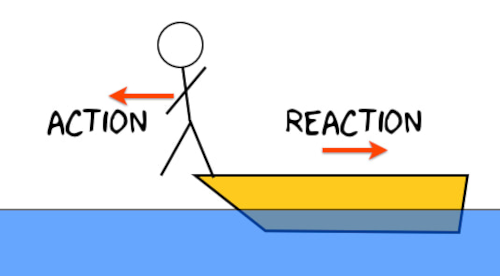
Answer: Newton's third law of mot-ion is often called the law of action and reaction. It states that for every action, there is an equal and oppo-site reaction, meaning that when one object exerts a force on another object, the second object simultane-ously exerts a force back on the first object of equal magnitude and opp-osite direction. I understand that you see the absurdity here; if two objects push each other equally, then they do not move. I will now give you an explanation that I believe you have not had the opportunity to hear.
1. When an object moves, it takes energy from its surroundings and its previo-us state of rest (S), and by changing time it gains force for further movement in a new system (S'). The relativity of the movement of two systems (S and S') gives the difference in the speed of the flow of time and the perception of ene-rgy, the slower flow as well as the increased energy of "the other", which is why the other has greater energy and therefore greater pushing force. Both push equally, each from their own point of view, but looking more broadly, they eventually push each other away and move away.
2. This applies equally to the smallest packages of information carriers, quanta (ΔE⋅Δt = h), which are products of the change in energy (ΔE) over time (Δt), and which, due to Planck's constant (h) which does not change in their excha-nges, produce an unusual effect. Namely, when time slows down, then the ti-me intervals grow and the energy decreases. The transfer Doppler effect with redshift supports this.
Because of the slowed time, the information sent or received is more attractive and with less energy than the one that will end up in the exchange. This illusi-on of perception facilitates communication, but we take the total energy of the exchange as the undiminished one. If it were not so, there would be much less communication, certainly reduced by the principle of minimalism.
3. Now we understand interference in another way. The tendency for waves that can interfere to stick together is attracted by the same relativity with wh-ich I explain the reaction to action here. We again have the damping of the co-mbined waves, but this time it is due to the reduced energies of the compone-nts and precisely because of the attraction by the mutual slowing down of ti-me. I explained this in terms of internal information that grows by combining, and this is just a supplement to that same explanation.
4. Bodies with mass are even deeper in this story. They push their information inward (In and Out), hiding part of the accumulated multitude of options from the current reality in pseudo-realities. Thus, parts of the body belong both to the past (until light reaches the end), and some also to parallel pseudo-strea-ms of time (Dimensions). Hence the increase in "inertial mass," at least as far as this theory is concerned. Internal forces bind the parts of the body, which hinders composition, and their whole itself is less free, hence less informative, less uncertain, and therefore more attractive to other bodies.
Graviton » srb
Question: Did you say (Reaction, 4) that the internal connections of bodies can reduce their external freedoms so they are attractive to other bodies?
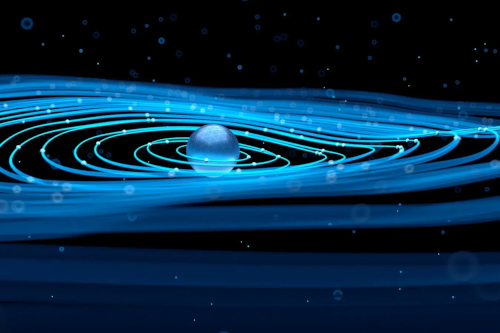
Answer: Yes, that is an observation of this information theory and, for now, it only makes sense in it, that is, it is the only place where we ha-ve the principle of minimalism of information.
Descriptively, just as a citizen sur-renders part of his freedom to the state for perhaps a layer of his sec-urity, so too does an electron in an atom surrender its freedoms for so-me distant efficiencies. Such concerns also affect the accessibility of atoms, so the mass in general, with the force of gravity. Electrons combined with proto-ns in atoms are less electrically negative towards their surroundings, but these associations offer new possibilities. As citizens in teamwork.
Gravitons are hypothetical elementary particles that are thought to mediate the force of gravity in quantum field theory. The graviton is assumed to be a massless particle of spin 2 because gravity is described by general relativity in terms of second-order tensors, due to the space-time metric. Furthermore, due to the spin conservation law, gravitons do not interact with electrons th-emselves, particles of spin $\frac12$, but instead produce particles of spin $2\pm\frac12$.
Particles with spin 3/2 are fermions and may include the gravitino, a hypot-hetical particle from supergravity theories, or the delta baryon (Δ), or some even less well-known one. The two particles mentioned are not part of the Standard Model but are predicted in extensions such as supergravity. This is all if the assumed graviton transmits gravitational action analogously to a photon of spin 1 that transmits electromagnetic force to an electron and a proton of spin \(\frac{1}{2}\). However, these details about the mode of action of the gravitational force are actually irrelevant to the principle of attraction, the spontaneous flow of states into less informative, toward less communication, or less action.
The role of gravitons could be quite different also, along with the effect on the environment of particles described by the addition of spins, indicating to them where the slower flow of time comes from. Mass particles and the environme-nts they create and in which they are located slow down the flow of time. This is known in relativity, but here let's put the emphasis on the aforementioned lack of information of such particles and therefore on the lack of external ev-ents, and hence on the slower flow of time. Such particles travel more slowly into the future compared to the further surrounding vacuum.
Because of its mass, a point is slower in time than a place where it is, and the space further from the center is gravitationally moving away from it even fas-ter in time than if this mass were not there, and the space closer to the center, with stronger gravity, catches up with it. The situation then repeats itself, and that small mass approaches even closer or remains trapped by centrifugal fo-rce, orbiting empty space around the center of that larger mass. If such parti-cles approach the center, then they do not fall, but the larger mass catches up with them and hits them (Gravity II). Gravitons propagate in a spherical wave around the centers of mass and define these changes in the speed of time with decreasing amplitude.
Centrifugal » srb
Question: Why do satellites stay in orbit, does it have to do with maintaining averages?
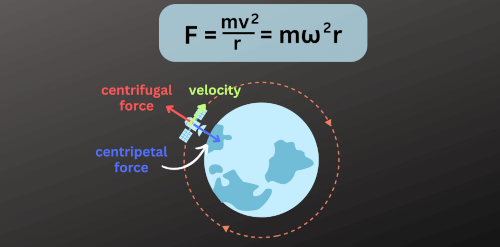
Answer: You have already announ-ced the answer in the question. Mi-nimalism emphasizes above all ma-intaining the optimum and, when possible, descending to smaller co-mmunication. This is the idea of the variations calculus, which can be used to derive Einstein's (1916) long-known equations of general relativity without using his principles. I'll try to explain those formulas again, hopefully a little better now.
1. From the point of view of relativistic time dilation at a distance r from the center of the planet where the satellite rotates, due to the tangential velocity of rotation whose square is v² = gr, where g = GM/r is the gravitational acceler-ation at this height, G is the gravitational constant, and M is the mass of the planet and c is the speed of light, is:
$$ \Delta t_1 = \frac{\Delta t_0}{\sqrt{1 - \frac{v^2}{c^2}}} \approx \Delta t_0 \left(1 + \frac12\frac{GM}{rc^2}\right), $$where Δt1 is the time interval observed by a relative observer at rest, which the orbiting observer measures by its own (proper time) duration Δt0. This is a ca-lculation that neglects the effect of gravity on the slowing down of time, which is:
$$ \Delta t_2 = \frac{\Delta t_0}{\sqrt{1 - \frac{2GM}{rc^2}}} \approx \Delta t_0 \left(1 + \frac{GM}{rc^2}\right), $$where Δt0 is the proper time of the now stationary point in the field in orbit, and Δt2 is the relative time of that point of the observer at rest outside the fi-eld. It is clearly seen that the gravitational increment of time dilation of the point in the field is twice as large as the increment due to tangential velocity to the rotation itself without gravity. The slower flow of time pulls on itself, so the satellite deviates from a straight line to a circular path. The repulsive ce-ntrifugal force is in equilibrium with the attractive gravitational force.
2. An infinitesimal distance dℓ is traveled at a speed v in a time dt. By these, define the increment of the square of the action (ds)² = (dℓ)² - (dct)². Then all points on the path of light have zero action. This also comes from Ei-nstein's (1905) special theory of relativity, which describes how light, by its motion, defines simultaneous events. Each (v < c) smaller speed than light (dℓ/dt < c) determines a larger absolute action on space-time:
$$ ds^2 = d\ell^2 - c^2dt^2 = -(c^2 - v^2)dt^2 = -\left(1 - \frac{v^2}{c^2}\right)c^2dt^2, $$so putting dt0 for the specific time of one moving at speed v is ds² = -c²dt0², because for such a case v = 0. Again, the above expression gives:
$$ dt = \frac{dt_0}{\sqrt{1 - \frac{v^2}{c^2}}} = \gamma\ dt_0, $$and this is relativistic time dilation. Relative time dt slows down compared to its own (proper) dt0 with an increase in the coefficient γ = √(1 - v²/c²), which we name after Lorentz, who speculated with these options before Einstein.
The minus sign in front of the square of such a 4-dimension action (three spa-tial and one time dimension) says that the path traveled by light is imaginary, that the fourth coordinate is dτ = icdt, where for the square of the imaginary unit i the equality i² = -1 holds. Hence my idea to take into account bypasses in additional dimensions of time. On the other hand, hence the space-time in-terval has long been written ds² = dℓ + dτ², just like the Pythagorean theorem.
3. The Schwarzschild solution of Einstein's general equations is a metric in sp-herical coordinates:
$$ ds^2 = \frac{dr^2}{1 - \frac{r_s}{r}} + r^2d\Omega^2 - \left(1-\frac{r_s}{r}\right)c^2dt^2, $$where rs = 2GM/c² is the so-called Schwarzschild radius (within which the bl-ack hole is), and dΩ² = sin²θ dφ² + dθ² defines spherical circles without leng-th contractions unlike radial displacement dr. When the mass M = 0 then we have rs = 0 which is a flat metric in spherical coordinates with literally zero action ds = 0 along the path of light. So, for a point at rest (then dℓ = 0) we find:
$$ dt = \frac{dt_0}{\sqrt{1 - \frac{r_s}{r}}} $$where dt is the relative time of the proper dt0 of that point. This relative obs-ervation is outside the gravitational field, which implies that all points at rest around a mass M experience a greater deceleration of that time the closer they are to its center. If they are moving, then this deceleration is even greater, and, since the slow flow of time attracts, movements in a gravitational field are spo-ntaneous.
4. A more tightly packed mass is more organized and more certain inside, and the inevitable question is how much this affects its external information (In and Out). We know that the gravitational force, $F = GMm/r^2$ with m mass of a smaller body, and that it does not depend on the "tightness" of its masses. This may seem to us as if its internal information is not sufficiently reflected in the external one, except that more of one means more of the other, and besid-es that, a denser body is smaller and further from the same points outside, yet with the same gravitational influence (it turns out that the denser one throws further).
4a. A substance near absolute zero appears in a solid or liquid state at the low-est energy, often exhibiting exotic properties such as superfluidity and super-conductivity; it is not stationary and "frozen." For example, helium remains a superfluid liquid at ordinary pressure, while other elements solidify into spe-cific crystalline structures, and the particles still retain a minimal amount of zero-point energy and are not completely immobile.
4b. When the Sun “burns out” in about 5 billion years, it will expand into a red giant, engulfing the inner planets, and then collapse into a small, hot, dark white dwarf. Then, it will slowly cool and fade, eventually becoming a cold, dark dwarf. There are many dwarfs in the universe that are described as small in size but also huge in mass. They have such gravity on their surface that their largest mountain is less than a millimeter high. However, their particles are in constant motion because there is no viscosity of that heavy mixture and no friction. These “dwarf” stars seem to compensate for the loss of freedom due to the enormous compression by the chaotic movement of their particles.
4c. Black holes are regions in space where matter is so incredibly dense that their gravitational pull is immense, preventing anything, including light, from escaping. They result from gravity so strong that it compresses all mass into an extremely small space, creating a boundary called an event horizon from which nothing can escape. Although they are invisible, black holes can be detected by their interactions with the matter and stars around them. They come in different sizes, such as stellar-mass black holes and supermassive black holes.
5. Greater curvature of space occurs with greater time dilation, and this su-pports the idea that information is the cause of gravity, and then that these satellite deflections, from the question posed, are also manifestations of the principle of minimalism. The satellite constantly returns to orbit from its tangential directions, because it does not want to change the optimum of communication (action), which is then some average value (between two, stronger closer and weaker farther away, attractive gravitational forces).
Must do lie » srb
Question: Living beings are a blend of reality and fiction, you say, so is the un-iverse also a "living being" since it certainly contains both?

Answer: You could explore that qu-estion elsewhere, because somehow the topic it opens up is too difficult for me. However, I do have some specific opinions on it that might be interesting.
1. Let's start with some of my insig-hts into the otherwise widely kno-wn but previously poorly underst-ood two of Gödel's incompleteness theorems. I have already exploited the first so many times that I need only mention it here (Deduction II). It says that a consistent (which has only truths) logical system cannot be complete (it always has truths outside). The second says that no logical system can prove itself. The second is more interesting to us now because of the "equality" of truths and lies that (in my interpretation) it talks about.
The logical system that Gödel meant was arithmetic, but it could obviously be other sets of independent statements (either true ⊤ or false ⊥ statements, wi-thout a third). When these statements are simple and easy to distinguish, we call them axioms, and they form an independent set when they do not contr-adict each other by deduction, and the theory is incomplete without one of them. Then we can replace them with their negations and each time obtain a "true" theory, always different.
2. For example, lines are parallel if they lie in the same plane and have no co-mmon points. This is a definition, not a statement, and it does not assert som-ething that can be either true or false. However, the assertion is that through a given point outside a given line, one and only one line parallel to the given line can be drawn, and it is the so-called fifth postulate of Euclid, which together with the others determines his, i.e. plane geometry. The sum of the angles of every triangle of the Euclidean plane is 180°, and the ratio of the circumferen-ce to the diameter of a circle is the irrational number π = 3.14159... . There is no doubt that plane geometry is correct, because countless attempts to find some inconsistency in it have been unsuccessful for a couple of thousand years.
Gauss (1777–1855, German mathematician) was a pioneer of non-Euclidean geometry, but he did not publish his ideas, considering them controversial until he found more complete evidence. He also surveyed land to check the sum of the angles of a triangle. At that time, the question was whether the Fifth Postulate was an axiom, independent of the others, or a theorem that should be derived from the previous ones. Namely, this sentence of Euclid is striking in its length.
The same question troubled Lobachevsky (1792-1856, Russian mathematici-an), and he found an answer to it in a very interesting way. He reversed the Postulate in it, contradicting it: through a given point outside a given line, at least two different lines parallel to the given line can be drawn. He kept all the others and spent years looking for a contradiction. The idea was that if it could be found, then Euclid's fifth postulate could be derived from the rest of his geometry, and it was not needed. But he got a hyperbolic geometry, of saddle surfaces, for which he even found proof that it was as accurate as the flat Euclidean one. He found models of the first in the second and the second in the first, thereby proving the (non)contradiction of the first if and only if the second is also such.
Moreover, Gauss's student Riemann developed tensor calculus and found an expression for Gaussian curvature by noting that the sphere is the surface on which the greatest circles are "lines" for which it is stated: through a given point outside a given line we cannot draw two parallel lines. In fact, parallel lines do not exist on a sphere at all, which makes the above definition of para-llelism there meaningless. These three examples of the distortion of the Fifth Postulate teach us that lies are not some universal untruth. In one reality, Euclidean truth is valid, but in another it is a lie. We have already seen this with Einstein's (1916) discovery of the general theory of relativity, where gravity curves space-time.
3. The algebra of logic knows only those lies that are the negations of truth and only such truths that are the negations of lies (¬⊤ = ⊥ and ¬⊥ = ⊤ ), and there is no third. Although this is logic in the narrow sense, all polyvalents are redu-ced to it, and it is a good basis. On the other hand, if we prove that something is false in physics, such will not happen, so we can say that nature adheres to its truths and only the truth. Our reality is thus like an island surrounded by a sea of lies that we can only leave by using these lies to perhaps reach some ot-her such island. This is exactly what mathematics does using ⊤ and ⊥, or the method of contradiction. It must also use lies to reach the truth, and these procedures themselves follow the traces of the true in the false.
Physical nature is a prisoner of truths themselves. It is correct (it knows only truths) and therefore incomplete (there are other realities). I further derive this from Gödel's first incompleteness theorem. When we thereby discover realities other than the current one, we should not confuse them with addi-tional dimensions of time. The universe is a far more complex concept to which we are now discovering even further layers of content than simple pa-rallel realities. These further, third realities are of different physical laws, di-fferent "truths" that we could say are lies, but even such have their own par-allel realities. All parallel realities of one current reality are equally correct, because they are only the consequences of different outcomes of given possibilities.
4. Living beings are combinations of reality and fiction, but they are not the only such combinations. The very question suggests that the universe does not have to be a living being, even though it contains both. Because of this doubt, I use the term “vitality” for that part of the fictions of a living being that is surp-lus to its physical substance. It bridges the islands of truth, analogous to reali-ty, by having perceptions (abstract thought) about those there. The universe, however, does not have to have such perceptions (our ability to think like us) when it already possesses them as “reality”. Even if it were more than that, it would not have awareness of its creatures, nor anything close to what we have (certainly negligible) about our own erythrocytes, liver cells, and the like, or convenient metabolisms.
What follows from this interpretation of the universe is the necessity of untru-ths along with truths. Roughly speaking, truths correspond to a reality that is both enduring and observable, unlike untruths that give us options. Nature, in which chance is an objective phenomenon, contains both in the same package. Literally, then, untruths are just kinds of truths in alternative realities, and conversely, in some such, truths are untruths in ours.
Streams » srb
Question: What is the benefit of lying, and what is the harm?
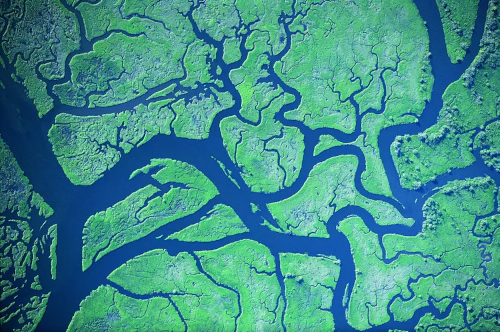
Answer: I can only talk about lying in general terms, like the previous answer (Must do lie), or a little mo-re relaxed like some previous answ-ers. First of all, a lie, or rather a de-ception, is a departure from the cu-rrent or possible reality and there-fore leads to failure in the long run, but it is attractive because of the lo-wer information density it contains.
In line with this is the classification of characters of personalities that I made based on their (un)success in life according to the "game theory" of this information theory. Thus, leaders, charismatic and generally people who need popularity will, sooner or later, have to use this attractive trait of lies despite the risk of being recognized as liars and becoming corrupted by the audience. Hence, I call people of such a category "manipulators", otherwise from the II league in competitions. Below them are the "good guys" (III league) who imitate still nature, above are the "evil guys" (I league) who also use lies but only for the purpose of achieving the ultimate truth, that is, to reach reality. The game of the higher league regularly wins the game of the lower league, in simulations.
We are living beings, and we are a combination of truth (physical reality) and lies (fiction). We are not given to follow only one of these two extremes, but si-nce a half-truth is a lie, we are constantly in a kind of haze towards truths. De-aling with pure truths, such as mathematical theorems, is not an ability of a huge number of living beings. Various forms of “lying”, or more broadly, dece-ption, are very widespread among living beings, from simple camouflage and simulated injuries in animals to complex social manipulations in humans. Al-though not always conscious in the human sense, deceptive behaviors such as mimicry, concealment, and strategic signaling are useful for survival and so-cial interaction throughout the animal kingdom and are a natural part of the environment for many species.
We have seen why we like lies when they are not exposed, because they do not have the sharpness and weight of saturated information (nature spontaneous-ly goes towards uninformed, more probable states), but why do we not like th-em when they are exposed? Simply put, because deceptions are generally uns-uccessful in the long run. That is why excessive deceivers as a biological speci-es died out more easily than weaker deceivers during evolution, and a legacy remained in us, such as disgust for lies, similar to the rot that (only in the 20th century were microbes discovered) contains diseases and leads to ruin. Things are actually a little more complicated due to local divergence and global con-vergence (Approaching), like rivers that can flow towards the same, but also different seas.
Dogma » srb
Question: What can you say about the concept of "sleep, eat, pray"?
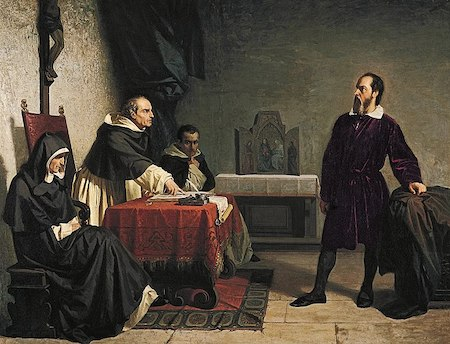
Answer: I assume you are thinking of religions in general, or more bro-adly of dogmas, and I could just as easily discuss this, in a non-specif-ic, theoretical, and abstract way.
A dogma is a principle, set of princ-iples, or teaching that an authority has established as an indisputable truth. Many well-known theories, from religious to mathematical, fit this description. The notion that the universe is a "living being" wo-uld also fit this description, in acc-ordance with Gödel's second incompleteness theorem (Must do lie), which states that a consistent theory is inherently unprovable.
1. My domain is the algebra of logic, which has the form that every lie is a gro-up of axioms in which that lie is true. Namely, since the negation of a lie is tr-ue, by turning the statements of some of the given axioms into opposite state-ments, by changing them into their negations, we can always obtain such a gr-oup, a theory, or a system that is consistent. How to fit all these dogmas into one concept of illusions, which is my theory of information, is the million-do-llar question. However, here are some suggestions.
2. By mapping “true” to “false” and vice versa within the statements of the al-gebra of logic, some tautologies (always true) will be contradictions (always fa-lse) and vice versa, but we see the equal cardinality (number of elements) of truths and lies in the universe. We obtain a stronger finding of the same simi-larly, with the negations of each statement. Then, by understanding that every lie in this reality is truth in some other, we realize that the being of the univer-se does not have lies (fictions) and also that there are many of them. In such a way, the universe is a “living being,” and at the same time, it is not. Thus we are still in mathematics where, for example, the empty set and the whole of space are equally open and closed. Also, with the zero vector perpendicular to every vector and at the same time parallel to every vector. That is one way.
3. Louis de Broglie proposed in 1923 that all matter consists of waves, primari-ly referring to the particles of quantum mechanics. Schrödinger (1926) formu-lated this idea in the form of a second-order wave differential equation:
$$ i\hbar\frac{\partial}{\partial t}\psi = \hat{H}\psi $$where i is an imaginary unit, ℏ is the reduced Planck constant, ψ is the wave function of the quantum system, and $\hat{H}$ is the Hamiltonian operator (the sum of the kinetic and potential energies of the given system). The solutions to this wave equation have been consistently confirmed in various experiments in qu-antum mechanics, first to the surprise of the then connoisseurs of science, and then to the astonishment of all other interested parties. They are so far the be-st confirmation of De Broglie's idea. A step further, they are also the basis of the idea that all matter is a kind of superposition of waves, given that it is a collection of quantum particles.
Therefore, historical processes also have a certain "periodicity" (more complex phenomena have a lower chance of being repeated exactly), and similarly, the replacement of dogmas occurs. For example, despite today's pro-Western co-mmunities that see well-being through comfort through money, power, and material goods in general, they will be replaced by religious communities bec-ause they are sterile. The dogma of scientific atheistic efficiency will melt away next to the dogma of spiritual religious peace, simply because of the biological superiority of the second, due to their significantly higher birth rate. Existing scientific and technical achievements will not necessarily be destroyed; for example, artificial intelligence can be declared "sacred intelligence" or "divine revelation," a type of reincarnation through then incomprehensible software-hardware phenomena, or the like.
4. A dogma that lasts is reality because it already has perceptibility, as well as (established) truth. Therefore, it is not a "lie" that can just disappear. The fate of manipulation, deception or untruth, and one could even say their definiti-on, is that they do not last. Those who gain popularity by avoiding the truth sacrifice the future for the present, that is, they are middle-league players ac-cording to my classification (Traits). The beliefs of such people, let's say their reach, remain at the level of dogmas that do not last.
Stretch » srb
Question: What about the amplitude of changing dogmas given the “global co-nvergence”?
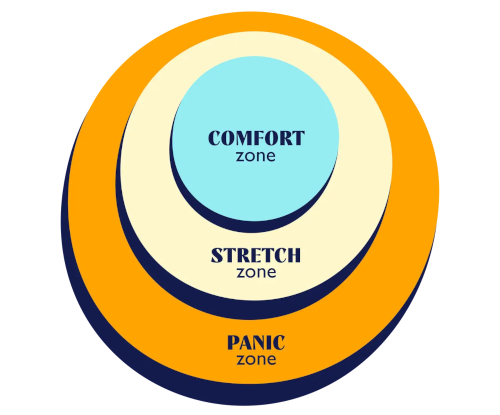
Answer: That is a good question, and it leads us to a very useful ob-servation, at least as far as the style of this theory is concerned. The ex-tremes of local dispersions are bro-ught closer together by global conv-ergence, and the amplitudes of the phenomena in succession become smaller, and therefore their oscilla-tions become less and less informa-tive. Development is otherwise inc-lined to less uncertain states, and this result is expected from previ-ous (my) theories of information, but not beyond it.
1. For example, the replacement of dogmas from the previous answer over ti-me will be in the decreasing differences between the "religious" and "scienti-fic" concepts at the time of their greatest dominance. This is not about the sc-ientific-mathematical and any true concept of religion per se. Neither is there an ultimate proof of the accuracy of mathematics itself, nor some other dogma than it. Again, in the case of a real dogma (periodically permanent) there is no ultimate refutation. Generally speaking, it is not possible to prove the existen-ce or non-existence of God with mathematics. Here we are talking, say, about the average smaller condemnation of sinners like Giordano Bruno in the futu-re dominance of religion or smaller raptures with scientific discoveries during the time of atheism.
2. Uniqueness is one of the fundamental discoveries of this theory. There are no (quite) identical states or processes in the entire universe! Hence, we reco-gnize the necessity of change, both of everything that "does not change" (stat-es) and of everything that changes them (processes). Positions change and ch-ange over time. So, if we want change, we spend time, but what we then perc-eive is a representation of a different pace for different relative points of view. According to the theory of relativity, this is not an increasingly lively phenom-enon with increasing speed of movement, because the speed of time flow with greater relative speed is lower.
Because of the same, the system that is approaching us comes from the future, for time moves more slowly and events are in our present only with the disap-pearance of distance, so on this model we can observe the above. Only if the amplitudes are transverse, perpendicular to the direction of movement (like light), are they increasing the closer the object is to us, i.e. those in the further future are decreasing. In this case, the longitudinal values are constant and shortened. Amplitudes that are longitudinal (the same as sound) are constant, as are the wavelengths. This is a model whose other details we will not look into, but it suggests that we can consider these periods of succession of histo-rical phenomena as constant.
3. A slightly different example is the virtual photon that spreads around, say, an electron until it eventually interacts with some charged particle. Unlike the current explanation of physics, in (my) information theory this is a "virtual sp-here" of photons that spreads with the center in the electron whose amplitud-es are like a "blink", or alternating light and dark effect with an ever-decreasi-ng range of light intensity, but constant wavelengths. In an eventual interacti-on, the amplitude defines its probability, and the wavelength its the moment-um that is then transmitted (Feynman diagram, p. 18, Space-Time, 2017).
4. Examples of dogmas outside of religion and mathematics include political ideologies such as totalitarianism, where the tenets are unquestionable; pse-udoskepticism, where a skeptical stance is dogmatically maintained; and spe-cific social movements or ideologies that have unquestionably true positions, such as the belief that the Earth is flat or aspects of market fundamentalism. I divide these into "enduring dogmas" that are true, observable, and sustainab-le, thus real phenomena, and others that are fictions. Thus, a "false constructi-on" is not one that cannot be proven, but one that is not contradictory, hence one that cannot be challenged.
If this does not seem like a clear novelty to you, then note that it singles out the “false construction” by means of unsustainability. A sustainable concept, which lasts and lasts and eventually alternates with some other phenomena, is “a true construction”, and that is all. The amplitudes of replacing the basic su-stainable dogma with others throughout history become smaller and smaller due to global convergence, and this is the essence of this theory where “reality” is not some absolute, but the phenomenon closest to such from those offered in nature. Convergence and in the eventual replacement with fictions, we learn that even the most accurate dogmas are ultimately a kind of deception.
Concept » srb
Question: You have an unusual interpretation of lies and truth. Can you expla-in them to me?

Answer: A consistent, mathematic-al theory, therefore one that is “ab-solutely” correct, cannot actually be proven with it (Must do lie). This is stated by Gödel's second theorem. Hence, every consistent dogma is “true”, for example, like arithmetic. So a “lie” is that and only that whi-ch contradicts the concept where we test it.
Physical reality does not lie, becau-se what we would prove would not happen will not happen, so the “truth” is the equivalent of the actual physical reality. Other constellations of axioms wi-ll give other “realities” whose “truths” do not have to be ours. This should be distinguished from the parallel times of these truths, the additional dimensio-ns of time that are merely variations of given possibilities.
1. The simulations I made using this recipe are interesting. Thus, a concept is like a group of independent axioms, therefore non-contradictory, which there-fore gives a correct theory. And in these computer games, processes are, say, like a network of roads that one travels between two given places. At intersec-tions, one can choose to continue (sometimes in a random way, and even with different probabilities of outcome) and often reach the goal, unless we get lost in a dead end and have to go back a few intersections (if that's possible). One-way roads are especially interesting, as implications (if ..., then ...).
2. Once you start, it becomes easier to build such networks. Let vehicles pass through them, say at least a thousand times, and record the streets they would pass through. The densest passages will be the main flows (events), and the representations you work with will increasingly resemble stochastic processes. They almost always have favorite routes that you will recognize in these proce-sses as their characteristic values (scalars and associated vectors). In this way, you also get the game of "local divergence and global convergence" (Just-In-Time), which applies to almost all processes, not just stochastic ones.
3. However, there are also such blind alleys where vehicles will pile up, with only a few managing to get to the right path. Detours are analogous to the use of lies to reach the truth (in mathematics when we use the method of contradi-ction, or in general statements that are also incorrect), and dead ends are ana-logous to the "sand tower" that we build with lies when we give up the race for reality. The competitor who gives up on truths more easily, who is less able to cope with current reality, will lose. That is why the "good guys" (Traits) are in the lowest league. They are easy prey for "manipulators" who know how to get stuck in lies and then suffer. That is why such people regularly lose to the "evil guys" who also pursue lies, but only the truth, that is, reaching reality, is their goal.
4. I can't explain this new thing about truths and lies any better. What can I add? Read my previous texts that explain this issue a little more precisely, and build the models mentioned until everything becomes clear to you at some po-int. Lies are not part of the current reality, and indulging in them underestim-ates the power of reality, which is the only indestructible force in the given en-vironment.
Concept II » srb
Question: Can you give me an example of a "road network" so that I can better understand the interpretation of lies and truth?
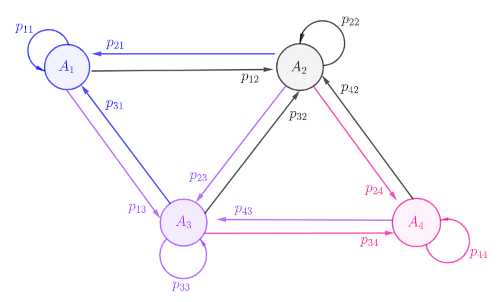
Answer: The image on the right sh-ows a simple road network suitable for the previous answer (Concept). The vehicle we count as arriving at intersection A1 could have just tur-ned around there with probability p11, could have come from interse-ction A2 with probability p21, or fr-om intersection A3 with probability p31, so p11 + p21 + p31 = 1, where all probabilities are non-negative numbers. In general, intersection Aj receives a vehicle from intersection Ai with probability pij, where i, j ∈ {1, 2, 3, 4}.
If $\vec{x}$ = (x1, x2, x3, x4)⊤ the vehicle probabilities of the intersection (A1, A2, A3, A4) in the previous states, and $\vec{y}$ = (y1, y2, y3, y4)⊤ the probabilities in the ne-xt, then $\hat{A}\vec{x} = \vec{y}$, or in detail:
$$ \begin{pmatrix} p_{11} & p_{12} & p_{13} & 0 \\ p_{21} & p_{22} & p_{23} & p_{24} \\ p_{31} & p_{32} & p_{33} & p_{34} \\ 0 & p_{42} & p_{43} & p_{44} \end{pmatrix} \begin{pmatrix} x_1 \\ x_2 \\ x_3 \\ x_4 \end{pmatrix} = \begin{pmatrix} y_1 \\ y_2 \\ y_3 \\ y_4 \end{pmatrix}. $$This $\hat{A}$ is a stochastic column matrix, as opposed to (often in the literature) a stochastic matrix of rows (Chains). Such matrices are interpretations of proc-esses whose coefficients can be different numbers, say, parts of a vehicle, or even complex ones, and in general we call them scalars (Vectors).
When matrices are adjoint (equal to their conjugate-transpose) they will have real (λ ∈ ℝ) eigenvalues ($\hat{A}\vec{v} = \lambda\vec{v}$), as follows:
$$ \begin{pmatrix} 0 & 0.5 & 0.5 & 0 \\ 0.5 & 0.1 & 0.2 & 0.2 \\ 0.5 & 0.2 & 0.2 & 0.1 \\ 0 & 0.2 & 0.1 & 0.7 \end{pmatrix} \begin{pmatrix} 0.25 \\ 0.25 \\ 0.25 \\ 0.25 \end{pmatrix} = \begin{pmatrix} 0.25 \\ 0.25 \\ 0.25 \\ 0.25 \end{pmatrix}. $$The largest eigenvalue of a stochastic matrix is always λ1 = 1, and its eigenvect-or $\vec{v}_1$ is always of the type of probability distribution such that $\hat{A}\vec{v}_1 = \vec{v}_1$ whi-ch we have in the equation shown. The other eigenvalues here are λ2 ≈ 0.63, then λ3 ≈ -0.56 and λ4 ≈ -0.57 of the corresponding eigenvectors which we would denote by $\vec{v}_2$, $\vec{v}_3$ and $\vec{v}_4$ in that order. The eigenvector of a stochastic matrix does not necessarily have constant coefficients, as in this example $\vec{v}_1$ = (0.25; 0.25; 0.25; 0.25)⊤ which tells us about an intersection that ultimately yields a uniform distribution of vehicles.
Going from A1 to A4 is less likely (p13 + p34 = 0.5 + 0.1) via A2 than via A3 (p12 + p24 = 0.5 + 0.2) but in the latter case there is also a delay due to the turn (p22 < p33) which exactly compensates for the differences. There is no diffe-rence in the "falsity" (or truthfulness) of the process by paths A2 and A3.
Abating » srb
Question: In the "roads" model, a longer tour represents a bigger "lie"?
Answer: That's right. First of all, because the perceptions of the world of each subject are unique, which means that each of them has a "false" image for all the others. This dispels the myth of a possible "absolute" truth about the world around us.
Secondly, physical still life follows the principle of least action, and this involves the shortest lengths for the least time spent. Anything that abandons this principle is wandering, a waste of time, and ultimately it is an abandonment of reality. That is why deceptions are houses of cards, because in this constellation of values I define “lie” as “truth” that does not last, in “reality” that is observable, permanent and true phenomenon. The excess freedom we gain through vitality, by incorporating fantasies into physical realities, we abandon unlimited durations for the sake of the power to sometimes go beyond the paths of least action. We can lie in quantities that are not given to bare physical substance.
The current reality has the objectivity of chance and therefore its options alo-ng all realizations. They, like the outcome of a coin toss, lead by chance to “pa-rallel dimensions” of time that we distinguish from “false” realities. The latter would not only give a significantly different picture of the world we see, but would also show it as contradictory to ours. Formally, they would be worlds of extreme lies. I know that many people find this representation of reality (whi-ch seems clear to us, but in fact is not) strange to the point of being unaccepta-ble, but I believe that in time many will wonder at our current wonder and see it as a long-overcome, primitive view of the world.
In this (my) information theory, it is implied that a particle, if it is smaller, can more often, but with a very low probability, jump out of the current reality and thus appear in this one (Bypass). Jumping through contradictory realities is also extremely rarely possible. These are the findings that have kept this theo-ry private for a long time. What keeps this world within the framework of cur-rent reality is the principle of minimalism, choosing more likely outcomes, or less informative ones, more often. That is also the domain of this theory, no matter how "obvious" it may seem to have been known before.
We sometimes fall behind to catch up, for a better bounce, to rest and make up for the loss, and not every fall behind promises a loss of the race, but every loss of the race was accompanied by some fall behind. It's just that, statistica-lly, in the "roads" model, a longer detour can represent a bigger "lie" for us.
|
|
|