|
|
|


Relativistic II » srb
Question: I have two questions. Why is Newton's equation (Relativistic, 7) a straight line and not an ellipse, and finally why does light refract?
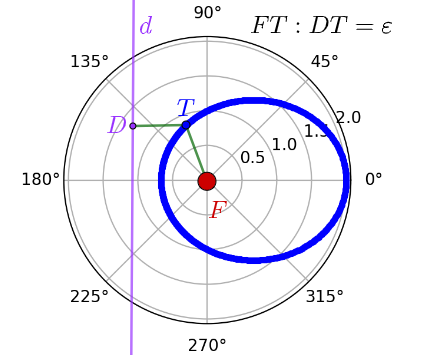
Answer: You are referring to the equation of the path of light, not some massless particle. By the way, the ellipse, in the image on the right, has a polar equation:
\[ r = \frac{\varepsilon\cdot p}{1 - \varepsilon\cdot\cos\theta}, \]where p = Fd = 2 and ε = 0.5. The focus is F, the point D is on the directrix d, and T is on the ellipse. When ε < 1 the graph is an ellipse; when ε = 1 the graph would be a parabola; with ε > 1 a hyperbola.
1. The link states the substitution u = 1/r. Taking the derivatives, we find:
\[ \frac{d^2u}{d\theta^2} + u = \frac{1}{\varepsilon p}. \]This is a second-order differential equation for the paths of massive particles in a Newtonian field. It is obviously different from the one given there, where the right-hand side is zero and which refers to straight lines, the paths of light.
When the eccentricity of the ellipse tends to unity and the distance of the focus from the directrix increases, ε → 1 and p → ∞, then the major semi-axis of the ellipse increases relative to the minor and the ellipse becomes flat, that is, a long broken line and finally a straight line. It then also goes through the pha-ses of refraction of light by the gravity of the mass M with the center at the focus F. On the contrary, when ε⋅p → a > 0, where ε → 0, then r → a = const. and the graph tends to a circle of diameter 2a.
2. In the case of Einstein's gravity, the equation for light was:
\[ \frac{d^2u}{du^2} + u = \frac{1}{\varepsilon p}u^2, \]with 1/εp = 3GM/c² and u² = 1/r². At large distances, r → ∞, when it resem-bles a flat ellipse (ε → 1 and p → ∞) and gradually becomes a straight line, it corresponds to the path of light in a Newtonian field. At closer distances of the charge (T) from the center of the field (F), the solutions of this differential eq-uation are not ellipses, and, since they are not conics, it is no longer a field of constant central force with constant speeds (c, of light) of propagation of the action through the field.
Such a field refracts light, and, for example, at smaller distances we would ha-ve precession. However, here in particular we have the gravitational constant G = 6.674×10⁻¹¹ m3⋅kg-1⋅s-2, then the mass of the Sun M = 1.988×1030 kg and the speed of light c = 2.998×10⁸ m⋅s-1, so 3GM/c² ≈ 4.429×10³. The radius of the Sun is r = 6.963×10⁶ m, hence u² = 1/r² = 2.063×10⁻¹⁴ and the right-hand side of the above equation, from the surface of the Sun onwards, will be values less than (3GM/c²)⋅u² = 9.134⋅10-11. So, the light ray is too far away and has no chance of entering the Sun's orbit and precession.
3. So much for the first question, what can be said about the difference betwe-en the old and new theories of gravity. The second question is why light “fina-lly” refracts, which I understand as a search for an “informatics” cause in this otherwise rarely well-researched phenomenon. Not only physics, but also sc-ience in general, still does not recognize the “principle of minimalism” with which I work extensively here, so it is an opportunity to see refraction from that point of view.
Namely, uncertainty is always repulsive, and in situations where there are exits to more probable states, it will be found spontaneously. These are the outcomes of smaller densities of possibilities and therefore also ordinary states but with slowed-down time flows. They are also found on spheres of ever-smaller radii with centers in the sources of the gravitational field and, perhaps, next to fluids in faster motion (Bernoulli II). As for light, this exp-lanation could be transferred to all waves if we were to distinguish their wavelengths by their ability to exchange information (interaction) with the environment. We know that not everything communicates with everything, and there is only one step to that transfer, or generalization.
4. For example, sound with speed v = λν reaches further if it has a longer wa-velength λ and is less dissipated, so we will now say that it stores information better (In and Out). Such a sound reacts less to the environment because it has a lower frequency ν, it is considered to have fewer peaks of the strongest intensity of interactions. Now let's say, because it has fewer chances, it is like light versus the middle of a slower flow of time.
If the refraction of sound were only due to "fewer peaks," then the lower velo-city medium, v1 < v due to λ1ν1 < λν in the regular case λ1 < λ and ν1 = ν would have the same number of peaks, and the sound would not deviate to the lower velocity medium. However, this deviation occurs due to a transition to a path of lower uncertainty, which has a shorter length λ. Then the story of principled minimalism becomes more convincing than the one we know from physics. This explanation also has the opposite outcome for the same reason in the ca-se of Compton scattering (Space-Time).
5. Finally, because it “plays” the weakest strategy (Traits), nature is thus “win-nable” by us vitals. Mortals in the competition against the great indestructibil-ity. I am talking about the definition of reality, by which I mean perceptibility, including our ability to understand the laws of nature, which, in addition, I regard as its species, its constituent parts. With descriptions of our perceptio-ns, this amounts to “I know a man who heard from someone that someone th-ere really saw it.” Considering truth and only truth, which is the third property of reality, this otherwise derogatory statement in the case of its perceptibility has far-reaching properties.
Adaptation II » srb
Question: Why do bodies move in such a way that they pass through all the places in between?
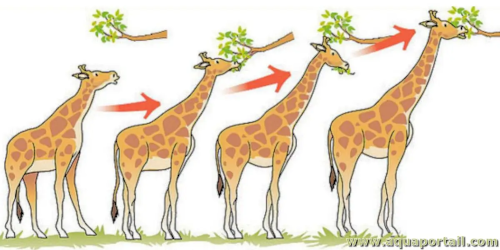
Answer: The assumption here is that you don't want popular stories of the "adaptive strategy" type, like the one below the image link on the left, about the evolution of giraffes, but rather some deep answer. Fun-damental and rarely known, so that both sides would be equally intere-sted in the same topic. Informatic review?
1. I have explained it several times, and yet it seems to go unnoticed, that nat-ure spontaneously tends towards more probable states, less informative ones (Adaptation). For example, there is a well-known theorem (Emergence II) that the mean value of one probability distribution (pk) of the information of anot-her (Hk = - log qk) gives the smallest value of the sum (Σk pk⋅Hk) if and only if the two distributions are equal (pk = qk in order for all k = 1, ..., n). Nature si-mply tends to associate probabilities with the associated information, moving towards less informative, hence more probable outcomes.
2. Markov chains are approached a little differently, but a similar result is fou-nd. It is a process that sequentially transmits a message, a probability distrib-ution vector, mapped repeatedly by a stochastic matrix, say the label M. For each Markov matrix, there is one vector v that it will map to, Mv = v, which is then called the eigenvector of the given matrix. That is, every other vector mapped repeatedly by this matrix will become more and more similar to this eigenvector. I exclude here the identity matrices for which every vector is an eigenvector.
For example, a Markov chain is a natural process, a development of events that we perceive from the point of view of the present, with more links taken as we go deeper into the past (Believing). We believe that what memories, fo-rensics, or archaeology can reveal stands as the real past, but the information we get from it is a series of copies and a bad original. The more distant the "past" thus depicted becomes, the more similar it becomes to v, the inherent state of the M matrix of the transmission channel. The past that we can per-ceive, whether it is an illusion or not, also adapts. It selects more likely out-comes and adapts the message to the transmission channel.
3.Let's be more specific with matrix equalities, taking x = (1/2, 1/2), the distri-bution vector with the highest possible information, and the given chain:
Mv = v, Mx = y,
\[ \begin{pmatrix} 0.7 & 0.4 \\ 0.3 & 0.6 \end{pmatrix} \begin{pmatrix} 4/7 \\ 3/7 \end{pmatrix} = \begin{pmatrix} 4/7 \\ 3/7 \end{pmatrix}, \quad \begin{pmatrix} 0.7 & 0.4 \\ 0.3 & 0.6 \end{pmatrix} \begin{pmatrix} 0.5 \\ 0.5 \end{pmatrix} = \begin{pmatrix} 0.55 \\ 0.45 \end{pmatrix}. \]Shannon's (1948) information vectors x and y are:
S(x) = -0.50⋅log20.50 - 0.50⋅log20.50 = 1.00 bit,
S(y) = -0.55⋅log20.55 - 0.45⋅log20.45 = 0.99 bit.
Therefore, the mapping M : x → y produces less information, as it is skewed towards the eigenvector v = (4/7, 3/7) of the channel matrix. For example, in the fourth step it will be M4x = (0.57, 0.43), which also shows the gradual ap-proach to the eigenvector by stringing together the links of this chain.
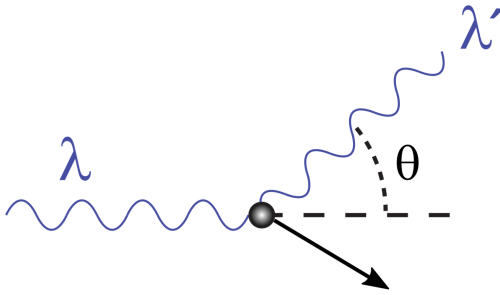
4. The movement between two po-sitions can be viewed as a process, a series of state mappings, so I have thus answered the question posed, reducing the trajectory to the high-er chances of closer positions.
On the other hand, maintaining that direction of travel is a similar story, slightly different. It is seen in the figure on the right, an effect that is not mentioned for now with Compton scattering. In short, for a photon coming from the left and hitting an electron to change direction by an angle θ and its wavelength λ → λ' to increase by the amount:
\[ \lambda' - \lambda = \frac{h}{m_ec}(1 - \cos\theta), \]a collision, i.e., a force is required. Here, h is Planck's constant, me is the mass of the electron, and c is the speed of light. In this case, the wavelength increa-ses, which requires a collision, i.e., a force. In other words, there is no sponta-neous deflection to a longer wavelength, i.e., to directions with greater uncer-tainties. That's not likely.
Unnatural » srb
Question: Did you mistakenly order the process backwards, sequencing events from the present to the past?
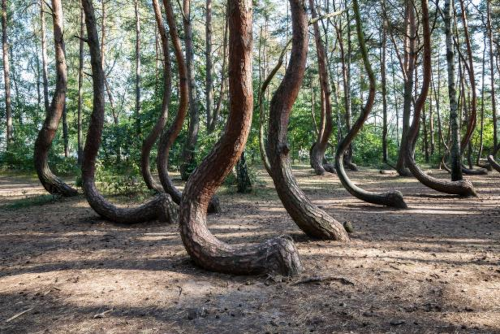
Answer: This is how we see develo-pment. We find this reality directly, only to then imagine it and reduce it to "flows from the past to the pr-esent," into further fiction.
Natural, spontaneous flows go to-wards the principle of minimalism, towards more probable states, and towards less information and less action. Unnatural, especially artifi-cial, can also do a lot of things that are not found in nature. That is my determinant, a litmus test, of a spontaneo-us and non-spontaneous, but also inanimate, physical state from one supplied with vitality.
1. A Markov chain is a message carrier that (mostly) has noise. We refer to this as channel noise, which generates "misinformation." It reduces, increases, or takes over the input information, corrupting the original message until, after a series of links, it is finally lost altogether. Each announcement will eventually become specific to a given channel, gradually adapting to it, ultimately making the chain a “black box.” The meaning of this is that, based on the output, we do not know what the input was.
The copying process described in this way is artificial and, in that sense, unn-atural. Physical reality cannot lie; it is far from the tools of mathematics and “recognizes” its results in ways completely different from ours. However, when we use these products of fiction, the primary perspective can be to search for the past from the point of view of “today” in the direction of “yesterday,” and the secondary perspective in the direction from “yesterday” to “today.” Both are unreal, and the latter is a fix by making fiction out of fiction in order to "adjust" to reality.
2. Let's take a slightly more general (Adaptation II, 3) example of a Markov matrix:
Av = v, Ax = y,
\[ \begin{pmatrix} a_1 & b_2 \\ b_1 & a_2 \end{pmatrix} \begin{pmatrix} \frac{b_2}{b_1 + b_2} \\ \frac{b_1}{b_1 + b_2} \end{pmatrix} = \begin{pmatrix} \frac{b_2}{b_1 + b_2} \\ \frac{b_1}{b_1 + b_2} \end{pmatrix}, \quad \begin{pmatrix} a_1 & b_2 \\ b_1 & a_2 \end{pmatrix} \begin{pmatrix} p \\ q \end{pmatrix} = \begin{pmatrix} a_1p + b_2q \\ b_1p + a_2q \end{pmatrix}. \]The columns of the matrix A are distributions, positive numbers that sum to one, as are the two vectors x, y. Let us consider the differences ∥x - v∥ and so ∥y - v∥ both in the 1-norm space:
∥x - v∥ = |p - b2/(b1 + b2)| + |q - b1/(b1 + b2)|,
∥y - v∥ = |a1p + b2q - b2/(b1 + b2)| + |b1p + a2q - b1/(b1 + b2)|.
After a short editing, we find that these are equalities:
∥x - v∥ = 2|pb1 - qb2|/(b1 + b2),
∥y - v∥ = 2|pb1 - qb2||a1 - b2|/(b1 + b2),
namely:
∥y - v∥ = |a1 - b2|⋅∥x - v∥.
So, whenever |a1 - b2| < 1 there will be a copy closer to the eigenvalue of the channel. This is always the case unless A is an isometry, i.e., the identity ma-trix or the matrix obtained by permuting the columns of the identity matrix.
3. An immediate consequence of this is that the principle of minimalism wou-ld be violated if the eigenvalue of the Markov matrix were close to maximum information. In this case, we would have:
\[ \begin{pmatrix} 1 - b_1 & \frac{a}{b}b_1 \\ b_1 & 1 - \frac{a}{b}b_1 \end{pmatrix} \begin{pmatrix} a \\ b \end{pmatrix} = \begin{pmatrix} a \\ b \end{pmatrix}, \]which is easily verified by multiplication. This is the same previous characteri-stic equation Av = v, now written using the coefficients a and b, positive num-bers that sum to one, the eigenvector v of the matrix A, and any real number b1 ∈ (0, 1).
When v is close to a uniform distribution, a ≈ b, i.e.,. |a - b| ≈ 0, then the Sha-nnon information is:
S(v) = -a⋅log2a - b⋅log2b ≈ 1 bit.
Every other binary information is smaller than this one (Extremes, 1.5), so adaptation to this one means an increase in information, which opposes the spontaneous flow of natural processes given the principle of minimalism. These processes are artificial, non-spontaneous, or violent, and in that sense unnatural.
4. Mathematical theorems are true and permanent, and we perceive them. Therefore, they are “realities.” However, the process of finding theorems is a “fiction,” because it requires the use of untruths. That is why we find ourselves in an absurd situation: we know that we are working with reality, but we fail to truly perceive it as such and always miss our estimates. We should be comfort-ed that “reality” is perceived by each subject in a special, unique way, and none in the “right” way.
Completion » srb
Question: How does perception information relate to this?
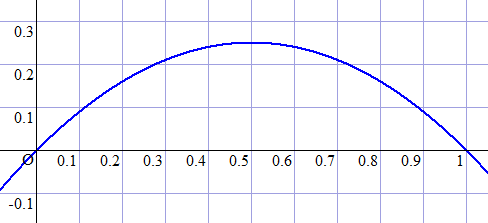
Answer: The natural, or spontane-ous, flow is, in principle, minimali-sm. It is towards more probable st-ates, less informative, and less act-ion. This determines the action as physical information. In this way, communication is observed by the method of first quantum and then physical interactions in general. So, we are between the classical theory of information and the idea of information perceptions.
1. Originally, Information of Perception (2016) arose from my unsuccessful attempt to convince others that intelligence I = S/H likes the freedoms of S but not the constraints of H. That is, that the freedom S = I⋅H is proportional to the "intelligence" I, in terms of the subject's ability to perceive and act, as well as to the hierarchy H, i.e., the constraints of the object, environment, or opponent. This freedom seemed to me at the time similar to "visibility". I considered both as sums:
S = S1 + S2 + ... = I1⋅H1 + I2⋅H2 + ...
different possibilities of perception, or action.
2. Let's simplify this with the help of the figure on the right, and let's focus on one of the pairs of product information of perception S = I⋅H. We measure this combined information S along the ordinate, and along the abscissa we compl-ement intelligence I and hierarchy H to one. So, we have I = x and H = 1 - x, and S = f(x) = x(1 - x). The graph shows that the greatest "freedom" is achieved by an even ratio of ability to constraint. This is the novelty of information perception.
Hence some insights are inaccessible to classical information theory. For exa-mple, a being with enormous powers of perception in conditions without any limitations is just as unfree as someone without those powers of perception in very limited conditions. In other words, enormous power without choice is ju-st as unfree as no power at all in an abundance of options. This, along with the requirement that information is a weaving of space, time, and matter, with ch-oices being its essence, leads to the conclusion that the aforementioned extre-mes are unnatural. So, we do not deviate from what we have found: informing means acting.
3. Whether S represents "freedom" (the amount of options) or "visibility" (the chance of information), it is first a sum of products, then a scalar product of sequences, and then a functional. All these interpretations must be reconciled with what is known from quantum mechanics, with the invariants of the mac-ro world, and finally with information theory. It is clear that such "perceptual information" cannot fit into the framework of classical information, but in ge-neral it will tell how much one state "lies" on another.
The scalar product of vectors tells us how parallel two vectors are. The inten-sities of the vectors a and b are |a| = a and |b| = b, and if we denote the unit vectors of their direction by ua = a/a and ub = b/b, their parallelism coeffici-ent will be ua⋅ub ∈ (-1, 1). If the product is zero, the vectors are mutually perp-endicular, and when it is extreme (±one) they are parallel. The interpretation of this coefficient is an expression of the "agreement" of the states we are com-paring. Sometimes it is the power of communication, the level of strategy, so-metimes internal information.
4. In physics, we would write a long list of interpretations of "information per-ception." For example, let's say \(|\psi\rangle = (\sqrt{\frac23}, \sqrt{\frac13})\) is the state of some particle when measuring an observable with the associated operator that has, say, an eigenstate \(|\phi\rangle = (\sqrt{\frac25}, \sqrt{\frac35})\). This in the standard basis of a quantum system, which can be in the state |1⟩ = (1, 0)⊤ or |2⟩ = (0, 1)⊤. So, the scalar product is:
⟨ψ|φ⟩ = ⟨ψ|1⟩ ⟨1|φ⟩ + ⟨ψ|2⟩ ⟨2|φ⟩ =
\[ = \sqrt{\frac23}\cdot \sqrt{\frac25} + \sqrt{\frac13}\cdot \sqrt{\frac35} \approx 0.964 \]Squared, this number, |⟨ψ|φ⟩|² ≈ 0.929, represents the probability of finding, measuring the desired observable. We can easily deal with these probabilities in classical information.
Polarization » srb
Question: You didn't tell me (Completion) what the "information of percepti-on" spontaneously strives for?
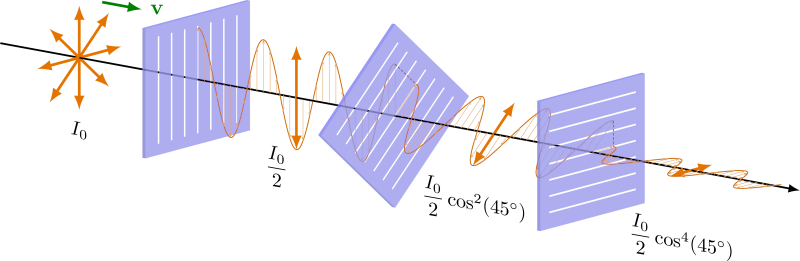
Answer: Well, something that depends on probability, for example, in the case of eigenvectors from the Markov matrix (Unnatural). A different, similar exa-mple is the orientation of light amplitudes and Malus's law. Linearly polarized light with intensity I0 at the output of an ideal polarizer, i.e., a grating of linear apertures that make an angle θ with the input polarization, will have an inten-sity I = I0⋅cos²θ at the output. In the picture, we see three such polarizers lin-ed up.
At the entrance to the first, the light is not polarized and passes about half of the total intensity, cos²45° = (√2/2)² = 1/2, predominantly vertical orientati-on. The second polarizer is tilted by 45° relative to the first, so it passes anot-her half of the intensity of that half. The third polarizer is tilted again by 45° relative to the second and passes another half, i.e., 1/8 of the intensity of the initial light. Paradoxically, encountering only two polarizers perpendicular to each other, there would be no light at all at the exit, because from the first to the second, cos²90° = 0 light would pass, in practice as according to Malus's law.
1. The law of polarization of light was discovered (Étienne-Louis Malus, 1808) before quantum mechanics and the Born's rule (1926), stating that the proba-bility density for finding a particle at a given position is proportional to the square of the amplitude of the wave function of the system at that position. You will find proofs and explanations in the book Quantum Mechanics. This is the case in the algebra of quantum mechanics when the coefficients of the vectors are complex numbers.
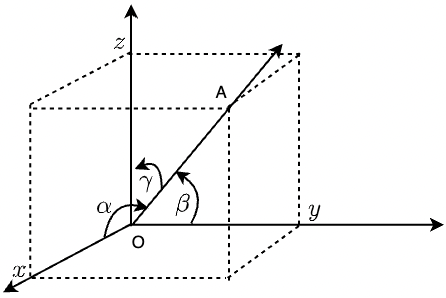
2. Let's try to see Born's rule first with an easy example. In the figure on the left, in the case of a real rec-tangular Cartesian system. A quad-rilateral with diagonal OA = d incli-ned to the axes at angles α, β and γ has edges of lengths x = OA⋅cos α, so y = OA⋅cos β and z = OA⋅cos γ. According to the Pythagorean the-orem, it is:
x² + y² + z² = OA²,
and hence, by adding and dividing by d² we obtain, respectively:
OA²⋅cos² α + OA²⋅cos² β + OA²⋅cos² γ = OA²,
cos² α + cos² β + cos² γ = 1,
and this is analogous to Born's rule in real space and its precursor in Malus's law.
Let us now imagine this quadrilateral in a complex coordinate system, of the 2-norm and the unit diagonal ∥OA∥ = 1. The axes as orthogonal vectors (a ⊥ b iff a ⋅ b = 0), and the scalar products of the diagonal OA with the axes as the squares of the cosines of the angles and the probabilities.
3. These cosine squares demonstrate the difficulties of simplification in explai-ning probability. Intuition alone would hardly allow for the above "turning the corner," when a third polarization of 45° between two perpendiculars gives an excess of light, relative to the two perpendiculars themselves, and this is only a detail of the "miracle" of the law of chance events. Nor is the "swing of the cra-mp," or the investment of potential into useful work, in the following example, any easier.
4. We have long known about the “incomprehensible” decline of Shannon inf-ormation in intelligent texts (Letter Frequency) compared to a random seque-nce of letters. Some signs, sounds, or smells are used by intelligent communi-cation more often than they naturally occur in still life. Thus we know that do-lphins talk, for example, or that possible similar distributions of signals from space could potentially originate from intelligent beings. This gives us an abu-ndance of freedom to identify regularities with minimal constraints. To write in order to direct the reader’s imagination into our plot or to recognize natural laws by finding order in disorder, in the eureka effect of a suddenly understo-od narrowing of options.
5. The position of greater knowledge and mastery of the laws of nature is a sta-te of increased "visibility", as well as information of perception (Completion). We understand this directly or by realizing that the development of civilization has enabled us to have both greater freedoms (say, travel to our and other pla-nets) and greater order (social, transportation, spelling, and others). However, it is not that information of perception tends spontaneously, everywhere and always, to balance and complete options and order, if we see it in the case of human development. These values do not tend to spontaneously increase pe-rceptual information.
If life appeared and developed where it could, in the evolution on Earth we witness how rare our intelligence is, because millions of species lived without it, for which intelligence was neither a need nor a goal. Life develops and be-comes more complex out of the need of the participants not to have excess options, but the field is crowded and everyone would like the same thing, so unwanted burdens are pushed into communities, creating increasingly com-plex forms of vitality. We give up freedom for the sake of security and effici-ency. This is how systems of greater information of perception arise, actually from the desire for less information. Just as storms arise because of the need for calm.
Choices II » srb
Question: Tell us something about the chances of random events happening in fictional realities?
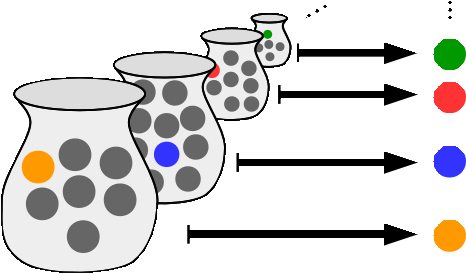
Answer: I admit you put it well: "fi-ctional realities." Reality is observ-able, permanent, and true, and "fic-tion" is anything that has one or at most two of those three properties, at least as long as we are within this information theory. Otherwise, the outcome will be anything that has at least some chance of being that.
1. Taking into account the relativity of simultaneity and the indefiniteness of time and energy, we view the pieces of the present as a discrete sequence that never ends. Analogously to a seque-nce of natural numbers, or the positions of just one binary number, likewise as 0.110100... ∈ (0, 1), of which in the interval from 0 to 1 there is a continuum of infinitely many, that is 𝔠 = 2ℵ0, although an infinite sequence has only counta-bly many (ℵ0 = log 𝔠) elements. We find that there is at least a continuum of fictitious realities.
2. In the image above on the right is a link to the axiom of choice. It states that from any group of non-empty sets we can choose an element from each witho-ut any rules about which to take, even from infinitely many groups. Therefore, there exists every choice function from which we find that every set can be we-ll-ordered, whose every subset would have a smallest element. Just as a set of natural numbers has them, or as each time slice from each fictional reality wo-uld have its own flow, its own sequence.
For example, given the set of three sets S = {{1, 2, 3}, {3, 4}, {5}}, then the th-ree equalities f{1, 2, 3} = 3, f{3, 4} = 4 and f{5} = 5 define one of the "choice functions" on S. Another is g{1, 2, 3} = 2, g{3, 4} = 4, and g{5} = 5, and so on. There are 3! ⋅ 2! ⋅ 1! = 12 of them. The points of the coordinate system determ-ine a function of choice of their coordinate axes. If the axiom of choice holds, there will be a continuum of fictitious realities arising from a single stream of the present.
3. An alternative to the axiom of choice is the axiom of determinacy. It refers to topological games ω in which one of the two opponents has a winning stra-tegy. The axiom of choice says, for example, that you are in a candy store with infinitely large candy jars, and you can take any candy you want from each jar and put them all in the other jar. The axiom of determinacy states that every game is determinate. That is, such a game, no matter what series of moves is made, results in a winner.
In the case of determinism, there is a non-empty winning strategy, and if we choose it, the other side will be left with no moves (lose the game) and have no more choices. That is why these two axioms are opposites, negations of each other. In this theory, this would mean that a universe without the axiom of choice would have a dead end in every variant of fictional reality except one. This would be the opposite of the assumption of objective randomness; it is a contradiction to this theory of information.
4. The development of logic since the 20th century has established that the axiom of choice is independent of the generally accepted axioms of set theory through the work of Zermelo and Fraenkel. Namely, Zermelo–Fraenkel set theory with the axiom of choice (ZFC) and set theory without the axiom of choice (ZF¬C) are equally logical and consistent theories. However, many mathematicians accept the axiom of choice as true and use it when necessary.
Packages II » srb
Question: Can you explain the Banach-Tarski paradox to me now?
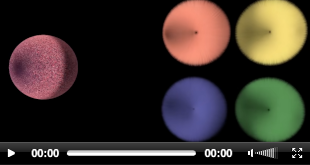
Answer: This is a question sent to me by a now-graduated engineer regarding a conversation about “packages” back when he was a student. Incidentally, all of these blogs were written months before the one titled above. It was about proof of the atomic, or quantum, structure of physical information.
Further from the assumption that it is a structure of physical reality, it is evi-dence of the atomization of matter in general (we are talking about mathema-tically proving something that has been established by experiments for a long time). The link in the image above left is certainly a more beautifully retelling of the "Banach-Tarsky paradox" than the way I will do it now. However, my contribution is all the more important because of the point that these well-known explanations and this video are missing.
1. First, note that numbers written in decimals that repeat periodically are ra-tional, from the set ℚ of fractions of whole numbers in the numerator and de-nominator. Here is an example of how we convert them to fractions:
x = 0,450450450... /⋅1000 1000⋅x = 450,450450450... 1000⋅x = 450 + x 999⋅x = 450 x = 50/111
However, there are irrational numbers, a subset of the real numbers ℝ from which the rational numbers have been removed, whose decimal notations are not periodic. The number √2 = 1.41421... and all roots that are not integers, or the quotient of the circumference and diameter of a circle π = 3.14159, is irra-tional, as is the number e = 2.71828..., as well as an uncountably large number of other real numbers. The rational numbers form a countably infinite set of cardinality ℵ0, as well as the set ℕ = {1, 2, 3, ...} of natural numbers, which can obviously be (infinitely) counted. An irrational number is also one whose deci-mals are the outcomes of random events.
2.It follows from the above that the sum of an integer and an irrational numb-er will always be some irrational number. Adding its integer length piece to a vector of irrational length gives a vector of irrational length. Also, if we move a point on a circle of integer radius along an arc always by a unit length, it will constantly come to new and new positions so that, circling, it will fill the line of the circle more and more densely, never arriving at the places where it was previously.
By choosing another starting point for this circle and constantly adding a po-int at a unit arc distance from the previous one, we would once again draw a line of its points dense everywhere. But it is possible that no two points from the first and second drawing will coincide, depending on the distance of the starting points. This is the idea of the Banach-Tarsky paradox. By removing points from the first and then from the second drawing, it turns out that we make two equal such circles from the starting one.
3. Now that we understand this concept, the immeasurably smaller (ℵ0) co-untable infinity of integers and rational numbers compared to the cardinal number of elements of the continuum (𝔠 = 2ℵ0), irrational and real numbers, then it is easy to make the variations. For example, following the rectangular Cartesian coordinate system for given irrational lengths of the axis vectors, starting from various points, we can draw equal, increasingly dense bodies by multiplying them. These figures that we thus obtain are everywhere dense sets of points but countable, unlike the continuum, which is an uncountable set of points.
It is easy to understand when and why combinatorial games are deterministic. These are open games with alternating moves by two players, such as chess, go, nim (taking turns taking objects from several piles), or tic-tac-toe. These are discrete games (with at most countably infinite moves) and, according to the above, do not have the possibility of the Banach-Tarski paradox, which is not a "paradox" but a mathematical certainty when the prerequisites are met. A player, by sequencing his moves, can exhaust the opponent's possibilities and thus leave him without an answer within the rules of the game.
4. The worlds of "parallel times" (fictitious realities) are uncountably infinite. They are therefore subject to the Banach-Tarski paradox and can multiply the-mselves infinitely. Therefore, it makes no sense to talk about their volume, be-cause the Banach-Tarski paradox is not possible in universes where the axiom of determinism holds. In such worlds, every subset of real numbers is measur-able (i.e. has a well-defined volume), and this paradox requires immeasurable sets.
On the other hand, looking at the fragmentation and division into ever smaller micro-worlds, the same concept of this paradox would require the axiom of choice, hence the negation of the axiom of determinism, thus leading to imme-asurableness. Therefore, the layers of micro-worlds in which the axiom of ch-oice would hold would negate the laws of conservation and would not be real in the way defined here. Hence the atomization, or, if you will, the quantizati-on of information and the matter based on it.
Zorn lemma » srb
Question: There are many applications of the axiom of choice. Can you name some?
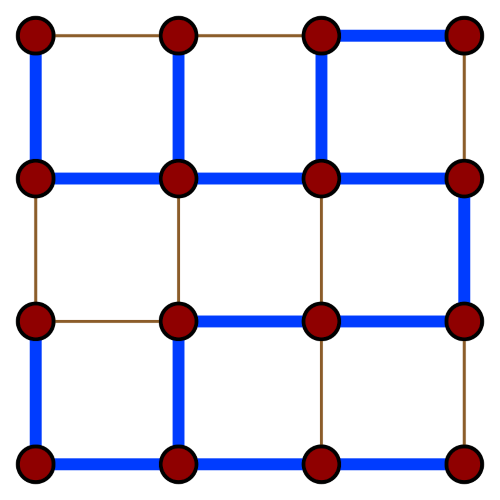
Answer: First of all, let us empha-size that the axiom of choice is in-dependent. It can be assumed and forbidden equally. In the first case, the Banach-Tarski paradox will ap-ply, and the worlds of “parallel tim-es” are uncountably infinite, and in the second, when the opposite axi-om of determinism applies, all mic-roworlds of individual time streams are quantized, and information is finitely divisible in them.
It's like saying we can take as many items as we want from a certain pi-le, or saying that we can only take two. There is no contradiction. Bo-th options are applicable depending on the circumstances. The question is wh-ich of the circumstances has proven to be more common or more useful to us.
1. The equivalent of the axiom of choice is the statement that every vector sp-ace X (over any field Φ) has a basis. This can be more easily understood when we see that the points of a coordinate system determine one of the "choice fu-nctions" of their coordinate axes. Otherwise, a point that did not have a coor-dinate on one of the axes would not be decomposed into a vector of that axis; it would not be in the basis and would not be in the linear combination of that point, the vectors. I hope that such an interpretation is sufficient without citi-ng a rigorous proof.
However, when we consider a single history of the world and work with a co-untably infinite sequence of presents (their fragments), then there will be no axiom of choice, and, therefore, we work with incomplete states within inco-mplete (quantum) systems, i.e., interpretations of incomplete vector spaces. Completing such is possible only after extending the current to other parallel (fictional) realities. It is the same if we consider it impossible to isolate just one property from a packet of information, from a quantum of action.
The space of free particles can be considered a continuum, but this is no com-pensation when we work with quantum systems (vector spaces) of emphatic-ally quantum states and processes (vectors). At best, we find such a continu-um for some broader background of "fictional realities" in which they refract, or bridge, and perceive each other.
2. The equivalent of the axiom of choice is the statement that every surjection has a right-hand inverse function. The surjection f : A → B, or the "onto" map-ping f, covers the entire codomain B.
In the first line of proof, we assume a surjection f and for all b ∈ B we observe f-1(b). This determines some subset of the domain, i.e. Ab ⊆ A. For different b these sets are disjoint. The axiom of choice gives g : B → A such that ∀b then is g(b) ∈ f-1(b). But that f∘g is an identity, so f has a right inverse. Conversely, as-suming that we have a collection of disjoint sets {Ai} and we define a function from the union of all of them, it will be a surjection. Its right inverse is then the function of choice for the collection {Ai}.
Observing the past based on findings from the present (archaeological, fore-nsic, memories) is a type of mapping from the present to the past. However, due to “transmission interference,” such as Markov chain noise, it is not po-ssible to have insight into everything that happened then, so they are not in-verse surjections in relation to mappings of that past into our present. This means that in temporal processes the axiom of choice does not hold.
3. The equivalent of the axiom of choice is Zorn's Lemma. It states that a parti-ally ordered set containing upper bounds for every chain, i.e. every completely ordered subset, necessarily contains at least one maximal element.
To simplify, let's try to understand this using real numbers. Let's say it's an open interval from zero to one. For every number 0 < x < 1, there is some number greater than it that is still in that interval, e.g. x1 = (x + 1)/2 ∈ (0, 1). The number 1 does not belong to the given interval; it cannot be chosen, and Zorn's lemma does not hold. On the other hand, in the case of a closed interval of real numbers, with 0 ≤ x ≤ 1, it is a set that contains an upper bound; there is a maximum number 1 that we can choose, and Zorn's lemma holds.
A slightly more complex example is a set of multiple intervals, say from 0 to 2, then from 1 to 3, ..., from a to b and so on. When all these intervals are closed, then they have many local maxima (2, 3, ..., b and so on), but they do not have the largest of them, or the maximal element, if we cannot choose ℵ0, a cardinal which is the "number" of countable infinity. In set theory we have ordinals and cardinals; the former speak of order and the latter of quantities.
We can order concepts like: bitter, salty, and sweet. In mathematics, we would rather work with sets with the order {a, b} ⊆ {a, b, c} ⊆ {a, b, c, e} ..., or witho-ut the order {a, b} ⊈ {a, c}. We can even give values by such ones; for example, kard{a, b} = 2, kard{a, b, c} = 3, or similar. It is possible (not always), and vice versa, so let's say -3 ≼ 33 ≼ ℵ0 ≼ 𝔠 ..., with these chains that are not always fin-ite. Moreover, which go beyond the idea of a set (there is no set of all sets).
Zorn's lemma is all the more interesting when its applications are extreme. Fi-nite sets are trivial examples of its validity, as well as the validity of the axiom of choice. This can be seen in the figure above right and the link in the expla-nation.
4. When we consider the above examples a little more closely, we will also see the “compromises” of the axiom of choice and its negation in our reality. For example, in a vacuum and with free particles, we can choose arbitrary positio-ns as well as arbitrary wavelengths, which leads to the conclusion that they are a continuum. Then there is no memory loss; there are no inseparable parts, as data from the quantum of action, every state or process (vector) has a clear de-composition into observables (base). However, we also encounter indistingui-shability, or let’s say the uncertainty principle.
Thoughtful » srb
Question: What is thought turns out to be less informative, so how is that? Where is this information theory going?
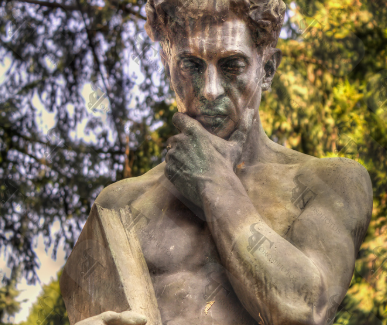
Answer: Thoughtful things are phenomena of vitality and are therefore further removed from inanimate nature. The art of the written word is in this respect like the separation of a stonemason's sculpture from stone, with the discovery of the hidden value inherent in the intellect and the effort of the excess freedom we possess in comparison with inanimate physical matter.
1. For a deeper understanding of what has been said, let us first note that the uniform distribution has the highest information (Extremes, 1.5). For example, distributions with equal numbers of outcomes:
a = (0.25, 0.25, 0.25, 0.25), b = (0.40, 0.30, 0.20, 0.10)
have different (Shannon, 1948) information:
S(a) = -0,25⋅log2(0,25) - ... - 0,25⋅log2(0,25) = 2,00 bit,
S(b) = -0,40⋅log2(0,40) - ... - 0,10⋅log2(0,10) ≈ 1,85 bit.
Thought makes the effort to dive below the surface, below the normal state of still nature, into the realm of rules that it otherwise unconsciously follows.
2. According to a study of the Letter Frequency (2022) of a regular Serbian te-xt with 3283 characters, a decreasing representation of 30 letters of the alpha-bet was found in the order A, I, E, O, ..., similar to the above b distribution. Translation into English gives decreasing frequencies of 26 letters of that alp-habet in the order E, I, T, N, O, ..., which also confirms the meaningfulness of the content. The information of their uneven distribution is less than the info-rmation of randomly and equally likely chosen letters of the same text length.
It would also show the uneven distribution of words of given languages, or ideas in general, in cases of intellectual content, compared to completely ran-dom choices of words or ideas. In such findings, there would be much larger numbers of possibilities than the aforementioned 30 and 26, but with a simi-lar attitude, that the meaning of the text reduces the information. The arran-gements of these frequencies are a kind of "fingerprint" of the content and author of the text.
3. We can look for the quantity of mental effort using Chebyshev's inequality and the contributions in the continuation of that blog, now that we know that they are consequences of the uncertainty force. In the abstract space of proba-bilities with which it is possible to define a metric, in places of higher probabi-lities are central forces whose attraction decreases with the square of the dis-tance. Like Newton's and Coulomb's forces, they can have different constants in front (gravity and electric forces), but only physicists have the right to their applications. Analogously to physics, such central forces will tend to move th-eir charges along conics (ellipses) when their effects propagate at the speed of light.
4. Everyone would like to reach a state of greater probability, from the smalle-st atoms to the largest bodies. In this competitive push, many from the enviro-nment make the work of creativity more difficult. In this sense, mental work is a struggle. The drive and strength are given to it by the excess of options com-pared to dead substance, which it receives when combined with vitality. The chances of success in outplaying are then increased by a higher level of strate-gy inaccessible to dead nature (Win Lose), which always "misses the stronger and pushes the weaker," not caring that it is the weakest game of all and not "afraid" of defeat because of its indestructibility. Combined with vitality, it be-gins to defy spontaneity and manages to defeat it.
Existence II » srb
Question: Paradoxically, it is impossible for me too that living beings consist of the inanimate world. Can you explain that?

Answer: The answer in this theory stands stubbornly before us, but al-as, no matter how hard I try to sh-ow it, the reader runs out of attenti-on to catch the point. I will try to repeat the same explanation now slowly and reasonably with the ho-pe of success.
1. Three things are key to underst-anding “existence” in the way this theory does. First, information is in the content of space, time, and matter, with uncertainty as its essence. This implies the impermanence, the shortness of life of information; stale news is no longer original news. Probability is shown to be such a tool for monitoring the behavior of information.
2. The second important point is the definition of reality with three assumpti-ons: perceptibility, maintainability, and accuracy. Expressed in this brief man-ner, they are too simplified to notice their connection. Namely, the first means that A can (optionally) perceive A1 and this can be perceived by A2 ... and this can be perceived by B, and all of them together are mutually real. This also im-plies constancy, and from constancy comes truth, because we consider untruth to be impermanent.
All three of these assumptions together define “reality.” I consider it to “exist” alongside phenomena that would only meet one or two of these three prerequ-isites, which I call “fictions” for the sake of distinction. The previous one desc-ribes the micro-world of reality as fiction. This is the confusing part of this to-pic that is difficult to explain and will make some people sigh: “Ah, now I get it, it’s perfectly clear! How is it possible that I didn’t understand this before?”
3. The third important point is the equivalence of the worlds of truth and fal-sehood, their cardinal number being equal. Namely, through bijection (a one-to-one mapping) by replacing ⊤ ↔ ⊥, for example, for disjunction:
| ∨ | ⊤ | ⊥ |
|---|---|---|
| ⊤ | ⊤ | ⊤ |
| ⊥ | ⊤ | ⊥ |
we find the equivalent:
| ¬∨ | ⊤ | ⊥ |
|---|---|---|
| ⊤ | ⊥ | ⊥ |
| ⊥ | ⊥ | ⊤ |
The negation of this conjunction remains, (⊤, ⊥) ↔ (⊥, ⊤), but tautologies (always true statements) are replaced by contradictions (always false stat-ements), such as: (A ∨ ¬A) ↔ (A ¬∨ ¬A). Check!
4. From the equality of quantities (3) and the maintenance of that value (2), we easily understand that the macro-world of fiction is as sustainable as reali-ty. On the other hand, it has already been mentioned that the micro-world of reality (2) is made up of fictions due to (1). Such at the borders of their worlds, they could have common properties that would easily unite them; that is, they would not separate them as far apart as they otherwise seem to us. That is also the answer to the question.
T-symmetry » srb
Question: Is it possible to reverse time?
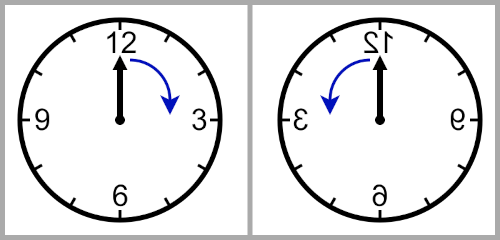
Answer: I speak in my theory of information without reference to research like the image link on the left or similar, or without the pos-sible curvature of time itself (at least there are three dimensions).
1. Reversal of time as the actual flow of events backwards is not possible, without violating the uncertainty principle — in a way that violates the objectivity of chance, the basis of natural phenomena in this information theory.
2. Another reason for the same impossibility, let's say its consequence, is the continuum of possibilities (cardinalities 𝔠) and such an infinite multitude of parallel realities around our "only" countably infinite (ℵ0). Especially in the small world of quantum, where such possibilities are most likely, the chances of events returning to the previous state of the same time flow are zero. The probabilities of drawing exactly one given irrational number on the interval of the real number line are equal, which is (almost) equal to exactly zero.
3. Time is important in this theory because it is the carrier of information and is therefore irreversible. Moreover, there is a force that pushes the present fr-om being to being. I call it the force of probability, or principled minimalism. We easily detect it in the more frequent realizations of more probable events, possibly when we are exposed to them. In the macro-world it is very muted by the law of large probability numbers. These interpretations are supported by the “bypasses” that supposedly come to us in the “Mandela effect”, via mass walking back and forth through parallel times. Unlike impossibility (2).
4. Therefore, it is not theoretically impossible to encounter a body that has go-ne astray in its course towards the future, but it is unlikely. Such an event wo-uld be all the less possible the larger the body, with the chances of it remaining on track in its time flow being even smaller. This theory, therefore, predicts that in our environment, in our reality, there are other processes that we do not perceive because they belong to parallel times (Free fall, 6).
Isometry » srb
Question: Are there any other time symmetries?

Answer: Yes, symmetries are the foundations of physical reality, of isometries, as we would call those changes that maintain distances between points. A good example of this is proper, or true, time τ. It is the one that flows equally for us whether we are at rest at a station or in any kind of motion.
1. However, others will see this proper (own) time in intervals:
\[ dt = \frac{d\tau}{\sqrt{1 - \frac{v^2}{c^2}}}, \]when we move at a speed v relative to them, where c = 300,000 km/s is app-roximately the speed of light. The analogous time dilation in a gravitational field is the same as after the shift v² = 2GM/r, where G is the gravitational constant, M is the mass of the field, and r is the distance of the observed point from the center of the field (Information Coupling, Example 115). The express-ion is otherwise written shorter, dt = dτ⋅γ, using the so-called Lorentz coeff-icient γ, or equivalent dτ = dt/γ.
2. The product of the applied energy and the elapsed time is the action:
E0 ⋅ dτ = E0 ⋅ dt/γ, E0 = m0c²,
\[ E_0\cdot d\tau = m_0c^2 \cdot \frac{dt}{\sqrt{1 - \frac{v^2}{c^2}}} \approx m_0c^2(1 - \frac12\frac{v^2}{c^2})dt = (m_0c^2 - \frac12m_0v^2)dt, \]where E0 and m0 are the proper (at rest) energy and mass of the body, and the approximate value is more accurate the smaller the ratio of speeds (v/c ≈ 0). Otherwise, the difference between the kinetic (T = m0v²/2) and potential en-ergy (U = m0c²) of the body is Lagrangian, so it is proportional to the change in the proper over relative time:
\[ L = -E_0\ \frac{d\tau}{dt} = -E_0\ \dot{\tau} = -\frac{E_0}{\sqrt{1 - \frac{v^2}{c^2}}} \approx T - U. \]There is no change, L = const, when there is no change in the relative speed of time, because then there is no change in the action.
3. The sum of kinetic and potential energy (H = mv²/2 + U), also known as the Hamiltonian, remains the same overall value during changes. This is the law of conservation of energy, which we relate to the conservation of action as follows:
\[ \frac{d}{dt}(\frac12mv^2 + U) = 0, \] \[ \frac{d}{dt}[mv^2 - (\frac12mv^2 - U)] = 0, \] \[ \frac{d}{dt}\left(\frac{\partial L}{\partial v}v - L\right) = 0, \] \[ \frac{d}{dt}\left(\frac{\partial L}{\partial v}\right)v + \frac{\partial L}{\partial v}\frac{d v}{d t} - \frac{dL}{dt} = 0. \]Considering that:
\[ \frac{dL}{dt} = \frac{dL}{dx}\frac{dx}{dt} + \frac{dL}{dt}\frac{dv}{dt}, \]including in what is found, it comes out:
\[ \frac{d}{dt}\left(\frac{\partial L}{\partial v}\right)v - \frac{dL}{dx}v = 0, \]for each velocity v, which means that:
\[ \frac{d}{dt}\left(\frac{\partial L}{\partial v}\right) - \frac{dL}{dx} = 0, \]and this is the famous Euler-Lagrange equation (Lagrangian II) from which we find the trajectories of (all) movements in theoretical physics. The signi-ficance of this derivation lies in the validity of the laws of conservation of energy and action.
4. The second meaning of the Euler-Lagrange equation is easier to see when we write it in the form:
\[ \frac{d}{dt}\left(\frac{\partial L}{\partial \dot{q}}\right) = \frac{dL}{dq}. \]It is emphasized that q does not have to be a linear coordinate, and \(\dot{q} = \frac{dq}{dt}\) is the velocity of movement along that coordinate. When the right side of this differential equation is zero, so is the left side, and vice versa. In other words, if there is no change in energy with a change in position, there is no change in time, and vice versa.
A slightly deeper meaning of this was noticed by Emmy Noether (Information Stories) in 1915, when she noticed that the Euler-Lagrange equation talks abo-ut symmetries. Whenever we have an invariance, we also have a correspondi-ng constancy. In this way, the same equation also talks about "reality" as I de-fine it here. In addition to expressing the impossibility of the existence of phy-sical space without time (and vice versa), it tells us that there is no universe without a past. Namely, space is a repository of past events.
Existence III » srb
Question: What about trajectories and the principle of least action at the bor-der of the worlds of reality and fiction?
Answer: It is a question of (Exist-ence II) the boundaries of the first reality, whose micro-world is ficti-on, and then the boundaries of the macro-world of fiction with reality. Here is how to connect the two pri-nciples of least action.
1. Given a functional f(y). This is some function f of the function y(s), which we would maximize or minimize by choosing the path y(s). We are looking for the extremum of the functional f(y) with respect to the argument y(s) by finding the first derivative that we will equate to zero. It will be f '(y0) = 0, where f0 = f(y0) is the largest or smallest value of the functional.
2. The functional is of the form:
\[ f(y) = \int_a^b g(y, y')\ ds. \]This is the integral with respect to the parameter s ∈ [a, b] of the function g which depends on the path y(s) and its derivative y'(s) = dy/ds and we are looking for the path of the largest (smallest) number y0. In other words, we are looking for the extremum of the functional f.
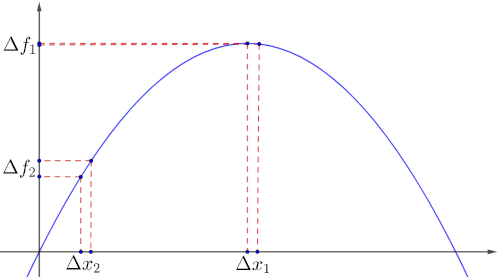
3. In the image above left, we see in a typical example what can be seen anal-ytically in general: that changing the argument by the same small amount of the abscissa Δx1 = Δx2 results in a smaller shift of the ordinate Δf1 < Δf2 when taken near an extremum, maximum or minimum, but the point where the ta-ngent to the graph is parallel to the abscissa.
Namely, by observing small variations for δx around the point x, using Tayl-or's theorem we obtain:
\[ \delta f = f(x + \delta x) - f(x) = f'(x)\delta x + \frac12 f''(x)(\delta x)^2 + ... \]but in the vicinity of the extremum f '(x0) = 0, so we have:
\[ \delta f = \frac12 f''(x)(\delta x)^2 + ... \]where sums with higher powers of this small number δx can be ignored, and also δx is significantly less than (δx)² from which it follows that results like the one in the picture could be a general phenomenon.
4. Here's how this relates to the question posed. Fiction is fickle; like lies, it doesn't last, but in its entirety, it always exists, just like truths. Thus, fiction, as a whole, behaves like reality. Conversely, reality consists of information that is no longer real as soon as it appears. The elements of reality are fickle like fictions.
Well, in the short term, the principle of minimalism forces both to stick to the smallest fluctuations possible. Fictions simply because they won't even reach their goal in the long term, and their existence won't succeed, while realities will appear, they will swim on, as if they were inclined to minimalism.
Genesis III » srb
Question: Can you explain this upgrade of reality from fiction to me?

Answer: Here we consider insight into the tiniest parts of reality, with only a passing note on their conne-ction to the largest (Genesis II).
Information weaves through space, time, and matter, and its fundame-ntal quality is uncertainty. So, we are made up of bits that do not last, because given news is no longer that, so at that smallest level reality will be fi-ction in the sense of permanence or impermanence.
1. When we talk about elements, let us remember those lighter chemical ones, or, for example, water molecules that are less dense than a stone thrown in, which is why it sinks and the water remains above. Therefore, let us avoid ta-lking about literally lower fictions and upper realities, because those specifi-cally more easily displaced will reach all heights. However, on the scales of weight and subtlety of influence, it makes sense to consider fictions as lighter phenomena.
2. At the border of reality, where the broadcast information ceases to be news and remains “only” its impact, the change caused by the delivery will be the breaking point of perception, duration and truth. The first was achieved by ch-anges due to delivery, the second because these changes have already entered reality, and then we have the third, because in physical reality nothing happe-ns that would really be provable as false. So, at the border of fiction-reality, in addition to the weighing of (im)permanence (Existence III, 4), we also have the refraction of (non)perception and (non)truth.
3. Inconsistent connections remain fictions, not to say half-worlds or half-information. Formally, it is represented by, say, the nucleus or null-space of the mapping (process). Since such "particles," here called (1) "lighter" pheno-mena, can be found anywhere, they are also found connected to the dead phy-sical matter to which they give vitality. By their inconsistency, these fictions increase the "quantity of options" of the reality of their coupling, which will no longer follow the trajectories obtained from the Euler-Lagrange equation of theoretical physics. This abandonment distinguishes living from non-living beings.
4. By the bijection ⊥ ↔ ⊤ we prove that the “world of lies” is as numerous as the “world of truths,” but this tells us nothing about their arrangements. The former are impermanent and often unnoticed, but I suppose attractive given the principle of minimalism, so that should be the more important reason for their presence. The construction of truth from lies can be tedious and will pr-ove to be an excess of effort in people who lie with the intention of not being noticed, and otherwise a lie is attractive because it is from the world of semi-information. Such exists as diluted information and continues to be attractive to others.
5. Nature is not inclined to events that "do not remember" (which repeat the same thing; see Dissipation, 2), due to the principled resistance to greater in-formation, and this is also the direction of the nature of reality, or the tenden-cy of fictions to be permanent, in the sense that they have a past. The half-tru-ths, therefore, "agree" to stand by the whole information when circumstances allow. Hence the strange combinations of desired (fictions) with unwanted (real) phenomena and living beings. We also recognize this aversion to natu-re's equality in the law of large numbers of probability theory.
Namely, the multitude and diversity (of different outcomes from repetition) seem to exhaust the uncertainty from the whole into the law of large numbers, which speaks of the relative probability of a random event approaching its pr-obability when a random experiment is repeated a large number of times. This is already a concept of maintaining reality (it is not mentioned as such in the literature), which further makes the increasingly large macro waves become like smooth sinusoids, while their micro forms are actually discrete waves of probability.
Exhaustion » srb
Question: It's intriguing to say that "multiplicity exhausts uncertainty in the law of large numbers," but how accurate is that?

Answer: This “intriguingness” is more of an inspiration to me than a method, and the law of large numb-ers is not alone in such “exhausti-on.” The state of uncertainty is “re-ality”, as far as this theory is conce-rned, and is therefore an expenda-ble phenomenon. It is unusual to view “expendability” in such a way, in such circumstances, and there-fore, for the time being, I avoid declaring such a quip a rule. Not because of the burden of the news here, but in principle to avoid haste.
1. Along with the remark you make goes (Dissipation, 2) nature's preference for events that are "remembered," which here means "lasting" and "real." This further explains a lot. For example, it opens up the possibility that fiction, wh-ich is attracted by reality because of its lack of information, is not as repulsive to reality as it might be because of the very principle of minimalism. And the deeper cause of the aforementioned preference is actually the avoidance of equality.
Information is the fabric of nature, starting from its smallest to all other con-tents, so constant change is inevitable. On the one hand, uncertainty is conta-ined in every part and every whole, state, or process, and on the other, there is the duration of their total quantities. It sounds interesting, as well as the intra-ctable problem of this information theory, but not contradictory. Nature "does not like" equality, because it "lives" the uncertainty.
2. A simple process for guaranteed permanent change is the continuous dec-line in the information density of the present, with the accumulation of the past, which then serves as a supplement to it until the total quantities are maintained. There are no two particles that are completely identical with respect to their environments, because there are no identical environments with respect to two different places, nor sufficiently equal at two different times. We can see this as the “exhaustion” of the present and the “storage” of its costs in the past, or in the distance. Space in this view is also a kind of “warehouse” of the past.
3. The depletion of the present and the deposition of acquired consumptions into its past could be seen as the work of an information exchange machine, were it not for other examples in which it does not fit. Such is the separation of the chances of accumulated uncertainties into “internal and external” info-rmation (In and Out), say at longer wavelengths λ which thus become less re-ceptive to external observers and, in turn, less expendable, with longer ranges. However, this idea of “wasting” the information of the present by “burning” it in hard work remains an interest for special occasions.
4. Again, hiding excess uncertainty in “internal” information is a form of manifestation of the principle of minimalism. Avoiding exaggeration of those emissions and communications would be easier to do. Let us remember that “principled minimalism” comes from the “principled thrift” of interactions. In such ways, accumulated masses of matter escape partly into parallel times, thereby remaining in deficit towards the current present, and then absurdly becoming even more gravitationally attractive to another external substance. I am talking about explaining gravity in a way typical of this information theory.
Defiance IV » srb
Question: You don't mention "depletion" of vitality. What can you add to that?

Answer: An important characteris-tic of "vitality" is defiance, it is not alone, but here I will mention it on-ly.
Inanimate nature, the phenomena of physical reality, gains excess fre-edom by attaching to itself fictions called then "vitality". Among other things, it is also the ability to lie, but on the other hand, it gains the impossibility of duration.
From the point of view of game theory and information perception (Traits), vitality can outplay dead nature, which uses exclusively the strategy of League III (good), the weakest in that classification and regularly defeated by players of League II (manipulators) and especially League I (evil). Physical nature does not know how to play; it blindly follows the principle of least acti-on, which means it misses the strong and advances to the weak. In turn, dead substance, its matter and energy with momentum (linear, angular, spin), is indestructible and does not need to worry about lost games. On the contrary, vitality makes us mortal and combative. It so happens that the laws of victory favor the vital, so in their expendable periods of life they can subordinate the non-vital.
Memory is not a characteristic of fiction; rather, it emerges as a dynamic co-mpromise with reality, never occurring in extreme circumstances. Memories and witness statements are unreliable in relation to forensic evidence and the findings of science in general. This means that the power of memory should not be overestimated in the participation of vitality in outsmarting nature. Chimpanzees have better short-term memory than humans (Chimps ). On the other hand, duration is also not a feature of fiction, so the ability to remember is not correlated with the lifespan of an individual. Thus, according to one cla-ssification (Best Memory), dolphins, elephants, crows, and so on, in that ord-er, have the best memories in the animal world, but they do not have the same average lifespans.
It is obvious that memory should not be underestimated in the evolution of life, so I say this beforehand so that we do not go to the other extreme. A lot of the skill of outplaying revolves around balance, the optimum of actions and reactions. The one who exaggerates more often loses the game, whether it is a case of overplaying or underplaying. Practically, whoever responds to the good (or bad) intention of the opponent with too much support (challenge) lowers his level of play (see Reciprocity). It's like a load in a boat that can capsize just as easily if it's all on one side as if it's all on the other.
Creativity is a more prominent feature brought about by vitality. It expresses an increase in the freedom (amount of options) of an individual, penetration into the unknown, and resistance to the forces of uncertainty that otherwise push us towards routines, or Laziness. The correlation between memory in ge-neral and creativity is small, so research is trying to find something more sig-nificant with certain types of memory (Memory and Creativity). Creativity is also distinguished from intelligence, from the general ability of freedom. The-re are still ongoing discussions on better definitions and correlations between the two (Intelligence and Creativity).
The method of determining "freedom" S = a1⋅b1 + a2⋅b2 + a3⋅b3 + ... here is slightly different from the usual one. Roughly speaking, we observe a set of observables ω1, ω2, ω1, ... available to both subject A and object B which may or may not communicate with intensities ak and bk with observable ω, respec-tively for k = 1, 2, 3, ... This is the scalar product S = a⋅b of the given two vec-tors a = (a1, a2, ...) and b = (b1, b2, ...) of mutually conjugate (dual spaces). The larger this product S, the greater the information of the perception of these two, that is, the greater their internal information, the greater the vit-ality of this coupling. Hence these new rankings of strategies for games of winning (Win Lose).
When the components of the vectors a and b are constant, but the angle φ = ∠(a, b) between them changes, then the perceptual information with the sm-aller angle is greater, because S = a⋅b cos φ, where a = ∥a∥ and b = ∥b∥ are the intensities of these vectors, and the cosine of the smaller angle is greater. De-scribed differently, when the states (vectors) of the communication participa-nts are more aligned (parallel), their perceptual information is greater. That is the point of the advice for a better game: timely, proportionate but creative responses, and “to the good with good and to the bad with evil.” Creativity, or unpredictability, is needed as the fundamental force (of uncertainty) that can result in victory. Others are just prerequisites for it to function.
Finally, we arrive at the answer to the question. The information of perception (Completion) grows with the freedoms of individual sums. However, this incr-eased freedom withdraws into itself; it becomes the internal information of the competitors or participants in the coupled communication. Like longer wavelengths that carry greater uncertainty of the wave position and yet com-municate less with the environment, the greater vitality of the coupled does not mean greater communication about what they are doing with the enviro-nment. We can also say that their communication is too great for the rest of the world to follow. Like a game of grandmasters to the losers. There is no "exhaustion" of their skill everywhere.
Measurement III » srb
Question: Can you explain the measurement to me again?
Answer: Measurement is an instructive example of the application of perce-ptual information. In quantum physics, observables A are described by their Hermitian operator  with an eigenbase |ak⟩, in order k = 1, 2, ..., n up to the dimension n of the space, corresponding eigenvalues ak so that Â|ak⟩ = ak|ak⟩.
1. Let us say that a particle is in the quantum state |ψ⟩. It can always be writ-ten in the eigenbase  by linear expansion:
\[ |\psi\rangle = \sum_k \psi_k |a_k\rangle, \quad \psi_k = \langle a_k | \psi\rangle. \]2. The measurement postulate in quantum mechanics states that, when we measure an observable A, then Pk = |ψk|² the probability of measuring ak after which the system collapses to the state |ak⟩.
3. The same is stated a little more precisely in the previous explanation (Me-asurment II), but this can be simplified further. Let's take for example a real symmetric operator that looks like an adjoint (Hermitian), because it does not change under adjoint (transpose and then conjugation). It also has real eigen-values.
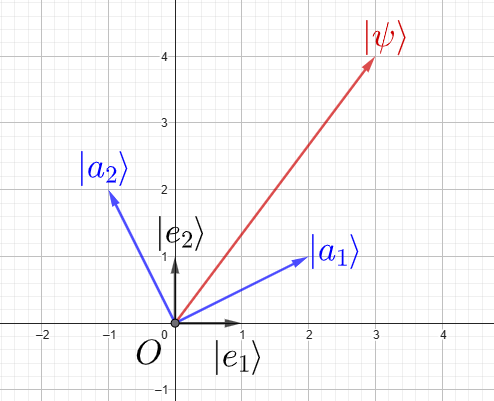
4. Example. In the image on the left are:
|a1⟩ = (2, 1)⊤, |a2⟩ = (-1, 2)⊤
two vectors written in the standard basis |e1⟩ = (1, 0)⊤, |e2⟩ = (0, 1)⊤. These two span the same two-dim-ensional space. They are also mutu-ally perpendicular, but not unit. There is also a state, a vector:
|ψ⟩e = (3, 4)⊤,
written in the standard basis. We are looking for the operator  of the given eigenvectors |a1⟩ and |a2⟩, and their eigenvalues a1 and a2 which will repre-sent the corresponding observable A.
Solution: The auxiliary matrix (Modal matrix) of the given observable A is P[|a1⟩, |a2⟩] with columns eigenvectors, the states of the observable. Hence the matrices for A = PDP-1, i.e.:
\[ \hat{A} = \hat{P}\hat{D}\hat{P}^{-1}, \] \[ \hat{A} = \begin{pmatrix} 2 & -1 \\ 1 & 2 \end{pmatrix} \begin{pmatrix} a_1 & 0 \\ 0 & a_2 \end{pmatrix}\cdot \frac15\begin{pmatrix} 2 & 1 \\ -1 & 2 \end{pmatrix}, \]where for a1 and a2 in the diagonal matrix we can take any eigenvalues of the given states. We find:
\[ \hat{A} = \begin{pmatrix} \frac{4a_1 + a_2}{5} & \frac{2a_1 - 2a_2}{5} \\ \frac{2a_1 - 2a_2}{5} & \frac{a_1 + 4a_2}{5} \end{pmatrix} = \begin{pmatrix} \frac65 & -\frac25 \\ -\frac25 & \frac95 \end{pmatrix}, \]where the eigenvalues are chosen to be a1 = 1 and a2 = 2. Check for these two that indeed Â|a1⟩ = |a1⟩ and Â|a2⟩ = 2|a2⟩.
Let us further decompose the given state in the quantum state |ψ⟩ into two given eigenvectors, comparing the notation in the two bases:
|ψ⟩e = (3, 4)⊤, |ψ⟩a = (x, y)⊤ = x|a1⟩ + y|a2⟩,
\[ \begin{pmatrix} 3 \\ 4 \end{pmatrix} = x\begin{pmatrix} 2 \\ 1 \end{pmatrix} + y \begin{pmatrix} -1 \\ 2 \end{pmatrix}, \] \[ \begin{pmatrix} 3 \\ 4 \end{pmatrix} = \begin{pmatrix} 2x -y \\ x + 2y \end{pmatrix}, \] \[ \begin{cases} 2x - y = 3 \\ x + 2y = 4 \end{cases} \]x = 2, y = 1,
|ψ⟩a = (2, 1)⊤.
The point |ψ⟩ can be reached with two vectors |a1⟩ and only one |a2⟩. Finally, from |ψ⟩ = 2⋅|a1⟩ + 1⋅|a2⟩ it follows that ⟨a1|ψ⟩ = 2 and ⟨a2|ψ⟩ = 1. ∎
5. In quantum mechanics, these vectors can be complex, but they would alwa-ys be normalized and have real eigenvalues. Then the squares of the intensity, |⟨ak|ψ⟩|² for all k = 1, 2, ..., would be the probability distribution of finding the observable A in the kth state.
6. In the example, as in the general case, the scalar product of vectors, ⟨a|ψ⟩, is a measure of the extension of one along another. The square of the modulus ∥a∥²∥ψ∥²cos²φ of such an extension, |⟨a|ψ⟩|², is increasing as the angle φ or ∠(|a⟩, |ψ⟩) is decreasing. But the smaller this angle, the less present (directed) each of these vectors is in the further neighborhoods (directions) of the other.
Projection II » srb
Question: In the exercises, we calculate these characteristic values (Measure-ment III, 4) in reverse order, but it is understandable. The question is how to explain (2) and especially the collapse to the state |ak⟩?
Answer: Three topics have been started by this question. For the first, I will give an example of the "school" solution to the eigenvalue problem (Eigenva-lues), and the second was discussed in a recent answer (Polarization, 2). The third remains, the collapse of superposition, which Schrödinger (1926) also listed as one of the most difficult questions in quantum mechanics. To this day (April 22, 2025), it remains open.
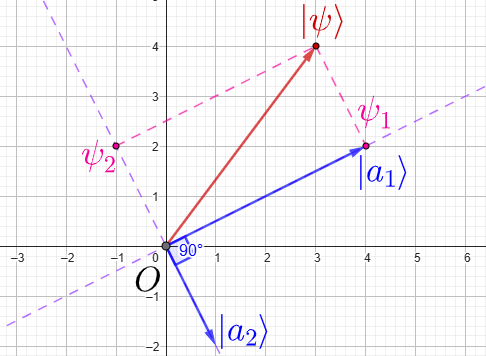
1. Example. Let's show that:
\[ \hat{A} = \begin{pmatrix} 1.4 & -0.8 \\ -0.8 & 2.6 \end{pmatrix} \]has eigenvalues a1 = 1 and a2 = 3 with corresponding eigenvectors:
|a1⟩ = (4, 2)⊤, |a1⟩ = (1, -2)⊤,
shown in the picture on the right.
Solution: We solve the characteri-stic equation:
Â|a⟩ = a|a⟩,
Â|a⟩ - Îa|a⟩ = 0,
\[ [\begin{pmatrix} 1.4 & -0.8 \\ -0.8 & 2.6 \end{pmatrix} - \begin{pmatrix} a & 0 \\ 0 & a \end{pmatrix}]|a\rangle = 0, \] \[ \begin{pmatrix} 1.4 - a & -0.8 \\ -0.8 & 2.6 - a \end{pmatrix} |a\rangle = 0, \] \[ \begin{vmatrix} 1.4 - a & -0.8 \\ -0.8 & 2.6 - a \end{vmatrix} = 0, \](1.4 - a)(2.6 - a) - 0.8² = 0,
a² - 4a + 3 = 0,
a1 = 1, a2 = 3.
The matrix  is symmetric and has real eigenvalues a ∈ {1, 3}.
Next, we solve the characteristic equation again, now twice with two known eigenvalues:
\[ \begin{pmatrix} 1,4 & -0,8 \\ -0,8 & 2,6 \end{pmatrix} \begin{pmatrix} x \\ y \end{pmatrix} = a \begin{pmatrix} x \\ y \end{pmatrix}, \] \[ \begin{cases} 1,4x - 0,8y = ax \\ -0,8x + 2,6y = ay \end{cases} \] \[ |a_1\rangle = \begin{pmatrix} 2\alpha \\ \alpha \end{pmatrix}, \quad |a_2\rangle = \begin{pmatrix} \beta \\ -2\beta \end{pmatrix}, \]with arbitrary parameters α and β. ∎
2. The example in the previous answer told us that given eigenvectors go with different matrices with their eigenvalues, and now we see that a given matrix and its eigenvalues correspond to different eigenvectors. Knowing that they describe observables, it follows that the perception of the observable is a ma-tter of the observer's viewpoint. It is a different view of the uniqueness of the subjects of perception. I explained it in a recent book (Information Coupling), but each perspective has its own insight.
Note that in the same image above, the particle is in a "quantum" state:
|ψ⟩ = ψ1|a1⟩ + ψ2|a2⟩ = |a1⟩ - |a2⟩ = |1⟩ - |3⟩.
Its eventual observation of this observable has no hesitation if we observe these vectors, states |1⟩ and |3⟩, only normalized. This is the meaning of the transferability of perceptibility, permanence, and truthfulness of “reality.” However, from the point of view of different subjects, the circumstances viewed more broadly are not unique. They are divided by the limited speed of light and distance, then by viewing angles, then by time, because not everyone is looking into the same past.
3. In the space of the Euclidean norm (L2), which is the only one used in ph-ysics, and of normalized basis vectors, the projections of the state of a given particle are the cosines of the angles it subtends, the sum of the squares of which is one. There is the above-mentioned explanation of the second part of the question. Let's try to understand the third and most difficult part by two parts.
The first part is by means of a projection, which, when it becomes observable, all alternatives are perpendicular to it and therefore inaccessible to it. Then, Shannon's information is used, which is the same for the uncertainty before realization as for the outcome after. This, together with the law of conservati-on of uncertainty, will not allow two or more outcomes (collapses) of the pre-vious uncertainty (superposition), not in the same reality.
Directions » srb
Question: Why do we represent states with vectors?

Answer: This is one of the funda-mental questions that cannot be briefly clarified, especially since it delves into unusual scientific nove-lties. First, states are vectors becau-se they are sums of quantum states, a representation of vectors. Second, because they describe directions, strengths, and distributions well.
1. Among other things, vectors can be sequences whose components are carriers of various observables (physically measurable properties) and whose larger number means a “strong-er” directionality of the state, or a greater commitment to some direction, its more likely determination. The more members such a sequence has, the better grounded, landed, or more “likely directed” we will see its state. We should di-stinguish this “commitment to direction” from the intensity of the vector, like, say, the dispersion from the mathematical expectation of a random variable.
2. In the conversation, I awkwardly (not my topic) touched on chromosomes, those small packages of information that define the development of the incre-dible complexity of an adult living being from conception. Thus, the human genome has three billion bases that have taken their places in 24 different ch-romosomes. Of these, 22 chromosomes are autosomes arranged from the lar-gest (the complex nuclear genome of over 99% of the total genome) to the sm-allest (the small mitochondrial genome), and the remaining two chromosomes are sex chromosomes: X and Y.
These 23 different chromosomes are in pairs, so we say there are 46 chromo-somes in humans. Monkeys mostly have 48, two more chromosomes than we do, and the number varies from species to species (List). As the secrets of the genome are revealed even better, I hope, their concept will be a better example of the vector-array directionality mentioned. A small number of their compon-ents in a huge number of possible combinations will be an example of the ini-tial impulse in the development of a complex adult individual based on mode-st initial instructions.
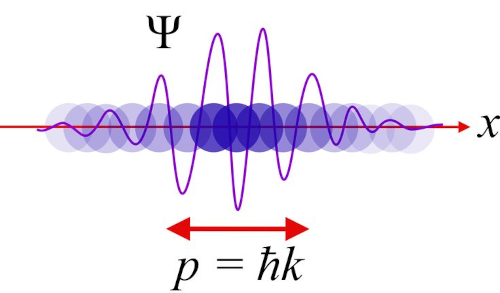
3. In a very simplified form, we already have everything we would like to talk about in quantum mec-hanics. For example, the image on the right shows the wave function of a free particle:
ψ(x) = Ae-ikx + Beikx,
where the constants A and B are determined by the given conditi-ons. This i² = -1, and the wave number k² = 2mE/ℏ². The mass m and the ene-rgy E belong to the particle, and ℏ = h/2π is the reduced Planck constant. It is easy to check that this function is a solution to the Schrödinger equation:
\[ \frac{d^2\psi}{dx^2} + k^2\psi = 0. \]Planck's constant h and frequency ν define the energy E = hν. Further using the angular frequency ω = 2πν we find:
\[ E = h\frac{\omega}{2\pi} = \hbar\omega = \frac{\hbar^2k^2}{2m}, \]where ω = ℏ²k²/2m. The independent solutions Ae-ikx and Aeikx of this, Schr-ödinger's time-independent, equation superpose to give the general ψ(x), and all three are vectors.
4. In the book Quantum Mechanics, from page 309 onwards, you will find de-tailed solutions to such problems for more complex quantum states.
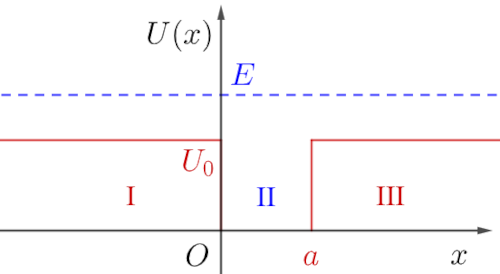
For example, in the figure on the left there is a so-called potential well along the abscissa (x-axis) where a particle of energy E > U0 can be found. The potential U(x) is U0 everywhere on the intervals x < 0 and x > a, while U = 0 on the interval x ∈ [0, a]. The solutions of the Schrödinger equation give a wave function in three parts for each of the regions:
\[ \begin{cases} \psi_1(x) = A_1e^{ik_1x} + B_1e^{-ik_1x} & x \lt 0 \\ \psi_2(x) = A_2e^{ik_2x} + B_2e^{-ik_2x} & x \in [0, a] \\ \psi_3(x) = A_3e^{ik_1x} & x \gt a \end{cases} \]The wave numbers in the first and third regions (I and III in the figure) are eq-ual to k1, and the wave number of the second region is k2. From the comparis-on with the previous one (3), we can easily recognize:
\[ k_1 = \frac{1}{\hbar}\sqrt{2m(E - U_0)}, \quad k_2 = \frac{1}{\hbar}\sqrt{2mE}. \]A more precise calculation of these numbers is not the topic now, nor is it an analysis of the constant amplitudes A and B. It is sufficient to note that such wave functions are vectors. They are linear combinations of an orthonormal basis of four vectors e±ik1x and e±ik2x.
5. When we have a superposition of very many (4) such basis vectors, and there can be very many of them in the object we hold in our hand, then the contribution of a single one is very small, it will be:
eikx = cos ikx + i⋅sin ikx ≈ 0.
Thus, the imaginary (i² = -1) of the micro-world in the macro-world disappe-ars, and with that, their bypasses disappear too.
On the other hand, the squares of the modulus of the coefficients in front of such vectors, |A|², are probabilities. Related to them, the Borel–Cantelli lem-ma states that when the probability series of a distribution converge, only a finite number of those events can occur with probability one.
|
|
|