|
|
|


Graduality » srb
Question: Why are natural changes usually gradual?
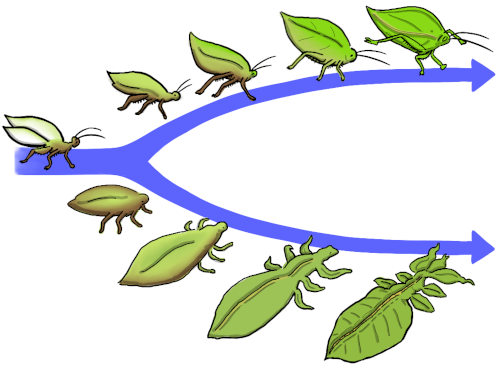
Answer: Unlike the descriptive an-swer to this question in science in general, here we learn the answer using the principle of minimalism. This is not the first time that I have been asked the same question, first of all, because easy answers to diff-icult topics confuse (Adaptation II), and then we are also bewildered by the principle of objective randomn-ess of this theory. These two, rand-omness and minimalism, are faces of the same theme. Namely, less probable outcomes are rarer and more informative, and they are against the principle of minimalism. Nature should develop into more certain ones.
1. Intuitively, we understand that equal outcomes have greater uncertainty. If we know that something happens more often and it happens, then it is not big news. Let's say a coin is flipped and it is twice as likely to come up heads as ta-ils, so the probability of the former is $p = \frac23$ and the probability of the latter is $q = \frac13$, then the Shannon information of tossing such an unfair coin is:
$$ S_1 = -\frac23 \ln \frac23 - \frac13 \ln \frac13 \approx 0,64 $$Shannon's information of a fair coin would be:
$$ S_2 = -\frac12 \ln \frac12 - \frac12 \ln \frac12 \approx 0,69 $$There is also a general proof of this (Extremes, 1.5). Nature will spontaneously move towards differences in order to move towards smaller uncertainties, like an unfair coin, and this actually means that it will move gradually.
2. The above general proof is for continuous probability distributions, but it is similar for discrete ones. Namely, the function $f(x) = x - 1 - \ln x$ has a deri-vative $f'(x) = 1 - \frac{1}{x}$, so its minimum is $f(1) = 0$, i.e. $f(x) \ge 0$ for all x > 0, and equality is achieved only when x = 1. Hence:
ln x ≤ x - 1,
so replacing x = qk/pk in order by k = 1, 2, ..., n where the sequences (pk) and (qk) are some probability distributions, therefore positive numbers which sum to one, by addition we find:
$$ - \sum_{k=1}^n p_k \ln p_k \le - \sum_{k=1}^n p_k \ln q_k $$where the equality holds if and only if pk = qk for each k = 1, 2, ..., n. On the left side of the inequality is the Shannon information distribution (pk) and if we put another uniform one, qk = 1/n, the right side will be:
$$ - \sum_{k=1}^n p_k \ln q_k = - \sum_{k=1}^n \ln\frac{1}{n} = \ln n \sum_{k=1}^n p_k = \ln n, $$and that is the information of the uniform distribution. So, an arbitrary distr-ibution (pk) has Shannon information no greater than the uniform distributi-on. This means that nature will spontaneously tend towards diversity and th-erefore gradualism. There is no random jumping of outcomes here and there, but they would rather all go through a bottleneck.
3. Given the mean, the mathematical expectation μ, of any probability distri-bution, the exponential has the largest Shannon information (Extremes, 1.6). The exponential growth (or decline) of a function is among the fastest known and applicable, and for this reason alone we feel that it might be "unnatural," that it spontaneously breaks down. Let us therefore look at where the expon-ential distribution occurs in order to understand its resistances.
When we toss a fair coin, the probability of getting a "tail" is $p = \frac12$, and that it will not come up is $q = \frac12$, when p + q = 1. If we toss a fair die, the probability of getting a "six" is $p = \frac16$, and that it will not come up is $q = \frac56$, so again p + q = 1. Let p ∈ (0, 1) be a constant number of the probability of the event A recur-ring and q = 1 - p of the negation of that event A', so let's find the probability that exactly in the kth repetition, A will happen for the first time.
In the first throw, this probability is p. In the second throw, it is qp, because A did not happen in the first (q) but only in the second (p). In general, in the kth repetition, A did not happen k-1 times, so the probability is qk-1p. This is a dis-tribution, as can be seen from the independence of these events and:
$$ p + qp + q^2p + ... = \sum_{k=1}^\infty q^{k-1}p = \frac{p}{1 - q} = 1. $$However, the individual probability of that distribution can be written:
$$ q^{k-1}p = \frac{p}{q}q^k = \alpha e^{-\lambda k}, $$which shows that we have an exponential distribution. We conclude that the constant repetition of the same thing will not be a desirable natural process, due to the principle of minimalism, and then that interference with interact-ions is desirable if some conservation law does not allow the decrease of un-certainty.
4. The state changes like news that fades with reporting, happily pushing thro-ugh the most likely outcomes, those bottlenecks. However, processes are also states, and the same rules of gradual changeability apply to them. They are a necessity, the changes themselves and their gradualness, but unlike other th-eories, this one is based on such a representation of natural phenomena. (July 18, 2025)
Solar System » srb
Question: That interpretation of the exponential distribution sounds like a fa-ntastic announcement to me. Can you elaborate on it a bit?
Answer: Exponential distribution (Graduality, 3) tells us about outc-omes and repetition without mem-orization. Then the principle of mi-nimalism tells us about the sponta-neous tendency to memorize. Seco-nd, they will tell us about the exist-ence of theories of perfect copying and will challenge the concreteness of such. Third, they will tell us som-ething about the ongoing loss of energy in the world and its constant replenis-hment. There is more, but let's stick to these three for now.
1. The exponential growth of a bacterial colony means that their number could double at a constant rate with each generation if their food sources did not die or become immune. This would be if the process of their reproduction could continue as it did at the beginning, and this is not possible as long as they are real and therefore last and have a past. What was before them affects the pre-sent by adding information to it and, by implication, directs the future with that past part. When an object is real, it is implied that it has exactly as much influence from its own past as it lacks uncertainty now.
On the other hand, the tendency towards more probable outcomes, or less un-certain states, drives fictions without duration and past towards reality. This is one of the reasons, namely the spontaneous necessity, for which untruths co-mbine with truths in living beings when they are able to do so. I hope it is clear here that not everything communicates with everything and that this property of information is consistent with its need for diversity.
2. The theory has no difficulty in perfectly equal repetition of, say, tossing a fair coin, with probability $p = \frac12$ of getting a "tail" and probability $q = \frac12$ of getting a "head." Then the probability that exactly in the kth toss, a "tail" will come up for the first time is:
$$ P_k = q^{k-1}p = \left(\frac12\right)^{k-1}\frac12 = 2^{-k}, \quad k = 1, 2, 3, ... $$and this is the exponential distribution. Putting λ = ln 2 ≈ 0.69, we can write this as Pk = e-λk, with the irrational number e ≈ 2.71828, the base of the natu-ral logarithm. However, specific natural phenomena that would perfectly ac-curately follow the values of this distribution (P1 + P2 + P3 + ... = 1) are not possible.
The information theory I am presenting here solves precisely this problem: how is it possible to have such a difference in the phenomena of theoretical perfections that are absent among concrete things, with an explanation der-ivable from its foundations? In short, a certain event has probability 1, and impossible event has probability 0 (they are not the subject of probability th-eory anyway), so the laws of nature (along with mathematical theorems) are also random phenomena. Due to their unlimited duration and zero energy (Δt → ∞, and ΔE → 0), universal abstract laws are special in their extraordinary attraction, which the concrete things that can read them cannot resist.
3. The quantum of action, Planck's constant h = 6.62607015×10⁻³⁴ m²kg/s, will always have the same value, but it is not always the same in terms of h = Eτ, because both the photon energy E and its duration τ at a given location are variable quantities. This is written as E = hν, with the meaning ν = 1/τ of the frequency of light. The longer the retention of that wave, the longer its wave-length λ = cτ, with the constant c = 299 792 458 m/s, the speed of light in a vacuum. As the frequency decreases, from gamma rays (1024 Hz) to long radio waves (1 Hz), the wavelengths increase from 10-16 to 108 meters and the cha-racteristics of light change.
Shorter wavelengths are less introverted photons, as ostentatious and commu-nicative, i.e., prone to handing over their information to the environment, and larger λ have particles burdened with uncertainty that cannot be easily resolv-ed. In this we see an analogy with abstract laws. The all-valid λ → ∞ are packe-ts of information (waves in the broader sense) whose transformation time do-es not stop (τ → ∞) and which are of great attraction to matter that can comm-unicate with them. Analogous to gravity that pulls where time flows more slo-wly, the greater the dilation of time, i.e., the larger Δt. I explain (2).
4. Information is the structure of space, time, and matter, and uncertainty is its essence. Literally. This means that the cosmos is also information both to-wards some environment (there is always more) and towards its interior, whi-ch contains intelligent beings like us or similar ones with the possibility of pe-rceiving some of the abstract laws, in total in all the ways in which they could be real (observable, permanent, and true). In addition, there are changes.
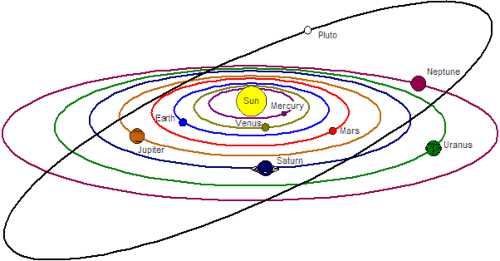
In the image of the solar system, above right, we can see different planets in orbits with different speeds. The closer body rotates faster. Something similar happens with the pieces from Saturn's rings (the first to calculate them was Ruđer Bošković in 1756, a Serbian mathematician), which gravity tries to tear and break into pieces, accelerating the near end and slowing down the far end. The position of my theory is that the energy of gravity is spent, but also that it constantly flows from the uncertain future (only uncertainty has an action and force). But, after millions of years of space, this flow is getting thinner, becau-se the present is becoming more and more certain. More and more uncertain-ty is captured by the past. (July 19, 2025)
Variety » srb
Question: The subject is unique, and if it isn't, then we have the theory?

Answer: It's like that; subjects have the property of uniqueness, so the-ories are multiple. However, art is also multiple, and every real numb-er, viewed in particular, is unique. Riesz's lemma states that every si-ngle functional φ of a finite-dimen-sional space X is determined by a unique vector y ∈ X such that φ(x) = ⟨x, y⟩ for every vector x ∈ X. Since the vectors are states, and their fu-nctionals are their information of perception, this lemma then estab-lishes the uniqueness of mutual perceptions.
The idea that the present and the cosmos are moving towards a more certain future because they are pushed by greater uncertainty into a smaller one, att-racted by slower time and its lower frequencies of events, is theoretical beca-use there are parallel realities around to which the same thing happens, and their global appearance is again a single subject in something, who knows wh-at, larger. If this is indeed the case, then this concept is also a repeated combi-nation of the unique and the multiple and an addition to the answer to the ab-ove question.
A good theory could have many more models and applications than those just listed, but that does not mean that we can easily recognize them. When we no-ticed that two plus two apples are four apples, to understand the theoretical value of the calculation 2 + 2 = 4, we needed to know that it would also be true for objects that we cannot even imagine. To a different question from the same conversation, whether this movement of the cosmos towards certainty will be of the same form as the immersion of a body in a gravitational field, I would not rush to answer. But, we agree, at first glance they have their common el-ements.
Concretenesses are the “atoms” of abstraction (Awry), and not vice versa. He-nce, good theories are the structures of a large number of particular realities, and therefore, they are observable, permanent, and accurate. However, if we have no ability to perceive concreteness nor experience with it, we have addi-tional obstacles in their generalizations, but neither of these is enough. For a deeper understanding of reality, in the way we know it, we need vitality, that is, more information than the substance of which we are composed has, and the ability to bridge, say, with lies (Deduction II). Theory is therefore an uni-maginably broad phenomenon for us, and subjects are something that seems small, something that we think we can perceive as a whole. (July 20, 2025)
New Quantum » srb
Question: Prof, have you seen this, physics has reached three dimensions of time and the "bypass" you told us about a long time ago?
Answer: Yes, I have been receiving such contributions from recently, and even congratulations on a good prediction, but not from physics officials. They privately support my work, as long as I do not mention them publicly. Three (and more) dimensions of time were my disc-overy using the topology method while I was finishing my mathem-atics studies (early 1980s). I was delighted and then disappointed by the ign-oring of my colleagues. We were all referred to the "more serious matters" of current events from the exercises and lectures of the scheduled classes. The Many worlds of quantum mechanics was not known at that time, and the au-thor of that interpretation (Everett, 1957), when it was "discovered" a couple of decades later, was generally considered a charlatan. It would be detrimental to the career of someone who would mention him.
It was a fortunate circumstance that I did not know the interpretation of the "Many Worlds," because then I might have diverted my idea to "string theory", which was emerging at that time. Not because of belief or not in these "strin-gs," but because of their possible influence on my inspiration and originality. String theory is about extra dimensions of space, mine is about more dimensi-ons of time. It turned out that I was not a team player and that by signing oth-ers up for "my team," I lost interest in further work. Popularity attracts some and repels others, I realized.
Working on the theories that were emerging in science at the time, I would not have arrived at a version of the theory of information, or information of perce-ption with three or more dimensions of time. This theory of mine is all the more repulsive to experts because additional dimensions of time have not be-en on the horizon in the discoveries of physics for a long time (until recently). Due to the "disappointment" in my colleagues (not really, because I liked an-onymity), my "information theory" is not anything like the known one; it is not just mathematics or just game theory, nor is it just physics, quantum me-chanics, or psychology, sociology, and the like. I use it as a starting point for all of them, especially in the connection of the living with the inanimate world, and not only the biological but also, let's say, the artificial tomorrow.
Victim » srb
Question: Is sacrifice worth it in game theory?
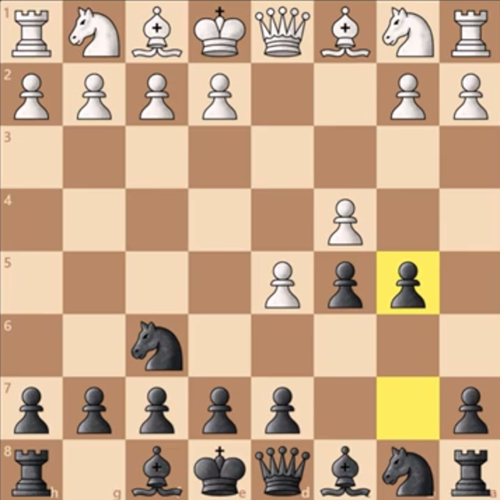
Answer: Indeed, the finding in computer games and simulations was unexpected. Professional nego-tiators often wax poetic about win-win outcomes, where both sides cooperate and compromise. In pra-ctice, the win-win strategy is never dominant. The lose-lose game almost always beats it.
1. Game theory originated with the discovery of the "minimax theor-em" from a completely different field of mathematics. It was disco-vered by John von Neumann in 1928 and applied to two-player zero-sum games where there is an optimal strategy. In this case, the player minimizes the maximum possible loss (minimax) while the opponent seeks to maximize the minimum possible gain (maximin). However, when there are too many moves or too little time, or if the opponent abandons his "optimal" strategy, for example, by temporarily sacrificing position, the player may find that the "minimax strategy" is no longer applicable.
2. In chess, the number of pieces is important, but so is their arrangement. One of the best players of all time was Capablanca, who during his ten years as world chess champion lost only one game to the then unknown grandmaster Reti (1924). It is difficult not to lose a game in chess, but Capablanca was an unrivaled master of positional play, optimal position, and guarding of pieces. And perhaps that is why he lost this game against the risky game of Reti. And indeed, he soon lost a match against Alekhine (1927), who was a master of the "crazy" game with frequent sacrifices of pieces. Sacrifices and gambits are very popular and successful in chess today.
3. Much more complex games are like economic, political, or war matches wh-en you respond at once to several independent levels and there is not enough time, nor is it possible to know all the moves. Nature acts according to the pr-inciple of least action and does not play, is not destructive, and does not care that we can constantly "defeat" it, who, along with its substances, also posses-ses vitality (excess information). That is why the worst players are those who behave in the manner of indestructible nature. I call them "goodies" (Traits), because they retreat before the stronger, do not take risks, and take only what they can, which is offered to them.
4. Players who have the power to lie and are carried away by it are "manipula-tors." They will almost always defeat the "goodies" with the attractive power of lies (the force of sparse information). But physical reality reacts poorly to fic-tions, does not see them and continues on its own path, leaving that middle league of players behind. They are almost always defeated by the "bad guys," who know how to read deceptions but appreciate reality better and react in a timely, measured, and creative way. It turns out that these strategies can be expressed algebraically using the sum of products and that the best of them roughly corresponds to reciprocity.
Taking out a loan for investment and eventual business success is a kind of sa-crifice for the sake of profit. Waiting for the opponent to “make the first move” (the gun in cowboy movies) or other inconveniences, as is political action on some other occasion, is a measure that pays off better. Letting a strong oppo-nent into your territory and creating a “cauldron,” as Russia likes to do in war, is a tactical sacrifice of territory for the sake of later victory.
5. Let the states a = (α1, α2, ..., αn) and b = (β1, β2, ..., βn) be from some vector space of the game with n = 1, 2, 3, ... dimensions. Then the scalar product is:
S = a ⋅ b = α1 β1 + α2 β2 + ... + αn βn
information perceptions, if αk and βk are corresponding pairs of their commu-nication intensities, respectively, for k = 1, 2, ..., n. Because S = ab cos θ, when a = ∥a∥ and b = ∥b∥ the intensities of individual needles that we can consider as hard to change (constant), and θ = ∠(a, b) is the angle between their vecto-rs that is easier to change, S will be larger when θ is smaller, because then cos θ is larger. In other words, when these vectors are more “parallel” (they do not have to be the same length), the vitality of their coupling is greater, the higher the level of the game. Hence, the “proportionality” of the response shows stre-ngth, and “originality” simply because uncertainty is a fundamental force of nature.
Penalty » srb
Question: You mentioned that punishment is like a sacrifice for gain?

Answer: Heh, heh, not really, actu-ally yes, but in a twisted metaphor-ical way. I'll explain, but you know, I've written about Crime and Pena-lty and otherwise.
Excessive punishment can paradox-ically increase the chances of more serious offenses. Although the inte-ntion of harsh punishments is gen-erally to deter crime, the practice of overly harsh punishments often sh-ows them to be ineffective and even counterproductive. This may be due to several factors, including the possibili-ty that punishments may be perceived as unfair, leading to resentment and a desire for revenge rather than deterring future criminal behavior. It may also be due to the reduced attention of investigators, who then rely on the power of fear of punishment, the attraction of greater profits due to less competition, and the like.
1. The first way of treating punishments is, for example, by monitoring the pe-rpetrator (criminal) in the state a = (α1, α2) and the investigator (pursuer) b = (β1, β2) with only two parameters αk = αk(t) and βk = βk(t) possibly dependent on time, index k ∈ {1, 2}. Let α1 be the criminal's gain if he were to succeed in committing a crime at a given moment, and α2 be the chance of failure of such an act. These numbers usually increase together or decrease together when a larger prize entails a greater risk. Similarly, but inversely, we have the invest-igator; let β1 be the reward for the captured fugitive, and β2 be the chance of failure. Also, these two numbers usually increase together, because a larger reward goes with a greater chance of failure.
2. The chances of success and failure are quantities related to probabilities, so we can define them as positive numbers that sum to one. It is convenient to then use auxiliary smaller quantities, not much larger than these, for the gains (and then multiply them later by coefficients proportional to monetary measu-res). Therefore, the commutator:
C = [a, b] = α1 β2 - α2 β1
is a measure of the gain from violating the law and is possibly dependent on time t. The principle of minimalism will tend to keep this quantity (C) const-ant when we limit ourselves to some general law, type of wrongdoing, and other circumstances, and this is then a phenomenon analogous to the motion of a charge under the action of a constant central force (Conics). It does not surprise us here to discover new regularities that we place within already kn-own frameworks, because the ultimate concreteness is unique, but their abs-tractions are not.
3. Not to mention Kepler's second law when we talk about crime and punish-ment, I will give another example of such a model that you have not heard an-ything about anywhere until now (today is July 22, 2025). Namely, we know that in a photon, the electric and magnetic wave phases are always perpendi-cular to each other and that they oscillate as the photon moves, spreading, normal to both.
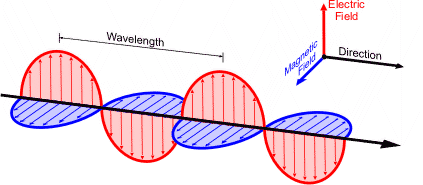
Each of the two phases, red electric and blue magnetic in the image on the left, has a wavelength and an amplitude that we can encode in the same way as a and b, the perp-etrator and the investigator in the previous one. Now the first is inte-nsity (of momentum), and the sec-ond is probability (of sight). When the photon is observed, it has not managed to spread further, like a thief who is caught stealing. The commutator [a, b] is |a| |b| sin θ which is the intensity of the cross product of the given vectors. So the mathematics of that calculation, I hope we know, is indisputable. Howev-er, the story of a far-reaching photon as a "crime that pays" is a twisted meta-phor.
4. Because of the amplitude that changes direction as the "thief's light" oscill-ates, it sometimes takes and sometimes returns profit. Something even worse happens to real thieves who often end up in prison and in severe minuses, but a planet orbiting the sun seems to be in constant profit, to make fun of my tw-isted metaphors at the end.
Thieves » srb
Question: How do you come up with ideas for examples like "robbers and co-ps" in quantum physics?
Answer: Boredom is a miracle. At one time, I was fascinated by the thick monograph Quantum Mech-anics, by Dr. Dragiša Ivanović, who was not my professor, with a colle-ction of various proofs of, say, Hei-senberg's uncertainty relations—a book I borrowed once and lost. I knew them all then, and I would invent some myself for fun. I regret that I did not keep a diary of those fantasies, from which, for reasons that seem strange to me today, I distanced myself and was ashamed to talk ab-out them, only for them to fade away over time after my studies. I have an ev-en stranger memory from that time, which is worth mentioning here.
One night, returning from my girlfriend, later my wife, I witnessed the arrest of a suspect in Belgrade on a street near Student Square, who allegedly broke a shop window to steal some electrical appliance. An elderly passerby was hyste-rically pointing at him and shouting to the few passersby around and to the police, “He’s the one, I swear on my eyes, he’s the one!” However, after a short while, the policeman did the right thing and let the suspect go. I was left with a strong impression that one should not trust one’s eyes, despite the common saying that a picture is worth a thousand words. For days, I would come up with situations from real life, then from physics and mathematics, that would reflect that impression.
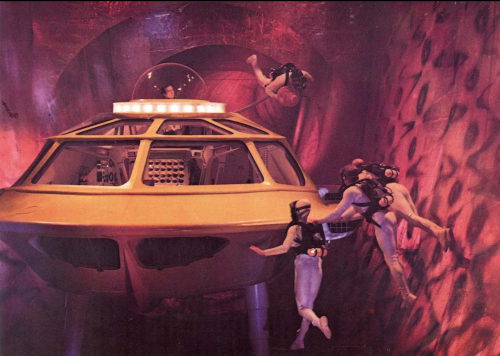
I also imagined little people, smaller than atoms, thieves and policemen who outplayed each other. I also watched movies about it (Fantastic Voyage, 1966), but of course, I knew that reduction changes physical reality and events, and that this is not the case in geometry. Volume changes with the cube, but surf-ace area with the square of the length, and I did not take homothety (uniform reduction of everything) as an "anomaly" of mathematics but as a consequen-ce of the assumed infinity that does not exist in physical reality. Anyway, my little "thieves" were particles, with impulses that would represent stolen pro-fits and lengths that would represent uncertainties. This corresponds to the above scene (Penalty, 2). That I was even "sillier" can be seen from the con-tinuation of that fantasy.
A micro-particle, that little thief, violates the rule "do not act, do not be provo-ked"; that action is only met with a reaction and with an equal force in the op-posite direction, jumping into our reality, stealing it, and appropriating to its-elf an momentum inversely proportional to the wavelength it occupies, which means the uncertainty of a given position, that is, the chance of failure of its misdeed. This is what one of the fantasies on the topic of uncertain relations that I avoided putting in the book Quantum Mechanics would look like, which is why it remained uninteresting and unfinished. The weaker the chances, the-refore the greater the uncertainties of the position Δx, that this particle mana-ges to steal momentum Δp, the smaller this uncertain momentum is, and the product Δx⋅Δp is of the order of Planck's constant.
What we see, what we measure in physics, are those tiny "thieves" caught in the act, and the real "life" of the honest ones takes place beneath that surface. And here we are in a story about vitality that bare physical substance does not have. So somehow one can fantasize about an otherworldly world beyond the physical, where we on this side are all sinners, unworthy outcasts, but perhaps precisely because of that, those who would envy them there. Or is there a wor-ld out there where imagination could do anything, but what dreams there sta-ys there? Continuing like this would lead to a lot of things, and as I said, things I'm ashamed to talk about. (July 23, 2025)
Fantasy » srb
Question: This explanation (Thieves) seems fantastic. Is there anything religi-ous about it?
Answer: Imagination is not burde-ned with truth like full information, and our brain, seeking meaning, flees into fantasies. This phenome-non is a vicious circle of “sweet lies” from which we somehow wriggle out through generations of scient-ists. The mathematical form is the truth I seek, and the idea of it is al-ways incomplete. It also happens the other way around; with seemi-ngly unrelated ideas, we cover the same truth, and it's always incom-plete. When we look at it this way, the given question becomes irrelevant. Dogmatic worldviews are inevitable, but some of them are further from the truth than others.
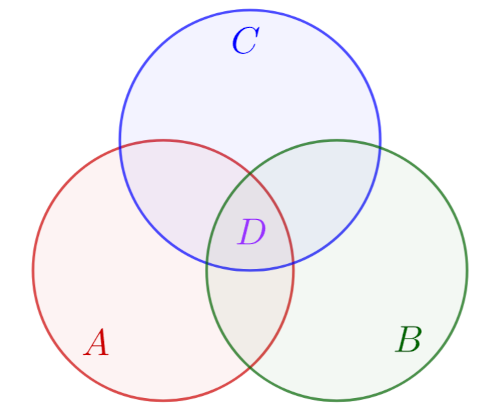
In the diagram above left, our idea of the world is A, some others are B, and the forms of truth are C. The ideal of democracy could be D, but in life it does not coincide with this intersection when, say, B manipulates the truth more successfully than A. We can change the previous fantasy (Thieves) a little and again get an equally accurate idea that the other world is a prison from which "criminals" escape by seizing the impulses Δp to obtain; the greater the chan-ces of successful escape, the less uncertainty of the position Δx. So again we have Δp⋅Δx ≈ h, and the wavelength, or indeterminacy Δx is also freedom ga-ined in a given attempt, but the world from which one escapes is "hell".
I avoid such interpretations and offer you, I hope, a better one. It is, first of all, in the equivalence of truth (⊤) and falsehood (⊥) in the entire algebra of logic, which is based on the bijection (mutually exclusive mapping) of, say, tautolo-gies (always true statements) into contradictions (always false statements) by replacing ⊤ with ⊥ and vice versa. Then there is reality (observable, sustaina-ble, and true) that fills our world in such a way that it does not allow others to approach. Those little thieves who insert themselves into it actually make up all of reality. They constantly push each other and never give up, thus mainta-ining reality. That is the third fantasy.
Each of the fantasies is worse than the others in some way, so borrowing helps in the search for truth. In my example (the third case), the idea of hiding from both previous ones helps when the thief gets hold of a smaller gain Δp from our reality by stretching along the greater uncertainties of the position Δx. Th-is helps in understanding the interference of waves (Wave in Wave), which are introverts with higher wavelengths and restrained in reactions with the envir-onment. Now we would say it is about the thief who remains a prisoner of his world outside ours because he has less chance of escape.
Compton scattering (Catch a Light) will help in both interpretations to under-stand the deflection of a photon by an angle θ when its wavelength increases from λ to λ'. An additional force is needed to make the photon move to a more uncertain path; that is my (third) description based on the principle of mini-malism. In other words, the photon is a struck, warned thief in a foreign land who is now having a harder time living in that foreign land but it is also more difficult for us to locate him, and that is the second, or first, description.
I hope we understand that in fact every interpretation of the world is fantastic and that there is no absolute, total truth about where we are. One that would be so true that nothing can be objected to it would challenge Riesz's Lemma about the uniqueness of the subject's experience and, simply put, would be mathematically untrue, therefore untrue. Namely, a uniqueness is the non-existence of another such, and here also the non-existence of a reference ar-ound which the others are grouped. Basically, these are vectors that are equ-ally represented everywhere.
Note that we do not need Gödel's theorem (Deduction II) for this position. However, it would also lead us to the same conclusions. Namely, if the theory is correct (it contains only truths), it is not complete (there are other truths), because truths are like islands that we (mathematically) bridge with lies (using ⊤ and ⊥, as well as the method of contradiction), which is a whole with untrut-hs, admittedly as auxiliary tools, but which formally merge into other fantasi-es. That is actually the convenience of the truths we are talking about. They are reached by different paths and various fantasies, none of which is "the right one" that we should keep and throw away all the others.
Antimatter » srb
Question: How is it possible that there are an equal number of correct and in-correct statements?
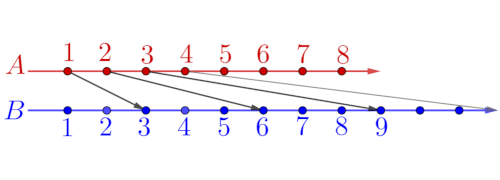
Answer: This question arises from the discovery, so far invisible in sc-ience, that we have a bijection ⊤ → ⊥ ("true" and "false") in the algebra of logic from which the equality of their "quantities" also follows. The-re are as many truths as lies in our two worlds, and it is as if the number of at least one of them changes, or the "world of lies" is unstable while reality on the other side is permanent. Anot-her thing in this theory, which is also so far unnoticed in science, is that info-rmation is the fabric of the world, that it is not infinitely divisible (it comes to us in packages) but is unbounded from above like the set of natural numbers ℕ = {1, 2, 3, ...}.
There is a similar, well-known, and still open problem in physics today (July 25, 2025) with antimatter, so I will reduce this question to that. It is the "ant-imatter paradox," more formally known as the matter-antimatter asymmetry problem, which refers to the observed imbalance in the universe where matter significantly outweighs antimatter, despite the expectation that equal amounts should have been created in the Big Bang. This imbalance is a fundamental puzzle in cosmology and particle physics.
In the concept where there can be as many elementary particles as there are natural numbers, in the figure above right, we note the possibility of joining A to B both sets of natural numbers, so 1 → 3, then 2 → 6, and so on ..., n → 3n, ... for each n ∈ ℕ. The sets A and B are of equal cardinality (have the same nu-mber of elements); this is a bijection, but there are three times fewer elements used from B than from A. This is the property that defines infinity, that it can be its own proper subset. In the case of annihilation (cancellation) of antima-tter A with matter B, it is possible that the latter remains "twice as much" as the former initially, even though there were "equal" amounts of them initially.
The assumption of infinity that we use here is not a problem for my theory of information, where what is real is what is perceptible, permanent, and true, and this includes the objects of mathematics with sets of ℕ, natural numbers. In particular, there is infinitely much information, as much as there is true as there is false in the way just described.
Vibrancy » srb
Question: What does "collective intelligence" have to do with the title synergy in that answer?
Answer: The synergy seemed obvi-ous to me, but I'll explain. The topic there is the Stein phenomenon; alt-hough it is not a simple theorem at all, it can be considered proven. But the novelty is the explanation of the same via perception information, which can be discussed.
It is a scalar product S = a⋅b that expresses the communication, i.e. the amount of interaction, that can be exchanged between two partici-pants a = (ak) and b = (bk), expre-ssed using two equally long strings (k = 1, 2, ...., n).
The coefficients of these sequences are the strengths of the corresponding inf-ormation changes and are easier to change than the intensities of the partici-pants themselves, a = ∥a∥ and b = ∥b∥. This means that to change the overall vitality, or ability to act, S, of the mutual interaction of the subjects, it is easier to rearrange their coefficients than to change their overall intensity. It is easi-est to explain all this using the 1-norm:
∥a∥ = |a1| + |a2| + ... + |an|, ∥b∥ = |b1| + |b2| + ... + |bn|,
but, the scalar, dot, or inner product is common:
S = ⟨a | b⟩ = |a*1 b1| + |a*2 b2| + ... + |a*n bn|.
The latter is the scalar product of the 2-norm (Euclidean), and even quantum when the coefficients are complex numbers (ak, bk ∈ ℂ), but we will work only with real numbers (ak, bk ∈ ℝ), and perhaps only with integers (ℤ) to make th-ings even clearer.
Let us consider the capacity S = ... + 3⋅5 + ... of communication of given states a and b given the corresponding members ak = 3 and bk = 5 of their sequenc-es. These can be the sums of groups or the common opinions of parts (works-hops) of participants. When there are opposing conclusions, we will give them different signs and write 3 = -1 + 4 for 5 = -2 + 7, taking into account the adju-stment (good with good, and bad with bad, and proportionality) in order to have the largest possible S. Then:
... + 3⋅5 + ... < ... + (-1)⋅(-2) + 4⋅7 + ...,
because 15 < 30, so by breaking it down into opposing groups the information of perception increases. That higher vitality there means a more accurate ass-essment. In games, it would mean a more intense game as in the "divide and conquer" strategy.
In the case of factoring into equals 3 = 1 + 2 and 5 = 2 + 3, we find:
... + 3⋅5 + ... > ... + 1⋅2 + 2⋅3 + ...,
because 15 > 8, so by breaking down into groups of like-minded people, the information of perception decreases. There (Synergy III) this would mean a weaker assessment, which we have after the campaign before the elections, or by employing like-minded people who have worse collective assessments in complex issues. In games, war, and issues of simple victory over the opponent, the consolidation of like-minded people gives the player greater strength. We also know this from practice. Isn't this a matter of synergy, when even fictiti-ous things combined become real (Synergy II), and in general groups of the same type exhibit more intelligent forms of behavior than individuals of that type, or when groups show properties that their individuals do not have (Emergence II).
The seemingly confused results of perceptual information come from the fact that at lower levels it speaks of a barren reality, but in a larger quantity also of the additional influence of vitality. The aim of this is no longer truth alone (as in the case of dead physical nature) but domination by means of fiction, with which then bare physical reality can be defeated. This is not easy to talk about in a simplified way to be understandable until you try some of it out in the al-gorithms of complex games. Then things become clearer.
Justice » srb
Question: You say that the legal system can be analyzed with the “information perception”. Can you clarify that?

Answer: Justice, in literature, is the concept of fairness, equality, and morality through the application of law by the power of the state in the distribution of benefits and burde-ns. Formally, law encompasses id-eas of fair procedure as well as app-ropriate consequences for actions and the protection of individuals from harm. Justice is also a system of laws and institutions designed to achieve these goals. There is more, but he-re I reduce “justice” to, essentially, increasing or at least maintaining the level of acquired freedoms. Punishment, in contrast, is enforced by the deprivation of freedom. Plain and simple.
The legal system is an imitation of natural laws and their shaky superstructure and is in accordance with our vitality, which is also a shaky truth on the dead nature that we also contain but that cannot lie. The goal of a healthy legal sci-ence is to increase, or at least maintain, the level of acquired freedoms of the wards. Law seems to oppose the principle of minimalism. This is again an im-itation of the principle of least action in physics and speaks of laziness to cha-nge the amount of uncertainty if it is not possible to reduce that amount. In this subtle "impossibility of reduction," we also find the desire of the living to remain alive.
When we throw a stone, giving it an impulse that will make it fly high, it will also be affected by the constant acceleration of the earth's gravity, which will take away the impulse from us and will eventually consume and overcome it. Any body that flies up like this will fall down. It is similar with living beings. By their birth, they acquire an impulse for development in the midst of a pr-incipled minimalism, then the death instinct, which, with its constant action, ultimately defeats vitality. The goal of law is the distribution of equality among the inhabitants of a just state, because this means supporting maximum info-rmation, that is, its justice. When we put portions in front of the same animals (cats, dogs, monkeys) and give them unequal amounts of food, they will feel injustice. They instinctively, like people anyway, feel the lack of information that eventually comes to them, because the greatest information is in the uni-form distribution (Extremes). An unjust state is one that does not give them such portions.
Complications arise with otherwise unequal citizens, for example, according to “merit” (whatever that is). A good rule of law would be one that would still manage to maintain fairness with the greatest available distribution of infor-mation by giving more to the more deserving. In that contribution (I don’t have it in these blogs), I do not discuss the definition of the term “merit” or the valuation of such, but only assume that it is given in advance. That was about reducing the “rule of law” to “information of perception,” and I conti-nued to use the methods as in the previous answer.
I will skip these numerical details here and go straight to the final question: what happens to a state whose law is “alienated” (Latin alienatio—something separate, foreign to something) from the role of giving impulse to the vitality of society? Such a state becomes “oversaturated” with laws when laws multiply and become an end in themselves (some correct others) or “anarchy” when it is far from the optimum of capabilities and limitations (Completion), which means less freedom for creativity and development of society. These are “cr-iminal” societies, or “dying” societies dominated by the death instinct. I have mentioned them several times (Hierarchies, 4) giving examples of states, or empires, oversaturated with laws, after which their downfall occurred. It wo-uld certainly happen, but the alienation of justice accelerates the decay of vitality.
Continuation » srb
Question: It seems normal, but are you defining "justice" the wrong way?

Answer: I deal with forms so that they achieve the accuracy of math-ematics. Otherwise, whenever pr-actice is confronted with such a truth about itself, the latter would prevail. In the long run, truth is al-ways right, and that is why we work so hard for it, because we want to be on the winning side. If I happen to come across such an accurate ex-planation of “justice,” then the legal systems of the then and precisely for that reason advanced countries will bow to that truth.
1. Life, for example, can also be viewed incidentally, as a misfortune that befell this planet. It encountered a kind of combination of indestructible matter with impermanent fiction, the first combination of inanimate and vital, which allo-wed substances to avoid the very principle of least action in physics, where lies rode on the truth and subdued it. The tendency to kill each other, both plants and animals or people, “logically” explains the intolerance among us, those cr-eatures, in addition to the poor and powerless matter that would get rid of us if it could. In this explanation of understanding how we limit ourselves in free-doms through legal systems, it seems that this is exactly what we are doing wi-th law, that we are helping inanimate nature by limiting our freedoms and ar-bitrariness.
2. The misfortune is increased by the incident that a living being manages to reproduce, so its natural mortality is postponed in the transfer of vitality thr-ough generations of descendants into species and collectives, and in humans into states and civilizations, which will further defy the principle of least acti-on of a simple and innocent physical substance. Statistically, there are clearly more and more such chains because they survive like weeds. The legal system can thus be a "finger in the eye" of that innocent, giving efficiency to society in the destruction or subjugation of the rest of the world. We have seen (Comple-tion) that there is an optimum of ability and limitations that maximize these unwanted freedoms of the new scourge. Formally, I do not see a problem in such an observation of life, but it is noticeable in this extension of its mortality into offspring, into colonies, and into our civilizations that it seems as if what is alive wants to be alive as long as possible.
3. Law shows itself as a younger brother to the laws of nature, still immature but promising, and experienced would say, and worthy of them. In this transi-tional form of the above interpretations, from destructive to fraudulent to an-other fighter for the prolongation of the life of one's own community, the legal system can be seen as a continuation of vitality itself. The equality of all the above interpretations would mean that we should not look for meaning in th-em, but we can also make the theory more palatable. Such a fiction that gives life to a dead substance is a type of vitality that itself fights for life, for its own duration. And a good legal system for it is one in which that life is better nur-tured.
4. If the truth is reached in this way, legal states will follow it and be as succ-essful as all ideas supported by mathematics. Since then, with the turn into a truly scientific law, this previous one will be remembered as a period of naive and random wandering in the darkness of primitive times, dictatorships, and tyrannies, when law did not serve to improve the life of the social community. This will be because it was previously impossible to know what the vitality of society was and how exactly to increase it. Communities that do not want this doctrine will lag behind. From the link to the image above, we can see that so-me groups believe in the role of mathematics (now only algorithms) in social science, without even knowing whether it is worth it.
Supervention » srb
Question: Politicians today see leadership as stealing, bribing, and intimidati-on. How is that?

Answer: Social science has not yet come to understand the state as an extension of the vitality of its citize-ns. In the meantime, corporations emerge as market leaders, managi-ng to control the same citizens and, with their higher-order skills (Trai-ts), subverting politicians into their market as middle league (the “ma-nipulators”), subordinate to them (the “bad guys”), and which more easily governs the lower league (the “good guys”), otherwise with a sufficient majority of voters.
These assumptions are supported by the classical theory of society (Good Ru-ler), which Kant rounded off with the idea of a "good ruler" who "acts and ju-stifies" (fac et excusa), then "denies his mistakes" (si fecisti, nega), and occa-sionally uses Caesar's maxim "divide and conquer." This is the concept of a "selfish ruler" that easily degenerates into one of the questions of we and is nested between the upper and lower leagues. However, the theory of infor-mation that I explain here understands the "state" in a completely different way, which is an extension of the vitality of its citizens.
1. When I point to a stone and say that it is a flower (Ax = 0), then I am not telling the truth, but if I point to a flower and say this is a flower (Bx = x), it will be true. Not in the language of the algebra of logic, but of linear vector algebra, the first sentence can be simulated with:
$$ \begin{pmatrix} 1 & -2 \\ -2 & 4 \end{pmatrix} \begin{pmatrix} 2 \\ 1 \end{pmatrix} = \begin{pmatrix} 0 \\ 0 \end{pmatrix}, $$and the second by:
$$ \begin{pmatrix} 3 & -4 \\ -2 & 5 \end{pmatrix} \begin{pmatrix} 2 \\ 1 \end{pmatrix} = \begin{pmatrix} 2 \\ 1 \end{pmatrix}, $$but these are not the only ways. More broadly, all false processes are fictions, and they do not tend to last nor to be observed. Linear operators are also vect-ors, so we can view fictions as their null spaces, as in the first case, vectors that give zeros under their operators. There are also null-processes that vanish un-der such processes:
$$ \begin{pmatrix} 1 & -2 \\ -2 & 4 \end{pmatrix} \begin{pmatrix} 2 & 6 \\ 1 & 3 \end{pmatrix} = \begin{pmatrix} 0 & 0 \\ 0 & 0 \end{pmatrix}, $$for example, as a fictional story in a novel. However, it is possible that the sa-me ones are the reality of some reality.
2. Looking at random, such random combinations will give an unlimited num-ber of truths and falsehoods, and since some fictions, ceasing to be false, can become real, they resemble, say, a game of dice throwing where the outcome of a "six" excludes a lucky player from further repetition, while other outcomes would force it into new throws. Thus, there would be more and more stopped "sixes," as well as reality (observable, permanent, accurate phenomena). The postulation of objective randomness of this information theory does not exc-lude such events, provided that we have an explanation of the law of conser-vation, for example.
It is not difficult to imagine a model of such a game with very low probability "dice" of "six" such that the number of desired outcomes is balanced by the rate of arrival of a multitude of new ones that constantly arrive in the present. Add to this idea a delay into the past, and you will have approximately what we are talking about. The good thing about models is that they can be applied to other situations. Here, first of all, the emergence of life by combining dead physical substance with fictions. In the picture above right, genes are made of DNA with text below the link that should conjure up the aforementioned mul-titudes.
3. A similar model, or a game of random numbers, is also valid for the trans-mission of traits from parents to offspring, and even more so when we talk about the evolution of biological species on Earth. Then fiction, and perhaps matter itself, seem to us to be fighting for survival, or for the latter to escape the dungeon of the principle of least action. It is also a model; looking at more frequent outcomes of events with higher probability seems like a greater “de-sire” of some than others. I believe that it can be dragged far to the point of possible contradiction. At times, the way of describing is juicy, more human than the forms of mathematics.
Then, such a picture can be extended to social phenomena and similarly to the “evolution” of legal systems. The evolution of biological life is not always on the rise, just as legal systems after the Roman Republic were not a level above it. So, leadership today does not have to be at the level prescribed by Kant, al-though even that is lower than what it could be. Observing these winding lines of the “evolution” of vitality, the conclusion is imposed on us that a good legal system should actually be one that is an extension of the vitality of our society.
4. Nature does not like equality, because equal outcomes are more informati-on, and more informative are those that have greater uncertainty and less pro-bability. This is the essence of the principle of minimalism and the principle of smaller effect. However, vitality likes greater equality, so it is unnatural in this sense. The goal of increasing vitality is always in the broadest defiance of natu-ral spontaneity, and this is where we should look for a “good state,” and not, say, in Kant’s recommendations mentioned above, and even less in the beha-vior of the leaders in question.
Looking at known biological species, we find a common structure in cells, int-egrity for the survival of the whole, and different roles of hierarchies scattered across bodily functions. Consciousness is one of these small hierarchies respo-nsible for generally supervising them while they make fairly independent de-cisions. The most successful states, or rather their legal systems, are likely to develop in this direction. It is not easy to oppose the force of local diversity, but life can take advantage of spontaneous global convergence. Future states will tend to have similar systems of organization, but with greater local free-doms.
Influence » srb
Question: Can we change spontaneous global convergence willingly?

Answer: Yes, but very difficult. It is initially just a local issue of the diff-erence in influence from manipula-tion (see image link on the left), which grows into a growing effort to hinder the growth of those dif-ferences. Game simulations show that this grows into a "pie more expensive than a casserole" (Tra-its), poorly paid for by the mani-pulator.
1. There is Mark Twain story about two characters who meet in a meadow and the first asks the other what his occupation is, and the second replies that he is a cattle herder. Okay, tell me—asks the first again—when there are three cows on a plain and one is looking in one direction, where are the other two looki-ng? And what a stupid question you have, says the second. How do I know where the other two are looking? Those cows can look wherever they want. Well, never mind,- says the first again. You are a weak cattle herder if you don't know that all three cows then first look in the same direction.
2. Mark Twain's story speaks of the need for imitation, the persuasion power, and, more broadly, of globalism. It is such resistance that is barely noticeable to manipulation at first; it starts with a spontaneous desire to differentiate in a locale when the initiatives of "fraudsters" (weak imitations of reality) are wel-come, but as events develop, the laws of large numbers take over and the dep-artures from their expectations and dispersions become increasingly larger anomalies and less likely outcomes, which has its price. Uncertainty is power, and defiance of it means a cost, and when that cost exceeds the power of the manipulator, his world collapses like a house of cards.
3. For example, birds flying through a dark tunnel instinctively avoid head-on collisions by turning to the right. (Birds Avoid). A manipulator could train one of his flocks of birds to turn left in such situations, but in a wider context, they would be the unfortunate ones in new flocks who would suffer more often. Th-is is a picture for insight into the development of fraud, which, due to the im-possibility of knowing all the consequences of illegal (unnatural) actions, can turn into losses that ultimately exceed the total previous gains.
4. Another example, all "good" leaders are justifiably afraid of rivals or subo-rdinates whose successes could overshadow them, and by working "smartly" each will surround themselves with those less capable. This negative selection also exists from civilian to military leadership (the Roman Senate against Cae-sar), which is why some countries are “unexpectedly” unsuccessful in the eve-nt of military conflicts. We usually see them as Islamic countries (whose civi-lian intelligence is further diluted by religious intelligence), but in principle they are dictatorships that grow into tyrannies. Within themselves, they wield enormous power of state apparatuses but in the hands of less capable people, while against them they gain other weak state powers but more capable and often more numerous attackers. This is also alienation and a recipe for failure.
5. Third example. Watching directed film actions with conversations along wi-th the activities, one can notice an unnatural alternation through the utterance of the actors' texts. When one speaks, the others are silent, waiting for their turn. But, in reality, the speaking of one often inspires the idea and story of the others, so the stories are told in harmony with many digressions. The inte-rlocutors interrupt each other and make the spoken topic shallower but more vivid by participating in other ways of communication. Nature also tends to diversity, but we would like to restrain and impoverish it through direction.
Approaching » srb
Question: I really liked the story about local outreach and global inreach. Do you have any other example?
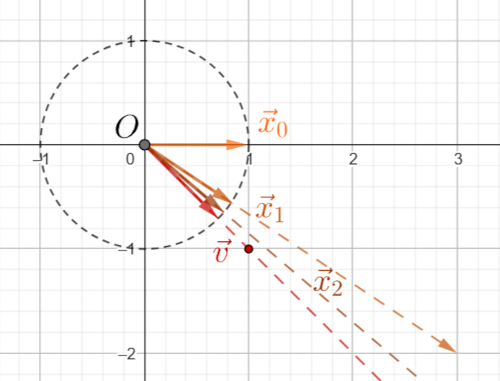
Answer: In contrast to the sponta-neous local dispersion of all natural phenomena, there is a similarly sp-ontaneous global clustering (Global Convergence). I am usually asked about this because of geopolitics, which is not my subject, so I give the example of tariffs used by all countries (globally), but with di-fferent percentages of tariffs (lo-cally), and my interlocutors sur-prise me with some much better examples. One gave an interesting example of an atomic bomb explosion (Mushroom) whose particles violently flee from each other (locally) but still remain a mushroom-shaped cloud (gl-obally). I will stick to my domain and this image at the top right.
1. Let us consider a process represented by the matrix B (Supervention, 1), whose characteristic equation $B\vec{v} = λ\vec{v}$ has two solutions:
$$ B\vec{v}_1 = \lambda_1 \vec{v}_1, \quad B\vec{v}_2 = \lambda_2\vec{v}_2, $$ $$ \begin{pmatrix} 3 & -4 \\ -2 & 5 \end{pmatrix} \begin{pmatrix} 1 \\ -1 \end{pmatrix} = 7\begin{pmatrix} 1 \\ -1 \end{pmatrix}, \quad \begin{pmatrix} 3 & -4 \\ -2 & 5 \end{pmatrix} \begin{pmatrix} 2 \\ 1 \end{pmatrix} = \begin{pmatrix} 2 \\ 1 \end{pmatrix}, $$with eigenvalues λ1 = 7 and λ2 = 2 of the given matrix B and their correspondi-ng eigenvectors v1 = (1, -1)⊤ and v2 = (2, 1)⊤ in the same order. It is easy to ch-eck the correctness of these equalities by direct matrix multiplication. The first eigenvalue is dominant, |λ1| > |λ2|, therefore every vector $\vec{x}_0$ by concatenating with this matrix will converge to v1, i.e.
$$ \vec{x}_n = B^n\vec{x}_0 = B(B^{n-1}x_0) = B\vec{x}_{n-1} \to v_1, \quad n \to \infty. $$This approximation occurs in increasingly short steps that give a common glo-bal picture to the multitude of starting vectors.
2. The specific results of multiplying the initial vector, say $\vec{x}_0$ = (1, 0)⊤, with the given matrix B, i.e. $\vec{x}_1 = B\vec{x}_0$, $\vec{x}_2 = B\vec{x}_1$, $\vec{x}_3 = B\vec{x}_2$, ..., are:
$$ \vec{x}_1 = \begin{pmatrix} 3 \\ -2 \end{pmatrix}, \quad \vec{x}_2 = \begin{pmatrix} 17 \\ -16 \end{pmatrix}, \quad \vec{x}_3 = \begin{pmatrix} 801 \\ -800 \end{pmatrix}, ..., $$or shorter $\vec{x}_n = B^n\vec{x}_0$ for n = 1, 2, 3, ... . It is possible to normalize these vect-ors by dividing each by its intensity and obtain their different lengths, but the same directions. Then in 1-norm x1 = |3| + |2| = 5, however the same vector in 2-norm has intensity $x_2 = \sqrt{3^3 + 2^2} \approx 3.61$. In general, in p-norm this vector has intensity:
$$ x_1 = \|x_1\|_p = \left(3^p + 2^p\right)^{1/p}, \quad p \gt 1, $$which is a (new) decreasing sequence with increasing p ∈ (1, ∞). The unit vec-tors are then with vertices on the unit circle, the dashed line in the given figu-re, but which is of a different shape for every other p. Without going into those details, we have what is in the figure. The angles between these vectors do not change, and it is important for us in the further explanation.
3. Each of the vectors in the sequence $\vec{x}_n$ can be the starting point of a new sh-ortened sequence without the previous terms but with the same ones that foll-ow them. Noting how the angle between the neighbors of the vectors in this sequence decreases in steps, this tells us about a general phenomenon. How-ever, the non-normality of these vectors is also expressive.
The intensities of the vector series in the image increase and approach the di-rection $\vec{v}$ = (1, -1)⊤ so that there is an increasing compression around increasi-ngly distant points in a given direction. This well expresses the law of large nu-mbers of probability theory, order with decreasing dispersion around expecta-tions, i.e. gathering around a certain state value. Another matrix will have a different gathering than this B, but a large number of such, like a block matrix, will still have its own group gathering. Simply put, nature works that way and it is our only chance to perhaps notice such a property of hers and eventually use it.
4. Our entire cosmos has this orientation. In addition to it, there are additio-nal dimensions of time that expand similar local options and add some global directions to each one so that all of them converge again into some new globa-lism. So great is the certainty of mathematical prediction that the question now arises: what about its symmetries anyway, and how does everything wh-ere it is applied turn out to be in one river and one single flow, or have we mi-ssed something?
I have already mentioned part of the solution that bothers me about this que-stion. It is the fading of the transmission of information further and further into the past, so that at the end of the journey we have a “black box,” such a long Markov chain transmitter that based on the received message we cannot know what it was that was sent to us. This is in each of the aforementioned cosmoses, so that no reasoning or measurement is possible to see through that black barrier. So, the past is not at all what logic and observations tell us, and, moreover, it may even change itself.
Memories » srb
Question: How does the past change?
Answer: 1. We think of memories, but we change them every time we remember them (Memories). Every time we remember a story or tell it to others, we change small parts depending on whether it seems too good or too boring to our audience. Then, when we retell it, we remem-ber only those last versions, and the errors accumulate like in the childr-en's game of broken telephone or the loss of a message to noise through a Markov chain (information transmit-ter). That's one way.
2. A subject is a state, an interpretation of a vector in some space of states that it can perceive. The inner product of such two vectors is information of perce-ption, the power of mutual perception of two states. But there is one and only one vector that expresses such a coupling, the functionality of space, and that means the uniqueness of the subject. In short, every subject that perceives so-me environment, including inanimate physical objects whose interactions are "perceptions," sees the common environment differently, and here we are thi-nking especially of its common past, then of its own past. In other words, that subject is constantly changing, and its common and own past, as it sees it, is changing. This is not the same as changing memory (1), but it is fundamenta-lly different.
3. Data transmission sooner or later has errors, external interference, or cha-nnel noise that we interpret using the Markov chain. It was mentioned above (1) in memories, but it represents a broad class of transmitters to interpret and dive into the past. Reality lasts and, therefore, has a history that forms a whole with its present. Knowledge of the past is information (information is the structure of space, time, and matter, and uncertainty is its essence), but the further and further into the past we get, the less and less of it we have. The further and further past is burdened with increasing “channel noise,” and sin-ce we constantly travel further and further from that past into our future, the event of the past fades; the past is constantly changing for us. This is the third way.
4. The question above all is whether the past can be changed in the same way as it would be changed by the position of a distant star, since the light that co-mes to us from there actually testifies to its past. After some time, the constel-lation of these will change, albeit slightly, negligibly, but not at all differently from all three previously listed ways. I have thought about this in a positive way, especially in connection with the twin paradox (Twins II), but since I also have a radical solution to that paradox, it would be too much to present this now. Let that fourth way wait for some future opportunity.
Opposites IV » srb
Question: You say that opposites attract in principle. What do you mean by "in principle"?

Answer: In principle, it is in certain circumstances. There is no manda-tory attraction or repulsion, nor re-st, and in that sense the vocabulary was a bit excessive. For example, individuals of one biological species are directed towards each other, to avoid a perhaps hostile environme-nt. However, over time it turns out that the common life of more simi-lar people can be more harmonious. For example, due to lower community co-sts, or due to lower uncertainties (otherwise repulsive), or living beings are in-dividuals.
2. The supply of cells (A → B), e.g. metabolism, delivery of calories and eryth-rocytes, or oxygen, and the like, can be simulated by a “transport problem”, as in the following diagram. From positions A1, A2 or A3, quantities of 35, 40 or 45 are delivered to positions B1, B2, B3 or B4, whose demands are 25, 35, 45 and 15, respectively. In the middle of the table are the delivery costs per unit of quantity. We are looking for the lowest transport cost.
| B1 | B2 | B3 | B4 | Given | |
|---|---|---|---|---|---|
| A1 | 4 | 1 | 6 | 3 | 35 |
| A2 | 2 | 7 | 4 | 8 | 40 |
| A3 | 9 | 5 | 3 | 2 | 45 |
| Search: | 25 | 35 | 45 | 15 | 120 |
This is one of the problems of the so-called linear programming that we are now solving in third ways. First, let's ignore the cost for a better understand-ing of the method.
2. A1 starts with his 35 units of goods and first leaves 25 pieces in B1 so that the remaining 10 arrive in B2. B1's position is settled, and B2 demands anoth-er 25. A2 moves and gives his 25 to B2, and puts the remaining 15 in B3. Now B2 is settled, and B3 demands another 30. Then A3 moves and puts 30 of his 45 in B3, so that the remaining 15 reaches B4 to complete the transport.
When we calculate the cost of such a deployment, we find:
C2 = 25⋅4 + (10⋅1 + 25⋅7) + (15⋅4 + 30⋅3) + 15⋅2, C2 = 465
monetary units in common transport, or communication units.
3. When supplies start by paying the cheapest route, then A1 hands over all his units of goods to B2. Then A2 gives 25 to finish with the requester B1 and is le-ft with 15 undelivered, while A3 at the same price (2 per piece of goods) leaves 15 to B4 and keeps 30. Then the goods of price 3 are delivered, so B3 receives 30 from A3. Finally A2 leaves the remaining 15 to B3.
| B1 | B2 | B3 | B4 | Given | |
|---|---|---|---|---|---|
| A1 | 4 | 1⋅35 | 6 | 3 | 35 |
| A2 | 2⋅25 | 7 | 4⋅15 | 8 | 40 |
| A3 | 9 | 5 | 3⋅30 | 2⋅15 | 45 |
| Search: | 25 | 35 | 45 | 15 | 120 |
When we calculate the cost of the new deployment, we find:
C3 = 1⋅35 + (2⋅25 + 4⋅15) + (3⋅30 + 2⋅15), C3 = 265.
That's a cost of 200 units less than the previous mode of transportation.
4. This process (3) is found in nature, for example, in the flow of water (liquid) through connected vessels. Water first occupies the lowest levels, which are gravitationally most probable (cheapest), and then fills higher and higher po-sitions.
Another example is calculating the "amount of similarity" of triangles, where now greater similarity would be a "cheaper commodity" (Opposites III), which also makes sense given that gradualism (Adaptation II) has a natural advanta-ge.
The relationship between opposites attracting (say, bisexual reproduction has an advantage) and likes attracting (by uniting for efficiency) is a separate topic that belongs more to "local separation and global union" (Approaching).
Barycenter II » srb
Question: Why do black holes rotate?
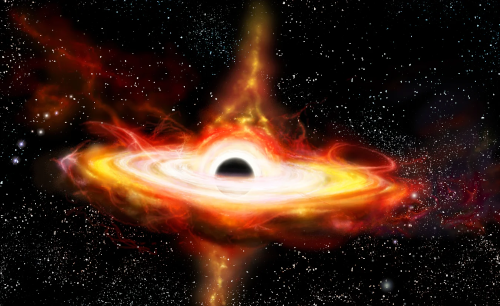
Answer: I received a comment bel-ow the image on the left asking if I had ever wondered why galaxies ro-tate, why planets orbit stars, how come so much of it orbits a black hole. I wrote about this before (Ba-rycenter), and this answer can also be added to such a question. (Today is August 3, 2025.)
My answer also explains precess-ion, so I will first explain the finding about it from the point of view of (my, private) "information theory". Precession is otherwise the slow movement of the axis of a body that rotates about another axis due to a torque. While Mer-cury orbits the Sun in an ellipse, precession is the rotation of the major axis of Mercury's ellipse in the direction of the planet's rotation. Each of the planets in the solar system has a similar precession, but it is smaller and negligible in an increasingly weak gravitational field.
The basis of this theory is information and uncertainty as the weaving of spa-ce, time and matter, and the part that I call "reality", among other things, has duration. This means that (real) space remembers and also acts on the present through information, and this effect is primarily reflected (reality is at least somehow observable) in the action of gravity, perhaps by "dark matter".
As two bodies revolve around a common center of gravity, i.e., barycenter, the influence of gravity from their pasts on the present is increasingly faint, and that happens at high speed. The gravitational force weakens with the square of the distance and the time dimension due to the high speed of light in vaccuum c ≈ 300 000 km/s quickly becomes negligible (ict, i² = -1, t elapsed time). In this way I explain the stronger past influence of the closer second body, which is the tail that drags behind the star and pulls the precession of the planet.
The larger body pulls everything from the smaller one's surroundings into ro-tation in one plane. This is how the flat structures of Saturn's rings, the solar system, or the glowing rotating mass around a black hole are created, dragged by part of the plane behind the larger body that escapes around their center of gravity. Once obtained, the angular momentum is maintained as well as recti-linear motion outside gravity. The motion of an arbitrary mass in a direction past the center of any gravity is plausible, and if such a passage occurs, it eas-ily becomes a victim of angular momentum. On the other hand, those rare objects that pass, or fall into the center, are only moments in these circular repetitions.
This contribution that was sent to me today, that official physics, would bene-fit from a similar explanation from the previous part of this answer, but those are ideas that have yet to mature there.
Degeneration III » srb
Question: Why do you call the possibility of choice a degeneration?
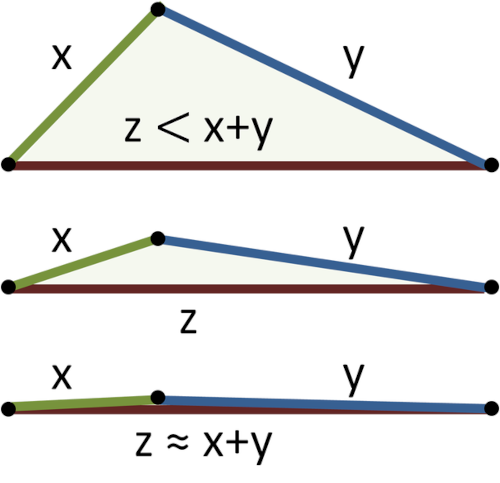
Answer: It is common to call the state or process of becoming in decline so that it gets worse a de-generation. In mathematics, deg-enerate refers to a simpler case of the general and often a limiting case when the properties of an object are simplified to such an extent that it is qualitatively dif-ferent from the general case. For example, when the upper vertex of a triangle is lowered, in the figure on the right, then it degenerates in length into its lower base.
In particular, a degenerate linear operator in vector algebra would be a linear mapping that is not invertible. Th-is means that its kernel (null space) is non-trivial, i.e., it contains more than just the zero vector, or its image (range) is not the entire target space. In sim-pler terms, it is a linear operator that "compresses" the dimension of some vectors, mapping them to the same output or to the zero vector.
The kernel of a linear operator T is the set of all vectors x that such an opera-tor maps to the zero vector, such that Tx = 0. When there is at least one non-zero vector (x ≠ 0) in the kernel, the operator is degenerate. Otherwise, the image of a linear operator T is the set of all possible outputs of that operator. When the image is not the entire target space, the operator is degenerate. As in the image of the degeneration of the upper triangle, if we take all vectors x from some vector space X on which a given operator T acts and in doing so we do not get all vectors of that space, but its proper subset Tx ⊂ X, then the ope-rator reduces, or simplifies, that space, and we say it is degenerate.
A degenerate operator reduces the basis of a vector space to a smaller number of basis vectors. Therefore, its image cannot span the entire original space, and it is not an invertible mapping; there are equal copies of different origin-als and therefore losses of the original space. With more original than input so that the same original has more copies. This brings us to the question posed: the possibility of choice is degeneracy.
1. For example, a stochastic triangular matrix (Degeneration II) degenerates when it is scaled, which means that when it acts repeatedly, mapping a vector, we get a non-invertible matrix. From the copy we know the original more and more vaguely, so that in the end this mapping composition becomes a "black box" (we cannot know the input from the output).
2. Examples of degeneration are also found in applications of this algebra, us-ually rarely noticed or misunderstood. Civilizations, also collectives (not only living beings), lose information in the manner of the aforementioned stocha-stic matrix while transmitting their collective memories (procedures and hab-its) that preserve their way of life, or in general content consistent in principle minimalism. They age like that. Living beings and their communities as semi-living entities literally age, and structures decay, and materials exhaust and tire. Even the cosmos slowly loses the information it leaves as a trace of its past, with the present losing the density of uncertainty. All of these degene-rations actually come with choices.
Illusion II » srb
Quesion: You say reality lasts and the past fades (Illusion). Do you see a contr-adiction in that?

Answer: Yes, it's paradoxical. At a first glance it's contradictory, but not otherwise. Here's how I answe-red a similar question earlier (Line up), and the point is as follows.
Stronger gravity slows down time more, so even astronauts floating in space have a somewhat slower flow of time than the surrounding vacu-um. Vacuum, therefore, moves to-wards the future faster than any su-bstance. It is further calculated that there is more and more space, indicating that the universe is expanding. I note that what I am talking about is mostly unknown to official physics.
However, the differences are what matter. If we assume that in the beginning, some 13.8 billion years ago, the cosmos was a homogeneous soup and that th-ere was no difference in the speed of time inside, from our point of view it cou-ld have lasted infinitely long. It did not matter how fast time flowed, whether it went infinitely fast or stood still. Photons arriving from the vicinity of that period bear witness to those moments by standing still for them and being, in this way, both there and here at once. But, in the same way, they also bear wi-tness to the infinitely fast flow of that time.
If we were to hypothetically travel back in time to the Big Bang, we would en-counter less vacuum than we do today and an increasing average density, but the big question is whether we would ever reach that beginning, which today seems 13.8 billion years away. This is the paradox of the slowing down of time that happens in the present. The time of the very beginning can stand still or flow too quickly, all the same, so that the end seems ever closer to us, but that we can never reach it.
On the other hand, the slower our time flows, the further away the past seems to us, the longer it is, and so the very slowing down of events seems to create history. It is as if we are in the “illusion” of a self-creating past and in the du-ration (reality) that defines itself. I say alleged illusions because we have no way to prove their (un)reality. Namely, a mathematical concept is without the possibility of proving its ultimate (in)accuracy and equally ultimate (un)real-ity. Physical measurements do not help here, nor do they help in proving, say, the Pythagorean theorem.
Sparse structures (weaker gravity and deep vacuum) have less present sheddi-ng and a weaker contribution to the formation of the past. These differences in sum behave like series:
$$ \frac12 + \frac{1}{2^2} + \frac{1}{2^2} + ... = \frac12\cdot\frac{1}{1 - \frac12} = 1, $$ $$ \frac13 + \frac{1}{3^2} + \frac{1}{3^2} + ... = \frac13\cdot\frac{1}{1 - \frac13} = \frac12, $$...
$$ \frac1q + \frac{1}{q^2} + \frac{1}{q^2} + ... = \frac1q\cdot\frac{1}{1 - \frac1q} = \frac{1}{q-1}, $$when q > 1. Similarly, we arrive at the aforementioned (Line up) equal ages of the cosmos from everyone's point of view of the surrounding present. Hence this story has no contradictions, nor does the assertion that mathematics in general is as correct as it is incorrect.
|
|
|