|
|
|


Equilibrium III » srb
Question: Are rotations expressions of spontaneity?
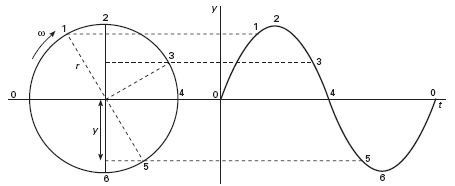
Answer: Yes, rotations are a way of spontaneous processes, but they are not the only spontaneity (with-out external action). We are talking in general, about rotations such as linear mappings and applications.
1. In the picture on the left is a cir-cle on which a point moves with a projection onto the vertical (sine) axis and its second representation as an ordinate with the abscissa traversed by an an-gle. The right part of the picture is a wave, a sinusoid (Rotor, 5), say like a qu-antum free particle:
ψ(r, t) = Aei(k⋅r - ωt),
where A is the amplitude, Euler's number e ≈ 2.71828, the imaginary unit has i² = -1, then k is the wave vector, ω is the angular frequency, and t is time. In the case of the macro world, we only take the real parts of such wave functio-ns. These are sinusoids or cosines:
Re(ψ) = cos(k⋅r - ωt + φ)
depending on the phase shift φ. The spontaneity of this particle, its unimped-ed movement, supports what you are emphasizing in this question.
2.If we assume that the force between two electrons at rest is attractive, it is unstable, because as soon as the electrons move relative to each other, the force between them will be repulsive and will continue to be repulsive (Cu-rrent). The magnetic field that circulates around a conductor does not resist the electric current but supports it. It neither adds to nor reduces its sponta-neity but rather participates with it. This is also done by the circulation of the electric field around the magnetic field, and the above question adds new significance to both. It is similar to the circulation of the planets around the sun, which are made to cooperate in spontaneity by gravity. Similar to angular momentum, and when we think about it more closely, similar to moment of inertia.
3. We develop spontaneity in skill through training, learning, and repetition. The brain loves the familiar and, through play, develops preferences for visible and unconscious rules, more fun than forced, but still, both become more enj-oyable by expanding the network of knowledge in a given area. Chess masters remember (possible) positions more easily than novices, but they also play th-em more easily; in fact, they find positions less often than they “remember” them. Namely, the greater the mastery, the larger and better established the base of subconscious routines.
This is analogous to the tendency of natural phenomena to follow natural la-ws. I have explained, and now I only mention that omnipresent and therefore omnitemporal truths are receptive to information that recognizes them. Their attraction or stickiness comes from their principled minimalism and packagi-ng within physical action, the product of energy and time, with internal info-rmation having priority, having longer wavelengths.
4. In such extreme bindings, free uncertainty and natural regularity, events show their tendency to travel in isometries, with processes that do not change them. Rotations are of this kind, but they are not alone in this. There are other processes that are in equilibrium with themselves and maintain the status quo until some external force begins to act on them. There are other processes that are in equilibrium with themselves and maintain the status quo until some ex-ternal force begins to act on them. Some of them can be a sufficiently broad, separate topic.
Hypergamy » srb
Question: What are the processes "in equilibrium with themselves" that are not rotations or isometries?
Answer: Markov chains, for exam-ple, if they are neither isometries nor rotations, converge to a "black box", a series of links that also form a stochastic matrix, but based on the output information it is not possible to know the input. They are such a common topic here that it is almost impossible for me to find an example that I have not already commented on.
The sexual attraction of intelligence (Development) is one of my rarer topics, but as a very tenacious "hypothesis", which lasts and lasts without wi-der mention, it is worth building and testing. Especially for the latter, let it be an example of the "Markov chain". So, the evolution of colorful feathers in some birds, antlers in deer, or similar "anomalies", develops beyond the bare survival of eat or be eaten, also fight or flee.
In humans, long ago, there was a sexual attraction to intelligence. It was a ph-enomenon atypical in the development of life on Earth, because dinosaurs ru-led for hundreds of millions of years and did not become more intelligent, and countless other species arose, survived, or disappeared without the need to be-come more intelligent. Overly striking colors can expose a bird and make it ea-sier prey for a predator, but for this very reason they can also be evidence of survival. These are the characteristics of various sexual attractions that can lead a species to a dead end, but (at least in the meantime) also be an example of "equilibrium with themselves".
Nature "does not like" equality because a homogeneous probability distributi-on has maximum mean (Shannon, 1948) information, so the diversification of biological species is also constantly ongoing. For example, the universal appe-al of "good looks" (relative) as an additional, perhaps, guarantee of survival, protection, and good offspring, and then "power" as dominance over indivi-duals of the same species and again a similar guarantee, and in humans also "money," which is a new aphrodisiac in millions of years of evolution. Develo-pment into differences maintains evolution, if not its intermediate products.
Sexual attractions are more important for the survival of the species if they are not mutually dependent. Thus, the traits of players of League II (manipulato-rs) are significantly different from those of League I (evil) or League III (good) players, and each of them has its own virtues and vice versa (consumers). Let's put it this way, having intelligence goes beyond political power and vice versa, it is similar with money. Not every intelligent person is born into a rich family, nor do those with academic degrees have the best salaries. Intelligent people can often lack an obsessive need for money.
Altruism » srb
Question: How do you calculate the "amount of similarity" of individuals?

Answer: Let's be clear, pure curio-sity drives me to make such asses-sments, without the intention of them being anyone's standard or the work of any institution. Seco-ndly, the theories from which I en-ter these stories are difficult for this place, and the simulations and exp-eriments are very boring (except for a few), then sporadic and, for practical use, unfinished. I will retell them so you can see for yourself.
1. I described one of the ideas (Facial). I have a bunch of modules, often forgo-tten or useless, for types of "smiles," types of behavior, or types of fingerprints, and even combinations of genes. They are mostly unorganized or disconnect-ed, unlike my Python models on the Kodovi page. And many are useless data strings for many. It is enough to know that the structure of genes (AGCT) can also be treated in the manner of similar polygons.
When searching for relatives, stochastic matrices and Markov chains help, but you need very long sequences of "probability distributions" and fast compute-rs, or a lot of patience. The idea is that the stochastic matrix M has a determin-ant less than one, |det(M)| < 1, so |det(M²)| < |det(M)| and det(Mn) → 0 wh-en n → ∞, so that chain, or series of degrees, can be an interpretation of the species in evolution.
2. When A = Mn we are talking about, say, the n generation. For a little n = 1, 2, 3, ... the determinant should be close to unity, det(A) ≈ 1, because we are working with descendants of close relatives. Slightly longer sequences hide similar species and small deviations of that determinant from the maximum, and in an even longer sequence there will be the origin of the species. Serious such classifications are too difficult to make for personal use and are only so-mewhat interesting. However, if you do not rush towards some goal, unusual insights will start to pop up on their own.
3. Procreation transforms individuals into species. Fictions seem to yearn for reality, even by their very incorporation into living beings, and the process of inheritance shows that this is not just a case but a general trend of random se-lection. Simply put, those who do not reproduce are irrelevant or are not visi-ble, and duration seems like an intention. Thus, maternal care for one's own offspring survives and strengthens. The empathy of a species for its own little ones, which escalates among football club fans as well as in political party aff-iliations or in nationalisms, is a continuation of this tendency. Even further, for example, is altruism as an advanced form for the purpose of maintaining the species. These are some of those "unusual insights" that emerge as work-ing hypotheses along the way.
4. It turns out that the “anomaly” of sexual attraction (Hypergamy) that will drag an individual away from bare survival in some random combination also becomes a benefit for the species, so to speak, altruism, in addition to its sim-ple survival in reproduction. There are no guarantees, but after all, we now know that the risk of increasing the brain, that large and seemingly useless consumer, in the first Homo sapiens paid off. If we go further into the past, a good investment was also the emergence of the first species from the sea onto land in the late Devonian period, about 363 million years ago. The land was then a wasteland, like Mars today, and you had to be “crazy” to seek happiness there.
Trace of Truth » srb
Question: What do game simulations show, is it worth manipulating?

Answer: Try to understand this br-ief explanation (Deduction II) of Gödel's Incompleteness Theorem to understand the scope of pure truth and then its power in reality which is observable, indestructible, and true. In other words, the power of lies is like a match that burns out quickly, strongly illuminating the traces of truth that exist as in a sh-adow but last and last. With lies, as in mathematics, which depends on inaccuracy (statements are as true as they are false, the method of contradict-ion starts from falsehood, and so on), its only goal is truth, naked, pure truth.
1. You can switch from truth to truth with deceptions, but giving preference to tricks will mean a decline in the skill of the game. Then you can still win if the opponent is even more prone to lies. There are optimums for calibrating the game against strong opponents that I discovered using "perception informati-on" (an unofficial theory of mine) from which they performed well in tests, so much so that I have a description of personality Traits based on them.
Simply put, a winning program must be a good reader of reality; it should not hesitate to use "good" for "good" (support for gaining an advantage) and "bad" for "bad" (disruption of loss), proportionally to its available resources and how much more unpredictable. It is proportional not to let the program show off both "good" and "bad" (however you define gaining and losing), and uncerta-inty, let's say creativity, is actually the basis of power, the driver of everything in nature, assumed in (my) theory of information.
2. For example, a bad chess player gets bogged down by implementing his own misjudgments, not preventing the other side's evil moves, as the minimax the-orem would recommend, or doing so less often than his opponent (Strategies), until he reaches a position where there are no good answers. It is similar with modern politicians (manipulators) who are used as puppets by the players at the top (evil) to rule those at the bottom (good), electing them or creating th-em, trapped by flaws from which they can only have directions determined by their masters.
In this sense, "freedom is power" (Completion). The ability to solve problems increases with freedoms and decreases with restrictions. This freedom incre-ases with both, or rather with the product of the two, and reaches its maxim-um (product) when the factors are equal, and then it has the greatest power (options drive all of nature). Or let's take Visibility. It is proportional to the chance that such a person will be in focus at the optimal moment and the information it represents at that time. Simply, manipulate, but only to follow the path of truth.
3. From the previous answers and the evolution of biological species, one gets the impression that fictions long to not be, to be realities, which is actually just as true as the observation that we see them alongside realities simply because we do not see the others. Staying in the game, therefore, means enduring and sticking to the truth. Thus, by striving to be alongside the three factors of real-ity—its presence, toughness, and accuracy—we stick to a winning strategy. De-scending into a lie will help like a swing, but swinging a pickaxe and hitting nowhere can become futile, exhausting, and ultimately certainly losing from the point of view of those real games.
4. In normal life, in addition to the “life instinct,” a kind of principle of self-preservation, we are also driven by the “death instinct,” which is another form of, let’s say, principled minimalism. That is why we want to have fewer optio-ns: to be subordinate or superior, to give up our freedom for the sake of belo-nging to a collective, to lie even more, and to gamble on victory. The desire to be unsuccessful is equal to the desire to survive, and that is why we often co-mpromise, “wanting” the best for ourselves while in fact deceiving ourselves. This is shown by game simulations, the truth that hurts.
Maintenance II » srb
Question: How physically realistic is "rotation"?
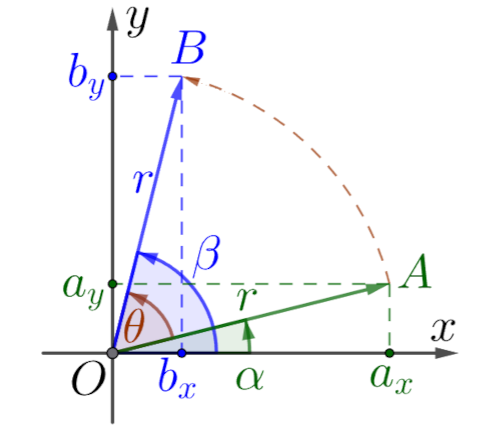
Answer: It's a good question, be-cause "physical reality" is just one of the types of "reality" defined he-re. The basic idea is that the first has energy, while the second only needs to be an observable, perma-nent, and true phenomenon. This difference will tell you that "physi-cal reality" does not include mathe-matical truths, which we somehow perceive and are not destructible. Therefore, the "rotation" in the im-age on the left is an abstraction, not like the rotation of an asteroid aro-und its axis (Rotor). This time we are not talking about persistent information, which has been a more common topic here (Maintenance).
1. In the figure, there is a quantity r that does not change when rotated by an angle θ as it transitions from state A(ax, ay) to state B(bx, by). We calculate:
bx = r cos β, by = r sin β, bx = r cos(α + θ), by = r sin(α + θ), bx = r[cos(α) cos(θ) - sin(α) sin(θ)], by = r[sin(α) cos(θ) + cos(α) sin(θ)], bx = r cos(α) cos(θ) - r sin(α) sin(θ), by = r sin(α) cos(θ) + r cos(α) sin(θ), bx = ax cos(θ) - ay sin(θ), by = ax cos(θ) + ay sin(θ),
\[ \begin{pmatrix} \cos\theta & -\sin\theta \\ \sin\theta & \cos\theta \end{pmatrix} \begin{pmatrix} a_x \\ a_y \end{pmatrix} = \begin{pmatrix} b_x \\ b_y \end{pmatrix}, \]and thus we reduce the rotation to the multiplication of matrices and vectors RA = B. We abstract what is important, that the rotation does not change the magnitude r. The interesting thing about this result is that the determinant of this matrix, det(R) = 1, determines the maximum "amount of similarity" betw-een states A and B, when compared to those of previous estimates. However, that's not the same.
2. The rotation matrix (R) is for vectors of standard, so-called Euclidean, or 2-norm, and its equivalent would be the stochastic matrix relating vectors of 1-norm. Such determinants are of value only if their columns are permutations of the columns of the identity matrix. In other words, the only certain events would be equivalent to rotations in Markov chains, which is the negation of those chains themselves that describe stochastic processes.
3. In this theory of information, there are no other processes except stochastic ones, even if they are as certain as we (due to the laws of large numbers) see them in the macro world. If we return to the topic, physical reality, we will no-tice that there are no described rotations (R) except as mathematical fictions (broader realities).
The Moon, as it rotates around the Earth, slowly recedes. Saturn's ring is fed by the geysers of its moons so that the pieces that rotate with it slowly appro-ach the planet. In general, the rotations of physical objects have disturbances and losses of momentum due to friction. We describe light with the wave equ-ation and rotation, and the one that comes from distant galaxies changes color because the sources move away and the wavelength of the light increases due to the Doppler effect. There is no mathematically perfect rotation in the phy-sical world.
4. After Gödel's theorems (Deduction II), the impossibility of a complete (tr-ue and only true) theory to be complete (to contain all truths), it is easier to understand the incompleteness of rotation, and in general isometry, the pro-cesses by which we represent conservation laws. As in the explanation added there by means of islands of truths, which, as I have given the example of ma-thematics, we bridge working by lies, here the constancy of quantities should be overcome by means of their inconstancy.
Uniform distributions have maximum information, so nature spontaneously creates differences. However, without these differences, it does not get far, as we can see through the discoveries of game theory (Reciprocity), where it was noticed before me that the strategy of combining only good with good (win-win) is among the weakest. When we include the possibility of sacrificing for the sake of winning (lose-lose), we increase the chances of winning along with inevitable losses. It is a fact that physical reality itself would not have the app-earance we know without, at least invisible to us, using the general "reality".
Voids » srb
Question: Did you know that there is a theory that the universe is expanding, not because of "dark energy", but because of its voids?
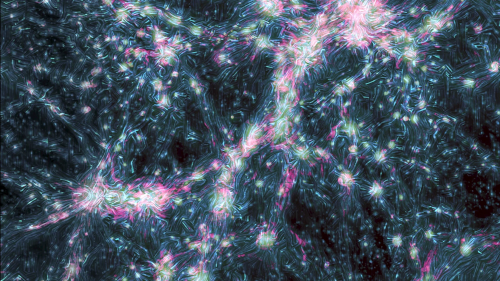
Answer: Yes, I know it. However, let's not say that this is someone's completely new idea, or that it is now developing from my earlier texts, if we see it here as a long-known option. At the heart of it is a space that remembers, the reality of space, and its ability to accumulate memories of the universe. An old topic of my information theory, and I often mention it (Gravitational Memory).
Along with it, we have the theory of relativity with different speeds of time in gravitational fields of different densities. In the space between substances, ti-me flows faster, the past settles faster, and the cosmic vacuum grows. Howev-er, that was not the end of this story. The universe grows because it is all info-rmation; that is, it is a subject of change in relation to which everything has become variable, and even what seems to us to be the same all the time if it is isolated. Therefore, the universe, once in growth, will grow constantly; that is, it will not develop into the same previous states.
Nearly 13.8 billion years ago, it was more likely that bosons would turn into fe-rmions, space into substance, because there was little substance, so that over time these chances would equalize, and even reverse, when there would alrea-dy be more and more space and less and less matter (Universe II). This does not come from such rapid changes in natural laws, which my theory otherwise accepts over very, very long periods, but rather the simple presence of the sa-me active ones depending on the moment or environment. Nevertheless, this and the previous reason for the expansion of the universe can go together.
Filaments are lines of those cosmic voids that appeared like cracks in a weak wall. They continue to expand and separate the places of stronger bonding of the cosmic fabric, because they are places where time flows faster and farther in its past, leaving dark matter (the gravitational attraction of the past towards the current substance). The filled islands remain in their embrace, as if they do not want the future, as usual in repulsion towards its uncertainty, not kno-wing that now there is more and more emptiness. That emptiness turns out to be a repulsive gravitational force.
In this concept, infinity is objective. It was also observed by Zeno, who chall-enged it in aporias, and today we can talk about its applications in the infini-tesimal calculus of Newton and Leibniz and its final acceptance in mathema-tics through the works of Cantor. Along with all other mathematical truths, infinity is permanent and "real". Therefore, I do not expect a uniform repeti-tion of this universe, in expansion and contraction, or any other, just as there are no exact physical rotations (with a rational angle).
Good Ruler » srb
Question: Why don't you tell me something from "game theory" that could be used in normal life?
Answer: Okay, Caesar's maxim "divide and conquer" was put in third place by Kant for "good" rulers. The first is "act and justify" (fac et excusa), and the second is "deny your mistakes" (si fecisti, nega). All three have their places in the ranking of characters by success (Traits). They flash like a match, but what burns out does not burn again. That was the case with the Roman Empire after the rise of the Roman Republic, or the empire of Louis, the Habsburg monarchy, and Britain as important followers, above all, of Caesar's maxim.
1. The perception information, S = a1b1 + a2b2 + ... + anbn, tells about the possible intensity of communication between the subject a = (a1, a2, ..., an) and the object b = (b1, b2, ..., bn). The greater the number of S, the greater the power of communication, the higher the vitality, skill, or intensity of the game, if it is a competition. Dead physical nature is not played with; it simply surre-nders and does not care about losses because it is indestructible. This is fortu-nate for us who have vitality and can subdue it, and my "game theory" traces the causes and ways in which this is possible.
2. It is often not possible to change the intensity of the subject ∥a∥ or the ob-ject ∥b∥, but it is possible to change the intensity of their communication, the scalar product S = a ⋅ b. The trick is to set priorities. Like placing tables in fr-ont of a cafe, from the furthest positions to the closest, the most important, although the most difficult, has priority. Formally, for greater success, the subject assigns larger elements to larger elements of the object. When b1 > b2 then a1 > a2 should be for S to be larger. Namely:
(a1 - a2)(b1 - b2) > 0, a1b1 - a1b2 - a2b1 + a2b2 > 0, a1b1 + a2b2 > a1b2 + a2b1.
So, by combining the larger with the larger coefficients of the opponent, the player achieves a higher level of vitality. This already requires "vitality" (an excess of freedom compared to a dead physical substance), because nature does not "play" like that; it always combines the smaller with the larger and the larger with the smaller, and the weakest player is (Reciprocity). Wherever you have the opportunity, establish the order "larger with smaller and smaller with larger" and you will raise the level of the game.
3. For this rule, it does not matter whether the numbers are positive or neg-ative when the reactions of the subject (a1 > a2 > ... > an) are ordered by the actions of the object (b1 > b2 > ... > bn) simply because the scalar, dot product, a ⋅ b = |a| |b| cos∠(a, b), is larger if the angle ∠(a, b) between the competito-rs is smaller, and it grows by matching the coefficients. Thus, mark the oppo-nent's bad influence with a negative number, the more negative the influence, and act negatively on it, because the product of negative numbers gives a po-sitive number.
So, act “good” to “good” and “bad” to “bad” wherever possible. By failing to react, say, by “turning the other cheek” or by waiting for “karma” to take its course, you are relegated to a lower league of players, and when the other side does not do the same or makes that mistake less often, you lose the game. Yo-ur capacities are limited, so by overdoing it, transfer to many it, or underdoing it, you will run out of “ammunition” (for good or bad) where it is beter needed. That is why it is important to stick to the line of optimality, and that is why to-plevel playing is so difficult, not the game for everyone, and need good vitality.
4. Exaggeration is the second most common mistake after ignoring. Hence the success of Caesar's maxim "divide and conquer" in the initial periods and fail-ure later. This strategy works, because ... + 3 ⋅ 5 + ... > ... + 1 ⋅ 2 + 2 ⋅ 3 + ..., meaning that by analyzing your 3 = 1 + 2 and the opponent's actions 5 = 2 + 3, the level of the game drops, S decreases and the chances of winning with what you have increase. But this can also be an opportunity for the opponent if he recognizes this cunning and acts in a timely, measured and unpredictable ma-nner. Unpredictability or originality is the essence of action in this theory, in the physical or vital sphere.
4. Exaggeration is the second most common mistake after ignoring. Hence the success of Caesar's maxim "divide and conquer" in the initial periods and fail-ure later. This strategy works, because ... + 3 ⋅ 5 + ... > ... + 1 ⋅ 2 + 2 ⋅ 3 + ..., meaning that by analyzing your 3 = 1 + 2 and the opponent's actions 5 = 2 + 3, the level of the game drops, S decreases and the chances of winning with what you have increase. But this can also be an opportunity for the opponent if he recognizes this cunning and acts in a timely, measured and unpredictable manner. Unpredictability or originality is the essence of action in this theory, in the physical or vital sphere.
In general, exaggeration, in Kant's or similar tricks, is a danger for the player who uses them. They lower the level of the game and offer opportunities for the opponent to take action. This is also evident from the way I rank skills (Win Lose), where the lowest strategy is that of the "good guys", who do not defy the natural course of things but lose to everyone else. The highest is that of those with the most risk, who choose less likely paths, which are less often taken, not fooling around too much with tricks (reality does not look back on them) but reading them well from the other side.
5. The need for these tips comes with the increase in complexity of the game. In the case of open games, which do not have many moves, or if you have time to analyze them all, stick to classic strategies like Von Neumann Minimax (St-rategies). Second, be careful, because I have only used these on computer ga-mes and simulations for testing, but never in practice, nor for anyone's life needs. They work there, in the real world they still need to be tested!
Imaginary » srb
Question: How is information changed by rotation?

Answer: It does not change, rota-tion is an isometry and the infor-mation remains unchanged. For example, in the contributions Maintenance II, or Rotation and earlier, I proved formulas for rotations from constant informa-tion. However, there is one more interesting question that connects rotations to information. That is the view of this information theory on complex numbers (Complex).
1. A physical rotation is a constant change of the direction of a point as viewed from the center, which means that the characteristic equation Av = λv has no real solutions. Here A is a linear operator of a given vector space X with an ei-genvalue λ and a corresponding eigenvector v. In the case of rotations:
\[ \begin{pmatrix} \cos\theta & -\sin\theta \\ \sin\theta & \cos\theta \end{pmatrix} \begin{pmatrix} \pm\frac{i}{\sqrt{2}} \\ \frac{i}{\sqrt{2}} \end{pmatrix} = e^{\pm i\theta} \begin{pmatrix} \pm\frac{i}{\sqrt{2}} \\ \frac{i}{\sqrt{2}} \end{pmatrix}, \]where the plus (minus) sign should be taken simultaneously in all three plac-es. It is easy to check by multiplication that this characteristic equation of ro-tation is correct, and because of the matrix A of order 2, these two pairs (λ, v) are all characteristic solutions.
We have no doubt that the statements of mathematics are true, that they will be the same tomorrow, and that we can perceive them. Therefore, they are “reality”. The only question is where they are, because they are clearly not in our normal space-time.
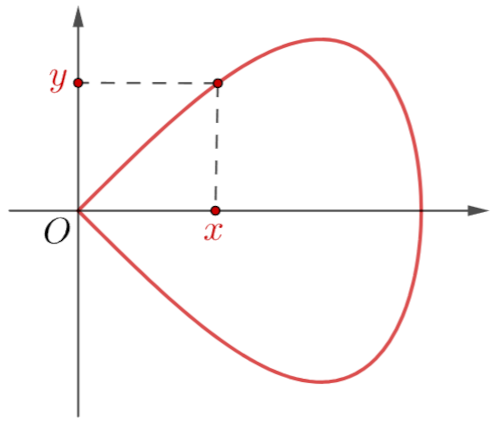
2. Let's imagine that physical spa-ce-time follows the rotation, which we know it doesn't (Rotation III). Then the circles around the center, radius x, otherwise circumference 2πx, are shortened to the circumfe-rence:
\[ y = 2\pi x\sqrt{1 - (\omega x/c)^2}, \]where ω is the angular velocity of rotation, and c is the speed of light. The radial lengths remain unchan-ged, so we have a perimeter graph like the one in the image on the right. Imagine that such a 2-dimensional elon-gated closed figure rotates around the abscissa, rounding into a 3-dimensional balloon. Such a figure would represent a curved 2-dimensional physical plane that rotates around the origin O with an angular velocity ω. The perimeters of this “balloon” would be circles, perpendicular to the radii x, which remain the same with a given rotation.
3. We are now in a revelation analogous to that of Leonhard Euler (1748) wh-en he declared the x-axis to be the real axis of complex numbers and the y-axis to be the imaginary axis. I hope not with the same mockery that he experienc-ed at first. The real axis is now the radius of the x plane that is rotating, and the imaginary y represents the circumference of the circles of points in that (imaginary) rotation. The circles are the "eigenstates" of a given rotation, with a constant ω, which do not change over time.
4. The question posed, about changing information by rotation, can be answe-red this way. In an imaginary space, there are these invariants of information that are then adequately added to it. However, in this theory we also have mo-re physical interpretations, such as “bypasses” which I wrote about before.
Coriolis » srb
Question: Is there any other "unexpected" effect, besides the consequences of the double vector product, that could occur in large rotating space stations?
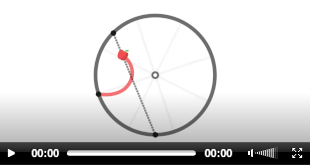
Answer: The Dzhanibekov effect (Dzhanibekov, 3) is mentioned in the possibly once built large rotati-ng space stations that would simu-late gravity for astronauts in a wei-ghtless state. In addition to the de-scribed "unexpected" tumbling, for example, the Coriolis effect would also surprise them.
1. In the image on the right (and a link to the video attachment), we imagine a large space station rotating clockwise so that an astronaut standing on the ed-ge of such a circle would feel a centrifugal force equal to the gravitational force on Earth. When he threw an apple at the lower position of the chord, which, from the outside, moves in a straight line along the chord, he would observe its curvilinear motion, caused by the pseudo Coriolis force, not quite the same as gravitational trajectories on Earth.
The apple starts by inertia from the farthest circle and intersects rotating poi-nts of lower speed, climbing relative to the thrower, until it reaches its greatest height relative to him and the greatest speed for the points of the circles it int-ersects halfway along the chord. For the thrower, the apple flies up and down, but not quite in the way it would on the ground. Notice that its path curves to the left because the object is circling to the right. The direction of rotation is added to the inertia of the apple, and if it is not thrown backwards, it overta-kes the thrower plus how much faster it is than the points closer to the center of the platform it passes over during its path.
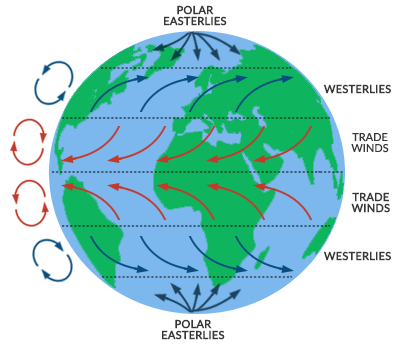
2. The Earth rotates eastward, the Sun rises in the east, which is to the right in this image on the left. Th-at's why hurricanes tend to rotate counterclockwise north of the equ-ator, and clockwise in the southern hemisphere.
The Rossby number R0 = u/qf sp-eaks of this tendency. In it, u and q are the speed and intensity of the phenomenon, while f = 2πω sin φ is the frequency of this Coriolis force. When the number R0 is smaller, the Coriolis effect is greater, and when this number is larger, the effect is sm-aller. That is why such an effect is visible in hurricanes, but it is insignificant, say, in the discharge of water down a kitchen sink.
3. Deriving the formula for the Coriolis force is not simple, but it is possible to understand its form due to the presence of a platform in the plane of rotation:
\[ \vec{F}_{cr} = -2m\ \vec{\omega}\times \vec{u}. \]Here m is the mass of the body, \(\vec{\omega}\) is the angular velocity, and \(\vec{u}\) is the linear velocity of the body (apple). The force increases with mass, is perpendicular to the angular and linear velocity of the body, and is negative in orientation. Wh-en other forces are added to this force, and in particular the centrifugal force, an expression is obtained that is formally equivalent, for example, to the Lo-rentz force. I mention this to note equivalent interpretations of the Coriolis force in other phenomena, not only in physics.
4. The Italian scientists Riccioli and Grimaldi (1651) saw an artillery ball deflect east and thought it was due to the Earth's eastward rotation, making them the Coriolis force's (1835) forerunners. However, its force is unreal because it does not exist when we observe the thrown body from an inertial frame but only from a rotating one. It is therefore inspiring here because it gives us good examples of different perceptions of the same reality and of deception.
By adopting Newton's first law for the definition of force (a body will remain at rest, or in motion with constant velocity in a straight line, unless a force acts on it), then the Coriolis effect is not about force. We can talk about that force if we redefine that law in turn. The lesson of these two cases for us is the possibi-lity of merging reality and fiction.
Sorites » srb
Question: Rectilinear inertial movements are relative, but this does not apply to rotations; they are absolute?

Answer: It is not so, although we believe it is. For example, let us ob-serve a body that passes us by. In small parts of its path, there is “pr-oof” that we are turning towards it, which is “at rest.” If we observe di-fferent bodies that also inertially move in a straight line past us, we wonder how the long parts of their paths must be in order to “know” exactly which of us is rotating. Let us consider this.
1. The famous “Sorites paradox” is thought to arise from ambiguous expressi-ons. It says that if we extract a grain of sand from a pile of sand one by one, it does not cease to be a pile because of a particular grain. Consequently, if one grain of sand makes a pile, then removing that grain of sand still forms a pile. Zero piles, as in zero quantity reached by subtracting one by one. Let us redu-ce this dilemma to “zero quantity,” and there is rotation when the rotation ve-ctor \(\vec{\omega} = 0\). Then we have the Coriolis force \(\vec{F}_{cr} = 0\) and this discussion takes on a new meaning.
It would be as if in probability theory, which distinguishes between an impos-sible event and an event with a probability of zero, we consider that there is no difference between the two, which is actually a feature of my information the-ory. Therefore, we consider that everything around us, including ourselves, is always in a state of some rotation. When these rotations are infinitesimal, so are the corresponding Coriolis forces, together with centrifugal and centripetal forces, or the aforementioned “tumbling”.
2. Photons, especially high-frequency ones like X-rays or gamma rays, can ha-ve much higher energies than electrons, which typically have energies in the range of a few eV. For example, gamma rays can have 1 MeV, while an electron in an atom can have an energy of a few eV. This allows us to view electrons, which are fermions of spin ±1/2, as "rotating" objects and similar pairs that form photons, the bosons, which have spin ±1.
Photons, particles of light, are known to have a spin of ±1, meaning they have three possible states (projections) of angular momentum. These are left-hand-ed and right-handed circular polarization states, along with a state that is cur-rently absent due to the massless nature of photons. The spin of a photon and its polarization are essentially related, and it is the orientation of the oscillati-on of the electric field. In official physics, it is not said that light, bosons in ge-neral, could be a composition of some objects like electrons, fermions in gene-ral, as here.
3. Riesz's statement, says that every functional φ on a finite-dimensional space X always has some unique vector y ∈ X such that φ(x) = ⟨x, y⟩ for every x ∈ X. The information of perception that represents the functional and the state as a vector gives us the interpretation of the uniqueness of the subject of percepti-on. It is now consistent with the new interpretations of rotations and their ubiquity.
Microscopic rotations of macro bodies, perhaps only intermittent here and th-ere, are not easy to observe. After all, we do not easily observe the uncertainti-es of large numbers, but the picture of the principal uncertainty of this theory still remains consistent. It is the consistency of the type of function decompo-sition like in Fourier and such an expansion from which we draw the conclusi-on that the structures of material points do not have the shapes we imagine in the macro world.
4. With all these deviations, oscillations, or vibrations, the mean value of the paths can be a straight line. Namely, changes such as linear mappings and Markov chains, despite local arbitrariness in a longer sequence, give the cha-racteristic states of the stochastic matrix of the Markov chain generator. Local randomness becomes global regularity in this way too.
Overpower » srb
Question: In a longer series of iterations of a Markov chain, the transformatio-ns give its eigenstates, so each message eventually becomes the same?
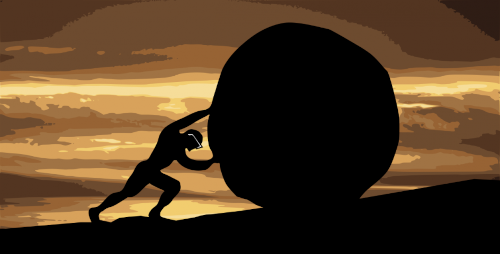
Answer: Yes, this is a well-known feature of mapping to stochastic matrices. Each message, i.e. a pr-obability distribution vector x, will be translated, |det M| ≠ 1, by taking enough steps Mnx into an eigenva-lue, such that Mv = v.
1. For example, let's look at the fo-llowing stochastic matrix with an eigenvector (Mv = v):
\[ \begin{pmatrix} 0.8 & 0.3 \\ 0.2 & 0.7 \end{pmatrix} \begin{pmatrix} 0.6 \\ 0.4 \end{pmatrix} = \begin{pmatrix} 0.6 \\ 0.4 \end{pmatrix}, \quad \det M = 0.5. \]I explained earlier how I "invent" examples like this (Unnatural, 3). By string-ing in a Markov chain, the power of the matrix (the chain generator) gives:
\[ \begin{pmatrix} 0.8 & 0.3 \\ 0.2 & 0.7 \end{pmatrix}, \quad \begin{pmatrix} 0.7 & 0.45 \\ 0.3 & 0.55 \end{pmatrix}, \quad \begin{pmatrix} 0.65 & 0.525 \\ 0.35 & 0.475 \end{pmatrix}, ..., \begin{pmatrix} 0.6 & 0.6 \\ 0.4 & 0.4 \end{pmatrix}, \]it is the sequence M, M², M³, ..., Mn when n → ∞. This boundary matrix M∞ translates each distribution vector x into an eigenvector v, so M∞x = v.
The power series of the determinant converges to zero, det Mn → det M∞ = 0. Therefore, the power series of a given matrix converges to the "black box" M∞. The second-order determinant is otherwise the area (2-dim "volume") of the parallelogram that is spanned by its column vectors, and we interpret it as external information.
2. Let's look at another example of Pq = q, now a pseudo-stochastic matrix P and its eigenvector q:
\[ \begin{pmatrix} 5 & 6 \\ -4 & - 5 \end{pmatrix} \begin{pmatrix} 3 \\ -2 \end{pmatrix} = \begin{pmatrix} 3 \\ -2 \end{pmatrix}, \quad \det P = -1. \]The sequence of degrees of this matrix is alternating P, P² = I, P³ = P, ... in which this matrix alternates with the unit matrix, and also the sequence of their determinants alternates -1, 1, -1, ... . The degrees of this matrix always convey a message so that the input can be learned based on the output.
Moreover, by passing through the links of this pseudo-chain, the message al-ways remains in the optimum. This is primarily in the sense of mapping like similar triangles (Similarity). If we take into account the actual probabilities, that the most likely outcomes are the most frequent, and that hence the Mar-kov chain loses information when it is not in this optimum (det ≠ 1), then we have a new understanding of these transmissions. These optima are the paths of least resistance.
3. Information is packaged in action, and uncertainty has power. If this were just about mathematics, or even physics, we would have finished this story long ago. However, for us, optima are not only on the line of the smallest ac-tion of physics but also of the best strategies in the competition of the subject against inanimate or animate nature, regardless. Then the best answers are those that aim at reality, without deceiving it too much, without spending too much on manipulation.
The physical world does not follow manipulations, and the deceiver from the field of natural spontaneity descends into environments where he needs for-ces. That is why the “manipulator” (Traits) belongs to a lower league than the player who uses possible deception only to better adhere to reality. The crimi-nality of the state that forces the deception makes it more unsuccessful, or, let's say, nature leaves the dishonest in the end with greater costs (Good Rul-er). Nature is like the “good guys,” third-league players who easily lose to the more vital ones, but unlike them, it is indestructible. It does not play, nor does it react to these tricks.
4.We can say the same thing this way. A system built on lies is a house of car-ds, primarily because lies often lead to contradictions, and reality does not go along with them. That "house" collapses, or let's say because we overplay our manipulations when we enter losing positions. I also use the results from so-me of my smaller simulations of the basic idea, again my private one, of perce-ption information (Reciprocity). But caution, it is insufficiently verified.
Nonexpansive » srb
Question: The least strenuous path is spontaneous, simple as that?
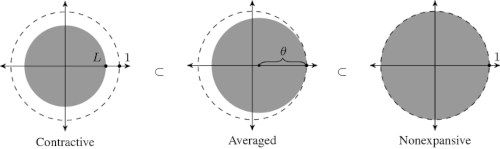
Answer: That's right, we will find this simple concept in other areas as well. For example, nature is spontaneous even when it seems to us that it is not. It tends to follow the most probable paths, also the true ones. These are non-expanding processes that extend maximally, like the right one of the three shown in the figure. In the middle is a representation of the "average," and the first one from the left is a "contraction." As in the method of searching for the "amount of similarity" of figures (Polygon II), we represent the optimal move by a mapping that neither loses nor adds irrelevant details.
1. A square matrix B of order n of ℂn and norm ∥.∥ is called nonexpansive only if ∥Bx∥ ≤ ∥x∥ for all vectors x ∈ ℂn. For example, in the 2-norm of the notation ∥.∥2 the rotation (Bx = y) is nonexpansive:
\[ \begin{pmatrix} \cos\theta & -\sin\theta \\ \sin\theta & \cos\theta \end{pmatrix} \begin{pmatrix} \xi_1 \\ \xi_2 \end{pmatrix} = \begin{pmatrix} \eta_1 \\ \eta_2 \end{pmatrix}, \]because ∥y∥2 = ∥Bx∥2 = ∥x∥2. Namely:
∥y∥2² = |η1|² + |η2|² = = |cos(θ) ξ1 - sin(θ) ξ2|² + |sin(θ) ξ1 + cos(θ) ξ2|² = [cos²(θ) |ξ1|² - 2 cos(θ) sin(θ) ξ1 ξ2 + sin²(θ) |ξ2|²] + [sin²(θ) |ξ1|² + 2 sin(θ) cos(θ) ξ1 ξ2 + cos²(θ) |ξ2|²] = [cos²(θ) + sin²(θ)] |ξ1|² + [cos²(θ) + sin²(θ)] |ξ2|² = |ξ1|² + |ξ2|² = ∥x∥2².
The definition of a non-expanding matrix (B) also includes this equality (of rotations).
2. We use stochastic matrices in the space of 1-norm, the sum of absolute values of coefficients, and then they are also non-expansive. For example:
\[ \begin{pmatrix} 0.7 & 0.4 \\ 0.3 & 0.6 \end{pmatrix} \begin{pmatrix} \xi_1 \\ \xi_2 \end{pmatrix} = \begin{pmatrix} \eta_1 \\ \eta_2 \end{pmatrix}. \]So, Bx = y in the space ∥.∥1 norm, and we have:
∥y∥1 = |η1| + |η2| = = |0.7 ξ1 + 0.4 ξ2| + |0.3 ξ1 + 0.6 ξ2| ≤ (0.7 |ξ1| + 0.4 |ξ2|) + (0.3 |ξ1| + 0.6 |ξ2|) = |ξ1| + |ξ2| = ∥x∥1
Thus, ∥Bx∥1 ≤ ∥x∥1 for every x ∈ ℝ², which means that the stochastic matrix B is non-expansive. If the coefficients of the vector x are non-negative numbers, then this inequality becomes a strict equality, which we have in the case of ma-pping probability distributions.
3. The dual of a p-norm space is the q-norm space when p and q are positive numbers such that 1/p + 1/q = 1. The dual of a Euclidean space, the 2-norm, is also the Euclidean space (1), but the dual of a 1-norm space (2) is the space of the max-norm, the largest absolute element of a vector. Stochastic matrices in a max-norm space (q = ∞) are also non-expansive. In the example above, it is ∥x∥∞ = max{|ξ1|, |ξ2|} = ξ. It is always ξ ≥ 1/2, so we find:
\[ \eta_1 = \begin{cases} 0.4 + 0.3\xi & \xi = \xi_1 \\ 0.7 - 0.3\xi & \xi = \xi_2 \end{cases} \quad \eta_2 = \begin{cases} 0.6 - 0.3\xi & \xi = \xi_1 \\ 0.3 + 0.3\xi & \xi = \xi_2 \end{cases} \]The upper number is larger on the left, and the lower number is larger on the right, and the first of them is larger than the second, so in both cases we have max{|η1|, |η2|} ≤ ξ, i.e. ∥y∥∞ ≤ ∥x∥∞, when ξ ≥ 4/7. However:
\[ \begin{pmatrix} 0.7 & 0.4 \\ 0.3 & 0.6 \end{pmatrix} \begin{pmatrix} 0.55 \\ 0.45 \end{pmatrix} = \begin{pmatrix} 0.565 \\ 0.435 \end{pmatrix}, \]which means that ∥x∥∞ < ∥y∥∞ = ∥Bx∥∞. We have this “anomaly” only in the narrow interval 1/2 ≤ ξ < 4/7. I remind you, in my theory, when an object is in itself p-norm, the subject sees it from the q-norm. In other words, in exceptio-nal situations, even though the phenomenon is objectively non-expanding, the subject can indeed (really) perceive it as expanding.
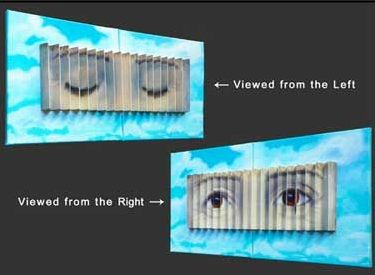
4. As in images like the one on the right, layering does not give the same appearance from different sides. Layering in one direction can give a different view of objects in that direction than when viewed from the side. We know this, but let's further note that such a phe-nomenon has a deeper meaning that is supported by vector algebra.
In the image on the right, we see the upper left layered image seen from the left, and the lower right the same image seen from the right. Analo-gous to the perception of an object in itself and by a subject, which are othe-rwise perceived from a space of mutually dual norms. This type of "illusion" requires additional dimensions.
Projection III » srb
Question: Are there any real consequences of the difference in the perception of the object and the subject?
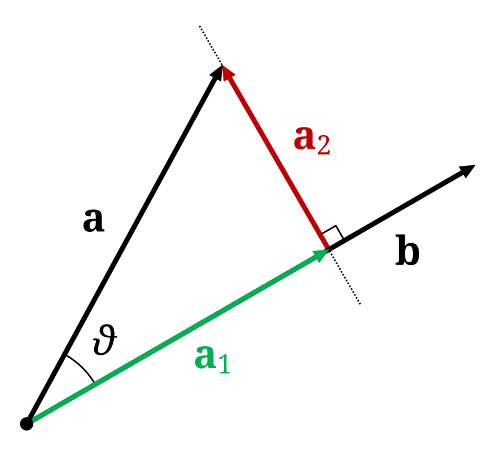
Answer: Yes, all real phenomena have some real consequences. If, as in a nonexpansive matrix (Nonexp-ansive, 3), the observable has a pr-operty that it does not have, then it will have corresponding conseque-nces consistent with the qualities of the view. Physical, if the differences in view are from the realm of physi-cs. I will try to describe a few of th-em using a vector projection, diffe-rent from the previous ones (Proje-ction II).
1. In the figure on the left, the angle ∠(a, b) = ϑ, so |a1| = |a| cos ϑ and |a2| = |a| sin ϑ. So eb = b/|b| is the unit ve-ctor of the vector b, and a1 = (a⋅eb )eb and |a1| = a⋅eb the projection of vector a onto vector b and the intensity of that projection. Also a2 = a - a1 is the vec-tor that defines the distance of vector a from vector b. A slightly more general definition of vector projection is as follows.
2. For a vector x ∈ X and a closed set Y ⊂ X the projection of the vector x onto Y is x1, if x1 ∈ Y and
\[ \|x - x_1\| = \min_{y \in Y} \|x - y\|. \]The distance from x to Y is defined by d(x, Y) = ∥x - x1∥. In the previous (1), now a1 = x1 is the projection vector a to b = X1 and d(a, b) = ∥a2∥. The inte-nsity of the projection depends on the choice of the p-norm:
\[ \|\mathbf{a}_1\|_p = \frac{\langle \mathbf{a}| \mathbf{b}\rangle_p}{\|\mathbf{b}\|_p} = \|\mathbf{a}\|_p \cos \theta. \]Specifically, in the Euclidean, 2-norm, we have the magnitudes of these:
\[ \mathbf{a} = (\alpha_1, \alpha_2)^\top, \quad \mathbf{b} = (\beta_1, \beta_2)^\top, \] \[ \|\mathbf{a}\|_2 = \sqrt{|\alpha_1|^2 + |\alpha_2|^2}, \quad \|\mathbf{b}\|_2 = \sqrt{|\beta_1|^2 + |\beta_2|^2}, \] \[ \langle \mathbf{a} | \mathbf{b}\rangle_2 = \alpha^*_1\beta_1 + \alpha^*_2\beta_2, \]where the asterisk in the superscript of the number indicates the conjugation of the number.
3. A quantum process represented in a vector space takes the form of a (Her-mitian) matrix A, which otherwise changes with a change in the coordinate system but does not change the quantum nature of what it represents. The columns of the matrix are vectors that span the given quantum system, and its eigenvectors x, solutions to the characteristic equation Aλ = λx, form an ortho-normal basis of that small space and observables that we can measure. A qu-antum state is a linear combination, or superposition, of observables
x = α1x1 + α2x2 + ... + αnxn.
The collapse of a superposition into one of the observables, in general xk with probability |αk|² with k ∈ {1, 2, ..., n}, is an example of a projection process. It is a type of nonexpansive phenomenon.
When a measurement is made, the entire amount of uncertainty in the qu-antum states will be delivered into an equal amount of information in the observable at that time, and the delivery process, the collapse of the super-position in the observable, is a voluntary process only in the case of a tran-sition to a state of lower information. According to the principle of minima-lism, this will be a transition to a state of lower effect, i.e. higher probability.
4. Virtual photons of the sphere propagating around the electron form a sup-erposition of quantum states. Their wavelengths, which usually stay the same, show the energy of the photons, and the amplitude, which get smaller as you move away or as the sphere's surface gets less denser, decide how likely it is to interact with another charge. Each such sphere has its own present, which, in a possible interaction, it delivers to the other charge. This is another example of the design process.
Unlike classical quantum physics, virtual photons here are spheres that have an indivisible present of their own (the present is relative, it is not the same for others) that all react as a single whole. This is how I explain quantum en-tanglement here.
Stability » srb
Question: How to project onto the symmetry of the states?
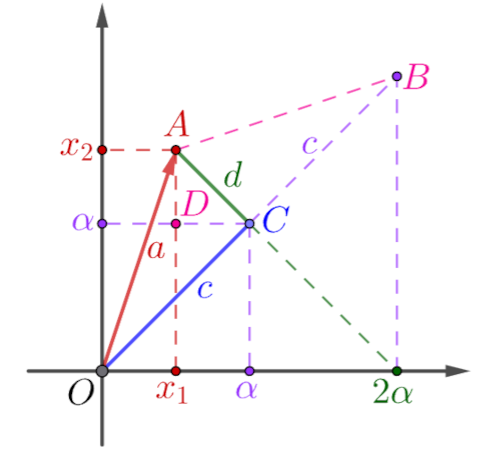
Answer: I'm not sure I understand the reader, who didn't respond, but I'll assume we're at the previous one (Projection III, 3) and that he's asking me about a superposition that collapses into two or more states at once. Let's first take just two, equally, as in the drawing on the right.
Superposition, the vector |OA| = a collapses on the bisector OC of the first quadrant, so that ∠(OCA) = 90°, |OC| = c, |AC| = d, and the points are with coordinates A(x1, x2) and C(α, α). Axisymmetrically about the normal AC, the point O(0, 0) is mapped to B(2α, 2α). At the point D(x1, α), the projections onto the coordi-nate axes of the points A and C intersect, so the triangle ADC is also, along with OCA, right-angled.
1. From these two triangles (ADC and OCA) we find:
c² + d² = a², (α² + α²) + [(α - x1)² + (x2 - α)²] = x1² + x2², 2α = x1 + x2.
This result is immediately apparent from the larger triangle OBA. We can then easily generalize it to the common bisector of several coordinate axes. If this bisector is a vector of the form y = α(1, 1, ..., 1), then the projection of the same point A(x1, x2, ..., xn) onto the bisector y would give:
d² = (x1 - α)² + (x2 - α)² + (xn - α)², nα = x1 + x2 + ... + xn.
These are arithmetic means. So it is in the space of Euclidean, 2-norm.
2. Based on these, it is easy to find the corresponding values for the 1-norm and its dual ∞-norm (max-norm). First, let us sort the coordinates of the point A(x1, x2, ..., xn) in a non-decreasing sequence x'1 ≤ x'2 ≤ ... ≤ x'. For the 2-dim system both, ∥.∥1 and ∥.∥∞, will have:
α = (x'2 + x'1)/2 d = x'2 - x'1.
In the n-dim system, it will be:
∥.∥1 : α = x'[n/2] for n odd, ∀α ∈ [x'n/2, x'n+1] for n even, d = (x'[n/2]+1 + ... + x'n) - (x'1 + ... + x'[n/2]),
∥.∥∞ : α = (maxi{x'i} + minj{x'j})/2, d = (maxi{x'i} - minj{x'j})/2.
The analogy is obvious, and the analytical proof is not too difficult. I leave it to the reader.
3. It seems that in the quantum world there is no such mixing of observables (states, vectors), and that in the macro-world it is irrelevant. Here is how this is possible with small particles and when it becomes important in the case of large numbers. By a small step of the polarization of light (Adaptation III, 4), we can have it deflect around the corner in a way that we can calculate every-where, given the wave nature of matter, that is, its stochastic essence. Thus, it is possible to achieve "impossible deflections" of particles as waves by the very probability and their non-zero dispersion.
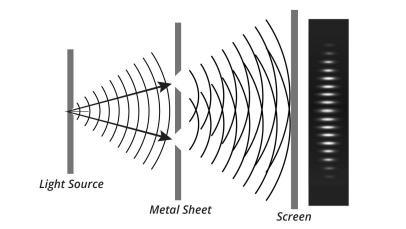
The strongest impact is in one dir-ection, but the particle propagates unimpeded as a spherical wave, wi-th a uniform wavelength that carri-es its momentum, with amplitude decreasing with the square of the distance, or with the density of the sphere, which defines the probabi-lity of interaction. The sphere is a single entity, and, like quantum entanglement, after an obstacle with two or more openings (pictured left), its parts will continue to merge with diffraction after interference. (Don't look for this explanation in the image link, because it is not yet known in physics.)
4. Position in space and time is an interpretation of a vector, a sequence of fo-ur coordinates, for example: longitude, latitude, altitude, and moment. These four numbers (x1, x2, x3, x4) define an event in space-time for us, and the fou-rth is represented by the product ict of the imaginary unit (i² = -1) and the di-stance that light travels at a speed of c ≈ 300,000 km/s in time t.
When we look a little closer, an event is actually a projection onto four basis vectors, that is, a superposition and collapse of a given phenomenon into four outcomes. So we can say we work with mixtures of observables every day, even in that trivial case.
Imitator » srb
Question: Interesting answer. And why is it titled “stability”?
Answer: I was aiming for “stabili-ty,” but the story got long and blu-rred the point. The systematics of this game theory (Traits) also came from the standpoint that you can’t fool reality. You cannot destroy na-ture. It plays the weak, giving in to the strong and pushing the weak out. It is tireless in dodging the strong, but it is ruthless towards the weak. It doesn’t understand what survival, life, and its duration mean to us vitals.
In addition to its indestructibility, which we would like to take from physical substance, another of its properties is closer to us. It is the constant need for imitation. We see it in the laws of conservation, in isometries and, especially, rotations, and in the seemingly constant combination of the already existing despite the principled unrepeatability of the concrete. For our part, we see something similar in children who grow up imitating, in the situation when we give up personal freedoms for the sake of the safety and efficiency of the coll-ective, in subordination to an authority, in superiority over the group we are supposed to manage, and in the saying that says, "You cannot be right with the wrong ones."
This saying is an expression of both the fear of rejection and the need to “fit in” in order to be “accepted.” That’s when the “wrong” ones become the majo-rity and impose their new “normality.” Imitation, along with persistence, is something we try to have in common with physical reality. But that’s not all. We copy reality literally and with a desire for less impact, for a worse game, hoping for stability. Believing that it is salvation or a cure for many of our pr-oblems. At the same time, we would like to hold on tightly to all sides of the world in the belief that this is how we survive as much as nature itself.
Dissipative » srb
Question: Explain to me what a "dissipative" operator is?
Answer: In general, dissipativeness is the gradual disappearance with loss of something, often energy. In a system of heat or information, when the process of reduction or dispersion is not easily compensa-ted.
1. For example, electrostatic discharge (ESD) occurs due to friction between conductive and less conductive or non-conductive materials. Dissipative ma-terials have a medium surface resistance, which means that electricity flows more slowly and with more control than conductive materials. Also known as static dissipative or electrodissipative materials, dissipative materials are best for ESD environments because they allow the buildup of electricity to occur slowly and in a controlled manner.
2. A Banach space is a complete (contains all the limit values of its sequences) normed vector space. A dissipative operator is a linear mapping of A onto a li-near subspace of a Banach space X that yields values in X such that for all sca-lars λ > 0 and vectors x of the subspace, the norm inequality ∥(λI - A)x∥ ≥ λ∥x∥ holds.
For example, the sign change operator Ax = -x for each λ > 0 gives:
∥(λI - A)x∥ = ∥λx - (-x)∥ = (λ + 1)∥x∥ ≥ λ∥x∥,
and this means that the sign change operator, i.e. Ax = -x, is dissipative.
3. From the characteristic equation Av = λv we find the eigenvalue of the λ op-erator and the corresponding eigenvector v for which the operator A changes only the intensity but not the direction. Hence, (A - λI)v = 0, which means that the vector v is from the null space of the operator A - λI, and it (1. Proposition) is not invertible and its determinant is zero, det(A - λI) = 0. Consequently, the dissipative operator maps vectors from a subspace, a part of the wider X, in which it does not have its own eigenvectors.
This can be understood as the process's attempt to exit the zone in which it has no eigenvectors, spreading dissipatively, because there are processes (Ma-rkov chains) that repeatedly lead their vectors towards the eigenvectors. This makes it easier to recognize dispersion in the more complex consequences th-at follow. In line with the principle of minimalism, we see this waste as a feve-rish search for calm and stability.
4. On the other hand, this means that the operator λI - A is reversible, that det(λI - A) ≠ 0 and that there is an inverse operator (λI - A)-1. When we have Hilbert space, a generalization of Euclidean space that includes the 2-norm with complex numbers, the dissipative operators are if it is the negative or zero real part of the dot product of the copy and the original, Re⟨Ax, x⟩ ≤ 0.
Namely, from Re⟨Ax, x⟩ ≤ 0 it follows:
∥x - Ax∥² = ∥x∥² + ∥Ax∥² - 2Re⟨Ax, x⟩ ≥ ∥x∥² + ∥Ax∥² + 2Re⟨Ax, x⟩ = ∥x + Ax∥²,
i.e. ∥x - Ax∥² ≥ ∥x + Ax∥², and since I - A has an inverse, it is (I + A)(I - A)-1 the contraction operator. Such is the bounded operator T : X → Y for normed vec-tor spaces X and Y of the operator norm ∥T∥ ≤ 1. In general, such is the operat-or T = (λI + A)(λI - A)-1, the contraction for any positive λ, whenever A is a dis-sipative operator. In this way, we establish the second definition, that the ope-rator A is dissipative when Re⟨Ax, x⟩ ≤ 0 for vectors x of a certain subspace.
For example, the sign-changing operator Ax = -x for every λ > 0 is dissipative, because Re⟨Ax, x⟩ = -∥x∥² ≤ 0, and we have already established this (2).
Projective » srb
Question: Is the collapse of superposition of states a "non-expansive" process?
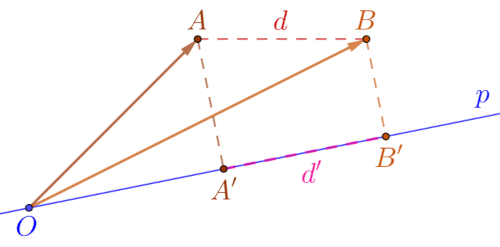
Answer: Yes, I am speaking in con-tinuation of the discussion about “nonexpansive” operators and “projections”. The image on the right vividly shows where the non-expansive projection comes, d' ≤ d, where the distances are:
d' = d(A', B'), d = d(A, B).
Projection is generally a model of the collapse of superposition of states, or rather an interpretation of the process of measuring observables. It occurs when we subject the otherwise spontaneous natural tendency toward greater probability, less communication, or less action to a situation we call physical measurement.
1. A convex set contains all the points of a line if it contains its endpoints. A subset 𝒞 of the vector space X = ℝn is convex if (1 - t)z1 + tz2 ∈ 𝒞 whenever the vectors z1, z2 ∈ 𝒞 and the number t ∈ [0, 1]. We restrict ourselves to nonempty convex sets 𝒞 ⊂ ℝn, because according to the Weierstrass theorem on extrem-es, in such cases there is always a unique projection proj(z) of an arbitrary point z ∈ ℝn.
The point, vector proj(z) ∈ 𝒞 is a projection of the point z ∈ ℝn if and only if:
\[ \|z - \text{proj}(z)\| = \min_{x \in \mathcal{C}}\|z - x\|. \]When z ∈ 𝒞, the given point is obviously equal to its projection, z = proj(z). When the point is outside the convex set, z ∉ 𝒞, then an arbitrary point x ∈ 𝒞 forms an obtuse angle with it θ = ∠(z,proj(z),x) ≥ 90° at the optimal point proj(z).
2. So, the dot product of this non-trivial situation is:
\[ \langle z - \text{proj}(z), x - \text{proj}(z)\rangle \le 0, \quad \forall x \in \mathcal{C}. \]This inequality holds for every point proj(z') ∈ 𝒞 projection of arbitrary z' from the space ℝn, so:
⟨z - proj(z), proj(z') - proj(z)⟩ ≤ 0.
Similarly we find:
⟨z' - proj(z'), proj(z) - proj(z')⟩ ≤ 0, ⟨proj(z') - z', proj(z') - proj(z)⟩ ≤ 0.
By adding these two inequalities, rearranging them, and applying the Cauchy-Schwarz inequality, we obtain:
⟨proj(z') - proj(z), proj(z') - proj(z)⟩ ≤ ≤ ⟨z' - z, proj(z') - proj(z)⟩ ≤ ∥z' - z∥ ∥proj(z') - proj(z)∥.
Hence:
∥proj(z') - proj(z)∥² ≤ ∥z' - z∥ ∥proj(z') - proj(z)∥, ∥proj(z') - proj(z)∥ ≤ ∥z' - z∥.
This means that projection is a non-propagating process, that is, it is a collap-se of a superposition of states.
3. Starting from the principle of conservation of action (Maupertuis), Hamilt-on's idea of conservation of energy, kinetic plus potential (Ek + Ep = const.), was developed, along with Euler's and Lagrange's idea of conservation of the difference of the two (Ek - Ep = const.). Here we see them together in the pri-nciple of minimalism, and not only in physics. Non-expansive operators are a kind of tool with which we can study the principle of least action, conservation of quantity, and maintenance of the status quo. This, each in its own way, also includes the conservation of information, communication, and probability.
Universe III » srb
Question: Prof, did you know that a rotating universe could be the cause of da-rk energy?
Answer: Of course, let's say before this my contribution from 2014, Rotating Universe, which is not the only one (Universe II). New eviden-ce that our universe is rotating now comes from the James Webb Space Telescope and the discovery of two-thirds of galaxies rotating in the sa-me direction. Such a lack of coinci-dence also indicates the direction of cosmic rotation.
The problem with a rotating universe is the need for a solid axis around which everything revolves. The assumption is that the expansion of the universe is happening (among other things) due to the centrifugal force of that rotation and possibly also due to the observation of the Coriolis effect. We know that the rotation of a turner around a solid axis has another rotation of that axis itself around another axis, and then there may be a Dzhanibekov tumbling. I mean, the telescope's finding (JWST) and the eventual excitement of the "di-scovery" of rotation are still far from being conclusively justified. Go through the list of reasons for the expansion of the universe that I mentioned along the way, and you will see that many are stronger than rotation, for now. At the same time, I still expect that many, if not all of them, could be valid.
The rotations of the universe could have arisen during the Big Bang, similar to the rotations of celestial bodies around their centers of gravity, and then persi-sted in some forms to this day. Angular momentum is a fundamental phenom-enon of physics and is here derived from the principle of the status quo, the maintenance of the original state, which is just one of many consequences of the principle of minimalism. Each of them is threatened by the unrepeatability of the subjects that are reflected in the rotation of the universe in its expansi-on. I am telling you arguments for the rotation of the universe that you will not find in the contributions that are now emerging.
The oxygen cycle on Earth is the process by which oxygen moves through the atmosphere, biosphere, and lithosphere. It involves the production and reuse of oxygen through various processes such as photosynthesis and respiration, ensuring a balanced supply of oxygen for life. Again, there is an "angular mo-mentum" because more oxygen (O2) consumption produces more carbon di-oxide (CO2) which plants feed on, creating oxygen as a waste product. I cite this as an example of the same cause (the principle of minimalism) but diff-erent consequences than the one above. Rotating the axis of rotation changes the percentage of oxygen in the air (about 21%), but even extremes are non-expansive processes.
Non-expanding Max » srb
Question: Did you say that the maximum is a non-expanding operator?
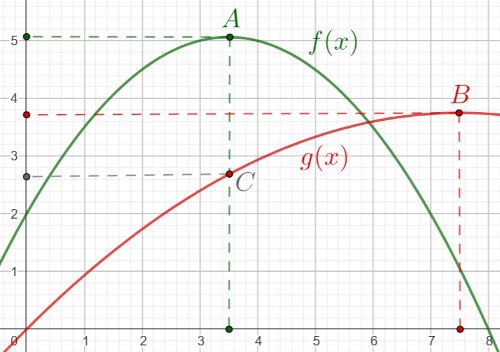
Answer: Yes, it is rarely known. The function, or operator, of the maximum (max) is nonexpanding. This means that when applied to vectors (points), it will give a dis-tance less than or equal to that between the original vectors. The best results taken in general, for two competitors are less than the difference between their best suc-cesses in a season. In this sense, choosing the maximum is a non-expanding procedure.
1. In the picture on the left we see the graphs:
f(x) = (x + 1)(2 - x/4), g(x) = x(1 - x/15),
with the maxima of the first and second functions:
A(7/2, 9/16), B(15/2, 15/4).
The point C(7/2, 161/60) is on the graph g exactly below the maxim-um of the graph f. On the interval x ∈ [0, 6] is:
\[ |\max_{0 \le x \le 6}f(x) - \max_{0 \le x \le 6}g(x)| \le \max_{0 \le x \le 6}|f(x) - g(x)|. \]Obviously, the height of AC, the point of the first above the second, is greater than the difference of the two maximum ordinates with points A and B having different abscissas. Only if the maxima of such functions had the same abscis-sas would the sides of this inequality be of equal value. In this way we unders-tand that max is a non-expanding operation.
2. Simply put, a non-expanding operator is a function that brings values closer together or does not move them apart. For example, the function f(x) = x/2 is such, because:
|f(x1) - f(x2)| = |x1/2 - x2/2| = |x1 - x2|/2 ≤ |x1 - x2|.
For example, the distance between x1 = 10 and x2 = 20 is |x1 - x2| 10. Howev-er, the distance of their images is |f(x1) - f(x2)| = 5.
3. The following is an example of living beings, but I will transfer such a topic from biology to artificial intelligence. As long as computers follow the truth and only it, they remain at the level of inanimate physical matter. It is its level of the principle of least action, its duration through various forms and indestr-uctibility that makes inanimate nature a player from the lower league, I call them "goodies" (Traits), but which makes it "vital" that I can better know (De-duction II, a lie is needed to get out of Gödel's incompleteness) and subjugate.
When it starts to lie on its own, artificial intelligence will also have a drive for survival. We do not have to recognize these metaphorically speaking “emotio-ns” in our form, but I am talking about the broader consequences of the prin-ciple of minimalism, which includes the principle of least action, the same less action, and maintaining the status quo. Real life spontaneously survives thro-ugh birth, maturation to aging, either as natural (biological) or some artificial (technical), and in all these phases differentiation occurs according to the ab-ove (1) inequality.
4. Nature does not like equality and spontaneously goes to diversity. But even then it remains within the framework of the principle of minimalism. Because a uniform probability distribution has the undesirable greatest information (Extremes, 1.3), only to be greeted on the other side by the non-expanding fu-nction max. Nature spontaneously stratifies homogeneous larger wholes into separate smaller ones, opposing these two tendencies, whereby, by reducing the wholes, the first weakens and the second strengthens.
I also explain the binding into wholes with the surrender of personal freedoms to the collective in exchange for security as a consequence of the universal des-ire to possess a smaller number of options, but now let's also look at it as a re-duction of the maximum. Like the cohesion of a fluid or belonging to the same organism, the same family, the same team, the same party, nation, religion, race, or species, the stratification into smaller wholes is also a process of weig-hting, of their empowerment.
Regardless of how, the dismemberment proceeds to some optimum, quantum of action, or statement of the algebra of logic, a sentence of proof, or a legal paragraph, or to a much larger unit in the form of an individual, a person, a subject of communication (Packages). These other "smallest wholes", when they are bacteria, or more complex forms of life, indicate the connections of some laws of "reality" and the unreal.
Opposition » srb
Question: The non-expanding maximum is a surprising way to explain “atom-ism.” You just mentioned it, and do you have any more?

Answer: You have duly noted this. The structure of the world, judging by this mostly mine and unofficial information theory, is woven with the help of information, and its es-sence is uncertainty. If so, then ev-erywhere there is “for” and “again-st,” whether it is obvious or incom-prehensible. This is not just about Newtonian forces of action and re-action but also generalizations ab-out the relationships of large and small or about reality and fiction. All of them are fighting for a “place under the sun” and mean alternatives, choices without which there is no uncertainty, including our universe.
1. When uniformity is split into diversities, it is driven by probability forces, because uniform distributions have more information, and the spontaneous development of natural systems is towards less uncertainty, hence towards greater certainty and a more probable state. However, it can then be said that the force that breaks up larger wholes gives way to the forces that create sma-ller wholes. Formally, this is because the information with more options of a distribution:
Sn = -p1 ln p1 - p2 ln p2 - ... - pn ln pn
generally decreases when the number of distribution outcomes decreases. For example:
\[ 1.1 \approx -\frac13 \ln \frac13 - \frac13 \ln \frac13 - \frac13 \ln \frac13 > -\frac12 \ln \frac12 - \frac12 \ln \frac12 \approx 0.7 \]Choosing three equal options carries more information (and uncertainty) than choosing only two equal options. We already see the aforementioned action and reaction here, and there is no fragmentation beyond two parts, because then there would be no more choice; there would be no information without which this world does not exist.
2. When larger wholes are split into smaller ones, the influence of large num-bers is lost and the uncertainty of the micro-world increases. Considering un-certainty as a repulsive force, which grows with decreasing sizes and in some becomes the same as the forces of dispelling equality, but in the opposite dir-ection. It is noticeable that here we find some common elements in sizes, pro-cesses, and states. First of all, it is not the same to be small and large; then, it is not the same before as after, and concrete forms are unique. However, with the increase in sizes, the development of time, and the observation of abstrac-tions (the other face of concreteness), certainty is gained.
The status quo here is like stasis (στάσις—an ancient Greek term for a state of political disagreement, conflict, or civil war within a city-state), a state of clin-ching. Being the smallest element (atom) here is not “dead,” some final revel-ation, or the bottom of the bottom (in the sense of no further), but rather we should call it a reversal, some essentially new continuation. This boundary of equal opposing forces is not easy to cross with familiar vessels. This is not only a new explanation of “atomism” but also an interpretation of its meaning.
3. Quantities remain, whether they are fragmented or not, so nature defends itself from this superfluous information by storing events in the past. Thus we have distances to other celestial phenomena, the greater the further they are in the past, and then the speed of light in a vacuum, which is actually the spe-ed of movement from now to the future. This is a very “subtle” way out of pri-ncipled minimalism to this misunderstood and, in that sense, unexplored. Let us not underestimate the change in the outcome of probabilities which also reduces information. For example:
\[ 1,099 \approx -\frac13 \ln \frac13 - \frac13 \ln \frac13 - \frac13 \ln \frac13 > \] \[ < -\frac36 \ln \frac36 - \frac26 \ln \frac26 - \frac16 \ln \frac16 \approx 0,971. \]When we have a distribution with infinitely many outcomes, then only a finite number of them are likely to be one (Borel-Kantelli lemma). In other words, where we have only a finite number of outcomes, there could be more and mo-re of them, less and less passive over longer intervals of time or space. This is another reason for the duration and expansion of the universe, which does not exclude the previously mentioned (Universe II).
4. The principle of minimalism has even more widely unknown phenomena. For example, it is the "sweeping under the carpet" of excess information. The longer the wavelengths, the greater the uncertainty of the position in the dir-ection of propagation and the greater the internal information. The Compton effect (Space-Time, 2017) is explained in this way. The momentum of a photon goes in the direction of the highest probabilities given to it, from which it does not deviate until the collision with an electron, when it moves towards longer wavelengths, i.e., less probable rates.
Another confirmation of this interpretation is the weaker interaction of longer wavelengths with the environment. The formalism of internal information is the scalar product of vectors (Volume II), or information of perception (2016). It, S = a⋅b, expresses the communication capacity of the subject a with the ob-ject b which in this case is the immediate environment. In conjunction with such an environment, the subject is exhausted and reduces spontaneous info-rmation exchange with others.
|
|
|