|
|
|


This so-called June supplement (written on March 12, 2025) arose due to fre-quent questions about the definition of "reality" that I now routinely use but is not widely known. By such, actual, I understand all those phenomena that, ro-ughly speaking, meet three requirements: observability, durability, and truthf-ulness. And when one or two of these are missing, the phenomenon is a "ficti-on," also "existing.".
Spheres » srb
Question: Why are the "virtual spheres" you're talking about not real, but ficti-tious phenomena? How come?
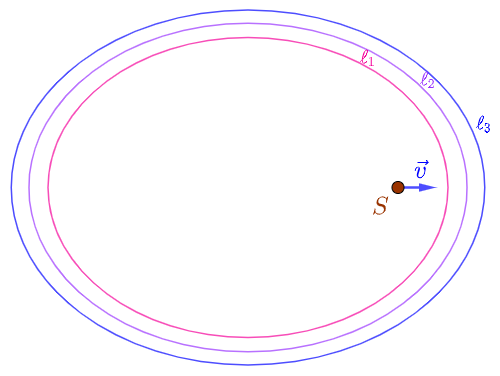
Answer: This is a slight modificati-on of Feynman diagrams (Gravitat-ional Memory, 2). They propagate as a "force field", similar to Newt-on's or Coulomb's, but they are on-ly "fictions" until they eventually interact with the environment so-mewhere. Then they are "real".
In the figure on the left, a source S moving at a speed v emits such sp-heres ℓ1, ℓ2, ℓ3, ... of the same wave-length λ and of decreasing amplitu-des a1, a2, a3, ... spheres farther away from S. Moreover, the ellipses in the fi-gure will be circles in the case of the emission of virtual photons because the speed of light does not depend on the speed of the source. In any case, the wavelength defines the momentum of the body S in a possible interaction of the sphere and the amplitude of the probability of interaction.
1. When we view the image as a cross-section of 2-dimensional space-time wi-th virtual photon spheres, then it correctly displays virtual ellipses ℓ1, ℓ2, ℓ3, ..., oblique intersections of planes and cones. They are simultaneous for the sour-ce S, but not for any other relative observer. Namely, the finiteness of the spe-ed of light at approximately c = 300,000 km/s makes more distant points dee-per in the observer's past, since time stands still for light. What we perceive as a photon in motion is actually a series of its states in our perception.
2. Note that this concept would be contradictory if there were no additional time dimensions. In my interpretations of a phenomenon of special relativity (Information Coupling, 1.3.5 Simultaneity), I stated that primary (proper) and secondary (relative) observers of mutual motion are not in the same realities until they come to mutual rest. I repeated such an interpretation here in the same (Crash), or slightly different way (Fizeau). I see the same effect in the twin paradox, which has not yet been observed there (on March 2025).
This is precisely why light movements in three (spatial) directions are possib-le, because there are three (temporal) dimensions of reality. Secondary obser-vers perceive the slowed-down flow of primary time because primary is only partially in their realities. They are of the same kind only when they are at rest with each other, but even then they do not have the same present because of the limited speed of light.
3. Different secondary observers in the movement of the primary see its simu-ltaneous events at different times. However, in cases of interaction, the virtual sphere becomes real because the conservation law makes it one indivisible wh-ole. For example, the zero sum of the spins of two parts of the same virtual sp-here, if the sphere interacts, will remain zero. Although there is uncertainty in the spins, when one has given up information about itself through interaction, the entire sphere has lost that amount of uncertainty, and the other part of it no longer has it with its spin (Languages, 4).
However, different relative observers see these two parts of the previously vir-tual sphere (its particle-waves) as different events at different times. Assumi-ng that there is some transfer of information (which does not exist without du-ration), relative observers can (badly) conclude that there is "phantom action at a distance" if these events are too far away for light to see.
4. Therefore, the eventual interaction of the previously “fictitious” virtual sph-ere is its “realization,” precisely because of (1) the observation that would then occur, further because of (2) the law of conservation, and (3) the mathematical correctness of this process. These are the three assumptions of “reality.”. Befo-re the interaction, the virtual sphere was not observed and did not have the fi-rst of these conditions of “reality,” but it had the other two, so I consider them “existing.”. Simply put.
Vanish » srb
Question: What do you mean when you say that the past fades with the square of the elapsed time?
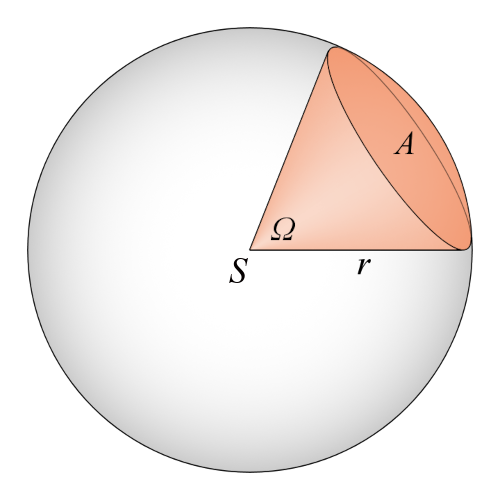
Answer: I am thinking of Chebysh-ev's inequality (Chebyshev) and es-pecially of the consequences that touch on my information theory:
\[ \Pr[|X - \mu|\ge r] \le \frac{\sigma^2}{r^2}. \]Here X is a set of random values. Then μ is their mean, and σ is their dispersion. The distance from the mean is r. In the figure on the right is a sphere of radius r and total ar-ea 4πr². I imagine it in some prob-ability space, with the center at that mean value of Chebyshev's inequal-ity. When the surface area of its cap (calote) is constant, A = const, then the specific density of its “substance” decr-eases with the square of the distance. But that's not all.
1. Kepler's second law states that the motion from the sun to the planet (in ge-neral, from the center of force to the charge) sweeps out equal areas at equal times. This is true for all constant central forces from negative through zero to any positive. Their charges are pushed along conics, which are straight lines, circles, ellipses, parabolas, and hyperbolas. And, lo and behold, their force de-creases with the square of the distance as if they were all copies of some abst-ract probability spaces. I proved this in detail in the book "Information Coup-ling" on four pages. I deal with them analogously with Chebyshev inequality.
2.Virtual spheres that are further from the center S are older, but their const-ant area A = const. has a smaller amplitude and therefore a less chance of in-teracting with the surrounding object. In other words, it has less chance of co-mmunicating with the outside world and with the present of other subjects. The radius of the sphere is r = ct, where c is the speed of light, and t is the el-apsed time, hence the age. In this sense, I say that the past fades with the sq-uare of the elapsed time because the probability density A decreases in that way.
3. It turns out that using probability theory, one can derive, or prove, the for-mula for the surface area of a sphere (4πr²). This is not unusual in mathema-tics, since every part of any of its theories is consistent with every part of the others. Let's remember "Buffon's needle", a problem from probability theory that found the number π, or take a look at the example of Stochastic, a meth-od of calculating the probability of seeing a couple in a park between 1 and 2 o'clock so that they wait 20 minutes upon arrival at the agreed place, which is nicely solved geometrically. Not to mention the many theorems of analysis, algebra, or geometry that are proven from probability theory.
4. The quantization of interaction energies now comes with constant wavele-ngths λ between adjacent, otherwise concentric virtual spheres. The total en-ergy of all these infinitely many calotte (particle-wave) spheres of the same surface at different distances reduces to the sum:
\[ \sum_{n=1}^\infty \frac{1}{n^2} = \frac{1}{1^2} + \frac{1}{2^2} + \frac{1}{3^2} + ... = \frac{\pi^2}{6}, \]so-called Basel problem, multiplied by an appropriate constant to obtain the energy. Similarly, looking at all virtual spheres of the same source S as a single probability distribution, we would also find the probability coefficient (6/π²) since the sum of all is one, i.e. it is smaller by as many times as the energy of one interaction is compared to the energy of the source.
5. We see all this in astronomy by looking through a telescope. All those dista-nt celestial bodies are so far back in our past that they are exactly as many lig-ht-years (the distance light travels in one year) away. It is then a matter of opt-ical perspective and the decrease in resolution with the square of the distance (Inverse-square law). We understand how much this boils down to the above, but I note that these are statistical expectations. In addition, by digging and forensically, or by deduction and technique, it is possible to change that score to some extent, but in principle that past fades with the square of the elapsed time.
Square Law » srb
Question: So what's the problem with this interpretation?
Answer: It's too early to publish it. It's like the APR paradox which was discovered too early (1935) and was therefore misinterpreted as Jung's experiment which at the time 1801 would have been difficult to interp-ret properly, the way we look at th-at "double slit" today, or even a lit-tle better. But, at your insistence, here's an option that I like.
1. Virtual spheres make up the very structure of the source S. They are its entirety. For example, the electron that emits them has spin +1/2 (the only other possibility is -1/2), and the virtual spheres, photons, have spin ±1. In a possible exchange with another electron Q of spin +1/2, such a photon must have spin -1 so that the electron Q remains with the possible spin -1/2. Then S has acquired spin -1/2, due to the law of conservation of the total spin of a closed system. This is only one of two optio-ns for such an exchange, which is partly unknown to us due to the uncertainty principle. The question is, what if such an exchange were to happen again, lea-ving the electrons with an impossible spin of -3/2? More precisely, how does the system know that it must not happen again?
2. By the time the information about the realization of the virtual sphere rea-ches the relative observer, it is already a thing of the past for the participating electrons. Electron S has transferred momentum to electron Q and they repel each other to that extent. Since the process of repulsion is constantly ongoing, we know that these exchanges are constantly ongoing. However, between suc-cessive transfers, there are changes in the spin of the participating electrons. The realization of one sphere affects everything inside it, including the sources themselves. This is also part of the same “phantom action at a distance,” that is quantum entanglement.
3. In the case of electrical attraction, electron-positron, electron-proton, and the like, I also considered the option of a wave in phase (La Ola, instead of Fe-ynman's idea of a countercurrent flow of time. Imagine a group of people mov-ing in a column while they alternately pass a package to each other overhead. Regardless of whether the package reaches the end of the group, it will not be delivered until the group reaches its destination. The mass, or inertia, of the package, would move with the group, in phase with the wave, constantly in a virtual state until its eventual realization. However, the movement of the pac-kage can be in two directions, wave or reverse. In the case of interaction, the first transfers momentum to the surroundings, and the second takes it away. Analogies are welcome.
Instead of momentum, the stimulus (impetus) within the wave phase, a model of surpluses and deficits of information and uncertainty in the transmission of eventual communication with the environment, comes into play. Excess is re-pulsive; deficiency is attractive, whatever the options are.
4. Einstein (1905), in his work called “Special Relativity” defined the simulta-neity of a system in motion by moving a clock so that it follows the movement of light. Events on the path of light are simultaneous, and time does not flow for light, in short. This is in accordance with what was said here, where the realization of one sphere affects everything inside it so that simultaneous ev-ents are actually synchronized at the moment. This solves the first part of the problem of this interpretation (from the question we asked).
That would be all if it weren't for the attraction of charges (by the Coulomb or Newtonian force), and that second part is otherwise an open topic in physics. The idea of applying the Chebyshev inequality (Vanish) is that electromagnet-ic, gravitational, and similar waves transmit information about their excess or deficiency, or about the excess and deficiency of the probability of the environ-ment. According to the principle of minimalism. But that is no longer a physi-cal interpretation of otherwise physical phenomena, and that is a special pro-blem of the above interpretations.
Bending II » srb
Question: You sent me this wonderful video, and yet light travels in the shor-test time (Fermat's principle). How is that?
Answer: This "flaw" in Fermat's principle is exaggerated, that light will not travel the shortest path be-cause it is unaware of its own abili-ty and, therefore, does not have it. This logic is wrong because other-wise it would be inexplicable why Fermat's principle is so consistently and precisely valid. Here is a proof of Snell's law of the path of light th-rough media of different speeds in the least amount of time (Fermat's princip-le), so let's look at an explanation consistent with the previous one.
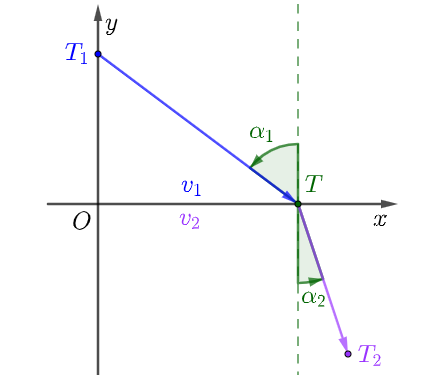
1. In the figure on the left in Carte-sian coordinates (Oxy), light from the point T1(0, y0) travels abscissa T(x, 0) to reach point T2(x0, -y0) in the shortest time. The given veloci-ties are v1 and v2 above and below the x-axis. Thus, instead of light, it could be other waves, and we prove Snell's law:
v1 : v2 = sin α1 : sin α2
looking for the path T1-T-T2 that takes the least time. We have:
t = t1 + t2 = T1T/v1 + TT2/v2,
\[ t(x) = \frac{1}{v_1}\sqrt{y_0^2 + x^2} + \frac{1}{v_2}\sqrt{y_0^2 + (x_0 - x)^2} \]We look for the extreme time by equating the derivative to zero:
\[ t'(x) = \frac{1}{v_1}\frac{x}{\sqrt{y_0 + x^2}} - \frac{1}{v_2}\frac{x_0 - x}{\sqrt{y_0^2 + (x_0 - x)^2}} = 0, \] \[ \frac{1}{v_1}\frac{y_0\tan\alpha_1}{y_0/\cos\alpha_1} - \frac{1}{v_2}\frac{y_0\tan\alpha_2}{y_0/\cos\alpha_2} = 0, \] \[ \frac{1}{v_1}\sin\alpha_1 - \frac{1}{v_2}\sin\alpha_2 = 0, \]and that is Snell's law in the way it was supposed to be proven.
2. The second question is how is light so "smart," or where does it get such a "powerful computer" that it calculates these complex optimal paths everywh-ere and always, and, if so, why does it "suffer itself so much"? I intentionally underline absurd similar questions to emphasize the incorrect statements of the problem.
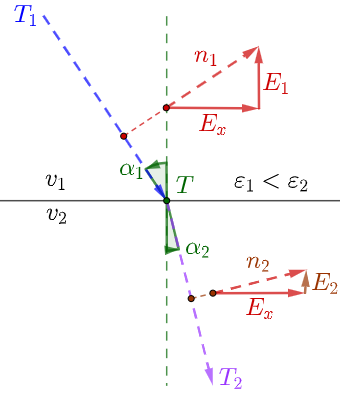
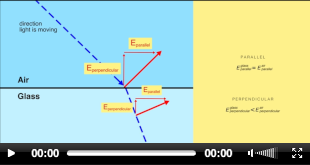
The figure on the right is an interp-retation of the same thing in terms of the electromagnetic nature of li-ght. A higher speed (v1 > v2) goes with a smaller dielectric constant of the path (ε1 < ε2) and with a longer y-component of the electric part of the light wave (E1 > E2). At the spe-ed border, the horizontal compone-nt (Ex) is common to them. Hence, the normal path of light in the slo-wer medium (n2) takes a more ho-rizontal direction. The line of light is therefore refracted. A light wave is transferal because, along its tra-jectory, electrical and magnetic co-mponents perpendicular to it chan-ge, mutually inducing each other. For more about Maxwell's equations, see the book "Information Coupling".
This is a nice explanation; it fits with other derivations of Snell's law just as any correct mathematical theory will fit with other equally correct theories. But it is not enough to explain Snell's law for waves that do not have electro-magnetic components (Sound Waves).
3. I have considered other options in explaining Snell's law. I add to this and, I hope successfully, test the principle of minimalism (Refraction). Namely, light of a longer wavelength has a greater uncertainty of position; therefore, a lower probability density (lower probability, greater information) and less interacti-on with the environment are less attractive to it. Informative means laborious, repulsive, and "less informative" means "more expressive" (Wave in Wave). That is why red light refracts less than blue because it has a longer waveleng-th. This interpretation is not widely known; I have not published it (as usual), although I believe it is correct. The promise is that we will keep such to our-selves!
4. The last in a series of similar ones is the most controversial, but neverthele-ss the most interesting possibility of explaining Snell's law using virtual sphe-res. A package of simultaneous events is unpacked with "all or nothing." We considered it as a cone whose sections are what relative observers see. Such observers, however, do not see the entirety of the primary wave-particle (S) and its ability to choose the shortest distances between two points in its im-mediate environment or wider. When we know that such an ability exists, we can also use calculus of variations to arrive at its longer path. The same app-lies to the shortest time between given points.
When you have a low income and survive by eating cheaply, you will have fe-wer overall expenses during the month than other people, or less than usual.
As we can see, from the point of view of mathematics, there is no problem in unrolling its longer path, given its infinitesimal surroundings. This does not apply to a group of particles that are not related like the wave. Individuality breaks their simultaneity; it hides it or cancels it in such a way that relative observers do not notice it. It is not real for such. The wave seems to absorb it and (3) makes refraction work for our perception as well. This absorption, viewed more broadly, because of the waves of matter in general, is not total.
Bernoulli II » srb
Question: Is it possible to explain the refraction of light by Bernoulli's attrac-tion?
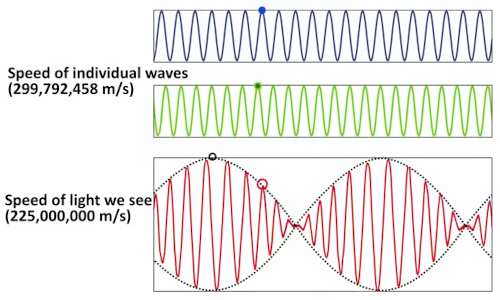
Answer: Yes, but it is also compl-etely unknown to today's physics. These personal "little secrets" are uncomfortable to reveal, almost like anomalies to a disabled person, but I will make an exception again. You will like the video in the image link on the left, I believe, more.
The detail is the interference of li-ght as it passes through a medium of lower optical velocity. The resulting packet travels slower than its wave co-mponents. First, capture that deceleration, and then it will go easily with Ber-noulli's attraction. Ignore the second part of the video, the one that talks about the all-seeing wave and the group velocity, which is a superposition of the various paths that light could take.
The Bernoulli's principle and equation form one of the fundamental mathe-matical phenomena in the branch of physics called fluid dynamics (of gases and liquids), the branch of fluid mechanics that deals with the flow of fluids. The basic form of Bernoulli's equation is:
v²/2 + gz + p/ρ = const.
where v is the velocity of the fluid, g is the acceleration due to gravity, z is the elevation (altitude), p is the static pressure, and ρ is the density of the fluid. If we multiply the given equation by the density ρ, we obtain its different form:
ρv²/2 + ρgz + p = const.
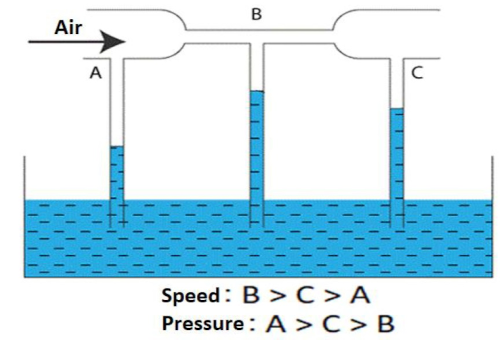
where the first sum ρv²/2 is called the dynamic pressure.
The picture on the right shows the operation of this principle. Below is a pool of water from which three suction pipes A, B, and C protrude to the upper pipe through which air flows. The highest airspeed is above B, then C, and the lowest is at A. This results in the highest press-ures, attracting water through the openings B, C, and A in that order. Higher-speed air sucks water in more stro-ngly. In general, faster fluid is more attractive. Now let's combine this with the interference above.
The air particles interfere with the water particles, grouping together in a wa-ve-like manner and matching their speeds. Unlike individual particles, the waves in a packet are "stuck together" and pull on each other. It is this diffe-rence between a group of particles and a wave packet (Bending II, 4) that ca-uses the wave to bend toward the slower medium, while the particles do not. Now let's add to that the principle of minimalism.
The connection with relativity comes from the interchange of the positions of a fluid that is moving (in the picture, air) and one that is at rest (water from a swimming pool), and also with the contraction of lengths and the dilation of time. From general relativity, it is widely known that the slower flow of time is gravitationally attractive, and this can now mean the attraction of moving par-ticles to stationary ones, that is, give us an explanation for the "gluing" of wa-ves into connected groups, wave packets. This makes sense of attraction from the standpoint of principled minimalism.
Suppose we now return our attention to light or sound entering water or glass from the air, refracting. In that case, we will notice that the slowing down of the waves, and thus the deflection, which comes from the slower waves of pa-rticles in the new environment, comes with a relativistic slowing down of time. A slower flow of time would mean fewer events and less uncertainty, which is in line with minimalism, that processes spontaneously tend towards less info-rmative, i.e., more probable, outcomes. That this is a general phenomenon fo-llows from the universal wave nature of matter (Louis de Broglie, 1924).
Visibility » srb
Question: Explain to me the concept of "visibility" from our conversation abo-ut "wave in wave"?

Answer: That "visibility" is actually an idea I was thinking about until I decided on the one from the book "Information of Perception". It was completed in 2016. It means rough-ly what the title says, but with too much emphasis: "Brands need to be visible to do well in the market," which is a quote from the link to the image on the left.
In short, the visibility V of an empl-oyee, as well as of a star in a conste-llation, is proportional to the chan-ce of finding it in focus at the right moment and the information it represents at that time. For a star to be seen, it needs to be sought in the right place. Aga-in, it must be conspicuous enough, or interesting, or unexpected enough for us to pay attention to it. It is an analogous story with the information of percept-ion (S = I⋅H) which is proportional to the abilities (I, intelligence) and limita-tions (H, hierarchy), which was then visibility (V = P⋅I) proportional to the probability and information.
It can be said differently that information is proportional to the visibility of the observed and inversely proportional to the chances of finding it (I = V/P). Namely, the bigger news is “a man bit a dog” than the news “a dog bit a man,” because the first event is rarer and less probable than the second. Information is greater when the probability is lower. On the other hand, in order to obtain information, we must have its visibility.
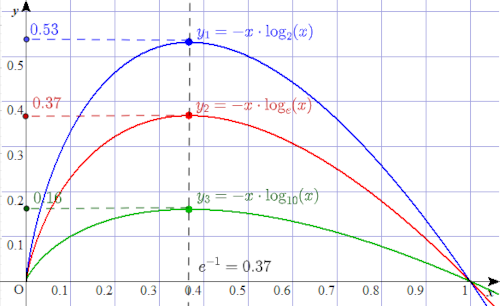
Visibility, expressiveness, and also penetratingness have a summand:
y(x) = -x⋅logb(x)
of Shannon's information:
S = -p1⋅logb(p1) - p2⋅logb(p2) - ...
where p1, p2, ... are the probabiliti-es of the given distribution. In the figure on the right, three such sums y1, y2 and y3 are shown in blue, red, and green, respectively, with logarithms of bases b1 = 2, b2 = e and b3 = 10. The graphs have maxima y(e-1) = 1/(e⋅loge b). The base of the logarithm (b) is the unit of measurement of information.
Intrusiveness has its optimums, no matter how we define “probability” and “information.” Put, if there is no chance of seeing something, it is not worth it, which could mean something, and in the opposite case, if we encounter some-thing at every step, it becomes worthless. These are situations when greater vi-tality has a greater ability to manipulate still life, but it also brings transience, that is, the mortality of fictions or lies. Like when in a rickety boat, saving it from capsizing, we move all the weights from one end to the other, and the boat still capsizes. I emphasize the universality of this idea of “visibility”.
In the case of the "wave in wave", supposedly empty space (2) does not mani-fest itself to the outside world like particles, due to the too-low probability of communication with us, although it can be full of wonders in its uncertainty. Large uncertainties have large wavelengths, up to completely flat, canceled waves, which are then all the less probable. They interact less with the envir-onment, react less to it, and deviate less into the middle of other speeds, and therefore refract less. On the other hand, rays of short wavelengths "friend" too much with the environment, are destructive, and have a short range.
Woofer » srb
Question: Does the above (Visibility) apply to other types of waves, or only to light waves?
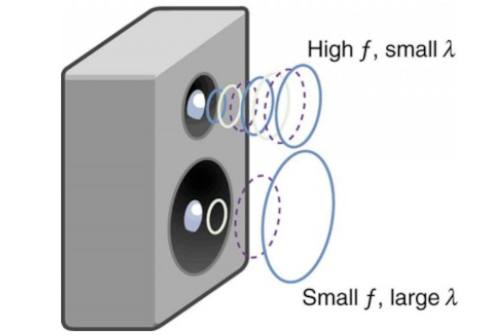
Answer: Matter is in waves (Louis de Broglie, 1924). Its parts are ato-ms and even smaller particles, but their parts are waves. The forms of these are vectors, and they are also states and processes, also are wave packets, and our great reality is ma-de of such.
Sound is the undulation of a subs-tance like these micro packets. In part, with their basic, abstract, and universal truths, deductions are universal. In this way, they differ from concr-ete subjects of perception, which are unique. By such logic, the deep tones of a "woofer" (the bass of a speaker that produces low-frequency sounds, often fr-om 50 to 200 Hz) behave analogously to low-frequency light, and it is our job to discover which of these analogies are and which are not.
Deeper tones contain greater uncertainty, greater information -logb(p) → ∞ so therefore a fewer probability for interaction p → 0 and not so great "visibility," -p⋅logb(p) → 0. This is a deeper reason for the faint refraction of longer wave-lengths than the known explanations of today's physics. For example, when asked, "Why are longer wavelengths of light refracted less?" they will tell you, "The energy peaks of the waves are further away." That is all and nothing mo-re, until what was said here (18 March 2025).
At the other end of the "visibility" range are waves of high frequencies and high chances of interaction; therefore, they are more communicative with the environment and therefore quickly expendable. They have a short range, and again, the same alleged visibility is small.
As a reminder, the refractive index of a medium is higher for shorter wavele-ngths. These are the blue and violet light from white light, and it is lower for longer wavelengths of red light. This means that shorter wavelengths of light will slow down more than longer wavelengths as they pass through the medi-um, and their rays are bent or refracted more. That's it, as far as physics goes today.
When white light enters a transparent solid, it is slowed down by encountering molecules in the crystal lattice. Shorter wavelengths, because they have more wave peaks at a given distance, are slowed down more than longer wavelengt-hs. This is not significant when the light enters perpendicularly to the surface, but when the light enters at an angle to the surface, its wave nature causes it to bend, or refract, proportional to the change in its speed.
For example, waves with longer wavelengths λ propagate faster in deep water than shorter ones. The phase velocity (peaks) of deep waves is given by the fo-rmula:
\[ v = \sqrt{\frac{g\lambda}{2\pi}}, \]where g is the gravitational acceleration, which decreases with depth. In sha-llow water, the dynamics are different. As the wave enters shallow water, its speed depends more on the depth of the water than on the wavelength. How-ever, the speed of sound does not depend directly on the frequency or ampli-tude of the sound wave as much as on the medium through which the sound travels. Sound will travel fastest through solids, somewhat more slowly thro-ugh liquids, and even more slowly through gases. A third example: all wave-lengths of light travel at the same speed.
Frightening » srb
Question:It's strange to hear that a lower frequency carries more information. Isn't it the other way around, that more vibrations of light carry more inform-ation?
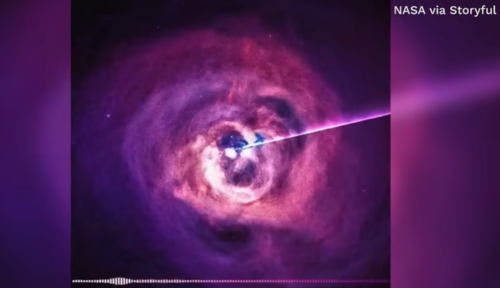
Answer: A higher frequency can gi-ve more information to the enviro-nment, but a lower one contains more for itself. This phenomenon of keeping to itself resembles the embrace of a black hole (its sound is in the image link on the right) and is not a property of longer wavelengths; it is not a peculiarity of the wave itself, it is not unique, so it is theoretical. It is universal and can be felt in the terrifying roar of lions and their deep voice (Sneaking) to distract prey from resistance.
1.The basic idea here is that space, time, and matter are made up of informati-on (quantities of possibilities) and that their essence is uncertainty. This is the guiding idea of my information theory. Hence the use of probability, or the di-scovery of the probability force which makes more likely outcomes more freq-uent. In addition, we have the uncertainty force, which is repulsive in contrast to the first. You will find them in interpretations ranging from boredom to the motion of charges along conics.
In the abstract probability space, with metrics of 1-norm (ℓ1), the constraint of the surrounding uncertainty "drives" the charges around the expected value in the way that planets orbit the sun. We understand this as the "repulsive force" of uncertainty (outer space) or the "attractive force" of probability (the sun). It would seem that all uncertainty is repulsive, but then we notice that vitality sometimes wants freedom (when there is not enough of it), or in the case of larger wavelengths, that uncertainty manages to hold it.
2. The aforementioned “embrace of uncertainty” contradicts the principle of minimalism at places where reality breaks. Let us try to clarify this with Göd-el’s impossibility theorem (Deduction II). No matter what set of axioms and theorems derived from them we have, there are always true statements that cannot be derived from them, as long as we use deduction of the first kind, or truths and only truths. Namely, the falsity of a statement can also be proven by the method of contradiction, but then the procedure uses falsehoods.
In this way, one reality is a “connected land” surrounded by seas of untruths. However, it is not the only “land” in that sea. Moreover, that “sea of lies” con-tains an infinite number of “islands of truths.” It is interesting that until rece-ntly no one noticed that there are an equal number of mathematical truths and untruths, say due to bijection, ⊤ → ⊥, or vice versa, of statements. And this then means that there are an equal number of realities and unrealities. The aforementioned uncertainties are, more or less, prisoners of those envi-ronments.
3. Physical reality cannot lie; therefore, it cannot play and must blindly follow the principle of least action of theoretical physics. However, combined with fi-ction, with which it gains vitality and additional degrees of freedom, it achiev-es the possibility of jumping out of the “island of truth” by adhering to the pri-nciple of minimalism. This looser tendency towards less action, a combination of reality and fiction, depicts a system that can embrace more uncertainty than other "islands" simply by not knowing what is there and, let's say, fearing their possible options.
I speak metaphorically because we are now in a new scientific field and witho-ut the appropriate terms. Therefore, it is good to try to understand our situati-on also with the help of examples from game theory (Dominance). With the ability to lose for the sake of winning, the lose-lose strategy will almost always beat the win-win strategy, and this gives a new character (Traits) to the player. Such permission, not to always follow the smallest action, elevates us to the ability to manipulate nature. We can invent the wheel, which reality itself will never do, but in return, we also get a mortality unknown to it.
4. As an example of a game, let's look at the following table.
| A\B | 1 | 2 | 3 |
| 1 | 3 | 2 | 1 |
| 2 | 2 | 1 | 3 |
| 3 | 1 | 3 | 2 |
Two players, A and B, will try to achieve the highest score possible, freely ch-oosing one from the set of offered points {1, 2, 3} but not knowing what the opponent has chosen. If A chooses 1 and B also chooses 1, he will get 3 points, and if B then chooses 2, the former will get 2, and if the opponent chooses 3, he will only get 1. In general, in each row, the choice of player A that results in the points given to him is in the column of player B's choices.
Without any knowledge of the opponent, the player is completely indifferent to which move he will make, and without knowledge of the range of "gains," it would be wiser not to engage in the game. Except when his curiosity and adve-nture overcome his fear of the unknown and push him to take such a risk. This is a model of the previously mentioned. Namely, if player A knows something about player B, let's say that he is greedy; A can go with number 2, hoping that the opponent would choose 3 so that he also gets 3.
5. The game also represents the advantages of the power of manipulation over the blunt “truth and only the truth” of bare physical reality, as well as the diff-erences that even the slightest knowledge of “the other side” gives us. My the-ory of information is based on the idea of “objective” uncertainty. By this I me-an the impossibility of some knowledge at all, up to and including knowing by obtaining information about a given. No further. An event without informati-on will not happen.
Finally, we see that more light vibrations carry less information precisely from the “playfulness” and the principle of minimalism. Fear of uncertainty, or spo-ntaneity in realizing more likely outcomes, will make less “lively” parts more content with possibilities. Where we are shown the least (vacuum) remains the most, while “showiness” comes with additional limitations. To that I add the well-known interpretation of wavelength by uncertainty of the position. More of one, more of the other.
Dwindle » srb
Question: Explain that "gravity embrace" from the previous answer?
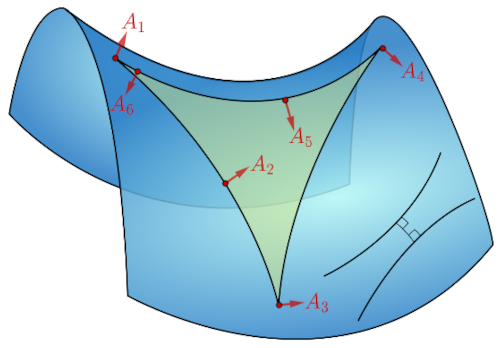
Answer: I have written about this many times, and it seems to me th-at it has gone unnoticed by most, so I can repeat the same thing, becau-se each time something more inter-esting about gravity can be pointed out. I used a recent similar contri-bution (Simultaneity) to draw the non-simultaneity of points (4-dim events) in the gravitational system, now I will use such a picture to des-cribe the loss of a body in the curv-ed space of the general theory of relativity. More precisely, to increase the wa-velengths of the mu parts.
In the upper left image we see a curved saddle surface and a triangle. Its three sides are on the lines that are the shortest distances between the vertices. Note that the sum of the interior angles of the triangle is less than 180°. The vector that slides down the sides A1 → A2 ... → ... A6 is translated in parallel, but after completing the trip around the triangle, its value is no longer equal to the ini-tial value. The vector is always perpendicular to the sides and arrives at the starting point in almost the opposite direction.
Such a change in the vector, say momentum, leads to a still unexplained, ph-antom loss of energy in the gravitational field that was first observed by Lev Landau shortly after the publication of the general theory of relativity. Here I attribute this to the principle of minimalism. Gravitational attraction is an ex-pression of the tendency towards less information emission, i.e., higher positi-on probabilities. Hence the longer wavelength of the light of the source in the field, seen by a distant observer. This is the meaning of the loss of frequency, and therefore energy, of light due to climbing after leaving the gravitational field (Gravitational redshift). To him, the deeper meaning is the embrace of gravity that translates information from the outside into the inside (In and Out).
Bodies are attracted by the slower flow of time from the gravitational field, which means to them a smaller number of events and a smaller emission of information, and it is unimportant to them that this can be translated into the capture of their own information and into the conversion of its emission into retention. This is a story that I have been telling for a long time in various ways, for example, by deriving Einstein's equations (1916) from the principle of least action in the book "Minimalism of Information" (2020).
Believing » srb
Question: What do you believe in?
Answer: It's one of the most frequ-ently asked questions about these blogs (What do I believe?). And it's certainly one of the rarest in my an-swers. It targets different topics wi-th different interlocutors, but from the point of view I strive for (to do-ubt, verify, and prove), almost any question about belief is without re-al meaning, at least as far as the se-arch for truth is concerned.
1. The basis of scientific “faith”, I believe, could be doubt and questioning. In that sense it is not a dogma, but alas, how do we know that even a mathematical truth is really true, say, behi-nd my next discovery (Universe II). Namely, the past fades (Concatenation), because the transmission of information from the past is disrupted and, like a Markov channel, becomes a “black box”. This chain of message carriers will eventually always give the same message, the eigenstate (inherent state) of the channel, no matter what is sent.
Interpreted, it states that what we consider the Big Bang is actually an illusion that cannot be refuted by any measurement or logic lower than mathematical. The Big Bang that we see, verify by measurement, or prove in any scientific way is first of all not the real state of what could have been 13.8 billion years ago but is the inherent state of the medium. So how can we trust reasoning when mathematics itself tells us that we should not trust it?
2. When we leave an object with an acquaintance and he actually finds it like that, then we know that the object is real. Such is reality, I say (Reality IV), which is observable, permanent, and true. Observability is necessary even for physics itself, which raises it to the level of measurability with their apparatus. The observable must be repeatable, and for this reason alone, this implies permanence, which we now reinforce by thinking of the law of conservation (of quantity).
To find something “really” means to have a kind of mathematical certainty of truth. Such “reality”, because of (1), does not guarantee absolute existence (whatever that may be), but it is something very reliable, with which we can work quite convincingly. These three assumptions are mostly “reality” in the ways that science sees it and that I mean in information theory. We will also see how rough a rating this is of these very complex, layered phenomena.
3. When one or two of the assumptions of "reality" are missing, we will say that these phenomena exist, but that they are "fictions." Fiction is Pinocchio, also any lie or fabrication that "lives" in some fantasy. This is a special feature of this theory of information. All deities are like that, existing fictionally, but are they real? This question requires an analysis different from the one given in Gödel's Incompleteness Theorem (Deduction II).
God is observable, as he is in our thoughts. He is permanent as long as a beli-ever lives on this or any planet in the universe. If God is “truth” (according to some), then he also fulfills the third condition of reality, but then he is not om-nipotent. If he is “love,” then he is fiction, because we can love lies or liars. If we and all (possibly) religious creatures in the universe disappeared, the god who is fiction would disappear. That's how things are, if we believe the stories I tell here.
Nature is a deity for some; the universe as a god is reality with all its truths and lies. We believe in its duration even before the Big Bang. Then we imagine truths about the universe 14 billion years ago that do not have any confirmati-on, say by looking through a telescope, because something is real, although not always or from everything observable. Not everything communicates with everything is the main consequence of the fundamental uncertainty of this theory.
4. The problem with “reality” is that, within the framework of this logic, it does not exist as something in itself, absolutely. By subjects I mean particles, or ph-ysical bodies, also individuals who “communicate” (interact) with the environ-ment, thus creating their own world of perception. By what they can perceive, subjects are the information of perception with their environment. The states themselves that can be observed, as well as processes, are interpretations of vectors. Consistent with quantum mechanics, which works with such states and macro states that are their sums.
It follows that subjects are unique. The world that such people perceive arou-nd them is conjugated. Reality is therefore not what it "is" (which is why it do-es not exist), so the idea of "real" becomes colorful, dependent on the relative observer. The interestingness, or beauty, of this world is precisely such "reali-ties" that remain with the above definition (observable, permanent, and true) for each of the immeasurable worlds of subject-object coupling and are at least slightly different for each. Nature does not like equality (Differences).
Alienation » srb
Question: Is the appearance of vitality an alienation from reality?
Answer: This question is both witty and inspiring. Alienation is also the transfer of ownership of property from person to person. In a broader sense, it is something separate fr-om, or foreign to, something else. Alienations are the names of the state of a person in whom actions, products, or ideas become an opp-osing power that subjugates him, foreign to him and independent of his acti-vity and existence. Marx mentions the alienation of people from human natu-re in the production process and in the social life of capitalism. In this sense, we are not talking about the alienation of physical nature from itself, so you are right when you say that the phenomenon of vitality is an alienation from reality. I find it interesting to add a few more examples to the topic.
1. The rating of scientists (h-index) is mainly based on productivity, citations of others, and the number of citations from others. To support a career, there are various qualifications and associations (I to you, you to me) for the purp-ose of gaining rating points in front of one's own scientific results. This is an open secret in various literary, political, and similar "achievements." For the orthodox, it represents injustice.
In a study of such an anomaly (Journal of Empirical Research on Human Re-search Ethics, 2006), with a particular focus on academia, it was found that when scientists believe they are being treated unfairly, they are more likely to behave in ways that undermine the integrity of science. Thus, the rating is a self-perpetuating phenomenon, one that feeds itself and further alienates sc-ience from orthodox scientists.
2. If professors could write, they would be writers — is a common response from writers to the remark that they should write about what they know well. There are significant differences between those who “should” be exemplary scientists, or artists, or successful businessmen and even athletes and those who are. A system like the one mentioned above, “which feeds itself,” says that “behind every successful person stands a teacher who supported him,” but practice will more often say that “behind every very successful person stands a teacher who told him he would never succeed in that job.”
The previous (1) and this quote tell us about conformism. The need for fewer actions, or rather the striving for principled minimalism in vitality, is not at all or barely recognizable in the drives, which therefore need to be emphasized. The fictions associated with our physical nature also strive for as little infor-mation emission and communication as possible, for more probable states, for no energy consumption. This subsidence of vitality, in psychology the "death drive", is the opposite of the "life drive" and the seemingly absurd striving for greater communication if the force of the status quo is ignored (Ladder III).
3. Degeneration of democracy occurs through a slightly different process. Since nature does not like equality, it models the free will of voters through "one man, one vote" in the manner of a network of equal connections that goes into a network of a small number of nodes with many such connections with many nodes and few of them. These large nodes are concentrations of a large number of flows of money, goods, and services, to which everyone has an "equal right" who disposes of these exchange values.
The owners of money thus transform the majority will of the voters into the majority will of the owners of otherwise equal elements of the flows (money is money no matter whose it is), alienating democracy into an oligarchy of the owners of money. Currently (March 2025), almost all European rulers are representatives of some corporations and banks. But nature still does not like equality, so the "small owners" tend towards further disunity. The desired democracy grows into a network of interconnected hierarchies. Similar to the accumulation of power of former fiefdoms.
4. Common to the trends of alienation from science (1) and the degeneration of democracy (3) is the reduction of the need for information. The decline in uncertainty through the decline in originality in science and the increase in the efficiency of network communication have in common the reduction of information emissions. Therefore, preventing this trend costs the first by undermining the authority of scientific institutions or the second by slowing down economic development. Giving crucial importance to the systematic education of exemplary scientists (2) is a contribution to slacking off, for ex-ample, by alienating the educational process and favoring suitable personnel in employment.
On the other hand, letting these flows run their course spontaneously also leads to libertarian rebellions. Namely, the decline in the vitality of society is not at the same speed as the decline in the vitality of members of society and their needs for freedom. The evolution of individuals is much slower than social change, and improving the security, orderliness, or efficiency of the system will result in a narrowing of the freedoms of participants. It can also result in a loss of interest in finally reorganized societies. I emphasize in the end that the method of analysis here is not the usual geopolitical one, nor is it following the paths of money.
Dissipation » srb
Question: Are there general assessments of the alienation of vitality from what is desired?
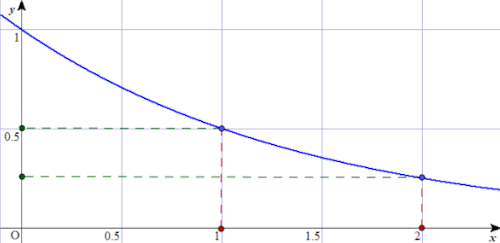
Answer: This rougher help comes from statistics and a little more precise from probability theory. However, this information theory is too new and fundamental for me to get into the details. I will give a simple example to show how many major new chapters it opens.
1. We toss a fair coin until it lands on a “head.” The first “head” has the proba-bility p1 = 1/2 = 2-1. For the first toss to land on a “head” the second time, the first toss would have to be a “tail,” so the probability is p2 = (1/2)(1/2) = 2-2. The probability of the first “head” in the third attempt is p3 = 2-3. In general, the first toss to land on a “head” is exactly n (n = 1, 2, 3, ...) with the probabili-ty pn = 2-n. If it fell in the nth, it did not fall in the mth (m ≠ n) and will fall at some attempt, so the sequence p1, p2, p3, ... forms a probability distribution. Hence:
p1 + p2 + p3 + ... = 2-1 + 2-2 + 2-3 + ... = 1.
Formally, the terms of the sequence of any single probability distribution are non-negative, but the real numbers sum to one. The graph above right shows this probability distribution. Such exponential distributions, whose subsequ-ent outcomes do not depend on the previous ones, so we say that they do not remember, are maximum information. Their presence is "unnatural," against the spontaneity of the course of events, because it defies the principle of mini-malism.
2. The morale of the above is that there must be a natural aversion to events that "do not remember" (to always repeat the same thing), due to a fundame-ntal resistance to greater information, and this is also the natural inclination to reality, or the tendency of fictions to be real. I only note that this opens a chapter on the symbioses of the "living" (vital) and the "non-living" (material).
3. The number n = 1, 2, 3, ... of coin flips until the first outcome is "heads" is an example of a random variable of the given distribution (1). If we record in which trial the desired outcomes occur, we also obtain a random sequence of natural numbers x1, x2, x3, ... which will be another corresponding sequence of (natural) numbers on another occasion. However, these numbers xk cluster around some mean value μ > 0, the number of trials to land "heads". The expectation (can also be calculated like this) is:
μ = 1⋅p1 + 2⋅p2 + 3⋅p3 + ... + n⋅pn + ...
μ = p1 + p2 + p3 + ... + pn + ... +
+ p2 + p3 + ... + pn + ... + + p3 + ... + pn + ...,
μ = 2-1 + 2-2 + 2-3 + ... + 2-n + ... → 1 + 2-2 + 2-3 + ... + 2-n + ... → 2-1 + 2-3 + ... + 2-n + ... → 2-2 + ... + 2-n + ... → 2-(n-1)
μ = 1 + 2-1 + 2-2 + ... + 2-(n-1) + ... = 2.
So, the mean value of landing heads for the first time in a series of fair coin tosses is μ = 2. When the distribution changes to a less exponential one, this expected value increases (μ > 2).
4. The lesson here is that the spontaneous departure from the exponential distribution towards a thinning of its density gives rise to increases in the mean values of the random variables. Thus, increasing the added random variables will likely result in higher expectations as the exponential distri-bution loses its sharpness.
For example, in biology textbooks, we still find that microbes should multiply exponentially, which is not true in practice (Exponential). Microbes destroy their host and change the environment; their prey dies or becomes resistant, and the pace of disease spread slows down. The spontaneous flow of nature that "should" be exponential will thus "remember"; it will not be the same in the future as it was before. This development goes towards diversity because nature "does not like" equality. In that sense, vitality will also lie in the diver-sity, in the uniqueness of subjects.
5. An unfair coin has probabilities p ∈ (0, 1) of getting "heads" and q = 1 - p of getting "tails." If we toss such a coin until the first outcome is "heads," the pro-bability that this will happen in the nth toss will be qn-1p. Similar to (1), where p = 1/2, this is also a distribution, because:
p + qp + q²p + ... + qn-1p + ... = p(1 + q + q² + ...) = p/(1 - q) = 1.
The expectation of this distribution is:
\[ \mu(p) = \sum_{k=1}^\infty kq^{k-1}p = p\sum_{k=1}^\infty kq^{k-1} = \] \[ = p\frac{d}{dq}\sum_{k=1}^\infty q^k = p\frac{d}{dq}\frac{q}{1-q} = \frac{p}{(1 - q)^2} = \frac{1}{p}. \]In the previous, fair case, p = 1/2, so μ(1/2) = 2, which is again true. When the certainty of the desired outcome is large, p → 1, then we get what we want fr-om the first because μ(p) → 1. Conversely, when the uncertainty of the desired outcome is large, p → 0, then we never get what wanted, because μ(p) → ∞.
6. The Variance, or the mean square deviation from the expected value, of the mean μ(p) of a random variable of this (5) distribution is:
\[ \sigma^2 = \sum_{k=1}^\infty (k - \mu)^2q^{k-1}p = \] \[ = \sum_{k=1}k^2q^{k-1}p - 2\mu\sum_{k=1}^\infty kq^{k-1}p + \mu^2\sum_{k=1}^\infty q^{k-1}p \] \[ = p\sum_{k=1}k^2q^{k-1} - 2\mu^2 + \mu^2 \] \[ = p\frac{d}{dq}\left(\sum_{k=1}^\infty k q^k\right) - \mu^2 \] \[ = p\frac{d}{dq}\left(q\sum_{k=1}^\infty kq^{k-1}\right) - \mu^2 \] \[ = p\frac{d}{dq}\left[q\frac{d}{dq}\left(\sum_{k=1}^\infty q^k\right)\right] - \mu^2 \] \[ = p\frac{d}{dq}\left[q\frac{d}{dq}\left(\frac{q}{1-q}\right)\right] - \mu^2 \] \[ = p\frac{d}{dq}\left[\frac{q}{(1-q)^2}\right] - \mu^2 \] \[ = p\frac{1 + q}{(1-q)^3} - \mu^2, \] \[ \sigma^2 = \frac{q}{p^2}. \]In the case a fair coin, p = 1/2, the expectation μ = 2, and the variance σ² = 2. However, in the case of certainty of the desired outcome, p → 1, q → 0, so the variance σ² → 0, and there is no dispersion. Conversely, in the case of uncer-tainty p → 0, q → 1, and the variance σ² → ∞. The dispersion is unlimited.
7. The universe is constantly changing; it is never the same and, at the same ti-me, tends to develop into a more certain one. Therefore, such dispersions are reduced, uncertainties are becoming smaller, and outcomes are moving towa-rd more probable states. There is a similarity between reality and fiction, so in terms of general assessments of the alienation of vitality from the desired, we can also use what is known to us from Markov chains. The messages (states and processes) of the past are scattered, but they nevertheless converge to the inherent states (eigenstates) of the universe found along the way.
Adjustments to each other bind states and processes. They trap them and do not allow them to go too far in their expansion, at least as far as the universe from which they started, in which they once found themselves, in which we are now.
Model » srb
Question: What's the point of these calculations (Dissipation)?
Answer: It is a model. That tossing of a (unfair) coin, with the probabi-lity p and q = 1 - p of positive num-bers for the desired and undesired outcome, is a model, a kind of inte-rpretation of various isolated phen-omena. This can be applied to a sw-itch in true-false logic terms or to the presence or absence of current in electrical circuits. That is why the “fair coin” is convenient, inspi-ring, and instructive for many inv-estigations, especially considering successive attempts to achieve the desired outcome.
1. If we toss such a coin until the first outcome is "heads," we had this in the previous answer: qk-1p is the pr-obability that this will happen in the kth toss. The Shannon information of such a distribution is:
\[ S_\infty = -\sum_{k=1}^\infty q^{k-1}p\ln(q^{k-1}p) = -p\sum_{k=1}^\infty q^{k-1}[(k-1)\ln(q) + \ln(p)] = \] \[ = -p\ln q \sum_{k=1}^\infty (k-1)q^{k-1} - p\ln p \sum_{k=1}^\infty q^{k-1} \] \[ = -p\ln q \cdot \frac{q}{(1 - q)^2} - p\ln p \cdot \frac{1}{1-q}, \] \[ S_\infty = \frac{1}{p}(-p\ln p - q\ln q) = \frac{1}{p}S_1, \]where S1 is the Shannon information of one throw. The function S∞(p) ∈ (∞, 0) is rapidly decreasing for p ∈ (0, 1) and q = 1 - p.
2. When the probability (0 < p < 1) of a particular outcome increases, the ex-pectation of its realization μ(p) = 1/p in the sequence of outcomes decreases, their frequency increases and this is exactly what we are talking about, for ex-ample, with the frequency of light (Wave in Wave). Also, meaningful text is made more regular.
Speech is characterized by sequences of differently represented signs, which can distinguish it from a random natural signal that is more uniform. For ex-ample, observing distant stars could distinguish intelligent conversation from an ordinary cosmic phenomenon.
Excess freedom is what we need to express something with less freedom than it has in itself. That is the power of vitality and intelligence, that we can, like a pickaxe, hold it higher for the momentum with which to drive it deeper. In th-is sense, intelligence is absurd, because its result is a less informative phenom-enon, better directed, reduced of excessiveness.
3. The derivative of Shannon's information (1) is the function:
\[ S'_\infty(p) = \frac{\ln(1-p)}{p^2}, \quad q = 1 - p, \]which is easy to check. Since the numerator is the logarithm of a number less than one and is a negative number, this function is negative, and the graph of the function S∞(p) is decreasing. As p ∈ (0, 1) is a larger number, the increme-nt of S'∞ is smaller, i.e., the derivative of the derivative is an increasing functi-on, and this tells us something about the slowing down of the decline in the information density of the present.
In order for the information of the present to decline, consistent with the pri-nciple of minimalism, it can be stored in the past. This is the way in which the pursuit of more probable states (less informative) leads fictions towards reali-ty, more precisely into duration. By forming a trace of the past, which leaves its messages in the present, the present can be relieved of uncertainty. Our past thus governs our future because by taking over its options, it induces the present. The law of conservation of total uncertainties is valid.
4. This brings us to an earlier hypo-thesis of this theory that may now have experimental confirmation, at least according to the video link in the image on the right. Notice the part that talks about the slowing down of the acceleration of the ex-pansion of the universe. (March 24, 2025)
Namely, light from cosmic distances reveals to us the past of the universe. Th-ese spaces are a kind of storehouse of the past, and there are more and more of them, like the history of the universe. The expansion of these spaces, with the galaxies moving away, is interpreted here as the progress of the present into the future. This is a kind of deposition of the universe's records into its memories.
Absurdity » srb
Question: You just stated that intelligence is absurd because its result is a less informative phenomenon, better directed, reduced to nothingness. Is that rea-lly so?

Answer: Yes, that kind of absurdity is different from the little-known one that the caption on the left tal-ks about, and that's why it's even stranger and more unreasonable. I'll explain it.
1. Dead physical nature is made up of systems of the least information (quantity of uncertainty). They do not lie and strictly follow the least action, to mention only two of ma-ny. However, it, combined with fictions, can acquire vitality, or a surplus of options that allows for greater freedom of decision, the ability to defy the laws of physics, and the power to lie. Then we can speak of the emergence of a grea-ter “intelligence,” by which I mean here the usable capacity of vitality (a surpl-us of options in addition to dead physical matter).
2. This surplus of options is necessary to overcome the surplus of options pos-sessed by every possible system, even inanimate matter, because information is the fabric of space, time, and matter, and uncertainty is its essence. Inform-ation is not for spontaneous emissions; it is forced to do so by the law of pres-ervation and its own short duration (as soon as the news is communicated, it is no longer). The deeper meaning of this is that the emitted information perf-orms the work of force. The intelligentsia uses its surplus of options, I say, to perform the actions of unfolding the surplus options of other systems, thus fi-nding more abstract phenomena, cleared of interference.
3. The results of intelligence's work, its trace, and what we recognize it by thus become less informative phenomena than they would be spontaneously. This reduction in (Shannon's) information of a better writer's text (Letter Frequen-cy) gives the expressiveness that we consider the quality of the author. And the forces of probability help them with this.
I estimate the aforementioned probability forces, for example, from changes in the time course of the Schwarzschild metric of the gravitational field:
ds² = -(1 - 2φ) dt² + (1 - 2φ)-1dr² + r²dΩ²,
where the time component attend with the metric tensor gtt = -(1 + 2φ), where φ = -GM/r is the gravitational field potential of the bodies of masses M at a di-stance r from the center of the field. The proper time of the position in the fie-ld is \(dt_0 = \sqrt{-g_{tt}}\ dt\), while dt is the same relative time, observed outside the field. The field strength changes along the radius proportionally to changes in the speed of time:
\[ F = \frac{\partial}{\partial r}\sqrt{-g_{tt}} \approx \frac{\partial}{\partial r}(-1 - \varphi) = \frac{\partial}{\partial r} \frac{GM}{r} = -\frac{GM}{r^2}, \]which is also Newton's force, i.e., the force of gravity on masses up to the or-der of the size of the solar system. I further take the slowing down of time by immersion in the field as the equivalent of a decrease in the number of events, i.e., a decrease in information, or uncertainty.
4. I have described to you one of the preparations for the procedure in which a model, or an analogous way of slowing down events, can be used. A similar one would be using Lorenz's gamma coefficient, which gives time dilation and energy increase:
\[ E = \frac{E_0}{\sqrt{1 - \frac{v^2}{c^2}}} \approx E_0(1 + \frac12\frac{v^2}{c^2}) = E_0 + \frac12 m_0v^2, \]where E0 and m0 = E0/c² are the proper (resting) energy and mass of the body. This increase is the kinetic energy obtained by the action of a force on the body, analogous to the previous one. The change in that force, again, is proportional to the change in the resultant quantity of the outcomes.
5. Gravity, like a system in relative motion (Dissipation), carries part of the in-formation of the observed body in parallel time. In this way, it traps part of the uncertainty for the relative observer. It makes the body less accessible to him so that he sees a slowdown in time along with a reduced number of outcomes. Much like an "intelligence" that unfolds a surplus of options, except that these natural blunt forces simply dilute the information.
Аbstraction IV » srb
Question: How can you compare gravity to intelligence?

Answer: The little they have in co-mmon is the power of uncertainty to delve “below the surface.” These are the possibilities of theories, be-cause they are everyone's, unlike practice and subjects, which are unique.
Let's try to understand this using geometry, say, with its three axio-ms of incidence:
- For every pair of distinct points, there is exactly one line containing them;
- Every line has at least two distinct points;
- There are three points that do not all lie on a single line.
Let us call the outcome of a random event a “point” and the probability distri-bution a “line,” and we obtain a geometric model of probability theory. It is co-nsistent with all further derivations, just like Euclidean geometry.
For example, the second axiom (ii) states: every probability distribution has at least two different outcomes. In other words, every dilemma has at least two possibilities. If we achieve parity of the other axioms of geometry with proba-bility, then this gives us the right to use all the theorems of geometry consiste-ntly in probability without reservation.
Axioms are very abstract, washed away from the concrete, and this gives them a special place in the world of information. Many of them are needed to descr-ibe simple subjects, and there are always more of them than we would need to encompass everything. It is impossible to have all the axioms and all their co-nsequences and thus encompass all truths. However, subjects and concretene-ss in general are complete phenomena. There is another connection between gravity and intelligence.
The indeterminacy of bodies that gravity hides from relative observers in other time dimensions resembles the indeterminacy of (always) unfinished theories. Plunging into the field as well as into the worlds of the abstract, each with the help of its potential (field energy and excess possibility), the former goes towa-rds parallel realities, the latter towards naked truths and understanding.
On the other hand, these goals are attractive, each in its own way. Gravitation-al, as well as the attraction of bodies in motion (Bernoulli II) comes with a slo-wer flow of time, and that with parallel realities. The attraction of abstract tru-th is very similar to the first, because we again have a slowed flow of time, or more precisely a time freeze. Namely, the equivalence of action (ΔE⋅Δt) and information again leads to the attraction of a slow flow of time (ΔE → 0 with Δt → ∞), since abstract truths are all-time, universal.
The inertia of mechanical bodies, as well as our laziness, has a common root in a principled minimalism and hence a tendency towards order. We seek regula-rities in the desire to reduce options for the sake of direction and automatism. Inanimate physical matter behaves similarly, each recognizing its own circum-stances. The uncertainty principle of (this) information theory states that dir-ect communication of everything with everything is not possible.
The second part of this question, "How come the attractive force of probability decreases in the same way as the gravitational force and/or with the square of the velocity?" is answered by Chebyshev's inequality and in several answers af-ter that. This topic is discussed in detail in the book "Information Coupling" (pp. 20-29), where evidence is provided that any constant central force decre-ases with the square of the distance and also that it moves charges along coni-cs. The link to the aforementioned Bernoulli equation will explain the depend-ence on the square of the velocity.
Basel problem » srb
Question: I was at one of your lectures (for better mathematicians)... Can you send me a recording?
Answer: Yes, it's been on YouTube for a long time, since 2018. The ca-meraman was from the photo secti-on, probably practicing, so it's not an excellent recording. The video was uploaded, maybe not that year, and it's better to send you the topic by email.
That's what I did with the correspo-ndent. So, I'll retell that Basel problem here, because it's very related to the th-eme of this blog (Model).
1. Let's go to prove:
\[ x = \frac{1}{1^2} + \frac{1}{2^2} + \frac{1}{3^2} + \frac{1}{4^2} + \frac{1}{5^2} + ... = \frac{\pi^2}{6}, \]using methods of elementary mathematics. I cite this long-known solution be-cause its application in information theory has yet to be discovered.
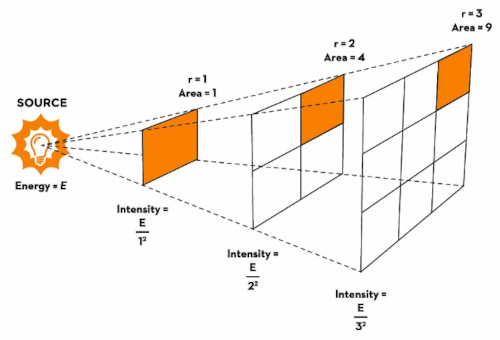
2. Let's imagine that from the origin (T) of the abscissa we observe to the right a series of light sources A1, A2, A3, ..., bulbs of equal power and arrangement. The light decreases with the square of the distance, as can be seen in the follo-wing figure on the right.
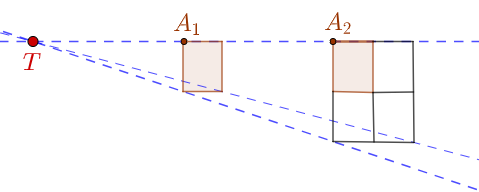
To see the same illumination at po-ints A1 and A2, at a distance r it wo-uld have to be r² times brighter, or, to put it another way, the light inte-nsity decreases with the square of the distance. There are infinitely many sources, and their light decr-eases too quickly, so the total illu-mination reaching the observer T will be finite, and the sum of their contri-butions converges. This is what we need to prove and indeed calculate their total sum.
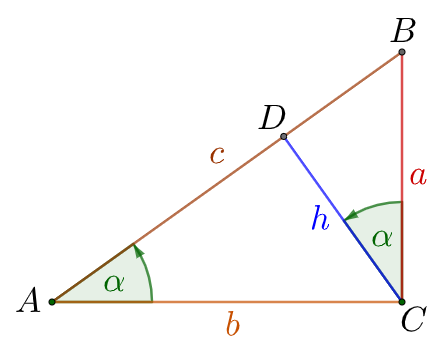
3. The sum of reciprocal squares can also be found for the right triangle ΔABC in the following figure on the left. Namely:
\[ \frac{1}{a^2} + \frac{1}{b^2} = \frac{1}{h^2}, \]whose legs are a = BC and b = AC, and the height to the hypotenuse is h = CD.
Indeed:
\[ \sin\alpha = \frac{h}{b}, \quad \cos\alpha = \frac{h}{a}, \] \[ \sin^2\alpha + \cos^2\alpha = 1, \] \[ \left(\frac{h}{b}\right)^2 + \left(\frac{h}{a}\right)^2 = 1, \]whence squaring the fractions and dividing the equality by h² yields the required equality. These two angles are equal, ∠CAB = ∠BCD = α, because their sides are perpendicular. The base of the altitude from the vertex of the right angle C to the hypotenuse AB is the point D.
Applied to the previous bulbs (2), this means that two identical lights at points A and B give the observer at C the same illumination as one such light at D. The same would be the cumulative effect of gravitational and also Coulomb forces and, in general, central or probability random variables (Vanish) of the same dispersions and mean values at points A and B, replaced by one at D. That is interesting in itself, but let's look at the next similar one.
4. In the following figure, the circle on the left has a diameter d, a circumfer-ence of 2 = πd. According to the previous, at point T the light bulb O shines with an intensity proportional to the number 1/d² = π²/4. The middle two ci-rcles touch at point T, the larger of which is twice the diameter of the smaller. The diameter PQ = 2d is tangent to the smaller at point O, from which the lig-ht, for the observer T, is the sum of the two light bulbs at points P and Q, i.e., the light from point P is proportional to π²/8.
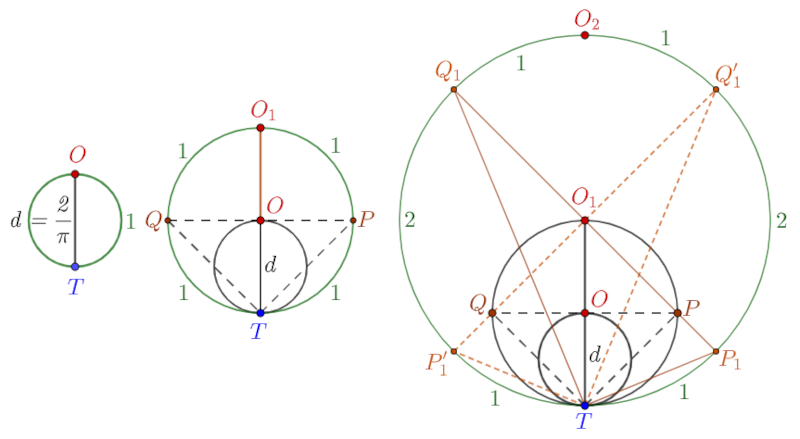
Both middle circles of that figure are on the right-hand side. That largest circle has diameter TO2 = P1Q1 = P'1Q'1 = 4d. Triangle TPO is right-angled (the peri-pheral angle over the diameter is right), as are triangle P1TQ1 and so triangle P'1TQ'1. From (1) it follows again that the light intensities P for T are equal to the sum of the intensities from P1 and Q1, or the sum of the intensities P1 and Q1. We have two pairs of diagonal points, each with a sum of π²/8, which is again a total of π²/4 of the light intensity for the observer T.
5. Notice how the structure of this third image is repeated by doubling the cir-cle. When a circle twice as large is added to the last outer circle, the two points O2 and P1 define the line on which its diameter lies. Then TP1 becomes the he-ight of the corresponding triangle P2TQ2 of the new circle whose diagonal poi-nts P2 and Q2 give the total illumination at point T as one P1. Symmetrically, P'2 and Q'2 have the same total illumination, as does the third pair, now diag-onal points on the tangent of the smaller circle at O2. The sum of all six such points is again π²/4, also adjacent at arc distances of 2.
Continuing to double such circles, the distances of all adjacent corresponding lamps along the arcs are 2, with the total illumination T always the same inte-nsity π²/4. Each new double circle straightens more, so that these points are linearly further apart. Finally, these enlarged circles become the abscissa with T at the origin and lamps at positions ±1, ±3, ±5, ... illuminating it with a total intensity proportional to π²/4.
6. The right semi-axis is with bulbs at points 1, 3, 5, ... of total illumination π²/8 at observer location T, so that:
\[ \frac{\pi^2}{8} = \frac{1}{1^2} + \frac{1}{3^2} + \frac{1}{5^2} + ... \]For the above (1), the required sum x is missing:
\[ \frac{1}{2^2} + \frac{1}{4^2} + \frac{1}{6^2} + ... = \frac{1}{2^2}(\frac{1}{1^2} + \frac{1}{2^2} + \frac{1}{3^2} + ...) = \frac{x}{2^2}. \]Accordingly, we find:
\[ \frac{\pi^2}{8} + \frac{x}{4} = x, \] \[ \frac{\pi^2}{8} = \frac{3x}{4}, \] \[ x = \frac{\pi^2}{6}, \]and this is what was to be proven in (1), the equality of the Basel problem.
7. I do not consider the Basel problem as useful for the discussion pages of this blog as much as the intermediate results of the proofs. These steps occur in analyses of the decreasing probability of interaction of virtual photons, ex-panding spheres of electrons (Spheres), or the action of gravitational, electric, and generally central force fields of any strength. More on that later.
Bending III » srb
Question: Should that answer (Bending) be understood as meaning that you don't believe that gravity bends light?
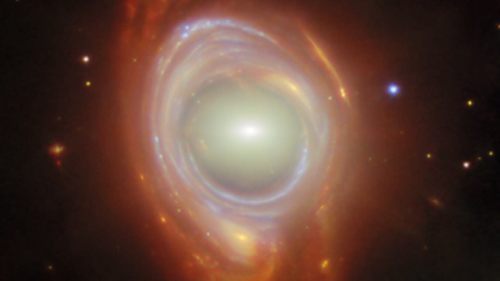
Answer: Not at all. The fact that I am happy to consider alternatives is a matter of curiosity, not belief. If I can even live the story so much that you think it is real, then expe-riencing the plot is not the bane of good narrators alone but a virtue of good researchers as well. In that sense, thanks for the praise!
However, I will disappoint us. The text about the bending of light due to gravi-ty does not discuss the absence of this bending but rather the possibility that this phenomenon will surprise us again one day in science. We still use Newt-onian gravity for weaker fields (planets of the solar system) with its predictio-ns, and Einstein's improves on them. That's all. The emphasis was on the dev-elopment of the very idea of waves in refraction, not only light, which you will see in other forms in these answers (Bending II). Don't believe that this makes me believe that waves don't refract.
1. The Schwarzschild interval defines the infinitesimal distance between even-ts of general relativity, in polar coordinates (Orθ):
(ds)² = (1 - rs/r)(cdt)² - (1 - rs/r)-1(dr)² - (rdθ)²,
where rs = 2GM/c² is the Schwarzschild radius, G is the gravitational const-ant, M is the mass that produces the gravitational field, c ≈ 300 000 km/s is the speed of light in a vacuum, and r is the distance from the center of the fi-eld. Motions slower than light have ds a real number, and this expression is positive. Representing motion at the “speed of light” gives a zero value for the expression, and thus we see that light slows down in a gravitational field, whi-ch is why it is refracted.
2. When light moves in a circle, perpendicular to the radius, that is, when it is tangent to that circle, it will be r = const. and only the angle θ changes. Then dr = 0, so for ds = 0 we calculate:
0 = (1 - rs/r)c²dt² - r²dθ²,
where we don't write the unnecessary parentheses that are implied. Hence:
\[ r\frac{d\theta}{dt} = c\sqrt{1 - \frac{r_s}{r}} = c_\theta \]the speed of light perpendicular to the radius, in a circle of radius r around the center of the gravitational field. Analogously, when θ = const, we find the radi-al speed of light:
\[ \frac{dr}{dt} = c\left(1 - \frac{r_s}{r}\right) = c_r. \]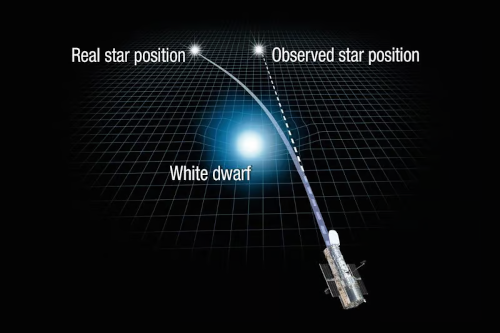
3. In the picture on the left, it is as the one above with the link, we see a sketch of the deflection of light from a distant source in the field in front of us and in the description of the benefits and difficulties of these findings. We rarely make a statem-ent out of caution about the (2) sp-eeds of light given above, which are almost impossible not to take into account. Such is the persuasiveness of the special theory of relativity and its assumption of the constancy of the speed of light in a vacuum. But cur-iosity is a miracle, and we never get tired of trying to doubt even what seems undoubted, no matter how much we shy away from ridicule.
Starting from the Schwarzschild metric (1), it is found that this deflection, he-nce the refraction of light, for the angle:
Δφ = 4GM/c²r0,
where r0 is the shortest distance of light on its path past a body of mass M. This is twice the refraction obtained from the estimate using Newtonian gra-vity and more closely matches measurements. This was first verified by Ein-stein in 1919 and has been verified many times since. Gravitational deflection is the cause of the gravitational lens and the Einstein rings now well known in astronomy.
Lagrangian II » srb
Question: Can you demonstrate to me the derivation of bending light in a gra-vitational field by the angle Δφ that you specified yesterday (29.03.2025)? At least an introduction to the final deducing?
Answer: The calculations of gene-ral relativity are mathematically very demanding, but perhaps I can slow them down or simplify them enough to reduce the refraction of light by gravity to something more understandable to everyone. I will use the principle of least action via the Schwarzschild solution of Ein-stein's general equations. Otherwi-se, we can obtain Einstein's equati-ons from the principle of least action (Minimalism of Information, 2.5), where the general Lagrangian is important, and without explicitly stating the princi-ple of relativity.
1. Physical forces cause motion, and motion under the action of forces is always a change of potential energy Ep into kinetic energy Ek. We design the first so that the sum of the two is constant (Ep + Ek = const.), according to the situation, and the second is the semi-product of the mass of the body and the square of its velocity (Ek = mv²/2). And we do this so that the sum of kinetic and potential energy, i.e., Hamiltonian (H = Ek + Ep) and their difference, Lagrangian (L = Ek - Ep), are conserved values when there are no forces. It seems as demanding as it is, but fortunately, this work has already been done by the greatest minds in theoretical physics over hundreds of years, so it is enough for us to just quote it.
2. Euler and Lagrange summarized the above in the differential equation named after them:
\[ \frac{d}{dt}\left(\frac{\partial L}{\partial \dot{q}_j}\right) = \frac{\partial L}{\partial q_j}, \]where the n-tuple q = (q1, q2, ..., qn) consists of the generalized coordinates of an arbitrarily chosen system. It turns out that the solutions of this equation are all the trajectories known to us from theoretical physics and, on the other hand, that it is just a different statement of the principle of least action. Its derivation is not the topic here, but I will give a few examples to demonstrate its efficiency. For a little better familiarity, you can also see some of its simple explanations (For Dummies).
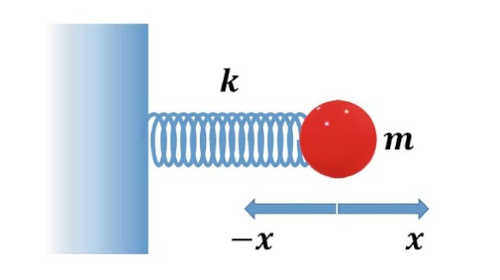
3. Let's find the equations of motion for the spring from the upper right figure. The kinetic and potential energy of the weight on the spring along the x-axis are given by:
\[ E_k = \frac12 m\dot{x}^2, \quad E_p = \frac12 kx^2, \] \[ \frac{d}{dt}\left(\frac{\partial L}{\partial \dot{x}}\right) = \frac{d}{dt}\left[\frac{\partial(E_k - E_p)}{\partial \dot{x}}\right] = \frac{d}{dt}m\dot{x} = m\ddot{x}, \quad \frac{\partial L}{\partial x} = -kx, \] \[ m\ddot{x} = -kx, \]and that is exactly Newton's expression F = ma, the force F on the mass m gives an acceleration a.
4. Let us find the Euler-Lagrange equations of motion (2) of a body of mass m in the gravity of a planet of mass M. The kinetic and potential energies in a ce-ntrally symmetric field are:
\[ E_k = \frac12 m\dot{r}^2, \quad E_p = -G\frac{mM}{r}, \] \[ \frac{d}{dt}\left(\frac{\partial L}{\partial \dot{r}}\right) = m\ddot{r}, \quad \frac{\partial L}{\partial r} = G\frac{mM}{r^2}, \] \[ m\ddot{r} = G\frac{mM}{r^2}, \]and that is Newton's gravitational force.
5. In my Information Stories (2021), you will also find the one about Emmy Noether. She is interesting here because of her original interpretation of the Euler-Lagrange partial differential equations of the second order (2) from 1750, which expresses any motion using the minimum of the difference bet-ween kinetic and potential energy (L = Ek - Ep). These generalized trajectories are expressions of the "paths" of evolution of physical systems of the unchang-ed Lagrangian L, which we call symmetries or invariants.
A mirror image, a translated (parallel moved) body, and isometry in general, i.e., a mapping that does not change the mutual distances of the points of an object, are examples of symmetry. Emmy Noether noticed that the left-hand side of the Euler-Lagrange equation is the time-dependent change of the La-grangian (energy) in terms of velocity. Whatever it is, she noticed, the right-hand side does not have any changes in time, but only in generalized coordi-nates. When there is no change in time, there is no change between coordin-ates, and she firmly concluded that the presence of this “invariance” means some symmetry, namely the conservation of the corresponding physical qu-antity, the law of conservation.
Whenever we have immutability, we also have a corresponding constancy. For example, water spinning in a glass always looks the same; it has rotational sy-mmetry, and this is the rotational law of conservation (of angular moment-um). Once a spinning top is set in motion, it will continue to spin until some force (friction) stops it. A body in inertial motion does not change, and we have the well-known law of inertia of rectilinear motion. In quantum physics, processes, evolutions, are described by regular, reversible operators. All of them are types of symmetries, so the law of conservation also applies to info-rmation flows.
6. This was the introduction I was looking for to the ultimate derivation of the refraction of light in a gravitational field, for the aforementioned angle, that is Δφ = 4GM/c²r0, where r0 is the shortest distance of light on its path next to the body mass M. There is no change of form without change in time; that is its point in itself. Thus the story of the Lagrangian incidentally reaches the need for time in order to have space, or, in other words, a space woven with information.
Metrics IV » srb
Question: How to apply the metric tensor to the gravitational refraction of light?
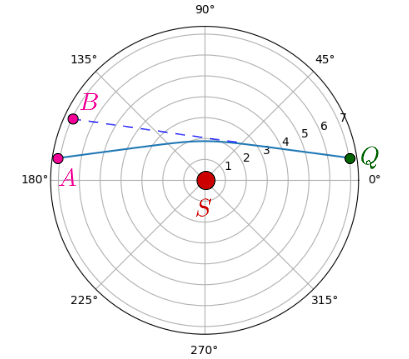
Answer: This is about the Schwar-zschild interval and the bending of the path of light in a gravitational field (Bending III), and the story about that tensor is a frequent dis-cussion here. The image on the left shows a view of a star (A) from Ear-th (Q), whose light trajectory is ref-racted due to the Sun's (S) gravity. That's why we see the star in a diff-erent position (B). However, I also answer various sub-questions. The background of the image on the left is the polarrlg() module.
1. Light comes from point A and at the closest distance x0 near S is refracted twice, first at the entrance to the gravitational field of the sun and then symm-etrically at the exit, making a total angle Δφ = ∠BSA, continuing towards the earth Q. Its path has three parts: I (AS), II (SS) and III (SQ), the first symmet-rical with the third and the second piece from entry to exit outside the sun's environment. The double angle Δφ is also the angle between the normals to the first and third paths (the angles with the perpendicular arms are equal or are supplementary). These two normals are the two shortest distances, x0 from the sun to the light ray.
Due to the symmetry of the paths, we are mostly concerned with the first part. There, if x is the distance from the foot of the normal, of length x0, to some po-int towards the star A, then the square of the distance from the sun S to that point is r² = x² + x0². The Schwarzschild interval (Bending III, 1) has a time ct, a radial r and a circular coordinate rθ perpendicular to it. In calculating the time of light approaching the sun with a radial velocity cr, we ignore the perp-endicular coordinates.
2. We saw there that the radial speed of light cr = dr/dt, now on the path x fr-om the star (x → -∞) to the foot of the normal (x = 0) gives the elapsed time:
\[ T = \int_{-\infty}^0 \frac{dx}{c_r(x)} = \int_{-\infty}^0 \frac{dx}{c\left(1 - \frac{r_s}{\sqrt{x^2 + x_0^2}}\right)}, \quad r_s = \frac{2GM}{c^2}, \] \[ T \approx \int_{-\infty}^0 \frac{dx}{c}\left(1 + \frac{r_s}{c\sqrt{x^2 + x_0^2}}\right), \]because 1/(1 - x) ≈ 1 + x, for very large x. We are looking for the extremum of this function, the shortest elapsed time T depending on the length of the nor-mal x0, i.e., the shortest distance of a ray from A when passing the sun S on its way to the earth Q. This is done by finding the derivative of time with respect to the lengths of the normal and equating the result to zero.
3. We look for it in all three parts of the light path.
I. On the first part of the route there will be:
\[ \left(\frac{dT}{dx_0}\right)_I = \int_{-\infty}^0-\frac{r_s}{c}\frac{x_0}{(x^2 + x_0^2)^{3/2}}\ dx = -\frac{r_s}{cx_0}\int_{-\infty}^0 \frac{dy}{(y^2 + 1)^{3/2}}, \]where the substitution x = x0y is used. The integral at the end is one because:
\[ \int_{-\infty}^0 \frac{dy}{(y^2 + 1)^{3/2}} = \int_{-\pi/2}^0 \frac{d\tan\phi}{(1 + \tan^2\phi)^{3/2}} = \] \[ = \int_{-\pi/2}^0 \cos\phi\ d\phi = \sin\phi \Bigg|_{-\pi/2}^0 = 1. \]Hence it is:
\[ \left(\frac{dT}{dx_0}\right)_I = -\frac{r_s}{cx_0} = - \frac{2GM}{c^3x_0}. \]II. On the second and much shorter part of the path of length ℓ, it will be ℓ ≈ x0⋅Δφ, because the angle Δφ is very small, which means that is sin Δφ ≈ Δφ. However, we then also have ℓ = cT, where T is now the time it takes light to travel this length ℓ, so:
\[ \left(\frac{dT}{dx_0}\right)_{II} = \frac{\Delta\varphi}{c}. \]Due to the very large distances r, as well as x0, compared to the relatively sho-rter path ℓ, i.e., due to the shortness of that flight, we have taken that the perp-endicular speed of light at the radius cθ is approximately equal to the speed of light in vacuum c, i.e., cθ ≈ c.
III. The third part of the path is symmetrical to the first, so we can put:
\[ \left(\frac{dT}{dx_0}\right)_{III} = \left(\frac{dT}{dx_0}\right)_I = - \frac{2GM}{c^3x_0}. \]4. These three parts make up the total journey of light:
\[ \frac{dT}{dx_0} = 2\left(\frac{dT}{dx_0}\right)_I + \left(\frac{dT}{dx_0}\right)_{II} = 0, \] \[ -\frac{4GM}{c^3x_0} + \frac{\Delta \varphi}{c} = 0, \] \[ \Delta \varphi = \frac{4GM}{c^2x_0}, \]and that is the desired result.
5. This result is particularly interesting for my information theory because systems spontaneously tend towards more probable, or less informative, less uncertain states. Due to the slowing down of time, the present and the flock are there. And then, there are such presents that seem to sink into an incre-asingly strong gravitational field, with the slowing down of time and the dec-reasing speed of light (in a vacuum). And then, they converge like light in a gravitational field. However, in this theory, this is not new. We found a simi-lar result by studying Markov chains.
Namely, the message transmitted through the Markov chain converges to the eigenstates (distribution vectors) of that channel. In other words, through dif-ferent trajectories, these or those choices are inclined to be similar; they tend to continue along some common directions. Events and processes adapt; they begin to resemble each other.
Relativistic » srb
Question: How to apply the Lagrangian to a metric tensor?
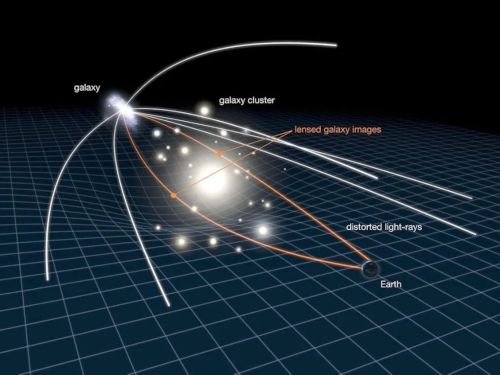
Answer: Still in the discussion abo-ut the bending of the path of light with gravity (Bending III), the topic now turns to the question of what the Lagrangian has to do with it. In other words, the calculated angle Δφ of refraction (Metrics IV) needs to be clarified, that is, to reduce that calculation to the principle of least action or to the relativistic Lagrangian.
1. The Lagrangian is L = Ek - Ep, or in notation L = T - V. It is the difference between kinetic and potential energy. That is a quantity whose greater change tells us about the greater presence of forces. Outside forces' activity, there is no change of L. From special relativity we have:
\[ L = -mc^2\sqrt{1 - \frac{v^2}{c^2}} = -mc^2\left(1 - \frac12\frac{v^2}{c^2}\right) = - mc^2 + \frac12mv^2 = T - V, \]which is true in the limiting case v/c → 0, where m is the mass of the body, v is the velocity of the given body, and c is the speed of light in a vacuum. The action is dS = Ldt, the product of energy and time, or:
S = -mc∫ ds, ds = cdτ,
where ds² = gμνdxμdxν, written in metric tensor and relativistic notation (adding repeated subscripts and superscripts), and dτ is infinitesimal real (which we measure wherever we are) time. The metric tensor of particular interest to us is the Schwarzschild tensor, a solution to Einstein's general equations for centrally symmetric gravitational fields.
2. The choice of reference system in the theory of relativity has no restrictions. The three spatial coordinates x1, x2 and x3 can be any, and the temporal x0 can be determined by an arbitrarily running clock. But, when they are mutually perpendicular, like spheres and radii in spherical coordinates, the metric tens-or has no mixed coefficients; gμν = 0 iff μ ≠ ν. It is as follows:
\[ ds^2 = -\left(1 - \frac{r_s}{r}\right)dt^2 + \left(1 - \frac{r_s}{r}\right)^{-1}dr^2 + r^2d\Omega^2, \]Schwarzschild metric. For the sake of brevity, dΩ² = dθ² + sin²θ dϕ², while rs = 2GM/c² is the so-called Schwarzschild radius, the radius inside which not even light can escape gravity. In general, we write, implying addition by repe-ated superscript and subscript:
ds² = gμνdxμdxν,
where in this case x0 = ct, the path traveled by light at speed c in time t, and the spatial coordinates are x1 = r, x2 = ϕ and x3 = θ. The metric tensors chan-ged by gravity are only g00 = -(1 - rs/r) and g11 = 1/(1 - rs/r).
3. If the angle of deviation from the z-axis is straight and fixed, θ = π/2, then the angle Ω = ϕ and we have the plane Oxy of the Cartesian rectangular syst-em, also of orthogonal coordinates. Any other fixing of θ will give some anal-ogous plane. The fixed spatial coordinates and the above ds = cdτ then give:
\[ d\tau = \frac{1}{c}\sqrt{-g_{00}}\ dx^0. \]Because of |g00| < 1 we have that the relative time t = x0/c flows slower than the true τ, which is often called the proper time. This is a common result for all, as well as non-orthogonal systems. In this general case, we easily find:
\[ d\ell^2 = \left(g_{\mu\nu} - \frac{g_{0\mu}g_{0\nu}}{g_{00}}\right)dx^\mu dx^\nu. \]It is a distance using elements of any spatial coordinates, and in the Schwarz-schild case, it becomes:
\[ d\ell^2 = \left(1 - \frac{r_s}{r}\right)^{-1}dr^2 + r^2d\Omega^2. \]For radial lengths, there is no change in angle, dΩ = 0, and only the first term remains.
The smaller the distance r from the center of the field, the greater the contra-ction of the radial lengths. The length of the circles does not change, so the qu-otient of the circumference and the diameter of the circle increases. As this ratio grows larger and larger, π = 3.14..., the space of the centrally symmetric gravitational field becomes increasingly saddle-shaped. It takes on the prope-rties of hyperbolic, or Lobachevsky, geometry.
4. Let's take the derivative of the interval with respect to the true (proper) time τ, we get:
\[ L = \left(\frac{ds}{d\tau}\right)^2 = -c^2\left(1 - \frac{r_s}{r}\right)\dot{t}^2 + \frac{\dot{r}^2}{1 - \frac{r_s}{r}} + r^2\dot{\Omega}^2, \]given the Lagrangian L discussed above (1). If we insert it into the Euler-Lagr-ange equation (Lagrangian II, 2), we find:
\[ \frac{d}{d\tau}\left[-2c^2\left(1 - \frac{r_s}{r}\right)\dot{t}\right] = 0, \quad \frac{d}{d\tau}\left(r^2\dot{\Omega}\right) = 0, \]because the derivatives of the spatial coordinates with respect to time are zero. Because θ = const. and the independence of t, the right-hand side of the EL equation is zero. We further have that when the derivative of a function is zero, that function is constant:
\[ \left(1 - \frac{r_s}{r}\right)\dot{t} = C_0, \quad r^2\dot{\Omega} = C_1, \]where C0 and C1 are constants. The equations are conservation laws, respecti-vely, for energy and angular momentum.
5.Inserting the constant equalities into the Lagrangian (4), we obtain:
\[ L = -\frac{c^2C_0^2}{1 - \frac{r_s}{r}} + \frac{\dot{r}^2}{1 - \frac{r_s}{r}} + \frac{C_1^2}{r^2}. \]This is an equation that applies to both photons and particles with mass; it is a general law of space-time geometry. If we are only interested in the photon, we need to add ds² = 0. Then, since L = (ds/dτ)², the photon Lagrangian will be zero, Lf = 0. So, we are looking for:
\[ -\frac{c^2C_0^2}{1 - \frac{r_s}{r}} + \frac{\dot{r}^2}{1 - \frac{r_s}{r}} + \frac{C_1^2}{r^2} = 0, \] \[ -c^2C_0^2 + \dot{r}^2 + \frac{C_1^2}{r^2}\left(1 - \frac{r_s}{r}\right) = 0, \] \[ \left(\frac{dr}{d\tau}\right)^2 = c^2C_0^2 - \frac{C_1^2}{r^2}\left(1 - \frac{r_s}{r}\right). \]The following are routine processings of this expression from mathematical analysis, which I will list (6) for the sake of completeness, but you can skip them.
6. These are the derivatives by chain rule, with the substitution u = 1/r in the second case:
\[ \frac{dr}{d\tau} = \frac{dr}{d\Omega}\frac{d\Omega}{d\tau} = \frac{dr}{d\Omega}\dot{\Omega} = \frac{C_1}{r^2}\frac{dr}{d\Omega}, \] \[ \frac{dr}{d\Omega} = \frac{dr}{du}\frac{du}{d\Omega} = -r^2\frac{du}{d\Omega}, \]where for the angle Ω we can put ϕ in polar coordinates when θ = 90°, or the analogous great circle of the sphere. Therefore, here and in (5) we have:
\[ \frac{dr}{d\tau} = \frac{C_1}{r^2}\left(-r^2\frac{du}{d\Omega}\right) = -C_1\frac{du}{d\Omega}, \] \[ C_1^2\left(\frac{du}{d\Omega}\right)^2 = c^2C_0^2 - C_1^2u^2(1 - r_su), \] \[ \left(\frac{du}{d\Omega}\right)^2 = \frac{c^2C_0^2}{C_1^2} - u^2 + r_su^3. \]We take this derivation from Ω:
\[ 2\frac{du}{d\Omega}\frac{d^2u}{d\Omega^2} = 0 -2u\frac{du}{d\Omega} + 3r_su^2\frac{du}{d\Omega}, \] \[ \frac{d^2u}{d\Omega^2} = -u + \frac{3r_s}{2}u^2, \quad u = \text{const}. \]These are the required solutions, the first of which is more interesting to us. As a reminder, the substitution was u = 1/r, where r is the distance from the center of the gravitational field.
7. So, we have the equation:
\[ \frac{d^2u}{d\Omega^2} + u = \frac{3GM}{c^2}u^2, \]with the reciprocal distance from the center u = 1/r of mass M and with the gravitational constant G. Newtonian mechanics for the equation of light in the same way gives an equal expression on the left side but zero on the right, the homogeneous form:
\[ \frac{d^2u}{d\Omega} + u = 0. \]It is a second-order homogeneous differential equation whose one solution is a straight line in polar coordinates uℓ = b-1⋅sin(Ω), that is:
\[ r = \frac{b}{\sin\Omega}. \]The line misses the origin for b, the center of mass M. Compare this with the broken line (Metrics IV) in a relativistic gravitational field, adding an increm-ent to the solution of the inhomogeneous u = uℓ + Δu, so we have:
u = b-1 sin Ω + Δu,
\[ \frac{d^2}{d\Omega^2}(b^{-1}\sin\Omega + \Delta u) + (b^{-1}\sin\Omega + \Delta u) = \frac{3GM}{c^2}(b^{-1}\sin\Omega + \Delta u). \]8. Considering that:
\[ \frac{d^2u_\ell}{d\Omega^2} + u_\ell = 0, \quad (u_\ell + \Delta u)^2 \approx u_\ell^2, \]where the latter is due to the negligible increase in relation to the line. Thus we arrive at:
\[ \frac{d^2\Delta u}{d\Omega^2} + \Delta u = \frac{3GM}{c^2b^2}\sin^2\Omega, \]whose solution is:
\[ \Delta u = \frac{3GM}{2c^2b^2}[1 + \frac13\cos(2\Omega)], \]which is easy to check by substitution. Finally, for smaller masses M the refra-cted path of light is given by the equation:
\[ u = b^{-1}\sin\Omega + \frac{3GM}{c^2b^2}[1 + \frac13\cos(2\Omega)]. \]Here we can include the gravitational constant G = 6.674×10⁻¹¹ m³⋅kg-1⋅s-2, the mass of the Sun M = 1.989×1030 kg, the speed of light c = 300,000 km⋅s-1 with, say, b = 300,000 km. Anyway, we have the equation:
\[ r = \frac{b}{\sin\Omega + \frac{3GM}{c^2b}[1 + \frac13\cos(2\Omega)]}. \]One of these is the equation of the broken line in the image of the previous answer. We find the angle of refraction there for this line as well, now by limits, r → ∞, when Ω → 0 and π. We get Δφ = 4GM/c²b, where b = x0 is the shortest distance of the ray from the Sun.
|
|
|