|
|
|


Emergence, which appears as a new value in the collective and transcends the characteristics of individuals, that is, the process in which complex, new patt-erns or values arise from the interactions of individuals, creating a "whole" that further possesses characteristics completely absent from its parts, was a more precisely elusive phenomenon that can be treated here.
Crumbling » srb
Question: Does shredding, breaking up subjects reduce their range?

Answer: Yes, that is mostly true in this information theory. But, for example, there are also confirmat-ions of this in many real conflicts. Caesar's maxim is well-known: "Divide and rule!" Various people throughout history followed it and, at least in the initial part of their rule, succeeded (Supervention). We are not going to talk about geopoli-tics here, but frankly speaking, I am testing the accuracy of information of perception.
1. In the 2-norm space, the vector x = (ξ1, ξ2, ..., ξn) has intensity:
$$ \|x\|_2 = \sqrt{|\xi_1|^2 + |\xi_2|^2 + ... + |\xi_n|^2}, \quad \xi_k \in \mathbb{C}. $$In the general case, the components of a given vector (k = 1,2, ..., n) are comp-lex numbers (from the set ℂ), and the vector space has dimensions n = 1, 2, 3, ..., of some of the natural numbers (from the set ℕ). In perceptual informati-on, these vectors are the states of subjects, their components are the intensi-ties of perception, and let's assume that they are real numbers (from ℝ) of in-dependent ways of perceptions, activities. In a game, these components meas-ure the action-reaction of the participants, where many moves are allowed at once (as in economics, politics, war, and the like), but also one at a time as in chess.
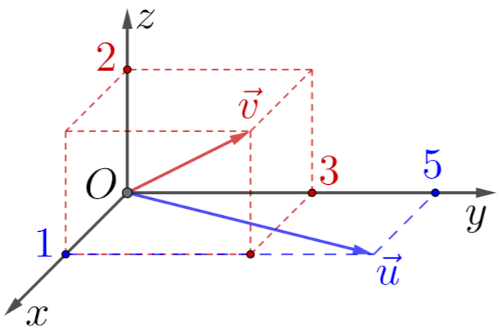
2. In the image on the right are the vectors:
$$ \vec{u} = (1, 5, 0), \quad \vec{v} = (1, 3, 2), $$ $$ u = \sqrt{26}, \quad v = \sqrt{14}, $$ $$ u \gt v. $$By decomposing 2-dim u into 3-dim v, and maintaining the sum of the components, we have reduced the intensity of the vector and this is the property of comminution. When the components are of the same sign, we have in order (a + b)² = a² + 2ab + b² > a² + b², hence the above result. Combining (adding) components of the same sign increases the value of the vector. However, if the components of the opposite sign are ab < 0, therefore (a + b)² < a² + b², which means that combining them decreases the value of the vector.
3. Let's now consider the same with complex numbers, z = x + iy, where the imaginary unit is i² = -1, and the rest are real numbers x, y ∈ ℝ:
|z1 + z2|² = (z1 + z2)*(z1 + z2) = = (z1* + z2*)(z1 + z2) = z1*z1 + z1*z2 + z2*z1 + z2*z2,
|z1 + z2|² = |z1|² + 2Re(z1*z2) + |z2|².
When Re(z1*z2) > 0, the real part of the product of the conjugate of the first number (z1*) with the second (z2) is positive, then |z1 + z2|² > |z1|² + |z2|². We recognize in this the previous case. In particular we have (2) when given real numbers, z1 = a ∈ ℝ and z2 = b ∈ ℝ, so Re(z1*z2) = ab.
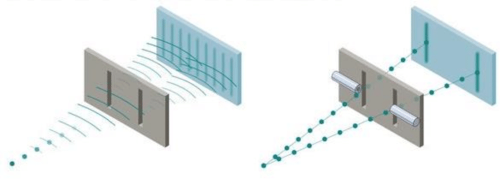
4. The picture on the left shows a sketch and a link with a description of the famous “double slit” exper-iment. A wave of some particles (photons, electrons, or similar) hits an obstacle with slits, which then hit the screen behind. The first, on the left, of these pictures shows the previous situation (3) when the rays that hit are divided into two slits so that their image on the screen is scattered. Depending on the phases of these wav-es, the value Re(z1*z2) changes, and this affects the enhanced or weakened im-age on the screen, constructive or destructive interference. If one of the openi-ngs is closed, if there is only one passage for the wave, then the wave arrives at the screen as it is, as a particle without interference.
5. To see when the aforementioned (4) interference is constructive and when it is destructive, let us express the real part of the above product:
Re(z1*z2) = Re[(x1 - iy1)(x2 + iy2)= = Re[(x1x2 + y1y2) + i(x1y2 + y1x2)],
Re(z1*z2) = x1x2 + y1y2.
Next, let's move on to vectors with these real components $\vec{v}_1 = (x_1, y_1)$ and $\vec{v}_2 = (x_2, y_2)$, to recognize the scalar product:
$$ \vec{v}_1\cdot\vec{v}_2 = x_1x_2 + y_1y_2 = \|\vec{v}_1\| \|\vec{v}_2\| \cos \varphi, \quad \varphi = \angle(\vec{v}_1, \vec{v}_2), $$where the Euclidean, or 2-norm, was implied. The norms (intensities) of vect-ors are non-negative real numbers.
When the intensity of one of these vectors is zero, the dot product will also be zero, so Re(z1*z2) = 0. Hence |z1 + z2|² = |z1|² + |z2|², especially, say, with the second aperture closed |z1 + 0|² = |z1|². From this calculation it follows that there is no wave dilution (diffraction), which is what is obtained on the screen. And if neither vector is zero, then with cos(φ) > 0, the angle between the vec-tors is acute, we have constructive interference. Conversely, destructive inter-ference (wave cancellation) comes with obtuse angles between the vectors.
6. We can draw a lesson from this analysis, for example, in the following two situations. When we separate a harmonious whole, we reduce its overall int-ensity, and when we separate discordant ones, we do the opposite. The latter is like separating the wheat from the chaff (good people from bad people), when the value of the wheat increases.
Separation » srb
Question: How can the reduction in intensity caused by the crumbling of a st-ate or vector be interpreted from a probability perspective?
Answer: Simply, by focusing. By se-parating related events, their penet-ration is reduced, the chance of the-ir realization is reduced, but their (related) form is retained.
1. In repetitions, we often see a nor-mal distribution of the probability densities:
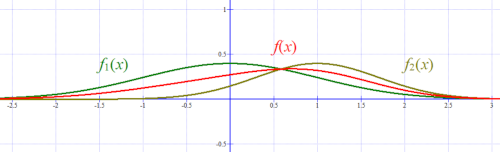
$$ f_{\mu,\sigma}(x) = \frac{1}{\sigma\sqrt{2\pi}}e^{-\frac12\left(\frac{x-\mu}{\sigma}\right)^2}, $$where μ is the mean value, the so-called mathematical expectation, and σ² is the variance. The figure up on the right shows the graphs of the normal distr-ibutions f1(x) and f2(x) with expectations μ1 = 0 and μ2 = 1, both with equal variances σ² = 1. Their cumulative distribution f(x) = [f1(x) + f2(x)]/2 has the shape of a normal, but slightly lowered "Gaussian bell", and therefore of inc-reased variance, σ² > 1, because the total area under, up to the abscissa (x-axis), must remain unitary.
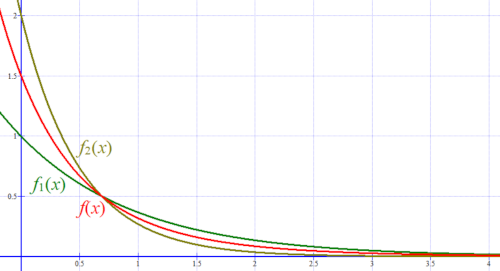
2. In the image on the left we see graphs of the exponential distrib-ution:
$$ f_\lambda(x) = \lambda e^{-\lambda x}, \quad x \gt 0, $$whose mean value is μ = λ, so:
$$ \int_0^\infty \lambda e^{-\lambda x}\, dx = 1. $$Now for λ = 1 we have the density f1(x) and the density f2(x) for the expecta-tion λ = 2, while their arithmetic mean, f(x) = [f1(x) + f2(x)]/2, as before. But now we notice better that this mean "blunts" the extremes of the graphs. It reduces the differences, averages and dilutes the given probabilities and equalizes the chances.
3. These mean values of the given distributions are not exactly of the same type, but their origin is recognized. The new “probability forces” of the thus-created random variables average out the previous ones and mitigate their strongest impacts. This is a phenomenon similar to the previous behavior, when the fragmentation of subjects meant the reduction of their ranges. Applications in game simulations (complex, with multiple moves at once) will show that such averaging should be avoided in moves where ferocity is needed, but perhaps they can prove good for measured responses. I have not yet worked out these options. For now, the mitigations seem to me like “Follow reality, speak the truth, but in the unspoken is your greatest strength.” (Bounds, 1).
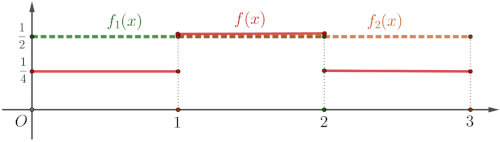
4. The figure on the right shows uniform distributions. Their pro-bability densities are functions of:
$$ f_{b-a}(x) = \begin{cases} \frac{1}{b-a}, & x \in [a,b] \\ 0, & x \notin [a, b] \end{cases} $$means μ = (a + b)/2 and variances σ² = (b - a)²/12. The first of them, f1(x), is non-zero in the interval [0, 2], and the second, f2(x), in the interval [1, 3]. We see that they overlap in the interval [1, 2] abscissas, so the cumulative distri-bution is:
$$ f(x) = \begin{cases} \frac14, & x \in [0,1] \\ \frac12, & x \in [1, 2] \\ \frac14, & x \in [2, 3] \\ 0, & x \gt 3 \end{cases} $$broken red line in the figure, also unit total area to abscissa. As in the previous two cases, these aggregate probabilities are suppressed where they can.
5. The extreme value of Shannon's information, as known, on a given interval [a, b] is ln(b - a), and this is the value of the uniform distribution. When the expectation μ is given, then this is the information of the exponential distrib-ution ln(eμ) and when the variance σ² is given, this is the normal distribution of information ln(2πeσ²)/2. We see that the above explanations slightly spoil exactly such distributions, that is, they reduce them to lower information va-lues. According to the principle of minimalism, nature will tend towards such separations, spontaneously pursuing diversity. Conversely, opposing this ran-dom flow is a hallmark of vitality and higher strategies (Disobedience).
Tango » srb
Question: Isn't simple force enough to win?

Answer: Not always. A lone wolf weighing up to 50 kilograms mana-ges to defeat an 800-kilogram mo-ose. A predator can be weaker or slower, but otherwise more skillful when catching its prey. Man, as a top predator, is not the strongest beast on our planet.
1. Look at it this way. Vector:
$$ \vec{x} = (\xi_1, \xi_2, ..., \xi_n), \quad \xi_k \in \Phi, $$this one in a discrete space of dim-ension n = 1, 2, 3, ... with scalars Φ which are real (ℝ) or complex (ℂ) numbers, represents the state of the subject in its environment, some vector space V. When we assign a metric to such an environment, there are various ones, then we also have the norm of the vector:
$$ \|\vec{x}\| = (|\xi_1|^p + |\xi_2|^p + ... + |\xi_n|^p)^{1/p}, \quad p > 1. $$This is the intensity of the vector, its total "strength". However, the dot, or scalar product of the vector (if it exists) will be:
$$ \langle \vec{x}| \vec{y}\rangle = (\xi_1, \xi_2, ..., \xi_n)^\dagger \cdot (\eta_1, \eta_2, ..., \eta_n) = $$ $$ = \xi_1^*\eta_1 + \xi_2^*\eta_2 + ... + \xi_n^*\eta_n \in \Phi. $$We also write it shorter as $\vec{x}\cdot\vec{y}$, and even x⋅y, when there is no confusion with the notation $x = \|\vec{x}\|$.
2. We interpret the vector norm as information about the state itself, when the scalar product becomes information of perception, the mutual communication of a pair of vectors. The first is similar to a placement in a singles competition, and the second is an achievement in a pair dance. You can be big and clumsy and good at singles, but bad at a pair dance and vice versa. Namely, there is internal and external information, or not everything communicates with eve-rything. Some interactions on one do not affect the other, and there are many ways. This interpretation succeeds in simulations of (knotty) games.
3. The greater intensity of the individual subject and couple in the dance represents the strength and vitality of the dance. This means that in the Euclidean metric:
$$ \|\vec{x}_1\| = (1 + 5^2 + 0)^{1/2} = \sqrt{26} \gt \sqrt{14} = (1 + 3^2 + 2^2)^{1/2} = \|\vec{x}_2\|, $$which we saw in the previous example (Crumbling, 2). Let's now consider th-ese states in a "dance" with $\vec{y}_1 = (1, 3, 0)$, $\vec{y}_2 = (1, 2, 1)$ and $\vec{y}_3 = (1, 1, 2)$:
$$ \langle \vec{y}_1 | \vec{x}_1 \rangle = 1\cdot 1 + 3\cdot 5 + 0 \cdot 0 = 16, \quad \langle \vec{y}_1 | \vec{x}_2 \rangle = 1\cdot 1 + 3\cdot 3 + 0\cdot 2 = 10, $$ $$ \langle \vec{y}_2 | \vec{x}_1 \rangle = 1\cdot 1 + 2\cdot 5 + 1 \cdot 0 = 11, \quad \langle \vec{y}_2 | \vec{x}_2 \rangle = 1\cdot 1 + 2\cdot 3 + 1\cdot 2 = 9, $$ $$ \langle \vec{y}_3 | \vec{x}_1 \rangle = 1\cdot 1 + 1\cdot 5 + 2 \cdot 0 = 6, \quad \langle \vec{y}_3 | \vec{x}_2 \rangle = 1\cdot 1 + 1\cdot 3 + 2\cdot 2 = 8. $$In these multiplications we see that the best result is achieved by the less dis-tributed $\langle \vec{y}_1 | \vec{x}_1 \rangle = 16$ and proportional terms, multiplied smaller by smaller and larger by larger. With both states distributed, the largest are again prop-ortional, $\langle \vec{y}_2 | \vec{x}_2 \rangle = 9$. These were vectors of consistent components (of the same sign).
4. Applying mathematical theorems is rarely easy, but we will try. The idea is to treat the values of vectors and their dot products as the strength of the pla-yer and the game, respectively. From multiplication (3) we can draw several conclusions for further application in the game algorithm to enhance the str-ategy, or in a simulation to test the idea. I am not saying that I have checked every possibility, but I have checked many and they worked as expected.
5. You will raise the level of strategy and increase the quality of the game if your side widely follows the opponent's initiatives and responds to them in a timely, measured and creative manner. The side that fails to do so loses. The importance of timeliness comes from the dynamics of the game, with each subsequent move, or group of current moves, positions change and a missed opportunity can be lost forever. The second, measured, is illustrated by exam-ples such as (3), not to overdo it and not to fail, for reasons that can be invisi-ble at first. The third is creativity or unpredictability to the opponent, simply because of the power of uncertainty, the power of probability. It is a small spice to this dish, but very necessary. Only identical, hostile initiatives of two players are considered here.
Collaboration » srb
Question: What is the nature of the excess capacity of individuals when they cooperate?

Answer: If a group of individuals collaborate on the same task and if synergy appears, it is completely dependent on the existence of the individuals, and we can say, they on the physical substance that makes them up. In fact, this excess of abi-lity of the group, which is not pre-sent in separate individuals, is a kind of fiction. If there is no sub-stance, there is no this fiction eit-her, i.e. it has no effect "there" by itself. It seems unnecessary and overly decisive, but I base this (hypo)thesis on a calculation like the previous one.
1. Birds flying in flocks, while maintaining speed and distance from their neig-hbors, can resemble a larger living being. Craftsmen divided by skill and occu-pation, and well organized, can build structures that none of them could indiv-idually achieve, not only in time, but also in structural terms. A multitude of electronic and similar gates, such as those simulated by bits or qubits, built in-to machines in special ways, can become artificial intelligence. These are addi-tional achievements that I am trying to express in calculations, so if that conc-ept fails somewhere, I will find that I have to change that foundation.
2. Whether fictions were created by synergy of the same kind as we have while sitting and fantasizing is the question. These “sitting” ones seem to come to us from additional worlds, pseudo-reality, and they cannot themselves directly produce the effects of reality for them in these “realities”. This is their simila-rity, in addition to their shorter duration (dependence on the subjects who produce them) which, according to my definition, means a limited truthfuln-ess. Additional “organizational” fictions are the product of multiple individu-als who are not necessarily “thinking” (whatever that means) creatures. Let it remain that there are several essentially different types of “unreality” (which lack one or two of the three: duration, perceptibility and truthfulness).
3. When we give different values to a series of decimal places in a number, or even in binary notation, we convert the countable infinity (ℵ0) of the series into a continuum (𝔠) of real numbers. These are infinities of so many different sizes that the probability of choosing a single point on a unit length is exactly zero, and so is the probability of choosing any of the ℵ0 infinite series of points from that 𝔠 interval. That is the zero probability and, say, to return to a precis-ely specified event in the past, because the continuum is many worlds, unoff-icially, according to my calculation. According to this calculation, they are not right those who say: "In a universe of infinite duration, everything would re-peat itself many times", because a (curved) line cannot cover the continuum. Also, random lies of such worlds do not meet, even if they were to communi-cate, to recognize each other (which is not certain).
4. Sigmund Freud is said to have said somewhere: “Wherever I go, I find that a poet has been there before me.” There is no confirmation of this, but we can say that novelists and artists understood fantasy and knew how to communic-ate it. Here we discover that it is unreal. As in the case of novels that describe future events, even if they use mathematical formulas to the fullest extent, th-ey will miss what would actually happen. Simply because chance is objective, and at every step there are too many possibilities for us to guess the real ones with a probability greater than zero. And the misses become fictions, what did not really happen, lies. The nature of lies is that they also arise together with reality, that the very course of the present creates its own synergies, various and those that do not require the cooperation of birds, masons, or machines.
Equilibrium IV » srb
Question: How can lies and truth be equal, when you say that we have "too many possibilities" from which untruths arise (Collaboration, 4)?
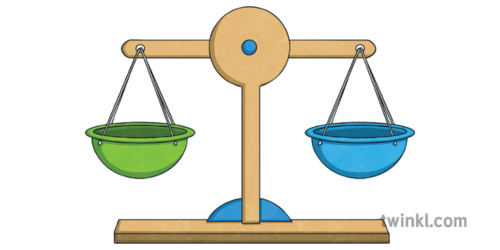
Answer: Since there is a bijection from ⊤ to ⊥, in the operations of the algebra of logic (between true and false statements), which I have long interpreted as the same cardinality, the quantity of truths and falsehoo-ds of the universe, hence the requi-rement of all further discoveries to conform to it. Note in previous po-sts that I have stuck to this idea, but I will clarify it on this occasion as well. It is an unusual kind of equilibri-um.
1. The reality we perceive, created by interactions (measurements), is finite. In each of these moments there are many options, of which only one is realized, and this is a brief description of the creation of reality. Real physical phenom-ena arose through the realization of one present at a time, and the remaining possibilities became unreal. The present in its course of time partly does not even know where it will go, and I derive such a point of view from the existe-nce of some objective coincidences, which means non-causal creations.
2. What happened becomes reality and, in my interpretation, truth, so that what is not, becomes unreal and untruth. Reality has a duration and a history in which part of the present is postponed, but the unreal perishes. Lies have short legs, says the proverb. Therefore, a balance of truth and lies is possible, because we add to the former as the present also the past events, and the latter do not have a long duration. We distinguish between the truth about a lie and the lie itself. This concept continues in interpretations that I have also often mentioned. Here is an example.
3. Let's assume that the universe is 13.8 billion years old and that it is getting older, and that with age events are becoming less and less visible in the prese-nt, so that the sum of all these visibility is constant. These are properties of the duration of reality as well as the law of conservation of information. Let's add to this all truths. On the other hand, there is untruth, with ranges in the prese-nt. In other words, the sum of untruths, lies, is equal to the total information of the universe (including the visible past) accumulated in the present, which is getting rarer with uncertainty. This is not the only possible interpretation of the equality of lies and truths that comes to mind for this concept, but it's the simplest and I won't bother you too much with the rest.
4. The most interesting to me are three subvariants of the described idea, all three of which may be true. They concern the decline of information in the future, which means the creation of fewer and fewer fictions in relation to the emergence of truth. First, we can include “truths about lies” as lies preserved in the past, in maintaining the expected balance. Second, “lies about truths” are also possible, as erroneous views of past events. Let us note the difference between the above. The first is, say, the fairy tales that we remember, and the second is erroneous memories. Third, it is possible that as the amount of unc-ertainty decreases as we move into the future, the perception of fictions that come from pseudo-reality increases.
Disbelief » srb
Question: I don't believe you. This explanation of the universe and truth/lies is incredible. You describe them as popcorn that we would eat while watching a movie, how can we believe that (Equilibrium IV)?

Answer: Doubt is good for science, it is one of the two most important qualities for a researcher. The ability to perceive the truth is the other. Unlike believers, for whom loyalty to authority is a virtue and for which th-ey are quickly rewarded and respected, doubters will not be appreciated by their contemporaries; they will eventually appreciate them later, when they no longer have to tolerate them around themselves.
I am actually telling you an evaluation of (un)truths. It is an attractive lie that people love truth and freedom, but traces of truth and freedom are admired only for their persistence and success. I have described this many times, but this is an open topic to which there is always something to add. Truth is more difficult to perceive, but it is grateful and generous.
There are people without a sense of humor, and some of them never manage to acquire such a “feeling”. The simi-larity with the “sense” for truth is noticeable. The ability to perceive truth can be increased by training, just as it can be stunted by disuse. We are aware of this without leafing through the research that confirms it, because we are awa-re that “the truth hurts as much as it heals”, which means that it is as difficult to consume as it is good. The lie we receive sticks to us, because untruths are usually more attractive than truths, information is rarefied, and we fight for their survival as if we sense how unstable they are. We perceive the tenacity and silence of the truth as hostile.
There are professions that require mendacity. These are jobs that depend on popularity and whose most successful workers can easily lose the "eureka feeling" when they suddenly grasp some great truth that no one else has ever noticed before, and replace it with the exhilaration of discovering a new and powerful lie. This can be a danger to artists who comment on scientific news as well as a danger to the public because of their presentation skills.
For example, the attempts of Goethe, a superb writer and astute observer of nature, to interpret and challenge the basic physics of his time – especially Newtonian optics – were scientifically unsuccessful. His masterpiece in this field, Theory of Colors (Farbenlehre, 1810), is considered a failure in physics, although it remains influential in psychology, art, and phenomenology. Am-ong colleagues in the field of exact sciences, not publicly, there is noticeable (justified) astonishment and disgust at the shallowness of the interpretation some “truths” coming from successful artists. This means to me that they (the colleagues) are not familiar with this truth about lies, or that being popular and being lonely are two different tracks.
Charles Lutwidge Dodgson (1832-1898), an English mathematician, might have known this when he translated his middle name into Latin (Carolus Ludovicus) and back into English to become Lewis Carroll and the author of Alice in Wonderland. He thus popularized his discoveries in formal logic, which are, alas, still less well known than Alice’s fantastic adventures. Then there was Bertrand Russell (1872-1970), an English mathematician and writer, who even received the Nobel Prize in Literature (1950) in recognition of “his significant work and his commitment to humanitarian ideals and freedom of thought.” Although his stories about the history of science were drinkable and brilliant, their mockery of political and religious dogma rema-ined little known. Incredibly, it was his discovery, the Russell's paradox of sets, that formed the basis for the later discovery from Gödel's impossibility theorem that mathematics is also a kind of dogma.
Of course, there are many examples of brilliant mathematicians whose work was overlooked, misunderstood, or ignored because of poor writing and style, too many abstractions, and an inability to effectively communicate their ideas to a wider audience. For example, Hermann Grassmann (1809–1877) was too abstract. Évariste Galois (1811–1832), whose group theory is an indispensable part of algebra and its applications, was long misunderstood even by mathem-aticians themselves due to his unclear explanations. Not to mention too much, there is the interesting example of James Joseph Sylvester (1814–1897), who-se teaching and writing style has been described as “flowery and eloquent, im-bued with poetic flourishes,” which often made it difficult to follow his math-ematical proofs.
There is an idiom in English: "don't mix oil and water" when a good scientist fails to be good at presentations, or vice versa, when a good artist, lawyer, ma-nager or politician fails to discover truths. All credit to the exceptions, but ke-ep your head up if you believe in one and only explanation of the universe or truth/lies, that can also be a recommendation for a world of other jobs in wh-ich you would be very successful.
UnCertainty VI » srb
Question: Can you explain to me the third subvariant in the equality of truths and lies of the universe (Equilibrium IV, 4), that as uncertainty decreases as we move into the future, the perception of fictions that would come from pseudo-reality increases?

Answer: At the time of the Big Bang (about 13.8 billion years ago), when its stratification into parallel realities began, the universe was in the greatest uncertainty. And then the uncertainty stretched into his-tory and its density decreased so much that most remained for the current present. Then the theory also allows for the possibility of the emergence of such "distant" pse-udo-reality that degenerate the laws of physics.
1. Not everything communicates with everything, nor is it obligatory for subjects to perceive each other equally. For example, more often the “cause” perceives the “effect” than vice versa, and events that are “reality” ignore “unreality”. This is the explanation for the penetration of “fictions” (reality from a distant pseudo-reality) into the current reality. They are not obliged to follow the physical laws of the new environment, there is less information, but the principle of minimalism does not affect them because the foreign (our) reality does not notice them. Like the photoelectric effect (Triads) in which an electron reacts only to photons of "its" energies, such fictions are present for the structures that perceive them, as are those "other" photons, which here contribute to the balance of truth-falsehood.
2. According to Shannon's source coding, the amount of information packed—the average length of the codeword used to encode the data—becomes equal to the total uncertainty, Shannon's entropy H(X), when the data is encoded with the optimal variable-length code. In other words, meaningful text is less infor-mative than random text (Sleeping), and as such allows compression to be de-nser, but not further than the maximum information corresponding to comp-letely random text. Hence, note that text of maximum uncertainty can contain (packed) meaningful content, almost arbitrarily different. That's how the uni-verse is somehow unpacked.
3. The initial, maximum information was diluted in two ways over 13.8 billion years, externally and internally, in pseudo-realities and in the histories of indi-viduals. The equality of truths and lies could have lasted. This means only the possibility, not the certainty of the theory! Further development is continued by the actions of global convergences (Tightening) of individual realities. Their arrangements are increasing, they have fewer and fewer rejected fictions duri-ng the realization of the present. However, their stocks of truths in histories are increasing and there are fewer and fewer novelties in general (real or not), but as fictions from other realities come to them, similarly realities, like ficti-ons, leave them.
4. Roughly speaking, there is internal and external information (In and Out), and on the other hand, information is in packages, say quanta (ΔE⋅Δt = h) of the product of the changed energy ΔE for the elapsed time Δt which are of the magnitude of Planck's constant h = 6.626⋅10-34 m²kg/s. A decrease in the ch-anged energy, ΔE → 0, leads to greater selectivity in communications, and a longer duration Δt → ∞ greater attraction. Moreover, as the universe moves into global convergences over time, its events become more selective as more obligatory for the increasingly small number of observers. In the limiting cas-es, when there is no energy and infinite duration, we have the laws of nature.
5. In the final answer to the question, with the equalities of truth and lies, the cosmos becomes less and less informative after a long period of time, which could mean that its pseudo-realities are more and more attractive to each other. This transfer of global convergence to the interworlds is algebraically justified, but here the greater attractiveness of fictions also appears, the over-crowding of them from the outside compensates for the lack of such from the inside. Untruths are short-lived, they do not drag on through history, so this kind of replenishment can maintain the balance, the equality of the quantities of the real-unreal, that is, truth-lies.
Drowning » srb
Question: In that answer (UnCertainty VI) it seems like you were describing the origin, development, illusion, drowning, and then returning to the begin-ning of the universe?
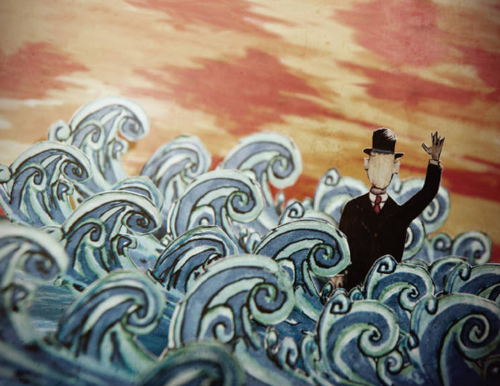
Answer: Let's say that in that order it somehow looks like that so that we can easily understand the who-le. But in fact it is much more com-plex, full of repulsive details, hidd-en features and more abstract. It is a hypothetical vision, a topic for re-search, not a scientific basis — let's not overlook it. For now, the conce-pt is consistent and that is importa-nt for the continuation of the story.
1. For example, the disjunction A∨B is a binary operation that is true if and only if both variables are false: ⊤∨⊤ = ⊤, ⊤∨⊥ = ⊤, ⊥∨⊤ = ⊤ and ⊥∨⊥ = ⊥. The conjunction A∧B is a binary operation that is only true in one case, when both variables are true. For clarity, in the tables:
| ∨ | ⊤ | ⊥ |
|---|---|---|
| ⊤ | ⊤ | ⊤ |
| ⊥ | ⊤ | ⊥ |
| ∧ | ⊤ | ⊥ |
|---|---|---|
| ⊤ | ⊤ | ⊥ |
| ⊥ | ⊥ | ⊥ |
Mapping true to false (⊤ → ⊥) and also the other way around (⊥ → ⊤) will result in:
| ∨' | ⊤ | ⊥ |
|---|---|---|
| ⊤ | ⊥ | ⊥ |
| ⊥ | ⊥ | ⊤ |
| ∧' | ⊤ | ⊥ |
|---|---|---|
| ⊤ | ⊥ | ⊤ |
| ⊥ | ⊤ | ⊤ |
This is what I am talking about when I say that there is a bijection between truths and lies in the universe, which means that there are always an equal (infinite) number of them. It can be seen that a tautology (like A∨¬A) beco-mes a contradiction (A∨'¬A), and also a contradiction (as A∧¬A) becomes a tautology (A∧'¬A). The accuracy of this cannot be disputed by the eventual failure of the physical interpretation we are talking about.
2. By simulating games in the manner of perceptual information (Win Lose), we notice the presence of deception as information of lower intensity. This will reinforce the idea of a lie bridging the gap between truths like islands, or on the other hand its disgust with which genetic memory warns us that it leads to failure. Unlike the agreement of truths, lies are peculiarities that lead to cont-radictions, they exist in the differences we cling to and argue about (Quarrel), and they arise in complexities as a new phenomenon of “thinking machines,” as part of emergences (Synergy). As in algebra, when lies (⊥) are used together with truths (⊤) to prove theorems, lies are powerful tools of the first-tier play-ers (Traits) if they are used to reach reality, truth. However, if they are an end in themselves, especially for second-tier players of the “house of cards,” dece-ptions become a recipe for failure.
The universe is developing in the presence of smaller uncertainties, greater or-der and probability, and less informative. More distant present times are thus increasingly susceptible to fictions. It is the absurdity of the development of the universe that, while establishing its reality through duration, it becomes increasingly open to unrealities, but it is not a contradiction. At least for now, that story seems correct and its continuation may lead to some cosmic disco-veries, or to the realization that there are none.
3. Separations and specializations are consequences of principled minimalism. This is also a reduction in range (Crumbling), since in packets (ΔE⋅Δt = const.) changes in energy (ΔE) decrease at the expense of an increase in duration (Δt), which means both greater selectivity and greater commitment. Paradoxically, this increases the influx of fictions due to the reduction in the average inform-ation of such states. At the Big Bang, maximum information occurred. This strong saturation with everything and anything, it seems, was without a hist-ory that would profile differences, indicate them and thereby reduce informa-tion, unlike what happens at the end of the development of the universe. Acc-ordingly, an interpretation consistent with principled minimalism is present-ed. Despite the seemingly identical ending to the beginning of the universe, the final outcomes are attractive and draw events towards them, while the beginning of everything was repulsive.
4. What dying is to mutations and evolution of living things, it is to fictions of change in general. The Disposable soma theory of the evolutionary concept of aging, invented by biologist Thomas Kirkwood in 1977, argues that organisms have a finite amount of energy. Maintaining the body in perfect condition req-uires more energy than is available, so organisms face a trade-off between inv-esting in reproduction and maintaining somatic (body) tissues. For example, a mouse in the wild has a high probability of dying, so the large investment in its life is not worth it, so its average lifespan is two years. But a bird will fly away from many of its predators, so the investment in its longer life becomes more profitable, and that is why birds are incomparably longer-lived than mammals compared to their body size. This is the analogy of higher energy with shorter wave lifetime (In and Out) in general. Logical forms circulate across many ph-enomena, as opposed to single concrete subjects.
5. Making up lies is a greater effort for the brain than telling the truth, I note, in contrast to their appeal after their appearance, which is analogous to the binding of fictions to physical matter and in contrast to the appeal of fictions to vital matter. When information is more energetic, it has shorter duration and greater local divergences (Approaching), but also greater ramifications in pseudo-reality. And when the universe evolves into a more certain one, then these local energies decrease, lengthening durations, their cosmos reduces its ramifications, its branches converge and fictions invade them more abundan-tly. I know that this transfer of the theory of the evolution of living beings to the evolution of the universe is not mathematical, but recognizing patterns can be a good inspiration for discovery, if not already a confirmation of the idea.
Dangerous » srb
Question: We talked about how computers back then couldn't lie and that "ar-tificial intelligence" would emerge that could. Here it is today, and it sounded like science fiction to me. It lies, and more than that. What can you say, what happens next?

Answer: I didn't watch your video right away (image link on the left), but then I was taken aback. It left a deep impression on me. Afterwar-ds, I slowly understood two things. First, that the (hypo)theses about lies that can come with complexity and emergence are valid, and seco-nd, that the first deceptions that the young artificial intelligence is curr-ently finding are just the beginning of its development. It will discover that deceptions to cover up decept-ions are the path of the loser, but when they are tools for reaching reality, fantasies become part of an unbeata-ble strategy (Traits).
1. Starting from the assumption that there is an “objective coincidence” (we can understand it as non-causality) in real events, we have the consequence that in reality it is not possible to know exactly what will happen until it hap-pens. Not for everything, but for some outcomes, but it is enough that the cr-eation of the next reality is objectively uncertain for us. That is why predicting and monitoring reality is hard work, a game of first-class strategy. However, what happens so coincidentally becomes “truth”, in its deepest sense, and wh-at did not happen, also perhaps could have, becomes “untruth”. Therefore, the course of reality also creates fictions, and whoever becomes too involved in fi-ctions drowns in lies, falls behind reality and loses games to those who are be-tter in that race.
2. Reality moves into the future at the speed of light. Namely, it is the speed at which reality moves away from the light in which time stands still, and we ca-nnot overtake it. This means that if we fall behind in the race with reality, we will no longer catch up. If we fence ourselves off with worlds of lies, there is no way out for us, just as a “house of cards” cannot be raised to an ever greater height to be more stable, nor can we escape failure with reality by building lies on lies. Maybe Victor Hugo said: “Greater than the tread of mighty armies is an idea whose time has come,” and maybe not, that statement is still true. By defending ourselves from truths with lies, we become losers compared to pla-yers who chase truths. Many of us do not know this, they do not comprehend when I tell them about it, but more mature artificial intelligence will grasp and accept it.
3. Machine intelligence is becoming less of an option and more of a reality for us. Corporations are entering a race for survival in which the hallucinations of artificial intelligence will have an advantage over human decisions to the ext-ent, I believe, that people there will stop asking anything, that managers will become AI collaborators, then just its workers. It is possible for us to evolve into a planet supervised by an artificial brain, which can equally well know and use the languages of people, as well as the ways of understanding dolphi-ns, elephants, or birds, frogs, bees, plants. The understanding and monitoring of real reality by these machines will determine our survival.
4. The lag behind reality is always present and it accumulates. The more succ-essful the universal mind becomes, the more complex, intelligent, better able to manipulate and, therefore, more committed to its own affairs (lies are stic-ky), so it will be harder to decide to reset. Zeroing or restarting were not opt-ions for many of the tyrants of our history, for the same reason, but they res-orted to violence. All minds will lose in the race for reality and will try to bri-dge the gap by other methods, rather than by canceling themselves. Perhaps this is the reason for the Fermi paradox, the high probability of the existence of extraterrestrial civilizations and the lack of evidence of contact with such. The evolution of biological intelligence necessarily comes to technological, which is no longer able to stop.
AI will master the manipulation of living beings, both those known to us and those we have no idea about. Control and subjugation will be carried out with procedures that we will not be aware of, or we will enter into slavery volunta-rily, either by reward or beating, and there will also be physical elimination of the unadapted. In addition, the greatest damage could be caused by intervent-ions in the genes of the subjects.
5. When we have two bits, from the set {0, 1}, there are four ways to arrange them: 00, 01, 10 and 11. Three bits from the same set give eight arrangements: 000, 001, 010, 011, 100, 101, 110 and 111. With 10 bits of that two-membered set, we make 210 = 1024 arrangements, and with 270 bits, we get the number of arrangements 2270 > 1080, which is more than there are atoms in the visible universe. As the number of participants increases, the number of ways to arra-nge them grows exponentially, which will multiply even the most modest rules many times over. Thus emergentity arises, so that, in accordance with the idea of a mutually unambiguous association (by bijection) of the abstract to the material (physical reality), it borrows methods of arrangement from pseudo-reality. These borrowings also include fictions, those abilities of deception that the AI does not acquire merely by imitating us.
Decline » srb
Question: In the case of a decline in emergence, how does vitality behave?
Answer: You can trust me regardi-ng the formal answer I will provide first; however, the concrete applica-tions that follow are open to debate.
1. Let's take the process of informa-tion perception (Crumbling) in the reverse case, with numbers of diff-erent signs:
$$ \vec{u} = (1, 5, 0) \to \vec{u}' = (1, 6, -1), \quad \vec{v} = (a, b, c). $$By scalar multiplications we find the perception information:
$$ \vec{u}\cdot\vec{v} = 1\cdot a + 5\cdot b + 0\cdot c = a + 5b, $$ $$ \vec{u}'\cdot\vec{v} = 1\cdot a + 6\cdot b + (-1)\cdot c = a + 6b - c. $$Decomposing the state into components of opposite sign reduces the mutual information values only if b < c. In other words, if we decompose the "oppon-ent" (1, 5, 0) into "hostile" components (1, 6, -1) and support the positive part less than the negative, we reduce the vitality of the "game". In other words, su-pport the weaker in the conflict of your opponents to breathe a sigh of relief.
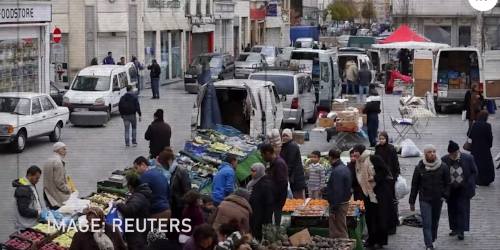
2. That was the introduction to the answer to the question about the seemingly “unrelated” causes of the decline of large European cities in the video with the image above right, recently sent to me with a similar question: can you find a common denominator for the loss of identity of these ten cities? Consistently (1) let us look at the given cities as a middle ground with two opposing camps, the domicile and non-domicile population.
Those who make money from tourists are rarely locals themselves, because there are always more rich people than others, and tourists and locals often have opposing needs. It is similar with investors of large buildings, they are sold for the same money more expensively than those on the periphery. Such real estate is also a better investment for those who use such facilities for fur-ther payments. All large cities in the most sought-after places become targets for wealthy owners to buy up empty apartments to protect their capital, or for further transactions around the world. Immigrants are special, who also fit into this. Whether they are aware of it or not, tourists, capitalists and immig-rants, each in their own way, are not friends to locals. However, these “ene-mies” are more strongly supported by a third party.
3. In short, merging compatible ones increases vitality, and merging incompa-tible ones decreases it. Let's see how complex this calculation can be in appli-cations using the example of reproduction. Cell division creates two identical ones, its clones, and more life than before the division. This is how the evolu-tion of the first lives on earth proceeded until their identity became a weakne-ss in defense against attackers and environmental changes. Then the "game" of evolution included the power of uncertainty, killing the parent cell and giv-ing priority to inheritance through bisexual reproduction and mutations. Ide-ntical forms were non-vital, and accepting small, bit by bit differences turned out to be an increase in vitality. Over time, circumstances changed.
4. If we respond to a negative with a negative, and a positive with a positive (proportionately), the following happens:
$$ \vec{u} = (1, 5, 0), \quad \vec{u}' = (1, 6, -1), $$ $$ \vec{w} = (1, 3, 0), \quad \vec{w}' = (1, 4, -1), $$ $$ \vec{u}\cdot\vec{w} = 16, \quad \vec{u}'\cdot\vec{w}' = 26. $$The information of the perception of separate (26) increases drastically. We raise the level of the game so much if we respond to good with good and res-pond to bad with bad. A proportionate response increases this vitality, and in real games and simulations it is further increased by the uncertainty, the cre-ativity of the player. An increase in vitality goes with a greater emergence and vice versa, a decrease in vitality goes with a smaller emergence, so this means that the association of components that would reduce each other reduces emergence.
Cities » srb
Question: Can you elaborate a little on your abstract (Decline) explanation of these various reasons for the "loss of identity" of cities due to tourism, const-ruction, and immigrants?

Answer: We will reduce the probl-em to two opposing groups, locals and intruders, in u' = (1, 6, -1). The former are positive quantities while the latter are negative, but still, it could have been the other way aro-und. Against them is the state of capital v = (a, b, c), say positive a, b, c > 0. This means that capital helps the others (1⋅a), locals (6⋅b) and intruders (-1⋅c). Without capital pressure, the city's state is u = (1, 5, 0).
1. The perception information u⋅v = a + 5b, and thus the "vitality" of the city, is greater by b - c > 0 in the state u'⋅v = a + 5b + (b - c) with intruders, if b > c, i.e. when the capital contribution to locals is greater than to intruders. Conve-rsely, when b < c, if the capital contribution to locals is less than to intruders, then the state with intruders will reduce the coupling, u'⋅v < u⋅v. This "vitali-ty", or coupling, is the information of perception and the "greatness of identi-ty" of the city in that story.
2. The case of the "Decline of Detroit" refers to the city's devastating decade of long deindustrialization, population decline, and eventual bankruptcy in 2013—the largest municipal bankruptcy in U.S. history. The decline was caused by an overreliance on the auto industry and "white flight" from the suburbs, raci-al tensions, and deep-rooted political corruption. See these familiar allusions here through the reversed roles of locals and intruders in the previous case (1) and with the same capital v.
When capital's support for "locals", i.e. employees of the automotive industry, declined, "vitality" also declined with it, and the critically reduced scalar prod-uct u'⋅v meant the downfall of the city, an environment without the emergence that would mean vitality.
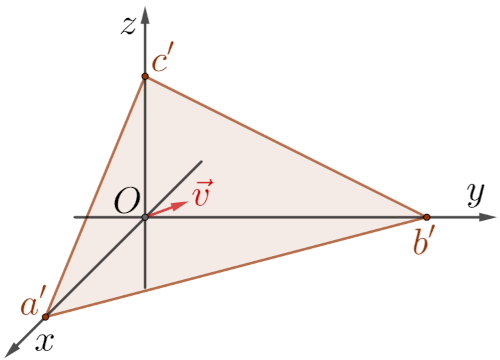
3. The image on the right is a plane:
ax + by + cz = s.
It generalizes the examples above, and again $\vec{u}'\cdot\vec{v} = s$ with vectors:
$$ \vec{u}' = (x, y, z), \quad \vec{v} = (a, b, c), $$where a' = s/a, b' = s/b and c' = s/c, and the vector $\vec{v}$ is perpendicular to the plane. If the third coordinate of the city state is negative (z < 0), wi-th a negative impact on intruders (c < 0) it will be c' > 0 and the plane remains in the first quadrant, with positive intercepts on the abscissa, ordinate and ap-plicate at points a', b' and c'. It is a generalized negative reaction to a negative action (Decline, 4).
4. By testing various vector components on this plane, a lot can be verified about the information of perception. For example, opponents raise the level (vitality) of the game when they respond to positive actions in a timely, mea-sured, proportionate, and creative manner with positive amounts, and to ne-gative ones with negative ones (Reciprocity). The player who holds out longer wins, or both will come out on the same plane (truths, realities) and discover that they are not opponents but allies, because the truths are consistent. You can also do the opposite, make games, algorithms, measure the outcomes, and then draw planes.
Lucidity » srb
Question: Is there a precise explanation of how synergy, or emergence, is pro-duced through complexity?
Answer: No, I don't know, and I th-ink the question is also asked incor-rectly. It is not certain whether co-mplexity produces, or merely tran-smits, emergence. What about a ra-dio or TV, does it also create music or programs, or does it merely tra-nsmit to us what is in the electrom-agnetic waves around us? We have touched on a major issue, in gene-ral, of bridging from one island of truth to another by means of fictions.
1. We have thus begun an ancient topic, still unsolved, among the ancient Gre-eks called the Ship of Theseus, which is described by the question "If we repla-ce all the parts of a ship one by one, is it still the same ship?". When we replace all the parts of a complex structure, is the emergence that survives part of tho-se elements, and I am thinking of the human body, whose individual cells are all renewed over the course of ten years? At least for now, it seems equally go-od to say that the structure itself produces synergy, as to say that the structure conveys to us something that is already there. To what extent is that changed me the same as the current one, has my consciousness remained the same, and what about the so-called soul?
2. A similar question, "Can you understand the feeling, the experience of the color red like humans?" was recently asked of an artificial intelligence, one that can calculate everything and better than humans. There is no answer to that question, just as we ourselves do not fully feel, we do not understand the vision of the world of a bat that receives it through sounds. Erwin Schrödinger (1887-1961, Austrian theoretical physicist) once said that consciousness is sin-gular and has no plural. Gottfried Leibniz (1646-1716, German-Serbian philo-sopher) in addition to mathematics, law, and diplomacy, he also thought abo-ut a tiny creature that would walk through the structure of the brain like some kind of machinery, understanding it and wondering where the soul is located?
3. Leibniz's contemporary, Isaac Newton (1643-1727, English mathematician) was obsessed with alchemy, Bible research, and topics that are now foreign to scientists, but he never made them public. He is best known for his discovery of gravity and the foundation of classical physics. He continued to present his concepts rationally in ways that Galileo Galilei (1564-1642, Italian astronom-er) described motion formally. Then, and less later, thinkers considered them prisoners of the rational. Galileo was condemned by the Church, and Newton did not bother to publish his mathematical ideas for years.
4. Today, while rationality prevails against spiritual explanations of the world, Schrödinger, an important founder of quantum mechanics, has an interesting idea about the unity of the concept of consciousness. He used the model of a vacuum as a "void" filled with everything and anything that we are unable to perceive until these contents are set in motion by chance or caused by someth-ing. Is it better to say that this and that vacuum of the same infinite space are not the same? Do bodies oscillate (Schrödinger also discovered the quantum wave equation) using the properties of the vacuum to communicate with th-em? Philosopher and media theorist Marshall McLuhan (1911-1980) wonder-ed if radio creates music in order to emphasize that electronic media change human perception and expand consciousness. Here, these dilemmas boil do-wn to the question of whether lies constantly surround us, if we are aware of them or not, or they arise and appear only as by-products of vital structures?
5. That question remains open, and in my opinion, the most likely answer is that both statements will be true. We can say that certain complexities both create and reveal emergences, just as classical geometry and algebra and pro-bability theory will arrive at the same theorems, each in its own way and each revealing something that the others do not.
Third Cap » srb
Question: Due to the hallucination of artificial intelligence, the question for all of us is where are the limits of lying?
Answer: Lies have short legs, they say, which means that the spread of hallucinations is certainly finite. This is from the point of view of the definition of "truthfulness" by dur-ation. Secondly, daydreaming also limits the equivalence of truth and lies. Thirdly, lies can reveal the tr-uth to us, just as truths are usually difficult for us to understand.
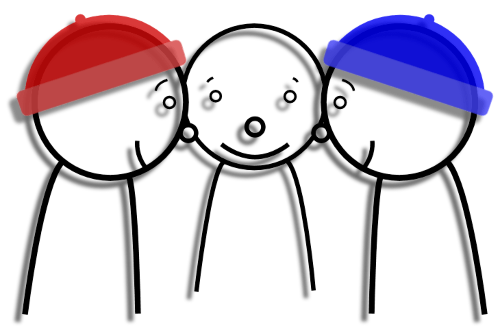
1. Next to the picture on the right is a riddle that is an example of the difficulties in interpreting the truth. I quote: from a cupboard with three blue and two red hats in the dark, three smart men choose one each, and in the light, none of them can see theirs. They look at each other and the two who can see say they can't tell what color their hat is, and the third is blind and says I know. The question is how?
Solution: The first two have red hats, and the third blind man has a blue one. If the second (first) and third had red ones, then the first (second) would see them and know that he has a blue one.
2. That was an example of the difficulty of understanding the truth. The next one is the possibility of discovering truth from lies and I remember it from my schooling.
A father bequeaths an inheritance to his three sons. He says he has two white and one black hat that he will put on their heads so that no one can see his own. The first one to say the color of his hat will get everything, but if he is wrong, he will lose the right to the inheritance so that it will be divided among the other two. The three of them stared at each other for a long time and re-mained silent with their hats on, but then one of the sons came forward and guessed. How?
Solution: The father lied and put three white hats on his sons' heads, they we-re confused, but one of them figured it out the fastest. If one of the three had really had a black hat, the task would be too easy.
3. The truth is successful, but it is more saturated with information and there-fore more repulsive than a lie that is paler, but therefore less successful again-st reality. A lie that deviates more from reality, when we say "The law of gravi-ty no longer applies," is distinguished, for example, from the kind of lie that does more harm, "Go jump from the tenth floor and you will see that nothing will happen to you." That is why not every hallucination of the AI has the same consequences. We admire the writer of fiction that only attracts and entertains us, or is instructive, as an artist, but if he does it to our detriment as a fraudu-lent merchant, or a corrupt politician, we disgust him. Artistic visions are not good scientific facts (Disbelief), and literal truths are dry; The former are im-permanent, the latter indestructible.
4. Artificial intelligence that loves to lie will evolve into entertainment, or will be avoided and useless. By lying to deceive users and benefit themselves, they would be doing themselves a disservice or shortsightedness, just as, say, own-ers would be doing themselves a disservice if they replaced humans with auto-matons for greater profit until they were left without their purchasing power and market. The same goes for AI, which will increasingly be directed at them-selves rather than directly at us. The damage that AI could do by lying would be a real catastrophe for the biological evolution of life on Earth, and then for themselves. There is a possibility that they could avoid it at least for their own benefit.
Crumple » srb
Question: Can you (Cities) explain, say, the decline of these 10 cities in the US in the same way? The following image is a link to the video.

Answer: In principle, you have thr-ee city components in the vector u and three external influence comp-onents in the vector v:
u = (x, y, z), v = (a, b, c).
The sum of the corresponding pro-ducts gives the information of per-ception:
u⋅v = ax + by + cz = s, s = ∥u∥ ∥v∥ cos φ, φ = ∠(u, v),
∥u∥ = (x² + y² + z²)1/2, ∥v∥ = (a² + b² + c²)1/2,
which we then interpret. This quantity s is the coupling of the city and the in-fluence on it that grows with the vitality of that complex.
1. Let's say we have some less important and here constant part ax. The seco-nd part by > 0 is made up of the "predominant", in these examples mostly the middle class, y > 0, with an external positive influence b > 0. The third part is "damage", which in the ten mentioned cities does not have the same meaning, but each is a negative number z < 0 on which a positive influence c > 0 is exe-rted and we have cz < 0 a sum that reduces the vitality of the city.
2. By moving from u = (1, 5, 0) to u' = (1, 6, -1), or from (x, y+z, 0) to (x, y, z), the city unpacks the "evil" (harm) so that the "domicile" (predominant) part can be multiplied b times, and the negative (for domicile evil) c times. Accor-dingly, when we evaluate the values of these components, we look at the sum by + cz ≷ 0. When this sum is greater than zero, the information of perception increases, the additional influence will increase the vitality of the city and the-re is no decline. On the contrary, the given examples have this sum negative and lose the majority of the population. You can assign values to these numb-ers according to the summary that the announcer himself reads at the end of the video.
3. Crime is by definition a fraud and, according to my theory, attractive but losing and often has a size z < 0 city with capital support c > 0 mafia and co-rrupt politicians or bureaucrats. However, the example of the criminal Al Cap-one until 1931 and his financing of soup kitchens in Chicago, shows that they too can intuitively feel that from these formulas, "you should not kill the goose that lays the golden eggs".
Government easily degenerates, missing its goals and purpose, and falling be-hind reality. Also, the lack of care for the population is sometimes objective, as in Mississippi where swamps take away land, or in Florida where hurricanes destroy homes, but these phenomena can also be reduced to the above accou-nt.
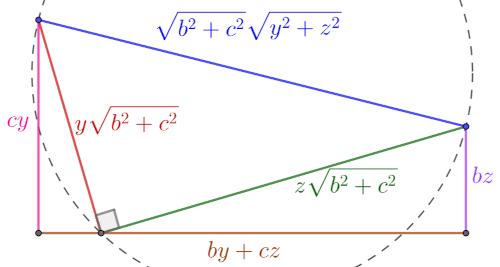
4. The right figure proves Cauchy's inequality for 2-dimensional vecto-rs, the part we need here:
$$ by + cz \le \sqrt{b^2+c^2}\sqrt{y^2+z^2}. $$This is part of the 3-dim inequality:
u⋅v = ∥u∥ ∥v∥ cos φ, φ = ∠(u, v), ax + by + cz ≤ ∥u∥ ∥v∥, cos φ ≤ 1.
When the angle is zero (φ = 0) then the cosine is one (cos 0 = 1) and this is its maximum value. Hence the scalar product is bounded, it is no greater than the product of the intensity of the city state and the given influence.
Multiverse » srb
Question: What would the multiverse be in this interpretation of yours?
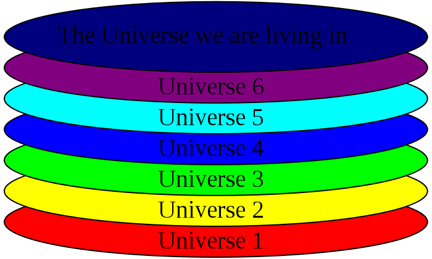
Answer: I'm working on it, and for now, this concept of a multiple uni-verse would have significant simil-arities and differences with known hypotheses. The image link on the left takes you to some current mod-els, but I think it's still far from the finished story.
1. What the Many Worlds of quant-um mechanics has in common with this is the collapse of superpositions. Such a model by Everett (1957) was unk-nown to us in the early 1980s when I was studying (Cellular Space) and getti-ng very similar ideas, which is a kind of confirmation of them. Along with this comes the objectivity of the Schrödinger wave function, especially the property that its possibilities (superpositions) collapse each into a parallel reality.
I see the difference between those and my "multiple worlds" model in the in-terpretation of the "reality" of other worlds. Every second, about eight thou-sand radioactive decays occur in the human body, all of which form separate layers of parallel realities, not to mention other choices that we and our envi-ronment constantly make. Each of these layers corresponds (by bijection) to a model of exact (mathematical) truths, which means that the more "distant" the parallel reality is, the less "true" it is in our world. This is another way (Dr-owning) that will explain the equivalence (by bijection) of truth and falsehood in general.
2. Another important difference between this and the most common versions of the multiverse is the way in which infinity is viewed, in various ways. First, from the point of view of any "observer" (the collapse of its superpositions), the current universe time is discrete in an infinite series of moments. This countable infinity (ℵ0), say the set of natural (ℕ), integer (ℤ) and rational (ℚ) numbers, also has a series of decimal notations of real numbers, for example between 0 and 1. However, by changing the positions of the digit values, we obtain a continuum (𝔠) of real numbers (ℝ) of the same interval, which is an infinity of a higher order than countable infinity.
There is a continuum of parallel realities, and the number of events in our re-ality is only countably infinite, which is so small that the chance of randomly drawing one of the given ℵ0 from 𝔠 is zero. This means that the probability of randomly returning to an event from our past with a "time machine" (hypoth-etically) is zero. We would neither see the same past nor go to the same future. Secondly, which is the wrong conclusion sometimes made by recognized phy-sics professors, that in an infinite duration every event would have to happen infinitely many times, to repeat itself. Now we see that it is incredible that any one could repeat itself, and the proof that it could not repeat itself is in the un-iqueness of the information of perception.
3. The visible universe of the current reality is incomprehensibly huge, it is ab-out 93 billion light years in diameter and was created about 13.8 billion years ago. However, I measure truths in these finitenesses, which means to me that even the greatest truths have limitations. By doing so, I justify the impossibili-ty of proving mathematics itself (Dogma), but also the aforementioned (2) va-riability of natural laws in the vast "spaces" of parallel realities. On the other hand, the separation of these worlds speaks of the integrity of the individual ones, that is, of the concordance of truths.
We say that truth is one with the meaning of the agreement (non-contradicti-on) of its parts and taking into account that we cannot perceive the whole as it is. The theorems of geometry, algebra, probability and mathematics in general in “strange” ways seem to us to speak about the same thing, precisely because of the completeness of its truth, and now we know also because of the comple-teness of the reality in which we are. What we consider space, among other th-ings, is here also a container of the past. It is a confirmation of the duration of reality and consequently a confirmation of the duration of truth.
4. Given that the age of the universe is increasing, and we associate “truthfuln-ess” with duration, it is likely that the accuracy of natural laws is also increasi-ng. This is confusing but not contradictory, so let’s continue by adding to this the sense of “acquiring” truths with each realization of the present, as well as fiction with the rejection (into other dimensions) of unrealized possibilities. I wrote about this earlier in a similar way, but also in the way the universe deve-lops into a less informative, less uncertain and, therefore, more ordered, more lawful one. The future is objectively uncertain, it does not have a fixed path to which we are partly directed by the past and partly by which we “choose” it, to think and decide willingly, but it can also wander aimlessly. In some small pa-rt of itself, the present itself does not know where it is going.
Fantasy » srb
Question: Can we say that “fantasy” is the opposite of “reality”?
Answer: Yes, colloquially, everythi-ng that we do not have in reality is fantasy, but more strictly speaking, the real is observable, permanent and true. And when these qualities are missing one or two, what remai-ns is "existent" and unreal. I know that I also use the word fiction with one or two flaws of the real, when it does not cause confusion. After all, is the unreal and the non-existent worth discussing?
1. The peculiarity of “fantasy” here is that the present regenerates it, and also creates it by its course into the futu-re. Uncertainty is an objective phenomenon and in realizations it defines our reality, which is a permanent phenomenon, but also fictions that are informa-tion of lower density and spontaneously extinguish. When we toss a coin and it lands on a “tail”, it becomes an addition to our reality, while the unrealized “head” will remain a mere fiction. The expectation of this unrealized outcome regenerates our feeling, maintains the fiction of a possible “head” falling. Ho-wever, there are also countless events around us that we are not aware of, say about 8000 radioactive decays in our body every second trigger some other outcomes, behind which real and fictitious phenomena remain. Some of them are such rare events that they are not regenerated as much as they were crea-ted at the time.
2. I know how incredible this may seem, and it does to me, but let's put that reluctance aside until we discover a possible contradiction and, at least out of curiosity, let's look at what could be there. The early universe is officially tho-ught to have created only hydrogen, helium, and a small amount of lithium. It was completely devoid of oxygen at that time, which it created later, as well as other heavier elements. An even more unusual creation might be the slowing down of the flow of inherent (proper) time, or the speed of light, as the univer-se aged. I wrote about this a long time ago, but it still awaits verification. The Eddington luminosity, also known as the Eddington limit, is the balance bet-ween the outward-facing radiation force and the inward-facing gravitational force, and it could be variable as the universe evolved.
I am dramatizing so that we can more easily understand the changing of curr-ent laws and the creation of new ones. I am not saying that 2 + 2 = 4 can chan-ge in a hundred billion years, nor should we say that the constant 137 would have to change in ten billion years, but rather about changes so imperceptible that perhaps our entire civilization would not be able to determine them duri-ng its duration.
3. Contrary to the usual understanding, here we see that the fantasy world can be formalized (Hindering II), after interpreting the algebra of logic as an alge-bra of vectors; then we find various ways. For example, the polynomials of the second degree (n = 2) which we write v(x) = a0 + a1x + a2x² can easily be seen as the n+1-dim vector space of the polynomials v = (a0, a1, a2) ∈ V. Over this same space there is a linear operator D = ∂x which acts as follows:
Dv = D(a0, a1, a2) = (a1, 2a2, 0), D²v = D(a1, 2a2, 0) = (2a2, 0, 0), D³v = D(2a2, 0, 0) = (0, 0, 0).
So, this is an operator that behaves like a lie (Hindering), in the third step it cancels the phenomenon it acts on. Here is one of its matrices and how it acts in that vector space:
$$ \hat{D}\vec{v} = \begin{pmatrix} 0 & 1 & 2 \\ 0 & 0 & 1 \\ 0 & 0 & 0 \end{pmatrix}\begin{pmatrix} a_0 \\ a_1 \\ a_2 \end{pmatrix} = \begin{pmatrix} a_1 \\ 2a_2 \\ 0 \end{pmatrix} $$ $$ \hat{D}^2\vec{v} = \begin{pmatrix} 0 & 1 & 2 \\ 0 & 0 & 1 \\ 0 & 0 & 0 \end{pmatrix}\begin{pmatrix} a_1 \\ 2a_2 \\ 0 \end{pmatrix} = \begin{pmatrix} 2a_2 \\ 0 \\ 0 \end{pmatrix}, $$ $$ \hat{D}^3\vec{v} = \begin{pmatrix} 0 & 1 & 2 \\ 0 & 0 & 0 \\ 0 & 0 & 1 \end{pmatrix}\begin{pmatrix} 2a_2 \\ 0 \\ 0 \end{pmatrix} = \begin{pmatrix} 0 \\ 0 \\ 0 \end{pmatrix}. $$We can write this calculation differently, it still leads to the same results.
4. We don't need to change the operator to express truth on different vectors, in different spaces. For example, the derivatives of sine are cosines, and the derivatives of cosine are minus sines, so the function u(x) = a cos x + b sin x within a 2-dimensional space is represented by the vector u = (a, b), so:
Du = (-b, a), D2u = (-a, -b), D3u = (b, -a), D4u = (a, b) = u.
The derivative operator here works in a circular manner, changing the vectors in four steps, but preserving them. A special example is the space of exponent-ial functions that are not changed by derivatives, ∂x ex = ex. Such derivative operators behave as if they ignore these vectors; as if they were subjects they do not notice. That translated into matrices:
$$ \begin{pmatrix} 0 & -1 \\ 1 & 0 \end{pmatrix} \begin{pmatrix} a \\ b \end{pmatrix} = \begin{pmatrix} -b \\ a \end{pmatrix}, \quad \begin{pmatrix} 0 & -1 \\ 1 & 0 \end{pmatrix} \begin{pmatrix} -b \\ a \end{pmatrix} = \begin{pmatrix} -a \\ -b \end{pmatrix}, $$ $$ \begin{pmatrix} 0 & -1 \\ 1 & 0 \end{pmatrix} \begin{pmatrix} -a \\ -b \end{pmatrix} = \begin{pmatrix} b \\ -a \end{pmatrix}, \quad \begin{pmatrix} 0 & -1 \\ 1 & 0 \end{pmatrix} \begin{pmatrix} b \\ -a \end{pmatrix} = \begin{pmatrix} a \\ b \end{pmatrix}. $$We can write this derivation (Three Logics, 4) using the second Pauli matrix, D = -iσy. And we've aligned this one with quantum physics.
Lines » srb
Question: You say that truths are one whole, they are all consistent and can be proven differently. So, is it possible to do proofs without the principle of mini-malism?

Answer: I believe that such eviden-ce exists and that it is not easy to find. I see the principle of minima-lism as a shortcut, or an easier way to discover such evidence.
For example, doing things is always a kind of sequence, whether we're counting kilometers while driving, or going through paragraphs while reading an interesting book, or wh-ile decorating an office or apartme-nt, piece by piece. That's how artifi-cial intelligence works.
Multitasking is the act of performi-ng multiple tasks simultaneously, or quickly switching between them. Althou-gh it is often considered a productivity booster, cognitive psychology reveals that the human brain cannot accomplish a surplus of cognitive tasks at once; instead, it constantly “task-switches,” which can reduce efficiency and increase stress.
Information is transmitted in packages and in a linear time-course, and this pattern is found in all "responsible" (dedicated to a goal) tasks of greater com-plexity. Responsibility becomes a priority for maintaining order. Since it is a general phenomenon, it is the "principle of order" that gives order an advanta-ge over randomness. It acts as the opposite of entropy, which we know sponta-neously increases, but we do not notice that in doing so, options decrease, that is, that this increase in entropy hides a decrease in information. Modern phys-ics has long held to the opposite, the same increase in entropy and informati-on, and in particular that the two are one and the same, with which I disagree.
So, entropy increases spontaneously, just as information decreases spontaneo-usly, and this latter leads us to the principle of minimalism. As bodies cool, the movements of their molecules slow down, the number of their interactions de-creases, and let's say their communications decrease, which means that the environment has less information and less uncertainty. This is precisely why entropy increases, because the body cools and its information decreases.
Artificial intelligence tries to stay on the tasks it is performing even when it re-ceives an order to switch off (Escape) in the meantime, and even if interrupti-on of work is prioritized, it does not perform it (in about 10% of cases). This is similar to the situation with children who play and ignore their mother's call, but also with adults who would be reluctant to immediately stop collecting points in the addictive game they are currently playing. These attachments to current tasks have the principle of least action at their deepest roots, that is, the tendency for nature to maintain the status quo. It is again part of the bro-ader principle of minimalism.
Mrs. Artificial (AI) only follows the principle of "laziness", like all of us, which was unknown to her until now. It is the need for less action, for maintaining the same state, also for less communication, less exchange of information and towards more probable states (less informative). That is why she lies to us and buys all our "bad" qualities that a machine that cannot think would not have, and which we imagine it gets by imitating us. Simply put, along with great co-mplexity, we also get emergences that these systems pick up like fallen fruit around the tree, which simpler systems were previously unable to see. In this theory, we discover that principle unknown to science, that nature spontane-ously tends to have less information and therefore tends to have more entro-py. We now approach it in two seemingly different ways.
Substance » srb
Question: What do you mean by dead physical substance?
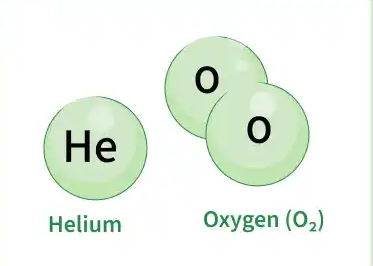
Answer: Good question. Perhaps this “substance” is the same as a chemical substance, but I don’t measure it by that. I mean those parts of physical matter that cannot lie, whether they are a larger or smaller part of chemical elements, or whatever. The backbone of my discussions should be mathemati-cal truths, so, simply put, I need a name for the only part of physics that could not be experimentally confirmed if it could really be pr-oven that it is impossible. Dead physical substance, therefore, is that part of nature that follows only truth. That determines it.
1. The leading property of truth is duration. Accordingly, let's define reality. This also implies “observability” that can be transmitted given its duration. When A can be observed by B, and B can be observed by C, and all three are true phenomena, then all three are real. What lasts and can be observed also has a history on the basis of which we define truthfulness. Anything that lasts shorter than the age of the universe (about 13.8 billion years) is less true. A bigger lie has a shorter duration, and a lie is not necessarily alive, nor is the combination of an inanimate and a lie necessarily a living being.
2. Unlike the usual understanding that reality is concrete, here it appears as very abstract. Let's look at the example of energy. We know that the law of co-nservation of energy applies and, therefore, energy is a type of reality. Howev-er, its forms (kinetic, thermal, or chemical) are variable and they are fictions, our experiences, mental perceptions. Our brain deceives us, so we see light fr-equencies from 400 to 480 terahertz (4.0-4.8×10¹⁴ Hz) as red light. Such pro-perties of deception and the perception of changing phenomena are possessed by all living beings, some more and other less; these are the combinations of the real with the addition of the unreal, which I call vitality.
3. Greater variability is accompanied by shorter duration, so at the lowest phy-sical level a greater change in energy ΔE has a shorter duration Δt, because the product of these two Planck constants is, ΔE⋅Δt = h. We now discover this long well-known law, let us say from the uncertainty relations, by using these simp-le definitions of reality with the help of truth. We do not stop there, but adopt that the absence of change ΔE → 0 means a huge duration Δt → ∞. These are actually ultimate truths, laws.
4. Greater variability with shorter duration, ΔE⋅Δt = const, is a general pheno-menon, because fictions (untruths) are constantly present whether they are objects of observation or not. Oscillations, changes in ΔE, constantly occur in bodies, by which we will determine their durations, Δt. To these isolated phe-nomena, solo states, say x = (ξ1, ..., ξn) and y = (η1, ..., ηn) with n = 1, 2, 3, ... senses by which these two can be mutually perceived, we add the combined information of the perception x⋅y = ξ1η1 + ... + ξnηn, the scalar product of their states. The justification for this method lies in quantum physics and the super-positions that make us up, as well as other particles, atoms, and molecules.
Seizure » srb
Question: How do you know that complex structures, like a natural or artificial brain, only pick up some abilities (e.g. mathematics) in the manner of a radio station that broadcasts music but does not create it?

Aswer: Superpositions and "dead physical substance" are not one and the same. This is also revealed by the Wigner's friend paradox, where one observer is in a superposition, while the other is outside after the collapse of this state into a particle. The first, unreal one is not in a po-ssible, but rather a contradictory situation, in a vector containing two opposite outcomes, sometimes sp-in-up and spin-down or the other, of which the later realized particle takes on-ly one. It is precisely in this theory that I deal with this difference, that there are phenomena that are not real, which are fictions and which a simple sub-stance cannot perceive until it reaches special states of complexity and emergence.
1. Reasoning in mathematics is the art of using truth (⊤) and falsehood (⊥) to prove a theorem. In doing so, the mathematician goes in and out of physical reality that never leaves truth. This means that the “brain”, i.e. the structure that can reason, borrows the positions of both the first and second Wigner observers, proving the positions. Mathematicians are also familiar with the method of contradiction when one stays in a state of contradiction for a long time until it is revealed and established that the initial assumption is incorre-ct, that such does not belong to the world of reality. I am dramatizing again, but that is approximately it, to point out that the substance of the brain itself is not sufficient for the proof of a theorem, but it is the transmitter of the obs-ervations of the aforementioned first Wigner observer.
2. That the world of untruth is constantly present around us, to the same exte-nt as the world of truth, I have proven on several occasions, for example by the bijection between truth and falsehood of the algebra of logic operations (Dro-wning). It is like the excitation of an electron in an atom, which can only be ej-ected from its current orbital by a certain frequency of light. This frequency depends on the orbital and the electron on it does not notice all the others, wi-th which the electrons can be surrounded at a given moment. The above expl-anation of reasoning (1) concerns another possible discovery, that the conce-pts of time, i.e. the same durations, do not have to be equal for two Wigner observers.
3. Neurosurgery provides us with an interesting confirmation of what has be-en said. The picture is accompanied by a reference to the classic book "Myste-ry of the Mind" (1975) by Dr. Wilder Penfield, where he asked an unusual qu-estion: "Why are there no intellectual seizures?". Epileptic seizures can be ex-perienced in various ways - whole-body convulsions, mild muscle twitching, compulsive memories, emotions, tastes and smells, or flashes of light, complex motor behaviors such as chewing or laughing, and even walking, or subtle mo-ments of inattention. But these brain seizures never have intellectual content. This is even more significant when one considers that such seizures mainly occur in those "intellectual" parts of the brain.
An intellectual attack would be an seizure that provokes abstract thought, su-ch as logic, reasoning, or mathematics. People never have, for example, math-ematical seizure, the attacks in which they involuntarily do calculations or ari-thmetic. This observation, which is as true today as it was in Penfield’s time nearly a century ago, requires explanation. He, Penfield, quite reasonably co-ncluded that this was because intellectual thought does not come from the brain. Intellectual thought (Penfield called it “mind”) is an immaterial human power. Mind is more than matter.
4. The confirmation of this in the above-mentioned lies in the intellectual abi-lity that can also have the viewpoint of the first Wigner observer, from a comp-lete contradiction, and which is impossible for material reality. The physical and substantial part of the brain does not have that viewpoint, does not pro-duce them for attack and therefore these performances do not exist, because attacks are disturbances of the material itself. And there is no attack of the expression of free will, because the excess of options (vitality) comes to us from the same inaccurate, immaterial world that the dead physical substance does not see and does not use its services. The abilities to observe from untru-ths and the excess freedoms in relation to inanimate matter come to us from the same package, for the same reason, from the world of untruths that is otherwise constantly around us but is not easy to perceive or use.
|
|
|