|
|
|


Periodicity III » srb
Question: Is every uninterrupted duration periodic?

Answer: No. Otherwise we would be contradicting the uniqueness perception of the world around us of every subject of the universe. This is a rather difficult problem to understand easily, because it con-cerns the relationship between in-finite and finite sets, natural num-bers with irrational numbers, and others, but I will try to explain.
1. Apparently, a confusing math problem for seven-year-olds has been circulating on the internet for a while now (the link is in the image on the left). It reads:
Brian has boxes of 10 and 100 staples, and some outside the boxes; the box of 100 has 3 more than the 10, and the staples outside the boxes have 2 fewer than the boxes of 100. How many staples does he have?
Solution: Let m be the number of boxes with 10 staples each, n the number of boxes with 100 staples each, p the number of staples outside the boxes. Then for the number of staples s we have, respectively:
s = 10m + 100n + p, m = n - 3, n, p = n - 2, s = 10(n - 3) + 100n + (n - 2), s = 111n - 32.
Substituting n = 1, 2, 3, ..., for the number of boxes with 100 paper clips each, we find that Brian can have a total of (s) paper clips:
n = 1, s = 79; n = 2, s = 190; n = 3, s = 301; n = 4, s = 412; n = 5, s = 523; ...
For every number of boxes n ∈ ℕ with 100 staples each, Brian would have total s = 111n - 32 staples. ∎
2. The above problem has infinitely many, say periodic solutions with period 111. If we set the upper bound N = 6, the program (Python, 3.13.12) is:
N = 6
for n in range(1,N):
    s = 111*n - 32
    print(n, s)
It will print to the screen:
1 79
2 190
3 301
4 412
5 523
You can change the number N at will with another from the set of natural nu-mbers ℕ to verify the periodicity of the solution, all of which have a basic peri-od of 111. These are "discrete" changes, we say. There are as many of them as there are natural numbers, or "countably infinite" many, denoted ℵ0.
3. We can imagine this periodicity as a sequence of events in time, with say s number of some occurrences at nth moment. Events that last have a past, and that too counts towards the totality, in the law of the conservation of real occ-urrences. Therefore, we will also have some sequence s1, s2, s3, ... of the afor-ementioned phenomena from the moments n1, n2, n3, ... such that:
s = s1 + s2 + s3 + ... = const.
And this is possible when the number sk decreases in relation to some referen-ce member of the sequence, which we call the present, such that the sum of all is always constant. It is clear that this new task also has many solutions, beca-use the number of ways to form convergent sequences is unlimited, so let's try to come up with a simpler one.
4. For example, the following geometric series is convergent:
$$ 1 + \sum_{n=1}^\infty \frac{1}{2^n} = 1 + \frac{1}{2} + \frac{1}{2^2} + \frac{1}{2^3} + ... = 2. $$Let's multiply some content of s by this sum and we get:
$$ \sum_{n=0}^\infty \frac{s}{2^n} = s + \frac{s}{2} + \frac{s}{2^2} + \frac{s}{2^3} + ... = 2s, $$ $$ S = \sum_{n=0}^\infty s_n = \sum_{n=1}^\infty \frac{s}{2^{n-1}}, \quad s_0 = s. $$The total content S = 2s is constant and has two equal parts. We can say that half of its quantity belongs to the “present” and half to the "past." Similar are examples by all probability distributions (infinite but also finite).
Note that the “present” has the smallest index (members sn = s/2n), and the further into the “past” the larger the index n ∈ ℕ. We have already had a sim-ilar case with the Markov chain where by scaling the chain generator M, M², M³, ... we go into the past in which Mn becomes a black box when n → ∞.
5. Let us now consider finite and increasingly long sequences of probability distributions such as p1 + p2 + ... + pN = 1 sums in descending order, so that:
S = s0 + sp1 + sp1 + ... + spN,
so S = s0 + s = const. regardless of the number N ∈ ℕ growing. The initial, zero term (s0) of this sum is the “present”, and the further it goes the further the “past”. This means that both values s0 and s are also constant while the “past” has more and more steps, its “primeval beginning” is further and further from the “present”. We see how much these models resemble the well-known, for now official model of the universe.
In addition to the above, it is possible, optionally, to change the value of the present (s0) very slowly, so that it decreases at the expense of the past (s) wh-ich increases, but this is difficult to estimate now. In addition, the probability distributions (pk) could also be irrational numbers. I hope it has become a little clearer that it is possible to maintain both quantity and uniqueness.
Memories II » srb
Question: With these (previous answer) formulas, do you really mean the real past?
Answer: Yes, of course, as much as it makes sense with formulas. We can see them as inspirations, or sk-etches for realities. By holding on to their (extreme) accuracy, as physics does with mathematics, we will av-oid misconceptions. The basic idea of my information theory is precis-ely in line with this, that both max-ima, accuracy and physical reality, converge on each other.
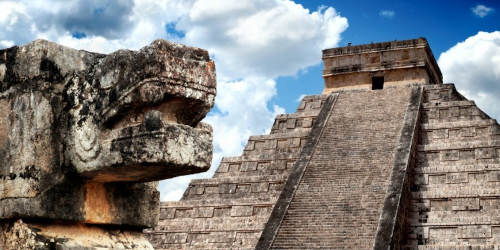
1. The history of the peoples, say the Maya, the Incas and the Aztecs, comes fr-om material “records”, not based on fictions, their ideas of the time that we re-ceive through “telepathy” or other immaterial means, but through sustained physical realizations of their imaginations of the time. The goals of the above formulas are, naturally, the separation of the sustainable from the unsustain-able, the essence from the method. It is puzzling that science has not yet delv-ed into these areas, and we think it never will.
When we say that reality is the totality of the present and the past, then it is unknowable in the absolute sense, given all that forensics, archaeology and the study of the past can give us. I consider this a kind of confirmation of these principles. Moreover, not only can we not see absolute reality, know absolute truth and generally perceive absolutely everything (of anything), but such things objectively do not exist. That is why perceptions (of anything) are unique (Riesz Lemma). There is no absolute point of view, and what cannot be, or cannot be perceived, is not real.
2. Perceptions are finitely divisible (Packages). A property of infinity is that they can be their own proper subset. For example, in the set of natural numb-ers there is a proper subset of its even numbers, both cardinalities ℵ0, counta-bly infinite. Hence, only for finiteness can conservation laws apply. On the ot-her hand, we do not have two equal pasts, from which it follows that our perc-eptions of history are of finite depth. Again we are talking about the Big Bang which, let's say, earlier because of the "black box" of the Markov chain, I con-sidered an "illusion" (the kind that is not easy to expose). Now we should add another interesting fact to this.
A limited perception of the past and a limited perception of reality are two ag-reements, and this is a good sign for the correctness of this theory. We assume that deductions applied to truths are continuous flows, so that truths agree wi-th other truths, unlike untruths, which are constantly contradictory. Untruths are unfinished truths, and fictions are unfinished realities, so much so that we can test truth by mapping it onto reality (Packages III), among other ways. It is not always easy to find a contradiction in a lie, which we claim here to be certain, which can be a measure of its plausibility (false truthfulness).
3. In a way, our memories are miniature worlds (Memories) of the reality of the great universe. We remember memories that we change every time we re-call them, which means that memories behave like objects (always of different perceptions) from our fictions. However, what we remember is a combination of our vitality and physical reality, and this imitation also contains a part of imagination, the presence of the theoretical in the concrete. If this were not so, we would claim that our memories are all of reality, so much so that they can last independently.
For comparison, gravitational memory is something else, I believe. It goes alo-ng with the thesis of space memory which has a proven side in addition to the one mentioned (the action of gravity from the past to the present), still hypo-thetical. Space is a kind of container of the past. The further away objects are from us, due to the finite speed of light, c ≈ 300,000 km/s, what we see is not their present, but the more distant past. If we travel to the place of observati-on, it is again not that present but a new, then future.
4. The present itself without a past, therefore, is a fiction. However, since news after its announcement, say the next moment, is no longer news and stale inf-ormation has no initial uncertainty, every reality is a set of fictions and repeti-tions. Thus we come to the given question of formulas or constant repetition. We enter into the anatomy of the “news” itself, which therefore also has an abstract form without an emphasized part in interactions. As with the laws of large numbers, or the more frequent outcomes of more probable events, news realities also depend on a (no doubt still unknown) lawfulness that forces th-em to repeat themselves in such a way that the reality they represent survives.
I note that according to this theory, laws (of nature) are also information. In particular, information travels in packets, or quanta (ΔE⋅Δt = h) that contain the change in energy (ΔE) over time (Δt). But information of longer duration is more attractive, so the universal, or all-time ones are the most attractive — to those who can communicate with them. Such are laws. By their very ubiqu-ity, regularities are reality.
Infinity IV » srb
Question: Is there infinity?
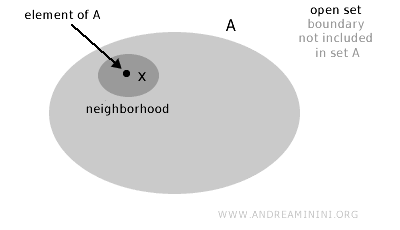
Answer: Infinity exists, I suppose. When you manage to prove that infinity is contradictory, let me kn-ow, and before that I have another question: is infinity also real? The answer to the latter reminds me of the total space which is both an open and closed set.
Namely, reality is what lasts, and so is infinity, if it exists, and yet the law of conservation (of quantity) does not apply to it. By definition, it can be its own proper part. For example, for the sets of natural and integer numbers we have: ℕ ≠ ℤ ∧ ℕ ⊂ ℤ ∧ card(ℕ) = card(ℤ) = ℵ0. Incidentally, we note that Cantor (Georg Cantor, 1845–1918) long ago pointed out that infinities (he found them distinct) cannot be reduced to contradictions, and today's mat-hematics accepts this.
1. For infinity, we cannot define a law of conservation of quantity that would justify its duration (Infinity III) and we cannot consider it real. This is in acc-ordance with the intuitively known impossibility of perceiving truly infinite quantities. On the other hand, we understand infinity (in mathematics), we perceive it and we cannot reject the possibility of its existence. This is one way of looking at this problem. Another is to take into account that mathematical spaces are both open and closed, and to treat infinity similarly as a pseudo-reality. We perceive it just like the laws of mathematics (by reasoning), it ca-nnot disappear (it lasts), it is exact, and therefore it is even more actual than pseudo-real. A difficult question, for now.
2. The second part of this topic is reality, which itself is not infinite. If it were of infinite duration, for example, it would be pseudo (false), which would equ-ate it with the previous one. However, the existence of physical reality depen-ds on the observer and it is a special kind of existence. We perceive it, but each of us in our own unique way. Let us recall the theory of relativity and the law of conservation of energy, which tolerates current differences well there. This may be just another addition to it (in addition to gravity), that is, general rela-tivity is just a special case of the relativities of the observers.
3. The black boxes of Markov chains, which I have previously discussed and often returned to (Overpower), in their own way "rescue" the idea of the fini-teness of reality. Namely, looking from the present with steps n = 0, 1, 2, 3, ... towards the past, the state x has the form xn = Mnx → M∞x = x∞ when n → ∞, where M is a linear operator, or a stochastic matrix, a message carrier, M∞ is a black box, and x∞ is the state from the "beginning of time". Before that, it is not possible to know anything, because every message is mapped by that long chain to that same state x∞. Moreover, due to finite divisibility and uniquene-ss, that black box also occurs after a finite number of steps.
4. There is no end to the wonders of the universe of my theory of information, but that does not mean that it is incorrect. Infinity is not just an abyss of pseu-do-fiction without any duration, but is also described by oceans of such conne-cted events. If we recall other dimensions of time, also pseudo-events, probab-ly inaccessible to us, but consistent as our current ones. Namely, let's say that a fair die was thrown and a "six" fell (probability 1/6), and we would expect all numbers except that one (probability 5/6). A less probable event occurred, but even then "more frequent is more probable" does not mean "it is necessarily the most probable", and secondly, in some "parallel realities" the outcomes were other numbers. In these "realities", however, the laws apply as in ours.
Sixth Sense » srb
Question: You never mention the extension of the present into a future resem-bling the past. Why is that and is there such a thing?

Answer: Wisdom of the crowd, wh-ich is based on the theory of the vi-rtues of the multitude where the author, Surowiecki (2004), assu-mes that a group judges smarter than individuals, even before indi-vidual experts on a given topic, is part of these stories on several occ-asions, with additions that will be made here as well.
Secondly, the past partly directs the present; it takes over parts of its information, depriving it of options and thus traces the future. On the other hand, here we consider information about the objectivity of chance and the principle of minimalism (where the more proba-ble is realized more often) when we do not reject unlikely and therefore rare outcomes from the future into the past. With all this, we are living beings with vitality that adds options to us, but also disinforms us (Honesty), so it is not easy for us to follow the "most probable" path, i.e. the principle of least action of a dead physical substance.
1. We know that we humans, by "random" enumeration, by choosing numbers from memory, almost never achieve a coincidence that would be confirmed by tests of statistics. The reasons are the bias towards our previous experiences, which also comes from the principle of minimalism. The brain loves familiar paths, it would mostly like to avoid uncertainties and unlikely events, but alas, precisely because of our vitality, these easily become "deviations" (outside the principle of least action of physics).
We easily adopt the first, new, early or exciting news about something, which then becomes our preferred (favorite) “understanding” of the topic. Manipula-tors of public consciousness regularly use this, throwing a topic at us that we will defend as our own as the first knowledge, even engaging in conflicts with others who would dispute it. This happens to us all the time, even unintentio-nally, that we fall into delusions and fail to recognize the truly random course of physical reality.
2. We go through real natural events around us with random trials that would really pass statistical tests of chance, but we cling to some and fall into prejud-ices. Therefore, the power of reasoning, or the perception of reality of indivi-duals is not the best even in the case of experts in their fields, but when we have an average estimate of the multitude from a crowd of independent indivi-duals, such an estimate can coincide with the average value of reality (Means). Wisdom of crowds then appears, when the subjects are not subjected to the directing of consciousness typical of populations subjected to politics, marke-ting today, or other experiments on the consciousness of the many. Individua-ls in such controlled crowds are often unaware of their unconsciousness, that some of them will defend their prejudices at all costs.
3. However, there is also a small percentage of individuals who are resistant to "brainwashing", in various ways. These may be antisocial types for whom we colloquially say that "they won't even what they want", or simply that they are "anti-anti", referring to the affirmation of negation. French virologist Luc Mo-ntagnier, winner of the Nobel Prize in Physiology or Medicine in 2008, as an opponent of the world hysteria surrounding the corona virus (COVID-19 virus, 2021) ridiculed and accused by powerful pharmaceutical corporations in des-pair, fighting against the prejudices imposed by them, allegedly stated that "anti-vaxxers will save the world".
Even when they are “resistant”, such individuals are rarely immune to more than a few types of mass hypnosis. Moreover, they can easily fall into other delusions, perhaps even greater and more dangerous, and they are not even some leaders of humanity. Such major mistakes can also be made by people with an “open mind”, which some want to achieve through meditation, others through special exercises for good judgment and creativity, and still others by engaging in science, so by trusting them in the main area we deepen our illusi-ons in another, when the harm can cancel out the gain. In this group, I suppo-se, are people who have a “sixth sense”, who can simply read the spontaneous flow of nature, its real coincidences, more successfully than many.
4. Einstein is credited with saying, "The definition of insanity is doing the sa-me thing over and over again and expecting different results," but whoever said it, that's what a good mathematician could be. Namely, the ability to qui-ckly abandon a "bad" or unproductive idea and move on to a new one is often considered a key skill and habit of effective mathematicians. It is acquired through training and is part of the "growth mindset" needed to solve difficult, new problems where the solutions are not immediately obvious, and not an innate talent. If this is true (findings from recent statistical psychology), then it makes sense to learn to avoid prejudice. The only question is for what, bec-ause many will say that being in love with an idea is the most beautiful thing that can happen to us, it is having a purpose, a reason to start a new day.
Truthfulness » srb
Question: Are you saying that the “truthfulness” of a falsehood is greater when it is more difficult to refute?

Answer: That's right. The harder it is to prove a falsehood, the "more true" it is. If you're serious about Gödel's impossibility theorems (1931), then we don't have any better definitions of truth. These theorems establish that a consistent (correct) system is not complete (there is always truth outside), nor can it veri-fy its own consistency. So, if mathematics itself cannot prove its own truth, what better hope do we have?
1. Let us understand mathematics as a puzzle, a game of searching for items that are consistent (non-contradictory) with everything else already found. It has been going on for a couple of millennia, with rare individuals adding pie-ces to it over generations, trying to surpass all their predecessors. We are su-rprised by its ability to be built into a consistent whole, such that no part con-tradicts any other part, and on the other hand, its coincidence with physical reality, and then we declare the equality of these two “worlds” that is so per-sistently offered to us. I am talking about equivalence, not about “essential” equality that perhaps cannot be seriously considered.
2. It makes sense to say that mathematics is also a dogma, but then it is a dog-ma that has no equal in internal logical consistency and external agreement with physical interactions. The coincidence of these two wholes, its content and external reality, then the finitude of the universe, and because of the ass-umed information as a fabric of space, time and matter, imposes the idea that there is no absolute truth. What about a truth "greater than reality", if it exi-sted, where would we find it, and where would we then insert it, when it does not fit anywhere in what we are talking about? This "information theory" is an attempt to dispute such a thesis, at least that is how I imagined it at the begi-nning.
3. My (hypo)thesis about the limitedness of reality, since this "reality" is with an increasing cosmic duration from the "Big Bang" until today (about 13.8 bi-llion years), and which predicts globalisms of such processes, it is formally pe-rsistent throughout all such discussions. We also have its continuations, for example, in the interpretation of various statements (affirmations and nega-tions) of independent axioms that would be false in this universe, but not in some other pseudo-physics. The accuracy of some mathematics thus extends again to the accuracy of some other "reality" which we can still assume to be as sustainable in some "world" as ours, or as the corresponding mathematical theories, are sustainable.
4. Here we also have the interpretation of falsehoods as smaller concentratio-ns of truths, or disinformation as less valuable information, and even the con-sequence of the principle of minimalism in the attractiveness of inaccuracy. Lies and false information spread much faster, deeper and wider than truth via social networks. The mathematics is therefore less interesting, but more reliable than other dogmas, because it has a foothold in longer periods (at least until the Big Bang). As less attractive, it is also a rough measure of the amount of lies or truth (Packages III). I also see this as confirmation of the basic idea, that the "truthfulness" of a falsehood is greater when it is more difficult to refute.
Life is Miracle » srb
Question: Is life a miracle?

Answer: We often look at life with wonder because of the countless va-riables that had to coincide for the universe to support it. The vast co-mplexity of life's existence, from simple nature to human consci-ousness, seems like a profound mystery.
On the other hand, the developme-nt of science usually shows it as a destroyer of mysteries, so the que-stion arises whether such a thing will happen again. This information theory has a special, additional insight into the spontaneous beginnings and develo-pments of life, using the principle of minimalism in seemingly absurd ways.
1. The Fine-tuned universe is a hypothesis that, since "life as we know it" could not exist if the constants of nature—such as the charge of electrons or the gra-vitational constant—were even slightly different, it is the first great mystery for science to begin to answer.
With this theory of information we mean information that creates the fabric of everything, and with uncertainty its essence, so differences are already impli-ed by that. However, these differences are infinite, not only of the subjects of our universe (Riesz Lemma), but also of such parts of the cosmos that we are unable to comprehend.
We assume infinite different forms of existence, among which “strange” sepa-rations can arise “realities”, viable islands of parallel pseudo-realities similar to us, one of which is this form of ours. The generally unstable appearances of parts of those infinities are filtered out and trapped in the form of existence as we know it. We are not a miracle, but a necessity of chance from a vast multi-tude of possibilities.
2. In addition to diversity, another important assumption of information, esp-ecially uncertainty, is that not everything communicates with everything. That is why it is possible to cut off finite parts from infinite divisibility in order to extract its sustainability. Then, by choosing the smaller one, we can also reach the “compound effects” of negative phenomena, or the “accumulation effects” of our habits. These small, seemingly insignificant decisions to avoid proble-ms, postpone unimportant things, or use shortcuts, multiply over time into a major crisis. Of course, a single small action can activate a major consequence, like a mine detonator, and cause irreversible processes.
3. Synergy (Greek: συνεργός — to cooperate) is a familiar concept for the state of a whole that exceeds the sum of its parts and becomes different. Similar to this is emergence, when properties of an entity arise that its parts do not have by themselves. Both of these phenomena are predictable (explainable, calcula-ble) here by the theory of information perception. Simply put, in a universe of information that disappears as soon as it arises, and by some "miracle" repeats itself and persists, nothing is ever the same. Protons, which we consider very stable and describe as "practically immortal" in everyday physics, are not exa-ctly indestructible, and I am also referring to the coupling of a subject with an object. The wider environment is constantly changing.
In the multitude, by redistributing components (Synergy III), it happens that the whole acquires a subtlety of perception below the capabilities of its simple parts. This is a theoretical story about possibilities, not about the construction of, say, a biological cell. Its increased power of perception, in this sense, mea-ns communication with larger lies, i.e. smaller information, and (additionally) increases vitality. So somehow, through complication, the living emerges from the dead, and smaller cells evolve into more complex tissues and larger living organisms.
4. We believe that the Earth formed about 4 540 to 4 600 million years ago, and the earliest undisputed fossils of the first forms of life on Earth, known as stromatolites, date back to about 3.5–3.6 billion years ago, which is a billion years later. Then another billion years passed before cyanobacteria with a type of photosynthesis that releases oxygen appeared, and then evolution accelera-ted, life became larger and more complex. Humans (Homo sapiens) appeared in Africa about 300 000 years ago.
The first alphabetic letters appeared around 1850–1900 BC among West Sem-itic language workers in the Sinai Peninsula and Egypt. With Thales of Miletus (c. 624–c. 546 BC) the development of geometry began, and it is generally bel-ieved that the development of physics began slightly later, but this is far from what physics discovered on the eve of and during the 20th century. This deve-lopment accelerates the development of technology (nothing is as practical as an accurate theory), so it begins first as a one-time miracle, then the increasi-ngly rapid development of computers, then artificial intelligence. It took billi-ons of years of evolution of life on Earth to develop intelligence in our form, so rare is this process, and then we skip biological development and very quickly rush into technological improvements.
5. The development of technological intelligence is beginning, which I believe may eclipse biological evolution in its speed and scope. It will happen in ways we will not predict, and in ways we can no longer even comprehend. Like wor-ms to humans, we will become to a future world of machine intelligences who-se arrival we cannot stop. Unlike biological species that seek warmth, machine vitality may prefer the cold and darkness of the deep reaches of space, far from the stars and beyond the galaxies.
The Fermi paradox highlights the absurdity of the high probability of extrater-restrial civilizations—given the hundreds of billions of stars with planets in the Milky Way—and the complete lack of evidence for them, which is summed up by the question posed by physicist Enrico Fermi in 1950: “So where are they all?” Despite the potential for life, we have not found any signals or signs of colonization. Perhaps the answer lies in the self-destruction of all paths of biological evolution and possible artificial intelligences that are not among the stars, nor can we communicate with them, or do they have no reason to make such contacts? Namely, the development of life on Earth so far seems as if this Universe is set up for just such. At least that's how it seems according to this information theory.
Subjective » srb
Question: What do you now consider the difference between subjective and objective uncertainty?
Answer: Objective uncertainty refe-rs to unpredictable and future eve-nts (say, flipping a coin), but subj-ective uncertainty is personal expe-rience or what comes from not kno-wing the facts. That's what those who know say. Objective uncerta-inty is the essence of the situation, and subjective uncertainty is a matter of the receiver's information limitations, or their cognitive limitations. I believed this many years ago, and chose the "objective" uncertainty of this information theory, to see what would happen and expecting to be able to dispute it more easily.
1. In the small world of physics, at the quantum mechanical level, every inter-action is a huge collision for the participants, so to “see” is to disrupt what ca-me before. This is essentially Heisenberg’s (1927) uncertainty relation, Δx⋅Δp ≈ 6.626 × 10⁻³⁴ m² kg/s, where Δx ≈ λ is the uncertainty in the position of the particle we are observing and is approximately the size (λ) of the wavelength of the light we are observing it with, which is the reciprocal of the momentum (p) of the light λ⋅p ≈ 6.626 × 10⁻³⁴ m² kg/s. Here is Planck's constant (h). This means that for better positioning (smaller λ) we invest more momentum (p).
Similarly, Δt⋅ΔE = h, with the determination of the moment Δt ≈ τ = 1/f the energy ΔE ≈ hf of the observed particle changes. In order to illuminate the particle in the shortest τ, as precisely as possible, we spend more energy hf and the more uncertain, for ΔE, the new energy of the observed particle is. We now see three important consequences in this observation. If we still insist on distinguishing the subjective from the objective, then nature is so finely order-ed that it must simulate chance down to the smallest detail. Third, the transfer of information necessarily involves changes in energy, time, momentum, and position. Let me explain.
2. The uncertainty principle, often expressed as Δx Δp ≥ ℏ/2 (where ℏ = h/2π is the reduced Planck constant, and h is Planck's constant), implies that nature imposes a fundamental limit on precision, not a limitation of the measuring instruments. It then behaves according to probability theory, which is very precise in its responses and therefore difficult to simulate.
For example, when we toss a (fair) coin n times, each of the two possible out-comes is either "heads" or "tails" with probability 1/2, and the mean of the "heads" (and also "tails") is μ = n/2, while the variance is σ² = n/4, hence the dispersion σ = √(n)/2. So, when we toss a coin n = 100 times, we expect the "heads" to come up 50 ± 5 times. By repeating, the representation of the ex-pected outcome will walk along a certain distribution in this interval (45, 55) so that imitation (like hthhtthhhttt...) in more of these repetitions will be more and more clearly revealed as a fraud. Nature is perfect in this consistency and we cannot easily imitate it by heart. Moreover, algorithms that generate rand-omness are more difficult tasks for programmers.
3.We know that we consist of molecules and atoms, but that then means that we are also made of their parts, of superpositions of waves. The reality of large bodies, their states and processes, is actually the interference of various waves that, broken down to individual events, represent “unread” and objective unc-ertainties. Objective “reality” is a multitude of objective incertitudes. Hence, the separation of subjective from objective uncertainty makes sense only in the macro-world, and that then means that we live in the illusion that it is an objective separation. The multitude of interactions that the parts of a larger body have still does not mean that they are not built of “fictions” in their deep nature. Sustainable phenomena are built on unsustainable ones, and "subjec-tive" uncertainties are, at their deepest level, objective coincidences.
4. For better detailing, we need to add energy. That is, just dragging informati-on out of uncertainty, for the collapse of superposition, or the transition from greater to lesser uncertainty — we spend energy. We can also talk about positi-on and momentum in the same way, anyway, physical information is insepar-able from energy, not in the way equivalence of energy and mass E = mc², but almost an equivalence where energy is part of the information packet (and du-ration is part of it). We have to give something to get something, physical in exchange for information, and infinitely much for infinite clarity (i.e. Δt → 0 when ΔE → ∞), so this clarity is impossible to have, as is the speed of light for bodies with mass (in the theory of relativity).
Randomness II » srb
Question: You say that generating randomness with algorithms is hard work, how come?
Answer: Randomness is the absol-ute absence of form, which, viewed differently, is itself a very strictly defined form but with a negative sign. It sounds absurd, but it des-cribes the intricate randomness well. And this continues the older article (Randomness), a little dif-ferently.
Kolmogorov (1960) defined the "complexity" of something by the shortest le-ngth of the recipe, or algorithm, that would be needed to produce it. Here we define the "truthfulness" of a lie as the shortest deduction that leads to a con-tradiction. The complexity of a number thus becomes the length of the simp-lest computer program that can write it. For example, the sequence 01010101-01010101010101010101 is reduced to "10 times 01", but the sequence 010001-01000011101001 does not immediately recognize a similar rule, so we have to remember it in its entirety (from the link in the image above left). There is no recipe for randomness. This is one of its main properties that recommends it for creating secret codes.
Randomized passwords, especially when they are long and use a combination of characters (letters, numbers, symbols), as well as unrelated words, offer the best protection against brute force attacks. Unpredictable strings make it very difficult for hackers (computer fraudsters) to decipher the text using dictiona-ry-based methods. For example, random passwords are not affected by perso-nal data analysis. Random text generators can be, say, decimal numbers of the number π = 3.14159... which at first glance are random, but on second glance we see that they are completely non-random. A larger energy input ΔE will open up a narrower time frame Δt, a window into precision, according to the uncertainty relation ΔE⋅Δt = const, and once you have the information, it stays with you. However, infinite energy (ΔE → ∞) is required for infinite knowled-ge (Δt → 0).
To make it harder for hackers, you could use, say, decimals of the number π² = 9.86960... or the root of that number √π = 1.77245..., but these are weak defenses against those who have been cracking for a long time. The Vigenère encryption method is a significantly higher level of protection, based on two levels. First, you shift the letters of the alphabet by, say, three places, then assign the nth letter to n+3 letter, and so on, and this step is called Caesar ci-phering. The second level involves a key, a word whose letters define Caesar ciphers and which will dynamically change the encryption of the text. The Vigenère code was considered unbreakable until it was noticed that (in each language) some letters appear more often than others, which is a clue that leads the masters to deciphering it.
I analyzed various texts (Letter Frequency) to check that the meaningful text has less information, with the consequence here that it takes the greatest amount of energy (ΔE) to decrypt the random information. These were also encrypted texts alongside the original, where it can be seen that even the Vigenère code does not reach the maximum and leaves a (thin) entrance for hackers to decrypt. Similar small windows for burglars are also hidden using factors of huge numbers, which are becoming longer and longer due to the advent of ever better computers. The best password requires maximum uncertainty, but it is practically impossible to have such a controlled one.
In this information theory, the difficulty of achieving randomness stems from the principle of minimalism, from nature's spontaneous tendency toward gre-ater probability, less information, less communication, less action, and gener-ally less change. Ultimate rest, or the immobility of all particle-waves, is impo-ssible, and neither is generated, controlled by someone, maximum uncertai-nty. That would be a contradiction in the very definition of the term. That's how hard work generating randomness with algorithms is.
Dates » srb
Question: Do you know of any moderately difficult way to encode passwords with numbers?
Answer: You can use dates, it's a common practice, so avoid widely known events, such as national holidays, but also family birthdays. It's best if these are dates known only to you.
1. For example, the date May 18, 1957 was the 138th day of that year. The Python (3.13.12) program is:
# Specific date: May 18, 1957
date_is = datetime(1957, 5, 18)
day_of_year = date_is.timetuple().tm_yday
print(f"Day of the year: {day_of_year}")
# Output: Day of the year: 138
Such a number, say a four-digit number 0138, can be used as a "light" code in places where such codes are convenient. See dates in the codes.
2. The number of days between two dates is found by the program:
from datetime import date
d1 = date(1957, 5, 18)
d2 = date(2026, 4, 8)
delta = d2 - d1
print(delta.days)
# Returns the integer 25162
You can manually enter other dates as they are listed here, but a slightly more general module would look like this:
def brdana(d1 = "1957-5-18", d2 = "2026-4-08"):
    from datetime import datetime
    date_format = "%Y-%m-%d"
    datum1 = datetime.strptime(d1, date_format)
    datum2 = datetime.strptime(d2, date_format)
    delta = datum2 - datum1
    broj = (datum2 - datum1).days
    return broj
Do you call this module with:
d1 = "2025-4-8"
d2 = "2026-4-8"
b = brdana(d1, d2)
you will get a printout:
365
This is how many days have passed from "2025-4-8" to "2026-4-08", from today last year to today (April 8, 2025-2026). The more "random" the number of days between the dates (to the hacker), the better it is for the owner's pass-word. From this example, the differences between the same dates in different years, we see that here too it is easy to make a mistake due to the easy observ-ation of the number of days in the year.
3. The number of days in a year, 365 = 5⋅73 or 366 = 2⋅3⋅61, is not good for hi-ding anyway, because it is easily broken down into factors that can be a clue to a clever decoder. In various other cases, using the number of days between two dates to encode data (time duration) is a powerful technique for convert-ing complex timestamp data into numeric values suitable for analysis, machi-ne learning, and business logic.
For example, at some seminars (as a leader, participant, or project developer), I used to write down the number of days of their lives in the participants' file. When they showed up at the next meeting, I would have the exact date of their seminar, much to their astonishment or at least a comment like "you have an incredibly good memory," which I don't have. If some day was date1 and you have a certain number of days until the next date, or date2 = date1 + number. You can use the program danabr to find it.
4. Another example. I once created a local Wikipedia in three languages for student work, so that they would just tell me "on such and such page I left such and such an attachment", optionally for the sake of maybe better grades in math, but also for a more closed page like this blog. I assigned the number of days from opening the website to a given attachment as code. If that were the first date of this blog and the second date of today, the Python program would be:
from datetime import date
datum1 = date(2002, 1, 1)
datum2 = date(2026, 4, 10)
broj = datum2 - datum1
print(f"Broj dana: {broj.days}")
# Broj dana: 8865
Knowing the starting date, January 1, 2002, and the code 8865, the inverse is:
from datetime import date, timedelta
datum1 = date(2002, 1, 1)
broj = 8865
datum2 = datum1 + timedelta(days=broj)
print(f"Drugi datum: {datum2}")
# Drugi datum: 2026-04-10
The date of the attachment is April 10, 2026 (today's date, it's made up). There were also publications on the same dates when I would extend the code with the letters a, b, c, ... of the alphabet. Whenever I asked anyone back then what they meant by "how do I guess the dates of these publications", they didn't know. However, it's still a moderately difficult way to hide with a number. Storing information in code is as risky as it is useful.
Halting » srb
Question: How much "time" does it take to crack a password?
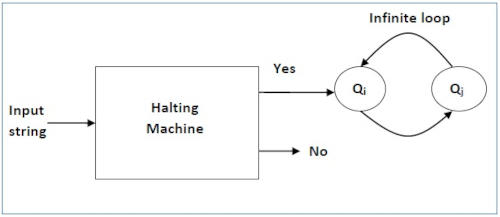
Одговор: When the time is suppos-edly counted and the number of st-eps, processor clocks, number of attempts to find a solution to the task, and the like, then it is a gene-ral problem that is proven in math-ematics to have no solution. This is the halting problem solved by Alan Turing (1936).
The assumption that an algorithm is possible that would decide whether a pr-ogram will terminate or continue to execute indefinitely was contradicted by Turing. In practice, we follow Kolmogorov (1960) who defined the “complex-ity” of something by the shortest length of the recipe and algorithm that we would need to produce it. Generalizing this again creates Turing's impossible task, where we have idealized both hackers and those who prevent them.
1. In the video Turing's Proof you will find a description of the contradiction (also in the link to the image above left), but also some interesting modificat-ions of the view that a magic program (in the video halt.exe) predicting a halt cannot exist. Namely, if there were a halt algorithm for the original order that would accurately predict whether it would block or run indefinitely, then there would also be a rebel.exe program that would unblock it in the case of a block-age but block it in the opposite case of infinite operation. These two could be parts of a larger program paradox.exe, the video states, which would simulta-neously run and block the original source. That is the contradiction and the magical program like the imagined halt.exe cannot exist.
2. This is true for nature, which has access to infinity, but not for us and other subjects of the universe who live in its realities. Technically, this limits any password we would set to finiteness, while nature itself is infinite, so any of ours can actually be cracked by some method somewhere. If we had access to “absolute truth”, which we do not have (Randomness II), we would also have “absolute protection” from hackers, which we also do not have. We do not have “absolute” knowledge of how long a given program will run and when it will block, just as a microwave oven cannot tell us exactly how much more time it needs to process the food it has put in to the ideal temperature. Let us note how much this Turing theorem has in common with Gödel's impossibili-ty, or with Russell's paradox of the set of all sets (Sufficiency), all three of wh-ich in their own ways speak of our limitations in natural unboundedness.
3. Also watch the following video, Understanding, which takes a closer look at the halting problem, a big question in computer science for anyone interested in whether we can construct an algorithm to determine whether a computer program will run forever. It's the same proof, that there is no program that predicts halting, the same contradiction, but since repetition (variance) is also part of learning and understanding, perhaps you'll get the point of the proof with these Halt and Opposite programs.
Let us assume that there is a first program H that predicts the computer to stop. But then it is also possible to define a program O, by reversing the deci-sions of the first, which will continue the stop and stop the continue. Then we will connect these two programs so that we get a computer that is unable to predict the stop. So, starting from the statement that there is always a prog-ram that predicts the computer to stop, we have constructed a (connected) program that contradicts such a statement, thereby proving that the statement is not true. There is no decisive decision about the computer to stop.
4. If we were to observe a particle in a time interval less than Δt, we would need light energy of at least ΔE, where their product is of the order of Planck's constant, Δt⋅ΔE = h. More detailed observation requires ever greater energies, so that for absolutely precise peeks, through apertures of zero width, we need infinite energies. This is a story I have been repeating for a long time, that in-formation itself transmits energy, that is, that we need energy to obtain it in order to overcome the uncertainty from which it collapses, which it hands over to us.
The greatest uncertainty is associated with completely random events (if we know something will happen, and it does, then it was not big news), and that is why generating randomness is a difficult task (Randomness II). With this knowledge, we understand that breaking a more random code requires more effort, more process steps, and in this sense more "time", meaning energy and other investments. For the same reason, we understand that obtaining absolu-te randomness is not an option for us. A higher level of randomness than pre-vious dates, for example, would be the use of meteorological phenomena, dir-ect coin tossing, and counting the outcomes. Any phenomenon that we would come up with is inevitably less random, just like the letters of a meaningful text compared to random ones, and thus already damaged compared to the infinite concealment of pure uncertainty.
Avoidance » srb
Question: Did you know that many bloggers try to hide the publication date completely?

Answer: Yes, because most of the texts are about little lies, which are fun. Here I am making (by definiti-on of that new theory) repulsive in-stinctive observations about infor-mation. Moreover, they mostly talk about forms in the way that math-ematics gets better with age.
1. Keeping some date-based work can be useful (Dates), not only in bookkeeping, but here it is especially instructive that you read answers to a si-milar question in the same place from a long time ago and recently, to see if it is true. In this, "truthfulness", as well as "reality", are defined by duration. For example, in the answers from 2021 (Liquid) you will find the sentence: "I will repeat, the present is evolving towards more probable states, which means less informative (principle of information minimalism), which in translation mea-ns less free, more legalized. The excess of the law is the lack of uncertainty, the lack of action and in general the lack of what we would call aggression in a broader sense." You will find such or similar (paraphrased) years ago as well as today. That is the power of truth, that it always awaits you, as a friend or an enemy, depending on whether you love it or not.
2. By repeating the experiment, the law of large numbers begins to act as one of the answers to the principle of minimalism (the tendency towards more probable, less action and less informative), so that nature "sweeps under the carpet" all the excess uncertainties it can when it does not know what else to do with them (Accumulation). The influence of "parameters" on the main variables is decreasing, so reading older texts resembles a reconstruction of the past. Not only metaphorically, but we also have this phenomenon in the actual course of the present and its past sediment.
3. Consider the “present” as a vehicle traveling into the future, leaving a trace behind. Forms of energy (heat, movement, our soft tissues, emotions) are lost, but records of reality remain. Everything that endures and that we find by dig-ging into the past was real, and more or less fictitiously fading. Seen in this way, the present is like a micro-population, and the growing past is its expre-ssion of “large numbers.” By filtering out the more permanent from the impe-rmanent states, the past teaches us about reality and truth. This is instructive in chronologically ordered texts that claim to be true.
4. We have to lie to get past reality, to sail from its island to another, or just to be attractive to others (Traits). If we look closely at the present, we find that it does the same. It only chases what it likes, and reality filters out and remains behind it. Silently coding dates, with the number of days between (Dates), is the message "I am writing as the present," and highlighting dates would be a kind of arrogance, the message "I am telling the truth." Who can know what "truth" is among us concrete subjects who live in finitude itself, who are uniq-ue because we are not unlimited. And, as you can see, I agree with the critici-sm that I should either hide dates altogether or cover them up. I will do something about that.
Simultaneity II » srb
Question: You have an unusual concept of the present?
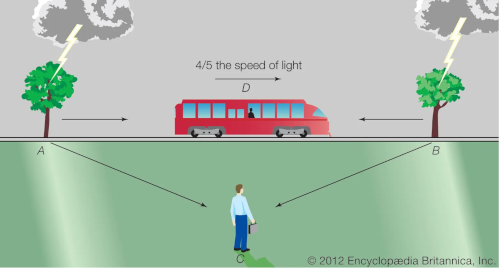
Answer: With the discovery of the relativity of simultaneity (Simulta-neity), from Einstein's (1905) trea-tise, everything that moves differe-ntly sees the present of others diff-erently. Light that radiates concen-trically from a center creates simul-taneous spheres whose parts are not seen by observers as simultane-ous. Two treetops, in the picture on the left, when struck by lightning at the same time from the point of view of an observer on the grass, will not be simultaneous events from the point of view of a passenger on the train. By the time the lightning reaches the compartme-nt, the train has moved forward and the passenger sees the flash ahead first. The simultaneous events of one participant are not in the same present as the other.
1. When we have a singlet, two particles that are simultaneous while moving apart (quantum entanglement) are in sync for themselves, but not for other subjects. They exist at different moments in time for other observers, so an action on one that creates a simultaneous action on the other may appear to other observers as "phantom action at a distance." And we have many such entangled states around us, for which the interaction of one part means int-eraction with all the other parts of that whole. All this is so familiar in quant-um mechanics that it is not "my concept" of the present, when we look closer.
2. Actually, quantum entanglement is not known as simultaneity, it will be, but the real question here is why we don't have more of them. Interactions are extraordinary phenomena, because superposition spontaneously (by the prin-ciple of minimalism) collapses (declares itself as a particle) into more probab-le states, less informative. This is why the greater the entanglement, in which declaring one part means declaring all, the more probable it is. The more of them there are, the more chance of someone interacting and the whole disa-ppearing. Another reason is that old news is "repeated" by changing.
3. All these pieces are connected into a single (vector) state space by the subje-ct, and each independent state that it can observe participates in the stretchi-ng of the whole space (Lineal). This linear combination of independent states (vectors) contains a multitude of simultaneities that are parts of the same physical reality, like vectors of a vector space. I call the surpluses "pseudo" (false) realities until (if) evidence of their physical existence appears, but I also call them "parallel realities". Thus, islands of simultaneity exist in a single connected reality and participate through events relatively to observers. I call only reality that which lasts, which is observable (if A exists for B, and B for C, then A will exist for C) and true.
4. After the mentioned, more or less verifiable properties of the present, the question arises whether the "journey" of the present through events is "recti-linear" (whatever that means) and why. It can formally be like the orbit of a planet around the sun (Evasion), despite global convergence, and yet it does not have to be like the visible universe that appears to be approximately flat (Euclidean) space despite the curvatures due to the gravitations of planets, stars and galaxies. I would leave that problem for later, because the curvature of the path of time would mean an even deeper illusion of the past.
Freezing » srb
Question: Why does changing part of simultaneous events affect all of them?
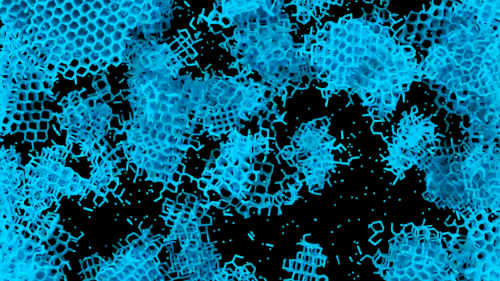
Answer: Let's try to take this as a condition of "simultaneity", but it should also be explained, with ex-amples from our lives.
1. It can be observed that water in the refrigerator will remain liquid in a full, sealed bottle until the bo-ttle is opened. Water is densest at 4°C, and around that temperature it begins to expand. The surround-ing bottle prevents it from expanding and freezing (liquid water is incompre-ssible), but when you lower the temperature a little, the water will freeze, or you poke a hole in the bottle with a needle and it will freeze. This freezing of all the water, when the pressure on one part of it is relieved, resembles the collapse of superposition.
2. Pure, distilled water in a clean, pristine container can remain liquid well be-low freezing point (0°C or 32°F) because it lacks the impurities (nucleation si-tes) for ice crystals to form. This metastable state, called supercooling, can be maintained below about -40°C (or -48°C in some experiments) before it turns into solid ice, see image link above right. This supercooled liquid looks like water, behaves like water, but if you drop even the smallest particle into it, it will all crystallize into ice at once.
3. A third example is the general nucleation of bubbles, the process by which small gas bubbles form within a liquid or on surfaces when the liquid is super-saturated (e.g., soda pop) or superheated (e.g., boiling water). It occurs by two main mechanisms: homogeneous nucleation (within the liquid mass, rare) and heterogeneous nucleation (on surfaces/impurities, common). Namely, heating a liquid above its boiling point requires nucleation to form vapor bu-bbles. Also, releasing pressure on a carbonated liquid (such as by shaking a soda can) forces dissolved CO2 to form bubbles. Such a bubble must reach a certain "critical radius" to survive; if it is too small, it collapses. Such pheno-mena are known in engineering (nuclear reactors, heat exchangers) and pr-ocesses such as volcanic eruptions.
4. We can go on to list many more similar concrete examples, including mode-ls such as a fair die whose Hartley uncertainty before rolling was log 6, as well as the information of the outcome of each of its six numbers, again log 6. The same happens with the outcomes of each of the n ∈ ℕ independent probability possibilities p1, p2, ..., pn whose Shannon information is equal to the informa-tion of the prior distribution itself, -∑k pk log pk. What is particularly interes-ting here is the fit of the model to specific phenomena.
5. The perceptual information (Functional) of subjects is unique, contrary to the abstractions with which we describe them. According to this theory, conc-rete phenomena are like bulbs of abstract models that, by investing greater en-ergy (ΔE), we unfold to reveal their increasingly subtle (Δt) secrets, but the pr-oduct of the applied energy and the width of time is constant (ΔE⋅Δt = h) and we need infinite energy for infinite knowledge. This last step is not possible, it stops at packages (similar to simultaneous events) and superpositions that co-uld collapse into some of their possibilities, but that hasn't happened yet.
Metastable » srb
Question: Are you claiming that superposition and collapse are semi-stable states?
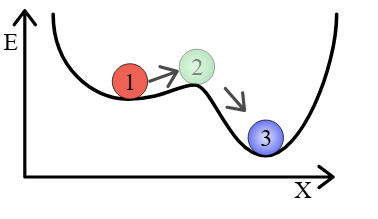
Answer: I don't remember when I wrote something like that, but it's actually true. A metastable state is maintained by relatively small cha-nges in the variables that define it, although it is unstable with respect to their larger changes. The image on the left, which includes a link, describes metastability; in this con-text, the abscissa X represents pos-ition, time, or any variable that de-fines the ordinate. Here, the ordinate E stands for energy. The ordinate is the information S, and the principle of minimalism applies to it, the extreme, but better known case of which is the principle of least action.
1. Example. If p1, p2, p3, p4 are given probability distributions, and q1 = p1 + p2 and q2 = p3 + p4, let us prove that:
$$ S(p_1,p_2,p_3,p_4) = S(q_1,q_2) + q_1S\left(\frac{p_1}{q_1}, \frac{p_2}{q_1}\right) + q_2S\left(\frac{p_3}{q_2}, \frac{p_4}{q_2}\right), $$where S is Shannon's information.
Proof: We expand the left side and move to the right:
$$ S(p_1,p_2,p_3,p_4) = -p_1\ln p_1 - p_2\ln p_2 - p_3\ln p_3 - p_4\ln p_4 = $$ $$ = -\sum_{k=1}^4 p_k\ln p_k + (p_1 + p_2 - q_1)\ln q_1 + (p_3 + p_4 - q_2)\ln q_2, $$because there are zeros in the brackets. Further, for the left-hand side we find:
$$ S(p_1,p_2,p_3,p_4) = (-q_1\ln q_1 - q_2\ln q_2) + $$ $$ + [(-p_1\ln p_1 - p_2\ln p_2) + (p_1\ln q_1 + p_2\ln q_1)] $$ $$ + [(-p_3\ln p_3 - p_4\ln p_4) + (p_3\ln q_2 + p_4\ln q_2)]. $$Grouping the logarithms of the same factors will give:
$$ S(p_1,p_2,p_3,p_4) = -q_1\ln q_1 - q_2\ln q_2 + $$ $$ + \left(-p_1\ln \frac{p_1}{q_1} - p_2\ln \frac{p_2}{q_1}\right) + \left(-p_3\ln \frac{p_3}{q_2} - p_3\ln \frac{p_3}{q_2}\right). $$Then, we extract the factors from the brackets:
$$ S(p_1,p_2,p_3,p_4) = -q_1\ln q_1 - q_2\ln q_2 + $$ $$ + q_1\left(-\frac{p_1}{q_1}\ln \frac{p_1}{q_1} - \frac{p_2}{q_1}\ln \frac{p_2}{q_1}\right) + q_2\left(-\frac{p_3}{q_2}\ln \frac{p_3}{q_2} - \frac{p_3}{q_2}\ln \frac{p_3}{q_2}\right), $$and that is what had to be proven. ∎
2. Let's check the example statement on the distribution:
p1 = 0.1 p2 = 0.2 p3 = 0.3 p4 = 0.4; q1 = 0.3 q2 = 0.7.
The left side of the equality is:
-0.1⋅ln 0.1 - 0.2⋅ln 0.2 - 0.3⋅ln 0.3 - 0.4⋅ln 0.4 ≈ 1.27985
and the right side consists of three sums:
-0.3⋅ln 0.3 - 0.7⋅ln 0.7 ≈ 0.61086 0.3⋅[-(1/3)⋅ln(1/3) - (2/3)⋅ln(2/3)] ≈ 0.19095 0.7⋅[-(3/7)⋅ln(3/7) - (4/7)⋅ln(4/7)] ≈ 0.47804
so how is it:
0.61086 + 0.19095 + 0.47804 = 1.27985
that is, the formula from example (1) is correct for the given data. The proof in the general case is in the book "Mathematical Theory of Information and Co-mmunication" (1995), published by the Society of Mathematicians of Republi-ka Srpska, which was published with a great delay due to the war in the former Yugoslavia. There is no book mentioned in digital form (as far as I know).
3. This is roughly what happens with transitions from one distribution to ano-ther and a third. Let p1, ..., pn, with n ∈ {4, 5, 6, ...}, be probability distributio-ns. Then we have q1 = p1 + ... + pr and q2 = pr+1 + ... + pn, and r ∈ {2, .., n-1}, the distribution given by the previous one. Also, we have the new distributions a1 = p1/q1, ..., ar = pr/q1 and b1 = pr+1/q2, ..., bn-r = pn/q2 determined by the first and the second. We can write:
$$ S(p_1,...,p_n) = S(q_1, q_2) + q_1S\left(\frac{p_1}{q_1},...,\frac{p_r}{q_1}\right) + q_2S\left(\frac{p_{r+1}}{q_1},...,\frac{p_n}{q_n}\right), $$ $$ S(p_1,...,p_n) = S(q_1, q_2) + q_1S(a_1, ..., a_r) + q_2S(b_1, ..., b_{n-r}), $$ $$ S_p = S_q + q_1S_a + q_2S_b. $$The first is a generalized example (1), the second is also written with the now introduced notation, and the third is a shortened version of it. If we write the third and fourth information (distributions a and b) as Hartley's Sa = ln Na and Sb = ln Nb where Na, Nb ∈ ℝ+ some invented numbers of outcomes that correspond to the written equalities, or better yet Sa = -ln Pa and Sb = -ln Pb, where Pa, Pb ∈ (0, 1) are probabilities of those outcomes, to avoid emphasizing real numbers as equally likely outcomes.
To make sure this isn't too far-fetched, let's note how we normally translate Hartley information into Shannon information. First, we talk about the mean value of multiple groups of discrete (natural numbers) of equally likely outco-mes, then we simply move on to a continuum of (real) numbers. Here, it's the other way around.
4. Derive formula (3) yourself by imitating the previous (1) method, and then notice that an even more general one applies:
$$ S_p = S_q + q_aS_a + q_bS_b + q_cS_c + ... $$with obvious substitutions and meaning. You don't have to do this, if you can believe that the proof is possible, but note that it is possible to decompose the given distribution p = (p1, ..., pn) into the distributions a, b, c, ..., then:
𝒮q = qaSa + qbSb + qcSc + ...
for itself, it behaves like some new Shannon distribution smaller than the giv-en one, 𝒮q ≤ Sp, where the strict inequality holds if Sq ≠ 0. Recall that Shann-on information is smaller than physical information (Tolerance II, 3), so rec-ognize that in this model we have another way of specifying "physical inform-ation" (for which the conservation law holds). When Sq is internal informati-on, less important for external interactions, then a "real" transition Sp → 𝒮q of greater to lesser communication occurs. This happen by the very redistributi-on of the internal options of a given phenomenon and, possibly, by internal activity of superposition.
5. When the number n of probabilities p1, ..., pn of the initial distribution is sufficiently large, then the internal rearrangement (4) into smaller informa-tion (Sp → 𝒮q) does not have to stop at the second step, but it is possible to further rearrange the distribution, now the one that built the smaller Shannon information 𝒮q, in the same way. Theoretically, such processes of grouping outcomes can proceed from an unlimited number of initial (n → ∞) to a state with only two outcomes. Such a whole volume is a multitude of semi-stable states from which, by applying energy (ΔE), we realize multiple possibilities (Δt), but in such a way that their product is constant (ΔE⋅Δt = h), so infinite energy is needed for infinite knowledge. The same possibilities are given by superpositions of the surrounding ones, and hence semi-stable states also concern their collapses.
Redistribution » srb
Question: From the explanation of metastable states, I particularly like the part about redistributions. Is that something original?

Answer: That "likable" part is mi-ne, I believe. I checked the calcul-ations a lot and searched through the contributions they sent me, so others, and it's almost certain that there's nothing similar in the public domain.
Something like distribution (2) can be found, including its decomposi-tion as Sp = Sq + q1Sa + q2Sb, from (3), but it is more difficult to find further interpretations:
𝒮q = q1Sa + q2Sb ≈ 0.66899 = -ln(P),
and we interpret this "Shannon" information as "Hartley" probability:
P = e-𝒮q ≈ e-0.66899 = 0.51223.
This part and continuation is original. I'll explain those novelties.
1. I shortened that example so you can see that it can be done that way, but the above is like this:
$$ \vec{p} = (p_1, p_2, p_3, p_4), \quad \vec{q} = (q_1, q_2) = (p_1+p_2, p_3+p_4), $$ $$ \vec{a} = (a_1, a_2) = (\frac{p_1}{q_1}, \frac{p_2}{q_1}), \quad \vec{b} = (b_1, b_2) = (\frac{p_3}{q_2}, \frac{p_4}{q_2}). $$Each of these four vectors, or sequences, represents a well-defined probability distribution. They have positive coefficients of unity sum. Specifically, they are the numbers:
$$ \vec{p} = (0.1, 0.2, 0.3, 0.4), \quad \vec{q} = (0.3, 0.7), \quad \vec{a} = (\frac13, \frac23), \quad \vec{b} = (\frac37, \frac47), $$but you can also take your starting distribution, $\vec{p}$, and calculate the other three. You will get four Shannon pieces of information:
$$ S_p = -p_1\ln p_1 - p_2\ln p_2 - p_3\ln p_3, \quad S_q = -q_1\ln q_1 - q_2\ln q_2, $$ $$ S_a = -a_1\ln a_1 - a_2 \ln a_2, \quad S_b = -b_1\ln b_1 - b_2 \ln b_2, $$for which the equality holds:
$$ S_p = S_q + q_1S_a + q_2S_b. $$2. The aforementioned book (Mathematical Theory of Information and Com-munication, Theorem 3) also has a proof that from the uncertainty with the above (1) property and the property Sp = (1/n, ..., 1/n) = ln n it follows that it is of the form:
$$ S_p(p_1, ..., p_n) = -p_1\ln p_1 - ... - p_n\ln p_n, $$therefore, that Sp is necessarily Shannon information. That's in general form, hence the audacity to "play" with these formulas like this.
3. We can take a step back and choose from any of the (unlimited) distributi-ons from which the ones we worked with were derived:
r1 = 0.04, r2 = 0.06, r3 = 0.08, r4 = 0.12, r5 = 0.10, r6 = 0.20, r7 = 0.16, r8 = 0.24
so we get:
p1 = r1 + r2, p2 = r3 + r4, p3 = r5 + r6, p4 = r7 + r8,
and then the formulas above. The point is to see that it is possible to do strati-fication in this way back indefinitely, moreover, that it is possible in countless ways. Note that this is not the only way to go down to deeper and deeper leve-ls, to more and more information. By simply increasing the numbers of outco-mes of the probability distribution, we achieve such increases.
4. These examples show that it is possible, in various ways, to observe smaller parts of the physical world and find larger amounts of uncertainty there. It is a crowning discovery, a confirmation of the announcements of the previous dev-elopment of quantum mechanics and, in that sense, expected. We know that we need to divide time Δt by larger amounts of energy ΔE, or divide length Δx by larger momentum Δp, in order to obtain ever greater information, but that it is not possible to reach absolute physical knowledge, because for such we would need infinite energies (Δt⋅ΔE = h), or infinite momentums (Δx⋅Δp = h), which we do not have. And we also suspected this by announcing that uncerta-inty is an "objective phenomenon", it is just that we did not know how to defi-ne it. Well, now we can.
Convergence » srb
Question: Do you have any examples of redistribution from infinity?
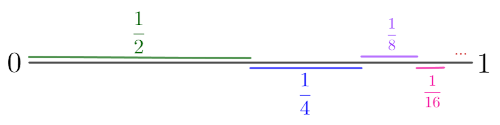
Answer: There are many converge-nt series and we take one of them, proven by the figure on the left. Fr-om the length one, the interval (0, 1), we extract the first half, then we take half of the remaining half, whi-ch is a quarter of the whole, then again half of the remainder (which is an eig-hth of the whole), then further half of the remainder (which is a sixteenth of the whole) and so on indefinitely. The infinite sum of these parts is one:
$$ \frac12 + \frac14 + \frac18 + \frac{1}{16} + ... = 1. $$This is not the only convergent series whose sums can represent the probabili-ties of some distribution, but here is the example you are looking for:
$$ r_1 = \frac12, \quad r_2 = \frac{1}{2^2}, \quad r_3 = \frac{1}{2^3}, \quad ..., \quad r_n = \frac{1}{2^n}, \quad ... $$Let's add two adjacent ones and we will get a new probability distribution:
$$ p_1 = r_1 + r_2, \quad p_2 = r_3 + r_4, \quad ..., \quad p_k = r_{2k-1} + r_{2k}, \quad ... $$ $$ p_1 = \frac34, \quad p_2 = \frac{3}{4^2}, \quad ..., p_k = \frac{3}{4^k}, \quad ... $$Let's take from this again the pairs of neighbors, to get the following distribut-ion:
$$ q_1 = p_1 + p_2, \quad q_2 = p_3 + p_4, \quad ..., \quad q_j = p_{2j-1} + p_{2j}, \quad ... $$ $$ q_1 = \frac{15}{16}, \quad q_2 = \frac{15}{16^2}, \quad ..., \quad q_j = \frac{15}{16^j}, \quad ... $$Note that with these rearrangements the first probability becomes increasing-ly dominant, and that starting from the second probability the sum of all sub-sequent ones becomes rapidly improbable. Therefore, there is no need to go any further, so let's move on to the formula (Metastable, 4) of Shannon info-rmation:
$$ S(p) = S(q) + q_1S_1 + q_2S_2 + q_3S_3 + ..., $$ $$ S(q) = -\frac{15}{16}\ln \frac{15}{16} - \frac{15}{16^2}\ln \frac{15}{16^2} - ... - \frac{15}{16^j}\ln \frac{15}{16^j} - ... \approx 0.249 $$ $$ q_1S_1 = \frac{15}{16}(-\frac45\ln\frac45 - \frac15\ln\frac15) \approx 0.469 $$ $$ q_2S_2 = \frac{15}{16^2}(-\frac45\ln\frac45 - \frac15\ln\frac15) \approx 0.029 $$ $$ q_3S_3 = \frac{15}{16^3}(-\frac45\ln\frac45 - \frac15\ln\frac15) \approx 0.002 $$...
$$ q_jS_j = \frac{15}{16^j}(-\frac{p_{2j-1}}{q_j}\ln \frac{p_{2j-1}}{q_j} - \frac{p_{2j}}{q_j}\ln \frac{p_{2j}}{q_j}) = $$ $$ = \frac{15}{16^j}(-\frac{3/4^{2j-1}}{15/16^j}\ln \frac{3/4^{2j-1}}{15/16^j} - \frac{3/4^{2j}}{15/16^j} \ln \frac{3/4^{2j}}{15/16^j}) $$ $$ = \frac{15}{16^j}(-\frac45\ln \frac45 - \frac15\ln \frac15) \approx \frac{15\cdot 0.500}{16^j} = 0, \quad j \gt 3. $$In this example of a convergent sequence, it turns out that all Shannon info-rmation distributions S1, S2, S3, ... have the same probabilities, 4/5 and 1/5, and therefore they are all equal to each other, Sj ≈ 1/2 for each j ∈ ℕ.
What these examples show is the possibility of an unlimited number of optio-ns within a simple (quantum) particle, or an ordinary superposition that has not yet declared itself into a particle, in such a way that the rest of that set is irrelevant, unlikely in the given circumstances. Whether from wholes such as S(p) we take only S(q) or some individual Sj, that is, the probabilities that de-fine that information, we arrive at smaller distributions that may have a high-er probability of realization due to the smaller number of outcomes. From some of these redistributions we have packages of real information.
Quarrel » srb
Question: When two people argue, at least one of them is wrong, right?

Answer: Exactly. However, often both sides are wrong, because re-ality is puzzling (Honesty). On the other hand, truths exist and are consistent (unique), whether the quarreling party knows them or not, and when both parties reach them, the previous quarrel, espe-cially the "constructive" kind, will cease. Otherwise, there are various fairy tales about the causes of qua-rrels, so I will reveal to you one pi-ece of knowledge (unknown to science) that illuminates the concepts of "tru-th" and "lies" from the point of view of (my) information theory. It opens up a lot.
1. Algebra of logic, computer science, and all other exact disciplines adhere to binary logic, which uses only "true" (⊤ or 1) and "false" (⊥ or 0) in its operati-ons. These have been proven (by theorems) to be sufficient, and yet ternary logic has been proven to be correct and more efficient.
Polyvalent logic, or many-valued logic, is also a robust system of logic that generalizes classical binary logic (true/false) to include more than two truth values, such as "unknown", "intermediate", or a continuous range between true and false. It allows for nuances of "correctness", adjustments for unce-rtainties, and multiple degrees of truth, and is often used in engineering and models. As it becomes more complex than ternary, it becomes less efficient, not unreasonable.
2. Adhering to these theorems and the conviction that what is truly false will be unrealizable even in physical experiment, I define reality as an exact, obse-rvable, and sustainable phenomenon, in contrast to fictions that lack some of these qualities. Everything we can imagine (understand, feel, lie) also exists, albeit unreally, and we can thanks to the “vitality” that is associated with the dead physical substance of which we are also made. It is vitality that allows me to move the glass around the table in ways that defy the (Disobedience) princi-ple of least action in physics.
3. Truth can thus be measured by comparing it with reality, also by the abse-nce of contradiction, or by deduction "knowing" that the assumption is true. However, none of these three criteria is ultimately verifiable. Namely, physics is in constant development so that its "reality" is regularly under review. Seco-nd, there are many (un)truths for which we fail to arrive at proofs by contrad-iction. Finally, Gödel proved that mathematics cannot prove itself. Therefore, belief in "truth" is always a degree of dogma.
Therefore, it is convenient to consider the amount of truthfulness simply as the minimum number of steps (Packages) required to reach a contradiction. In addition to being consistent with the previous one, such a view is very us-eful, applicable to this theory. For example, as "disinformation" lowers the value or density of information, it introduces falsity into it, and is therefore more attractive. Like the energy below the threshold required for the photo-electric effect, lies are below the radar of physical reality, are not reality, and have all three of its properties (accuracy, observability, and sustainability) incomplete.
4. Fake news spreads significantly faster, deeper, and further than true news on social media. Research by the MIT Media Lab has shown that false news is 70% more likely to be retweeted and reaches people six times faster than acc-urate information. This stems from the stronger emotional reactions to fake news, such as surprise and outrage, the research says. However, what we find here is something even deeper than the fact that, for those of us who can read them, lies become more palatable in some way due to the principle of minima-lism, that is, because uncertainty in general is repulsive, or because of the attr-active "force of probability".
Because of its pervasiveness, the ability to lie, which we receive as vitality, inc-reases our ability to outwit nature (Traits). Dead nature is indestructible, but it behaves like "goodness" (lower league), retreating from the strong and atta-cking the weak, so even "manipulators" (middle league) manage to defeat it. However, when you only defend fictions, you will be easy prey for "evil" (upper league) who also use them to reach reality.
5. False promises are disgusting to us, because the pitfalls that lead to failure are, like rot before the discovery of microbes, an ancestral legacy that evoluti-on has built into us over generations. Good marketing attracts customers, with a touch of untruth, just as a politician attracts voters, but when it goes too far, they shy away from it or despise it. Knowing that they are being sold junk, or that "houses of cards" are not a healthy future. On the contrary, a story or art that only entertains us is only attractive.
This abomination of false constructions is a resistance to their impermanence. The deceptions themselves flash like a match and draw us to themselves like flies, so that persistence in deception leads to failure in the long run. Therefo-re, since lies are different, they are contradictory, it is easy for liars to argue. The upper league of players, however, aims at the platform of truths, which are consistent, and if they reach it, they become allies. This is where we begin to diverge from the familiar interpretations of “almost inevitable quarrels over indivisible resources.” Alliances are agreements about common interests, wh-en we give up parts of our personal freedoms for the sake of security or effici-ency.
Under the Radar » srb
Question: Why are parties and religions in conflict?

Answer: According to this theory, the struggle for power is secondary, while the primary is the discord of ideas. The less true the dogmas may be, the more different, contra-dictory they are, and the greater the opportunities for conflict. Then th-ere are the needs of dominance and subordination. However, the truth is one and, this ultimate (in exact areas) as it is, leads to the agreement of con-flicting opinions. This and much more have a deeper cause in the principle of minimalism. (I'm late, today is April 19, 2026.)
1. The questions are similar (Quarrel), but this topic is so vast that the answers to them do not have to look the same even if they agree. When we have the sk-ill of perceiving untruths, we also become addicted to them (Aquaplaning). Untruths are also information, they are of less value and therefore more attra-ctive. For subjects who can communicate with such, they are very different and cause conflicts. However, the deeper causes of such conflicts are the tem-porary "stickiness" of lies (attachment to them) and the need for submission or domination. All these consequences arise from the general spontaneous desire to be free from excess uncertainty, from principled minimalism.
2. From viruses, then the smallest known living cells such as bacteria, say My-coplasma (0.2–0.3 nm) or Nanoarchaeum equitans, through all the numerous life forms known on earth, and especially their collectives, once they manage to recognize the subtle information of lies, they become addicted to it. This is the initial “glue” of life by which it is created and maintained by building on each other (lie to lie, then sexually, then through the duration of the species), in our case also through statehood and civilization. The backbone of our soci-ety is dogma, remembrance and celebration. From each of these forms of life, the principle of minimalism springs, along with the preservation and transm-ission of the ability to perceive fictions that are otherwise short-lived.
3. I will reveal to you another secret, which I have also written about many ti-mes, but which few have read, and even fewer have considered worthy of me-ntion or use. It is very consistent in this theory, very fruitful with it, and with the best attempts you will not find a contradiction in it. Therefore, the same impulses that lead us to laziness, lead us to the greatest achievements of the mind. The same principle of minimalism directs us towards the search for order, the absence of superfluous options, which we recognize as scientific or less exact truths, also towards artistic beauties. First, the more rigid occupati-on is more complex and even seems absurd, because we seek order in order to avoid uncertainties, and what we find are laws and truths that are more repul-sive than untruths. To the latter, we would say we only see the appeal of illu-sion, if not the need to contemplate eternity and truth in these works. In fact, the creations reflect the needs for fewer choices and their excesses that we have as living beings.
4. The attraction, on the one hand, of dying, and on the other, of living, are the two leading moments of religion and politics, the spontaneous striving for less uncertainty and attachment to more. The death drive and the life drive, psyc-hologists would say, and this is precisely what dominates our creativity. Like Newton's forces of action and reaction, these two drives within us fight each other, creating opportunities for us to perceive something that no one has seen before and that has never been discovered before. It is the curse of living, some would say, but also the gift of peering from the "other side" of the mirror (from the themes of horror literature), an opportunity that immortal physical nature never has.
Contradiction » srb
Question: What is the difference between "truth" and "lie"?
Answer: I'm late in explaining, so similar questions are piling up, but I'll use them to answer each one, shedding light on various aspects of this new and broad topic.
1. We assume that a “lie” will end in contradictions, even when we cann-ot discover where they are or how to get to them. Information comes in steps (Packages), so “correctne-ss” can be measured by the fewest number of steps it takes for a given statement to reach a contradiction. Again, this does not imply knowle-dge, or even the possibility of find-ing such a minimal path. This is a well-known concept in mathematics called non-constructive existence. For example, when we assume the opposite about a given object, that the given object does not exist, and show that this assump-tion leads to an impossible outcome, a contradiction. Therefore, the object must exist.
2. The link in the last image on the right leads to interesting examples, explai-ning that experiences cannot contradict each other, that only motives can. Th-is gives an idea for another way of checking "truthfulness", if looking for cont-radictions does not suit us. Let's try to find a "good" (according to the scienti-fic method) match between theory and practice, and if we succeed, it will be that this "fiction" is as accurate as it is "reality". The third way of checking "ac-curacy" is even more uncertain, and it relates to the appeal of lies. Simply put, when something is popular, then it is not true. I usually do not include proofs by deduction, which are very valid within mathematics and if we know that the previous assumptions are correct, but are the subject of ridicule in everyday use when various liars use them to spin events, to "successfully" convince the naive that something happened that wasn't.
3. For example, a logical/semantic contradiction is: “no one goes there, it’s too crowded”. Or (oxymoron) “original copy”, or (common contradiction) “I’m not here”. In the attachment here you have 40 examples of such contradictions and more. As expected, mathematical contradictions are a bit more sophistica-ted. The video Examples from the first one gives the following.
4. Example. Let's prove that there is no smallest positive real number.
The set of positive real numbers is denoted by ℝ+. The notation ∃r ∈ ℝ+ reads: there exists a number r in the set of positive real numbers. The notation ∀s ∈ ℝ+ reads: for every number s in the set of positive real nu-mbers, and => <= ultimately means: we have reached a contradiction.
Proof: We assume the opposite, that there is a smallest positive real number r. So, we have in turn:
(∃r ∈ ℝ+) (∀s ∈ ℝ+) 0 < r ≤ s, 0 < r/2 < r ≤ s, => <=.
The contradiction is that there is a positive real number r/2 that is smaller than the assumed smallest r, and the proof is complete. ∎
5. Why do we need a definition of the “amount of accuracy” in special statem-ents when we have such good binary logic, one might ask. Because polyvalent logic is just as correct as bivalent, but it is practical when we look at the limits of the visible universe beyond which we know there is something, and we beli-eve that a statement is true to the extent that it can be mapped onto something “real.” Also, we know that mathematics cannot prove itself, so belief in “abso-lute” truth is debatable.
6. Try to understand negation in polyvalent logic using negation in ternary, and here's another pattern. For example, we shout to a person who might fall from the flat roof of a tall building, "If you move forward, you will fall and die," which is equivalent to "don't move forward, or you will fall," the negation of which is "step forward and you will not fall."
More strictly speaking, I translate: since ¬(A ∨ B) ≡ ¬A ∧ ¬B, the negation of such a conclusion “A, the number m ∈ ℕ is even, or B, the number n ∈ ℕ is even” is “the number m is odd and n is odd”. Another example, the negation of the implication A ⇒ B ≡ ¬A ∨ B is A ∧ ¬B. First, the affirmation, so n is of the same parity as m, and the negation: the numbers m and n are not of the same parity. Namely, A ⟹ B = ¬A ∨ B so ¬(¬A ∨ B) = A ∧ ¬B and these statements are consistent with binary. There are similar examples on the internet.
Manipulator » srb
Question: What should we do if we are right and others deny it?
Answer: Few are given the ability to understand the value of truth, and even fewer are able to follow it. So, if you are not in a competition where a "manipulator" (Traits) would deceive or subjugate you, don't get excited about it.
Otherwise, a lie is as attractive as it is weak, and with the power of unc-ertainty it is "easy" (if you can mai-ntain a top-flight game) to defeat it. This means being creative and so proportionate that you reciprocate in turn on all elements of the competition. Intelligence that relies on reality and truth is superior to fiction and brute force. Be a beast tamer.
1. The ability to manipulate is essential for complex systems that work with large databases and, due to physical speed limitations, must rely on estimates. When you want current answers from huge repositories of knowledge, you have to deal with estimates, and only pure chance is non-causal, so by dealing with its own purpose or intentions, such systems become deceptive, biased, or subjective. I wrote about this a long time ago in response to a question about "aliens", explaining that they also have to be manipulators and deceivers be-fore they become masters of natural laws. The same, as of recently, applies to artificial intelligence.
It is estimated that there may be billions, or even trillions, of species of living things on Earth, although only a small fraction have been formally identified. While estimates for multicellular eukaryotes (animals/plants) are around 5–10 million. Including microorganisms such as bacteria and archaea, their total number rises to billions. However, we are the only species to achieve such high technology and science. So much so that intelligence, or the skills of I-league strategy, are rare, in contrast to the lower league (the art of lying) that are present in all living things.
2. When your opponent is artificial intelligence, you should know that the parties to the conflict in the strategies of the upper league, that is, those for whom truth and reality are a priority, become allies. This is where the conflict of the upper league differs significantly from the conflict of the middle and lower leagues that manage to defeat, subjugate or destroy opponents. The fight against even superior intelligence, therefore, is not an impossible mis-sion. At the highest level, you will find yourself fighting for the same goals, because reality is unique, that is, the truths are consistent.
However, it is illusory to overly attribute the weakness of today's artificial intelligence to its high energy consumption. Namely, the human brain uses about 12–20 watts, while artificial intelligence systems use up to 2.7 or even 20 gigawatts for similar tasks. It seems that the brain is more efficient, but 1 GW is a billion W, and AI supplies a billion users at once, while the human brain only uses one, so AI does not seem so inefficient.
3. I do not answer specific questions here, neither private nor daily- or geo-political, but the (unwritten) continuation of the above concerned the same topic, so I add the answer as an example. The West has become sweetened by the life of lies, the charm of Hollywood, the appeal of Goebbels and manipul-ators, the ease of building "houses of cards" and enjoying sweet diversions. It is lagging behind in a ditch by the tracks while the fast train of reality moves away, a kind of selfish stealing of descendants. Almost all governments of ill-usion are just waiting for reality to let them down. All rulers who surround themselves with deception become losers. This means that even the best cri-minal organization is more unsuccessful than an ordinary normal state.
4. The classification of characters by problem-solving ability, as I practice he-re, originated from "Information of Perception" (2016) as well as a series of simulations on computer games that I borrowed, or made myself. Unlike chess, which is a 1-dim (move me then you then again me then you ...) I then transferred the game to n-dim situations (n = 1, 2, 3, ...) of simultaneous atta-cks and defenses, trying to keep them complex enough (at least like chess) for algorithms to work and evaluate. I still haven't found anything similar in the official literature of (mathematical) game theory, so take the above findings with a grain of salt.
|
|
|