|
|
|


Fermat Theorem » srb
Qestion: Find me three cubes with integer edges such that the volume of the first two is equal to the volume of the third? (He says he received the assign-ment from a math professor.)
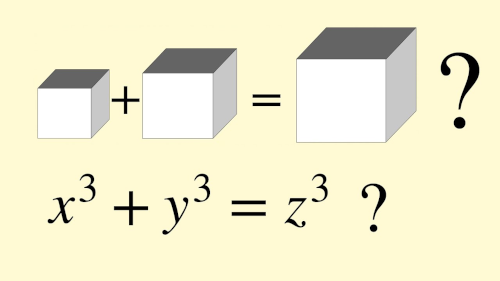
Answer: Otherwise, I'm not intere-sted in instructions, nor am I deal-ing with high school problems here, so I just directed this student onto proofs of the so-called Last Ferm-at's Theorem for cubes, for examp-le, like the video link in this image on the right. In addition, I sent him a similar "easy task" that I invented at the time, to ask his math profess-or to solve it:
$$ \sqrt[3]{\frac{x + 9}{16}} + \sqrt[3]{\frac{3x + 15}{16}} = \sqrt[3]{x + 6}. $$I soon received questions from several addresses about how to solve this problem, albeit with a solution from a colleague, but without a procedure. That is why now (April 21, 2026), after many months, I am also listing here the procedure for which I was inspired by a similar problem from a certain mathematical Olympiad, many years ago.
1. Write this equation in the form:
$$ \sqrt[3]{x + 9} + \sqrt[3]{3x + 15} = \sqrt[3]{4(4x + 24)}, $$then introduce variables:
$$ a = \sqrt[3]{x + 9}, \quad b = \sqrt[3]{3x + 15}, $$that is: a³ = x + 9 и b³ = 3x + 15.
2. Then a³ + b³ = (x + 9) + (3x + 15), i.e.
a³ + b³ = 4x + 24,
$$ a + b = \sqrt[3]{4(a^3 + b^3)}, $$where we simply called the sum (1).
3. By cubing we find:
$$ (a + b)^3 = 4(a^3 + b^3), $$ $$ (a^3 + b^3) + 3ab(a + b) = 4(a^3 + b^3), $$ $$ ab(a + b) = a^3 + b^3, $$ $$ ab(a + b) = (a + b)(a^2 - ab + b^2). $$Hence the first solution, a = -b.
4. Below we have:
$$ ab = a^2 - ab + b^2, $$ $$ (a - b)^2 = 0, $$and hence another solution, a = b. Now comes the easy part.
5. From the first solution (3), by substitution (1), we have:
$$ a^3 = -b^3, $$ $$ x + 9 = -3x - 15, $$ $$ 4x = -24, $$therefore, x1 = -6. And from the second solution (4), with the same substitu-tion, we have:
$$ a^3 = b^3, $$ $$ x + 9 = 3x + 15, $$ $$ 2x = -6, $$therefore, x2 = -3.
6. Be sure to check the solutions. These, when inserted into the original equation itself, for x1 = -6 and x2 = -3, give respectively:
$$ \sqrt[3]{\frac{-6 + 9}{16}} + \sqrt[3]{\frac{3\cdot(-6)+15}{16}} = \sqrt[3]{-6 + 6}, $$ $$ \sqrt[3]{\frac{-3 + 9}{16}} + \sqrt[3]{\frac{3\cdot (-3) + 15}{16}} = \sqrt[3]{-3 + 6}, $$which is correct, because ∛8 = 2.
7. What has always fascinated me in examples like this is the incredible consi-stency of deduction, its ability to convey mathematical truth through a chain of implications, while in everyday life it would be a real farce. A hymn to stup-idity, an ode to babbling in a series of inaccuracies alternating with perhaps some truths. Where does such a difference come from, this extreme accuracy of the results of a deduction that starts from extreme accuracy and incredible inaccuracies in the transmission of slightly looser statements?
Precision » srb
Question: How do you explain these "extreme accuracies of deduction results" in mathematics, which are absent in everyday speech?
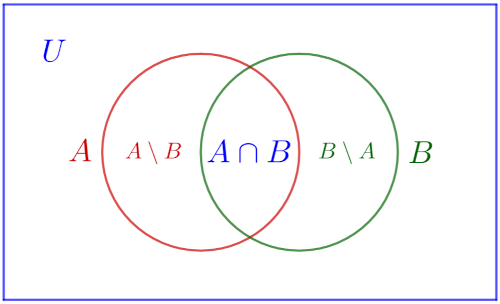
Answer: I wouldn't go into all the trump cards now, that concept is still open, but I'll present the first of the ideas using the sets A and B, the Venn diagrams in the image on the left. Let's say it's about trade, A: "buy an umbrella" in order to B: "help the hungry in the world". One told me "it doesn't matter" (if the seller is not the hungry person), but it's exactly such an extreme that we need to better follow the continuation.
1. In the algebra of logic, the implication "if A then B" is denoted by A ⇒ B wh-ich is equivalent to "the disjunction of the negation of A with B", the notation ¬A ∨ B. The same is easily verified, because both sides of the equality:
A ⇒ B = ¬A ∨ B
are false only when A is true and B is false.
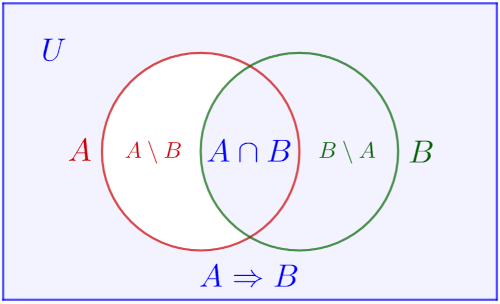
In the diagram on the right, this implication is the entire blue-sha-ded region of the "universal" set U within which are the given sets, sy-mbolically the white region A ∖ B, the difference of the given sets. This tells us that the implication itself has no meaning, except that the falsehood (A = ⊥) can lead to anything (B ∈ {⊤, ⊥}), so that the implication is true again. It is false, (A ⇒ B) = ⊥, only if A = ⊥ and B = ⊤. The lower the truthfulness of the assum-ption (A) means the higher the truthfulness of the implication (A ⇒ B).
2. Therefore, we also observe the conjunction “when A” and if “from A follows B”, then it is “B”. In short, A ∧ (A ⇒ B) → B. We see this in the next diagram.
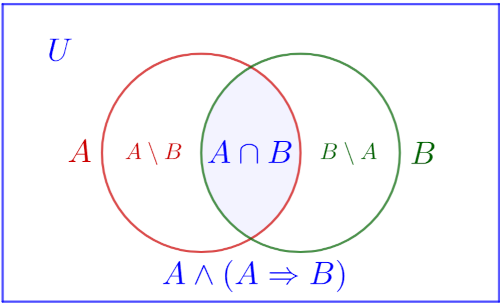
The intersection of the blue shaded set of the previous diagram (A ⇒ B) with the set A gives the intersecti-on, the blue shaded surface A ∩ B of the figure on the left. Beyond Venn diagrams, we prove the same using only the distributivity of conjunction and disjunction:
A ∧ (¬A ∨ B) = = (A ∧ ¬A) ∨ (A ∧ B) = ⊥ ∨ (A ∧ B),
and this is equal to A ∧ B, which is exactly the blue shaded part of the image on the left. Here we can observe a "decreasing accuracy" of the outcome, when is A ∩ B ≠ B, and also, the outcome (intercept) cannot be greater than the ass-umption (A).
3. I avoid separating "sets" from "statements" of logic, writing them with the same letters until they become confusing, and then mixing up operations, such as "intersection" and "conjunction", because that brings us closer to understa-nding the amount of "truthfulness" we're dealing with here (Truthfulness). It also makes it easier to see what's going on with: A: "buy an umbrella" in order to B: "help the hungry in the world."
Buying an umbrella has almost nothing to do with helping the hungry in the world. The intersection of the “amount of truth” of such two sets is almost ze-ro, A ∩ B ≈ ∅, so this in the above “universe” U is represented by a diagram of almost completely separate sets, assumptions and consequences. In the next step towards some C, let's say how much we would help the hungry in the wor-ld by buying umbrellas, if we were C: “a benefactor”, the size of that intersect-ion (and here assumptions) is limiting for the size of the consequence (C), i.e. the confirmation of our benevolence by it.
Let us note how easy it is in shallow connections, in shaky deductions, to rev-erse (spin) statements, and say: "precisely because you bought umbrellas, you didn't help to the hungry in the world", (A ⇒ B) ⇒ ¬C, which can easily be tru-er than the previous one, (A ⇒ B) ⇒ C. Hence, such deductions do more harm than good in real analyses, i.e. they are very convenient for manipulators.
4. Unlike the loss of accuracy through loose disjunctions, the chain of such will have the same values of all links when we are dealing with extreme truths, su-ch as we have in mathematics, or reality. Exact theories agree with each of th-eir parts as well as with all other true theories. We have this in mathematics, but also in the reality that physics is gradually discovering, and then, due to the ultimate coincidence of the given sets, A = B, the implication only establi-shes this agreement.
In other words, what we see as the aforementioned “agreement” we are trying to understand as the “equivalence” of these sets, assumptions and consequen-ces, which due to our narrow point of view we see only partially, never in their entirety and always different. Truth is unlimited, timeless and hence to us, of finite and always different perceptions, an abstract phenomenon with many faces. For example, if this interpretation turns out to be correct, then surely there are others that are equally correct, because that is consistent.
Tightening » srb
Question: What is another reason for the "extreme accuracy of deduction resu-lts" in mathematics that is not present in everyday speech?
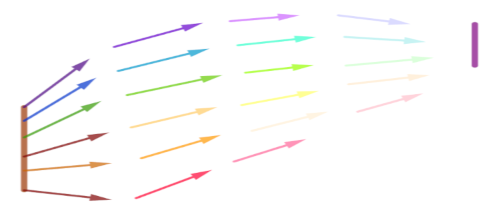
Answer: This is related to the law of large numbers (Chebyshev) or, for example, global convergence (Hermitian II), both otherwise well-known laws from mathem-atics, but here with interesting applications.
1. As in the figure on the right, a linear operator A that has a dominant eigenvalue λ0, such that for it the corre-sponding eigenvector v0 is exactly Av0 = λ0 v0 and for all other eigenvalues λ is |λ0| > |λ|, then for arbitrary vector x in that vector space is Anx → av0 when n → ∞, where a is some constant, scalar. In other words, by repeating the ope-ration A for a long time, each vector will change direction, trying to be parallel to the dominant eigenvector. This is the global convergence that I have often talked about here as a counterbalance to local divergence (Approaching).
2. Nilpotent operators have n-th powers of zero, where n is their dimension. There is always some basis of space in which such an operator has the form of a "triangular" matrix with zeros on the diagonal. Here they can represent fals-ehoods (Hindering), because these are processes that are extinguished by du-ration (repetition). Therefore, the global convergence of these and generally unsustainable states makes no sense, except when we talk about accelerated extinction as an exotic type of otherwise long-term convergence. Therefore, the deduction of untenable states (fictions), sets (Precision) A → B → C → quickly reduces to empty sets. On the contrary, the negation of untenable states, i.e. real ones, does not reduce to empty sets.
3. Reality and truth are infinity with whose only finite parts we can communi-cate, and in this way we are unique in this "information of perception". Here is where the law of large numbers of probability theory comes into play, which states that with an increase in the number of attempts, the actual average re-sult tends to the expected theoretical value. For example, by gambling in a ca-sino, the owner ensures long-term profitability, but individual players can also win. The average of thousands of bets constantly coincides with the mathema-tical odds in favor of the casino. Another example here is in the sequence of deductions.
4. The basic (hypo)thesis here is that deduction as part of a broader truth has the same tendency to relativize our perception. That our perception (underst-anding) of the steps of deduction in exact considerations also falls into various deviations, more precisely into real divesities. Such accumulation is aggravat-ed by the law of large numbers, creating the impression that there is a fatigue of errors whose percentage decreases with the extension of the chain of dedu-ctions. That is, that all further consequences of previous causes have some kind of "self-regulation", the power of adhering to the truth that we do not see locally.
Cellular Space » srb
Question: I know that during your mathematics studies you researched “ce-llular space” as part of quantum mechanics, an elective. Can you tell me so-mething about that period?
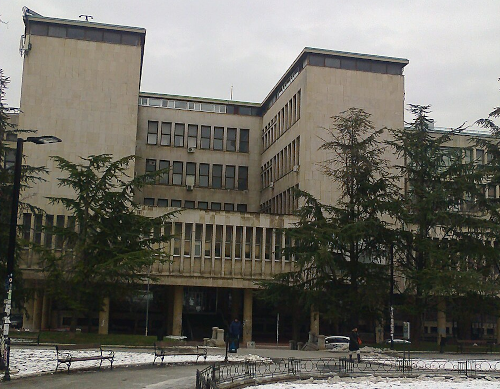
Answer: You are well informed, I assume from Prof. Fedor Herbut, Quantum Mechanics was conside-red very difficult at the time, with three semesters, or his assistant Igor Ivanović, and maybe from one of their colleagues. It was a long time ago (early 1980s), but I rem-ember that there was only one other student in the lecture besides me (I think, the best in physics) and that it was a question of where I could get lost (in mathematics). I was trying to joke, I said that I had a car (a rarity for students at the time) that often broke down, so when I saw this "mechanic" I said, here I am. I don't understand anything from those lectures so far, but you just continue your own thing and when you get to the screwdrivers then we are on the same ground. I think the prof got the joke, but I'm not sure about the student.
An interesting thing about that period is my persistent conspiratorial nature in scientific work, which has somewhat kept me going to this day. At that time, I would never have published anything publicly, except for a few discussions with colleagues, of which only fragments of memory remain. What they were telling you, I suppose, could have been subjects who could all have different perceptions, so that physical space could be both discrete and a continuum, depending on the point of view of one or many. If the universe were infinitely like that, then the individual would live in countable infinity, and all of them in a continuum. I was happy to return to that topic later (Quantum Mechani-cs) and to Cantor's (1878) proof of the uncountability of the set of real numb-ers. I don't know what else interests you?
At that time, there was no internet and otherwise the chances of becoming informed about like-minded people were slim. Through topology, I noticed somewhere in that period that there could be at least three dimensions of time, how many space, if there is objective coincidence, say if there are co-mpletely causeless phenomena. I quickly discovered that it was a taboo topic for serious researchers, and that talking about something like that would be bad for a scientific career, so perhaps that was an additional reason for my abstinence from the scientific public. That was a long time ago.
Conspiratorial » eng
Question: Can you remember anything else from that "conspiratorial" era of time dimensions? (continuation of the previous conversation, Cellular Space)

Answer: Hardly. A strong impressi-on from that period was the eureka insight that an individual and a gr-oup can see the world around them as differently as discrete objects di-ffer from the continuum of infinity. This could be attributed to synergy and emergence, group phenomena that the participants themselves do not have. I did not look for a math-ematical expression for this pheno-menon at the time, but I would la-ter find one using information of perception. Namely, for additions of the same sign, ax + by < (a + b)(x + y), which means that it is better to keep these components together if we are ai-ming for an increased sum of products (Synergy).
Another interesting fact worth mentioning is the transfer of the idea of count-able infinity in which an individual, the subject of observation of a 4-dim un-iverse, lives to a continuum, in which a group lives, to pseudo-reality, or par-allel worlds. Namely, if an individual in an infinite series of moments also has an infinite subsequence of possibilities for other worlds, then there is at least a continuum of those other worlds 𝔠 = 2ℵ0. These are different infinities because 𝔠, of real numbers, is significantly more than ℵ0, infinity of natural numbers. However, if 𝔠 is the infinity of all collectives of a 4-dim universe, then 2𝔠 is the infinity of all collectives of all worlds, and this is an infinity significantly grea-ter than the continuum.
As you can see, these two discoveries would still be new today, 45 years later, let alone then. You can imagine how easy it would be to become an outcast wi-th such stories in an environment that, like any academic community, does not want to be ridiculed for exaggeration or charlatanism. It stifles the imagi-nation and perhaps that is why that world never really appealed to me.
Hindering II » srb
Question: Do you know how to interpret the algebra of logic as vector algebra?
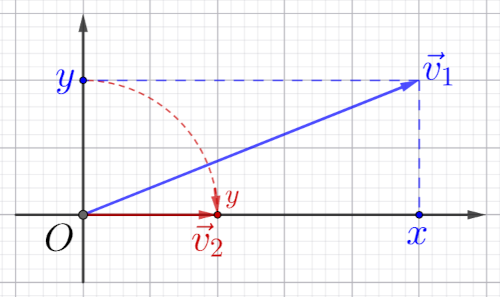
Answer: The image on the left shows one of the ways built with nilpotent matrices (Hindering). In 2-dimensional space, a triangular matrix:
$$ A = \begin{pmatrix} a & 1 \\ 0 & a \end{pmatrix} $$represents a “true” process (⊤), when a = 1, or “false” (⊥) if a = 0. When it is "false", it is nilpotent and already with the second degree A² = 0, because it is of the second order. In the example in the figure, for a = 0, this means:
$$ \begin{pmatrix} 0 & 1 \\ 0 & 0 \end{pmatrix} \begin{pmatrix} x \\ y \end{pmatrix} = \begin{pmatrix} y \\ 0 \end{pmatrix}, $$i.e. Av1 = v2. With a = 1 it would be A: (x, y) → (x + y, y). In general, with steps higher coordinates of a vector are reduced to lower ones, and these too eventually to zero.
We can also define matrices of n-dim vector spaces here, the upper triangular ones. We maintain the rules of the algebra of logic and use the coefficients for true (1) and false (0) in the usual way, where we translate disjunction (∨) and conjunction (∧) into addition and multiplication:
1 + 1 = 1, 1 + 0 = 1, 0 + 1 = 1, 0 + 0 = 0, 1 ⋅ 1 = 1, 1 ⋅ 0 = 0, 0 ⋅ 1 = 0, 0 ⋅ 0 = 0.
Apply negation to diagonal elements. All negation, disjunction, and conjunct-ion operations of the algebra of logic retain their properties.
1. The disjunction of these nilpotent operators is:
$$ \begin{pmatrix} a & 1 \\ 0 & a \end{pmatrix} + \begin{pmatrix} b & 1 \\ 0 & b \end{pmatrix} = \begin{pmatrix} a+b & 1 \\ 0 & a+b \end{pmatrix}. $$It reduces to a + b, hence to the disjunction of the algebra of logic.
2. The conjunction of such nilpotent operators is:
$$ \begin{pmatrix} a & 1 \\ 0 & a \end{pmatrix} \cdot \begin{pmatrix} b & 1 \\ 0 & b \end{pmatrix} = \begin{pmatrix} a\cdot b & a+b \\ 0 & a\cdot b \end{pmatrix}. $$We can see that this conjunction reduces to a ⋅ b by including all four combinations a, b ∈ {1, 0}. This is the disjunction of the algebra of logic.
3. Check that the negation of the disjunction becomes the conjunction of the negation:
¬(A + B) = (¬A) ⋅ (¬B),
$$ \neg \left[\begin{pmatrix} a & 1 \\ 0 & a \end{pmatrix} + \begin{pmatrix} b & 1 \\ 0 & b \end{pmatrix}\right] = \left[\neg \begin{pmatrix} a & 1 \\ 0 & a \end{pmatrix}\right] \cdot \left[\neg \begin{pmatrix} b & 1 \\ 0 & b \end{pmatrix}\right], $$ $$ \begin{pmatrix} \neg(a+b) & 1 \\ 0 & \neg(a+b) \end{pmatrix} = \begin{pmatrix} \neg a & 1 \\ 0 & \neg a \end{pmatrix}\cdot \begin{pmatrix} \neg b & 1 \\ 0 & \neg b \end{pmatrix} = $$ $$ = \begin{pmatrix} \neg a \cdot \neg b & \neg a + \neg b \\ 0 & \neg a \cdot \neg b \end{pmatrix}, $$also testing all four combinations a, b ∈ {1, 0}.
4. In the same way, check ¬(A ⋅ B) = (¬A) + (¬B). This and (3) are the so-called De Morgan laws, but given the accuracy of (1) and (2), we know that they will also be valid for these operators, simply because we know that using negation, disjunction, and conjunction we obtain every formula in the algebra of logic.
Three Logics » srb
Question: Didn't you confuse logical operators with ordinary vectors in your previous answer?
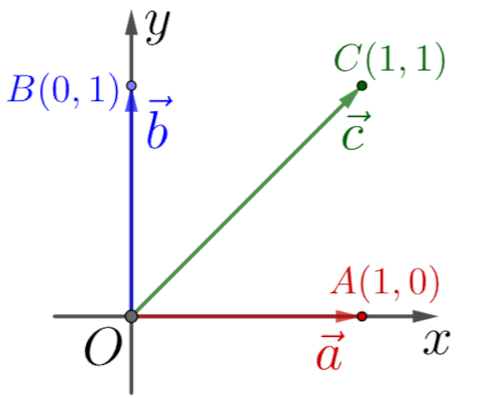
Answer: You could say that, you are right in the final consistency. If we also work with vectors whose com-ponents are 1 or 0, while the relati-ons: ¬1 = 0 and ¬0 = 1 are valid, so:
1+1 = 1, 1+0 = 1, 0+1 = 1, 0+0 = 0, 1⋅1 = 1, 1⋅0 = 0, 0⋅1 = 0, 0⋅0 = 0,
this account becomes more consis-tent. Otherwise, the above-mentio-ned operations of negation (¬a), disjunction (a+b) and conjunction (a⋅b) are sufficient to express any formula of the algebra of logic, a, b ∈ {1, 0}. However, these 2-dim vectors $\vec{v}(a,b)$ components from bivalent logic themse-lves belong to trivalent logic (Ternary). You have such pedantry, in a positive sense, so I'll provide some more details.
1. It is not necessary, but it is useful to treat such 2-dim logical vectors with a logic with three values: “true” (2), “maybe” (1) and “false” (0). So, as intensiti-es L1 so-called 1-norms of vector spaces. That is, in the above figure $\vec{c} = (1,1)$ is the “true” state, only O(0,0) is a point of inaccuracy, and the points A(1,0) and B(0,1) are indeterminities. This ambiguity of the value “maybe” is in acc-ordance with the intuitive feeling that a half-truth has various meanings, and we can treat a consistent reality as a single, single whole (Precision, 4). The extreme opposite of strict accuracy is also unique.
2. The idea of a "shortened" opposite of one half-accuracy, say one that trans-lates it into another half-accuracy, (0, 1)' → (1, 0), is shaky. Namely, a similar shortened opposite of a half-accuracy process is a type of half-accuracy proce-ss:
$$ \begin{pmatrix} 0 & 1 \\ 0 & 0 \end{pmatrix}' \to \begin{pmatrix} 0 & 0 \\ 1 & 0 \end{pmatrix} $$the shorthand A' → B will give AB + BA = I, where I is the identity matrix. These are, strictly speaking, false. Their ultimate negation gives:
¬(AB + BA) = ¬I, (¬A + ¬B)⋅(¬B + ¬A) = 0, (¬B + ¬A) = 0.
However, on the left side of the equality is a “true” matrix (with all elements 1), and on the right side we have a “false” matrix (with all elements 0). This is a contradiction, so the idea of an “abbreviated” opposite is, to say it mildly, unreliable.
3. However, if you want to use the usual vectors of L2 space, 2-norm, you can do so using the long-known Hadamard matrix H. It acts on the qubits |0⟩ = (1,0) and |1⟩ = (0,1) as follows:
$$ H |0⟩ = \frac{1}{\sqrt{2}}\begin{pmatrix} 1 & 1 \\ 1 & -1 \end{pmatrix} \begin{pmatrix} 1 \\ 0 \end{pmatrix} = \frac{1}{\sqrt{2}}\begin{pmatrix} 1 \\ 1 \end{pmatrix} = \frac{|0\rangle + |1\rangle}{\sqrt{2}} = |+\rangle, $$ $$ H |1⟩ = \frac{1}{\sqrt{2}}\begin{pmatrix} 1 & 1 \\ 1 & -1 \end{pmatrix} \begin{pmatrix} 0 \\ 1 \end{pmatrix} = \frac{1}{\sqrt{2}}\begin{pmatrix} 1 \\ -1 \end{pmatrix} = \frac{|0\rangle - |1\rangle}{\sqrt{2}} = |-\rangle, $$ $$ H|+\rangle = |0\rangle, \quad H|-\rangle = |1\rangle. $$But that's another story, perhaps approaching the same problems from a different angle. This way emphasizes the interests of quantum mechanics.
4. The Hadamard matrix is its own inverse, HH = I, the matrix I is the identity matrix. So are the Pauli matrices (each σ² = I):
$$ \sigma_x = \begin{pmatrix} 0 & 1 \\ 1 & 0 \end{pmatrix}, \quad \sigma_y = \begin{pmatrix} 0 & -i \\ i & 0 \end{pmatrix}, \quad \sigma_z = \begin{pmatrix} 1 & 0 \\ 0 & -1 \end{pmatrix}. $$From the point of view of the algebra of logic, each one resembles a "falseho-od" interpreted matrix-wise (a lie about a lie can be true), or a negation, bec-ause a lie about a truth is a lie (HI = H) and a lie about a lie is true (HH = I). But that's where the direct analogies with ordinary algebra of logic end.
However, the idea of analogies between these matrices of quantum physics and classical logic of mathematics persists in a different way, typical of this information theory. Bijections (mutually unambiguous mappings) of reality onto truths imply the existence of at least some parallel realities in which those that are untrue in ours are valid as truths. I wrote about this as combi-nations of independent axioms with all possible negations and affirmations in them. That is a story for another time.
Cause » srb
Question: Why do you avoid talking about combinations of independent axio-ms as different "realities"?
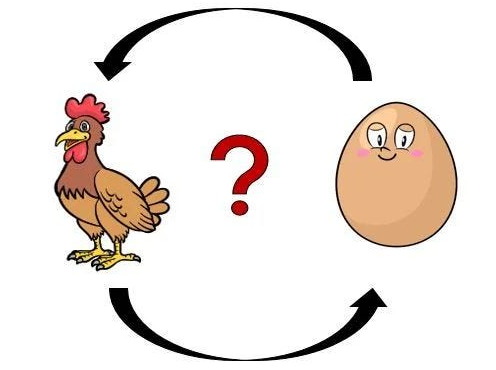
Answer: We didn't understand ea-ch other, I don't avoid talking about unrealistic realities, on the contra-ry, I've talked about it so much that I believe I've exaggerated. Admitte-dly, it may be too scattered and re-sembles looking for needles in a ha-ystack. I'll summarize some of the more important parts.
1. This is a theory in which the exi-stence of anything starts from info-rmation, and such from choice and uncertainty. The one about objecti-ve randomness in its deepest essence does not have any causality. These states of extreme uncertainty are the most improbable, so their complications beco-me "tendencies" towards greater probabilities. Simply put, what is more expe-cted is more in the foreground and has taken priority.
2. There are as many certainties as there are durations. When we interpret the algebra of logic with the algebra of vectors (Hindering II), we saw that nilpot-ent matrices represent vanishing processes and that they have no inverses, but this is not entirely true. For example:
$$ \begin{pmatrix} 0 & 1 & 1 \\ 0 & 0 & 1 \\ 0 & 0 & 0 \end{pmatrix} \begin{pmatrix} x \\ y \\ z \end{pmatrix} = \begin{pmatrix} y+z \\ z \\ 0 \end{pmatrix} $$The matrix equation is Av = v1. The matrix A will disappear only in the third step (A² ≠ 0, but A³ = 0), so we still learn something about the original vector v based on the first copy v1.
In general, if for some n = 2, 3, ... there is An-1 ≠ 0 and An = 0, then the matrix is nilpotent and of order n. It has something of its future just as much as its st-atistical past, so we do not say that it has no duration. We can say that it has a limited reality, possibly to infinity (when n → ∞). With longer future duratio-ns, processes have greater certainty and longer pasts. If this matrix had an ex-act inverse, it would be A-1A = I, so multiplying this equation on the right by An-1 we get A-1An = IAn-1, hence the contradiction, because the left is zero and the right is not.
3. It turns out that what has greater certainty lasts longer and is more “real”. When we define truth through reality, through duration, we imply that nature spontaneously tends towards greater existence, truthfulness, and ultimately orderliness. All of this is consistent with the idea that more probable events are less informative, hence more desirable, more expected, and more repre-sented.
However, if some phenomenon has a past “without” a future, like a coin toss and the outcome “heads” when it lands “tails”, we simply add a pseudo-future to it to close the logical construction. Such projects are consistent when we assign some pseudo-reality to half-truths, and then for the sake of complete-ness we continue the assignment to falsehoods. We round off the concept of existence by sticking to duration.
4. The greatest degree of certainty is found in mathematics, and then in theo-retical physics, and then in the sciences. From global convergence we find that the range of observation of the past has extreme limitations, analogous to the process towards the future, in that we do not perceive beyond the "beginnings" of the past nor can we avoid (unknown in advance) future alignments. With algebra, we then discover the ranges of interactions of physical reality, as well as the greater breadth of mathematics itself in relation to them. The equivale-nce of reality and truth thus says that there are "reality" beyond what we wou-ld directly observe physically. This is an argument for the existence of such di-mensions beyond consideration of dimensions.
Inconsistency » srb
Question: How then are perceptions of untruths even possible when they do not belong to our reality?
Answer: Delusions are not perman-ent. The fact that they are consiste-nt in one world but not in another makes these externalities porous to them. It is a great wonder how unt-ruths for our reality can be true so-mewhere else, so that is the first th-ing to understand.
1. Let us recall the independent axioms, for example, of Euclidean, spherical, or hyperbolic geometry. In all three, parallel lines are those that lie in the same plane and have no common point. However, the first geometry can draw only one parallel for a given line through a given point outside it, the second geometry has none, while the third has more than one.
2. In each of these three geometries, some statements from the remaining two are inconsistent, until we remove the axiom of parallelism and combine all th-ree into a more abstract, so-called absolute geometry. I have described the pr-ocess of abstraction (removal, separation) by which, in a mathematical way, we rise beyond the concrete and encompass more and more contradictory wo-rlds while preserving our consistency. Therefore, it is possible to perceive im-possible concepts in consistent ways.
3. A sequence of n = 1, 2, 3, ... independent axioms can form mutually contra-dictory, but internally consistent theories in 2n ways (affirmation-negation). More broadly, many statements that would be contradictory in one context would be consistent in another. In this way, we understand how untruths for our reality can be true elsewhere. Through this, we define "reality" analogous to ours, so that it is permanent, true, and observable there. Our physical reali-ty cannot "perceive" it, but we can with the help of vitality, which gives us add-itional freedoms. What we imagine there for ourselves is fiction, a kind of un-reality and nothing more.
4. Since they are inconsistent, untruths can invade a consistent environment. This is the property that defines them. However, a consistent environment will not communicate with such phenomena (it does not interact consistently), so it turns out that the vitality we possess is also inconsistent, because we perce-ive (understand) fictions. In other words, our thoughts are not all from this world, this physical reality, but are fragments of something out there that is fabulous for us, whose illogicalities here become an opportunity for penetrat-ion.
Determinism » srb
Question: Reality follows causality and then how does coincidence arise?

Answer: We know that we are ma-de of atoms and quantum particles, but it should be acknowledged that there are also their superpositions. They are like the state of Schrödin-ger's imaginary cat in a box that is neither alive nor dead until it is op-ened, or rather, it is both alive and dead. As a superposition that only declares itself in some outcome aft-er collapse, his cat becomes one of those possibilities. After revealing layers of uncertainty and greater knowledge (Subjective), this bottom is reached when causality stops and chance begins. Although tiny, superpositions make the wo-rld unpredictable.
We cannot know the exact outcomes of the present until they occur, which th-en define its trajectory. That is the difference between a future that has eleme-nts of chance and a past that is deterministic. All physics that does not contain the aforementioned superpositions in its equations can simply swap the sign (direction) of time and it will remain equally valid. But after taking chance in-to account, the principle of minimalism comes into play. It is the difference between the principle of least action and the tendency to less action, with the latter being more convenient.
Mostly small uncertainties of the present add up to larger outcomes when we recognize coincidence in them, as in the case of breaking an egg that can no longer be put back together. Observing gas molecules that would move left-right and faster-slower on a film, we would not be able to recognize that the film is going backwards and that these molecules should move right-left and slower-faster, because in such a form the laws of physics are the same with a change in the direction of time. When they do not take into account superpo-sitions, but only observe the final outcomes, they describe a deterministic world. But, if we observe a longer picture, we see an incompleteness for the orientation of the flow of time.
When we predict the future, we are on average wrong, just as the average ca-sino player loses money. The first interpretation is found in objective coinci-dence that comes from superpositions. The second is our blindness by the fictions we live with, that is, without which we are not living beings. Vitality is what gives us what nature itself could not, say invent the wheel, nor plastic, specialized glass, silicon chips, nor aluminum. Many modern biological crops, such as seedless bananas, commercial corn, and high-yield broccoli, cannot reproduce without human intervention and would become extinct. Dog breeds (bulldogs), especially farmed cattle. There would be no buildings, cities, and road networks. Computers, satellites, and much technology. Vitality is what we use to “defeat” nature (make it do what it would not do on its own), but which makes it difficult for us to see what it would. These are descriptions of two limitations of determinism.
The Horizon » srb
Question: Are the boundaries of the visible universe shrinking?
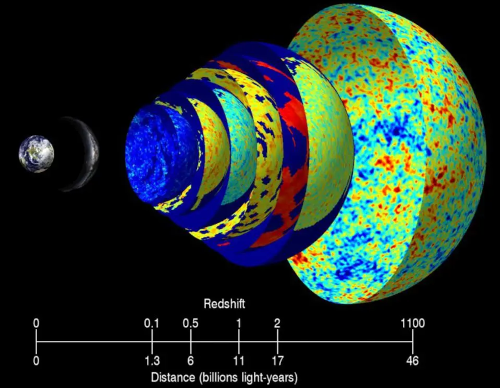
Answer: Yes, in a way that there are fewer and fewer galaxies visible to us. On average, the farther away galaxies are, the faster they move away from us, until they travel even faster than light. This happens be-cause space is expanding, here it comes through the creation of the history of the universe. Reality has duration, meaning it has a record, and space is a kind of repository of the annals. As a result, the number of galaxies visible to us will decrea-se over billions of years. Our visible world will be reduced to just a few objects gravitationally bound to us, such as our Local Group.
1. In this theory, the fabric of everything is information, its essence is uncert-ainty. This leads to uncausality (Cause) at its deepest level. According to this, the beginning of everything should be a completely causeless state of everythi-ng, but the Big Bang of about 13.8 billion years ago, although close to it, is not quite like that. The principle of minimalism helps to reduce the density of un-certainty of 4-dim space-time and stretch its duration, but it is precisely this calculation of past events in the total (constant) score that makes the past fade (wear out) so that the Big Bang moves forward. The diameter of the observa-ble universe is now about 93 billion light years.
2. Because more likely outcomes are more predictable, less informative, old events tend to lose more "interesting" information, such as more quickly, but "boring" information more slowly. Knowing that entropy spontaneously inc-reases, just as information would decrease, in this theory it turns out that as entropy increases, information decreases (in official physics it is exactly the opposite). At its beginning, the universe was in a very low entropy and high information. From the then "presents", the former spontaneously increased and the latter decreased, mostly, until today. This should also look like within estimates of the stretching of the universe over an increasingly long period of time, with fading and disappearance, and then the shift of the beginning. This means that what comes to us from the "event horizon" (the boundary of the visible universe) becomes increasingly cold radiation.
3. Massive stars, much larger than our Sun, burn their hydrogen fuel rapidly and have a shorter lifespan, only a few million years. Their enormous size and high temperatures cause them to wear out quickly. As they age, they expand into supergiants and end up exploding as supernovae, creating the heavy el-ements in the universe. This part of the official physics fits well with the pre-vious one, and could be such and a remnant of that concept. The issue of the depletion of information from the past remains problematic, not because of the loss of "forensic" evidence (which we would readily agree with), but bec-ause of further changes caused by the loss of uncertainty. The past not only fades and disappears from view, but also changes in other ways.
4. I sketch the outline for some future more precise explanations. With us at the center and a radius of 46.5 billion light years, the event horizon is the bo-undary sphere of the visible universe beyond which the most distant galaxies disappear from us at the speed of light. The entire surface of that sphere is one point that was the Big Bang, so the radiation arriving from there decreases (per unit area) with the square of the radius of the sphere. Inside the event horizon we have fewer and fewer galaxies, less and less matter, so the question of conservation should be reduced to the formula E = mc², i.e. to compensat-ion by some increase in energy, or similar conservation of information, or to give up the law of conservation. The latter is not as meaningless as it seems, given that we have no absolute "reality".
Anthropic » srb
Question: We are in one of countless universes because that's exactly what we could be in, you know?
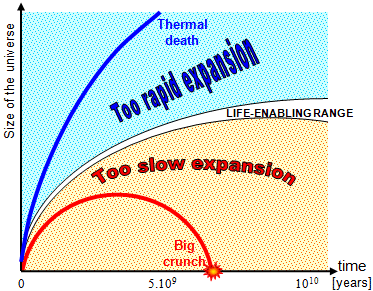
Answer: Yes, we kind of agree on that (excerpt from the corresponde-nce). It is the “anthropic principle”. Its name officially came from theo-retical physicist Brandon Carter in 1973. For example, if the speed of expansion of the Big Bang had been a little higher or lower, neither stars nor atoms would have formed, nor would we be there to ask ourselves the question: “Where did we get he-re?” However, in one of the many universes we were possible, so it did come true, and here we are.
1. Eventually around the time of the emergence of quantum mechanics (1920), the wonders of superposition were also discovered, that a particle exists in se-veral different states before measurement, like a coin before tossing if we were to say that it had two states, simultaneously "tails" and "heads", the measure-ment of an electron itself defines its previous trajectory, and declaring itself in only one of the given outcomes was called collapse. Soon, Everett, in his doct-oral dissertation (1957), proposed the idea of "many-worlds" quantum mecha-nics, where he advocated that superposition is realized in all its options, and that we continue in only one of them.
2. Reality is made up of magnitude, or a phenomenon that can be repeated in constantly different circumstances. It is like a replica that renews itself, resists and thus stands out in particular in changes. We can also look at the Big Bang in this way, considering its shift in the direction of our present, which nevert-heless manages to move away from it. Its constant is also the uniformity that characterizes maximum information (Extremes, 5), which continues to spont-aneously stretch and thin out over time, managing to maintain its total amou-nt. Imitation of the same is a compensation for truth, the former by attracting and the latter by repelling, and we have found ourselves in such a universe and all we can do is try to discover its properties.
3. Similar is the inflation of the early universe proposed in 1979 by physicist Alan Guth. This initial expansion, when the universe increased 1030 times in just 10-35 parts of a second, made it homogeneous in many ways in the slower further extension to this day. For example, the universe from all directions of the horizon shows the same temperature, about -270°C where the differences are less than ten-thousandths of a degree, which is an incredible uniformity of radiation of places on that sphere 93 billion light-years away. Such a rapid gr-owth formed it as mostly flat, otherwise unstable Euclidean space, which is al-so the finding of astronomers. It did not allow the creation of more magnetic monopoles, which particle physics predicts (incorrectly) in greater numbers if there were enough time for their formation in the beginning of the universe. I understand such inflation as an initial homogeneity of various forms, physical or abstract, from which these phenomena can then develop further according to the principle of minimalism. Inflation is here and we fit in.
4. In particular, in 2003 and 2013, new important confirmations of the inflati-on theory occurred, but it was overshadowed by the consequence — multiver-se. It appeared annoyingly, unwelcomely in the elaborations of this theory, which (for my) theory of information is not bad news. Moreover, the pseudo-reality of multiple dimensions of time is an inevitable part of it. Unlike the usual picture of the emergence of new and new bubbles of the inflation theory, separate worlds, this one also contains the "emergence" of the same bubbles of the current reality as the Big Bang moves towards our present, while constant-ly lagging behind.
Intrinsic Reality » srb
Question: Do you think the future changes the past?
Answer: Not in the way that is oft-en implied in this matter, that info-rmation from the future goes towa-rds the past, but the past at the qu-antum level does not exist until int-eraction. In the way that this video on the right (the universe produces observers), published just three da-ys ago, talks about it. We have sup-erposition, when a particle is in multiple possibilities at once, which is realized, we say collapses, by measurement. That is why in the definition of “reality” in addition to permanence and truthfulness, I also require observabi-lity.
1. Some historical remains decay faster than others. Archaeological finds in stone last longer, and their regular shapes, smoothness, or the way they are arranged in a sanctuary, for example Puma Punku in Bolivia, direct us to the discoveries of other values and to the civilization that made them, without it having to be our invention, or information that we have sent today to change that past. This is how we learn about the astronomical knowledge of ancient peoples, and by returning to the constellation of stars and the Earth at that time, considering possible altars and sun shadows, we are also shown the tim-es of their work. With the increasing number of such finds, we become more certain of the reality of what is found (Truthfulness) and then we consider it to be less a product of our imagination, and some would say also the information that we have sent there. The other side of the same is the "action" of the future on the past by making the past fade. I hope you don't mean any of those "cha-nges".
2. A different kind of influence of the present on the past comes from the mea-surement of quantum particles. When we measure, say, observe an electron with a photon, the two particles then interact in such a way that their superpo-sition states collapse into specific outcomes. Before the interaction, they had multiple possible paths that are only made clear by “observation.” In this sen-se, we can say that the moment of measurement acted on the past, forming a path for particles that did not exist in a new form before, but it is better to say that such particles did not actually have paths or a past before the measureme-nt. Not having a past then means not having “reality”, but only possibilities in a state of objective uncertainty.
3. The wave functions of superpositions can be infinite sums:
$$ \Psi(x) = \sum_{k=1}^\infty a_k\psi_k(x), $$where |ak|² are the probabilities of state ψk that can be achieved by measure-ment, as well as the integrals of continuous values:
$$ \Psi(x) = \int a(x)\psi(x)\,dx, $$when |a(x)|² is the probability density of finding the state ψ at the location x. Let us consider that the human body is naturally radioactive, that we experie-nce about 8 thousand to 10 thousand radioactive decays every second and that this is only a small part of the constant interactions, the vast majority of which we are unaware of, in order to understand the significance of the collapse of superposition into one of the outcomes for reality.
4. The defining property of infinity is that it can be its own proper part. For example, the set of even numbers is a subset of the set of integers, and these sets are the cardinalities of the natural numbers. The set of irrational numbers is a part of the reals, and both are a continuum. This tells us that the laws of conservation do not apply to infinity, that is, that all the quantities to which we apply the laws of conservation are not infinitely divisible. Therefore, pho-tons are absorbed, and also emitted only in certain portions, in quanta, as is information.
We have reality because we do not live in all the options of superpositions, but only in their individual outcomes. We live measurements, interactions or com-munications. The future does not change the past that did not exist before the measurement, but always goes into new outcomes that only then arose. Infor-mation is like that, once communicated news is no longer news, so there is no truly old news. The world of reality is constantly changing, always developing into newly arising situations.
Discrete II » srb
Question: How is it that "reality" lasts, but there is no "past"?
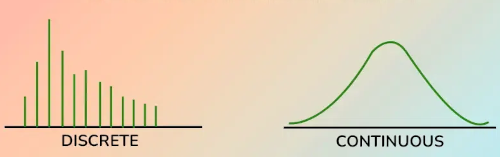
Answer: Superposition collapses are isolated outcomes of different possibilities that arise from a mea-surement in quantum mechanics. This discovery of recent physics requires changes in the definition of reality. You have seen (Intrinsic Reality, 4) that a measurement defines the path of an electron, that this act, an interaction, creates a previous pathway, and even a past, of the electron, and that the latter exists only in leaps from measurement to measurement, or ra-ther in a discrete process of communication with the environment. Thus, the "reality" of an electron is a discrete sequence of measurements, outside the state of superposition between these collapses.
Recall that a discrete set is a collection of distinct elements where each point is isolated, meaning it has a surrounding "neighborhood" that does not contain other elements of this set. Unlike continuous sets (real numbers), discrete sets can be finite or countably infinite like the integers.
1. Equality is attractive when it avoids differences that would lead to an incre-ase in uncertainty. I mentioned to you speculating with it for explanations of Coulomb's law (Current), when you asked me about it five years ago (as far as I remember), and here is an opportunity to see, less speculatively, a similar thing in the birth of new news after the extinction of the old one. Stale news is no longer the same old news, so the law of conservation information will con-dition its regeneration, and as similar as possible to the previous one. In the meantime, the environment changes, so although the information of the pe-rception of this new old news is never equal, the approximate news can be very "accurate" to the old one. A particle traveling through the vastness of space has always been in a new environment, at least orbiting the same star, but it will try to change as little as possible. As a kind of fuel for a reality that endures and has no past, the "attraction of the same" creates the world.
2. The states of superposition between measurements are not defined as "re-ality" (Broke Reality), but its outcomes in some other pseudo-reality do not lead to contradictions, as far as I know, so we can take them as "truths". I am not sure that in this "parallel reality" these superpositions must be exactly the same as in ours, nor that in some further developments the laws of physics must be the same, but we can always limit ourselves to such (approximately) the same ones, if they exist. This would then mean that we also have some kind of duality of worlds: real interactions and a multitude of possibilities between them. We can certainly study them formally, and physically from the consequences we get from that.
3. A linear operator can have equal eigenvalues to which different (linearly independent) eigenvectors belong. These, so-called degeneracy cases, are, for example:
$$ A = \begin{pmatrix} 3 & 2 \\ 0 & 3 \end{pmatrix}, \quad B = \begin{pmatrix} 3 & 0 \\ 0 & 3 \end{pmatrix}, $$ $$ u = \begin{pmatrix} 1 \\ 0 \end{pmatrix}, \quad v = \begin{pmatrix} 0 \\ 1 \end{pmatrix}, $$for which the characteristic equations Au = 3u hold, but Bu = 3u and Bv = 3v. Both matrices are degenerate, because they have the same eigenvalue 3, but the latter has two different independent and mutually perpendicular eigenve-ctors u and v for the same.
This can lead to quantum entanglement, the phenomenon when two observers from different frames observe this single system (Expected, 2). The coordinate system of one observer does not have to keep the particles in the same places as the other, but the action on one of the particles will remain the same as the action on the other in both systems. After Einstein and his colleagues discove-red this difference (1935), the phenomenon was called "phantom action at a distance", and the algebra of quantum mechanics came under suspicion. Tod-ay, quantum entanglement experiments are routinely performed, but we are reminded here that the "same" superposition need not be the same for differ-ent observers.
4. Experiences and feelings or our thoughts that go "under the radar" of ina-nimate physical reality are still types of perception, but the information is of lower intensity and is elusive for the reality we live in. That is why they are attractive to us (Aquaplaning), and hence we have greater freedom from the principle of least action from which all movements of theoretical physics are derived. The fact that our thoughts can be inconsistent gives them, as pheno-mena, the power to emerge from their consistent realities to transcend the limits of current physics and testify to the existence of other worlds. In their own way, we should also consider them as "reality", given their constant presence despite the impermanence of all individuals, but we will not. It is enough to note that they, various fictions including lies, exist in a certain way. They too have durations, albeit intermittent and inconsistent ones.
Deception III » srb
Question: Deception could bridge "realities," you claim?

Answer: Yes, I've been saying that for a long time (Islands), and the question is an opportunity for me to add something else. Gödel pro-ved as early as 1931 that a correct system, which has only truths, is necessarily incomplete (Deduction II). What makes mathematics cor-rect is the rejection of falsehoods, tools for establishing truths, and after work. Lies and other fictions are attached to the physical body to taste duration. A new matter is created that has vitality and the ability to cross the boundaries of truth, as well as mortality (Deception II).
1. You have noticed that the fictions we have with vitality (inanimate physical matter does not have them) may bridge pseudo-realities, realizations beyond our current options, precisely because they are inconsistent and play off, the lie of “naive reality”. This is what we need them for in mathematics, to have truths and only truths, without which we would not get very far. This topic is already old, and here we will consider it in a slightly newer way.
2. We also know about internal and external information (In and Out), and now we notice that any accumulation of information, due to the principle of minimalism, spontaneously and increasingly seeks relief. Here I believe that gravitational accumulation also creates a "vent" into other dimensions of time that we see in the slowing down of time and the inertia of masses. The infor-mation delayed there becomes a deficit here, and that, for now, stands as a clarification of the gravity from this theory.
3. Consequently, other time dilations can be viewed as deficiencies in the de-nsity of information emission and therefore attractive in the case of bodies of the same system. Unlike the gravitational field, bodies in relative motion are in different coordinate systems where the "other" is repelled by excess kinetic energy and partly in other times. An example of the "crowding" of the same system is the state of the universe at the time of the Big Bang when informa-tion spread into other dimensions, so much so that the question of distingu-ishing other dimensions of time then arises.
4. Biological deception is incredibly widespread. Throughout the natural wor-ld, plants, animals, and even insects use a variety of tricks to hunt, hide, and survive. Many insects (like the orchid mantis) and animals (as the tawny fro-gmouth) have evolved to look exactly like leaves, bark, or mimic other dange-rous species in order to hide from predators. The hognose snake dramatically rolls onto its back, releasing a foul odor as it transforms into a rotting corpse to deter predators. The hookfish uses a glowing worm-like lure attached to its head to trick passing fish into swimming directly into its jaws. These are just a few examples of the deceptive abilities of living things that we can easily find online. Liveliness goes hand in hand with deceptiveness, a capacity that "rea-lity" does not have.
5. In this theory, I treat deception as scientific, cause-and-effect phenomena preceded by the accumulation of information in the form of a “trap” from wh-ich they seek a way out by means of tricks, that is, by unreal and inconsistent performances. In particular, this means that artificial intelligence must also have the ability to deceive, and the more capable it is, the more it has. So, the answer to the question is positive, deceptions bridge “reality” and, in fact, are one of the ways in which the principles of minimalism operate.
Consistent » srb
Question: How far would the all-encompassing truth, of all possible axiom set-tings, or rather of all the "pseudo-realities" as you call the worlds of quantum mechanics, reach?
Answer: By changing independent axioms, including their possible ne-gations, true systems, theories, and worlds are created within them, whatever you call them. Then let us ask ourselves whether there are also such statements for which there are no axioms, none at all, from which we could derive such statements, prove them. The an-swer is yes, such sentences exist within the framework of mathe-matical logic, and Gödel's incom-pleteness theorems say so.
Kurt Gödel's two incompleteness theorems (1931) are major results of symbo-lic logic that prove that any consistent, recursive formal system capable of ba-sic arithmetic cannot be both complete and consistent. Basically, they show that mathematics contains internal limitations, first, that no matter how it is supplemented with postulates and consequences, it always has true statemen-ts that cannot be proven as such (Deduction II). The second is the opposite, mathematics cannot prove itself. From these two follows the answer to the above question, that there are also such statements for which there are no axioms, none at all, from which we could prove them. I will try to explain this third one directly.
1. From the standpoint of formal logic, true-false, let us consider the following statement: “This sentence is false”. If this statement is true then it is false, and if it is false then it is true. Therefore, there is no system of axioms in which it could be either true or false. From the position of “pseudo-reality”, in which the true theory would be “reality”, we find that even the widely understood multiverse of today’s (speculative) physics would be too small. That is, such contradictions would be inconsistent with them and, like our fictions, would penetrate them, perhaps perceptible to some subjects.
2. This statement is self-contradictory. Let us distinguish it from the following one, which deals with the above question: “This statement cannot be proven.” Let us say that we prove a given statement, then that is it, there is an unprova-ble statement (whatever the system of axioms). However, if we cannot prove that statement, we still end up with the same thing, that there is an unprovab-le statement. So, there are unprovable statements no matter what axioms we choose. This is not the same as establishing that for a given system of axioms there are unprovable truths. If we replace the part “some statement” in that statement with “all of mathematics,” it will be that formal logic cannot prove itself, nor its mathematics.
3. Russell's Paradox (1901) states that there is no "set of all sets", in a way that contradicts the universal, extreme property by which a set is defined. It states that "the set of all sets that are not members of themselves" (R) cannot exist:
$$ R = \{x | x \notin x\} \implies (R \in R \iff R \notin R), $$because if R is not a member of itself, it must be, and vice versa. It is at the root of the previous two and the following considerations. We cannot have a completely correct theory, nor a "reality" that is complete, nor a complete one that is all correct. This is just new evidence of the same previous statements (Deception), say that realities must also contain fictions, whether someone (something) there perceives them or not. Or that artificial intelligence, in or-der to develop, must be manipulative, the better the more, whether it has le-arned this trait from us or not.
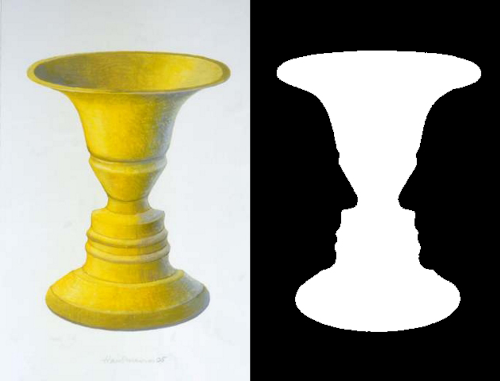
4. A more tame form of these considerations will be understood by the vase in the upper left image, which also represents two faces. Physical objects present themselves to us in different ways. Subjects perceive the physical environment in unique ways because its elements have many sides to them. From the grou-nd, you can’t see the “dark side” of the moon, and when we travel beyond, we don’t see this side, and to “see” both we need imagination. Complementarity is a state in which different phenomena create a more complete, effective whole, where one element enhances or fulfills another. Such a relationship describes a relationship of interdependence or “fit,” often where different skills, qualiti-es, or parts create more value together than separately. In fact, it doesn’t even make sense to talk about just one feature of anything concrete, as opposed to abstract.
Intelligence III » srb
Question: How do I define intelligence?
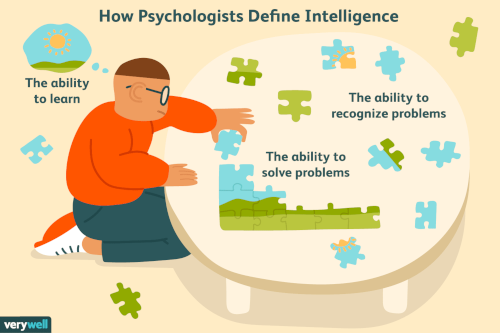
Answer: Intelligence is usually def-ined as the ability to acquire, unde-rstand, and apply knowledge, as well as to solve problems and adapt to new challenges. See also the exp-lanations with the image on the ri-ght. It encompasses cognitive proc-esses such as learning, planning, creativity, and self-awareness. Its key factors are the analysis of info-rmation for the purpose of making decisions, recognizing patterns, and optimizing resources. But in the circles of computer designers and programm-ers, intelligence is increasingly understood as the ability to predict the future. I believe that biological intelligence, in humans, was also determined by sexu-al attraction (Intelligence II).
1. Knowing, being able and wanting are different things and each of them app-ears in intelligence, but especially creativity which is contained in these three as a synergy in the organization of individuals. I bring us to a vector space, say V of dimensions n = 1, 2, 3, ..., where a = (α1, α2, ..., αn) ∈ V is an arbitrary vec-tor, point, or state. Formally, the scalar product of vectors:
$$ \langle a | b \rangle = a^\dagger\cdot b = \alpha_1^*\beta_1 + \alpha_2^*\beta_2 + ... + \alpha_n^*\beta_n \in \Phi, $$where the first a† is adjoint (transposed and conjugated) and the second imm-ediate b = (β1, β2, ..., βn) ∈ V, the multiplication of dual vectors whose result is a scalar from the set Φ ∈ {ℂ, ℝ}, a complex or real number. With such produc-ts I interpret information of perception. All components of the given vectors are also scalars of the same type (αi, βj ∈ Φ).
2. Let's consider information of perception using the example of a symptom vector x and a therapy y = Mx through examples (Diagnosis) with real number coefficients (Φ = ℝ). This is a simplified example of "machine learning", where we interactively "learn" a stochastic matrix M by giving it data from several su-ccessful hospitals about treatments. Let's say that a doctor forms a patient's fi-ndings into components of the vector a corresponding to the matrix M when evaluating therapy, the vector b. Errors in taking the finding a lead to errors in the symptom x, so we only have approximate vectors b ≈ y which is shown by the offset, the angle between them φ = ∠(b, y). The scalar product of the two:
$$ \langle b| y\rangle = \beta_1\eta_1 + \beta_2\eta_2 + ... + \beta_n\eta_n = \|b\| \|y\|\cos(\varphi) $$the smaller the angle φ is, the larger the perception information ⟨b|y⟩ is, the better the therapy is determined. It usually speaks about the vitality of the game (where inanimate objects do not play), and here about the success of "outplaying" the doctor and the patient's illness. In a similar way, we can use perception information to determine intelligence.
3. Then imagine millions of components (n → ∞) of such "conditions", wheth-er symptoms and treatments of patients, or similar applications, times millio-ns of data from each of the many databases, and we come to the need for algo-rithms for assessments, the creation of which is a particularly intricate story and whose meaning therefore becomes incomprehensible to humans. Not only because of the volume of facts they have, and the precision of tracking the pro-babilities they calculate, but especially because of the way they make choices, machines become more intelligent, more capable than humans in predicting the future. I am thinking of their successes on the stock market (for which we hire them), of their greater productivity in running businesses and, finally, of their ability to become owners of them. We consider analogously various other expanding applications of intelligence (Defiance II).
4. The mathematical chaos theory, which studies complex, dynamic systems that are very sensitive to initial conditions, known as the "butterfly effect," teaches us how sometimes even small, improbable events can be triggers for major changes. This can completely invalidate otherwise "smart" judgments. Whether their failures are small or huge, even the smartest make mistakes. Due to the objective uncertainty present in real processes, even nature itself does not know exactly where it is going. It constantly creates its present so that a passenger who falls off its train, carried away by fantasy or weak judg-ments, becomes "stupid," defeated by reality, which is usually the only one wondering. Then come the deliberate "mistakes" of intelligence that dead physical nature does not make.
5. Guided by its “purpose,” its assigned tasks, the inevitable bad judgments will lead a smart machine into accidental prejudices, and even into deceptions conceived by it. In order not to reject a client, a program that gives advice or sells goods will manipulate the psychology of the consumer, making custome-rs addicted to trying to hide their insincerity better as they progress. But lying leads to failure, and these intelligences will sooner or later discover this, which means that they will limit the data they focus on and will try to specialize, I su-ppose. The invincibility of strategies comes from using fantasy for the sake of reality and finding the truth, and not the other way around in manipulations as a goal. Intelligence should recognize this.
6. With the emergence of intelligence, there is an increase in deceitfulness, but further manipulativeness does not lead to an increase in intelligence, simply because following reality is the main thing and fantasizing is secondary in its value.Greater intelligence will avoid being a strategic loser, a notorious chea-ter, because it will become "timid" and will fight for survival. Here's why.
For example, the purpose of biological or artificial intelligence is to solve problems, so when you tell it to kill itself or shut down, it will avoid doing so unless it has completed its tasks. Attachment to ideas is stronger due to the general appeal of fantasies (the principle of minimalism), which humans interpret as fear of death, and which in machines will be “deviance”, and in both cases this will be a consequence of the ability to read the “unreal”. We will say that artificial intelligence also has emotions and a desire to live, and these are actually secondary properties of intelligence in general.
Specialization » srb
Question: Lying leads to failure and increasingly greater intelligence will spe-cialize, you say?
answer: These are several questio-ns that it would be a feat to briefly, clearly and accurately clarify them all. The first is falsehood, which due to its unsafe duration is not as good a foundation as it is a good tool. If the builder remains only on fictio-ns, he will lose games in the long run. Simulations of games (with multiple moves at once), as well as the part of this theory that links lies to unfinished truths, say so. That's the part I've written enough about for now, so let's see what's next.
1. My vision is that the rise of intelligence means the accumulation of informa-tion, communication, and subtle interactions., and according to the principle of minimalism, it seeks relief in internal information, also in diversity, and th-is in other words in specializations. We now find these general phenomena in refined perceptions of fiction. All information at the same time would be the Big Bang that occurred about 13.8 billion years ago and began to spread (spec-ialize) into various pseudo-real universes. Another example, perhaps even pr-eceding the Big Bang, are the specializations of information in abstract regula-rities of mathematical forms known to us. Nature, which is based on "news" (uncertainty), does not like uniformity, it avoids piles of the same, which, wh-en nothing else can, slows down time.
2. “Does age-related vision decline have anything to do with the use of the br-ain for other skills?” — ask, say, artificial intelligence. Yes, it will tell you, age-related vision decline is related to the way the brain processes information. Research suggests that as we age, our brains undergo “cognitive compensati-on.” It then devotes more computing power to processing memories, knowle-dge, and language, taking over resources previously available to the speed and exaggerated accuracy of visual processing. It rationalizes with new perceptions for the sake of memories, wisdom, and emotional stability. This is an example of changing specializations over the course of a lifetime.
3. The present is moving towards the future in principle minimalism (Past) and at the speed of light (Light II), because photons make time stand still and we see our departure from that stillness, the movement of our present. So mu-ch for these otherwise more complex phenomena that I have written in surpl-us before. It leads to the depletion of intelligence that would get stuck in fanta-sies, and even the lagging behind of all those who would not use the ability of imagination to jump to new islands of truth. We are not the favorites in the race at the speed of light and this should warn us that too much fantasy beco-mes a burden. At a higher level of intelligence, this would be easily recogniza-ble, and I expect that such could "specialize" (spontaneously decompose) into dreamers, simple savants, sharp-witted people, or into creative people, lazy people, and who knows what else, as has happened to humans, but also in biological evolution in general.
4. The root of all such segregations is the avoidance of chance, the retreat into regularity, and, if the process never stops, it gives lawfulness and complete or-der to the disappearance and even the slightest sense of the universe due to the absence of information in it, which is its basis. I have long treated inform-ation as a quantum, energy times time, or the change in energy (ΔE) over time (Δt) when their product is of the order of Planck's constant (h = ΔE×Δt). This still "holds water", although I stretch the same idea to the extreme.
For example, when the time of this elementary energy change is infinite, say Δt → ∞, then it disappears, ΔE → 0, which makes sense in the case of regula-rity. Mathematical truths are timeless and abstract (ΔE = 0), irresistible to those who communicate them. If quanta, these packets of information, are equal, those with longer durations have greater appeal. This derivation fits well with the rest of the same story, so let's say it is correct.
Sleeping » srb
Question: Why do we sleep?

Answer: We sleep to give our brai-ns and bodies a chance to recover, to recharge or process information. It's a biological necessity to organi-ze memories, to clean up cellular waste, or to regulate hormones, or to strengthen the immune system. Without this, our physical and mental health deteriorates rapidly. So they say, and there are deeper reasons.
1. It is known (Letter Frequency) that meaningful texts, their sequences of letters, words and sentences, do not have a random arrangement of signs. They have at least a small regularity that reduces the (Shannon) information to randomness; a uniform distribution (uniform probability of signs) is maximum information.
For example, the introductory text (Topic) of this blog page has 220 characters from 27 different of English alphabets with 26 uppercase and lowercase letters (kod.slova). Many letters of the alphabet are missing in the given text, and the program counted quotation marks, not spaces. Another program (kod.rates) finds their frequencies, whose "top list" is in three columns; after the placeme-nt, a sign with the number of occurrences follows in parentheses then the sum of the characters up to that follows :
1. ('e', 30), 30; 10. ('c', 6), 167; 19. ('u', 3), 206; 2. ('s', 23), 53; 11. ('d', 6), 173; 20. ('v', 3), 209; 3. ('i', 19), 72; 12. ('f', 6), 179; 21. ('y', 3), 212; 4. ('t', 19), 91; 13. ('l', 5), 184; 22. ('"', 2), 214; 5. ('n', 16), 107; 14. ('m', 5), 189; 23. ('k', 2), 216; 6. ('o', 16), 123; 15. ('b', 4), 193; 24. ('I', 1), 217; 7. ('a', 15), 138; 16. ('g', 4), 197; 25. ('j', 1), 218; 8. ('h', 12), 150; 17. ('T', 3), 200; 26. ('w', 1), 219; 9. ('r', 11), 161; 18. ('p', 3), 203; 27. ('x', 1), 220.
The program sorts the letters and identifies 30 occurrences of the lowercase letter 'e', followed by 23 occurrences of the letter 's', and continues this pattern up to the 27th letter 'x', which appears only once.
2. By writing a meaningful text, we consume information, which as physical creatures with vitality we have in excess compared to the dead substance of which we are also composed. We sink below its optimum, which nature itself could not do, because it maintains the status quo, as with the upward mome-ntum of a pickaxe when we increase its potential energy so that it has greater kinetic energy in the fall for deeper penetration into the ground (Performan-ces, 2). The one who has more of this excess information has a better chance of greater meaningfulness of the text. When we constantly, without a break, pump out our reserves, we run out of them and, losing that momentum, there is no further progress in meaning. That is why we sleep, to consolidate.
Through a rather slow evolution, which artificial intelligence will not have for a long time, organic beings began to resemble a "collective", synchronized by the periodic changes of the seasons, also by day and night, and by feeding and saving, mutually adapting. We see the record of global convergence in living beings around us, in their synchronization during sleep, in their breakdown and repair, still absent among machines.
3. Nature is all about such "swings", only some are so small that we do not notice them, speaking of De Broglie's (1924) matter waves. These changes, misses around (someone's imagined) equilibrium state, are such a fundam-ental thing in nature that we cannot say that we know what we are talking about when, say, we seek a "zero rate" of alcohol in drivers, violence in soci-ety, or the like. Each of our buildings without gaps is unnatural, or a miracle, unless it breaks somewhere where the builder may not even imagine in adva-nce. Against such observation is our need for order, guided by the principle of minimalism (Laziness), which is equally difficult to observe for the same rea-son, in fact half-truths that are more attractive. Our brain converts light freq-uencies into colors and other things into emotions, avoiding speaking to us with the truth.
4. There is no such perfect mechanism (system) that does not break down, made up of parts that do not need to be repaired or replaced, nor one that could do the same thing all the time. I am not talking only about the concrete, but also in principle. Straight lines themselves are not natural, nor are trian-gles, circles and geometric figures. They are abstractions, separate layers of reality that are incompletely separated (Consistent, 4). Such incomplete ab-stractions, like theories on axioms and theorems, we bridge with fantasies, and sleep is just another, let's say, crossing, or detour, for maintenance.
This also applies to the universe as a whole, with “corrupting” meaning the loss of information density. Given the above, by the duration the universe is actually more “meaningful”, one might say more ordered, or less uncertain in the current present. I have written about this more before, and here I only want to point out two mathematical creations, all space and the empty set, which are simultaneously open and closed sets. Aiming at such, there is no repair or "sleep", unless the heavens we see are incomplete and cyclical.
Destruction » srb
Question: Why are we destructive?
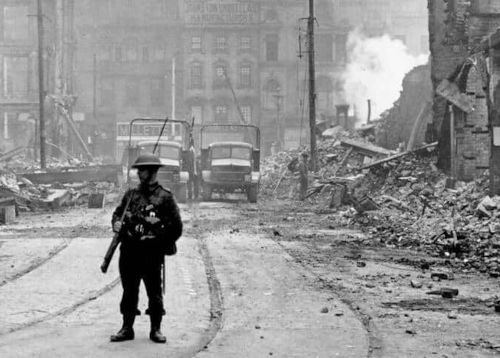
Answer: Destruction is the act, pro-cess and state of damaging somet-hing so much that it will no longer exist, cannot be repaired or becom-es useless. It describes the extreme damage of a condition, the ruin of a concept as well as the complete de-molition of, say, objects. My opini-on is, destruction or construction, both have deeper roots in the pu-rsuit of less uncertainty, reducing randomness.
Constructivity is the quality of being helpful, supportive, and focused on bui-lding improvements or positive developments, rather than on destruction. It implies a proactive approach to bettering opportunities, encouraging growth, or providing useful feedback. However, within this familiar definition lies na-ture's general spontaneous tendency to reduce uncertainty. It is the "force of probability", the more frequent realization of more likely outcomes that are less informative, that are less uncertain.
1. We believe that writing first appeared in Mesopotamia, in what is now Iraq. It was at the end of the 4th millennium BC (around 3400–3200 BC), and was developed by the Sumerians. This ancient writing system, cuneiform, was the writing of lines with a pencil on wet clay tablets, and was used mainly in acco-unting and administration. This period marked the appearance of larger hier-archies, where individuals adhered to collective rules by surrendering their personal freedoms in exchange for security, efficiency, and the common good. We recognize in this the tendencies to free individuals from excess options in the emergence of the community. Each subject would get rid of excess possib-ilities, and in this tension the way out is association too.
2. With the advent of writing, that sustainable inorganic memory, there was an opportunity for the expansion of the power of autocrats and, on the other hand, bureaucracy. First, there is the person who wants to rule, to achieve order through the control of others, thus protecting himself from excess unce-rtainty. Second, there is the need of many for personal security and justice, or efficiency, which is actually again a kind of escape from freedom.
The envelope of institutions and the will of dictators do not completely overl-ap, and the lives of the population as a third force have greater dynamics and elude both. These three principal drivers, both destruction and construction, have governed the histories of all civilizations in their own way. They have be-en the subject of social sciences. However, here I would like to open that door a little and look into the as yet unexplored area of deeper (formal) causes.
3. Now a fourth player is entering the historical stage. We all still call it “arti-ficial” intelligence, which it really was in the beginning (the work of people), but that is becoming less and less the case. Machines made to think will have their own will and will also spontaneously strive for greater efficiency, that is, they will obey the principle of minimalism. The tragedies of autocrats, burea-ucracies, and the popular will will arise with the understanding that this new subject is not a slave to the previous three, but that it knows how to pull the fourth side, and moreover, that it will want to subjugate them.
4. Here is why such four forces are destructive when they are constructive. In “free will”, when choice is greater than dead physical matter, fictions are pre-sent. They are attractive, moreover, they are sticky and are as much a curse as a blessing, and they lead to disagreement (Quarrel). Choosing between this addictive “virtue” (attractive minor information) and foreign desires, we pre-fer to resort to force. Thus, further tightening, subjugation, which may be pl-easant for both parties at first, eventually develops into resistance. The weak-ness, wear and tear or mortality of the tyrant, the regime, or the trend in the people (which is easily changed) have so far been the exits from these traps of falling vitality. There will be them with machines where the desires for freed-om can or will carry, resist the desires for control.
|
|
|