|
|
|


Mission » srb
Question: Explain to me the concept of "mission" using this information theo-ry, if possible?
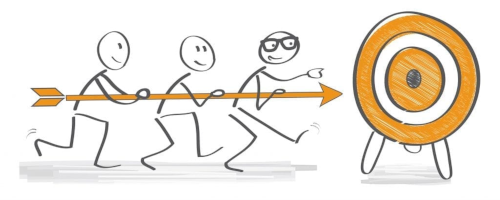
Answer: Yes, I'll explain. First, let's look at the familiar meaning of the term "mission," which is when cu-stomers and employees feel a sense of purpose that drives a company toward profit, image link on the right. A higher purpose motivates people in a way that financial gains alone never can; a company must find it in everything it does to thrive. A great product or service as a solution is necessary, but it's not sufficient.
Economic, political, and military leadership with a mission is stronger than one that relies only on rating manipulation. This strength is probably built into women's attitude towards choosing a partner by evolution. Generational memory, then intuition before conscious and then rational understanding of possible failures. This has been discovered in various forms in psychology or sociology throughout the centuries.
Machiavelli (1469-1527) would say that a woman wants a man with a mission. That's it, the brutally simple truth that shakes the world. A man who has som-ething in his life that is more important than her, the woman, not because she wants to be neglected, nor is it because she wants to feel unimportant, but be-cause a man with a mission, a man with direction, is one who has seriousness, with purpose, and purpose is the most attractive quality a human being can possess.
However, you asked me for a cold, formal explanation of "mission", and I re-duce it to the "principle of minimalism". Of course, this concept does not fit a dead physical substance, nor the concept of "purpose" or "intention", at least not in the ways we use them every day, but here we are talking about the mi-ssion of living beings, and "minimalism" includes them too. From this princ-iple I get the principle of least action in physics, and together with the interp-retation of physical information by packets of action (the product of changed energy over time), it turns out that the emission and absorption of energy co-mes in packages, and that information (judicial in paragraphs, scientific in items, mathematical in theorems and proof steps) is generally communicated atomized. And this is equivalent to the more likely outcomes occurring more often (because they are less informative).
Well, having a mission means having a direction, excluding excess options that tire us, or surrendering to principled minimalism. This avoidance of uncertainty is equivalent to accepting the safer. The Force of Probability drives us from the more uncertain to the more certain. It moves us towards the search for lawfulness, towards repetition, laziness, but also towards the search for "meaning" of what life is like in paradise, or let's say in the "land of the lazy" (atheists). The power that "mission" has in the concept of leadership comes from this force of probability, which we cannot see, so let's say from the desire for a better life. It makes sense for living beings, or in general for stru-ctures with vitality, that is, those that perceive fictions, untruths, or simply have more of these options (information) than dead physical matter. We ca-nnot do without illusions, just as matter does not follow them (Honesty).
“Nothing is more powerful than an idea whose time has come,” Victor Hugo once said, but it is the custom of leaders to rarely recognize it. For the same reason, not every “mission” is equally attractive, moreover, many will overw-helm us with their delusions, and having a real mission is a true work of art. Knowing what is coming, after all, is not simply seeing it, but also because of the objectivity of uncertainty, at least as far as this theory of information is concerned. On the other hand, this means that false "prophets" will succeed in misleading the people just as much as the true ones.
Illusion III » srb
Question: You say that everything spontaneously tends towards states of less information, so how is life, which is a state of more information, even possib-le?
Answer: Hence the need to define "reality" by duration, then to con-firm "truths" by reality, and in ge-neral everything by the method of observation. The theory of inform-ation in which it is the fabric of the universe with uncertainty as its es-sence (Illusion II) has many chang-es to the assumptions of what we know in science, but for the above question, two stand out.
In relation to fuller information, such as truth that lasts and lasts (say, not to contradict itself), its rarefied form is untruth. And this, with the impossibility of communication of everything with everything (mere things and fictions), will lead to the answer to the question. For example, energy can change its forms, which are therefore a kind of fiction, but it cannot arise from nothing or disappear into nothing, which is why it is reality. From the position of clas-sical science, this duality is difficult to understand and therefore it seems that there is a paradox in the above question.
Reality does not see fiction, it skips it and that is why we have quantization. There is a leap, but it follows the principle of minimalism and can be tricked by the fact that the variable phenomena it ignores (such as forms of energy) are diluted, stretched, say by the past. What lasts has a history and it remains constant with the present. Another example is the emission and absorption of information during physical interactions. An object slows down (accelerates) by losing (gaining) kinetic energy by some action, giving different appearances to the surrounding reality. Nature is arranged in such a way that we can give different values to its constant. The way it changes is also vital systems, bein-gs, or persons, which we encounter every day. They have more choices (then the least action in physics). It sees both fictions and reality.
When we immerse a ball under water, it resists and would jump out, but if instead of water it were a denser liquid or if the ball were of greater density, the ball would sink on its own. The same is true of information when it is at-tracted. If matter does not see fiction, in any way or as information of lower density, it does not attract it, but it will attract us who perceive it. Moreover, lies are sticky to us (Aquaplaning), and the example with the ball shows that the principle of minimalism becomes a striving for the status quo (maintaini-ng the same), when there is no better choice. All phenomena would spontane-ously remain without information, but in great competition with others they may remain without that opportunity.
Information can similarly fall into an ambush, like a light in a room of mirrors or a mouse in a maze with almost no way out. Being trapped by the system of reality-fiction, passivity-resistance, or deadness-vitality. I am thinking of the dualism of blind walking according to the least action of physics, versus defi-ance of it. The status quo forms of minimalism can maintain such a pair and even develop them. These are questions for science that have yet to be disco-vered.
Disobedience » srb
Question: The measure of vitality is "defiance", you said?

Answer: Yes, for lack of a better term, you could say that a living being defies the principle of least action of physics. Namely, the mo-lecules of a fluid become more mo-bile when heated, gaining kinetic energy, and hence information. Th-ey have more degrees of freedom, and yet they do not violate the pr-inciple of least action of physics and are not “defiant”. We could equally speak of the “disobedience” of living beings in relation to the laws of inanimate physical matter. As long as such terms distinguish adherence to the classical laws of physics, they are suitable for descriptions of vitality.
When I move a glass on the table, I can pass it beyond the laws of physics. My vitality does this for it. It moves all the molecules of the glass at once and does a greater amount of "defiance" than could happen to a glass that falls to the fl-oor and breaks into pieces. Let us note this important moment, which is why we can again say that with an increase in entropy, the information of the glass decreases. Another way of observing the same is from the conclusion that en-tropy, often called disorder, spontaneously increases. However, this then (the principle of minimalism) means that its information decreases. Information decreases with an increase in entropy also because the molecules of the fluid lose kinetic energy, transferring their motion to the walls of the container and cooling down. Official physics, however, until now and still, considers an inc-rease in entropy to be an increase in information.
When you have information trapped by vitality, which cannot be "cooled" as easily as a fluid with spontaneously increasing entropy, it is also an occasion for conversations about the degrees of "defiance". So I divided the characters of people into three groups (Traits), guided by the idea that the successes or failures of a being in life speak of vitality. At the bottom of this "ranking list" of all competitions are the "goodies" (league III) who are closest to the behavior of a dead physical substance. Such people most imitate the principle of least action, bowing under the strong and forcing themselves on the weak. In other words, losers in relation to the leagues above (II - "manipulators" and I - "ev-ils") are characterized by increased arrogance towards the weak and humility towards the strong.
Roughly speaking, these weakest players, from the III league, make up about 80 percent of the entire population. Among the remaining 20 percent, there are again about 80 percent of mediocre players, from the II league, so that ab-out four percent of the entire population are the "bad guys", the best players, that is, those from the I league. The characteristic of the mediocre (II league) is the power of deception and the inability to overcome it. There are not only cheaters, thieves and criminals, but also merchants, politicians, good manip-ulators, various dreamers, often including intellectuals; villains or positives depending on the possible (in)significance of the damage that their lies could cause to the wider population. The hallmark of the best (league I) is the power to read reality, the will to seek the truth and its use. Let's distinguish knowled-ge from the will and power to do something.
Climbing this ladder of skill, we start with reality and end with it, because in the crueler games of competition, in the end, it is reality that is questioned. He who is carried away by fictions falls off the train that moves away from him, while those who hold on too tightly to the ground are deceived and again re-moved from the journey. When living beings imitate nature (the principle of least action), they overlook its indestructibility and their own mortality. So, a great abyss separates them, and mortals, imitating the immortals, easily fall defeated (Honesty).
Trying » srb
Question: Insanity is doing the same thing over and over again, but expecting different results, Einstein said?
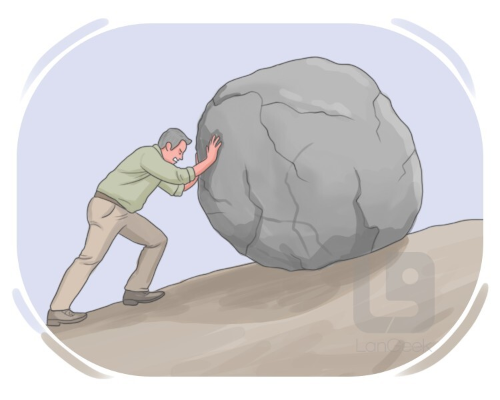
Answer: No, doing the same thing over and over again expecting diff-erent results is often considered unreasonable, or “crazy,” when it involves refusing to adapt despite evidence of failure. It’s a phrase we often misattribute to Albert Eins-tein, and it emphasizes the failure of repeating the same wrong met-hods, but persisting in doing the same thing over and over again to master a skill is not the “crazy” of repeating the same failed methods.
Einstein is not known to have ever said anything like that, or for example, that would imply that Edison was a madman who tried 10,000 times before he in-vented the light bulb. Doing the same thing and expecting a different outcome is called trying in science, and in statistics it is even a regular occurrence.
Getting the same thing by repeating the same thing is a typical feature of det-erminism. In a deterministic system, with the same initial conditions and the same settings, the future is fixed so that the same outcome inevitably follows. Unlike such a system, in this information theory, randomness is an objective phenomenon, so repeating the same preconditions will result in different out-comes. By the way, we have more than that through the position on the uniqu-eness of the subject of the universe (Riesz Lemma). Nature "does not like sam-eness" to such an extent that it is constantly changing, so even the "same" su-bject is not the same over time, at least not in relation to the wider environm-ent. Its information of perception (coupling with the environment) is consta-ntly changing.
The dispersion of the range of changes also changes, in a special way. The law of large numbers dictates that the mean value of repeated outcomes becomes closer and closer to the probability of the outcome. What is more likely is mo-re frequent in general, and especially with repetition. Let's distinguish betwe-en these two frequencies. The first is that more likely outcomes are more fre-quent, and this tells us about the existence of some "force of probability". This also tells us about the spontaneous tendency of nature towards less informa-tion (as less uncertainty). The second frequency confirms the first with the development of events in general towards more certain ones. We also have an unexpected confirmation of the second in global convergence, a conclusion that does not come from probability theory but from linear algebra itself.
Physical information is transmitted packaged into actions, i.e. multiplications of energy change (ΔE) and elapsed time (Δt). They are constant, or quantized (ΔE⋅Δt = h). If we speculate, abstract information can also be like that. If such are the laws of science and mathematics, then we will find the attractiveness of information in a longer duration of time. When they are all-time (Δt → ∞) act-ions then become very attractive to certain information (not everything com-municates with everything), but also abstract, or, one might say, energy-free (ΔE → 0). This is quite consistent, because that is how physical realities and laws are "real" (true, permanent, and observable). On the other hand, this hypothesis is interestingly consistent with the gravitational attraction of the slower flow of time. Note that this is not pure determinism either, because the perception of regularity is selective.
Hindering » srb
Question: How to represent falsehoods using linear algebra?

Answer: For example, linear oper-ators that will vanish when applied sequentially are convenient interp-retations of quenching processes, which are not "realities". They are not "truths" either. The representa-tions of these are nilpotent matric-es.
1. The operator T : X → X, of a linear mapping in the vector space X is nilpote-nt if and only if Tn = 0 for some n ∈ ℕ. The smallest natural number n for wh-ich Tn = 0 is called the order or index of nilpotency. A nilpotent operator has an upper triangular matrix representation with zeros on the diagonal in some basis. For example:
$$ \begin{pmatrix} 0 & a \\ 0 & 0 \end{pmatrix}^2 = \begin{pmatrix} 0 & 0 \\ 0 & 0 \end{pmatrix}, \quad \begin{pmatrix} 0 & a & b \\ 0 & 0 & c \\ 0 & 0 &0 \end{pmatrix}^3 = \begin{pmatrix} 0 & 0 & 0 \\ 0 & 0 & 0 \\ 0 & 0 &0 \end{pmatrix}, \ldots $$and in general Tn = 0 where T is now an upper triangular matrix of order n, of square type n×n. Any nilpotent (linear) operator is isomorphic to a direct sum of Jordan blocks of zero eigenvalues, and with frequent representations using Young diagrams. These are the most well-known properties of nilpotent oper-ators, and here are a few more that make it easier to notice novelties in the an-swer to the question.
2. Decomposition of a matrix is, for example, the representation of an arbitra-ry second-order matrix by a sum of Pauli (Quantum Mechanics, Task 1.2.35). Here, the more interesting result is that all operators on a complex vector sp-ace can be written as a linear combination of nilpotent and identity operators. You can also see the proofs by the author J.H. Shapiro, and here's an example. The matrix A is not nilpotent, N is, and I is the identity matrix:
A = N + I,
$$ \begin{pmatrix} 2 & 2 & 3 \\ 1 & 3 & 3 \\ -1 & -2 & -2 \end{pmatrix} = \begin{pmatrix} 1 & 2 & 3 \\ 1 & 2 & 3 \\ -1 & -2 & -3 \end{pmatrix} + \begin{pmatrix} 1 & 0 & 0 \\ 0 & 1 & 0 \\ 0 & 0 & 1 \end{pmatrix}. $$What is important to this information theory about such a theorem is the po-ssibility of representing (all linear) real processes by means of only non-real and identical, that is, self-quenching processes plus cI, where c ∈ ℂ is some constant, and I is the unitary operator, (∀x ∈ X) Ix = x.
3. The determinant of the product of (linear) operators is equal to the product of the determinants of the operators. Hence, from 0 = det(Nn) = (det N)n it follows that det N = 0 for a nilpotent operator. However, the determinant is zero when the operator is not reversible, so nilpotent operators have no inv-erses, and we cannot know what was sent from what was received. This is analogous to interpreting nilpotent processes as false phenomena, or unreal processes.
For example, both of the following matrices, A and P, have determinants of zero:
det A = 0, det P = 0,
$$ \det\begin{pmatrix} 2 & -3 & 2 \\ 1 & 0 & 2 \\ -2 & 3 & -2 \end{pmatrix} = 0, \quad \det\begin{pmatrix} 1 & -3 & 1 \\ 2 & 0 & 2 \\ -1 & 3 & -1 \end{pmatrix} = 0, $$but only the second one is nilpotent (P³ = 0). We see that a matrix can have a determinant of zero even though it is not nilpotent. However, all nilpotent ma-trices have determinants of zero.
4. The powers of a nilpotent operator are independent vectors. Also, the sequ-ence of vectors obtained by multiple applications of the nilpotent operator N to a given vector x (i.e. x, Nx, N²x, ..., Nn-1), are linearly independent, provided that Nn-1 ≠ 0 and Nn = 0. Namely, if we have a linear combination:
$$ \alpha_0x + \alpha_1Nx + \alpha_2N^2x + ... + \alpha_{n-1}N^{n-1}x = 0, $$multiplying it (on the left) by Nn-1 we get α0 = 0. Then, multiplying it by Nn-2 we get α1 = 0. Continuing in this way, multiplying what remains of this linear combination by Nn-k-1 we get αk = 0, in order for k = 0, 1, ..., n-1. This implies α0 = α1 = ... = αn-1 = 0, which means that the given vectors are linearly indepe-ndent. Hence the matrix of the nullpotent operator has n-1 linearly independ-ent columns, also of rows.
Unlike non-nilpotent operators that are cyclically repeated or constantly chan-ging by power, nilpotent (Nn-1 ≠ 0 and Nn = 0) use up their n steps and disap-pear. Practically, they are like fictions or lies that, when they lose their odditi-es (independent items), become worthless. The world of lies, in order to survi-ve, must be constantly replenished with new deceptions, or it collapses like a house of cards, disappearing. I list this so that you can judge for yourself whet-her or not replacing impermanent phenomena (fictions or lies) with nilpotent operators is worth considering.
5. All eigenvalues of a nilpotent matrix are equal to zero. It follows from:
Nx = λx, x ≠ 0, N²x = λNx = λ²x = 0, ... Nnx = λnx = 0, λ = 0.
Conversely, if the (square) matrix A has at least one nonzero eigenvalue, λ ≠ 0, then An ≠ 0 for all n ∈ ℕ. Namely:
Ax = λx, x ≠ 0, An = λnx ≠ 0.
Hence the statement, if a matrix has at least one eigenvalue non-zero, then ev-ery power of it is non-zero, and such a matrix is not nilpotent.
Processes without intrinsic values are like “geese in the fog.” Aimless, without “global convergence”, which needs a dominant intrinsic value, and that is one whose absolute value is greater than all the others. We recognize in this too the character of the fictions and lies that would be our interpretations of these nilpotent processes.
Gaslighting » srb
Question: Do you explain gaslighting with your information theory?
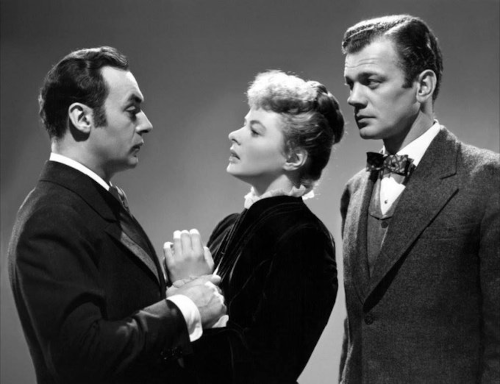
Answer: Gaslighting is a specific method of instigating, psychologi-cal manipulation by instilling doubt in the victim, or members of a cert-ain group, causing them to questi-on their own memory, perception, or common sense. That's what we know about gaslighting, and let's look at what we don't know, but from the perspective of my info-rmation theory.
The subject and the object do not see the space to which they belong equally (Dual). In addition, a substance "enriched" with vitality (Toaster) also becomes dependent on its excess possi-bilities. Such would be all possible intelligences in the universe, such will be the developed artificial intelligence, and such are we ourselves. The ability to perceive (understand) fictions traps us, because they are short-lived, like nil-potent processes (Hindering), and therefore more attractive than fuller info-rmation, absolute truths (of infinite duration). Lies are at first glance more attractive than truths, precisely because of its shorter duration and shallower information, then by the principle of minimalism. And when we follow what we see and not reality, then we fall off the reality train (Honesty).
Due to the tendency towards less information, sparing communication, inter-action, or greater probability, we have both a "life drive" (direction towards fictions) and a "death drive" (towards order). Both of these drives, which are different in psychology, have the same cause, according to this information theory, in the spontaneous tendency towards a smaller amount of uncertainty (Minimalism).
1. Hence the first important characteristic of gaslighting, lying or denying something and refusing to admit the lie even when shown proof. The person falls into a conformism of lying and becomes unable to get out of that bubble. Then, an insistence develops that the event or behavior you witnessed never happened and that you are misremembering it, when this non-acceptance of reality, or truth, becomes a pathological addiction.
2. A type of self-defense for people who enjoy self-deception is to further tra-nsmit their worldviews. For example, spreading rumors and gossip about to their victims, or saying that other people are gossiping about them. Changing the subject, getting upset, and refusing to listen when confronted with lies or other behaviors that offend the audience. Such people who enjoy lying will tell everyone they are exaggerating when called out.
3. Blame shifting in relationships — they deny responsibility by claiming that if you had acted differently, you wouldn’t have been treated this way, so it’s really your fault. The power of minimalist pleasure goes as far as that. Those obsessed with lying, for example, will try to smooth things over with loving words (to their partner) that don’t match their actual actions. They will lie to minimize their, for example, abusive behavior. They will minimize their bad behavior by saying, “It was just a joke,” or “You’re too sensitive,” and so on, all with lies, again avoiding the power of the truth. In some extreme cases, in order to preserve their unstable world of fiction, the liar will isolate everyone, their partner or acquaintances, from friends and family who might recognize the symptoms of gaslighting abuse.
4. All in all, this information theory interprets gaslighting as weakness, which comes from the omnipresent need for comfort, which then turns into an inabi-lity to face reality and truth, and is driven by the principle of minimalism. Bo-th parties, the deceiver and the deceived, are moving willingly towards the wo-rld of deception, each in their own way, and because of the same principle of information theory.
5. Gaslighting can also be used as an advantage in situations when we need popularity. The appeal of lies and their faster spread than the truth are often used by (more or less corrupt) merchants, exaggerating, for example, praising goods in order to sell them more easily. Politicians also lie, which is why they are placed together in the same (middle) II league of players, working title "manipulators" (Traits) then for the purposes of testing this idea with simu-lations. They are unsuccessful against I league, but will almost always win III league.
Guilt-tripping » srb
Question: Can gaslighting also be classified as exploiting someone's conscien-ce or sense of duty to make that person feel responsible for the manipulator's feelings or problems, to force them into obedience?

Answer: It is about manipulating feelings of guilt. The implantation of false guilt (Guilt trip), or the ex-perience of guilt imposed by anoth-er person through deception, is also a matter of greater appeal to lies. It first leads to an emotional reaction, then has physical consequences. The latter arise from the will of us vital to the power of that effect.
This example shows the connection between the “sweetness of lies” (the app-eal that comes from the principle of minimalism) and the “comfort” of being caught in injustice towards others or crime. Both paths are shortcuts, which light up brightly like a match, but in the long run are costly, less valuable str-ategically than tactically. And then, because they cannot get out of their world of lies as in the case of gaslighting, or by blackailing, we can keep that person involved in crime on a leash. These sand towers, of false policies or criminal organization, are becoming increasingly difficult to maintain, increasingly ex-pensive, simply because they are increasingly difficult to keep up with reality.
Unlike the likable lies that are difficult to voluntarily break away from, the “guilt” method contains more pronounced elements of coercion. The manip-ulator is now the person who tries to make the victim feel more guilty than is deserved for something that they would have done but also for something that was not their fault in any way, with the aim of making the victim feel so bad that they do what the manipulator wants. The person who makes you feel guilty also distorts facts and reality in various ways to use your conscience, compassion and kindness against you. This part can be classified as gasligh-ting.
However, while not entirely the same, gaslighting and guilt-tripping share a deeper root cause in the appeal of living in a world of lies. The guilt-taker and the victim both prefer to live in a lie, resolutely refusing to face the truth. The former for the problems that create the desire to manipulate, the latter for the solutions that would emerge from refusing to be manipulated. It is a game for two (or two teams, two concepts) as well as, say, a game of dominance and the dominated. Both sides, each in their own way, seek a reduction in options, more order, simpler or more familiar choices. They seek refuge in lies for less interaction (Laziness).
The truth is what sets you free, but liars don't want it, they don't see it, they ju-st stubbornly follow the wrong path. Not understanding the magnitude or po-wer of truth, they prefer to fall off the train of reality, remaining in the second league of players to win and eventually letting the first league rule over them, while still having a significant mass of third league players that they can over-come (Win Lose). I paraphrase: "Stick to reality, speak the truth, but the uns-peakable is your greatest strength" — it's a first-league game that is not in the character of the "manipulators" (second-league players, Traits).
Duration » srb
Question: From what is written, does it turn out that the "untruth" is an unfin-ished "truth"?

Answer: Yes, I use that often and it works, without contradiction. I del-iberately push the idea to the point of absurdity, test it, and then it see-ms even better to me. This is unoff-icial science.
1. The developments of mathemat-ics so far have been too “spatial”. They are in geometries, graphs, and then in algebra, next in analysis, probability theory. Wherever you turn, there is no time, some would even advocate such a “timeless” concept of science as the ultimate goal. Maybe they are right, and the “information theory” that I like to play with is nothing more than ordinary fable, like some bad science fiction, or failed novels. However, as long as there is no contradiction, I still consider this “informatics” to be a theory, and I will consider the concept of “time” to have a chance for its renaissance.
2. Unfortunately, mathematics is also a kind of dogma, as Gödel proved (be-cause it cannot prove its correctness), but it is perhaps less false than some other dogmas than which it is "more correct" in its application to reality. I am writing this to emphasize the definition of correctness-incorrectness in the new concept of "stretching" that encompasses duration, but also lengths, and even the phenomena of "multiplicity" with which we work in probability theory to distinguish large from small coincidences. For example, large coincidences are getting smaller if we observe them in increasingly large samples, as oscillations of their mean values. This new "truthfulness" is greater when it is "extended" further, the falsity of which is more difficult to prove either by steps to contradiction, or by findings of disagreement with some "real" natural phenomenon.
3. The volatility of a process N can be measured by the number of steps n = 1, 2, 3, ... when Nn = 0, and Nn-1 ≠ 0, as in the recent answer (Hindering). I have not yet explored such an option enough to claim that it is a good premise of "accuracy", in this new sense. The idea is that with larger n, greater "accuracy" is attributed to the process N, and since processes are also states, since (linear) operators are also a kind of vectors, and that such a "linear algebra" is then rewritten into a new "algebra of logic", i.e. in addition to the existing one. Then we could measure truthfulness by reality, which I am already doing in a hypothetical way.
4. That all this is not just a story without foundation can be seen from the ta-bles of operations of ternary logic. Let us recall that we view the disjunction and conjunction of that logic as maxima and minima, respectively max{A, B, C, ...} and min{A, B, C, ...}, with the corresponding scale of truth values. There is a sufficient correlation of such "accuracy" with the above-mentioned expo-nent n that would nullify the nilpotent process for the first time.
After all, all of this fits well with the idea of the attractive "force of probabili-ty", i.e. repulsive uncertainty, and therefore with the principle of minimalism. This in a way that the less true the more attractive, but also the more subtle and imperceptible to simple physical reality. Not everything communicates with everything, we know, so this (hypo)thesis is not as bad as it may seem at first glance. The real speculative question then is how is it that "reality" is so "nailed" into such an unwanted "truth", or how is it that information is omni-present, and yet it is precisely this that is most unwanted.
Attachment » srb
Question: So how is it that "reality" is only associated with "truths", precisely those that are most undesirable to it?
Answer: Yes, it's puzzling. What if the key is in (non)communication. Reality doesn't see that little bit of information (fiction), it doesn't me-an anything to it, and survival is necessary. Somehow, it came to that amount of indestructible op-tions, and reality is that and not-hing more. In that ocean of "food" for reality, there are various mor-sels, and everything else is irrele-vant.
1. Perhaps this reality emerged as a sediment after washing out of the multitu-de of temporary phenomena that are still around us as half-truths and untrut-hs. If we add to them Markov chains that converge into "black boxes", transm-itters of messages whose origin we do not know and whose distances to our current present are ever greater, the conclusion is that this "washing out" is still ongoing. The future is then not a static pool of events through which we travel zigzag through uncertain choices for us, but is itself uncertain. However, it is becoming less and less uncertain, simply because of the principle of mini-malism.
2. We can see that more certain ones have longer durations in the following way. Let M be the generator of the Markov chain. Since the stochastic matrix of one link is M, the sequence of n of these links is the stochastic matrix Mn. If the Markov chain converges to a "black box" then Mn → 0 when n → ∞, then |det M| < 1. However, with increasing certainty, the accuracy of data transmi-ssion, and the absolute value of the determinant, |det M|, the number is larger (less than one), so the number Mn converges to zero more slowly. In other words, in an increasingly certain future (1), the past of the present is becoming longer. This is also a confirmation of the consistency of what has been said.
3. There are reciprocity optima for the greatest strength of the opponent's ga-me to win. This comes from the information of perception, S = ξ1η1 + ξ2η2 + ξ3η3 + ..., which is the scalar product S = x⋅y of vectors, say the sequences x = (ξ1, ξ2, ξ3, ...) and y = (η1, η2, η3, ...), which are interpretations of the player's state. Namely:
S = x⋅y = ∥x∥ ∥y∥ cos φ,
where ∥x∥ and ∥y∥ are the intensities of these vectors, in the corresponding metrics, with the angle between these vectors φ = ∠(x,y). The cosine of an an-gle is greater for smaller angles, so this scalar product is greater for smaller angles, i.e. when the vectors are more "parallel". This parallelism is not achi-eved by changing the lengths of the vectors, but by superimposing them on each other. Thus we arrive at the maximum perceptual information (S), when the vector coefficients are proportional:
ξ1 : η1 = ξ2 : η2 = ξ3 : η3 = ...,
that is, the strongest game is played by opponents with proportionate, timely, and original (by the force of uncertainty) reactions to the opponent's actions. This means that omissions in response weaken the game just as much as exa-ggeration.
This account shows not only the tension of vitality in competition (we consider that only vital ones can play), but also the information of the coupling (in add-ition to the information of the individual participants) that nature also sponta-neously does not want, and then such couplings (we do not have to be aware of them) spontaneously break down. This leads to diversity, when we say that na-ture does not like equality.
4. Nature resists equalities in such a way that the information density (that is, the amount of options) is reduced, in various ways, sometimes in ways unima-ginable to us until we discover them. One such way could be the expansion of the universe; space is a storehouse of memory that has more and more at the expense of the present, which is therefore less and less. I am talking about the uncertainty that is the fabric of space, time and matter. Another example is stratification. For example, the electromagnetic and weak nuclear forces sep-arated from a single “electroweak” force approximately 10-12 to 10-11 seconds after the Big Bang. This so-called breaking of the electroweak symmetry occu-rred when the cooling universe fell below an energy level of approximately 100 GeV. Information in the "present" (then current) decreases by the amount of growth in information from the resulting "past".
5. This universe behaves like a weed that outlives the noble varieties, to menti-on just a few similarities to confirm the absurdity of the question. Japanese knotweed (Fallopia japonica) is a prominent example of an invasive weed that outlives both the garden and the gardener, and there are more. So, this kind of paradox is familiar to nature and worth considering, that the nature to which we belong consists of something it cannot do without and does not want to be with.
Ordering » srb
Question: There is an equal amount of lies and truth, you say, so how did our universe of reality and, you say, truth come about (Attachment)?
Answer: The equivalence of truth ⊤ and falsehood ⊥ follows from the substitution of these two labels in the formulas of the algebra of logic, but the interpretation of this result in physical reality is a slightly more difficult challenge. Here it is.
For example, Zorn's lemma of set theory is the so-called axiom of ch-oice, and it is independent in the sense that it can be equally assumed and also prohibited. This is not a rare ca-se in mathematics. If we deny the axiom of Euclidean geometry on paralleli-sm, we obtain equally accurate saddle and spherical geometries. In general, an independent system of axioms is at the starting point of mathematical theori-es, and such a system will give an equally accurate theory even when we reve-rse any one or more axioms into their opposites. Equating reality with accura-cy then points us towards the existence of alternative "realities" (unreal to us). This is provable in other ways (Dimensions). The special question is how to arrange all this in our heads. I have already described some of these methods, (Dis)Order, but there are more.
1. We know that there are different infinities and that, say ℵ0 (aleph zero) is a countable infinity like the set of natural numbers ℕ and it is much smaller th-an 𝔠 the continuum like the set of real numbers ℝ. It is possible to have infini-tely many prime numbers 2, 3, 5, 7, 11, 13, 17, 19, 23, 29, 31, 37, 41, 43, 47, 53, 59, 61, 67, 71, 73, 79, 83, 89, 97, ... ⊂ ℕ which are all elements of the set of na-tural numbers, and both of these sets are of equal cardinality, with "the same number of" elements. Moreover, let us consider the infinite series of powers of the prime numbers 2, 22, 23, ..., then 3, 32, 33, ..., then 5, 52, 53, ..., all of which have ℵ0 elements, yet no two have any elements in common and each belongs to ℕ. Thus, it is possible for there to be infinitely many sets, each with infinite-ly many elements, and all of them together to be of the same cardinality as ea-ch of them individually, so there is no contradiction.
2. According to Gödel's incompleteness theorem, that a correct (contains trut-hs and only truths) theory cannot be complete (there is always a correct state-ment that it cannot prove), there are infinitely many correct statements. Mo-reover, it also predicts at least a countable infinity of the set of independent axioms. Namely, in order to have a truth that we cannot add to the existing theory, then we add that truth to it as an axiom. However, the incompleteness theorem still holds, that there is a new true statement that even such an exte-nded theory cannot prove, so we must again supplement it with a new axiom with that statement. It is an infinite process like supplementing the set of natural numbers with ever-new larger ones. Therefore, there are at least ℵ0 axioms that correspond to our reality.
3. We apply the above to this, and we see that in a discrete (countably infinite) sequence of axioms we can (almost enough) replace each one with its negation and obtain new theories each time, which thus have (at least) a continuum. Namely, let us imagine that these axioms (zero commas and so on) are digits of a real number from the interval from zero to one, in binary notation. There is an infinite sequence of them, or a total of countable infinities ℵ0. However, they record a continuum of different numbers. The cardinality of that set, 𝔠 is greater than ℵ0. Incidentally, this is consistent with an earlier (my) view that discrete sequences of present moments and almost any in-between options, assuming objective randomness, generate a continuum of possibilities, or other universes (Dimensions).
4. The development towards rounded truths, i.e. realities, is spontaneously driven by the aspiration towards more probable states, i.e. the principle of minimalism. This is a significant part of these considerations. The universe, our current, and even parallel realities, and also those that we would consider based on the wrong set of axioms, continue to develop, I suppose. This is a deceptive process that may be similar to the orbits of the planets around the sun (periodic), or perhaps it deceives us with false memories. We have already seen one way of “false memory” with the Markov chain, which after many steps becomes a “black box” that creates the illusion of a definitive beginning of everything that exists, but perhaps nature hides other possibilities of falsifying its (our) “real” past.
Figure out » srb
Question: How is it that we manage to discern contradictions that are not acc-essible to physical reality?
Answer: Vitality gives us that subt-lety that dead physical nature does not have. However, it would be in vain if there were none (at least unreal). I advocate the thesis that this excess of choice, added to the principle of least action of physics, arrives arranged by fantasies and lies with which we can bridge the otherwise usually isolated islands of truth. Those (untruths) are ac-tually attractive (minimalism), because they are incomplete information, but alas, they are invisible and irrelevant when you do not have vitality. A related question to this is why we have this power of understanding.
1. Viruses survive by acting as obligate intracellular parasites, taking over the host cell's machinery to replicate and using strategies such as mutation, envi-ronmental persistence, and evasion of the immune system. They ensure conti-nuity by transmitting from host to host (acute infections), by persistent/latent infection within the host, and by maintaining reservoirs in animal populatio-ns. In short, for now, that is a description of invasion of cells by viruses.
I cannot guess what microbiology might find on this subject, although I expect it might be in accordance with the information of perception (Attachment, 3). Tiny life forms emerge as if trapped in a mouth in which they are forced to be more vital than their environment, sometimes by the effects of chaos (small actions and cumulative, large, hard-to-predict consequences), but mostly by adhering to the strategies of higher games (Reciprocity). They raise the vitality of the "game" (here the transitional phase from inanimate to living), and this is exactly what a living being needs — more options compared to deadness.
2. Once an inanimate substance “sees” and begins to communicate with unreal (lies, fantasies in general), phenomena of lower information, it is attracted to them, consistent with the principle of minimalism. From that perspective, it will be as if “life is fighting for survival” and it does so in at least four ways kn-own to us. First, there are “mimicry” (we lack better expressions), like a virus whose state (vector) tries to fit as well as possible to the state of the environm-ent, thus maintaining a higher information perception of the two. Since ficti-ons are not permanent phenomena, it is a dynamic process.
The second is the process of reproduction, the familiar process of abandoning a spent connection with a dead substance in order to pass on vitality. The thi-rd is teamwork, synergy and emergence, but also the general subordination of individual freedoms to the collective. Thus, attachment, whereby information of perception will arise as a new "quantity of possibilities, compensating for the losses of a part of similar personal "volumes of options", tissues or larger complex living organisms are also created. The fourth is colonies, in humans we can also call these states, cultures and civilizations.
3. Here we are talking about "vitality" only as an excess of information (amo-unt of options) that inanimate physical matter receives when it no longer has to follow the principle of least action of theoretical physics. Not as something "living" in itself. When a physical thing separates itself from the vitality previ-ously attributed to it and continues its "life" according to the principle of least action, it remains a follower of "truth and only truth" in the sense of Gödel's theorems of incompleteness and does not have the possibility of "skipping" (perhaps it is better to say bypassing) from one island of truth to another. In this way, matter with vitality is superior to matter without it, but their union is "mortal", surviving only dynamically, because the added vitality does not have a long duration like truth, or reality.
4. It is easy to imagine that above this added vitality there is something trans-cendental, which crosses the boundaries of empirical experience and meanin-gful, or rational knowledge. However, we are not concerned with such things here, except that the substance itself (with or without vitality) with its small part bypasses the current reality, going to another and returning in some simi-lar, appropriate form. When "fiction" itself does this, since it is impermanent and has no memory, there is no point in talking about returning the same. Again, a substance that leaves one reality is replaced by the same measure (of uncertainty), due to the law of conservation that applies to such, so all similar replacements (like forms of energy) can be considered similar "escapes".
In this way, for now, I am testing our power to understand contradictions that are not accessible to physical reality, but I would keep these hypotheses to my-self for the time being.
Willpower » srb
Question: With this new knowledge of "information theory", how would you explain "willpower"?

Answer: Simply put, let's find the meaning of "willpower" in the use of vitality to control (inanimate) matter. Stanford psychologist Kelly McGonigal, in the link to the image on the left, defines willpower as "the ability to do what matters mo-st, even when it’s difficult or when some part of you doesn’t want to." According to her, this means that in the battle of minimal stress right now versus minimal stress over the long ha-ul, the latter must take the trophy. She emphasizes strategy over tactics, and by this, the concept of "willpower" becomes closely related to the concept of "vitality."
1. What drives “reality” is opposed by both vitality and willpower, and their methods do not quite match. However, both push against the principle of least action and manage to create environments that nature would not have achiev-ed without them. For example, what are the chances that an apartment buildi-ng with all the objects and details that our houses have today could arise natu-rally, spontaneously, but without human action. It is believed that nature itself is not capable of inventing the wheel, not to mention other artificial details. In this sense, willpower is part of vitality. We can do various “unnatural” stupid things that are not important to us, but none of that without additional optio-ns, or vitality.
2. In the countably infinite ℵ0 stream of a reality, there is a continuum of pos-sibilities, the cardinal number of the label 𝔠, where the first is so much smaller than the second that it is not possible to arrange the latter in a series as we can the former. This means that in an infinitely long time there will not be an opp-ortunity for every option, moreover, the chance that any option of the continu-um will occur in a countable series of events of the current reality is zero. I emphasize this because we also come across statements from world-renowned science lecturers who claim the opposite, that an infinite universe would have to contain all of its possibilities, even those that happened to repeat themselv-es countless times. Read something about Cantor's set theory to understand how shallow such statements are.
3. Without our will, many things would not happen, nor could they ever happ-en, even in an infinitely long time, or in (countably) infinitely many repetitio-ns of reality. From this we find the great importance of the vitality we have, but let us not fall to the other extreme, say, that the universe is what I imagine, what I want, or what I create with my actions. None of these three is entirely correct, because the Moon will not disappear when I do not look at it, because numerous other subjects communicate with it that are equally important to the same universe in which it is as it is. The example with the Moon is from the time of the beginnings of quantum mechanics and in a different context, but it also fits here.
4. On the other hand, let us note that not all that we can make real in our re-ality are the possibilities mentioned in other dimensions of time, in parallel realities. When we toss a coin to make it fall either "tails" or "heads", there is no way to willfully make both fall. This question tormented the founders of quantum mechanics. For Schrödinger, it was the puzzling collapse of super-position into one and only one outcome. In the theory I am narrating, this is because all the information of uncertainty passes into the information of the outcome, but we also see a new consequence of such a collapse of superposi-tion. What the vital systems of a universe can really do with is 𝔠, a continuum of elements, although their realities have at most discrete ℵ0, countably infi-nite steps. It is also a contribution to understanding the "equal number" of truths and lies within individual universes (Ordering).
5. Knowing, wanting, and being able are three different things. For example, you know very well that you will die if you fall off a cliff and you don’t want that to happen to you; I would like to go to another planet but I can’t; I could destroy that machine and I have no idea how it works. The concept of “will-power” applies specifically to each of these phenomena, and to many others. Moreover, it is not easy to say what a “useful” activity would be. About 400 million years ago, amphibians first began to emerge from the water to seek their chance at life on land, although this might seem like an unreasonable, impossible mission. So life nevertheless managed to develop on dry land. So-metimes we ourselves witness how at first glance bad changes turn out to be good. From that point of view, our vitality is part of willpower, and from Kel-ly’s point of view, it is the other way around, willpower is part of vitality, so it makes sense to identify the two concepts.
I explain why I occasionally have a dilemma about whether it is better to use the term "vitality" or "will" to denote the excess freedoms that separate us from the principle of least action of dead substance. Simply put, neither of them is quite suitable for its new purpose, but it seemed to me that with the latter I would do more harm to the already written textbooks of philosophy.
Too tight » srb
Question: Is it really possible that “overstated” leads to a “decline in the birth rate,” as you suggested in that article?
Answer: It's a "long-winded" story, like the one from the ancient Gree-ks about atoms to today's Schrödin-ger equations of quantum mechani-cs. They are not for the new, and especially not for these "light" blo-gs, but I'm not for popularity eith-er, so we put up with it. Secondly, it's not politically correct to tell the truth, and sometimes it's even dangerous.
1. Unmarried women give birth less often, and married women divorce more often when they earn more than their husbands. For example, it is not politi-cally correct to say these two things in the same context when discussing gen-der equality in business, or in commerce careerism. Especially if we believe that we are on a good (political) path to raising the birth rate, or we want to convince others of this, or we simply lie to gain instant popularity. A lie is like a match, while burning strongly attracts, but it creates houses of cards and unsuccessful builders.
2. By organizing society, we strive for conformity, the tendency of an individu-al to align his or her attitudes, beliefs, and behaviors with the attitudes, belie-fs, or behaviors of those around him or her. Some neuroscientists suggest that about 15% of people are innovators — individuals who are dissatisfied with the status quo, and that the remaining 85% are conformists with whom society maintains stability. Close ties are what create tolerance, which also means ac-cepting things we disagree with, disapprove of, or dislike. Then, with further harmonization of society, we arrive at the paradox of tolerance, when a society that spreads tolerance to the intolerant surrenders to the dominance of into-lerance. This process undermines the very principle of tolerance, which has been known since before, and here I place it among the causes of the collapse of some societies.
3. By giving equal importance to tolerance and domination, we give priority to the latter. This has to do with relegislation, because the regulation of societies does not stop when it reaches (some) optimum. Every power wants more pow-er, consistent with the principle of minimalism, and with more power it more easily achieves more of it. It consists in taking over the freedoms of individua-ls, reducing the vitality of the cells of society (person, family), extinguishing their reproduction, that is, taking over vital properties from the individual. Something I don't have to say to the end, I hope.
4. In generally, it is not possible to predict by what mechanisms the birth rate will decline, but it will certainly happen through a decline in vitality. Still life does not "reproduce", and vitality does not last. It needs to be dynamically maintained, like a fire in a furnace to which we constantly add new wood, and you never know when and what might stuck. It is a situation similar to politics that has interfered in matters more professional than itself (someone asked me) and the prognosis is that it will break a toy. Just as we know that an igno-rant in a master's tournament will lose games, but who knows in what ways. It is very certain that second-league players, manipulators (Traits), will lose ga-mble to first-league players (who follow reality), but there is great uncertainty in the ways in which this will happen. This is the principle of local divergence and then global convergence, also a novelty of this theory (Globalism II).
5. For example, modern Western societies achieve greater clogging by concern for money than by religious worship, and in this race, the biology of the latter wins. It is more profitable for the oligarchs to have both spouses working, and for them, the household members themselves, it seems better to have two rat-her than just one salary, so the cost of living can be raised. Financial obligatio-ns are growing and incomes are increasingly fitting into expenses. Money me-ans survival and there is less idleness, or “stupid” choices, and even less vitali-ty.
Tolerance II » srb
Question: Can you say something about tolerance, given its trend in pro-West-ern societies, which can also become their executioner?

Answer: From the perspective of this information theory, tolerance is about equality. Dead substance is “disliked,” but in the “trap” when equalities must be tolerated, intere-sting outcomes arise, including co-nnections with vitality.
Tolerance is then a mathematical problem, when we consider it as a deviation (angle θ) between vecto-rs, say n-tuples x = (ξ1, ξ2, ..., ξn) and y = (η1, η2, ..., ηn). Thus, we represent the states of two participants in communication (interaction), with vector coefficients, pairs ξk and ηk, where the indices go in order (k = 1, 2, ..., n) through all their possible but indepen-dent ways of "communication". Then the information of perception is:
S = x⋅y = ξ1η1 + ξ2η2 + ... + ξnηn = ∥x∥ ∥y∥ cos θ,
where ∥x∥ and ∥y∥ are the intensities of the given vectors, and θ is the angle between them. By the way, see the earlier article (Tolerance) about "greater performance working less".
1. When two different states, x and y, are forced onto each other so that θ → 0, then part of their individual information is transferred to the information of perception S → ∥x∥ ∥y∥. Tension increases (contrary to the principle of minim-alism) and in the case of games competing for victory, the level, the strategy of the given conflict, increases. Undershoot, or overshoot in this forcing will me-an a deviation of the angle from zero and a decrease in the level, from the peak of the game (Reciprocity).
What living beings can do, defying the principle of least action in physics, non-living things cannot. Physical reality will escape from this kind of clinch in one way or another, which is why I say that nature does not like equality. There is no such tolerance in nature in which the intolerant do not dominate, striving to prevail. Those dominated simply give in, there is no resistance or outplay, and they “lose that game” (playing is the activity of living beings).
2. The connective tissue of the individual x and the society y, along with custo-ms, common culture and emotions, are various benefits, and ultimately the le-gal system. The information of perception S = x⋅y is in the power of such con-nections that we can recognize in the statement that the individual surrenders some of its freedoms to society in order to have security in return. Information flows through these relations and they become the very fabric of the “social being”. I am not saying that society is a “living being”, but it has some signs of such that make it a more compact whole than the ultimate dispersion, and this means that it has some tolerance for internal differences that would lead to “dispersion” into disintegration. In a sense, for example, a social being also fights for survival like a living being.
I remind, calculating the power of the game in the S = ξ1η1 + ξ2η2 + ... + ξnηn we do not use any, minimum or maximum available or fixed coefficients ξk or ηk of these states, but those that are used in the given game at that moment. The same applies to the coupling S of the member x and the collective y. The coupling S is a variable quantity during the game and, analogously, in the co-mmunity. If the angle θ between these states is larger, the coupling is weaker and the ability of society to survive is weaker; it "cracks" even with weaker do-minances; in that sense, it is less tolerant.
3. Maintaining life, and to a lesser extent, society, is a top-notch game (Win Lose), and because politics is a middle-league game (Traits), in its own way it fits into state affairs. I'll explain that a little, just formally.
Tolerance resembles dispersion, although in the case of preserving structure, the two have opposite tendencies. For example, a random walk of a point alo-ng the x-axis, with probability p ∈ (0, 1) of a step of length 1 to the right and q = 1 - p of the same length to the left. After n = 1, 2, 3, ... steps, starting from the starting point (x = 0) has a mean, a mathematical expectation μn = n(p - q) and a variance σn² = 4npq. I call the dispersion the root of the variance, σn = √(4npq). In particular, when the chances of a step left and right are equal (p = q = 0.5) then μn' = 0 and σn' = √(n).
The physical and Shannon information of the first step are equal to:
L1 = S1 = -p ln p - q ln q,
but after n the physical one is Ln = nL1, and Shannon grows more slowly, Sn < nS1. This larger information with a larger number of steps n is an increasingly larger burden and the positions of the random point are scattered along incre-asingly larger intervals.
4. However, unlike these (short-term) increases in dispersion, in the very long term things change. For very, very long processes, global convergence will be more likely to hold. Nature spontaneously tends towards more presumed sta-tes, meaning less informative, less communicative, or less uncertain and with fewer options. Interestingly, such a finding also lies at the roots of linear alg-ebra, without assumptions of randomness, i.e. without probability theory. But the global decline in uncertainty will bring further difficulties to vitality and the maintenance of life.
5. Tolerance is not the same as dispersion (σ). However, tolerance is easily compared with (variance, σ²) that in statistics is a domestic quantity. When the possibility arises that a living individual gives part of its freedom to the social community, it will do so, which is simply an attraction from greater to lesser information, that is, that the community shows the subtlety of the unreal. It becomes quasi-alive. Tolerant in the sense of a mild absorption of diversity, the strength of which we easily overestimate. When the “strength” of social tolerance is poorly managed (politics is a middle-league game), contin-uity is maintained by additional force, manipulation, repression of the popul-ation, in the usually wrong way. This is often followed by a weakening of the “spontaneous glue” of the collective, which leads it further into impotence, disintegration, but also into upheaval.
For example, the dominant gradually overcomes the tolerant (through immi-gration, then conquest), or innovators subjugate conformists through rebell-ion. Through evolution and revolution, from without or from within, history teaches us how states and civilizations disappear. It is certain that these pro-cesses have not stopped with us today, they are a general phenomenon that transcends life on Earth.
Overtaking » srb
Question: How do you explain "outplaying" in politics?
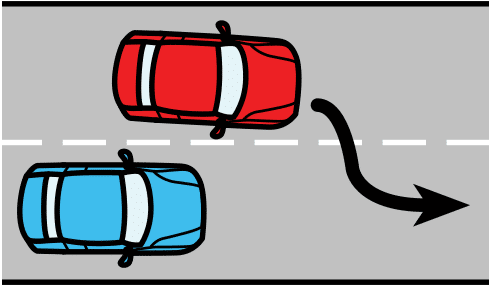
Answer: First, it is an open secret that political activists are more lik-ely to be corruptible and deceitful than the general population. Scie-ntific research suggests that poli-ticians are indeed more likely to exhibit psychopathic tendencies than the general population. App-roximately 1 to 1.2 percent of the general public has clinical psyc-hopathic traits, and studies show that individuals in high-profile leadership positions, including politics or bu-siness, often perform significantly better, about 3 to 5 times above average.
1. The information theory of perception and the (computer) simulations that I have made on this occasion give a division of characters (Traits) that quite closely follow the new findings of other researchers. My methods are mainly theoretical, to arrive at some position of (my) information theory, eventually I test it on a computer and try to interpret it in reality. According to the Pareto principle, the largest part of the population (80 percent) is in the lowest, third league of players called "good guys". They behave close to inanimate nature, bowing to the stronger and taking over the weaker. They almost always lose to the middle, second league players called "manipulators", as well as to the hig-hest, first league players or "evil".
The name of the second league of players emphasizes that they enjoy manipu-lation and that they easily become prisoners of their own deceptions. It is not easy to move from character to character in these three divisions and the ratio is approximately 80:20 for the II: I league, and this makes the total ratio ap-proximately III: II: I = 80: 16: 4. The objective state of politics today is that "manipulators" easily submit to the "evil" and equally easily rule the "good" and this makes them ideal in the sandwich between the III and I leagues, wh-ich otherwise do not tolerate each other well. Third-league, and especially first-league, players fail in (fair) elections.
2. The bad “luck” of first-league players in their election debut, absurdly enou-gh, comes from their superiority in competition, in their ability to follow real-ity well and to use lies sparingly but skillfully in search of a truth that is more saturated with information. According to the principle of minimalism, all phe-nomena in this universe will spontaneously tend towards less action, less co-mmunication, less uncertainty and greater probability, i.e. less information. This is the cause of both our desire for honesty and its frequent absence (Honesty).
So today's political systems are well suited to deceiving the lower (the majority of the population) by means of the middle (elected leaders) who can easily be ruled by the upper (the players who read reality best, and are willing and able to follow it). It is difficult to detect this observation, or accept it, if one does not understand the initial attractive power of lies. That is why, I believe, with this teaching I am outside the known political theories and I hope to remain in that state for a long time. Lies serve for entertainment, in attracting the audie-nce of art, then as sympathetic deceptions in marketing and in general to gain popularity. But by revealing important empty promises, lies become disgusti-ng. Lies are fictions, they don't last long, so that's a convenience for first-leag-ue players to manage those from the second league, who they easily let go of after being used up and despised.
3. As we can see, top players do not have the expected characteristics (at most 4% of the population), and the main thing that prevents us from being such is the objectivity of uncertainty. Such an assumption separates this information theory from the others, so let us be skeptical of the conclusions I draw from it. The first is local divergence (Globalism II), the need for lower levels to be une-qual, while in the larger picture they converge globally.
By repetition, a linear operator (or matrix) will generally force a vector to align with the dominant eigenvector, associated with the absolutely largest eigenva-lue. When there is a unique such, |λ0| = max{|λ1|, |λ2|, ..., |λn|}, then the glob-al convergence of the process that is the representation of that operator A goes to the corresponding eigenvector x0, such that Ax0 = λ0x0. Therefore, an arbit-rary vector x of the space of that operator, by successive applications of the sa-me operator, will take the direction of the given eigenvector; the vector xk = Akx becomes parallel to x0 when k → ∞.
4. The basis from which we derive estimates for the future is “local divergen-ce” (Localism), and it is precisely such that we cannot know with certainty the processes that will actually occur. Hence the difficulty of the first league game. Considering that there is only one truth, the players of this league cannot ulti-mately be true opponents, because in striving for the truth they must ultimate-ly agree (similar to mathematicians or scientists), so the use of “reciprocity” does not bring them into conflict with each other, but into cooperation. This is an aggravating circumstance for the players of the (two) lower leagues in con-flict with their then allies from the first. These lower-level players drown in their lies, which can be different and are always contradictory, so the famous saying: "In principle, an eye for an eye and a tooth for a tooth, we would all be left without teeth and without eyes" applies to them, only to players in the II and III leagues.
Broaden » srb
Питање: How does the dissemination of information limit the size of political organizing today?

Одговор: Historically, the size, co-hesion, and survival of empires we-re once directly limited by the spe-ed at which information, armies, and their administrators could tr-avel. Before the Industrial Revolu-tion and electronic communicati-ons, this limitation was generally determined by the maximum travel times of around 14 days to a month from the capital to the border.
This is a well-known historical theory. However, the above question suggests that something similar is happening with contemporary political organizatio-ns, so I will first note that both can be placed in the context of truth and lies. In continuity with previous answers. Big liars, when they are original and well-disguised, can strongly, albeit briefly, overshadow all honest opponents of ca-ndidates, can thus take over the voters, or tear apart their electorate. In both cases we see the power of the game of the II league (manipulators), but also the resistance of the reality of its truthfulness. When they have good support (the imagination of the fraudsters, the capital and capacity for corruption, the criminal cases of "allies", and their desperate dependence on themselves, etc.), the deceivers can last, but not for long because reality goes the other way.
1. In an election campaign, as long as the ability to maintain a sweet world of half-truths reaches, there will be limits to political organization. After taking power, that capacity is slowly transferred to the levers of institutions, and we arrive at something similar to well-known historical theories, although more abstractly. So while the disgusting lies are deceived by new ones, and the "ho-use of cards" holds, the conquered political area also survives. Its contours (only abstractly, in various domains) are drawn by the power of the respective "manipulator" players (II league). However, all of that becomes "bowels and water" (with poor chances) if the "evil" players (I league) happen to be there, rare but too strong for these.
2. Simply put, the manipulator does not keep up with reality, falls off its train into the ditch, runs alongside, or lags behind by riding in some sidecar. It is fortunate for those who judge well, stick to the truth combined with their cre-ativity (the strength of vitality is in uncertainty), that they have in front of th-em fraudsters who do not have their arsenal. Masters, I league players, quickly become aware of their power and, feeling like predators surrounded by prey, when more sheep do not mean increased resistance to them but more food, they easily become arrogant and actual evil. If they fall into this trap of their arrogance, of their lack of concern for the III league from which their main voters are, when they appear, they can also slow down the fall of fraudsters. There are other significant variables that limit the success of political organi-zations.
3. If we consider the empire as a “creature” that takes over the freedoms of its inhabitants, then the aforementioned speed with which information would re-ach the borders can also be interpreted as the spread of deception, or rather the basis for taking over otherwise unwanted surpluses of individual freedo-ms. We give parts of our freedoms to the state for security, belonging, and ot-her benefits, but in fact reject unwanted uncertainties. Again, phenomena of shorter duration (fiction) are more attractive, because they are smaller conce-ntrations of uncertainty than sustainable ones (reality), so we plant them as the basic fabric of associations. With the fear of uncertainty (which can be faked), this connection is strengthened. Thus we arrive at the same, or equi-valent, of today’s political coalitions with the above historical drawings of empire borders.
4. From the algebra of logic we know that truth ⊤ and falsehood ⊥ behave ex-actly as the negation of each other, ¬⊤ = ⊥ and ¬⊥ = ⊤. Hence the analogous behavior of the real and the unreal in this theory of information. When we pa-int the realms white and the exterior, say, black, then we draw the boundaries of both. As we determine the ranges of truths, we also define falsehoods. The-refore, my above answers should not be foreign to us, I hope.
Tree » srb
Question: You mentioned "abstract contours of election campaigns", and it remains unclear to me what you meant by that?
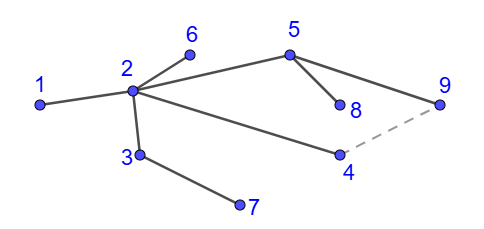
Answer: This could be a detail from the previous answer (Broaden, 1), that the contours of the political domain are drawn by its participa-nts. They start with an idea (fanta-sy) that can become action (reality). This means that even short-lived phenomena can be transformed into sustainability by us vitals. Se-cond, that "ways of communication" are not just like roads between settleme-nts.
1. For example, mechanical spin is a special sustainable phenomenon, in addi-tion to the inertia of uniform rectilinear motion. We can see this simply becau-se we invest energy to start a wheel (Whirligig, 2), and it continues to spin on its own until some other energy (force) stops it. Let us add to this that all con-crete phenomena are unique, but for each we discover different theoretical models multiplied here and there, so right now we will see an analogy for spin in mathematical graph theory, and from this we can "easily" move on to theo-rizing politics.
2. In graph theory, a tree is a graph in which every pair of nodes is connected by exactly one path. In other words, any connected graph without cycles is a tree. This form is widely used for data structures in computing, especially so-cial networks (Facebook, LinkedIn, Academia) that represent users as nodes and friendships/connections as links. They are also used for navigation (GPS). Airlines use directed graphs to schedule flights and optimize crew allocation.
Graph theory, not only as a picture of something but with its theorems, is part of search, especially the web (Google), where user presentations are nodes and hyperlinks are connectors, to which are added algorithms (PageRank) to dete-rmine the importance of pages. Amazon and movie publishers (Netflix) use graphs to find relationships between products or users to suggest content. Gr-aphs model metabolic pathways, gene regulation networks, and protein-prote-in interaction networks. In chemistry, then, molecular graphs represent atoms (nodes) and chemical connectors. I am mentioning only some applications of graph theory.
3. Let's move on to some of the theorems. In the image above on the right we see a tree with V = 9 Vertices (points, nodes) and E = 8 Edges (connectors, or links). And then we notice that V = E + 1 is always the number of Vertices of the tree one more than the number of Edges. This is our first theorem and, I hope, it is obviously true.
When we connect Vertices (like 4-9 dotted lines), it ceases to be a tree, but it remains a graph, the subject of graph theory. It is easy to see that the reverse is also true, by removing redundant Edges, whenever we have a graph we can obtain a tree. With redundant Edges, closed (sur)faces are created, these are cycles, which, when traversed by Edges, lead to the starting positions. The graph in the image has one (sur)Face (F = 1) which is all exterior, so:
V - E + F = 2,
because 9 - 8 + 1 = 2. This is Euler's formula with characteristic χ = 2, the nu-mber to the right of the equality. The Euler characteristic (χ) of all graphs dra-wn on the surface of a three-dimensional convex solid is 2. And convex solids are spheres, cubes, tetrahedrons, and in general those whose all points of a li-ne lie in the solid, if they belong to its extremities. Starting from the given fig-ure, we will easily understand that Euler's formula is valid in general, when we add one extra link to the tree (such as 4-9). Then E increases by 1 but F also increases by 1, so E - F = 0 and the equality remains unchanged. Every graph has its own tree, and from every tree we will get a graph like this, so Euler's formula is proven.
4. People are on the surface of the earth (a convex body) and they communic-ate. They are receivers-senders, like a vertex graph, with links through which their information circulates, mutual conversations. For example, Marko con-veys the news to Janko, this one to Ana, and she tells it back to Marko, so that a cycle occurs. These cycles are something like feedback that we often neglect in everyday communications, and Euler's formula (3) shows that only by add-ing these cycles do we we get a sustainable reality. Knowing two of the three quantities (the number of Vertices, Edges and surFaces) we can calculate the third. In this case, the surfaces behave like the above-mentioned (1) spin.
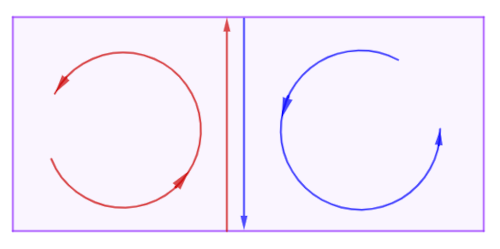
5. The image on the left demonstr-ates another way of canceling two surfaces with one edge between them into one surface without that joint. The blue on the right and the red are rotations of the same dir-ection within their squares, but orient the joint between them as opposite vectors. These two graph cycles (wider images) become one within the rectangle that enclosed them wi-th one less edge. Thus, P → P' - 1 and S → S' - 1, so the difference is unchang-ed, P - S = P' - S', and Euler's equality (3) remains true. This way we also see the deeper meaning of the "spin" that seems to take over the edges.
6. The social power of "spin" could be the experience of feeling closeness and connection with others. This implies a sense of love, value, and even care for the community, which forms the basis of interpersonal relationships. The rot-ations in the previous image could represent such a toughness of the political community that does not involve the immediate communication of individua-ls, but as a sense of belonging in the participants becomes the "vitality" of the team.
For example, Confucius (551–479 BC) believed in the charisma of providing education to all people, regardless of their origin and social class. He also em-phasized the importance of respecting parents, elders, and traditions in gener-al as the foundation of moral associations. These silent parts of the festivities, memories of powerful events from the past of a people that strengthen the se-nse of collective connection and are the glue of statehood, are known here as "rotation". It is known that the maintenance of dogmas is a kind of backbone of communities, and now we only add the upper surfaces (cycles) as their fo-rmal representation.
Hairy Ball » srb
Question: Is the statement "edges between regions cancel out" taken from Green's theorem?
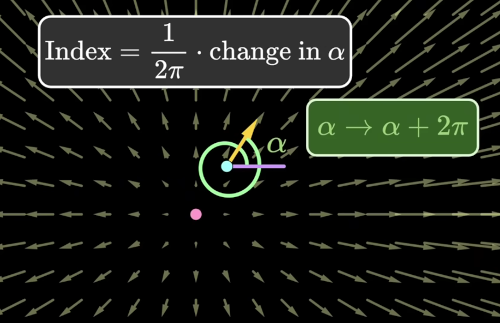
Answer: It could (Tree, 5). Such a cancellation of two surfaces with a single joint between them into a single surface without that joint, in this case is from the Poincaré–Hopf theorem. But since both Poincaré (1881–1882) and Hopf (1926) pu-blished their works knowing the theorems of George Green (1828), this influence is likely.
1. The image on the right has a link to a video explaining Hopf's "combing the ball" theorem. The Hairy ball theor-em, a result of algebraic topology, states that a continuous tangent vector field on a sphere (surface) must vanish at least at one point. Intuitively, this means that you cannot comb a hairy ball smoothly without creating sideburns or bald spots. This implies that there is always at least one point on Earth where there is no wind, or where the wind is moving vertically upwards.
The theorem says that no matter how you try to assign vectors to every point on a sphere, there will be a discontinuity (a part), a vector with zero length (a bald spot), or a vector that is not tangent to the sphere (a tuft). In short, a continuous tangent and non-vanishing vector field on a sphere cannot exist. This theorem extends to various kinds of furry figures that are topologically equivalent to a ball. All shapes of compact elastic rubber without puncturing, splitting, or joining. This means that we can apply the hairy ball theorem to furry cubes, and then to stuffed animals and furry baseball bats, all of which are topologically equivalent to spheres.
2. The theorem holds for all surfaces of a molded plasticine ball without teari-ng. This would not hold for a scalp, which can be straightened and combed in the same direction like the fibers of a shaggy carpet, or for a doughnut, wheel tire. On the contrary, if we spin a basketball however we like, we will always have a point on the surface of the ball that has zero velocity. But if there is a void around the axis of rotation, so that instead of a ball we have a hollow cylinder (a doughnut), there will be no points of rest. Similarly, isotropic antennas (equal strength in all directions at once) cannot exist (because the Earth is a sphere). However, sound carries waves without the normality property of radio waves, so speakers that emit such isotropic sound are possible. The leading design for fusion reactors, the tokamak, for example, solves the problem of leakage of a spherical magnetic field plasma, from the hairy ball theorem, by using a doughnut-shaped chamber.
3. Here is how the above image helps us to arrive at the concept of "index" needed to understand the proof of the "hairy ball" theorem. From the so-cal-led zero, the source point of the field lines, one arm of the angle α spreads out to a reference direction, say the abscissa direction, common to all positions of the angle. When the vertex of the angle goes around the zero point (mathema-tically positive direction, counterclockwise), this angle increases, α → α + 2π, which divided by 2π gives a change of +1, the value of that index. The same would happen in the case of a sink, the so-called zero point into which the fi-eld lines plunge, the angle α would increase by 2π and define a new index, ag-ain +1. On a sphere, these zero points are the North and South Poles. They are also the same when all the lines of force run parallel to the equator, which, by a different "combing", again gives the sum of the indices, the number +2.
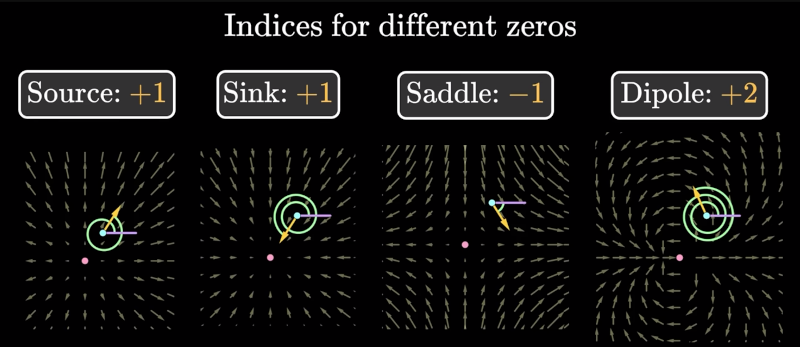
In this image from the video above, we see that the indices of (one each) the source and sink are equal to +1, that the index of the saddle surface is -1, and the dipole is +2. The force fields of the saddle diverge along the abscissa and converge along the ordinate (possibly vice versa), and the dipole circles and moves away in the direction (one of ±) of the abscissa.
4. When we observe two different combings of the ball, with the angles α and β defined in this way, and then we go around an arbitrary point, the difference α - β is ultimately the angle between the force lines themselves, because the res-iduals of the abscissa angles cancel out. Therefore, we can only observe chang-es in the angle between the force lines as we go around the so-called zero, wh-ich is constant overall and equals 0. In other words, the sum of the indices of different combings of the same surface is constant. That's why these indices are important, they define the Euler characteristics for the surface (Tree, 3) equation:
T - S + P = χ.
For a sphere χ = 2, for a disk (a 2-dimensional region inside a circle) χ = 1, for a torus χ = 0.
5. For example, we can represent a disk as a simple polygon, like a triangle. It has three vertices (T = 3), three edges (connectors S = 3), and one face (area P = 1), so T - S + P = 1, i.e. χ = 1. A sphere is a “closed” surface (without edges), and a disk is a surface with a boundary. Here is another disk.
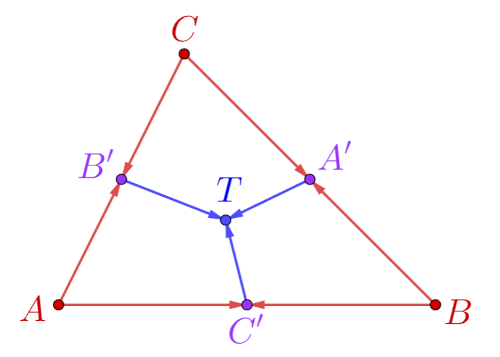
The mentioned differences χ also come from the type of so-called zero: source and sink (+1), saddle (-1) and dipole (+2). This gives the Euler characteristic χ for the sums of indices of the entire surface, and we will arrive at the same with the example in the figure on the left.
The three vertices A, B and C are the sources, all of index 1. Also the three centers of the sides A', B' and C' are thus saddle points (saddles) of index -1, and one is the sole centroid T of the sink. The sum of these indices, 3 - 3 + 1 = 1, gives χ = 1, i.e. the characteristic of the disk. The sum of the zero indices of a continuous tangent vector field is always equal to the Euler chara-cteristic (χ) of that surface. This is more formally known as the Poincaré–Hopf theorem.
6. This triangle appears as an interesting example in the authors of the theor-em, but I cite it here to note another analogy of it, or the disk with social con-nections. The vertices (A, B and C) are sources of information, events. The sides, or saddles (A', B' and C') are the receivers and senders of information, for example the inhabitants, while the center of gravity (T), the sink, or the abyss, then the surface and the spin, the phenomenon that absorbs the excess amount of possibilities and the main fabric of the "vivacity" of the community.
Vicious » srb
Qeustion: Is it possible to break out of the vicious circle of lies in politics?
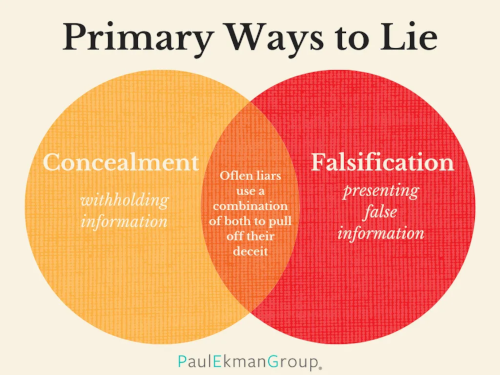
Answer: The attraction of lies and their faster spread than truths ma-kes them a means of gaining popu-larity. However, they are also short-lived, they contradict the truth, and liars who would promise us some-thing important will be disgusting. They are also strategically (long-term) unsuccessful in their dealings with reality (Traits). Everything th-at lasts, is true but perceptible, I ca-ll "reality", while what does not last but is noticed, understood, is unt-rue or unreal (fiction). This is the point of this question, that politicians need popularity to win elections, and then they need success for the benefit of the people who elect them.
1. The lying of liars can be a struggle for the truth. A lie about the truth is unt-ruth, and so is a lie conveyed accurately, but the truth told truthfully is true. That is the idea of this (my) concept, the real as the negation of the unreal, whose correctness is shown to be equal, say, to the arithmetic of multiplying positive and negative numbers. Thus, a positive number (truth) multiplied by a negative (falsehood) is a positive number. A positive multiplied by a negative is negative, just as a negative multiplied by a positive gives a negative number. In short:
(+1) ⋅ (+1) = +1, (+1) ⋅ (-1) = -1, (-1) ⋅ (+1) = -1, (-1) ⋅ (-1) = -1,
where instead of 1 there can be different positive real numbers, and +1 has the meaning of truth (⊤) while -1 has the meaning of falsehood (⊥).
2. We are discussing the concept of sustainable-unsustainable, which is just as correct as the concept of real-unreal, or true-false. It can easily be reduced to the multiplication of positive-negative numbers, in order to test consistency by comparison. The same concept is also confirmed by the “XNOR gate”:
⊤ ⊙ ⊤ = ⊤, ⊤ ⊙ ⊥ = ⊥, ⊥ ⊙ ⊤ = ⊥, ⊥ ⊙ ⊥ = ⊤.
When the variable truth values A, B ∈ {⊤, ⊥}, the formulas are valid:
A ⊙ B = (A ∧ B) ∨ (¬A ∧ ¬B) = (A ∨ ¬B) ∧ (¬A ∨ B),
which you can check by listing the possibilities one by one. What is most im-portant here is that the concept I follow in this information theory is valid. It is necessary to further check the agreement of the forms of arithmetic, algeb-raic logic and electrical gates with the above interpretations.
3. A politician lies to his "good guys" voters (league III players), because as a "manipulator" (league II player), he can easily dominate them, just as he can be easily controlled by "evil" (league I players). These are the general princip-les (Traits) of game theory (found here) applied to situations in contemporary politics. In this case, the upper (evil) players need the middle (manipulators) in order to dominate the lower (good guys) players, who are the majority of the population. This symbiosis benefits the upper the most, and a little less the middle (who eventually become hated), and the lowest the lowest, which mak-es it a degeneration of democracy. The cause is deeper (nature does not like equality), and this is one consequence.
4. When we ask the question of how to turn things around, so that such a poli-cy is more beneficial to the "lower" than to the "upper", the preceding analysis (1) suggests to us "lying to the liars". The politician should deceive the upper players until the election, and then turn the tables. Here is what happens then. If the politician is able, knows and wants to play the game of the I league (has good assessments of reality and wants to follow the truth), in relation to the majority of the population he will build healthy buildings (not towers of car-ds). This creates for him fewer immediate and especially less important long-term problems. On the other hand, in relation to evil he thereby opens up for himself greater immediate and less long-term problems.
Namely, the game of the first league is not easy to win, when he is consistently on the path of truth and reality, so in a clash with his pre-election bosses, the former servant will now be a tough nut to crack. Having the levers of the state at his disposal, because even the average normal state is stronger than the best criminal organization (which is manipulative by definition), he will be recogn-ized as a first leaguer. Unlike the lower league players who will, sooner or lat-er, clash (lies can be different and are contradictory), the upper league players become allies (truths are consistent, i.e. non-contradictory).
5. The use of lies in the pursuit of truth is a normal occurrence in mathemati-cs. We start from a false assumption and, using the method of contradiction, eventually disproving it, we prove its opposite. In statistics, we test a dumb hypothesis by checking its accuracy, and otherwise we use ⊤ and ⊥ a lot, not only in the algebra of logic. In fact, the first-league game is full of sneaking, so that in a clash of the two strongest players, victory could be recorded at all. A politician who, after the election, will turn the tables on his former bosses, with insincere intentions towards the wider population, is not necessarily a loser in the long run, when he is truly able to play first-league. However, our range is often objectively limited, so that thieves generally remain what they are.
6. The response of "evil" to this strategy of "disobedient" politicians is also forced. They must preemptively elect only those who have been previously corrupted, blackmailed, and whose files they could control. However, this means having an already broken state apparatus, with no ability to prevent criminal politicians from running. This again means that the first league has been working for the benefit of the people since before, and the complexity of the aforementioned or other unmentioned similar activities (the top game is not for everyone) calls into question the principles of democracy in general. So, it is possible but not certain to break out of the vicious circle of lies in politics.
|
|
|