|
|
|


Scrambling has several meanings depending on the context. It is basically a data encoding technique in which a digital signal is deliberately scrambled to facilitate transmission. The data is converted into a seemingly random sequ-ence to avoid long strings of zeros or ones, and the receiver later restores it to its original form with a descrambler. However, here it is also the scattering of information by transmission when it acquires interference, or noise, which leaves behind records of obstacles and phenomena that "destroyed" it, or concealed it by misinformation.
Reciprocal » srb
Question: What is the difference between a function and a relation?
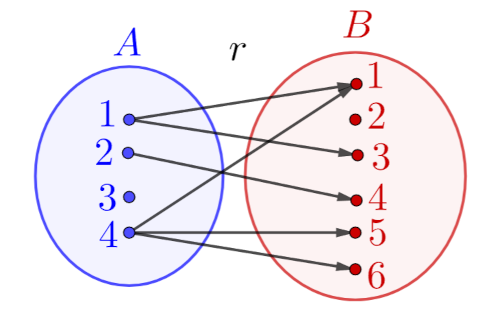
Answer: A function is a special case of a relation, a mapping where the original can have at most one copy. On the right is a representation of the relation r:
{(1, 1), (1, 3), (2, 4), (4, 1), (4, 5), (4, 6)}
between seets A = {1, 2, 3, 4} and
B = {1, 2, 3, 4, 5, 6}.
As we can see, 3 ∈ A is not related to any element of the set B, and elements 1, 4 ∈ A have two and three connections to elements from B, respectively. This is a well-defined relation, but it is not a function precisely because of these two multiply mapped elements. As we can see, a relation is a set of ordered pairs, where the first elements of the pairs are the originals and the second are cop-ies of the mapping, so we sometimes talk about functions when referring to relations.
1. Let f be some mapping from sets like A or B to X. If A ⊆ X, we denote by f(A) the set of images of all points in A and we say that f(A) is the image of the set A by the mapping f. In the general case, f(X) ⊆ Y, so if f(X) = Y, we are talking about a mapping of the set X onto Y (surjective). The name of the mapping is one-to-one (injection) when it copies different originals differently, and we call it mutually exclusive (bijection) if it is both a surjection and an injection.
2. Theorem. Let f map X to Y and let some A, B ⊆ X. Then:
- A ⊆ B ⇒ f(A) ⊆ f(B);
- f(A ∪ B) = f(A) ∪ f(B);
- f(A ∩ B) ⊆ f(A) ∩ f(B).
- f(A ∖ B) ⊇ f(A) ∖ f(B).
If f is an injection, then iii. and iv. are equalities.
Proof: i. is clear.
ii. ∀x ∈ A ∪ B ⇔ (x ∈ A) ∨ (x ∈ B) ⇔ (f(x) ∈ f(A)) ∨ (f(x) ∈ f(B)) ⇔ ⇔ f(x) ∈ f(A) ∪ f(B).
iii. ∀x ∈ A ∩ B ⇒ (x ∈ A) ∧ (x ∈ B) ⇒ (f(x) ∈ f(A)) ∧ (f(x) ∈ f(B)) ⇒ ⇒ f(x ∈ f(A) ∩ f(B).
Let y ∈ f(A) ∩ f(B) and y = f(a) for some a ∈ A while y = f(b) for some b ∈ B. Then y = f(a) = f(b) with a ∈ A and b ∈ B, but y = f(a) = f(b) for a = b ∈ A ∩ B, the injection case, so y ∈ f(A ∩ B). Therefore, the opposite inclusion is also valid, i.e. paragraph iii. is equality. The iv. is proved similarly. ∎

3. The image on the left is a link to an interesting video about our need to see ourselves in the mirror. Let's talk about the need to maintain the status quo, not to take "unnecessa-ry" risks (defeat of chance?), which is actually the principle of minima-lism.
It's like the mapping f : X → Y, such that the inverse mapping f-1 : Y → X, a copy into the originals, doesn't give a much different first image. The story is an emotional example, an interpretation of what we're just proving, if you delve a little deeper into the topic of the aforementioned video.
4. The reciprocal (inverse) image of an element y ∈ Y is the set of all elements x in X for which f(x) = y. We denote the reciprocal image by f-1(y), and it can also be the empty set when y ∉ f(X).
Theorem. For the inverse (reciprocal) image, the following holds:
- A ⊆ B ⊆ Y ⇒ f-1(A) ⊆ f-1(B);
- f-1(A ∪ B) = f-1(A) ∪ f-1(B);
- f-1(A ∩ B) = f-1(A) ∩ f-1(B).
- f-1(A ∖ B) = f-1(A) ∖ f-1(B).
Inverse images preserve inclusions, unions, intersections, and differences of sets.
Proof: a. ∀(A ⊆ B) x ∈ f-1(A) ⇒ f(x) ∈ A ⇒ f(x) ∈ B ⇒ x ∈ f-1(B).
b. x ∈ f-1(A ∪ B) ⇔ f(x) ∈ A ∪ B ⇔ f(x) ∈ A ∨ f(x) ∈ B ⇔ x ∈ f-1(A) ∨ x ∈ f-1(B) ⇔ x ∈ f-1(A) ∪ f-1(B).
Similar to this, c. and d. are proved. ∎
Sampling » srb
Question: Can you explain to me the sampling of analog signals into digital ones?
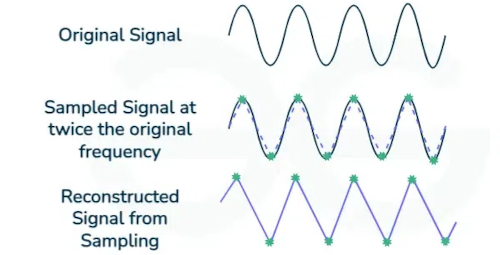
Answer: Signal sampling is the pro-cess of converting a continuous, an-alog signal into a discrete and digit-al format by recording certain peri-od values for bridging the physical world into digital technologies. Su-ch a signal is then passed to a com-puter for further processing, stora-ge and transmission.
1. The image on the right is a link to an explanation of the Nyquist-Shannon theorem, which states that for good transmission, the frequency of the samp-led fs signal must be at least twice as high as the highest fm of the original:
fs > 2fm.
In the figure, the upper one is a homogeneous (uniform) sinusoidal signal and let it be the part of the original that has the maximum frequency (fm). One pe-riod is one rise and a depression, a top and a bottom, and we sample those two extreme points with four, the middle row, to get the sampled signal, a broken zigzag line that is a digital copy of the continuous original.
Nyquist's theorem tells us that if we sample a signal at a rate greater than twi-ce its highest frequency, it can be reconstructed from those samples using me-thods such as interpolation and reconstruction algorithms to preserve impor-tant information from the original signal. For example, to preserve the sound of music on a digital carrier, the audio signal must be sampled at a rate of at least 40,000 Hz in order to reproduce it as a 20,000 Hz signal. To preserve the sharpness of the thumbnails in this column, which are 220 pixels wide, I store them in memory as images at least 440 pixels wide. And the private th-umbnails in the margin on the right, which I don't want to have sharpness, I store in memory at half the width.
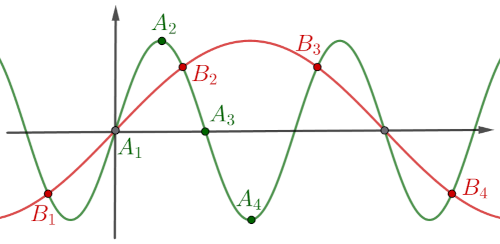
2. Aliasing generally refers to errors or distortion that occur when a con-tinuous signal is sampled at reduc-ed rates, causing it to be recorded or displayed as a completely differ-ent, "fake" signal.
In the image on the left, the original green well-sampled sinusoid has fo-ur significant points A1, A2, A3 and A4 taken at a shorter interval and requires a higher reproduction frequency, than the four points B1, B2, B3 and B4 given at a longer interval of the same signal whose aliasing gives a false reproduction, the red sinusoid. Sampling has applications in various fields and beyond engineering, and then random selection of significant points is often better than a regulated one, because by regulating we almost always cheat (Toaster).
3. Random sampling ensures that each individual in the population gets an equal chance of being selected, eliminating human bias and creating a repre-sentative group. But, true randomness is non-causality which is practically almost impossible for us to achieve and every sample made by the interested group should be checked by at least one other, then opposing group. Otherw-ise the sampling is unreliable, i.e. truly less valuable, not worthless in some other application (estimates, deception). I wrote about a big class of Traits, called "goodies" who are a usable audience for "manipulators".
4. In environments of increasing falsehood, we need more "second opinions" from statisticians and denser sampling. On the other hand, we approach sam-pling extreme falsehood as if it were a black hole, a celestial body so massive that it would trap even light in its gravitational embrace. This is similar to sampling real environments that are rich in detail, provided that there is no, or we cannot find, some regularity with which we would compress all such diversity. In the end, it turns out that diversity in the appearance of reality and falsehood equally complicate sampling.
Aliasing » srb
Question: What is your position on the need for more “second opinions” and a denser sampling of statisticians in both a deceptive environment and an envi-ronment with lots of detail?
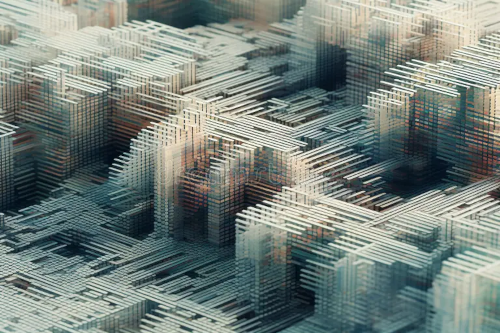
Answer: I understand that you are "surprised" by this question about the reduction of many details and falsehood to the same needs of de-nser sampling in order to avoid er-roneous transmissions. The image on the right is of poor sharpness with unclear details that we can see as buildings, or books on a table, exposed tile patterns, or something else. Aliasing is the phenomenon of ambiguity for restoring the original that occurs when the image is sparsely sampled. A drastic example is when we sample the periods of a sinusoid only by its nodes, whose image the recipient interprets as a straight line of the original. This second example shows how random sampling can be better in technical processing.
1. Truth is unique in the sense that different parts of mathematics do not con-tradict each other. For example, there are (Euler's Formula) at least 20 proofs of Euler's Formula (V - E + F = 2): for any convex polyhedron, the number of vertices (V) and faces (F) together is exactly two more than the number of ed-ges (E). For example, a tetrahedron has four vertices, four faces, and six edges 4 - 6 + 4 = 2. There are at least 10 proofs of the Gauss' integral:
$$ \int_{-\infty}^{\infty} e^{-x^2}\,dx = \sqrt{\pi}. $$By probability (Buffon's needle), we also find decimals of the π = 3.14159... . However, our observations are limited and when we look ahead we cannot see behind us, or if we see one side of the moon we cannot see the other, so simi-larly we look at mathematics in portions, by areas, and we make proofs in dis-crete steps (Packages). This gives that "purity" to the pure truth that is "poll-uted" by untruths. Lies are by their nature different, contradictory and it ma-kes sense to argue about incorrect beliefs (Quarrel).
2. The precision of science and its ability to predict within its domain, which is achieved with mathematics (Deep Learning), is extraordinary. However, in the environment of every such physical reality, the world of truth, there is a world of unreality, fiction, and untruth with which we perceive it. These are worlds of equal magnitude (Drowning), of equal cardinality, although the latter is im-perceptible to the former. When a mathematician proves the falsity of a start-ing assumption by contradiction, he takes the position of the latter, the world of lies, which means that it is both existing and useful. Moreover, pure truths are like islands that cannot be bridged without fictions, and the price we pay for that is not only mortality, but also the stickiness of lies that we can percei-ve and which we have a hard time giving up (Under the Radar).
3. Complexity leads to the emission of emergence, and emergence can result in vitality. Thus we arrive at falsehood, its lesser truthfulness and therefore a sh-orter life that must be constantly "fueled" to last. This is also the answer to the above question, dense and false environments equally require denser sampli-ng in making a digital copy, so that we can later reconstruct the original more accurately from it. Reality is surrounded, for itself, by an invisible fiction. Wh-en constrained, either physically or by the huge amount of data that artificial intelligence must monitor, which is impossible (e.g. due to the limited speed of light) and estimates, makes mistakes, and is guided by purpose, becomes biased. We are already seeing this today and here I say that lying is a necessity of intelligence (of any kind), and not, as is usually believed, a consequence of imitation (of us by machines).
4. Here we are talking about sampling in general and their relevance to descri-be what we want with them. In practice, it is good to be a little skeptical of the usual interpretation of the Nyquist-Shannon theorem. There is also an instru-ctive video (Nyquist theorem) that can help, that the technical quality should be improved with the expansion of the sample with more than double the fre-quency. Again, I refrain from making (hypo)theses about gravity using emerg-ence (part of the question, due to the previous statements), because I am not yet clear about the "black holes" then as its ultimate ranges. More on that later.
Reconstruction » srb
Question: How is the original reconstructed from a copy?
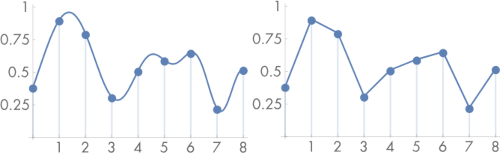
Answer: There is no easy answer to this question. Technically, sound and light are made up of waves, sinusoids, and of which matter in general is, which we recognize using Fourier coefficients and fit to given sample points. It is the idea that analysis and computers can produce unexpectedly good reconstructions of very different phenomena. The image link clarifies this kind of “guessing”.
1. The Whittaker-Shannon interpolation is the best way to reconstruct a cont-inuous, bounded signal from a discrete sequence of points. It perfectly recov-ers all intermediate values, provided that the sampling rate satisfies the Nyq-uist criterion (the sampling rate is greater than twice the highest frequency of the original signal):
$$ x(t) = \sum_{n=-\infty}^{\infty} x[n]\cdot\text{sinc}\left(\frac{t - nT_s}{T_s}\right). $$Here x[n] = x(nT) is a sequence of real numbers representing a sequence of samples at time intervals of T seconds, and the function sinc(α) = (sin α)/α.
2. For more information on signal processing and coding with Python, see the Kaggle pages. In addition, there is an example of sampling a sine wave of the frequency fm = 20 Hz with fs = 35 Hz, which is less than required by the Nyq-uist-Shannon theorem (fs > 2fm), to see the failure of the reconstruction com-pared to sampling with a frequency slightly higher than double (fs = 50 Hz) and even more successfully with five times higher (fs = 100 Hz). The progr-amming codes (Python 3) are detailed. The programming codes (Python 3) are detailed and at the end, after the plt.tight_layout() command, add plt.show() to get images of the graphs on the screen.
3. Quantum computers will improve these methods tomorrow, here's how. Let's say that information is initially scattered in at most 10 directions, light bouncing off walls, sounds traveling through media at different speeds, ideas that a professor conveys to his students are understood and further interpre-ted differently, and so on. Then all of these are transferred to the next 10, whi-ch makes a total of 10² = 100 receivers, all of which will transmit the received information to the next 10³ = 1000, and so on until the 90th step when the number of receivers of the initial information is 1090, which is more than the number of atoms in the visible universe. Along the way, you need to remember all those transient forms of information that they contain and the places where they were. These are large amounts of data that ordinary computers cannot work on, but quantum computers could. These would be useful reconstructi-ons for many.
4. The largest Shannon information S = log(b - a) of a bounded interval (a, b) ⊂ ℝ, where a < b, has a homogeneous probability density distribution:
$$ g(x) = \begin{cases} \frac{1}{b-a}, & x \in (a,b) \\ 0, & x \notin (a,b) \end{cases}. $$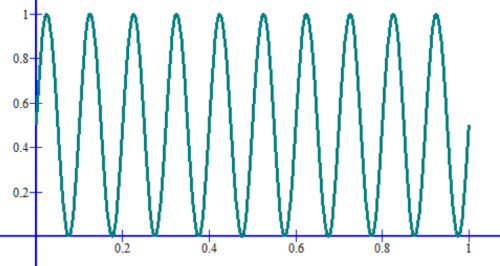
A signal of such density will be sim-ulated by y(x) = [1 + sin(nπx)]/2, if n → ∞. The graph of the figure on the right where n = 10 demonstrat-es this density for increasingly large n up to the very full interval (0, 1) when it is technically impossible to increase the frequency due to the conditions of the Nyquist-Shannon theorem (fs > 2fm) sampling.
I cite this as another explanation for the impossibility of more information th-an the aforementioned homogeneous distribution. An unusual, extreme exam-ple of such a maximum would be the radiation of a black hole, Hawking radia-tion, which we discussed earlier in connection with the "impossible" idea (so it was suggested to me) of the emergence of gravity in general and of black holes in particular. It is not possible for us to digitize and then read the content that comes out of a black hole, since it is not possible to exceed the density of that "frequency".
Causality » srb
Question: Browsing through these answers, it seems to me that causality shou-ld also be considered "material"?
Answer: You have observed well, that is self-evident. And perhaps I have explicitly stated this, that matter itself exists as an abstract, so that logical abstractions are also “material”. That which is actual is observable, permanent and true, and then consistency, or causality, in that sense is “real” to the extent that it is truthfulness. Let us note that conditioning can be a more or less “permanent” phenomenon and to that extent “concrete”.
1. This understanding is consistent with the rest of this theory, but it is so un-usual that some of my colleagues find it unacceptable. Until they find some inconsistency in it, I will hold it as if it were true. Anyway, such a “material” causality explains the attachment of fictions to physical reality, without which they cannot survive long as individuals. Some lies are short-lived and their constant presence (there are as many as truths) that the dead physical sub-stance does not notice, is maintained by substitutions. The constant produc-tion and replenishment of failed lies comes with the march of the present, which moves at the speed of light into the future and, in doing so, creates reality with its random choices and creates unreality in unrealized possi-bilities.
2. For example, consider the ancient Euclid's proof that there are infinitely many prime numbers. A prime number is a natural number greater than one and divisible only by 1 and itself. To prove that there are more prime numbers than any n = 1, 2, 3, ... assume the opposite. Let the n-tuple p1, p2, ..., pn con-tain all prime numbers and let P = p1p2...pn be their product. Let q = P + 1. Then q is either prime or not: if q is prime, then it is not in the given n-tuple, and if q is not prime then some p divides q. Since in this second case p divides both q and P, it also divides their difference, which is 1. There is no prime that divides 1, so p cannot be either. So, we have found a prime number outside of all the above. This disproves the assumption that there are finitely many pri-me numbers.
In Euclid's proof itself, which is typical of the method of contradiction, we use deduction as if everything is fine, as if we are in a world of accuracy, and by th-at alone we have consistency within an untruth that is like the real thing.
3. According to the principle of minimalism, nature should spontaneously go towards higher probabilities and therefore less information. It should have an aversion to engaging in longer deductions, but at the same time an attachment to them, once it is already in them. The latter is a consequence of the same pr-inciple. In the pursuit of fewer options, we like rules, clear instructions and sequences. We like to follow established paths of truth, but we do not like to search for them. It is similar with untruths, they are harder to invent than to overhear. In these flows, we become susceptible to lies, so much so that popu-larity can often be a crude indicator of untruthfulness. Secondly, if you want to sell something, or be elected, wrap yourself in untruths, but keep in mind that we have a genetic memory in the form of disgust for deceptions because they are unsuccessful in the long run.
4. This similarity of truths and untruths, the difficulty of conceiving and the ease of following their course, leads us not to treat them as dual phenomena. In one conversation, the opposite point of view of lies towards truths was me-ntioned, compared to this (2) from truth towards lies, I do not like it precisely because of this similarity (3). Currently, I am more sincerely working on trea-ting lies as pieces of truth that are poorly assembled parts of possible truths. This is even when they are “newcomers” from some very distant pseudo-reali-ty that more easily penetrates our laws precisely because, by definition, they do not adhere to them.
Reorganization » srb
Question: I don't understand how you explain that there is more and more of a past and is it changing?

Answer: It's a long story and conc-erns part of the Conservation Law (Information Coupling), as well as other topics I'm dealing with here. I'll try to summarize it without ma-king it difficult. If something lasts and can be observed, it has a histo-ry, and since lies do not last, then they are true phenomena. I call th-em reality. Hence the comparison of accuracy and reality — by simply reducing one to the other (Packages III), among other things, and thus also for considering the greater "truthfulness" of untruth, which is more difficult to dispute.
1. When the phenomenon does not last, then the given state has no previous one, when based on the image we can only guess about the original. This am-biguity of the past is not absolute even in the case when we burn documents, because ash varies significantly depending on the material that is burned. Countless universes are an unimaginable infinity of options, and we were a possibility now to this one that somehow constitutes an accumulated reality, and that's our story. I believe that the principle of minimalism is common to many of the worlds, and all such systems have in common the (spontaneous) tendency towards diversity, and hence the increase in interference, noise du-ring data transmission. Here's why.
2. As I said, nature wants to reduce information, as well as communication or interaction, and thus it wants to stifle the message, or misinform it during transmission. These "chunks" by which the sent message is reduced are also information, but like fictions, they have shorter durations and lower density. That is why they are so sticky to transmitters, as are lies anyway — if we can receive them. Secondly, noise saturation reduces the chances of the Nyquist-Shannon theorem (fs > 2fm) sampling, because maximum information of a limited interval has a homogeneous distribution. In this way, its origin is lost, the initial information is recycled, reorganized and can appear in a different form without violating the law of conservation of information. Like energy.
3. The aforementioned physical, objective recycling also occurs during the lo-ng past. First of all, with the discovery of Gödel's theorems, we learned that it is not possible to prove the accuracy of mathematics itself (Dogma), then we map such truths onto reality and establish that even what lasts cannot be abs-olute, of infinite duration, at least as far as our observation and physical meas-urement are concerned. The idea of the Big Bang, the origin of the universe (about 13.8 billion years ago), is also understandable, but with important ch-anges. Here, first, we see the emission of past information that is added to the reality of the present in accordance with the law of its conservation. Hence, the information of the present is getting smaller; entropy is growing, the un-iverse is cooling, uncertainty is decreasing, the number of options and in that sense the present is becoming more orderly.
4. By broadcasting into the present, the past is consumed, and its ever-expan-ding history can also be viewed through a Marov chain that, with many links, becomes a "black box," a transmitter whose information in the end does not reveal what was there at the beginning. All this flow, as well as the beginning, fades, melts, or disappears as the present moves toward the future, keeping the total information constant. This is possible and logical, if the time of the present slows down so that we see the history of the universe as getting longer, although some (impossible) observer fixed at some point would "see" both the Big Bang and the present moving forward, the former perhaps slower than the latter. The latter is achieved by slowing down time and is also in accordance with the principle of minimalism, because less happens in intervals of equal duration. I describe a universe that can be recycled, or reorganized on the fly, without us even noticing.
Black Hole » srb
Question: Why would information be two-dimensional?
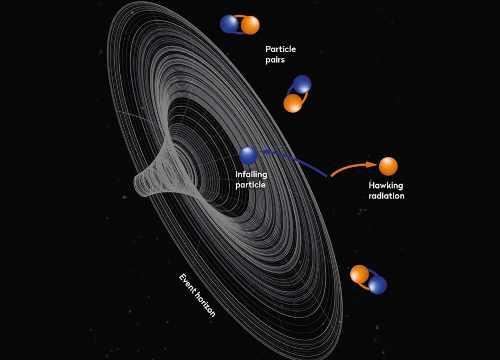
Answer: As far as I know, informa-tion 2-dim is still a theoretical, only hypothetical idea, however, as one of the most attractive. It appears in several independent ways. In my case, by observing physical bodies as a collection of quantum states, or vectors whose pairs span some sur-faces (Area), which I named the book Information of Perception (2016).
1. Long before that, a different idea of 2-dim information was developed in Hawking radiation (1974) and then un-known or uninteresting to me, because I would not have noticed the connecti-on synergy of states in mutual communication, in information perception, wi-th the largest celestial bodies. The connection between such two concepts later comes with the idea that gravity and black holes could have something to do with emergence, and then with this theoretical thermal radiation emitted by black holes due to quantum effects near the event horizon. Hawking radiation is the cause of the slow loss of mass of a black hole, it is believed, a phenomen-on called black hole evaporation.
2. From quantum mechanics we know that empty space can randomly emit particles that, due to the law of conservation, have zero-sum momentum, spin, and charge, instantly taking energy from the vacuum and quickly returning. However, if this happens at the border of a black hole, at the event horizon, a particle that enters the embrace of that strong gravity from which not even light can escape, stays there. The other one is free to leave and reduce the energy of the black hole by its amounts of information, energy, spin, charge, and the like. This is just the beginning of the story of 2-dim information.
3. The holographic principle arises from the observation of a body falling to-wards a black hole. Time for the body slows down until it stops at the event horizon, its radial lengths shorten, the body flattens out and lies on the hori-zon like a blanket tending to zero thickness and, seen from the outside, it nev-er enters the black hole. Any information that the falling bodies had becomes the 2-dimensional surface of the outer sphere of the black hole. There, all inf-ormation would be fragmented, hence the idea that they were always 2-dim-ensional.
4. This further agrees with (my) new interpretation of “internal and external” information, where the first is the scalar product of the two states:
x = (ξ1, ξ2, ..., ξn) and y = (η1, η2, ..., ηn), ∥x∥² = |ξ1|² + ... + |ξn|², ∥y∥² = |η1|² + ... + |ηn|², ∥x∥² = ⟨x|x⟩ ∥y∥² = ⟨x|x⟩,
and the second is a component of the vector product, respectively:
x⋅y = ∥x∥ ∥y∥ cos ∠(x,y), |x×y| = ∥x∥ ∥y∥ sin ∠(x,y).
The first determines the communication coupling of given states, their corr-esponding perceptions, pairs ξk and ηk for k = 1, 2, ..., n, which gives vitality, synergy, or emergence. The second determines the communication of such coupling with the outside world, the forces acting on the given pair.
The information we consider in this way is two-dimensional. In addition, the latter shows a tendency perpendicular to the event horizon, the sphere of the black hole, and will separate from it at some point, one way or another, where the radiation arises from the mathematics itself, the formalism of this interpr-etation. I particularly like that part of this story.
Repeatability » srb
Question: Why don't you define "truthier" as more likely?
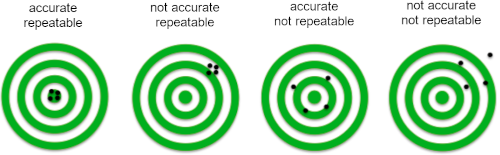
Answer: Look at these four targets in the image on the right. All four hits on the first one are grouped in the center, so we say they are accu-rate and repeatable. In the second one, they are not accurate, but they are also repeatable. The third one has accurate ones that are not repeatable, while the fourth one has both inacc-urate and non-repeatable ones. We notice how the concepts of “repeatability” and “accuracy” are independent, and it is similar between “probable” and “tr-ue”. More probable is what occurs more often under the same conditions.
1. When something that is more likely to happen, it is less news than outcomes that rarely or never happen. More likely realizations are more frequent and le-ss informative. As if pushed by some force of probability, random events tend to more likely states, less informative. This principle of minimalism is comple-tely unnoticed by other theories of information, even those that consider entr-opy as information — very wrong and even directly contradictory, because en-tropy spontaneously increases and information spontaneously decreases. Do not deepen their mistake by introducing that what is more likely is "truer".
2. Let's think of examples like Schrödinger's cat where a cat can be found alive or dead with equal probability, but after a dead outcome it is impossible for the cat to meow afterwards, which can easily happen to a living one. In reali-zations of some small probabilities, many phenomena will remain real, that is, true. These are confirmations that "truthfulness" and probability are generally not related phenomena. If we consider "further" parallel realities as less prob-able, we do so without metrics in the familiar sense and consider untrue pseu-do-reality to be very "distant". Hence we get incorrect fragments of their trut-hs that jump out of these quanta, message packets, and this alludes to the "perpendicularity" to our space-time. In this way, we see that not every fiction will be untrue, although it will still distance us from reality.
3. For example, when a unique object is here, it is not there. Thus, movement changes truth, and further in space means further in time, because the displa-cement of things occurs slower than light. Another example gives parallelism and different geometries in different places in the universe. In a flat, Euclide-an space outside a given line through a given point, it is possible for to draw one and only one line parallel to the given one. In a curved, non-Euclidean sp-ace, none or more of them, depending on whether the geometry is spherical or hyperbolic. Again, displacement is what determines whether the position on parallels will be correct. Similar “displacement” between parallel realities leads to similar, and even worse illogicalities.
4. Bringing a premise, denoted by Π, into contradiction is a sure proof that it is not true, that its negation is true. However, when such a proof is absolutely impossible, without going into the ways of whether and how it could be done, Π can be considered to be true. On this basis, I define this “truthfulness” of the (un)truth Π, as the smallest number of steps needed to bring Π into contradic-tion. Note that this definition does not imply knowing those steps, or proving that it is indeed the smallest. In addition, information is always in packages that it makes sense to count. Finally, here is a familiar example to understand the idea of contradiction.
5. For example, let's prove that there are two irrational numbers a and b such that ab is a rational number. Consider the number $x = \sqrt{2}^\sqrt{2}$. This number x can be either rational or irrational. If x is rational, that's what we're looking for. If x is irrational, we put a = x and $b = \sqrt{2}$, so the expression becomes $(\sqrt{2}^\sqrt{2})^\sqrt{2}$, which is $\sqrt{2}^{\sqrt{2}\cdot\sqrt{2}} = \sqrt{2}^2 = 2$, which is also a rational number. We have thus proven the statement without even knowing which of the two scenarios is "true".
Squeeze » srb
Question: How does a substance that knows only "truth" begin to "lie"?

Answer: This is one of the most di-fficult questions in life, and the mo-st I can do is sketch out a seemingly logical idea that is still awaiting ela-boration in detail in special scienc-es. It starts from crowded situatio-ns, selective perception, and the principle of minimalism.
1. Remember, still life would be in the lower league (Traits) if we were to assume that it knows how to pl-ay. When pressed, it yields, and when relieved, it expands. It can be defeated, but that doesn't concern it because it is indestructible. All the laws of physics, from quantum mechanics to relativity and beyond, can be reduced to the prin-ciple of least action. In this sense, still life is blind to the additional options th-at are available to us and with which we tame it. However, all parts of dead su-bstance have a fabric of fictions. Namely, we see light as colors, and they are waves that, in an even deeper sense, are not real. Ever since Fourier's (1807) decomposition of trajectories into pieces of arbitrary shapes, these smallest "shapes" could become questionable, but it was only with Born's rule (1926) that this became clear.
2. Substance is made up of matter waves (De Broglie, 1924) and here I establi-sh that they are made up of information. However, news ceases to be news as soon as it is communicated, so the permanent reality is all fiction, unreal parts that persistently add up. They are bound by the principle of minimalism, the need for as few changes, interactions as possible, or if possible (all surroundi-ngs would do the same) to descend into a state of even less action. Their exch-anges are discrete, in packages and this makes it impossible for them to disap-pear completely.
A place without information is not a vacuum, but a black hole, and that is why it is so attractive. Let me remind you, all information settles on the surface, or sphere, and event horizon of a black hole, because the time and radial lengths of the bodies that fall there disappear so that they never reach beyond that sp-here, which is like a hollow skeleton around an extremely attractive void. Fr-om this squeeze of information, one can exit perpendicularly to the surface of the sphere, but not enter inside.
3. Electrons in the shells, orbitals of atoms are very selective towards photons that could move them to positions further away from the nucleus of the atom. Thus, the following formula applies to the transition of electrons in an atom:
$$ \frac{1}{\lambda} = RZ^2\left(\frac{1}{n_1^2} - \frac{1}{n_2^2}\right), $$where λ is the wavelength of the photon, R is the Rydberg constant, Z is the atomic number, or the number of protons in the nucleus, n1 and n2 are the pr-incipal "quantum numbers" that denote the electron shells, the energy levels that an electron crosses in an atom. Larger crowds occur in heavier atoms, wi-th more protons in the nucleus, where emergences would occur more easily, although this is a characteristic of many atoms or molecules. Water is wet ev-en though its H2O molecules do not have this property. These presences of many cause "anxiety", undesirable situations from the position of principled minimalism, which displace new qualities of the collective unknown to individuals.
4. The first LLM (Large Language Model) of artificial intelligence were created in 2018 (ULMFiT, OpenAI GPT-1, Google's BERT) by training machines to gu-ess or recognize the continuation of a sentence, using millions of texts given to them. The second level of machine learning was in serviceability. We were am-azed by the ability of these computers to have polite conversations, and we la-ughed at their inability to solve real mathematical problems, brain teasers and search for proofs, not at the speed of calculations. But, already in 2025, at the International Mathematical Olympiad (the world's largest competition for 18-year-old mathematicians), LLM found solutions to five out of six problems and won a gold medal in a group of 50 participants. There are few professional mathematicians in the world who can achieve this result, and we are left won-dering how such machines manage to do this by mainly learning the chances of sentence continuations based on given patterns, unless it is also about em-ergence. After all, reasoning is an act of emergence (Seizure).
5. At differences in the height of our body, even smaller ones, when we stand on the ground, time passes more slowly for our feet than for our heads becau-se gravity slows down time. These are such small changes that we cannot noti-ce them during our lifetime, but we measure them with atomic clocks. So the-se tiny changes are important for complex systems that would perceive unreal phenomena that would otherwise be under the radar of the senses of reality. This is a detail of the influence of gravity that concerns the question I was as-ked, and I believe that there are other types of them, from mutual movements and beyond, a situation when complexity perceives what its parts cannot.
6. In any case, when a complex structure takes over reasoning from somewhe-re, it gains fictions and the ability to lie. If this thesis is correct, then it is nei-ther possible to have biological life, nor intelligent machines, aliens, i.e. any-thing “smart” that will not also be mendacity. I talked about this earlier, bef-ore the advent of artificial intelligence, and now it is especially relevant beca-use it is believed that it lies because it learns from us. When it is able to think strategically, now it is just a good tactician, it will understand that lies lose races with reality because of lies and are not higher league players (Traits), which is below the level of such capacities.
Errors II » srb
Question: Did you tweet about our conversation, that in some parts of infor-mation theory you are significantly ahead of science and that you are often wrong?

Answer: Yes, I wrote recently and that was on the X network, but don't worry because I don't me-ntion names except with permi-ssion. It's fair to say that I make a lot of mistakes, more than many, but I like to deal with difficult top-ics for a long time and, absurdly, I feel sorry when I close them. It ha-ppens that mistakes remain in these texts, I also have misconceptions, and in fact, removing errors on the way to the eventual truth makes me feel a bit of a fraud. For example, there was a fashion for looking for cracks in the theory of relativity, and hence some errors remained (Twins II), but I also believe in go-od judgments (Bernoulli). Otherwise, errors are inevitable.
1. Even the best tracking of reality will be with errors and lags, because the pr-esent moves forward with objective randomness. The winning strategy in the best case is to get lost in fantasies as little as possible (Traits). However, in ou-tplaying nature, whose game is a third league, it is enough to be a second-tier (manipulator), and that is more than enough for politicians, managers and tr-aders to outplay the majority of the population of the second/third-tier (good). That is why every policy, society or company will become obsolete, because li-es are attractive and a good tactic for them, but deceptions lead to failures in the long run — because they fall further behind reality, and in the end it is the only one that is asked.
2. Information of perception directs considerations towards observations, wh-ich is unusual for the exact sciences. Newtonian physics does not care about observers, but Einstein's is a slightly different story. The aforementioned "twin paradox" speaks not only about the relativity of motion, but also about the gr-eater importance of the amount of interactions. A twin who travels and retur-ns to Earth will find an older sibling, so it cannot be taken as if the Earth also left and returned to him, even though the motion is relative. The weight of the event is also given by the surrounding masses. Therefore, I imagine, if there were no other masses, but only two identical brothers, it would be as if they both set off from some central point and, returning to it, found that they had aged equally.
3. The Moon will not disappear when I am not looking at it, because there are countless others who then communicate with it and maintain it in physical re-ality. Quantum physics has come to an end with this type of observation. Wh-en there is no observer, a quantum state is a superposition, and if it appears first, it becomes a particle. Quantum superposition is a fundamental principle of quantum physics that states that mechanical, physical systems exist with multiple potential states simultaneously, until we observe them, that is, mea-sure them. Descriptions of combinations of all possible outcomes of measure-ments are expressed with a specific probability. From this well-known theory, I derive information perception, which emphasizes information created by mutual observation. Especially if the subjects of communication were them-selves without it.
4. Local divergences (Globalism II) are easier to observe in the micro-world, and global convergences in the macro-world of physics. Here I am thinking of space and scaling determinations, as well as analogies to the abstract law of large numbers of probability theory, which states that the size of a sample increases as its mean approaches the population mean. In other words, by repeating random events, outcomes accumulate around a probability. I am also thinking here of temporal processes, successive identical actions that push their actors in the direction of the dominant eigenvalue states of those processes. It is not possible to know the outcomes of local dispersions or the directions of global groupings, although the latter may seem predictable to us only after they occur.
5. In very complex systems, when emergences occur, eventually vitality as an addition to the physical body, a complication that increases its freedoms. Such a structure does not follow the principle of least action, but seeks a more gene-ral principle of minimalism. We notice that all the described phenomena tend to some regulation, but that they still have as a common feature the impossibi-lity and prediction of enlargement and accurate reconstruction of details. In nature, mistakes await us wherever we go, and even understanding it is a pro-cess where mistakes are a tool.
Progress II » srb
Question: Is scientific progress accelerating?

Answer: Scientific progress has a paradoxical form: while the volume of scientific production grows expo-nentially, the rate of basic discover-ies slows down. Scientists are faced with increasingly difficult fundame-ntal questions that require more ef-fort to tackle, and research is dive-rted into the realm of the familiar and the easy (Scientific American).
Here are a few more well-known facts. The number of published academic pa-pers has exploded, with over seven million published annually, and about 90% of all scientists in history are currently alive. But many researchers argue that this favors quantity over quality. The new explosion of labor, some economists and historians of science argue, is being accompanied by increasingly rare and difficult major innovations. The hallmarks of modern science are becoming easily accessible goals that leave scientists with very specific, niche problems that do not immediately translate into major scientific leaps (RMIT Universi-ty).
1. One of the oddities of (my) information theory is the way it treats "truth" and "lies" (Contradiction), so I'm taking this opportunity to use those ideas. That could be an interesting answer to the question, because it's not in the literature, on the internet, nor can artificial intelligence make such a leap in theorizing, unless it steals parts of these stories. Anyway, the more difficult it is to dispute, the more true it is, the longer it lasts, so the appearance of scie-ntific acceleration of progress today is given by the greater engagement of science in lying.
When periods are shorter, cycles seem faster, so the science of explaining and supporting fictions must run faster than the science of more permanent valu-es, i.e. be more productive in producing then shorter ranges. Management or sales, as well as modern politics, requires the kind of science that helps the "manipulators" (league II players) to dominate the "good guys" and the ma-jority of the population (Traits).
2. Modern science is facing an unprecedented level of systemic fraud. While isolated fabrications have always existed, fraudulent publication has evolved into a global, industrial-scale enterprise, driven by hyper-competitive “publish or perish” career metrics and technological advances (Phis.org). Devised oper-ations known as “paper mills” use artificial intelligence and intermediaries to produce, cite, and even sell fake research papers at a scale greater than legiti-mate scientific output (PNAS).
The great leap forward in artificial intelligence discovery (Squeeze, 4) occur-red when Google introduced the Transformer architecture (2017). This was followed by the breakthrough of today's sophisticated LLMs such as GPT or Gemini, which learn sentence continuation to generate human-like text from the analysis of huge data sets. Wanting to simulate and improve the once pr-imitive ELIZA program (Reciprocal, 3), few would have thought at the time that the new “Eliza” could win the gold medal in 2025 at the International Mathematical Olympiad (IMO, by solving five out of six problems. However, this giant leap for computers is not in the true sense a conscious technical or scientific discovery, although it is, like many scientific advances, the result of chance, not the intention of researchers.
3. When we lie, we live from today to tomorrow. We steal our future, because lies are attractive but like a match, they flash and burn. The result is that we remember events better than the lies themselves that caused them, and it is difficult to assess whether people lie more today than before. Lying has today shifted towards science, which is cool and a good spice for deception, I believe, and is not secondary and persecuted as it once was. If not the scientific frauds themselves, the traces of scientific frauds will remain in who knows what real consequences.
For example, during World Wars I and II, governments used posters, radio, and films extensively to demonize enemies and spread false accounts of victo-ries or atrocities about which we now know less than about the victims of war. We abhor totalitarian regimes, remembering their victims better than the pr-opaganda lies with which they tried to correct reality. We easily forget the re-gular deceptions of industry, such as the cover-ups by big tobacco companies that concealed the harmful effects of cigarettes on health. Similarly, all scient-ific lies, once they have passed their fashion, will be forgotten.
4. We use false statements because of their initial appeal, ignoring their long-term failure. Popularity exposes them, if we take into account that there are also useful lies, for example, the art or steps of proof by contradiction and in general that lead to truth or reality (the two are equivalent here). It follows that “accelerated phenomena”, such as science today, and similar to popula-rity, also smell of fraud. I remind you of the existence of stricter criteria for detecting lies, but they are often not within reach.
All in all, precisely because it seems to us that the scientific process is accele-rating, this or anything similar to it, we should also check the possible greater presence of lies that accelerates it, as well as the question of what happens la-ter. The increase in scientific fraud will devalue the kind of science that produ-ced them. Will anyone remember that this was preceded by evaluations such as scientific ratings, the race for prestigious jobs, or political careers, or will all of that be forgotten like the flood of "achievements" of this period. Truth is a real need for some, and science can also be a habit like a hobby.
Faster » srb
Question: Lies last shorter and live faster, you say, do you have anything else on that topic?
Answer: The old proverb says “a lie has short legs” (meaning that lies are quickly discovered) and “a lie will travel halfway around the wo-rld while the truth puts on its sh-oes”. If this is what you mean, I agree, but among us, greater truths are hidden behind these folk prove-rbs. I am not entirely sure, so I have not published it before, but I will say something about my “physics of lies” which could shock us if it turns out to be correct.
1. According to a major MIT study on the spread of true and false information, lies consistently outpace reality because human psychology is inherently drawn to novelty and surprise, they conclude. Lies are often fabricated to be sensational, evoking stronger emoti-onal reactions like disgust or astonishment, which makes people share them. In contrast, truth is usually more mundane and takes time to verify. I agree with this, to begin with, but I consider it an overly cautious, and in that sense a shallow, view, given the physically greater appeal of lies than truth — to those who perceive them.
2. This question is related to the previous answer, that science is becoming shallower and thus accelerating, which makes it less and less a science that does not compromise with untruths. We see a similar form in the acceleration of people telling us something when a faster story becomes more superficial. On another level, we see the same thing with machine learning (LLM) which is trained with sentences from our texts with which it will pick up our lying skills more quickly. That certainly comes with intelligence, because it gives it vitality as a surplus of options compared to the dead physical substance of the machi-ne itself. More intelligent machines will know how to lie more.
3. Starting from the premise that a lie is shorter and therefore more attractive than the truth, because nature spontaneously tends to be less informative, we arrive at its greater penetration and faster spread, and only then do we notice familiar examples of the previously established "law" (it is not precise). Some variations of this observation are also possible, for example, as we age we bec-ome more experienced and conservative, which means with more prejudices. Our brain deceives us, it gives us frequencies of electromagnetic radiation as colors, or vibrations of sound as music, and replaces every physical reality wi-th its own representations. Hence, the "mature" are actually increasingly en-veloped in these small deceptions and, as they age, they think that their years are passing faster.
4. Let us transfer these observations to micro and macro physics, since we co-nsider fictions to be unfinished parts of physical reality, that is, phenomena that reality hardly or not at all perceives, although they may be its tissue. We also have this in the case of cells of our tissue that we are not aware of. Here it is a little more dubious or imprecise, when we say that higher speeds of small particles in their environment speak of a proportionally greater presence of fictions, and that correspondingly slower motions of stars within galaxies ind-icate a heightened reality. My opinion is that more precise expressions of this should be sought in the laws of large numbers.
Dates II » srb
Question: How to calculate these dates that you use to code the answers?
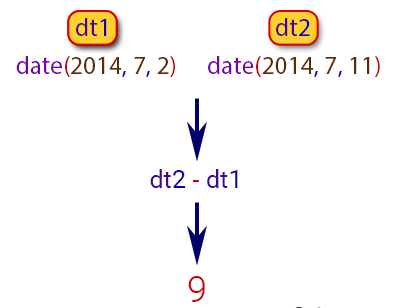
Answer: There is a little more det-ail on this in the image link on the left. I'm just encoding those dates sparingly, in response to a recent question (Dates), to have links to answers and to easily calculate the dates they were posted. Nothing special there.
On the computer screen (Desktop) there is a link that launches a prog-ram in which I pass (Enter) the first d1 and the second d2 date, or enter them in the year-month-day form-at, and it returns the number of da-ys between them. Again, I can enter the number of days from the first and get the second date. Here is the program:
from datetime import date, datetime, timedelta
date_format = "%Y-%m-%d"

def datumi(): # Definiši svoje datume
    date1 = input("Unesi datum (%Y-$m-$d) ili ostaje 2021-6-1: ")
    if date1 == "":
        date1 = '2021-6-1'
    d1 = datetime.strptime(date1, date_format).date()
    date2 = input("Unesi drugi (%Y-$m-$d), ili ostaje današnјi: ")
    if date2 == "":
        date2 = datetime.now().strftime("%Y-%m-%d")
    d2 = datetime.strptime(date2, date_format).date()
    br = (d2 - d1).days
    return d1, d2, br

def brdat(d1, br):
    d2 = d1 + timedelta(days=br)
    print(f"Od {d1} sa {br} dana je datum: {d2}")
    return d2

d1, d2, br = datumi()
print(f"Od datuma {d1} do {d2} ima {br} dana.")
txt = input("Unesi broj dana: ")
while txt.isdecimal():
    br = int(txt)
    dat = brdat(d1, br)
    txt = input("Unesi broj dana: ")
Ево шта се деси када позовем програм:
Unesi datum (%Y-$m-$d) ili ostaje 2021-6-1: 2022-11-17
Unesi drugi (%Y-$m-$d), ili ostaje današnјi:
Od datuma 2022-11-17 do 2026-06-08 ima 1299 dana.
Unesi broj dana:
In the first one I entered November 17, 2022, and in the second one I passed and that's today's date. Enter is the end of the loop, the number of days, and that's it.
Reciprocal II » srb
Question: Explain those reciprocal set mappings to me?
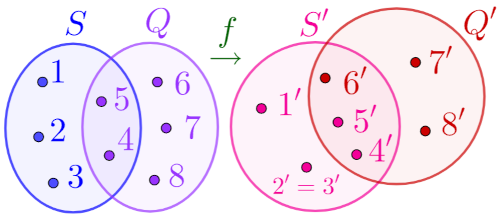
Answer: Let the sets be given
S = {1, 2, 3, 4, 5}, Q = {4, 5, 6, 7, 8},
in the image right, S ∩ Q = {4, 5}. The function f : X → X' copies S and Q respectively into the sets S' and Q', so:
S' = {1', 2'=3', 4', 5', 7'}, Q' = {4', 5', 6', 7', 8'},
where the intersection is a copy of S' ∩ Q' = {4', 5'}. On this specific data you can check that theorems (2) and (4) of that article are valid (Reciprocal).
1. For example, A = {4, 5} ⊆ {4, 5, 6} = B, so f(A) = {4', 5'} ⊆ {4', 5' 6'} = f(B), as stated i. A ⊆ B ⇒ f(A) ⊆ f(B), theorem (2). Note that the function f is not a bijection. It is not an injection because f(2) = f(3), i.e. 2' = 3', and neither is it a surjection because 6 ∉ S while 6' ∈ S'. However:
f(S) = {1', 2'=3', 4', 5', 6'}, f(Q) = {4', 5', 6', 7', 8'},
f(Q) ∖ f(S) = {7', 8'} ⊆ f(Q∖S) = {6', 7', 8'}.
This is also stated in Theorem 2, iv. f(A ∖ B) ⊇ f(A) ∖ f(B), when we put A = Q and B = S. This "escape" of element 6 corresponds to local divergence.
2. In theorem (4) we have for the first statement:
a. A ⊆ B ⊆ Y ⇒ f-1(A) ⊆ f-1(B), {4', 5', 6'} ⊆ {4', 5', 6', 7'} ⇒ {4, 5} ⊆ {4, 5, 6, 7},
with the substitution A = {4', 5', 6'} and B = {4', 5', 6', 7'}, which are now copi-es of the originals f-1(A) = {4, 5} and f-1(B) = {4, 5, 6, 7}. The transformation maintains the union, obviously, and we also note that this is in favor of the ap-plication of functions in general in tracking the duration of phenomena. Next, let's look at what happens with the intersection:
{4, 5} = {1, 2, 3, 4, 5} ∩ {4, 5, 6, 7, 8}, f-1{4', 5', 6'} = f-1{1', 2'=3', 4', 5', 6'} ∩ f-1{4', 5', 6', 7', 8'}, c. f-1(A ∩ B) = f-1(A) ∩ f-1(B),
and that is the third statement of the theorem (4), so it is true, where A = S' and B = Q'. Similarly, check the fourth statement.
3. The function f : x → y is a type of relation ρ : (x, y), i.e. a set of ordered pai-rs, when for one original x there comes at most one copy y. From the preserva-tion of the union it is seen that the function is suitable for describing duration. If it does not cover the entire domain (when it is not a surjection) it allows the description of local divergence, and the property f(A ∩ B) ⊆ f(A) ∩ f(B) leaves the possibility of global convergence. These properties are also possessed by operators of linear algebra.
4. For example, at one stand we have quantities of 3 and 4 goods at prices x1 and x2, with the sale of which we obtain y1 monetary units, and at the other stand we have quantities 2 and 1 of the same prices with a total value y2. This leads into a system of equations:
3x1 + 4x2 = y1, 2x1 + x2 = y2,
which defines the linear mapping Ax = y, where we have an operator A which, acting on the vector x = (x1, x2), gives the vector y = (y1, y2) of its own, some 2-dimensional vector space. We can also write this in matrix form:
$$ \begin{pmatrix} 3 & 4 \\ 2 & 1 \end{pmatrix} \begin{pmatrix} x_1 \\ x_2 \end{pmatrix} = \begin{pmatrix} y_1 \\ y_2 \end{pmatrix}. $$This system of linear equations, like a mapping and an operator, as well as a matrix, are types of functions. All of them hide the described properties. The plasticity or adaptability of such mathematical abstractions is very useful pr-ecisely because of the listed invariant properties of functions.
5. For example, the local divergence of such matrices, Ax = y, will be recogniz-ed in the inverse mapping, x = A-1y, specifically:
$$ \begin{pmatrix} x_1 \\ x_2 \end{pmatrix} = -\frac15\begin{pmatrix} 1 & -4 \\ -2 & 3 \end{pmatrix} \begin{pmatrix} y_1 \\ y_2 \end{pmatrix}. $$Due to the large choice of components y1 and y2 of the vector y, there are ma-ny possibilities for the vector x. It is assumed that AA-1 = A-1A = I, where I is the identity matrix of that (2-dim) space. Whenever we have linearly indepe-ndent vectors u1 and u2 of that space, we can uniquely write all vectors of it, including the vectors:
x = ξ1u1 + ξ2u2, y = η1u1 + η2u2.
By choosing the scalars (numbers) η1 and η2 differently, we obtain different ξ1 and ξ2 which determine (different) vectors x in unique ways, in the given basis of vectors u1 and u2 of that space. So much for local divergence.
6. Global convergence occurs by continuing in the same circumstances. Thus, the owner begins to resemble his pet and vice versa, communities will take the laws of each other, the movements of celestial bodies around a star will be re-duced to one plane. This general phenomenon is unusual for some of my read-ers, even for all who know linear algebra (where it is easily proven), because its application, or rather interpretation, is a discovery. For a given matrix, we find:
$$ \begin{pmatrix} 3 & 4 \\ 2 & 1 \end{pmatrix} \begin{pmatrix} 2 \\ 1 \end{pmatrix} = 5 \begin{pmatrix} 2 \\ 1 \end{pmatrix}, \quad \begin{pmatrix} 3 & 4 \\ 2 & 1 \end{pmatrix} \begin{pmatrix} 1 \\ -1 \end{pmatrix} = - \begin{pmatrix} 1 \\ -1 \end{pmatrix}. $$These are the solutions of its characteristic equation, Av = λv, with eigenvalu-es λ1 = 5 and λ2 = -1 to which belong the eigenvectors, respectively v1 = (2, 1) and v2 = (1, -1). These are independent vectors and form a basis of this 2-dimensional space. Now we write an arbitrary vector in this basis:
x = ξ1v1 + ξ2v2,
$$ \begin{pmatrix} x_1 \\ x_2 \end{pmatrix} = \xi_1\begin{pmatrix} 2 \\ 1 \end{pmatrix} + \xi_2\begin{pmatrix} 1 \\ -1 \end{pmatrix} = \begin{pmatrix} 2\xi_1 + \xi_2 \\ \xi_1 - \xi_2 \end{pmatrix}, $$x1 = 2ξ1 + ξ2, x2 = ξ1 - ξ2,
x = (x1, x2)⊤.
By transposing a vector of row (x1, x2), we obtain a column vector (x1, x2)⊤, which is the transition from the co- to the contra-variant coordinate (Vari-ance). Here is what happens during the duration of state x under the same circumstances A.
7. The successive action of the matrix A on the vector x gives:
Ax = A(ξ1v1 + ξ2v2) = ξ1Av1 + ξ2Av2,
Ax = ξ1λ1v1 + ξ2λ2v2,
A²x = ξ1λ1²v1 + ξ2λ2²v2,
A³x = ξ1λ1³v1 + ξ2λ2³v2,
...
Anx = ξ1λ1nv1 + ξ2λ2nv2.
When n → ∞, we divide this equality by the power of the leading eigenvalue (the larger absolute value), and here it is λ1 = 5, we find:
$$ \lambda_1^{-n}A^nx = \xi_1v_1 + \xi_2(\lambda_1/\lambda_2)^nv_2 \to \xi_1v_1, \quad n \to \infty. $$The direction of the degree of the matrix on a given vector Anx → αv1 with some scalar α. Thus, the vector x, like any other, will tend to have a direction, we say to align with the dominant eigenvector v1 of the given process A. So much for global convergence.
Revision » srb
Question: Do these mappings say anything about reading the past?

Answer: It seems easier to know the past than to predict the future, although the future is not as une-xpected as our brains forbid us from looking at. First, the brain likes familiar things. Second, the brain filters out countless possibi-lities without giving us a chance to notice them at all. If it didn't do th-at, we would be bombarded with so many tasks that we can't handle th-em. Therefore, the brain already knows two to seven seconds before our decision what we will decide, in most situations. By unconsciously calculating the future, we choose to cling tightly to our fictions, rather than reading and accepting reality. Lies are comfortable (Aquaplaning) and the brain protects us from unnecessary and painful truths. There is no easy way to decipher it, even with reading the past.
1. Just as the brain "protects" us from the future and present days, it also wor-ks to change our personal memories, and politicians and social communities work in a similar way to "protect" their wards from the unfavorable events of our history. In fact, it is about protecting their own lies, deceptions that have caused them to lose track of reality and (they think) are correcting what they can. This is a big topic, but I will not talk about it now, because we have enou-gh objective obstacles in deciphering the past. Let's just think about the ambi-guity of the value x when given x², x², ..., xn, and then in searching for the n-th roots of the matrix value An. Let's consider it, first in a "brutal" way.
2. Let A be a matrix, the process that in two steps becomes A² = B, in general:
$$ \begin{pmatrix} x & y \\ z & w \end{pmatrix}^2 = \begin{pmatrix} a & b \\ c & d \end{pmatrix}, $$ $$ \begin{cases} x^2 + yz = a & xy + yw = b \\ xz + zw = c & yz + w^2 = d \end{cases} $$Adding and subtracting the main diagonal, and dividing the secondary diago-nal:
x² - w² = a - d, x² + w² = a + d - 2yz, cy = bz.
By adding, also subtracting the first two equations, and then integrating the third, we easily find:
$$ x^2 = a - \frac{b}{c}z^2, \quad y = \frac{b}{c}z, \quad w^2 = d - \frac{b}{c}z^2. $$Again, from (x - w)(x + w) = a - d and z(x + w) = c, multiplying the first by z we find (x - w)c = (a - d)z, so with the second of these we have the system:
$$ x + w = \frac{c}{z}, \quad x - w = \frac{a - d}{c}z, $$which we (again) add and subtract to get:
$$ x = \frac{c}{2}\frac{1}{z} + \frac{a-d}{2c}z, \quad w = \frac{c}{2}\frac{1}{z} - \frac{a-d}{2c}z. $$By substituting this x into the previous x² we calculate z:
$$ \left(\frac{c}{2}\frac{1}{z} + \frac{a-d}{2c}z\right)^2 = a - \frac{b}{c}z^2, $$ $$ \frac{c^2}{4}\frac{1}{z^2} + \frac{a-d}{2} + \frac{(a-d)^2}{4c^2}z^2 = a - \frac{b}{c}z^2, $$ $$ [(a-d)^2+4bc]z^4 - 2c^2(a+d)z^2 + c^4 = 0. $$It is a biquadratic equation with four solutions for the number z, which we in-clude in the previous ones and obtain four groups of solutions of the matrix A, the roots of the given matrix B.
3. For example, when given:
$$ \begin{pmatrix} x & y \\ z & w \end{pmatrix}^2 = \begin{pmatrix} 17 & 16 \\ 8 & 9 \end{pmatrix}, $$the biquadratic equation becomes:
[(17 - 9)2 + 4⋅16⋅8] z4 - 2⋅8^2(17 + 9) z2 + 84 = 0,
576 z4 - 3328 z2 + 4096 = 0,
$$ (z^2)_{+,-} = \frac{3328 \pm\sqrt{3328^2 - 4\cdot 576\cdot 4096}}{2\cdot 576} = \frac{3328 \pm1280}{1152}, $$(z²)+ = 4, (z²)- = 16/9,
z1 = 2, z2 = -2, z3 = 4/3, z4 = -4/3.
In each of these four cases zk ∈ {±2, ±4/3}, respectively for k = 1, 2, 3 and 4, we find the corresponding xk = 4/zk + zk/2, yk = 2zk and wk = 4/zk - zk/2, so:
$$ \begin{pmatrix} x_k & y_k \\ z_k & w_k \end{pmatrix}^2 = \begin{pmatrix} a & b \\ c & d \end{pmatrix}. $$In the given case, the matrix Ak² = B, we have four roots, solutions:
$$ \begin{pmatrix} \pm 3 & \pm 4 \\ \pm 2 & \pm 1 \end{pmatrix}^2 = \begin{pmatrix} \pm\frac{11}{3} & \pm\frac{8}{3} \\ \pm\frac{4}{3} & \pm\frac{7}{3} \end{pmatrix}^2 = \begin{pmatrix} 17 & 16 \\ 8 & 9 \end{pmatrix}. $$Each of these four matrices Ak will give a state in two steps (squared), resulti-ng in the process B, which we finally only see and have to guess where it came from. The example is from the previous answer (Reciprocal II, 4), with the matrix A = A1.
4. Let us now consider the same in a "subtle" way, using the diagonalization of the matrix A = PDP-1. Here D[λ1, λ2] is a diagonal matrix with elements on the diagonal that are the eigenvalues of the given matrix (Av = λv) while P[v1, v2] is an auxiliary matrix whose columns are the corresponding (λk, vk) eigenvect-ors of the given matrix A, and P-1 is its inverse matrix. Thus:
$$ \begin{pmatrix} 3 & 4 \\ 2 & 1 \end{pmatrix} = \begin{pmatrix} 2 & 1 \\ 1 & -1 \end{pmatrix} \begin{pmatrix} 5 & 0 \\ 0 & -1 \end{pmatrix} \begin{pmatrix} \frac13 & \frac13 \\ \frac13 & -\frac23 \end{pmatrix}, $$which is easy to check. By exponentiation we find:
A = PDP-1,
A² = PD²P-1,
A³ = PD³P-1,
...
An = PDnP-1,
$$ \begin{pmatrix} 3 & 4 \\ 2 & 1 \end{pmatrix}^n = \begin{pmatrix} 2 & 1 \\ 1 & -1 \end{pmatrix} \begin{pmatrix} 5 & 0 \\ 0 & -1 \end{pmatrix}^n \begin{pmatrix} \frac13 & \frac13 \\ \frac13 & -\frac23 \end{pmatrix}, $$ $$ \begin{pmatrix} 3 & 4 \\ 2 & 1 \end{pmatrix}^n = \begin{pmatrix} 2 & 1 \\ 1 & -1 \end{pmatrix} \begin{pmatrix} 5^n & 0 \\ 0 & (-1)^n \end{pmatrix} \begin{pmatrix} \frac13 & \frac13 \\ \frac13 & -\frac23 \end{pmatrix}, $$ $$ \begin{pmatrix} 3 & 4 \\ 2 & 1 \end{pmatrix}^n = \frac13\begin{pmatrix} 2\cdot 5^n + (-1)^n & 2\cdot 5^n - (-1)^n \\ 5^n - 2(-1)^n & 5^n + 2(-1)^n \end{pmatrix}, $$and in particular, for n = 2, it will be:
$$ \begin{pmatrix} 3 & 4 \\ 2 & 1 \end{pmatrix}^2 = \frac13\begin{pmatrix} 2\cdot 5^2 + (-1)^2 & 2\cdot 5^2 - 2(-1)^2 \\ 5^2 - (-1)^2 & 5^2 + 2(-1)^2 \end{pmatrix}, $$ $$ \begin{pmatrix} 3 & 4 \\ 2 & 1 \end{pmatrix}^2 = \begin{pmatrix} 17 & 16 \\ 8 & 9 \end{pmatrix}. $$We recognize the previous (3) case A² = B, but let's further guess A based on B by another method, now using the eigenvalues (μ) and their corresponding ve-ctors (u) of the matrix (Bu = μu).
5. We solve the characteristic equation Bu = μu and find:
$$ \begin{vmatrix} 17 - \mu & 16 \\ 8 & 9 - \mu \end{vmatrix} = 0, $$(17 - μ)(9 - μ) - 16⋅8 = 0,
μ² - 26 μ + 25 = 0,
μ1 = 25, μ2 = 1.
Hence:
$$ \begin{pmatrix} 17 - \mu_k & 16 \\ 8 & 9 - \mu_k \end{pmatrix} \begin{pmatrix} u'_k \\ u''_k \end{pmatrix} = 0, $$ $$ u_1 = \begin{pmatrix} 2 \\ 1 \end{pmatrix}, \quad u_2 = \begin{pmatrix} 1 \\ -1 \end{pmatrix}. $$We recall that these were also the eigenvectors of the root of the matrix A, so that u1 = v1 and u2 = v2, but that these eigenvalues are the squares of those, or μ1 = λ1² and μ2 = λ2². This explains how to calculate A based on B:
$$ \lambda = \pm\sqrt{\mu}, \quad v = u. $$These are actually the following four solutions:
$$ A_k = \begin{pmatrix} x_k & y_k \\ z_k & w_k \end{pmatrix} = \begin{pmatrix} 2 & 1 \\ 1 & -1 \end{pmatrix} \begin{pmatrix} \pm 5 & 0 \\ 0 & \pm 1 \end{pmatrix} \begin{pmatrix} \frac13 & \frac13 \\ \frac13 & -\frac23 \end{pmatrix}, $$because all four combinations of the signs of the diagonal matrix are possible:
$$ A_{++} = \begin{pmatrix} 11/3 & 8/3 \\ 4/3 & 7/3 \end{pmatrix} = A_3, \quad A_{+-} = \begin{pmatrix} 3 & 4 \\ 2 & 1 \end{pmatrix} = A_1, $$ $$ A_{-+} = \begin{pmatrix} -3 & -4 \\ -2 & -1 \end{pmatrix} = A_2, \quad A_{--} = \begin{pmatrix} -11/3 & -8/3 \\ -4/3 & -7/3 \end{pmatrix} = A_4. $$On the right in the equations are the solution labels using the previous meth-od. Typically in mathematics, the solutions must be the same, but the methods may be different.
6. We formally solve the reading of the past using the inverse function, looking for all the functions that would lead to a given state. Here we did it in two wa-ys, in the simplest case, two steps. Knowing the two-step process, in 2-dimen-sional space we saw that such a process could appear in one repetition in four different ways. We can imagine how many ways such a process can arise in multi-dimensional complexity, and in several of the same steps. These are formal objective obstacles, which can actually help the planting of false his-tories by the powerful, the manipulators who still do not see that they have missed reality, or hope to deceive it, or want to hide their failure. This is also a huge topic, and one day it could also be part of algebra.
Revision II » srb
Question: I like these solutions, I collect them, but why don't you complete the revision with solving the third root, or larger?
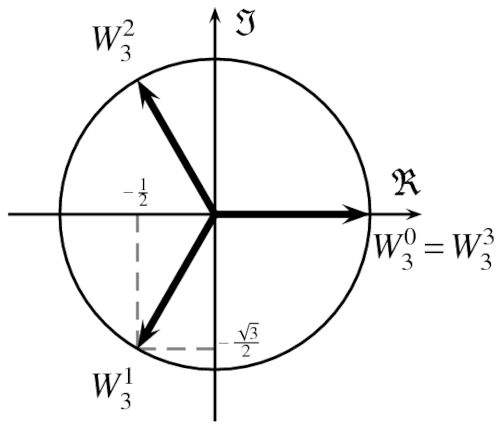
Answer: The third roots of the nu-mber one have three k = 0, 1, 2:
$$ e^{\frac{2k\pi}{3}} = \cos\frac{2k\pi}{3} + i\sin\frac{2k\pi}{3}, $$and whose graphs with explanati-ons you see on the right. This is from Euler's interpretation of co-mplex numbers, the imaginary unit i² = -1. For the case of the nth root it would be:
$$ e^{\frac{2k\pi}{n}} = \cos\frac{2k\pi}{n} + i\sin\frac{2k\pi}{n}, $$where n = 1, 2, 3, ..., and k = 0, 1, ..., n-1. When n = 2, then there are only two other roots, for k = 0 and k = 1, which reduces to the previous answer.
1. For example, we write two complex numbers of the complex plane ℂ in rec-tangular and polar coordinates:
$$ z_1 = x_1 + iy_1 = r_1e^{i\phi_1}, \quad z_2 = x_2 + iy_2 = r_1e^{i\phi_2}, $$where the coordinates and intensities are real numbers xk, yk, rk ∈ ℝ, and are also angles (arguments), here in radians. Their product is a complex number:
$$ z = z_1z_2 = (x_1 + iy_1)(x_2 + iy_2) = r_1r_2e^{i(\phi_1+\phi_2)}, $$as we can see, it is obtained by multiplying the intensity and adding the angl-es. So, when the argument (angle) of a complex number is 2π/3, which is 120°, such a multiplication rotates the complex number by a third of a full angle, which means that it returns it to the initial direction in three steps, and if it is of unit intensity, the multiplication will not change the intensity. The third roots of unity thus lie on thirds of a full circle, as can be seen in the figure up:
$$ z_0 = \cos\frac{2\pi\cdot 0}{3} + i \sin\frac{2\pi\cdot 0}{3} = 1, $$ $$ z_1 = \cos\frac{2\pi\cdot 1}{3} + i \sin\frac{2\pi\cdot 1}{3} = -\frac12 + i\frac{\sqrt{3}}{2}, $$ $$ z_2 = \cos\frac{2\pi\cdot 2}{3} + i \sin\frac{2\pi\cdot 2}{3} = -\frac12 - i\frac{\sqrt{3}}{2}. $$By direct multiplication, verify that zk² = 1 for all three roots.
2. If you have read the previous answers, you will understand the following more easily:
An = PDnP-1,
$$ \begin{pmatrix} 3 & 4 \\ 2 & 1 \end{pmatrix}^n = \begin{pmatrix} 2 & 1 \\ 1 & -1 \end{pmatrix} \begin{pmatrix} 5^n & 0 \\ 0 & (-1)^n \end{pmatrix} \begin{pmatrix} \frac13 & \frac13 \\ \frac13 & -\frac23 \end{pmatrix}, $$ $$ \begin{pmatrix} \alpha_{11}^{(jk)} & \alpha_{12}^{(jk)} \\ \alpha_{21}^{(jk)} & \alpha_{22}^{(jk)} \end{pmatrix} = \begin{pmatrix} 2 & 1 \\ 1 & -1 \end{pmatrix} \begin{pmatrix} 5e^{2ij\pi/n} & 0 \\ 0 & -e^{2ik\pi/n} \end{pmatrix} \begin{pmatrix} \frac13 & \frac13 \\ \frac13 & -\frac23 \end{pmatrix}, $$where j, k ∈ {0, 1, ..., n-1}, and n ∈ ℕ. Multiplying these matrices we find all n-th roots of the matrix B = An of which there are dn where d is the order of th-ese square matrices (here d = 2), and n is the number of layers of the process. We calculate:
$$ \begin{pmatrix} \alpha_{11}^{(jk)} & \alpha_{12}^{(jk)} \\ \alpha_{21}^{(jk)} & \alpha_{22}^{(jk)} \end{pmatrix} = \frac13 \begin{pmatrix} 10e^{2ij\pi/n}-e^{2ik\pi/n} & 10e^{2ij\pi/n}+2e^{2ik\pi/n} \\ 5e^{2ij\pi/n}+e^{2ik\pi/n} & 5e^{2ij\pi/n}-2e^{2ik\pi/n} \end{pmatrix}. $$For example, for j = k = 0 these complex exponents are units and we have the basic solution:
$$ \begin{pmatrix} \alpha_{11}^{(00)} & \alpha_{12}^{(00)} \\ \alpha_{21}^{(00)} & \alpha_{22}^{(00)} \end{pmatrix} = \begin{pmatrix} 3 & 4 \\ 2 & 1 \end{pmatrix}. $$However, that is only one of 2n possible ones.
3. When n = 3 we find the third root of the matrix:
$$ \begin{pmatrix} 3 & 4 \\ 2 & 1 \end{pmatrix}^3 = \begin{pmatrix} 83 & 84 \\ 42 & 41 \end{pmatrix}, $$ $$ \begin{pmatrix} 3 & 4 \\ 2 & 1 \end{pmatrix}^3 = \begin{pmatrix} 2 & 1 \\ 1 & -1 \end{pmatrix} \begin{pmatrix} 5^3 & 0 \\ 0 & (-1)^3 \end{pmatrix} \begin{pmatrix} \frac13 & \frac13 \\ \frac13 & -\frac23 \end{pmatrix}, $$ $$ \begin{pmatrix} \alpha_{11}^{(jk)} & \alpha_{12}^{(jk)} \\ \alpha_{21}^{(jk)} & \alpha_{22}^{(jk)} \end{pmatrix} = \begin{pmatrix} 2 & 1 \\ 1 & -1 \end{pmatrix} \begin{pmatrix} 5e^{2ij\pi/3} & 0 \\ 0 & -e^{2ik\pi/3} \end{pmatrix} \begin{pmatrix} \frac13 & \frac13 \\ \frac13 & -\frac23 \end{pmatrix}, $$where j, k ∈ {0, 1, 2}, and for the imaginary unit i² = -1. We find:
$$ \begin{pmatrix} \alpha_{11}^{(jk)} & \alpha_{12}^{(jk)} \\ \alpha_{21}^{(jk)} & \alpha_{22}^{(jk)} \end{pmatrix} = \frac13 \begin{pmatrix} 10e^{2ij\pi/3}-e^{2ik\pi/3} & 10e^{2ij\pi/3}+2e^{2ik\pi/3} \\ 5e^{2ij\pi/3}+e^{2ik\pi/3} & 5e^{2ij\pi/3}-2e^{2ik\pi/3} \end{pmatrix}. $$When j = k ∈ {0, 1, 2}, this expression simplifies to:
$$ \begin{pmatrix} \alpha_{11}^{(k)} & \alpha_{12}^{(k)} \\ \alpha_{21}^{(k)} & \alpha_{22}^{(k)} \end{pmatrix} = (\cos \frac{2ik\pi}{3} + i\sin \frac{2ik\pi}{3}) \begin{pmatrix} 3 & 4 \\ 2 & 1 \end{pmatrix}. $$Of those three, two are complex solutions, so an interesting question would be where they came from.
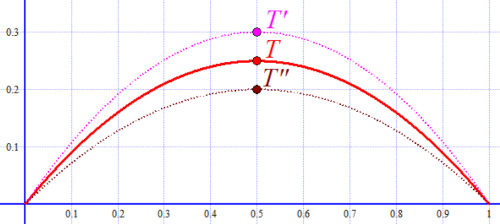
4. The image on the left shows a parabola:
f(x) = x(1 - x)
initial velocities vx = vy = 2.2 m/s at an acceleration due to gravity g = 9.8 m/s² as a “oblique shot” with air resistance neglected and the ve-rtex point T(0.5, 0.25) undershooting looking at T'(0.5, 0.3), or overshooting relative to T''(0.5, 0.2) in that imaginary shot. By choosing other initial shoo-ting conditions, the function f' = 1.2x(1 - x) would have the upper vertex, and the function f'' = 0.8x(1 - x) the lower T''. If we search for the upper ordinate from the current f(x), we find complex solutions:
x(1 - x) = 0.3
x² - x + 0.3 = 0
$$ x_{1,2} = \frac{1 \pm i\sqrt{0.2}}{2}. $$both complex abscissas x1, x2 ∈ ℂ would give the above topics:
$$ f(x_{1.2}) = x(1-x) = \frac{1 \pm i\sqrt{0.2}}{2}(\frac{1 - \mp i\sqrt{0.2}}{2}) = \frac{1+0.2}{4} = 0.3. $$However, that is not realistic, the current shot will miss both T' and T''. And in that I see the possibilities of interpreting complex numbers, to express fictitio-us values. I see them in the impossibilities for reality, which we are otherwise constantly surrounded by.
5. The first task was to find its cube B = A³, knowing B, a square matrix of the second or any higher order, and the second was the opposite, knowing B we found its cube root $A = \sqrt[3]{A}$. It is a bit unusual for matrices, but it was expect-ed that, as in finding the roots of numbers, we would discover multiple soluti-ons. Here, in matrices and processes, we understand the same multiplicity by the possibilities implicitly contained in each step, like a quantum superpositi-on that collapses into a single outcome. The third task would be to decompose a phenomenon that would be unique, moreover "indivisible", into a series of the same steps, or layers. Then we need an interpretation of complex solutio-ns, say as mentioned in (4), about the possibilities that give impossibilities.
Decrease » srb
Question: Is the past being spent informing the present?

Answer: This should be the case both for the sake of preserving in-formation, and on the other hand, because the present does not comp-lement the past. However, the loss of older information and the fading of the past will be easier to determi-ne in other ways. This is confirmed by the saying "strike while the iron is hot", or by forensic scientists who are important to be at the scene of a crime as soon as possible, or by arc-haeologists who have difficulty with further history.
1. There are as many ways in which the current process can arise as there are ways in which it has developed. This sentence of two identical statements says that the same quantities of the past as of the future are given to the present. Therefore, the previous answers, revisions of the past on the basis of the pre-sent, are analogous or symmetrical to the possible ones about predicting the future. Thus, the process A acting on the state x to produce the state y = Ax can be formally treated so that x is the present state and y is the future, but also so that y is the past. This is the method I use and which at first confuses us, but which we easily get used to. Let us add to this that the state x that is developing has just as many possibilities as the process A that is developing it.
2. For example, let's look at the exponentiation of the previous matrix:
$$ \begin{pmatrix} 3 & 4 \\ 2 & 1 \end{pmatrix}^n = \begin{pmatrix} 2 & 1 \\ 1 & -1 \end{pmatrix} \begin{pmatrix} 5^n & 0 \\ 0 & (-1)^n \end{pmatrix} \begin{pmatrix} \frac13 & \frac13 \\ \frac13 & -\frac23 \end{pmatrix}, $$ $$ \begin{pmatrix} \frac35 & \frac45 \\ \frac25 & \frac15 \end{pmatrix}^n = \begin{pmatrix} 2 & 1 \\ 1 & -1 \end{pmatrix} \begin{pmatrix} 1 & 0 \\ 0 & (-\frac15)^n \end{pmatrix} \begin{pmatrix} \frac13 & \frac13 \\ \frac13 & -\frac23 \end{pmatrix}. $$Since the matrix A has the eigenvalue λ1 = 5 dominant, which means that |λ1| > |λ2| = |-1|, we divided the equation by the number |λ1|n, so we also divided An by that factor, that is, we divided A by |λ1|. When n increases, the number (-1/5)n → 0 with n → ∞, so in the limiting case we have:
$$ \lim_{n \to \infty} A^n = B, $$ $$ B = \begin{pmatrix} 2 & 1 \\ 1 & -1 \end{pmatrix} \begin{pmatrix} 1 & 0 \\ 0 & 0 \end{pmatrix} \begin{pmatrix} \frac13 & \frac13 \\ \frac13 & -\frac23 \end{pmatrix}, $$ $$ B = \begin{pmatrix} \frac23 & \frac23 \\ \frac13 & \frac13 \end{pmatrix}. $$Note that under the action of this process, y = Bx, every state x becomes y always in the same direction (2, 1)⊤ as both columns B. This means that after many steps n = 1, 2, 3, ... the overall process An ceases to remember, the original cannot be known from the copy. In other words, reality ceases then.
3. As the exponent n increases, the "memory" of the process An decreases and disappears completely in the limiting case, n → ∞. A longer chain of processes becomes less sustainable, because the chances that real events will follow that entire path decrease. Hence the conclusion that a longer sequence An is less realistic, i.e. less true.
At the same time, because the steps themselves are also shortened and the arbitrary vector z = (x, y) becoming zn = Anz becomes closer to the leading eigenvalue, v0 = v/∥v∥, we see how the reality of the state is consumed in the steps, the repetitions of the same process. In order for reality to be maintai-ned, therefore, changes in the process are necessary and they are one of the reasons that make it impossible for us to predict the result of global conver-gence even though we know about such an event.
Подсећам да се вектор v својствене једначине, Av = λv, може множити и делити константом α, или својим интензитетом ∥v∥ да остаје опет „исти“ својствени, A(αv) = λ(αv). Такво праћење самог смера вектора уобичајено је код квантних суперпозиција. Кажемо да произвољан вектор, мислећи на нормиране тог простора, вишеструким деловањем сталног оператора постаје доминантни својствени вектор датог оператора.
4. This also applies to recursion (Sierpiński). Just as the law of conservation is threatened by infinite divisibility, it is also threatened by infinite repetition of the same. The first, because infinity (by definition) can be its own proper part, and the second, as mentioned above, because of decreasing duration. Namely, when B = An and after some large m the process Amn becomes unmemorable (becomes unreal, or false), then Bm is already false, even though m < mn. Ch-ains of a more real process, as special processes, are less real the longer they are chained. In particular, the attempt to endlessly reflect light between mir-rors fails because it is a repetitive process and becomes unrealistic, and only then should we talk about black-body radiation and Planck's discovery of quanta.
5. This formalism points to much deeper causes of the consumption of the past in informing the present. For example, simply because of the cascading presence of the present in layers that recede and multiply, an event from the past imitates a state or process that is repeated and therefore fades, and dis-appears from reality. Note that this concluding argument is not the same as the introductory one about the same phenomenon — the destruction of facts from the past.
Adjoint » srb
Question: Why are the eigenvectors of the operators from the previous answe-rs not perpendicular?
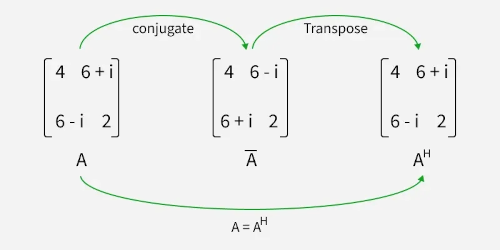
Answer: Self-adjoint or Hermitian operators (H), but only those that go with different eigenvalues (λ), have perpendicular eigenvectors (v). Then they solve the character-istic equation, Hv = λv. Such a pair can have as many pairs of solutions (λk, vk), for k = 1, 2, ..., n, up to a number that depends on further properties of the matrix H. The mentioned matrix A does not meet the given, Hermitian conditions, because A† ≠ A. Its conjugate and transpose matrix are not equal to it. In the figure on the left and in the attachment, Ā is the designation for the conjugation of the matrix A, often A*, and AH = (Ā)T is the adjunction, here A† = (A*)⊤, and the transpose is written A⊤. By definition, perpendicular vectors are vectors whose dot product is zero.
1. Given the real numbers a, b, cx, cy ∈ ℝ, the complex number c = cx + icy ∈ ℂ with imaginary unit i² = -1. Then the following matrix is Hermitian:
$$ H = \begin{pmatrix} a & c \\ c^* & b \end{pmatrix}, $$for H† = H. Namely:
$$ H^\dagger = (\begin{pmatrix} a & c \\ c^* & b \end{pmatrix}^*)^\top = \begin{pmatrix} a & c^* \\ c & b \end{pmatrix}^\top = \begin{pmatrix} a & c \\ c^* & b \end{pmatrix} = H, $$because the conjugate real numbers do not change, a* = a and b* = b, and the conjugate complex c* = cx - icy. The subject and the object have dual percepti-ons. Since they do not see the world equally, but as co- and contra-variant ve-ctors, we multiply them together if we are looking for their scalar product, or perceptual information. This is usually not important to us because of the real coefficients of the state of our environments, but at the quantum level it beco-mes crucial.
2. For example, the wave function of an electron in an atom, otherwise known as the mathematical probability amplitude, describes the quantum state of an electron in an atom:
$$ \Psi(r, \theta, \phi) = R_{n\ell}(r)\cdot Y_\ell^{m\ell}(\theta, \phi), $$where $R_{n\ell}(r)$ determines how the wave function decays as the electron moves away from the nucleus, and $Y_\ell^{m\ell}(\theta, \phi)$ controls the angular orientation and assigns the known shapes of atomic orbitals. The wave function $\Psi$ is complex-valued whose squares of the modulus $|\Psi|^2$ give the “probability amplitudes” that the particle is at a given location, here in a spherical coordinate system (Orθϕ). The operators that move these electrons across shells have infinite matrices (Leveling), but there are also smaller ones, even with second-order matrices (Spin III). For training and easier understanding of the point, sm-aller matrices are taken.
3. Let a = 3, b = 1 and c1 = c2 = 2. So the characteristic equation of the above matrix is Hv = λv, or (H - Iλ)v = 0, where I is the identity matrix, λ is its eigen-value and v its associated eigenvector. The matrix H - Iλ maps the components v = (vx, vy)⊤ to zeros, and the inverse would copy the zeros into that vector. As there is no such inverse, its determinant is zero, det[H - Iλ] = 0, i.e.:
$$ \det[\begin{pmatrix} 3 & 2 + 2i \\ 2 - 2i & 1 \end{pmatrix} - \begin{pmatrix} 1 & 0 \\ 0 & 1 \end{pmatrix}\lambda] = 0, $$ $$ \begin{vmatrix} 3 - \lambda & 2 + 2i \\ 2 - 2i & 1-\lambda \end{vmatrix} = 0, $$ $$ (3 - \lambda)(1 - \lambda) - (2 - 2i)(2 + 2i) = 0, $$ $$ \lambda^2 - 4\lambda - 5 = 0, $$ $$ \lambda_1 = 5, \quad \lambda_2 = -1. $$Substituting these eigenvalues into Hv = λv, we find:
$$ \begin{pmatrix} 3 & 2 + 2i \\ 2 - 2i & 1 \end{pmatrix} \begin{pmatrix} 1 + i \\ 1 \end{pmatrix} = 5 \begin{pmatrix} 1 + i \\ 1 \end{pmatrix}, $$ $$ \begin{pmatrix} 3 & 2 + 2i \\ 2 - 2i & 1 \end{pmatrix} \begin{pmatrix} 1 + i \\ -2 \end{pmatrix} = - \begin{pmatrix} 1 + i \\ -2 \end{pmatrix}. $$We scalar multiply the covariant v1 and the contravariant v2 vector:
$$ \langle v_1 | v_2 \rangle = \begin{pmatrix} 1 - i & 1 \end{pmatrix} \cdot \begin{pmatrix} 1 + i \\ -2 \end{pmatrix} = 2 - 2 = 0. $$This ⟨v1|v2⟩ = 0 means that the given vectors are perpendicular, v1 ⊥ v2.
4. Based on Hv1 = λ1v1 and Hv2 = λ2v2, we further form an auxiliary matrix P = P[v1, v2] whose columns are the eigenvectors v1 and v2 of the matrix H. It is easy to see that then HP = PD, where D = D[λ1, λ2] is a diagonal matrix, with the eigenvalues λ1 and λ2 on the main diagonal and with all other elements zero. Then H = PDP-1, where P-1 is the inverse matrix of the auxiliary matrix when PP-1 = P-1P = I. Hence:
$$ \begin{pmatrix} 3 & 2 + 2i \\ 2 - 2i & 1 \end{pmatrix} = \begin{pmatrix} 1 + i & 1 + i \\ 1 & -2 \end{pmatrix} \begin{pmatrix} 5 & 0 \\ 0 & -1 \end{pmatrix} [\frac16 \begin{pmatrix} 2-2i & 2 \\ 1-i & -2 \end{pmatrix}]. $$By exponentiation we get:
$$ \begin{pmatrix} 3 & 2 + 2i \\ 2 - 2i & 1 \end{pmatrix}^n = \begin{pmatrix} 1 + i & 1 + i \\ 1 & -2 \end{pmatrix} \begin{pmatrix} 5^n & 0 \\ 0 & (-1)^n \end{pmatrix} \begin{pmatrix} \frac{1-i}{3} & \frac13 \\ \frac{1-i}{6} & -\frac13 \end{pmatrix}, $$and by rooting:
$$ \begin{pmatrix} 3 & 2 + 2i \\ 2 - 2i & 1 \end{pmatrix}^{1/n} = \begin{pmatrix} 1 + i & 1 + i \\ 1 & -2 \end{pmatrix} \begin{pmatrix} \sqrt[n]{5}e^{\frac{2ji\pi}{n}} & 0 \\ 0 & e^{\frac{(2k+1)i\pi}{n}} \end{pmatrix} \begin{pmatrix} \frac{1-i}{3} & \frac13 \\ \frac{1-i}{6} & -\frac13 \end{pmatrix}, $$with arbitrary j, k ∈ {0, 1, ..., n-1}. These are analogous expressions to the previous one, where now we calculate the root of the matrix H and then we found A as the root of the matrix B.
5. When the order of a matrix is not just d = 2, but a larger and much larger number, even if it tends to infinity, the number of different solutions of its n-th root is at most dn. Countable infinity, for example, the cardinality of the set of natural numbers (kard ℕ = ℵ0) multiplied by itself at most finitely many times is still countable infinity (ℵ0n = ℵ0). Thus ℤ, the set of integers, is still countably infinite (2ℵ0 = ℵ0), and so is ℚ = {m/n : m ∈ ℤ, n ∈ ℕ}, the set of rational numbers.
However, the infinite root (n → ∞) of the matrix of order d = 2, 3, 4, ..., will have a continuum of solutions, because 𝔠 = dℵ0, or ℵ0 = log 𝔠. This tells us that every quantum particle and every process associated with it, which from the point of view of our physical reality we consider indivisible, could be stratified into a countably infinite number of sheets on a continuum of possibilities. Al-so, if the "now" can last for a countably infinite number of moments, then it leaves behind an uncountably infinite number of possibilities along the way. The aforementioned logarithmic equality, given Hartley's definition, can be translated as physical reality having the information of all its possibilities, as well as all quantum superpositions.
Gaia » srb
Question: When you tell me that there are no stupid questions, but only stupid answers, tell me, is life an unnatural phenomenon?

Answer: This observation in a con-versation is intentionally humorous and confusing, but I liked it in oth-er ways too. Life is not real because it defies the principles of least act-ion of theoretical physics, but it is real if we are too. Life achieves eq-uilibrium even where hard science would say it is not possible and la-sts and lasts. In the image on the right you have a link to a video that explains the Gaia hypothesis by chemist James Lovelock (1970s) according to which the Earth is an aggregate of self-modifying subsystems that together fo-rm the overall planetary system. Let's talk a little about it.
1. When NASA hired Lovelock in the early 1960s to perhaps detect signs of life on Mars from a spacecraft in its orbit that was not yet descending to the plan-et's surface, he was looking for chemical signatures of organisms in the atmo-sphere, he noticed that the atmospheres of Mars and Venus, which can also be observed from Earth, were in chemical equilibrium. The gases in those atmos-pheres had completed their natural reactions, and carbon dioxide, CO₂, domi-nated both. Everything was stable and chemically dead. If you put those atm-ospheric compositions in a vial in a chemistry lab, nothing would happen, they would just sit there.
In this sense, the Earth's atmosphere is unnatural, it should not exist. The air on Earth contains about 21% oxygen O₂ and methane CH4, which is formed during the oxygen-free decomposition of organic matter (in swamps). Oxygen and methane react with each other and are thermodynamically unstable. Un-der all "normal" circumstances, these two gases would have chemically react-ed long ago to form carbon dioxide and water H₂O. They could not exist sepa-rately if life on Earth were not constantly creating them. When there are no living beings, as on Mars, the atmosphere is in natural chemical equilibrium. This finding isolated Lovelock from the scientific community for decades, wh-ich confused his story about the consequences of life with life itself.
2. There are "stupid" questions, especially where there are expected answers, so don't take me at my word in all conversations. Even in a story like this wh-ere Lovelock seems to have been wrong for 30 years, and then he's right after all, it will be as if he's wrong again because substances are in chemical imba-lance if they erupt from, say, thermal springs too quickly to react. Especially since such springs exist at the bottom of the ocean where life forms (extremo-philes) have developed that don't know about photons, although they could also be lifeless. Lovelock's "chemical" search for life in particular can be obje-cted to from the point of view of silicon artificial intelligence, but tomorrow also some other non-organic substances. Still, it was a scientific contribution.
3. From the point of view of this (my) information theory, whatever “life” is, it must defy the “normal” state of nature, by which I mean the principle of least action of theoretical physics. The equilibrium of oxygen, which animals use for respiration, leaving carbon dioxide as their waste, and which plants use for development in order to then reject oxygen as their waste, is an example of a breakthrough into these “unnatural” states, into strange kinds of equilibriums of chemical substances. Life belongs to the oddities with excess freedom in relation to dead physical substance, perhaps not the only one of its kind. Wi-thout assuming the opposite, that defying the “normal” state of nature means “life”, let us note that we do have useful numerous incompatible examples, such as CO₂—O₂. Lovelock cited them throughout his rich and long career (he lived 103 years).
4. Possible traces of life are tensions, such as carbon dioxide and oxygen, that persist when they shouldn't be there. If we manage to assign numerical values to such pairs, say (ξ1, η1), (ξ2, η2), ..., (ξn, ηn), and determine the first as the state x = (ξ1, ξ2, ..., ξn), and the second as y = (η1, η2, ..., ηn), we have and the total tension as a dot product:
⟨x| y⟩ = ξ1*η1 + ξ2*η2 + ... + ξn*ηn,
where there can be an unlimited number of pairs, n → ∞. Then we can talk ab-out the interaction between the states x and y, or about their perceptual infor-mation. But even in the case of continuous functions x = x(ξ, t) and y = y(η, t) which correspond in some of the above ways to some parameter t ∈ (a, b), we can still talk about their scalar product:
$$ \langle \mathbf{x}|\mathbf{y}\rangle = \int_a^b x^*(\xi, t)y(\eta, t)\,dt, $$where the possibility remains that the product depends on the third param-eters ξ and η. These are states and numbers that can tell us something about "unnatural" phenomena.
|
|
|