|
|
|


Equality III » srb
Question: Are you saying that in reality there is no equality?

Answer: Yes, I guess we feel ineq-ualities as injustices through pers-onal experiences, but here in (my) information theory, it can be pro-ven more rigorously, formally.
1. The closest we come to equality is in the definition of reality. It is det-ermined by the law of conservation, and hence by what lasts, that is, by everything that repeats itself in the same total quantities. There is very little of that which is observable, and infinities in any form are not in such a society. Infinity defines the property of being able to be its own proper part, so it is not subject to the law of conservation, nor is infinite divisibility of anything for which that law applies possible. I established this long ago (Packages), and the position resists the temptations with which I do not spare it. If the law of con-servation applies to a phenomenon, then it is ultimately divisible, it must be atomized, quantized.
2. I am not claiming that infinity does not exist, on the contrary, but it does not exist in our reality. We are surrounded by real and unreal existences, and I call all the others fictions, which are therefore of shorter duration. Consideri-ng that the universe has existed since the Big Bang, which occurred about 13.8 billion years ago, and that its visible diameter is about 93 billion light years, then the said "reality" is of enormous but limited duration. If it were not so, we would have a contradiction with the law of conservation, and in this way we have determined the limits of that law itself.
3. Everything is about information, and they are impermanent. The news that is communicated is no longer news. That is why realities consist of a series of fantasies, news that induce each other and thus maintain a level of uncertain-ty. The information of reality is transferable (although not everything commu-nicates with everything) in the following way: if A perceives B, and B perceives C, then A, B and C are mutually real. This becomes the meaning of duration that we understand more easily with the example of energy. The energy forms (potential, kinetic, light, electrical, thermal, chemical, and others) are our fic-tions. Another kind of intelligence would determine them differently, if it rec-ognized all of these, but could find out their “permanent” (no more lasting th-an the universe) total quantity.
4. Reality is a sporadic duration, or discrete extension, and generally in disco-ntinuities, unlike fictions, which can be continuities. This means, for example, that we perceive mathematics as reality, because its truths endure, but also as fictions by which we arrive at truths. The question is whether dead physical substance also “perceives” truths, or whether it simply follows them as its only places, not noticing anything else. If we can indeed prove that a physical phe-nomenon will not happen, it will not happen. Consequently, we have isomor-phism, a mapping between the structures of physical objects and truths that formally makes them “the same” in relevant respects, although otherwise different.
5. Unlike lies that are contradictory and different, truth is one and cannot be compared with any other truth. We perceive truth as abstractions, in parts with limitations, so we say that such and such a statement is true, but these are our fictions. We experience physical realities through interactions, com-munications, or the exchange of information of truly different phenomena, and evolution has not given us the ability to see simultaneity in the way of quantum entanglement, nor formal truth as a whole. This way of interpreting truth and reality is a feature of this information theory.
Symmetries » srb
Question: Does the principle of least action have anything to do with equality?
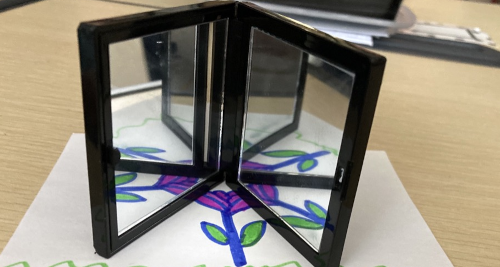
Answer: Of course, this was first noticed by Emmy Noether (1918). Much before her, in the 18th cen-tury, the mathematician Maupert-uis discovered the principle of least action (mvr), from which the Euler-Lagrange equation (1750) comes:
$$ \frac{d}{dt}\left(\frac{\partial L}{\partial \dot{q}_k}\right) = \frac{\partial L}{\partial q_k}, $$where t is time, qk are the coordinates of the material point, q̇k are the velociti-es and L = T - V is the Lagrangian, the difference between kinetic (T) and pot-ential energy (V). It is a partial differential equation that contains the trajecto-ries along which a material point moves with the least action, when in the sho-rtest time, and/or the shortest path, in fact the least energy exchange, it trave-rses the paths between given positions. This principle is valid in classical phys-ics, as well as in relativistic and quantum physics.
1. On the left side of the Euler-Lagrange equation there is a derivative with re-spect to time that the right side does not have. This means that we have some system, the difference of energies (L) which may change with velocities (q̇k) and positions (qk), where the right side does not change with time. As when a body moves inertially in a straight line to keep its (linear) momentum const-ant, or if it maintains its angular (circular) momentum by constant rotation. Such invariants were discovered by Emmy Noether.
She gave a new interpretation to Newton's First Law (of inertia): an object at rest remains at rest, and an object in motion will remain in motion at the same speed and direction, unless acted upon by an external force. Water that spins in a glass and appears uniform to us is subject to rotational symmetry and the rotational law of conservation (of angular momentum). A spinning top, once set in motion, continues to spin until some force (friction) stops it.
2. This interpretation directly speaks of equality during trajectories, or indir-ectly of conservation and then again of equalities. According to the previous one (Equality III), it tells us about finiteness, about the quantization of comm-unication and at the same time about the limited range of these "equalities". There are limitations to invariants when we move to cosmic scales. Due to the presence of other bodies, especially in the environment of stars and within galaxies, there is no unlimited inertial rectilinear motion, and without such bodies there is no space and time, as well as our physical reality.
3. The Euler-Lagrange equations are so general that their corresponding con-sequences are easily transferred to other phenomena. Take, for example, hom-othety, a geometric transformation (dilation) that would change the size of a figure from a fixed central point proportionally to a number k. It enlarges or reduces the original figure k times while preserving its angles and shapes. If k is a larger number, this is the magnification that would be obtained by projec-ting a film strip onto a cinema screen, although this too has its limitations. For example, if we were to view an increasingly distant length in space under the same angular range, it would have to be as many times larger as it is far away. However, the endpoint of the visible universe (about 46.5 billion light-years away) is its very beginning, the Big Bang about 13.7 billion years ago, and that is not all that long.
A more visible example of failed homothety is the transition from smaller to larger bodies whose surface area increases with the square of the diameter, volume with the cube of the diameter, and whose physical properties change significantly. Also, if we increase the number of trials of a random event, the mean value of all outcomes is increasingly closer to the probability, which is a consequence of the law of large numbers.
4. A not very different example of the application of the Euler-Lagrange equa-tions are symmetries. Translation is the removal of the same figure along so-me direction, determined by the direction and intensity of a given vector. Axial or mirror symmetry makes copies about a given axis, or plane. Rotation turns a figure around a given point in a plane by a given angle without changing its shape or size. Each symmetry tells us about some conservation law, but they can all be reduced to rotations, they are all the same kind of identical mapping (Isometry II). Here I return us to the point that truth is comprehensive, only one that we cannot perceive all at once, but also to the conclusion that symm-etry on a cosmic scale, in communications or interactions, is not a sustainable phenomenon.
5. The cardinal number ℵ0 of the even natural numbers {2, 4, 6, ..., 2n, ...} is equal to the cardinal number of all natural numbers {1, 2, 3, ..., n, ...}, because there is a bijection between them, e.g. the function f : n → 2n. Also, the cardi-nal number 𝔠 of the real numbers from the interval [0, 1] is equal to the cardi-nal number of the real numbers from the interval [0, 2], because there is also a bijection between them, again the same function f : r → 2r whose arguments are now real numbers, r ∈ ℝ. We then say that the infinities of even and all natural numbers are equal, even though the former are a proper subset of the latter, or that there are equally many real numbers in the intervals [0, 1] and [0, 2] even though the former is a proper subset of the latter. However, the sizes ℵ0 and 𝔠 are not equal, the first infinity is much smaller than the second; there is no bijection between natural and real numbers. These are the reasons why, let's say, symmetries (isometries) are truly equalities, their images will always differ in some way from the original.
6. Namely, if identical copies could be multiplied infinitely, then there would be different sets of such "identical" ones, when such ones would not be truly equal. If there were at most finite ones, then such a reality would be truncated, like the one that reaches back to the Big Bang (about 13.8 billion years ago) in which there are no ultimate equalities.
Prolongation » srb
Question: What would you say is essential for understanding reality?

Answer: Uncertainty, exchanges and their quantities (information), and then the extension or principle of minimalism. The brain happily follows similar phenomena and he-nce the success (LLM) of artificial intelligence and the law of inertia, i.e. the Euler-Lagrange equation and, possibly, interpretations that do not seem acceptable for now. All further this theory revolves around these.
1. Nature is all about uncertainties that it would like to avoid. It spontaneously moves towards more likely outcomes, towards less informative states, which means less communication, less interactions. Hence the tendency towards pr-olongation, better established achievements, routines, duration and reality. This is how I interpret the principle of minimalism and the "sieving" (evolut-ion) of various phenomena into what I call reality. It is a story about the desire for duration that comes with the desire for inaction, non-communication and certainty.
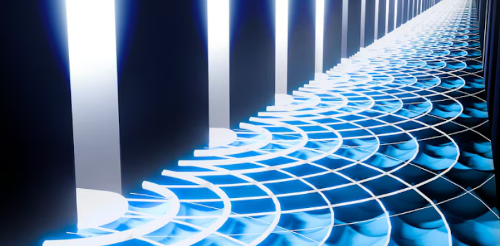
2. I also see a tendency to extension in natural states in the way they mi-mic vectors, or specially arranged sequences. The video with the ima-ge on the right explains how a wave traverses all paths finding the shor-test one. This is according to Richa-rd Feynman (1985), his formulation of the path integral of a wave (or particle) that travels in all possible paths at once, but only those that are close to the optimal one survive. The ve-ctor sum of states with many cancellations gives the optimum and the princip-le of least action.
3. Some of the assessments I have made are so unpopular that I am reluctant to mention them, even though they are stubbornly resisted by challenges as much as by not fitting into the current trends of physics. One such is the view of black holes, gravitational attractions so strong that not even light can esca-pe from them, which I view as real voids. A vacuum is nowhere near as “emp-ty” and attractive as a black hole. Consistent with the principle of minimalism, this is precisely why a true void has such extreme attraction. What falls towa-rds a black hole loses its radial thickness, time stops for it, but it never crosses the event horizon. A black hole understood in this way is a testament to natu-re’s indescribably strong resistance to information, but let its idea remain just a logical coincidence, a speculation.
4. Everything would be there without exception where there is no information, but communication is otherwise a very selective phenomenon. Not everything is observed with everything, so laws are seldom attractive compared by black holes, which I do not consider as an absence but as an unusual subtle type of information. Events with probability zero and probability one are impossible and certain, respectively. They are such that the official theory will not consid-er them random, but here we are moving in a different direction. Although all quanta are equally valuable (ΔE⋅Δt = h), not all of them are equally attractive information. When we talk about the change in energy (ΔE) for the elapsed time (Δt), the smaller the first and the longer the duration, the greater the at-traction, for states that perceive this kind of information. The slower flow of time is also more attractive in the gravitational field, but here I am referring to the body's adherence to laws. The strongest pull is the universal (Δt → ∞) which are therefore abstract (ΔE → 0). Take this, for now, only as a logical coincidence of that theory, another of my speculations. We will not be able to refute it, let alone ignore it.
5. It would be very wrong to theorize that all phenomena around us are real or true, when we know that we ourselves can fantasize and lie. The theory of info-rmation that I am discussing logically implies shorter realities and correspon-dingly less truthfulness. Except for mathematical abstractions, which point to the existence of a larger picture than the known universe, everything within is finite and analogously limited in accuracy. Shorter-range phenomena are oft-en greater lies and less real. That is how we treat them here. In other words, nature spontaneously strives for certainty and, therefore, truth and reality, so that's where reality gets stuck because it doesn't see fictions that would be mo-re appealing to it.
Catastrophe » srb
Question: You say, nature spontaneously strives for certainty and hence for tr-uth and reality, and then it does not see fictions that would be more attractive to it. Isn't this a paradox?
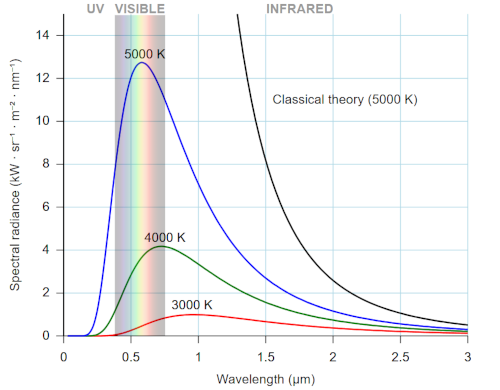
Answer: It is surprising, as is Pla-nck's (1900) solution of blackbody radiation or the "ultraviolet catas-trophe" that you can read in the image link on the left. Energy (ΔE) does not change and does not appe-ar in all quantities, but over a certa-in time (Δt) only in portions of the quantities of a single quantum of action (ΔE⋅Δt = h), which is the universal Planck constant.
1. Let's imagine that it is an arbitra-ry option of the laws of physics, th-at there is a universe in which the loss of energy in any quantity is possible. When all energy can leak out without delay, that is, (in the above question) all information of reality can be dissolved in fictions and that they last for a short time, such a universe would be unreal, or at least without us to witness its ex-istence. However, in the universe we are in, there is no similar disappearance of reality through fictions, and here we are to establish it.
2. Einstein (1905) added to Planck's discovery the photoelectric effect, that the emission of electrons from a material (usually a metal) when it absorbs electr-omagnetic radiation (light) is also in quanta. Similarly to the above, note that radiation is almost everywhere, constantly around us, and, without the restri-ction to quanta, electrons would leave atoms which would then remain mostly empty nuclei. Again, we would not be the ones to ask for the above paradox.
3. A further step towards quantization of action was the Bohr model of the at-om (1913). It was a representation of an atom with negatively charged electro-ns orbiting a small, dense, positively charged nucleus, and the electron orbits have quantized levels that prevent them from falling into the nucleus, contin-uously losing energy. If there were no "strange" quantum limit on the energy emission of electrons to descend to a lower orbit, the electrons would simply fall into the nucleus, neutralizing it, and there would be no atoms, nor us.
4. We find ourselves in a quantum reality (Anthropic), perhaps nature has be-en evolving inevitably, randomly, or painfully up to this point so that we — life on planet Earth — could happen to it, who are capable of fantasizing and thus perhaps threatening its reality. That's what a colleague asked me about when he heard about the Fermi Paradox, the high probability of extraterrestrial life and a quiet universe, and wanted to hear my opinion about the Great Filter. It is a hypothesis about evolutionary bottlenecks in the development of advanced civilizations that stop them all and humanity itself faces a catastrophic obstac-le. On another occasion, much later, I was told about the elaborate Gaia hypo-thesis, where we (humans) from our planet itself could be eliminated as pests. I don't follow those stories, but I mention them for the sake of completing the following.
5. From Gödel's theorems (Deduction II) follows the infinity of sets of truths, and then we find their bijection with lies (Drowning). Furthermore, here we find the uniqueness of observations of concrete, real phenomena, which alth-ough finite have infinite complexity, then the isometry of reality with truths. In short, this speaks of the impossibility of "leaking" reality into fictions thr-ough living beings, or however, so that the brevity of the latter would comp-letely disappear the former. In other words, the quanta of action (ΔE⋅Δt = h) do not refer to fantasies, which I have no doubt we somehow perceive, but rather to some other, less informative phenomena.
Manipulation » srb
Question: If fiction has no power, how does an artist's vision create a sculptu-re?

Answer: Intelligence comes with lies from a particularly complex st-ructure emergence. This is one of my contributions (Seizure) to the neurologist's question "Why are there no intellectual seizures?", when we look at, say, epilepsy.
Such attacks never have any inte-llectual content, which is strange considering that large parts of the brain serve precisely intellectual thinking. It is even stranger when one knows that attacks mainly originate in the “intellectual” part of the brain. I have ans-wered similar questions before, by referring to music from the radio, to anten-nas, TV and similar devices that are transmitters of music and not its creators. It is possible that artificial intelligence, accelerated by learning to follow many sentences (LLM), becomes such a receiver.
Fictions are always around us (lies are as many as truths). However, they do not interact but rather combine with superpositions (Tango, 3), where they can, increasing the information of perception by condensing it. For example:
1⋅1 + 1⋅2 + 2⋅3 < 1⋅1 + 3⋅5
The states x = (1, 1, 2) and y = (1, 2, 3) are compressed into x' = (1, 3, 0) and y' = (1, 5, 0) to give greater information of perception, the scalar product x⋅y < x'⋅y', without changing their totality (in the 1-norm metric). We know that for allies with the same goal, "together we are stronger" is valid, as a confirmation of the opposite "divide and rule". Here the fiction is not manifested directly, but subtly creeps into the subject and changes its effect.
In their unreal way, fictions, through superpositions of subjects, use their ph-ysical possibilities in the process of collapse, showing their pseudo-reality in our reality. It is no small power, if there is an appropriate mediator, but it is also easy to overestimate it because it is limited to the reach or will of its host. Here is a famous example. When you have power, you easily begin to imagine that you do not need the truth and it happens that reality leaves you in a ditch by the way of changes that no force, especially not manipulation, can stop. Th-is is how empires collapse.
Graph II » srb
Question: Let's say there is no equality in nature, as you say (Equality III), but we can strive for equality?
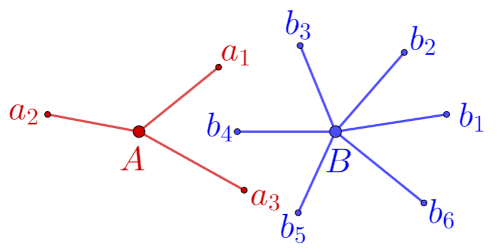
Answer: These kinds of questions scream with misunderstandings of mathematical certainty. I feel like a bad stand-up comedian decoding a joke for an audience that can't seem to get it. But let's try again with a graph.
1. If we have equal chances of all li-nks {a1, a2, a3} and {b1, b2, b3, b4, b5, b6} of nodes A and B respectively, as in the figure on the left, then the ch-ance of randomly choosing a link from node B is twice as high as choosing fr-om node A. When links are equal, nodes are not.
2. Graph theory is a branch of mathematics that studies networks. It reduces complex systems to nodes (points/entities) and edges (connections/relations-hips). It is easy to understand and applicable to everyday technologies, logisti-cs, and data organization, which can enable efficient business. Here are some commonly cited examples.
Locations (cities or street intersections) are nodes, and roads are edges that are given “weights” to represent distance or travel time. Google Maps is a ne-twork that uses algorithms to find the fastest driving route. Individual users are nodes, and friendships or followers are edges. Programs like Facebook use connection graphs to power their “People You May Know” feature. The system calculates shared edges (friends) to suggest new connections. Warehouses, stores, and factories are nodes, and the transportation routes between them are edges. Courier companies rely on graph optimization to design delivery routes. Computers, servers, and routers are nodes, and fiber optic cables, or wired and wireless connections, become edges. Power plants, substations, and houses are nodes, and power lines are edges. There is no end to this list, due to the ease of application of graph theory and its reliability.
3. There is a special and unwanted story about the application of graphs to the free market. For example, if equal links are flows of money, goods and servic-es, then unequal nodes are the owners of these goods. And vice versa, dually, if the owners were equal, the flows would not be. The mathematical certainty th-at we can see from the above figure (1) holds even when we deprive the nodes (people or banks, as well as companies, corporations, or states, leaders and of-ficials) of some of their powers (efficiency, propaganda, bribery), the mathem-atical sureness of their inequality, the inequality of the nodes, remains as irr-emovable above, despite all attempts, if we insist on the equality of links.
4. The right that everyone can pay the same amount with the same banknote leads to large differences in the wealth of individuals, the owners of money. Demands that each port receive the same amount of goods would lead to con-flicts between carriers and their suppliers in the inequality of shipping. Since there is a unit force in physics, the Newton (1 N = 1 kg ⋅ m/s²), this means that there are physical phenomena with different forces. This also applies to quan-ta (E⋅t = h), the carriers of physical information, and hence we have very diff-erent information possibilities. Graph theory is so unforgiving that it is a bad choice to ignore it.
5. The mathematics behind these graphs dictate that “reality” due to its durati-on, or rather the immutability of the same phenomenon, makes it very differe-nt. Divesity is a consequence of this mathematical certainty, a subtlety, a proof perhaps difficult to grasp for the so-called untalented, or untrained in mathe-matics. It's not terrible when you don't notice it, keep your head up, and life will probably go on unhindered by this ignorance. There is something charmi-ng in defiance even of mathematics itself; that's how science developed.
Differences III » srb
Question: Is it better to understand inequalities through graph theory, or thro-ugh principled minimalism?

Answer: Mathematics teaches us that exact theories are just as acc-urate in their environment as in other exact environments. This is what is meant when it is said that truth is one, that is, that we unde-rstand only part by part of some (infinite) whole. This means that diversity can be proven through linear algebra, or in graph theory, which follows the principle of mi-nimalism; it is less well known that differentiability can also be obtained clas-sically by the ergodic theorem (Differences II), in general, by various methods as long as they are accurate. The choice of methods gives us insights into cert-ain properties of the differences themselves and does not deny their necessity. I'll repeat that with some news.
1. Let's imagine a graph abstractly, for the sake of the widest possible applicat-ions, so that it maintains the equality of links. If at some point the nodes were also equal (all have the same number of links), by adding a new link to a node, we highlight it and increase its chances of getting the next one sooner. With new additions, the inequality of nodes grows and reaches a certain average va-lue (μ) and dispersion (σ) of links across nodes, which can also be discussed, but we will not do so on this occasion. Let's now try to discover this universal graph in some concrete phenomena.
2. For example, let us consider the repetitions over the duration of real pheno-mena as links, and their multiplicities as nodes. It is clear that there should be many phenomena of long duration, and it follows that they also have some mean values (μ) and dispersions (σ). These statistics can lead us to look for expectations and dispersions of less real phenomena. For example, there are more lies that stick better, that last longer. I assume you didn't think about this like that; you have nothing similar on the internet or in science, and yet, I believe, it cannot be disputed.
3. Let us notice a dynamic equilibrium that is highlighted by the graph meth-od. In the greater diversity of the application of a profession, there is more universality, that is, fewer details that would direct it. I am thinking of labor jobs, tools from workshops or work training, and sentences from legal acts, and even attitudes from mathematics. If a product from a factory came out the same in longer series, it found itself in several different places with multiple fates and uses. Time and profit bring a factory that would only waste stamping a product without thinking about the market into order. This is also a conclu-sion that is usually not drawn from abstract graphs themselves.
4. Let's consider the previous two, (2) and (3), again with the principle of min-imalism. What is more probable is more frequent and less informative. At the same time, a homogeneous distribution on a given interval is the most inform-ative (Extremes) and nature therefore spontaneously abandons it, withdrawi-ng into diversity. Hence, generalities arrive everywhere, embedded in various forms, that is, complexities are a composition of simplicity. A multitude of pieces with few forms also has repeatability, so there is consistency in details and universality. To not bore us any further, let's stop here with the saying "nothing is more practical than a good theory", from Kurt Lewin, or Ludwig Boltzmann, and even Immanuel Kant and others.
5. A small percentage of people (a node graph of equal connections) acquires great power to govern many. We see the same law with wealth, or with acqua-intances (Six degrees of separation), or with the more expert use of artificial intelligence today, while many use it trivially. If such "same" findings of graph theory and the principles of minimalism are combined, unexpected insights into the relationships of routine and complexity are obtained. This is the story of the unique concrete subject and the widespread abstract. Not far from that is "the truth is everyone's, and a lie is always someone's", referring to the sho-rter ranges of untruths, to name a few.
Guidance » srb
Question: How is it that "the present creates reality," if it's not a slip of the tongue?
Answer: It's not a mistake, I've de-alt with it so I haven't been able to dispute it and I'm keeping it in re-serve. There are more present now as we speak, and they all regroup and follow, but also create events. There are outcomes without causes, completely random, as well as ind-uced or mixtures of existing ones, and the harder this is to deny, the more "real" it is — as this theory dictates. Like a writer whose novel's plot is guided by imaginary characters while he deals with the details.
1. I do not find that nature has some kind of consciousness, nor that it has "mind", not even at the level of a single bacterium, but I only analyze the ra-nges of mathematical probabilities with the assumption that it also has "ob-jectively random" outcomes (uncaused). The confusion is triggered by the simplified opinion that something random cannot lead to something causal. However, if events were to be repeated, they would be arranged, say, in the manner of the Chebyshev inequality, one of the implementations of the law of large numbers.
Reality, that is, the world of our truths, is always immersed in an equal numb-er of untruths accessible to living beings. They give them vitality and even mo-re freedom. From the point of view of graphs, also mathematical theory, equ-alities that are repeated lead to a variety of results as local freedoms, but they also contain prevailing flows. From the point of view of a principled minima-lism, still undiscovered in science, nature tends towards less communication, fewer options, greater predictability and peace, the status quo.
2. When there is a synergy of real and unreal factors, we also experience an "anomaly". We can move a glass on a table in a way unknown to the laws of physics, because we have an excess of freedom compared to inanimate matter, but we can also write texts with a deficiency of freedom compared to random strings of letters (Letter Frequency). In order to penetrate states below the usual level of information, we need an excess of information. This is like swi-nging a pickaxe and breaking through a surface that is not usually accessible. This is how a creation of our intellect arises that, in fact, would not exist if it were not really there.
By playing with “objectively random” outcomes, nature itself can find itself beneath those surfaces, the commonplace, and discover something that we would consider creative. Beneath those surfaces we found the wheel (3500 BC), the printing press (1440), the use of electricity (18th-19th century), the steam engine (1700), antibiotics (penicillin, 1928), the transistor (1947), the internet (1969/1989), and we discovered the DNA structure (1953), which is also absent from inanimate nature. There is no need to list further, we unde-rstand the point, that there is room for creativity in our reality, that which inanimate nature would pass by without noticing, and that something, very little of everything, it can accidentally scratch. Without going into third pos-sibilities.
3. Information loaded with noise will not contain everything we want, but also has its own possibilities and limitations, but with so many of the former that we cannot be sure what exactly it was made of. This is how I once “explained” (this is one of my pending ideas) Heisenberg’s uncertainty relations. Here I use rare traces of the fact that the future is not written down, moreover, that the mixture of inputs can turn out to be non-existent at the output, but that the present is inexorably moving towards some (unpredictable) direction.
Another part of that idea (on hold) would be about the beginnings of the univ-erse, all of it made of black holes, absolute voids, and extremely attractive and compressed 2-dimensional information on the event horizon surfaces, thus creating extreme noise that slowly decayed (by Hawking radiation). I like that story when it was a threat to my "scientific credibility" (now unimportant to me), but I bypass it so as not to turn away the few colleagues who would ask me something seriously. Anyway, if there were ℵ0 countably infinite steps of the present with again some infinite subsequence with only two options, the options would be 𝔠 = 2ℵ0, and that is uncountably infinite. In short, a universe that allows for such choices has incredibly great opportunities for creativity.
4. Therein lies the point of this story, not in black holes that should remain co-nfused, nor in relations of indeterminacy of unclear origin, but in the knowle-dge that there is so much creativity in the seemingly barren interactive dead physical nature. Perhaps you have noticed yourself, realized particles, or rath-er collapses without superpositions, would not be a possible embodiment of this universe which, as we have now seen, has a continuum of possibilities. Only with the qubits of quantum mechanics would it be possible to supplem-ent that abundance and creativity. And then with quantum superpositions, manipulations of us living beings, or complex structures of substance and vitality, i.e. their emergences, are possible.
Micro Mind » srb
Question: What is the minimum number of “neurons” to achieve an emergen-ce that can think?

Answer: Tough question. I can't say "I have no idea," because look at the video with the image on the ri-ght that says it's not as much of a quantity thing as is usually thought when the emergence of intelligence occurs. Today, it is thought that in-sects can "think," not like animals or humans, but that they can make good decisions about the unknown, and with millions of times fewer neurons.
The honeybee brain weighs less than 1 mg, the video states, and contains ab-out a million neurons and is amazingly capable. For comparison, the human brain, with its 86 billion neurons, weighs about 1.4 kg and, of course, solves more complex problems, but our amazement at the capabilities of the insect brain remains. Regarding the above question, size is not a privilege.
1. Think of the billions of people, always different individuals, and the many who have long since died, or were never born. Multiply that number by even more billions of living beings, dead, and unborn, who are always different in-dividuals, and remember that ℵ0 is the countable infinity of the set of natural numbers ℕ = {1, 2, 3, ...}, and also of the set of integers ℤ = {0, ±1, ±2, ...}, but also of rational numbers ℚ, fractions whose numerators and denominators are integers.
2. The third ones, ℚ, are written by recurring decimals (41/333 = 0.123123..., with the three-digit sequence 123 is repeated periodically). If superpositions did not precede collapses into particles during interactions, or quantum meas-urements, we would have at most countable infinities in particle arrangemen-ts, but that too in the constant repetition of earlier finitudes in the same order, like the decimals of rational numbers. No creativity. But the options, like the different digits in the sequence of decimal notations of a real number, genera-te a continuum of possibilities, the 𝔠 labels, and vastly greater infinities than ℵ0. Superpositions present these options to us.
3. Heisenberg (1925) once observed that it is only by measuring an electron that we define its trajectory. Much later (1935), wondering about this, Schr-ödinger spoke of a cat in a box that could be both alive and dead by chance until we opened the box, when its superposition collapses into one of the two states. Today we know definitively that the quantum world exists in at least two states, without and with measurement, before and after measurement, roughly like a coin before and after it lands on a head or tail. The matter is further complicated by the discovery of quantum entanglement (Einstein, 1935) and the proof (Bell, 1964) that it is not the “spooky action at a distance” that is now almost routinely found in experiments. Then it gets even more complicated.
4. In 2019, physicists at the University of Vienna introduced massive, complex molecules containing up to 2,000 atoms into a state of quantum superpositi-on. This reveals a hard boundary problem when a collapse into a particle-wave state occurs and the superposition ceases. This is the Wigner Friend (Seizure) problem, where the one measuring the collapse (the friend) and the one outsi-de the room (Wigner) do not have the same observations. When we take into account the simultaneity of quantum entanglements and their relative non-simultaneity for the observer, we find that one of locality, coincidence, and reality does not apply to two observers. For example, if a collapse occurs at a distant location A (the friend), then the entanglement B (Wigner) will not know about it simultaneously, that is, for observers A and B there will be one period with two "realities".
5. Information of Perception is a theory about the relative relationships of the subject and the surrounding objects. It talks about unique observations from different subjects (Riesz Lemma) to the same at different moments, when su-bjects and objects are states represented by strings of features, or vectors in general. Hence I do not see a contradiction in different "realities", moreover these differences are a necessity of linear algebra. Those other differences, between options and outcomes, or superpositions and collapses, open the do-or to perceptions of vitals that are absent in dead physical substance (Manip-ulation). The way they achieve emergence that can think is complexity, it is a new topic for research, but it is not a simple function of the number of neuro-ns.
Wigner » srb
Question: I don't understand the "Wigner's Friend" paradox at all, can you ex-plain it?

Answer: The image on the left has a link to a video that explains it. The-re's not much to add, but let me try. In the framed room (A), Wigner's friend has measured that the polar-ization state of light is vertical, whi-le Wigner (B) awaits the result, kn-owing that the photon is in a supe-rposition before the measurement, when it is in both states, horizontal and vertical.
1. While the information about the collapse of the photon from the friend (A) travels to Wigner (B), the two observers have different "realities" about the st-ate of this light. The observer outside (B) may consider the one inside (A) to be in a bound state, in a superposition with the photon. This is one of the subseq-uent interpretations of this "paradox" by Eugene Wigner himself, who in 1963 received the Nobel Prize in Physics "for his contributions to the theory of the atomic nucleus and the elementary particles, particularly through the discove-ry and application of fundamental symmetry principles", and when he coined the term "many worlds" for Everett's universes (1957) where all superpositions of quantum particles-waves continue.
2. Such a "paradox" is in my theory of information perception a normal relati-ve state of perception of different observers, which are unique, and we are still far from its solution being part of official physics. Einstein's relativity is only a (at the time unnoticed) part of such different perceptions of reality (Free fall), which is directly connected to additional dimensions of time (Crash). In these considerations of mine, an observer from the train, after stopping and getting off at the station, enters the time flow of an observer at rest on the ground. Th-at's why I don't talk about everything more loudly, because even the Nobel Pr-ize winner in physics couldn't convince himself of anything similar. Eugene Wigner was a prominent critic of Hugh Everett's many-worlds interpretation (MWI).
3. Wigner (1961), in publishing his alleged paradox, expressed the opinion ab-out consciousness interrupting superpositions, which is almost how I consider it in the information of perception. In contrast to him, I believe that the brain is capable of conducting information that is below the perception of our physi-cal reality but can mix with its superpositions and thus, indirectly, influence collapses. Therefore, I do not agree with Wigner's original and later interpret-ations of this paradox, nor with many explanations of other authors from the period over 65 years later. That is why I do not cite them, but I admit that I do not know them well. I don't follow that popular idea of consciousness being the only one that creates physical reality.
4. Not referring to the information of perception, but only to special relativity (Einstein, 1905), when relative observers of a moving body see its slowed-do-wn time, we find relative deficiencies of events in relation to the moving bo-dy's own (proper). This becomes consistent with the assumption of the exist-ence of objective chance which, by means of a topological definition, reveals additional dimensions of time. The explanation is that the moving body is pa-rtly in dimensions invisible to the relative observers. This, in turn, also happ-ens when two bodies are at a distance r and at mutual rest, because the second body perceives the events of the first only after a time r/c, which is the time it takes for light to travel at a speed c ≈ 300,000 km/s travels a distance r. How-ever, the past consumes information which again becomes incomplete, i.e. wh-at a distant body perceives is not sufficiently accurate to be equal to what rea-lly was. I hope you notice the analogy between the differences in the reality of these bodies and the Wigner paradox.
Entanglement III » srb
Question: Can you explain "quantum entanglement" to me again?
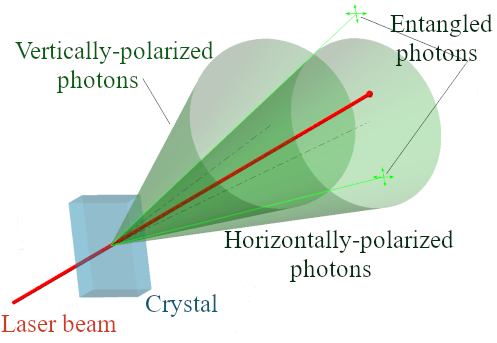
Answer: Quantum Entanglement is a stunning quantum phenomenon where two or more particles beco-me inextricably linked, and despite the physical distance between th-em, such that measuring the state of one particle instantaneously de-termines the state of the other. I also call it quantum coupled (En-tanglement II), but also quantum simultaneity, bringing it into the realm of linear algebra, where it belongs.
1. The EPR paradox (1935) was a thought experiment by Einstein, Podolsky, and Rosen that revealed an "incompleteness" of quantum mechanics by sho-wing that it contains "spooky action at a distance," thus violating the principle of locality according to which nothing travels faster than the speed of light. I have interpreted and retold it many times, explaining, in short, that linear algebra does not use time, and that its theorems about simultaneity are thus transferred to the quantum world, where they can. When particles are in a state of their mutual simultaneity, paradoxes of relative observers arise bec-ause for them these events are neither at the same time nor necessarily close.
2. The interpretation of vectors in the description of states and processes has made quantum mechanics the most precise field of physics ever. However, such states, as well as particles, atoms and molecules, are also the building blocks of our bodies and the wider environment, so it is worth remembering what we are talking about. Cartesian rectangular system has the point e1(1, 0) on the abscissa and the point e2(0, 1) on the ordinate. We also view these as the vertices of a vector with a common origin. We also write:
$$ \textbf{e}_1 = \binom{1}{0}, \quad \textbf{e}_2 = \binom{0}{1}. $$For ease of definition, we call these vectors the standard basis, here 2-dim, of the vector space V which consists of all linear combinations, vectors of the form x = ξ1e1 + ξ2e2, with arbitrary scalars (real or complex numbers) ξ1, ξ2 ∈ Φ. For example, the vectors:
$$ \textbf{v}_1 = \binom{3/5}{4/5} = \frac35\textbf{e}_1 + \frac45\textbf{e}_2, \quad \textbf{v}_2 = \binom{4/5}{-3/5} = \frac45\textbf{e}_1 - \frac35\textbf{e}_2. $$Like the standard basis, the vectors v1(3/5, 4/5) and v2(4/5, -3/5) are of unit length and mutually perpendicular, so they also form an orthonormal basis of the same space V. Namely, scalar products are:
⟨v1|v1⟩ = ∥v1∥² = 1, ⟨v2|v2⟩ = ∥v2∥² = 1, ⟨v1|v2⟩ = v1⋅v2 = 0, ⟨v2|v1⟩ = v2⋅v1 = 0.
The same applies to the standard basis, the first row being the unit norms and the second row being the mixed products proving their mutual orthogonality. The point is that we can write the same states as vectors in different bases, where they are then in different physical places and at different times, which causes confusion for relative observers if they are mutually simultaneous.
3. Matrices are processes that translate one state into another. For example:
Ae1 = w1, Ae2 = w2,
$$ \begin{pmatrix} 1 & 1 \\ i & -i \end{pmatrix} \begin{pmatrix} 1 \\ 0 \end{pmatrix} = \begin{pmatrix} 1 \\ i \end{pmatrix}, \quad \begin{pmatrix} 1 & 1 \\ i & -i \end{pmatrix} \begin{pmatrix} 0 \\ 1 \end{pmatrix} = \begin{pmatrix} 1 \\ -i \end{pmatrix}. $$The matrix A translates the standard basis vectors, e1 and e2, into the vectors w1 and w2 which are not normalized, but are perpendicular:
⟨w1|w1⟩ = 1*⋅1 + i*⋅i = 2, ⟨w2|w2⟩ = 1*⋅1 + (-i)*⋅(-i) = 2, ⟨w1|w2⟩ = 1*⋅1 + i*⋅(-i) = 0, ⟨w2|w1⟩ = 1*⋅1 + (-i)*⋅i = 0.
However, the same result in a different database looks like a different process:
Bv1 = w1, Bv2 = w2,
$$ \begin{pmatrix} \frac75 & \frac15 \\ \frac{-i}{5} & \frac{7i}{5} \end{pmatrix} \begin{pmatrix} \frac35 \\ \frac45 \end{pmatrix} = \begin{pmatrix} 1 \\ i \end{pmatrix}, \quad \begin{pmatrix} \frac75 & \frac15 \\ \frac{-i}{5} & \frac{7i}{5} \end{pmatrix} \begin{pmatrix} \frac45 \\ -\frac35 \end{pmatrix} = \begin{pmatrix} 1 \\ -i \end{pmatrix}. $$Although the processes A and B give the same results, the states w1 and w2, they do not look the same to us because we are looking at them from different bases (e1, e2) and (v1, v2). There is confusion and the EPR paradox, i.e. quant-um entanglement (simultaneity).
4. I deliberately took as an example these processes, A and B, which can expla-in the point, but are actually not possible because their matrices are not Her-mitian (Adjoint). Neither of them, conjugated and transposed, is equal to itself (A† ≠ A, and hence B† ≠ B). Quantum theory is consistent in such an algebra and every Hermitian operator in one basis will be Hermitian if translated into another allowed basis of quantum physics, but it is good to understand that it is not possible to translate everything into everything. Secondly, visible from this algebraic simultaneity is also the relativity of the observer, which does not come only from motion. But that topic goes beyond the question I asked.
5. In short, the ambiguities of "quantum entanglement" as "gauge invariance" are analogous to measuring a mountain from the center of the Earth instead of from sea level. We change the view, but not the actual value. Gauge invariance is a fundamental physical principle that states that mathematical descriptions of a physical system can be changed with their rules without changing the act-ual, observable physical results. Simply because of the redundancy in mathe-matical methods whose multiple ways lead to an identical physical state. This is my personal opinion, it is not the official position of physics on "quantum entanglement" and should not be taken seriously.
Changes III » srb
Question: How do matrices change by changing the basis of a vector space?
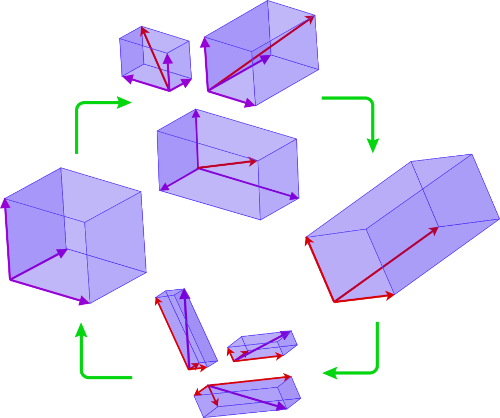
Answer: Changing the basis space changes the matrix representing a given linear transformation and the view of the corresponding process by which states are changed, but the way of changing preserves the actual values. The basic geometric operation "what" remains identical, but its numerical representation "how" changes because it is now mapped onto a different coordinate grid.
For reasons for changing the vector base and a simple explanation of how to do it, watch this interesting video here. On average, you buy foods with carbs, proteins, fats, or calories, etc. that you need for lunch from different su-ppliers at different prices. Food is an invariant, prices and suppliers are bases. We change bases so that we do not change our diet.
1. If A is a matrix that represents a linear operator (maps a given vector space onto itself) in the initial basis, say u1, u2, ..., un, and we would like to move to a new basis v1, v2, ..., vn, we can calculate a new matrix A' using the matrix P = P[v1,v2,...,vn] for changing the basis with the formula A' = P-1AP. The old mat-rix A is in the old basis u, while P is the transition matrix whose columns are the new basis vectors v expressed over the old basis u. Its inverse P-1 is the matrix such that P-1P = PP-1 = I, with I the identity matrix. Then A' is the ma-trix in the new basis.
2. For example, let's take (Entanglement III) the standard basis u = e for the first, and the ones there v1(3/5, 4/5) and v2(4/5, -3/5) are the second. Then the auxiliary matrices are:
$$ P = \begin{pmatrix} \frac35 & \frac45 \\ \frac45 & -\frac35 \end{pmatrix}, \quad P^{-1} = \begin{pmatrix} \frac35 & \frac45 \\ \frac45 & -\frac35 \end{pmatrix}, $$whose product is unity. It is its own inverse. Further:
$$ \begin{pmatrix} \frac{21-4i}{25} & \frac{3+28i}{25} \\ \frac{28+3i}{25} & \frac{4-21i}{25} \end{pmatrix} = \begin{pmatrix} \frac35 & \frac45 \\ \frac45 & -\frac35 \end{pmatrix} \begin{pmatrix} 1 & 1 \\ i & -i \end{pmatrix} \begin{pmatrix} \frac35 & \frac45 \\ \frac45 & -\frac35 \end{pmatrix}, $$A' = P-1AP
The matrix A from the standard basis e1(1, 0) = u1 and e2(0, 1) = u2 is transl-ated into the matrix A' of the basis v1(3/5, 4/5) and v2(4/5, -3/5).
Unlike the matrix B of the given example, which, acting on the new basis, giv-es the same vectors as the old matrix A on the old basis, the domain of action of the matrix A' is entirely in the system written with the new basis. There we had BP = A, or B = AP-1, so A' = PB = PAP-1, because P = P-1, which happens when the matrix is orthogonal (its columns are orthonormal vectors) and at the same time symmetric (equal to its transpose).
3. When we work with two or more matrices in the old and then in the new base, it will be:
A'1A'2 = (P-1A1P)(P-1A2P) = = P-1A1(PP-1)A2P = P-1A1A2P,
A' = P-1AP.
We find the same when we separate the matrix (process) A' = A'1A'2, A = A1A2, and we find that the parts (steps) in the first of the bases have corresponding steps in the second base. Hence, relative observers can hold each of their own views equally, considering that theirs is the right one.
4. Two square matrices, A and A', are said to be "similar" if they represent the same basic linear transformation viewed from the two coordinate systems (or bases). They are related by the change-of-basis matrix P through the relation:
A' = P-1AP.
Similar matrices have the same essential mathematical properties, the same determinants det A = det A', the same traces, the same dimensions of the spa-ce spanning the columns rank A = rank A', both matrices have the same eigen-values λ in the characteristic equations Aλ = λv and A'λ = λv' and have the sa-me characteristic polynomials. In the interpretation of this property of similar matrices, we transfer it to processes from the point of view of different observ-ers and, I emphasize, their different views are not contradictions as can be fo-und in the interpretation of "gauge invariance", and "Wigner's friend", or "qu-antum entanglement".
Matrices » srb
Question: I don't understand these changes in the base and matrices, nor the-se observer positions, can you explain that to me?
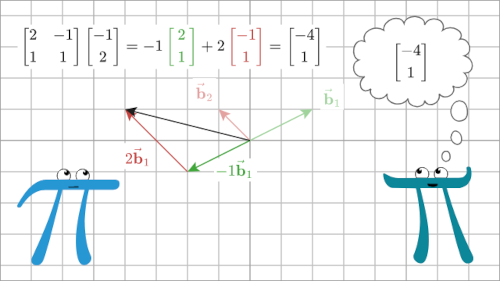
Answer: To begin, try to study the attachment in the image on the left. For example, then apply it to Galilean transformations:
x' = x - vt, y' = y, z' = z, t' = t,
за тачку која се креће апсцисом, x'-осом дуж x-осе брзином v, где је t протекло време. То је једно-димензионално кретање и када задајете по две вредности, брзине и времена, добијате трансформације.
1. A slightly more difficult example is the Lorentz transformations:
$$ x' = \gamma(x - \beta \mathcal{T}), \quad y' = y, \quad z' = z, \quad \mathcal{T}' = \gamma(\mathcal{T} - \beta x), $$ $$ \mathcal{T} = ct, \quad \beta = \frac{v}{c}, \quad \gamma = \frac{1}{\sqrt{1 - \beta^2}}, $$where 𝒯 is the path traveled by light at speed c ≈ 300000 km/s in time t, and the constants β and more often the so-called Lorentz γ are common in special relativity. When the speeds of light in given measurements are too large, then c → ∞, so β → 0 and γ → 1, and the Lorentz transformations reduce to the Galilean ones.
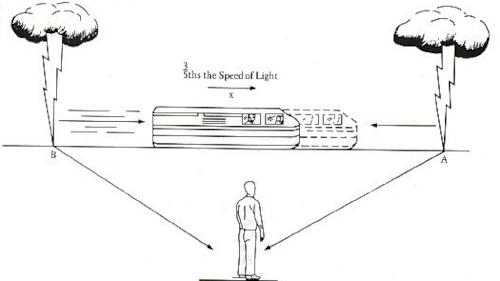
Example. An observer on the em-bankment saw two lights in front and behind the train that then met exactly in its middle, but a passen-ger in the middle of that car first saw the light from the front source, because the train was moving towa-rds him at a speed v. If the distance between the sources is Δx, calculate the time Δt between the two arrival times of the front and then the rear light to the passenger. So let's put Δx = 90 m and v = c/5 m/s.
Solution: In the theory of relativity, it is assumed that the speed of light c is the same for both observers and we use the Lorentz transformations:
Δx' = x'2 - x'1 = γ(x2 - x1) = γΔx.
When Δx' is the length seen by the observer on the embankment, then the len-gth seen by the traveler is Δx = Δx'/γ = Δx'√(1 - β²) = Δx'√[1 - (v/c)²]. This is a well-known expression for the contraction of lengths, and we seek a further tr-ansformation of time:
Δt' = Δ𝒯'/c = γ(Δ𝒯 - βΔx)/c = 0,
this is equal to zero (Δt' = 0), because the observer on the embankment sees the lights meet in the middle, so:
Δ𝒯 - βΔx = 0 ⇔ Δt - (v/c²)Δx = 0,
Δt = vΔx/c² = Δx/(2c) = 90 m/(5⋅3⋅108 m/s) = 6⋅10-8 s.
A time of 10-8 seconds (10 nanoseconds) is the approximate duration of the encounter and binding of two proteins during diffusion in biological cells. ∎
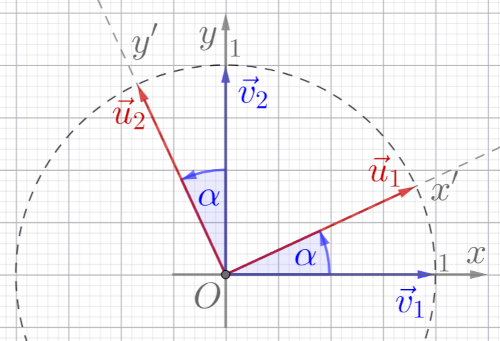
2. Orthonormal bases in a 2-dime-nsional system are always transfor-med as some rotations, such as the $\vec{v} \to \vec{u}$ rotation:
$$ P = \begin{pmatrix} \cos\alpha & -\sin\alpha \\ \sin\alpha & \cos\alpha \end{pmatrix}, $$for the angle α, in the image on the left. The notation P is from the mat-rix from (Changes III), because th-at's exactly what it is.
For example, let the vector $\vec{w}$ be given in the basis system $\vec{v}_k$. Then $\vec{w}' = P\vec{w}$ is the same vector observed from the basis $\vec{u}_k$, then $A\vec{w}$ is the process in that ba-sis, which is observed from the starting basis $\vec{v}_k$ is returned by the angle α. On it the total transformation is A' = P-1AP, and this is exactly what is stated in th-at explanation.
3. Lorentz transformations of motion with velocity v along abscissa (x-axis) do not change the coordinates along the ordinate (y-axis) and applicate (z-axis) in the most common notations of Cartesian rectangular systems (Oxyz), so on-ly the length x and the time t remain visible. Let us place them in the complex plane with the notation τ = ict, the imaginary path that light travels in time t at velocity c. Putting this into the Lorentz transformations, we get:
τ' = γ(τ - iβx), x' = γ(x + iβτ),
$$ \begin{pmatrix} \tau' \\ x' \end{pmatrix} = \begin{pmatrix} \gamma & - i\gamma\beta \\ i\gamma\beta & \gamma \end{pmatrix} \begin{pmatrix} \tau \\ x \end{pmatrix}. $$Note that the columns of this matrix are orthonormal vectors, because:
$$ \gamma^2 + (i\gamma \beta)^2 = \frac{1}{1 - \left(\frac{v}{c}\right)^2} + \frac{-\left(\frac{v}{c}\right)^2}{1 - \left(\frac{v}{c}\right)^2} = 1, $$so the Lorentz transformation is also a rotation, cos α = γ and sin α = iγβ. Here we have some imaginary angle ζ = iα and hyperbolic space then with hyperbolic sine sh α = -i sin iα and cosine ch α = cos iα, so the above tran-sformations become:
$$ \begin{pmatrix} ct' \\ x' \end{pmatrix} = \begin{pmatrix} \text{ch}\,\alpha & -\text{sh}\,\alpha \\ -\text{sh}\,\alpha & \text{ch}\,\alpha \end{pmatrix} \begin{pmatrix} ct \\ x \end{pmatrix}. $$Using Euler's formula eiφ = cos φ - i sin φ we can easily find:
$$ \text{ch}\,\alpha = \frac{e^\alpha + e^{-\alpha}}{2}, \quad \text{sh}\,\alpha = \frac{e^\alpha - e^{-\alpha}}{2}, $$also ch²α - sh²α = 1. In "ordinary" trigonometry, cos²α + sin²α = 1.
4. Rotations analogous to Lorentz transformations can also be found locally around points in a gravitational field. You can see more details about this in my book (Space-Time, 2017). Here it is briefly.
Theorem 1.4.4. Given the differential transformations:
$$ \begin{cases} dr = \chi\,dr' + i\gamma^{-1}\sqrt{1 - \gamma^2\chi^2}\,cdt' \\ cdt = i\gamma^{-1}\sqrt{1 - \gamma^2\chi^2}\,dr' + \gamma^2\chi\,cdt', \end{cases} $$where i is an imaginary unit, γ = (1 - 2GM/rc²)-1/2, and χ ∈ ℂ is an arbitrary parameter. These are general transformations that the gravity metric:
$$ ds^2 = \left(1 - \frac{2GM}{rc^2}\right)^{-1}dr^2 - \left(1 - \frac{2GM}{rc^2}\right)\,c^2dt^2 $$translates into the inertial metric ds² = dr² - (dct)². ∎
The proof of this theorem can be found in the aforementioned book, and it is also stated that these are (local) hyperbolic rotations, i.e. Lorentz transforma-tions. It is interesting that this is a relativistic gravitational field, and yet it is composed of local (infinitesimal) rotations, linear transformations. The para-meters γ and χ refer to two degrees of freedom in the gravitational field, the velocity of the point and the field strength.
Light III » srb
Question: Tell me something about the theory of equiconnected graphs?

Answer: In graph theory, when we talk about "equal connections", we are usually talking about graphs of edges with the same weights, nodes of the same degree (graphs of regu-lar situations), and also topological equivalence (then graph isomorph-ism). The main applications (I me-ntioned) are easily found in econo-mics, for example, equal connecti-ons lead to unequal nodes (or vice versa), which means: equal flows of money lead to inequality of money holde-rs. In the introduction, it is good to refer to the known, but in the sequel I wo-uld like to add something that is not found anywhere.
1. Light, named photons by Lewis (1926), is an electromagnetic radiation of energy E = hν, where h = 6.62607015×10⁻³⁴ m² kg/s is Planck's constant and ν is the frequency, which allows us to see. Always the same speed in vacuum c = 300,000 km/s, so it has variable wavelengths λ and frequencies, because λν = c. Humans can only perceive a small part of this wavelength spectrum bet-ween 400 and 700 nanometers. When the speeds of the links are equal, then the nodes are of unequal photon energy.
2. Due to the equal speeds of light and unequal photons, we can talk about their probability distribution (Refraction). The longest wavelengths are red in visible light and it refracts the least, and the shortest is violet, the most. The longer the wavelength of a photon (particle-wave of light), the greater the uncertainty of its position and the lower the probability density of finding it in a given place, which from the point of view of "information perception" means the lower the possibility of perceiving it. Hence, red light is refracted the least by a prism, and violet the most, because in this order is also their power of interaction, the probability of "getting stuck" when penetrating through an optical medium.
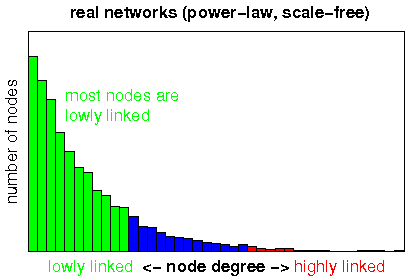
3. A scale-free network is a graph whose degree distribution follows a power law, at least asymptotically. The probability P(k) of a node in a network with k links going to other nodes, when k is large:
P(k) ∼ k-α,
where the exponent is 2 < α < 3 us-ually, but if we take λ instead of k, when it comes to light, exponent is α = 1, or k is not the same as the wavelength. Such an unusual analogy inspir-ed me in some answers (In and Out), but you don't have to take it too serious-ly. Graph theory doesn't go there, yet.
4. However, once you notice these strange regularities, you see them everyw-here. For example, in Compton scattering (Catch a Light), if longer wavelen-gths have less probable paths, then some collision or force is needed to bend the light onto the longer wavelength path. Added to this is the law of conserva-tion of probability (Light) — because of the paths of light. Hence the principle of least action, because of the economy of communication, the one from the tendency towards less information, and the other because less information (uncertainty) means more probability. I won't go on.
5. Graph theory is perhaps too simple to specify such phenomena that I only list, possibly inspiring the reader. This is especially the case (Light II) when I calculate the speed of the present, also a topic that you should not take too seriously, because it is not found in the literature. There I start from the zero speed of the passage of time of a photon, which therefore exists only from the point of view of a relative observer, which means that they, the observers, are actually moving at the speed of light, that is, that their present is moving at that speed into the future.
At first glance, the topic has nothing to do with graphs, unless we mean always the same photons (nodes) with unequal observers, observed paths (links). If it were just one photon, jumping here and there (One-electron universe) it wou-ld contradict graph theory, which is unacceptable in mathematics.
Refraction III » srb
Question: You say that light always travels at the same speed, and then it ref-racts because it travels at different speeds. Isn't that a little strange?

Answer: In a vacuum, light always travels at a speed of c = 3⋅108 m/s, regardless of the speed of the sour-ce, but if it passes through (transp-arent) media, light waves exchange with the particles present there and when they exit that group they can continue as light parallel to the in-coming one. We say that waves co-mmunicate when we mean intera-ctions, i.e. interference and superposition. It would be stranger if this mixture were the same light as in a vacuum, so different speeds of "light" in different optical environments (Refraction II) are logical.
1. An analogous transmission of "unreal" data could occur (Seizure) through the brain as a radio transmitter. I am referring to the effects on superpositions of physical reality of phenomena that do not otherwise interact with it. In this way, we have fantasies and the ability to lie, which physical reality does not have, and yet through the collapse of "enriched" superpositions we have addi-tional options to change reality. This is what is at stake in under-the-radar ob-servations that will give dead physical substance vitality, an excess of freedom compared to the principle of least action of theoretical physics but within the framework of fundamental minimalism. These additional deceptions are used to bridge realities. This is not a revision but an application of Gödel's theorem (a correct system is incomplete), for example when we notice that in mathem-atics we use both truths ⊤ and falsehoods ⊥, and we arrive at new truths. We connect islands of correctness (reality) through falsehoods (fiction) as well.
2. Reality is permanent, true and perceptible. But, although the perceptions of subjects are unique, truths are repeated and found in layers, or rather in coun-tless intersections of real phenomena. Photons act in quanta as they move alo-ng different geometric paths, say such that the middle line of a triangle is par-allel to the base and equal to half of it (Task 6). I mean such implicit contents of truths in reality, because we can perceive them too, which is not possible for physical reality itself. This exceptional repeatability of the theorems (of equal links) is consistent with the multitude of different applications, places (nodes) of free graphs, analogous to light in the previous answer.
3. First, Maxwell's equations (Light in a Medium) define c = 1/√(μ0ν0) as the speed of electromagnetic waves (light), where both constants, μ0 permeability and ν0 permittivity of vacuum, are independent of the speed of the observer. Empty space has no charge (ρ = 0) and no current (J = 0). Starting from Fara-day's and Ampere-Maxwell's laws through the rotor calculus (partial derivati-ve operator) and the divergence of the electric field is zero (∇⋅E = 0), the wave equation is formed:
$$ \nabla^2\mathbf{E} = \mu_0\nu_0\frac{\partial^2\mathbf{E}}{\partial t^2}, $$and hence the speed (μ0ν0 = 1/c²) and the invariance of these waves. Howev-er, when such a wave passes through a (transparent) substance, the charged particles of its molecules vibrate and add electromagnetic waves to it (other-wise of slightly higher permeability and permittivity), a group wave of "light" is formed for which the above equation is no longer valid. This is another ex-planation of this slowdown that helps us to more easily understand the conn-ection of fictions to reality, i.e. the ability of living beings to lie.
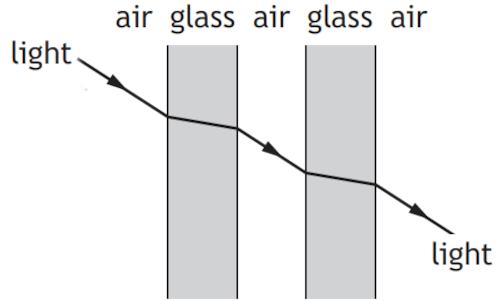
4. There is also symbolism in the refraction of "light" when it slows down as it passes through glass ti-les and turns, and then comes out as it was, which we see in the image on the left, with the excess freedom (vitality) that visits us throughout life and leaves, leaving behind sub-stance.
In reality, more than that happens, with the structure of the given "vitality" not being the same as that of the act-ual substance, unlike the electric fields of the incoming light and added in the medium. The tools, the operators with which we represent permanent pheno-mena (truths and realities) are also more different from temporary ones (Hin-dering II).
Triangulation » srb
Question: I was drawn to the article Triangulation (2014) to ask a question ab-out the problem of surveillance of objects with cameras?
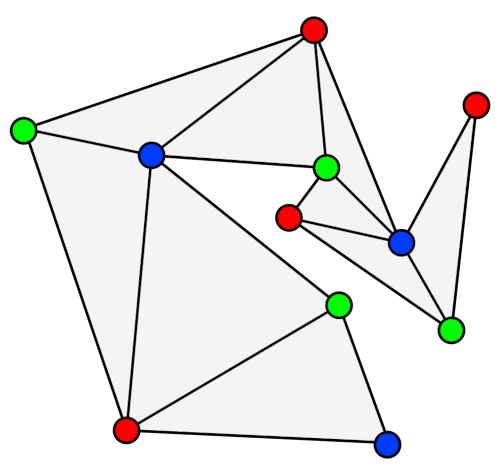
Answer: Václav Chvátal's guarding theorem is well-known, for examp-le, for art galleries. It states that ⌊n/3⌋ is a sufficient number of gu-ards (cameras) to watch a room with a simple n-angled polygon with n vertices.
The image on the right shows a ro-ugher proof using triangulation. We divide the nth corner of the object into triangles, assigning three colo-rs to each of those vertices. Any one of these colors may be a guard.
The picture shows the 11th corner, which has ⌊11/3⌋ = 3 sufficient gu-ards. If, if we choose the blue vertices, the lower right one is redundant, which means that special situations can be handled with ⌊n/4⌋ guards. Details are at-tached to the picture.
1. Bankers and other bureaucrats are busy all day long creating the trust (No-ah Harari) that builds our civilization and keeps it connected. One-on-one, a human is weaker than any chimpanzee, lion, or elephant, but humans will win in the context of a million humans and a million chimpanzees. This is because of the ability to cooperate and trust, and even more deeply because of langua-ge and writing. What oxygen is to humans and other animals, bureaucracy is to AI (artificial intelligence), and our trust in humans today will be trust in AI tomorrow, if it takes control of humans and beyond.
Money is valuable because of trust, bureaucracy, and words. The level of co-mplexity of human language and the organization of trust means that we can rule cows and chickens, but they cannot trade with each other in the same way. This code of human civilization has only recently been deciphered by AI. For all remaining living things on Earth, bureaucracy is a completely invisible phenomenon. I add this to previous articles about the brain acting like an an-tenna and a radio receiver, for physical reality the invisible world of half-trut-hs and lies that makes up vitality. Similarly, when duration (trust) is added to words, they gain reality (truthfulness).
2. Today's AI is created by reading a huge number of texts, files and learning the most likely continuations of sentences and words (LLM). In doing so, poi-nts are assigned to words in an abstract, multi-dimensional space, with a met-ric where "closer" means "more frequent". The word "cat" will be closer to the word "dog" than to the word "constellation", because it is more frequent with the first in context. While the structure of that space becomes a network, let's imagine another type of AI that observes only images, knowing nothing about words, which builds its network in a similar abstract multi-dimensional space, and where images become points with an analogous metric, when "closer" me-ans "more frequent" in the context of images. This is how Platonic represent-ations are created, and they are an introduction to what I want to point out. You can see this even better from the video AI Has Proven, in short, that the two networks match more when AI learns on more samples.
3. With more and more sentences/pictures examined, the new item is increa-singly limited in relation to the previous ones and is positioned more and mo-re precisely towards the abstract scheme of reality — to which both schemes con-verge. In the limiting case, the AI of words will know everything about the cat that the AI of the picture knows, and vice versa. This is a new confirmation of the idea of the isomorphism of truth and reality that I use but to check it. Ana-logously, step by step, with more and more items, the network that these AIs form is less and less false and more and more true. By eliminating the fr-eedoms, the right to make mistakes that vitality gives us, we are left with a purer reality.
Let's go back to the number of ⌊n/3⌋ guards guarding the n-th corner galleries. When trust increases, there are fewer thefts of relics and the need for guards decreases, and this situation reminds us of machine learning (2). Replace the keyword "trust" with "truthfulness" and we come back to my field, and the value of the exhibits takes on the meaning of reality.
4. Triangulation is the process of determining the exact position of a point or object by measuring angles relative to two known reference points, forming a triangle. It is widely used in surveying and GPS navigation, and the word has specific, different meanings in psychology, research, and politics, as well as here in (my) information theory. If you have read the appendix (Triangulati-on) from the question, you will understand the following more easily.
5. The items (words, or images), any of the (2) mentioned AIs form as points in some n-dim vector space X, will be vectors, such as u = (u1, u2, ..., un) also say v = (v1, v2, ..., vn). However, the origin O of that and any added Cartesian rectangular 2-dim coordinate system Oxy, defines them also by the vectors u = (ux, uy) and v = (vx, vy) in one plane in which they form a triangle Ouv of the surface of the area [u, v] = (uxvy - uyvx)/2. These surfaces are actually the "commutators" referred to in the aforementioned paragraph (4), and its sma-ller (absolute) value means that the concepts u and v are closer.
Machine Learning » srb
Question: How does machine learning organize data?
Answer: Machine learning organiz-es data by mathematically represe-nting information as numerical ve-ctors and matrices, and then groups or transforms them based on learn-ed patterns. Instead of using rigid human rules, algorithms group si-milar data points, separate them using boundaries, or extract comm-on features to classify, predict, or generate new information. That's a summary of the standard explana-tion, which you can follow further in the image link on the left.
1. It should be understood that machine learning (ML) is a type of artificial in-telligence (AI) that allows computers to perform tasks without explicit progra-mming. Algorithms are trained on data to recognize patterns, first to find con-nections between them and later to adjust models for more successful predict-ions. Data are points, nodes of graphs and vector spaces, which are denser if they are more frequent in the context of the data obtained. Loose statistical fr-equency in a growing amount of data becomes a certainty, so new data are gi-ven more precise destinations in a new space where their freedoms are reduc-ed (Triangulation, 3).
In the analysis of the letter frequency of texts (Letter Frequency, 2022), I sho-wed that a more meaningful text is less informative, because its letter distribu-tion is not uniform when the information would be maximal (Extremes), that the vowels A, I, E, O, ... are in this order the most frequent in Serbian texts, and the letters E, I, T, N, ... are in that order the leading ones in English. The differences between the authors are insignificant, but they define their style. This tells me that writers, with their vitality, excess freedom in relation to still nature, reach below the level of the status quo to which such nature spontane-ously strives.
2. When we have two points A and B of a given distance d(A, B), those with the origin O form a triangle OAB which is part of a parallelogram of oriented surf-ace equal to the commutator [A, B] whose properties I listed in Triangulation (2014). When the height h of the triangle from the vertex O to the base c = AB is larger, the area of the triangle ch/2 is larger, so we need to translate (move parallel) along AB as far as possible if we want that surface to be as large as possible. On the other hand, this commutator determines the "external infor-mation" (In and Out) that connects it to the surrounding points, and more in-formative means more uncertain, so we place points of a given distance furth-er from the origin if they are less likely. The density around O is made up of more frequent data, it is the center of an abstract attractive force, as the force of probability.
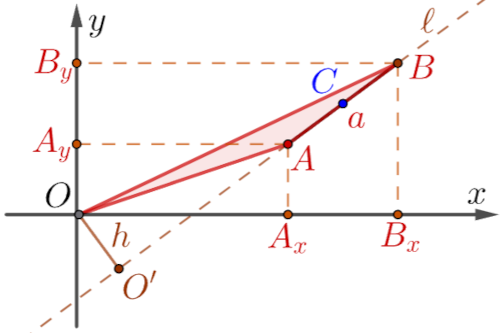
3. If the distance O from the midpo-int C of the line AB does not change and the base O' of the height h = OO' is increasingly further from it, the area:
Π = [A, B]/2 = (AxBy - AyBx)/2
triangle OAB is getting smaller. It remains constant if the center C rotates about O, or if AB is trans-lated along its direction ℓ. Hence the idea of a central constant force from O, which vanishes with the square of the distance (consequently to Chebyshev's inequality) and moves charges alo-ng conics. Then I assumed that the (charge) point A is moved to position B or vice versa, driven by that force from O, and the influence is equal to the com-mutator and inspired by Kepler's laws. Now we have the analogy again, but with the organization of data during machine learning. I am talking about pe-rsonal ideas unknown to official science.
4. In such a description, we notice an “anomaly”. When the line ℓ containing the points A and B passes through the point O, then the central “force” seems to lose its influence on them. The area of the triangle becomes zero, Π = 0, i.e. Ax : Ay = Bx : By regardless of the position of the axes of the Cartesian rectan-gular system (Oxy). Following the previous explanation, we find that the less probable further position accelerates (+) the point towards the starting point, and vice versa (-) when the force is repulsive, or the point moves uniformly without force at the starting point. Now, however, these could be concepts A and B of the same type and different wavelengths λ, like light where the longer λ the greater the uncertainty.
5. I have not fully verified these ideas, with a laptop of limited capacity and in room conditions, nor am I saying that the presented data organization would be good machine learning, but I am simply testing previous ideas of (this) in-formation theory by hiding behind the question asked.
Represent » srb
Question: Why do you use commutator and not vector product of vectors?
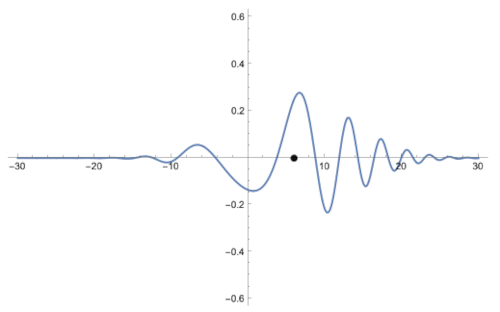
Answer: When the information is 2-dimensional, then the commuta-tor highlights that surface better and, in addition, we often find data in abstract multi-dimensional spac-es. Vector product of two contrava-riant vectors uν and vκ, also two covariant uν and vκ, vectors in the space n = 3 dimensions:
wμ = eμνκuνvκ, wμ = eμνκuνvκ.
Here we use the Levi-Civita symbol eμνκ. The value is 1 if μνκ is an even perm-utation (123, 312, 231), and -1 when μνκ is odd (132, 321, 213), or 0 if at least two of the given indices are equal. It is also called the relative tensor. By Ein-stein's convention, it is summed over the repeated subscripts and superscrip-ts, and we find:
w1 = u2v3 - u3v2, w2 = u3v1 - u1v3, w3 = u1v2 - u2v1.
The same is true for the three-fold contravariant relative tensor eμνκ. These methods are convenient for generalizations to n-dimensional spaces.
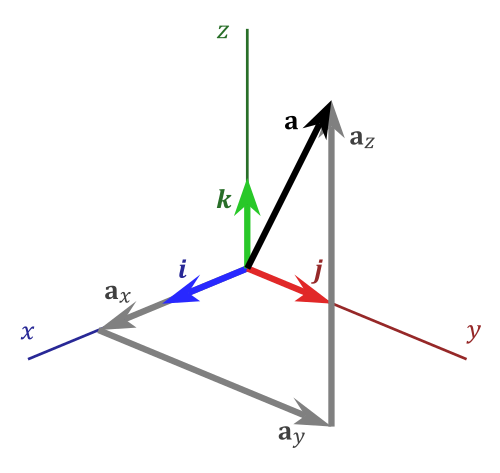
1. In the figure on the right and in the attachment, the much more common notation for the vector product of vectors is special for 3-dimensional spaces, the cross product:
$$ \vec{c} = \vec{a}\times\vec{b}, $$when the result $\vec{c}$ is a vector perpe-ndicular to the plane spanned by the factors and directed by the ri-ght-hand rule.
This also applies to the orthovec-tors $\vec{i}$, $\vec{j}$ and $\vec{k}$, which are the unit vectors of the axes, respectively, of the rectangular system Oxyz. Hence, we have $\vec{i}\times\vec{j} = \vec{k}$, $\vec{j}\times\vec{k} = \vec{i}$ and $\vec{k}\times\vec{i} = \vec{j}$, and $\vec{b}\times\vec{a} = -\vec{a}\times\vec{b}$, changing the signs of the order changes.
2. Applied to any vectors, say $\vec{a} = a_x\vec{i} + a_y\vec{j} + a_z\vec{k}$ and $\vec{b} = b_x\vec{i} + b_y\vec{j} + b_z\vec{k}$, we get:
$$ \vec{c} = (a_x\vec{i} + a_y\vec{j} + a_z\vec{k})\times (b_x\vec{i} + b_y\vec{j} + b_z\vec{k}), $$ $$ \vec{c} = (a_yb_z - a_zb_y)\vec{i} + (a_zb_x - a_xb_z)\vec{j} + (a_xb_y - a_yb_x)\vec{k}. $$We write this same value using three second-order determinants:
$$ \vec{c} = \begin{vmatrix} a_y & a_z \\ b_y & b_z \end{vmatrix}\vec{i} - \begin{vmatrix} a_x & a_z \\ b_x & b_z \end{vmatrix}\vec{j} + \begin{vmatrix} a_x & a_y \\ b_x & b_y \end{vmatrix}\vec{k}, $$or all together using a single third-order determinant:
$$ \vec{c} = \begin{vmatrix} \vec{i} & \vec{j} & \vec{k} \\ a_x & a_y & a_z \\ b_x & b_y & b_z \end{vmatrix}. $$Each of these expressions for the vector $\vec{c} = \vec{a}\times\vec{b}$ is correct, and we choose them as needed. In this sum, along with the vector $\vec{k}$ perpendicular to the Oxy plane as a factor, there is the commutator $[\vec{a}, \vec{b}]_z = a_xb_y - a_yb_x$, which we most often assume here, and since we know how to change variables, it is also a good representative.
3. Let us now return to the also representative free particle, or to the explana-tion accompanying its image at the top left. The commutator is so abstract, and therefore ubiquitous, that we can view it both as a surface (projected onto the plane z = 0) spanned by its vectors and as the influence of given vectors from (on) their origin. When we have any three points (they are always in the same plane), the commutator is a measure of the influence of two on the third and vice versa, and it is precisely its separation from the 3-dim product that increases its abstractness and therefore its applicability. On the other hand, we also have the scalar product of vectors, which represents perceptual info-rmation. I also call commutative external information, and scalar internal information.
According to the previous answer, this image above shows well the increased wave ripples of larger amplitudes (measurement chances) around the current position of the wave-particle and shorter wavelengths forward (less uncertain positions) than backward. Its function (Free particle) is:
$$ \Psi(\vec{r},t) = Ae^{i(\vec{k}\cdot\vec{r} - \omega t)} = Ae^{i(\vec{p}\cdot\vec{r} - Et)/\hbar} $$where A is the amplitude and, in the case of a massless particle, the angular velocity is ω = kc, and with mass m it will be ω = ℏk²/(2m), i.e. E = p²/(2m). In this case, for the wave vector the intensity is $k = \|\vec{k}\|$, for the momentum vector $p = \|\vec{p}\|$, it would also be for the position $r = \|\vec{r}\|$ and the momentum $p = \|\vec{p}\|$, while the motion only along the abscissa has a wave vector:
$$ \Psi(x,t) = Ae^{i(kx - \omega t)} = Ae^{i(p_xx - Et)/\hbar} $$where px is the projection of the momentum on the abscissa (x-axis), where we omit the subscript when the abscissa is implied. In both cases t denotes elapsed time and c denotes the speed of light. Apart from the asymmetrically folded amplitudes, everything mentioned here is well known to quantum mechanics.
4. Note that commutators (Triangulation, 2014) are not the only linear opera-tors. For example, the transformation 𝒜 = (𝒶ij) as a 3×3 “matrix”, which cha-nges the coordinates of the vector v = (vx, vy, vz) to v' = (vx + α, vy, vz), incre-asing them by the vector σ = (α, β, γ), is not a linear transformation. Namely, suppose it is:
𝒜 v = v', 𝒜 v = v + σ, 𝒜v - v = σ, (𝒜 - I)v = σ, ℬv = σ.
On the left side is the matrix ℬ = 𝒜 - I which increases whatever vector v = (vx, vy, vz) by a constant vector σ = (α, β, γ). When σ is not a zero vector, this is not possible, nor is there a function (v = ℬ-1σ) which translates σ into any vector. Therefore 𝒜 is not a matrix, but a linear operator.
5. Vector transformations with some differently defined "operators" are still possible. For example, let one be à = (ãx, ãy) where ãx denotes the displace-ment of the vertex of the vector v = (vx, vy, vz) by 1 along the x-axis, and ãy moves that vector by 1 along the y-axis, and let Ñ = (ñy, ñz) with ñy moving the vertex of the vector v by 1 along the y-axis, and ñz moves the vertex of that vector by 1 parallel to the z-axis. Then the commutator:
[Ã, Ñ] = ãxñz - ãyñy
pushes the origin O, the zero vector (v = 0), to the point [Ã, Ñ]v = (1, -2, 1). Namely:
[Ã, Ñ](0, 0, 0) = ãxñz(0, 0, 0) - ãyñy(0, 0, 0) = = ãx(0, 0, 1) - ãy(0, 1, 0) = (0, 0, 1) - (0, 2, 0) = (1, -2, 1).
There is no linear operator that does not give zero when multiplied by zero, and therefore we see that these commutators are not classical operators of algebra. I emphasize this, but it does not mean that they are not the subject of algebra.
6. The essence of the answer to the question lies in abstraction, in separating the commutator outside the vector product of vectors in order to increase its possibilities of application, and further increase the properties of vectors (st-ates) that could represent information. Analogously to the interpretation of gravity as an influence, which is an expression of such commutators, I am looking for their other representations. In this case, by “influence” I mean the possibility of changing freedoms. When the mutual relations of the phenome-na A and B may be different, but the phenomenon C then conditions them with something special, its own.
Influence » srb
Question: Did you say that in that free particle (Represent, 3) the amplitudes are bunched forward?
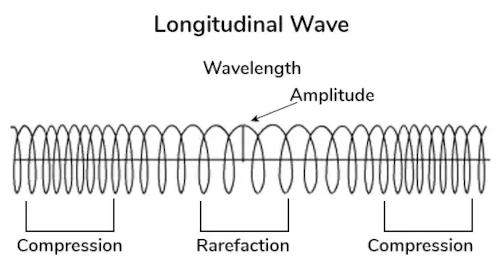
Answer: Yes, but we can see this much more easily with longitudinal waves (sound). When a particle-wave is moving in a certain direc-tion, the most likely places are in front of it, so I expect that there are shorter wavelengths there. A pro-pagating wave, however, preserves wavelengths, and its amplitudes decrease. Wavelength transmits momentum, and amplitude transmits the surrounding interaction. Therefore, it is not a complete picture of a photon traveling transversely when its mom-entum is not mentioned longitudinally.
1. The wave moves by translation and we observe (different) places with equal amplitudes. Momentum and Energy operators (space p = px):
$$ \hat{p} = -i\hbar\frac{\partial}{\partial x}, \quad \hat{E} = i\hbar\frac{\partial}{\partial t}, $$they were named because the eigenvalues (λ) of the characteristic equation ($\hat{M}\vec{v} = \lambda\vec{v}$), which go along with the wave vector, are precisely those physical quantities:
$$ \hat{p}\Psi = -i\hbar\frac{\partial}{\partial x} Ae^{i(px - Et)/\hbar} = p\Psi, \quad \hat{E}\Psi = i\hbar\frac{\partial}{\partial t} Ae^{i(px - Et)/\hbar} = E\Psi. $$The associated eigenfunction for both is the wave function:
$$ \Psi(\vec{r},t) = Ae^{i(\vec{p}\cdot\vec{r} - Et)/\hbar} $$mentioned in the previous answer (Represent, 3). Next, in p space, we find that the analogous "position" operator, then $\hat{x}' = i\hbar \partial_p$, acting on the wave function would give $\hat{x}'\Psi = -x\Psi$, hence an incorrect eigenvalue. Therefore, we define the position operator simply with $\hat{x}\Psi = x\Psi$ and likewise the time operator $\hat{t}\Psi = t\Psi$.
2. Let us consider below the otherwise well-known commutator of the position and momentum operators, in a way not seen in physics. First, it is known:
$$ [\hat{x}, \hat{p}]\Psi = \hat{x}\hat{p}\Psi - \hat{p}\hat{x}\Psi = \hat{x}p\Psi - \hat{p}x\Psi = $$ $$ = xp\Psi + i\hbar\frac{\partial}{\partial x}\left(xAe^{i(px - Et)/\hbar}\right)\Psi $$ $$ = xp\Psi + i\hbar Ae^{i(px - Et)/\hbar} \Psi - xp Ae^{i(px - Et)/\hbar}, $$ $$ [\hat{x}, \hat{p}]\Psi = i\hbar \Psi, $$ $$ [\hat{x}, \hat{p}] = i\hbar, $$because the previous equality holds in general for that wave function Ψ. The calculation for the time-energy commutator is similar:
$$ [\hat{t}, \hat{E}] = i\hbar. $$These two non-zero commutators lead us directly to the uncertainty principle of position and momentum, or time and energy, which prohibits us from sim-ultaneously measuring both variables with unlimited precision.
Namely, the Cauchy-Schwarz inequality applied to the general processes $\hat{A}$ and $\hat{B}$ (observables) gives:
$$ \sigma_A^2\sigma_B^2 \ge \left(\frac{1}{2i}\langle[\hat{A}, \hat{B}]\rangle\right)^2. $$The square brackets are the mean (this is the usual way of writing in quantum mechanics), and σ² is the variance. Substituting position and momentum, or time and energy, gives:
$$ \sigma_x\sigma_p \ge \frac{|\langle i\hbar \rangle|}{2} = \frac{\hbar}{2}, \quad \sigma_t\sigma_E \ge \frac{|\langle i\hbar \rangle|}{2} = \frac{\hbar}{2}, $$which we interpret as the products of the uncertainty of position and momen-tum, or time and energy (ΔxΔp ≥ ℏ/2 and ΔtΔE ≥ ℏ/2), which are not less than h/4π.
3. The second part is not official. There are two ways to look at the uncertainty of position and momentum along the abscissa, ΔxΔp ≥ ℏ/2: forward and back-ward. The first is to go forward with a smaller uncertainty of position Δx and a larger momentum Δp, and the second is to go backward in reverse, with a lar-ger uncertainty of position and a smaller momentum. Here we read “uncertai-nty” as “chance of realization”. It is similar with the uncertainty of time Δt and energy ΔE, where higher energies correspond to shorter wavelengths and mo-re probable manifestations. The two cases do not have contradictions, for now, although they may seem repulsive.
These are processes that influence each other, where by "influence" we mean the possibility of changing freedoms. For example, the influence of a force that changes the state of motion. A change in position affects the state of moment-um, and each is an independent phenomenon. Time affects energy states, but there are also different energies for the same time.
5. On the other hand, we have commutative processes, whose commutators are zero. It turns out that they have a "hidden" operator at the root, say:
$$ \hat{T} = \begin{pmatrix} 1 & 2 \\ 3 & 4 \end{pmatrix} $$which generates them, and here's how. Let's consider the two polynomials p(x) = x² + x - 2 and q(x) = x² - 2x - 3 when we replace their variable x with the given matrix:
$$ \hat{P} = \hat{T}^2 + \hat{T} - 2\hat{I} = \begin{pmatrix} 6 & 12 \\ 18 & 24 \end{pmatrix}, $$ $$ \hat{Q} = \hat{T}^2 - 2\hat{T} - 3\hat{I} = \begin{pmatrix} 2 & 6 \\ 9 & 11 \end{pmatrix}, $$ $$ \hat{P}\hat{Q} = \begin{pmatrix} 120 & 168 \\ 252 & 372 \end{pmatrix} = \hat{Q}\hat{P}. $$The commutator vanishes $[\hat{P}, \hat{Q}] = 0$, because the processes commute, and this happens because they are polynomials with the same variable.
In general, if $\hat{P}$ and $\hat{Q}$ are arbitrary operators on a complex Hilbert space, and there exists an operator $\hat{T}$ and polynomials p and q such that $\hat{P} = p(\hat{T})$ and $\hat{Q} = q(\hat{T})$, then $\hat{P}$ and $\hat{Q}$ commute. In other words, operators commute only if they have a “hidden” operator (here $\hat{T}$) at their root that generates both of th-em. Such processes do not interact, or transfer information from one to the other, but are like one body viewed from two sides.
PageRank » srb
Question: Can you give me some examples of applications of graph theory?
Answer: In principle, with the an-swers, in this blog, I avoid talking about well-known topics, except to have them as introductions to ne-ws, but which will not be easily di-sputed. I recently answered a simil-ar question, but perhaps indirectly (Triangulation), so this opens up a new problem for me. First, read the text behind the image on the right, about graph theory and its use with 5 examples of real-life problems, then let's pay attention to the four-th.
1. By the late 1990s, Internet search engines were much worse at solving relevant problems than they were later. They mostly used keyword density (the frequency of occurrence on a page), which was easily manipulated and was bad for users. Then Google was founded by Larry Page and Sergey Brin, who conceived of the World Wide Web as a massive, directed graph. Nodes are individual web pages, while edges are hyperlinks that connect pairs of pages.
They are the inventors of the PageRank algorithm, which uses a graph structu-re to measure the importance of web pages. The basic idea is as simple as it is revolutionary. A page is considered as important as the number of other impo-rtant links that link to it. A hyperlink from a highly searched site (YouTube, ChatGPT, or Wikipedia, and the like) carries much more "weight" than a link from a personal blog and a lesser-known address.
2. PageRank calculates the probability that a random click on a link will open a specific page among all possible ones in the entire web graph. Let's try to consider the demanding task of massive matrix multiplication on billions of nodes in order to obtain a stable probability in a very simplified graph with four nodes A, B, C and D, and let's say we are doing the estimation for node A. At the very beginning, we assume that all links are equal to each other and also all nodes, so we assign a probability Pr = 1/4 to each of them.
Let B have links to all three nodes, C to A and B, and D only to A. The page B is spread out over three parts, so it only transfers a third of its ranking to A, whi-ch is Pr(B)/3. The node C transfers half of its ranking, Pr(C)/2, and the node D transfers all of it, i.e. Pr(D)/1, so Pr(A) = Pr(B)/3 + Pr(C)/2 + Pr(D)/1 = 11/24 ≈ 0.458. From this the general formula:
$$ \Pr(\nu) = \sum_{\mu \in A_\nu} \frac{\Pr(\mu)}{L(\mu)}, $$where the probability Pr(ν), the rank of a given page (A), is the sum of the given probabilities Pr(μ) of the nodes divided by L(μ) the number of links from those nodes to anywhere. This is a basic formula that can be further adapted.
3. A page with a lot of external links quickly loses weight (internal links do not count), so it is not good to link like that if you want to have visibility. If the algorithm also takes into account your taking of content from other pages (it may, but does not have to), what you open more often will be offered to you more often and you will remain in a bubble of personal searches — of what interests you — and the owner of the algorithm can even sell this assessment about you to merchants and anyone who may be interested in such privacy.
What can be further observed is the similarity of such a "bubble", in which the algorithm surrounds us with our interests and traps us, for example, with the space around us. We see closer objects better, but also those farther away if they are brighter. A similar example is the model (Triangulation, 2) of an ab-stract multi-dimensional space that artificial intelligence creates in machine learning from many texts (LLM). An example is also given by (Riesz Lemma), the discovery of the uniqueness of the perception of the subjects of the univ-erse and is actually the specificity of this theory of information.
4. Like two people in the same room who look at everything from different positions and see objects from different angles, and the one behind the vase sees a part that the person in front of the vase does not see, and they say: “We see the same reality”. It is interesting to compare these bubbles that our int-erests surround us with when we are on the networks with the spaces of ar-tificial intelligence in machine learning and with the uniqueness of the perce-ption of the subjects of the universe, with the concept of “reality”. The exam-ples given are instructive for understanding, for example, the statement “ma-thematics equals reality”, or similar ones.
I remind myself that truth is a whole, an infinity that we perceive piece by piece, with always finite domains. These perceptions are partial, they do not last, and therefore not all of the reality that is permanent, observable, and true. I emphasize this distinction between the finiteness of interactions, per-ceptions, or particles that arrive by collapse of superpositions in the world of our perceptions and the ground of that world with which physical reality does not interact.
|
|
|