|
|
|


Infiltration II » srb
Question: I am working on a project on the penetration of fluids (liquids, gas-es, and vapors) and diffusion through solids, tissues, and membranes. What mathematical model would you recommend?
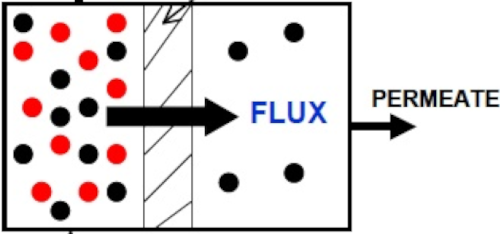
Answer: Try using a "random wa-lk". In steps, let p ∈ (0, 1) be the probability of penetration, and q = 1 - p if no penetration occurs, after n = 1, 2, 3, ... steps exactly k = 1, 2, ..., n penetrations would occur with probability:
$$ P(k, n) = \binom{n}{k}p^kq^{n-k}. $$It's the Bernoulli distribution. It's also good to understand the strategy of "re-sistance," the way it can deal with seemingly stronger opponents, which I've also written about (Infiltration).
1. You will be surprised by the scope and variety of ways to apply this seeming-ly innocuous and abstract random walk of a point. I admit that I used it once to consider the asymmetry in the movement of the present towards future events, more as an inspiration than something I would present to others. For example, I noticed then that time stands still for light, that it does not actually move, but we (all reality) are the ones who rush at the speed of light into the future. That the relativity of motion (Einstein, 1905) could arise from such a setting of "steps" and the aforementioned probability p, but that is not for the wider story except perhaps for the idea of the present of the speed of light. Here's how.
From the principle of objectivity of chance (my information theory), with all the certainties, the future of the present is also uncertain. It wanders and does not even know what will happen to it. This is a big problem for everyone who tries to follow it, say in a competition (Traits) where players who follow it mo-re successfully win more often. Reality thus creates truthfulness (another ex-ample) which I define by equal duration, so I unofficially find that any novel, fantasy, or attempt to predict the future must be unsuccessful. It is not possi-ble to come up with events that could pass the reality test.
2. From the subject's point of view, his own present always has the same flow of time, equal units of length, personal mass or energy, and so on, so he sees a faster or longer "step" and a change in probability p only relatively in others. This is not a discovery, but it should have been noticed. Also, the slower flow of time of some other object is its spatial displacement, we note, simply beca-use of its lag in time, and space as the accumulator of the past. The more di-stant the object is, the older events we see of it. Hence how the movement appears from the analysis of the "random walk", which I did not reject but rather ignored as triviality.
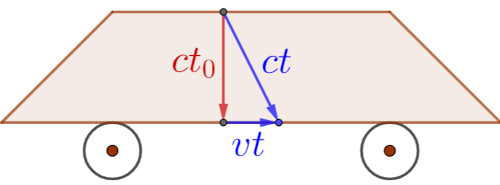
In order for light whose time stands still, from the perspective of a subj-ect who is at rest and looking at an object with a slowed-down time fl-ow, by reconstructing the previous-ly known relativistic proof of time dilation, the necessity of the obje-ct's motion is proven.
The image on the left shows in blue the time t, the speed v (which has yet to be determined) of the vehicle and the light c for a relative observer (at rest), and in red the same c and the second t0 for the object (moving at a speed v). The Pythagorean theorem gives:
c²t² = c²t0² + v²t², c²t² - v²t² = c²t0², (c² - v²)t² = c²t0², (1 - v²/c²)t² = t0², t² = t0²/(1 - v²/c²).
Hence the famous formula for time dilation:
$$ t = \frac{t_0}{\sqrt{1 - \frac{v^2}{c^2}}}, $$and here it is evidence of motion at speed v ≠ 0 of the object in the image.
3. Here is another informal example of a random walk. Like truthfulness, I di-vide all phenomena by duration, from the shortest false ones to the real ones. However, they also occur in random ways, so the more true they are, the long-er they last, and, if there are any at all among the random ones, the more they occur. This idea leads to the emergence of reality by accumulation, if we define "genuineness" as permanent. It explains the universe as an accumulation of sustaina-ble phenomena, such as some evolution or existence with a trace in the past. It helped me understand mathematics (the most permanent truths) as somethi-ng that existed before the Big Bang, and then to consider the possibilities of moving the beginnings of the history of the universe into the future.
I mainly adhere to the (hypo)thesis of the total information of the universe, both the present and the past. The present that loses the density of uncertainty at the expense of the past that is getting longer, but which is being consumed by sending its information into the future. I am also less concerned with the speculative idea of a collection of reality that is then released into the past wh-en its information is not being consumed by broadcasting back. In fact, I co-nsider both theses possible at the same time, but the first one interested me longer.
4. When there is no “duration,” the concept of “simultaneity” makes no sense. If one event is “simultaneous” with another, then they exist in the same “pres-ent” and acting on one means acting on the other, no matter how spatially di-stant they are. Understanding the universe in this way, its space becomes a repository of reality, something that lasts. This includes quantum entangle-ment, say, the constancy of the properties of a “left” and a “right” glove when we separate them far apart into two boxes, not knowing which one is with us, but after opening ours and immediately knowing which one is in the other. Then the “moment” lasts as long as “simultaneity,” that is, regardless of the distance between the boxes. Here are some other things you can explore while working on your project on fluid penetration, while constantly sticking to the “random walk” point.
Comparison » srb
Question: Without "duration", the concept of "simultaneity" makes no sense, how is that?

Answer: When we do not have a unit of measure, it is not possible to establish a value. It is impossible to put the number 1 in the position with the number 2 if there is no numbered axis. Simply put, it exists as an indefinite and poorly defined concept. Especially in “simultanei-ty” we mean “the same time”, which would mean that we have some “time”, which does not make sense without “duration”. These would be just “unimportant” word games colloquially, but they are frivolous determinants for a text that counts on exact statements.
1. We discuss this in the continuation of the previous answer (Infiltration II, 4), and the topic was the "random walk" of a point and the accumulation of phenomena that last, that is, the phenomena of "reality" and "truth". These are supposedly physical concepts, because we are also talking about the cos-mos, but not in the way of official physics. That is why we are so interested in them. My point of view is that there is a development of reality and truth, but not in ways that there are more and more of them "somehow", but I specifica-lly investigate whether it is confirmed by the history of the universe, stretching itself and moving the beginning of memory forward as the present becomes thinner with options.
2. Let's say that the occurrence, the pressure of uncertainty, is constant so that there is a certain probability distribution of different durations of phenomena. Those that live shorter disappear more quickly, and those that last longer sur-vive, and many also perish. This is reminiscent of the pressure of water on a submarine, which increases with depth in order to be balanced somewhere with the weight of the hull. If the Big Bang was about 13.8 billion years ago, then we are not dealing with physical phenomena of longer durations, except perhaps abstract mathematical truths that are woven into physical ones in various ways, also discussed here. In this way, we live in a universe that is in a kind of equilibrium of the quantity of truthfulness. I divide these phenomena by duration, from the longest real to various unreal ones, where the latter wo-uld also affect reality through living beings.
3. These are my current (hypo)theses that gain weight with the relativity of perception in general. If everything were white, without shades of gray, there would be no shapes, nor would we say that there are colors (including white). Two people in a room see the same thing differently, from different angles. A photograph has no depth of its own; we “see” it with our imagination and ex-perience. That is why we have triangulation, because one viewing position is not enough. The reality we describe in this way is an unlimited multitude of “illusions”, with a partial view of the present and always insufficient subjects, the totality of which gives new meaning. A special part of that story is space, which is a record of the past and grows because reality endures.
4. Today we know that duration comes with symmetries (Ammy Noether) and we look at theorems as timeless phenomena, longer than material ones, and more stable than the rules of physics. This reinforces the idea of the universe's shifting duration. The entire course of its history moves forward with the con-stant changes of this whole. It is such a radical idea, as difficult to dispute, that I am not putting it out there, I am not trying to challenge official physics with it. Mathematics is also involved here (through infinity, which does not exist in physical reality), and this is another place where I keep this theory in limbo.
Multiplier » srb
Question: Explain the Lagrange multiplier to me?
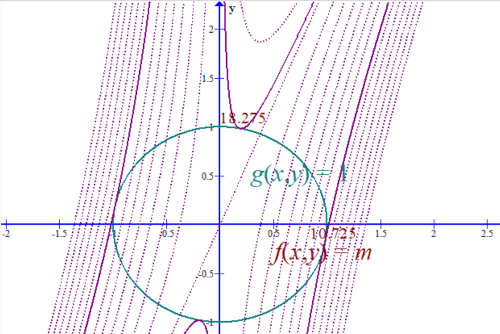
Answer: In the figure on the left we see the function f(x, y) whose m ex-treme value we are looking for wh-en g(x, y) is equal to a given const-ant, here it is 1. The conditional fu-nction g and the required f are tan-gent at the extreme. This means that their normals at such a point are parallel, ∇f = λ∇g, and hence:
$$ \frac{\partial f}{\partial x} = \lambda \frac{\partial g}{\partial x}, \quad \frac{\partial f}{\partial y} = \lambda \frac{\partial g}{\partial y}. $$The additional equation is g = 1, so we have three equations with three unkn-owns x, y and λ. The figure shows various values of m = 4, 5, ..., 19 with dash-ed graphs of the main function f(x, y) = m, then written explicitly y = y(x), and the conditional g = 1 until their graphs touch:
$$ y(x) = \frac{m-18}{2\sqrt{2}}\frac{1}{x} + \frac{7}{2\sqrt{2}}x, \quad x^2 + y^2 = 1, $$with a solid line at values m+ = 18.275 and m- = 10.725. As the numbers m from m+ to m- decrease by step 1, it is clear that the first is a maximum, and the second is a minimum of the function f, because outside that range they have no common points, i.e. the given function does not satisfy the given condition. A monotonic change of the extremes m to such common, tangent points makes the values of f extreme with the constraint g. The unknown parameter λ is the Lagrange multiplier.
1. I'm using this question to explain something more about states (vectors) and processes (operators), because from quantum mechanics we know that they are our stuff just like elementary particles-waves. We know that vectors here are usually n-tuples of numbers, x = (ξk) and y = (ηk), whose vertices are points of the same labels, and metrics are the distances between them. The most common are:
$$ d_\alpha(x,y) = (|\xi_1 - \eta_1|^\alpha + |\xi_2 - \eta_2|^\alpha + ... + |\xi_n - \eta_n|^\alpha)^{1/\alpha}, $$where the number α ≥ 1. When α = 2 it is the standard, Euclidean metric, and if α = 1 then it is the Manhattan metric which we usually encounter here with stochastic matrices. The norm of a vector is its intensity, i.e. the distance of the vertex from the origin ∥x∥α = dα(0, x). The norm of a matrix is the largest intensity of a vector that it gives by mapping unit vectors:
$$ \|A\|_{\alpha,\beta} = \max_{x \ne 0} \frac{\|Ax\|_\alpha}{\|x\|_\beta}. $$Often the norms of the image (∥.∥α) and the original (∥.∥β) are equal (α = β).
2. Example. Let us show that the norm of the product of matrices, say A and B, is not greater than the product of the norms of the matrices, ∥AB∥ ≤ ∥A∥ ∥B∥.
Solution: Because the norm is a maximum, it will be:
∥(AB)x∥ = ∥A(Bx)∥ ≤ ∥A∥ ∥Bx∥ ≤ ∥A∥ ∥B∥ ∥x∥,
and here we take ∥x∥ = 1. ∎
3. The norm ∥A∥α of a matrix A should be distinguished from the eigenvalue μ of that matrix, Av = μv; where v is the eigenvector corresponding to this eige-nvalue of that matrix (Changes III, 4). The absolute eigenvalue |μ| is never greater than the norm ∥A∥ of the matrix, and is usually smaller. Namely, with a B[v, ..., v] matrix whose columns are the corresponding eigenvector, it is:
|μ| ∥B∥ = ∥μB∥ = ∥AB∥ ≤ ∥A∥ ∥B∥,
and hence ∥A∥ ≥ |μ| for all eigenvalues μ.
Global convergence is a process that, by repeating the procedure A, leads any given state w closer and closer to the direction of the eigenvector v associated with the dominant (absolutely largest) eigenvalue |μ|. In this case, local diver-gence is the freedom in the direction or intensity of the mapped vector on the path to that limit value. The difference of the matrix norm from the eigenvalue is an addition to this local freedom.
4. Let's go back to the image above and map the unit vector ∥u∥ = 1, for exam-ple, with the following matrix A into the maximum norm vector ∥w∥:
Au = w, max f(x, y) = ∥w∥² = m, g(x, y) = ∥u∥² = 1,
$$ \begin{pmatrix} -3 & \sqrt{2} \\ \sqrt{2} & 4 \end{pmatrix} \begin{pmatrix} x \\ y \end{pmatrix} = \begin{pmatrix} -3x + \sqrt{2}y \\ \sqrt{2}x + 4y \end{pmatrix}, $$f(x, y) = (-3x + √2 y)² + (√2 x + 4y)², g(x, y) = x² + y²,
∂xf(x, y) = -6(-3x + √2 y) + 2√2(√2 x + 4y), ∂yf(x, y) = 2√2(-3x + √2 y) + 8(√2 x + 4y),
∂xg(x, y) = 2x, ∂yg(x, y) = 2y.
Next, we introduce the Lagrangian multiplier:
∂xf(x, y) = λ ∂xg(x, y), ∂yf(x, y) = λ ∂yg(x, y),
-6(-3x + √2 y) + 2√2(√2 x + 4y) = 2λx, 2√2(-3x + √2 y) + 8(√2 x + 4y) = 2λy, x² + y² = 1.
Solving these is a separate story, from task to task, here we get:
λ+ ≈ 18.27492 λ- ≈ 10.72508
Here's how.
5. Arranging the first two gives:
(11 - λ)x + √2 y = 0, √2 x + (18 - λ)y = 0,
We multiply these two equations and the result to shorten xy ≠ 0, we find:
2⋅xy = (λ - 11)⋅(λ - 18)⋅xy, 2 = (λ - 11)⋅(λ - 18), λ² - 29λ + 196 = 0, λ± = [29 ± √(57)]/2, λ+ ≈ 18.27492 λ- ≈ 10.72508
Due to the g = 1 and the above equations, it is not possible xy = 0.
6. We put these lambdas back into the equations above and find, rounded off:
(+) y = (λ+ - 11)⋅x/√2 = √2⋅x/(λ+ - 18) = 5.14414 x (-) y = (λ- - 11)⋅x/√2 = = √2⋅x/(λ- - 18) = -0.19440 x
Applying the condition g = 1 to the coordinates means normalizing them:
(+) x+ = 0.19082 y+ = 0.98162 (-) x- = 0.98162 y- = -0.19082
By inserting these pairs into the function, we find:
$$ u_+ = \binom{0.19082}{0.98162}, \quad u_- = \binom{0.98162}{-0.19082}. $$By squaring and adding the components, verify that each of these two vectors is unit. By including their components in the function f:
f+ = 18.27492 и f- = 10.72508
These are the squares of the norms, f = ∥w∥², and the norm of the matrix A is the larger root:
(+) ∥A∥ = 4.27492 (-) ∥A∥ = 3.27492.
The first solution (+) is the required norm, the second (-) is the minimum that is not needed for the norm, but we see both in the image above.
7. The two absolute eigenvalues μ of the same matrix A, the characteristic equ-ation Av = μv, are precisely the two "norms" of that matrix:
μ1 = 4.27492 μ2 = -3.27492
and the associated eigenvectors, v1 = u+ and v2 = u-, are the ones whose inten-sities define these "norms". This property of the characteristic values of linear algebra is less commonly recognized than, for example, the orthogonality of (eigen) vectors, here u+⊥u-, or symmetric and Hermitian matrices in general.
Direction II » srb
Question: Vectors whose intensities represent the norm of a given matrix are the leading eigenvectors of that matrix (Multiplier, 7)?

Answer: For most matrices, the no-rm is not the dominant (largest) ei-genvalue, but the leading eigenval-ue is equal to the spectral (2-)norm only when the matrix is Hermitian (Adjoint) and positive semidefinite. If the matrix is nonsymmetric, its norm is almost always greater than the largest eigenvalue.
This is because the norm represents the largest "stretch" that the matrix makes to the vectors, and the eigenvalues represent the stretch of the eigenve-ctors only. In the equality Av = μv, A = (aij) is a square matrix with n ∈ ℕ col-umns and rows, the scalar μ is a real or complex number, and v is an n-tuple of these numbers, in practice it is also one of the states of the system that cha-nges A as a process (Directions). On the other hand, the norm of the matrix is ∥A∥ = max Au, taken for all unit vectors ∥u∥ = 1 and the inequality ∥A∥ ≥ |μ| holds, as proven here (Multiplier, 4).
1. Example. Matrix equality, Av = μv:
$$ \begin{pmatrix} 1 & N \\ 0 & 2 \end{pmatrix} \begin{pmatrix} N \\ 1 \end{pmatrix} = 2\begin{pmatrix} N \\ 1 \end{pmatrix} $$has two characteristic values, the eigenvalue μ = 2 which goes with the eigen-vector v = (N, 1). Let us show that the norm of the matrix ∥A∥ ≠ 2, but is infi-nitely increasing as N → ∞.
Solution: In order to have different ∥A∥ = max Au in the definition of the norm ∥u∥ = 1, let us assume that the coordinates of that unit vector u(x, y) are cosine x = cos φ and sine x = sin φ, with an arbitrary angle φ. Then Au = w gives:
$$ \|A\| = \max_{\varphi \in (0, 2\pi)} \|w\|, $$∥w∥ = (cos φ + N sin φ)² + (2 sin φ)² = = 1 + N sin 2φ + (N² + 3) sin²φ,
∥A∥ → ∞, when N → ∞,
for almost all angles φ. ∎
2. Example. In the general form, Av = μv, the characteristic equation of a 2-dim real symmetric matrix A is:
$$ \begin{pmatrix} a & b \\ b & c \end{pmatrix} \begin{pmatrix} x \\ y \end{pmatrix} = \mu \begin{pmatrix} x \\ y \end{pmatrix}. $$i. Let us show that A has a real eigenvalue, μ ∈ ℝ.
ii. Its (μ) associated eigenvector v(x, y) has the property:
$$ y = \frac{c-a \pm \sqrt{(c-a)^2 + 4b^2}}{2b}x. $$The fraction is the tangent of the angle, tan φμ, of the direction of global conv-ergence of the process A.
Solution: Since Av = μv, hence (A - μI)v = 0, it follows that det(A - μI) = 0, be-cause the matrix in parentheses does not have an inverse.
i. That's why:
$$ \begin{vmatrix} a-\mu & b \\ b & c-\mu \end{vmatrix} = 0, $$(a - μ)(c - μ) - b² = 0, μ² - (a + c)μ + ac - b² = 0.
The discriminant of this quadratic equation is:
D = (a + c)² - 4ac + 4b² = = (a² + 2ac + c²) - 4ac + 4b² = (a² - 2ac + c²) + 4b², D = (a - c)² + 4b² ≥ 0,
$$ \mu_{1,2} = \frac{a+c \pm \sqrt{D}}{2} \in \mathbb{R}, $$because the root is a non-negative number.
ii. We insert these μ into the original equation Av = μv and find the system:
ax + by = μx, bx + cy = μy,
by = (μ - a)x, bx = (μ - c)y, $$ y = \frac{c-a \pm \sqrt{(c-a)^2 + 4b^2}}{2b}x, $$
and that was what was supposed to be shown. ∎
3. A complex symmetric matrix can have complex eigenvalues and vectors. For example:
$$ \begin{pmatrix} 1 & i \\ i & 1 \end{pmatrix} \binom{1}{\pm i} = (1 \pm i) \binom{1}{\pm i}. $$Here, in all three places, we take either the upper (+) or lower (-) sign simult-aneously. Such a matrix is symmetric, it is equal to its transpose A = A⊤, but it has an imaginary unit i² = -1 in the coefficients and we say that it is not real. A Hermitian matrix is equal to its adjoint, conjugate and transpose, but it can have complex coefficients, and it has real eigenvalues and real or complex, but orthogonal, eigenvectors. A real symmetric matrix is a special case of these, Hermitian matrices, so that it also has orthogonal eigenvectors and real eigen-values, but no complex eigenvectors. This follows from the 2nd example (ii), because x ∈ ℝ implies y ∈ ℝ, and the "eigenvalue" of a vector does not change when we multiply it by an arbitrary nonzero constant.
4. In application, in quantum mechanics and therefore in the real world, we define these operators so that their eigenvalues are real physical quantities, such as position, momentum, energy, and the like. Hence the interest in Her-mitian operators and their matrices. On the other hand, processes of such A (by repetition) converge towards the direction of the eigenvector v of the do-minant μ eigenvalue, when there is one absolutely greater than all the others. Such a matrix (Av = μv) pushes an arbitrary vector (u → v) towards the eig-envector, because it "stretches" it the most towards such. Analogously, the same matrix pushes arbitrary vectors the most towards the direction of the one that defines its norm, stretching them the most in that direction. This is one intuitive reason why the dominant eigenvector of a (Hermitian) matrix should be equal to the largest w = uA when u are arbitrary unit vectors, and that such are the most interesting.
5. This intuition is confirmed by examples, such as the matrix (a = -3, b = √2 and c = 4) in the previous answer (Multiplier, 4) where now (2, i) we can cal-culate the eigenvalues μ1 = 4.27492 and |μ2| = |-3.27492| and see that these are equal to the "norms" (maximum and minimum of the unit vector extensi-on). The corresponding eigenvectors:
v1: x1 = 0.19082 y1 = 0.98162 v2: x2 = 0.98162 y2 = -0.19082
are also equal to the leading vectors u+ and u-, whose image intensities define the aforementioned "norms" of the matrix A. Now try the third confirmation, by the general numbers of real 2-dim symmetric matrices, yourself.
Multiplier II » srb
Question: I still don't understand Lagrange multipliers, and how to solve the problem (Direction II, 5)?
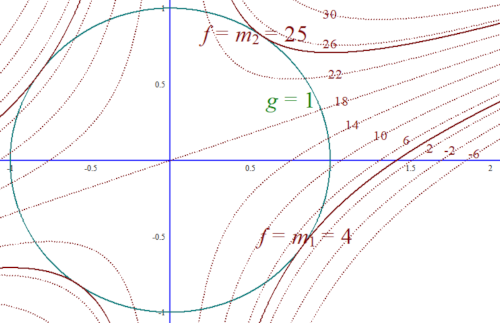
Answer: The figure on the left sho-ws the dashed graphs of the func-tions y(x) = α/x + β⋅x for various values of m = -6, -4, ..., 30, where:
α = (m - 18)/(14√2), β = 1/(2√2)
The condition is that the function g(x, y) = x² + y² has a constant va-lue of 1.
1. We expand the first and get:
xy = α + β⋅x²,
$$ 14\sqrt{2}\,xy = (m-18) + 7\sqrt{2}\,x^2, $$ $$ 11x^2 + 14\sqrt{2}xy + 18y^2 = m, \quad x^2 + y^2 = 1, $$ $$ (9x^2 + 6\sqrt{2}xy + 2y^2) + (2x^2 + 8\sqrt{2}xy + 16y^2) = m, $$ $$ f(x,y) = (3x + \sqrt{2}y)^2 + (\sqrt{2}x + 4y)^2, \quad f(x,y) = m. $$We are looking for extremes, min m1 and max m2, functions f(x, y) = m with steps m ∈ [-6, 30], while the graph bends and crosses the circle g(x, y) = 1. At the entrance to the circle, when f and g touch, we have a minimum, and at the exit a maximum m1 ≤ f(x, y) ≤ m2.
2. For example, for a matrix A we find its 2-norm by definition:
$$ \|A\| = \max_{\|u\| = 1} Au. $$In the general case of a real symmetric 2-dim matrix Au = w becomes:
$$ \begin{pmatrix} a & b \\ b & c \end{pmatrix} \begin{pmatrix} x \\ y \end{pmatrix} = \begin{pmatrix} ax + by \\ bx + cy \end{pmatrix}. $$We are looking for the maximum m of the function f(x, y) = m with the condition g(x, y) = 1, in general and in particular, the function and the condition are:
f(x, y) = (ax + by)² + (bx + cy)², g(x, y) = 1,
f(x, y) = (3x + √2y)² + (√2x + 4y)², x² + y² = 1.
We recognize the function of the graph from the image.
3. At these two points of contact, the tangents to the curves f and g coincide, which means that the normals to them are also parallel. Hence the conditions:
$$\nabla f(x,y) = \lambda \nabla g(x,y), $$ $$ \frac{\partial}{\partial x}f(x,y) = \lambda \frac{\partial}{\partial x}g(x,y), \quad \frac{\partial}{\partial y}f(x,y) = \lambda \frac{\partial}{\partial y}g(x,y), $$where is a number, parameter λ, the so-called Lagrange multiplier. We calculate:
2a(ax + by) + 2b(bx + cy) = 2λx, 2b(ax + by) + 2c(bx + cy) = 2λy,
b(a + c)y = [λ - (a² + b²)]x, b(a + c)x = [λ - (b² + c²)]y, b²(a + c)² = [λ - (a² + b²)][λ - (b² + c²)], xy ≠ 0, λ² - [(a² + b²) + (b² + c²)]λ + (a² + b²)(b² + c²) - b²(a + c)² = 0.
The discriminant of this quadratic equation is:
D = [(a² + b²) + (b² + c²)]² - 4(a² + b²)(b² + c²) + 4b²(a + c)² = = [(a² + b²) - (b² + c²)]² + 4b²(a + c)² = (a² - c²)² + 4b²(a + c)², D = (a + c)²[(a - c)² + 4b²] ≥ 0,
because the coefficients are real numbers, so the lambdas are also real:
$$ \lambda_{1,2} = \frac{a^2 + 2b^2 + c^2 \pm \sqrt{D}}{2} \in \mathbb{R}. $$These lambdas are Lagrange multipliers that we will use to find the extrema, min and max of the given function f = m with the constraints g = 1.
4. In particular, for the given coefficients a = 3, b = √2 and c = 4 the discrimi-nant is D = 21². For these, the lambdas are:
$$ \lambda_{1,2} = \frac{29 \pm 36}{2} = \begin{cases} 25 \\ 4 \end{cases} $$Now a = 3 with λ1 = 25 and λ2 = 4, and in the previous example (Multiplier) it was a = -3 with the same b = √2 and c = 4, so it was λ+ = 18.27492 and for min λ- = 10.72508. In the general case:
$$ \kappa = \frac{\lambda - (a^2 + b^2)}{b(a+c)}, \quad y = \kappa x, \quad x^2 + y^2 = 1, $$1 - x² = κ²x², ⇔ x² = 1/(1 + κ²) ⇒ x = 1/√(1 + κ²), y = κx.
5. In particular, now (a = 3, b = √2 and c = 4) for λ1 = 25 and λ2 = 4, we have:
$$ 1 - x_1^2 = \left(\frac{25 - (9 + 2)}{\sqrt{2}(3+4)}x_1\right)^2, \quad 1 - x_2^2 = \left(\frac{4 - (9 + 2)}{\sqrt{2}(3+4)}x_2\right)^2, $$ $$ 1 - x_1^2 = 2x_1^2, \quad 1-x_2^2 = \frac12x_2^2, $$ $$ x_1 = \frac{\sqrt{3}}{3}, y_1 = \frac{\sqrt{6}}{3}; \quad x_2 = \frac{\sqrt{6}}{3}, y_2 = -\frac{\sqrt{3}}{3}. $$These coordinates w1 = (x1, y1) and w2 = (x2, y2) give the extrema of the function:
m = f(x, y) = (ax + by)² + (bx + cy)²,
$$ m_1 = (3\cdot\frac{\sqrt{3}}{3} + \sqrt{2}\cdot\frac{\sqrt{6}}{3})^2 + (\sqrt{2}\frac{\sqrt{3}}{3} + 4\cdot\frac{\sqrt{6}}{3})^2 = 25, $$ $$ m_2 = (3\cdot\frac{\sqrt{6}}{3} - \sqrt{2}\cdot\frac{\sqrt{3}}{3})^2 + (\sqrt{2}\cdot\frac{\sqrt{6}}{3} - 4\cdot\frac{\sqrt{3}}{3})^2 = 4. $$These extremes are seen in the figure, the smallest m1 = 4 and the largest m2 = 25 value of the function f as it crosses the circle g = 1. Only the maximum can be the norm of a matrix, so ∥A∥ = max{m1, m2}. Now it is ∥A∥ = 25.
6. Here is how we find general expressions for the norms of the above matric-es, real symmetric second order:
$$ \kappa = \frac{\lambda - (a^2 + b^2)}{b(a+c)} = \frac{a^2 + 2b^2 + c^2 \pm \sqrt{D} - 2(a^2 + b^2)}{2b(a+c)} = $$ $$ = \frac{c^2 - a^2 \pm (a+c)\sqrt{(a-c)^2 + 4b^2}}{2b(a+c)}, $$ $$ \kappa_{1,2} = \frac{c-a \pm \sqrt{(c-a)^2 + 4b^2}}{2b}. $$Plugging in the known numbers (a = 3, b = √2 and c = 4), the plus sign (+) in front of the root gives κ1 = √2, and the minus sign gives κ2 = -1/√2 minus. Th-en, in general:
$$ 1 + \kappa_{1,2}^2 = \frac{(c-a)^2 + 4b^2 \pm \sqrt{(c-a)^2 + 4b^2}}{2b^2} = \begin{cases} 3 \\ 3/2 \end{cases} $$ $$ x_{1,2} = \frac{1}{\sqrt{1 + \kappa_{1,2}^2}} = \begin{cases} \sqrt{3}/3 \\ \sqrt{6}/3 \end{cases}, \quad y_{1,2} = \frac{\kappa_{1,2}}{\sqrt{1 + \kappa_{1,2}^2}} = \begin{cases} \sqrt{6}/3 \\ -\sqrt{3}/3 \end{cases} $$ $$ f_{1,2} = \frac{(a^2 + b^2) + 2b(a+c)k_{1,2} + (b^2 + c^2)k_{1,2}^2}{1 + k_{1,2}^2} = \begin{cases} 25 \\ 4 \end{cases} $$To check the formulas, I add the values listed on the right in curly brackets. As we can see, these results are equal to the previous ones. Further, applied to the norm of the matrix, the found extrema are the squares of the intensity of the copied vector, f = ∥w∥², so the norm is just the root of the larger ∥A∥ = 5. Note that this norm is again equal to the leading eigenvalue, Av = μv. This means that the leading vector, whose intensity defines the norm, also has the directi-on of the dominant eigenvalue.
7. Let's look at it from another angle. We have in order:
b(a + c)y = [λ - (a² + b²)]x, λ = [(a² + b²) + (b² + c²) ± (a + c)√[(a - c)² + 4b²]]/2, b(a + c)y = = x[c² - a² ± (a + c)√[(a - c)² + 4b²]]/2, b(a + c)y = x(a + c)[c - a ± √[(a - c)² + 4b²]]/2, y = x[c - a ± √[(a - c)² + 4b²]]/(2b).
Therefore, the tangent of the angle y/x of the vector w = (x, y) whose intensity determines the norm of the matrix max ∥w∥ = max ∥Au∥ is equal to the domi-nant eigenvalue of the matrix Av = μv, and these vectors are parallel, w || v. The proof is in example 2.ii of the previous answer (Direction II).
According to this information theory or global convergence, simply put, a mat-rix of real quantities (position, momentum, or energy) pushes in the same dir-ection, both by its dominant eigenvalue and by its norm. Simply because of the greatest intensities in that direction.
8. Here is another example. In the literature it is often written that multiplie-rs, here λ ∈ {25, 4}, serve only as additional variables to find the coordinates of the extreme points, but let's look at another use of them. From the previous answer (2nd Example) we take the formulas for the eigenvalues, Av = μv, and from this (3) the equations of the multiplier λ. We get the system:
aμx + bμy = λx, bμx + cμy = λy,
$$ \begin{pmatrix} a & b \\ b & c \end{pmatrix} \begin{pmatrix} \mu x \\ \mu y \end{pmatrix} = \frac{\lambda}{\mu} \begin{pmatrix} \mu x \\ \mu y \end{pmatrix}. $$When we divide this matrix equation by the eigenvalue μ, we get:
$$ \begin{pmatrix} a & b \\ b & c \end{pmatrix} \begin{pmatrix} x \\ y \end{pmatrix} = \frac{\lambda}{\mu} \begin{pmatrix} x \\ y \end{pmatrix}, $$which means that λ/μ is an eigenvalue of the same eigenvector v(x, y). Howev-er, by definition, a unique eigenvector corresponds to exactly one eigenvalue for a given linear transformation. This means that λ/μ = μ, and hence λ = μ². And indeed, if we apply the formula from the aforementioned 2.i example to these values, we get μ ∈ {5, 2}.
Comparison II » srb
Question: What about Hermitian operators, how do eigenvalues and norms relate to them?
Answer: The norm ∥H∥ of a Herm-itian H operator or matrix is equal to the eigenvalue with the largest absolute value:
∥H∥ = maxk |μk|, Hv = μv,
where vk are the corresponding μk eigenvectors, while k = 1, 2, ..., n, and n is the dimension of the mat-rix. A simple proof in a few steps goes like this.
1. The first, |μk| ≤ ∥H∥, is by the definition of the norm ∥H∥ = sup∥u∥=1 ∥Hu∥, while the Rayleigh-Ritz theorem gives the second ∥H∥ = max∥u∥=1 |⟨u, Hu⟩|, and together they give that the norm of a Hermitian operator is equal to its absolute largest eigenvalue.
For example, in the recent answer (Multiplier, 4, 7), A is a real symmetric mat-rix with norm equal to the eigenvalue, ∥A∥ = μ = 4.27492. This is a special kind of Hermitian, with also an example (Multiplier II) where such a matrix is ∥A∥ = μ = 5. The following examples are introductions to demanding topics, but are sufficient for readers with an applied mathematics background.
2. When a, b ∈ ℝ and det H ≠ 0, this is a Hermitian 2-dim matrix:
$$ H = \begin{pmatrix} a & c \\ c^* & b \end{pmatrix} $$where we put a = 2, c = 1 + i, c* = 1 - i, b = 3. Its determinant is:
$$ \det H = \begin{vmatrix} a & c \\ c^* & b \end{vmatrix} = ab - cc^* = 4. $$We find the eigenvalues by solving the equation:
det(H - μI) = 0,
$$ \begin{vmatrix} a - \mu & c \\ c^* & b - \mu \end{vmatrix} = 0, $$μ² - (a + b)μ + ab - |c|² = 0,
$$ \mu_{1,2} = \frac{a+b \pm \sqrt{(a-b)^2 + 4|c|^2}}{2} = \begin{cases} 4 \\ 1 \end{cases} $$According to (1), the norm of the matrix is ∥H∥ = max{μ1, μ2} = 4.
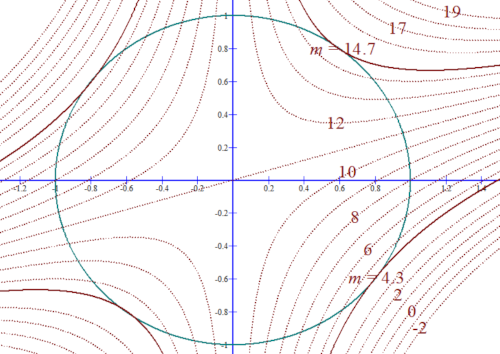
3. The image above shows a dashed graph of a sequence of functions:
y(x) = (m/10 - 1.1)/x + 0.3⋅x,
in order for m = 19, 18, 17, ..., -1, -2. This graph demonstrates how this funct-ion curves around the circle x² + y² = 1. As the number m decreases, it enters the circle at the value m1 and exits at the value m2. Visually, it shows that the function y(x) reaches a maximum at the entry point m1 ≈ 14.7 and a minimum at the exit point m2 ≈ 4.3. Multiplying the given equation by 10x and using the condition x² + y² = 1, we translate it into the form:
f(x, y) = 8x² + 10xy + 10y² = m,
f(x, y) = |2x + (1 - i)y² + |(1-i)x + 3y|² = m,
$$ f(x,y) = \|\begin{pmatrix} 2 & 1+i \\ 1-i & 3 \end{pmatrix} \begin{pmatrix} x \\ y \end{pmatrix}\| = m, $$f(x, y) = ∥Hu∥ = m,
where only real numbers of the unit vector u = (x, y) are used, and maximum √m1 = 3.8 < ∥H∥ = 4. The example proves that when we search for the norm ∥H∥ = max ∥Hu∥ of the Hermitian operator H for the condition ∥u∥ = 1 we mu-st also choose the complex components x, y ∈ ℂ.
4. A more precise search for the norm ∥H∥ involves the complex numbers x = x' + ix'' and y = y' + iy'', with real x', x'', y', y'' ∈ ℝ and i² = -1, but such that:
|x|² + |y|² = 1, (x' - ix'')(x' + ix'') + (y' - iy'')(y' + iy'') = 1, (x'² + x''²) + (y'² + y''²) = 1.
This means that the above searches were "short" for x''² + y''². Although these paths are imaginary (Bypass), they are active at the quantum particle level and hence Hermitian operators with real eigenvalues but allowed imaginary paths are necessary for accuracy there. Here I am thinking of further particle excurs-ions than those calculated by Feynman to prove that all their vectors add up to one (Prolongation, 2), and of the principle of least action.
5. Variety is a fundamental thing of this theory, first of all, because equalizati-on (at a given interval) increases information, and nature spontaneously tends to its lower value. Therefore, this discovery has a subtle connection with the recent answer (Comparison), say without experiencing darkness we would not understand light, or if there really is no unreal how would we understand the real. It is not the only bypass connection (Solenoid), but it is a loud one.
Position » srb
Question: Does the previous equality, norms and eigenvalues, of a Hermitian operator also apply to infinite matrices?
Answer: Yes, this is evident from the proof (Comparison II, 1). An example of such an operator is the position operator (Momentum II) of quantum mechanics $\hat{x}\psi = x\psi$ with the wave function ψ solution from the Schrödinger equation of a given situation (a free particle, or an electron in a hydrogen atom, etc.) which we treat further as an eigenvector, and the eigenvalue of the previously unknown operator $\hat{x}$ is declared to be the position x. Then, with the knowledge from quantum mechanics, we obtain the properties of this operator, including its matrix representations such as the following:
$$ \hat{x} = \sqrt{\frac{\hbar}{2m\omega}}\begin{pmatrix} 0 & \sqrt{1} & 0 & 0 & ... \\ \sqrt{1} & 0 & \sqrt{2} & 0 & ... \\ 0 & \sqrt{2} & 0 & \sqrt{3} & ... \\ 0 & 0 & \sqrt{3} & 0 & ... \\ ... & ... & ... & ... & ... \end{pmatrix}. $$It is an infinite, real symmetric matrix. Its type is Hermitian and, therefore, its eigenvalue (position x) is real and equal to $\|\hat{x}\|$. This norm is the "range" of the wave function, and when its range is infinite, the matrix will also be infinite.
1.For example, let's say the wave function has two options, ψ = (ψ1, ψ2), for only two possible outcomes (Born rule) the probability |ψ1|² + |ψ2|² = 1, so:
$$ \hat{x} \psi = x\psi, $$ $$ \begin{pmatrix} 0 & \sqrt{1} \\ \sqrt{1} & 0 \end{pmatrix} \begin{pmatrix} \psi_1 \\ \psi_1 \end{pmatrix} = x\begin{pmatrix} \psi_1 \\ \psi_1 \end{pmatrix}, $$according to the formula (Comparison II, 2) we find two eigenvalues, these are now the position labels x ∈ {-1, +1}. The particle can go left or right by one step depending on the probabilities ψ. Its range is $\|\hat{x}\| = 1$.
We find the components of the wave function by now inserting it into the orig-inal equation. For each of the found eigenvalues (x = ±1), we find ψ1 = ±ψ2, which means that the options are equally likely, |ψ1|² = |±ψ2|² = 1/2. There are so-called natural units, when we put ℏ/mω → 1.
2. In the infinite case, the mapping $\hat{x}\psi = \phi$ gives a vector $\phi = x\psi$ whose com-ponents are determined by a series of equations:
ϕ2 = ψ1, ϕ1 + √2ϕ3 = ψ2, √2ϕ2 + √3ϕ4 = ψ3, ...,
√(n-1)ϕn-1 + √(n)ϕn+1 = ψn, n = 1, 2, 3, ...
Explicit forms of these seemingly simple expressions are not easy to work wi-th, and quantum mechanics usually deals with their indirect interpretation on a case-by-case basis. Moreover, we are reluctant to use this very matrix repre-sentation of the position operator precisely because of the aforementioned complexity, and the alternatives are usually integral forms.
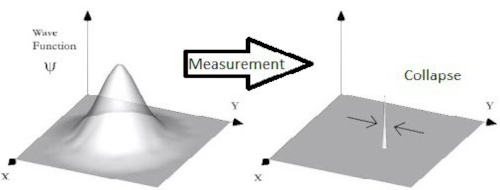
3. An eigenvalue is a unique and measurable number x that represents the lo-cation of a particle. This is anywhere in space, so the position has an infinite number of possible values, which in mathematics are called a continuous sp-ectrum. Any real number from -∞ to +∞ is a possible eigenvalue. On the other hand, an eigenvector is the state of the system when it has a particular eigen-value. If a particle is perfectly located at the exact point x0, its wave function converges to an infinitely high, infinitely thin spike at that location. This mat-hematical, graphical jump is the Dirac delta function, written as δ(
The formula for the eigenvector centered at x0 is ⟨x|x0⟩, where this scalar product is also the amplitude of the probability of finding the particle at x0. A more familiar example of a similar "finding" is taking a photo of a bird in flight with a flash. The eigenvectors tell us that the bird has a 100% chance of being in that exact flash and a 0% chance of being anywhere else. My explanation of this possibility is the difference between individual and group observation (Conspiratorial), which is discrete in a single outcome and increasingly continuous as the mean of the set.
4. The Borel-Cantelli lemma in probability theory states that a convergent infinite sum of probabilities always contains some finite subsequence of sum probability one. Appliedly, this means that it makes sense to approximate, that it would be enough for absolute accuracy, if we could know which sub-sequence that is, but the lemma does not give us such information. The info-rmation theory I am testing agrees with that lemma because of the finiteness of observations (Packages) and because of unpredictability (in principle, info-rmation is the fabric of the observable world).
5. Infinity is an existing category of the wider universe, it is permanent beca-use it is true (it is part of mathematics) and is partially perceptible to us. We use this power of connecting, the finite and the infinite, with the help of a “di-vided brain”, a correspondent tells me with the video The Divided Brain, whi-ch is worth mentioning. He hit very well on what I am trying to say in answers like Comparison, that there is a need, or benefit, to connect detail and genera-lization, for us and biologically similar species, because there is no single real-ity. The left and right hemispheres of the brain are a division that all animals have evolved with needs similar to ours, it is possible that it arose precisely because of the impossibility of perceiving the whole. Therefore, the path to the simple formula of the sequence (2) becomes so arduous, like an impossible mission, because from the "frog's perspective" one would have to see the "bird's".
Memory » srb
Question: What is memory?

Answer: Truth and reality in the attempt, memory is that, I would say, but I'm so stuck in it and have become so detached from official science that that definition will sound silly to you without a solid explanation.
1. Let us remember, an important part of the theory I am building is memory of space. To avoid repea-ting myself, read the answer (Gravitational Memory), to the enthusiastic que-stion of a correspondent "do you know that gravitational memory exists". In short, memory in its striving to be truth or reality is also explained by a recent answer about the course of a random point (Infiltration II), when this calcul-ation is applied to the constant encounter of reality with all sorts of fictions, i.e., impermanent phenomena, which creates a sediment of phenomena with an increasingly long survival. This is where the real story of memory begins, to which everything that exists, the living and the non-living world, strives, stru-ggle not to lose track of reality. However, only part of this theory deals with vitality, and excessive use of the word "memory" would overemphasize it.
2. When we take apart and shuffle a figure made of Lego bricks, we can make something else out of that pile of bricks. We find something similar in inform-ation oversaturated with noise (Guidance, 3), and even in what lies at the be-ginning of the universe, which could therefore have developed differently. The Big Bang created space, time, and the laws of physics, and as temperatures dropped to fuse neutrons and protons into atoms, completely different const-ants and laws of physics could have emerged instead of the valid ones, buil-ding a world unknown and impossible to us. This fundamental coincidence continues, becoming thinner in the present as the history of the universe str-etches further, so that even this extension and fading of uncertainty is a kind of "struggle" for memory.
3. Superdeterminism is an extreme form of determinism that claims that the entire universe is predetermined. According to this view (John Bell, 1980), ev-ery event—including the choices scientists make—has causes that go back to the Big Bang. It is used as a loophole in the law to explain quantum mechanics without the creepy action at a distance. However, it is not part of my theory, which postulates the exact opposite, a complete absence of causality—in some events that I call “objective randomness.” The surrogate phenomenon that cr-eates order here is the law of large numbers of probability theory (Chebyshev). Hence the force of probability that paves the way towards more probable stat-es, and then the principle of minimalism, or spontaneity towards less informa-tion. Entropy is an expression of the same minimalism, but not as a spontan-eous growth of information (by cooling) as is regularly explained, but on the contrary, by a decrease in the amount of choice.
4. Nature's general tendency to reduce uncertainty is a kind of craving for or-der that we recognize by the fact that "the brain loves the familiar," it is said, because it saves energy. Familiar routines act as well-trodden paths in our minds. Everyone's brain needs less effort to process the familiar compared to the unfamiliar, and it immediately feels safe and comfortable with the famili-ar. Here, too, it comes from a principled minimalism (of information). Howe-ver, the effect is broader, from a general laziness and search for regularity, from scientists to their users. This also falls under the category of "struggle" for memory, now as a desire for fewer freedoms (Information Stories, p. 11). Note that this is not simply “separating the wheat from the chaff,” as in the previous case (1), although it also applies to inanimate nature.
5. Life is a characteristic of natural systems that manage to evade the principle of least action of physics, which means that they have an excess of freedom. Viruses are non-living packages of genetic code with an RNA or DNA core in-side a protein shell that “hijack” a living cell in order to copy themselves. They are the border between the living and non-living worlds and, although they are the zero link, they are not part of the true evolution of life. Evolution begins with the discovery of the death of living individuals and the (genetic) transmi-ssion of memories to their descendants. I believe that it is possible to talk ab-out the development of memory almost as much as about the development of life itself, but let's wait for biology to have its final say on this.
Trust » srb
Question: Why don't viruses become living cells?

Answer: At first glance, this quest-ion seemed so stupid to me that I thought someone was playing a prank on me. But later I noticed that it was sent by a colleague from another industry with whom I had already discussed “Quarrel” and that he supposedly quite liked my answer. It could be that he was waiting for something of this level again and, I admit, I was nervously brow-sing through attachments like the link to the image on the left.
1. I don't know if all viruses don't become living cells, but given that their inva-sions last for centuries and that they are at the gates of fiction, it must be that as individuals they "fight a lot", far more fiercely and persistently attacking resources than the physical substance of which they are composed. I do not make this assessment based on biological or chemical reasons, nor are their "conflicts" as simple physical imbalances, but rather as "struggles for the tr-uth" of living beings (who know how to lie). On the other hand, the survival of the concept of struggles establishes their reality, their repeatability in given conditions.
2. The concepts of truth (⊤) and falsehood (⊥) are from the algebra of logic, and I also have analogs from the algebra of vectors (Hindering II), where the operations of disjunction, conjunction, and negation (Drowning) are represen-ted by nilpotent operators. Moreover, this mathematics proves that there is an equivalence of falsehood and truth, that there are just as many of them, that they are always around reality but invisible to it. Hence the persistence of the virus. Another thing is that I must now use imprecise concepts such as "confli-ct" or "trust" by retelling these algebraic ones. Take them with a grain of salt so that they come as close as possible to their roots in the algebra of logic and vectors. The word "trust" is, let's say, close to "shared truth", or "simultanei-ty", when "conflict" disappears.
3. Trust is the ultimate tool for cooperation. Bankers and other bureaucrats are busy all day long creating trust, says Harari (Triangulation, 1), which bu-ilds our civilization and keeps it bound. He adds that, one-on-one, a human is weaker than any chimpanzee, lion, or elephant, but humans win in the context of a million humans and a million chimpanzees. This is because of the ability to cooperate and trust, and even more profoundly because of language and writing. It is an introduction to him about the possible future superiority of artificial intelligence over humans, because of the power of such stronger co-nnections, and to me as an introduction to the discovery of "truth" in all its power, its persistence. Viruses could taste fiction and become pathological liars, addicted like drug addicts or gamblers, captivated by its alluring glow like a match that they must repeat because behind each comes darkness. They remain prisoners of that "beauty" and fail to spread mutual "trust".
4. The concept of broad trust is not acceptable to a cow, a chicken, a virus, as when you expect an unknown bank clerk to consider the money or pieces of paper brought by you as value and exchange it for another value without thi-nking about fraud. That is why every criminal organization (or fraudulent) is weaker than the average normal state, or the organization of a living cell is stronger than a virus. I speak in statistics, and that is how I view machine learning that, through long reviews, builds images or sentences (LLM) into artificial intelligence. Some viruses will always kill some living cells, some an-imals some people, and some fraudsters will outsmart some "healthy" (non-fraudulent) institutions, because the game of manipulation is tactically (short-term) strong and strategically (long-term) weak.
By combining concepts in this way, consistently with the fact that "more fr-equent" becomes "closer" in the metric of vector spaces, trust becomes an (algebraic) truth. Hence, by reading out images, as well as sentences, for ex-ample, the concept of "cat" within both models (image and text) will incre-asingly coincide.
Illusion IV» srb
Question: This explanation of the virus (Trust) is remarkable of you, and it would be even more interesting if it were true?
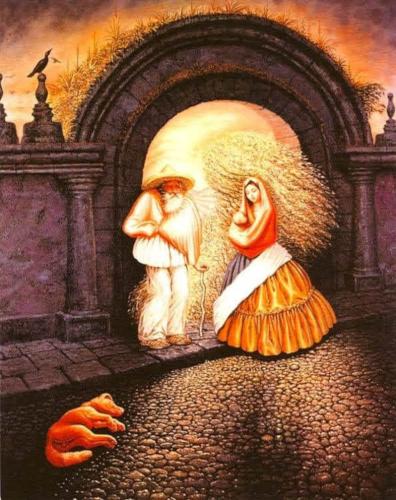
Answer: On the contrary, we are generally more interested in what is untrue, the more we believe it. That is the secret of the appeal of fiction, of great artists who direct us tow-ards the truth, and equally lesser ones who then lead us into thievery. Both in their own way control that attractive magic, with whose truthful (mathematical) background we are just playing with. I do not intend for my “truth” to be more widely recognized, so much as to preserve my game, so I hope we do not spread my story further. Everything spontaneously tends to states of less infor-mation, and yet a life, that is a state of exce-ss information, is possible (Illusion III).
1. If we are talking about secret knowledge, mine is buried within quantum mechanics that the world is divided into the physical reality of measured phenomena, known phenomena that arise from the collapse of superpositions, and the world of superpositions themselves. Such phenomena are like the falling of “tails” or “heads” by tossing a coin and the state of uncertainty in the coin before that outcome. I also see that world of superpositions, which lies ben-eath measurement physics, as a new kind of “atoms” discovered by quantum theory and these my researches.
The first recorded atomists were the ancient Greek philosophers Leucippus and his student Democritus in the 5th century BC. They taught that everything in the universe was made of tiny, indivisible, and indestructible building bloc-ks called atoms (from the Greek word atomos , meaning "indivisible"). Ruđer Bošković (1711–1787, a Dubrovnik scientist of Serbian origin) is also famous for his atomic theory. He discovered that the Moon has no atmosphere, and was the first to accept and apply Newton's Principles, for example, that Satu-rn's rings are fragmented bodies. Analogous to his teachings about various forces (actually discovered) in ever smaller volumes of substance, this is about new aspects of matter at even lower levels.
1. No matter how much we train a frog, we will not make a horse out of it, or, admittedly, in much smaller failures, even the best fiction writer is revealed. Many readers will discover fictions in the novel about Tarzan (Edgar Rice Bur-roughs, 1912), also in the novel “Journey to the Center of the Earth” (1864) by the French writer Jules Verne, but sometimes we are not sure. Fifteen years after the emergence of the conspiracy theory that a man did not set foot on the moon in Apollo 11, in 1969, and which spread after 1976 and especially in 1978 (the film Capricorn One), I was asked for my opinion on it. Pay attention to the developments in science in those years between and you will catch the conspiracy theorists in a lie.
For example, the lunar sand (regolith) is extremely like a thistle, which is why it is sticky, and this problem was first discovered and experienced by astrona-uts during that Apollo mission. The conspirators saw the sharp edges of the astronauts' boot prints in the lunar dust as an alleged fraud, and this is preci-sely what exposes them as ignorant. Also, the starry sky, which they wanted to see in the background of the pictures from the moon, is a fiction. The high co-ntrast for the cameras of that time showed that sky dark without stars, if even a fragment of the bright hull of the ship or the lunar surface appeared. There were six such misconceptions of the conspirators, and, as is common, those who were overeducated with outdated knowledge. Their dogma made them laugh when I claimed that people had been on the moon and especially when I said that Armstrong himself should be asked "Why are you lying?" if he were to declare that he had never been to the moon.
2. These were stories about the impossibility of the imagination to conceive of a truth that did not happen, but the reverse is also true. When we really prove that something is not possible, that it is not true, it will not be confirmed by physical experiment, and this is at the heart of the idea that physical reality cannot lie, but also that there is an equivalence of reality and truth. The latter is a consequence of reality being mixed with all the colors of mathematical and other truths. Such layers are countless theorems from geometry, such as (8. Example) the midpoints of an arbitrary quadrilateral are the sides of a paralle-logram's vertices. However, geometry is not the only pool of those truths that we are usually unaware of when we think of "reality". In our inability to perce-ive them all and in our need for decisions, we hallucinate, as has recently been the case with artificial intelligence.
Fictions cannot communicate with outcomes, with collapses, i.e. particles of physical reality, but some can interfere with their superpositions. This includ-es us, the means by which fictions can manipulate reality. Therefore, the brain does not create fictions (as is commonly thought) but rather conducts them li-ke a radio or TV receiver. (Manipulation).
3. The difference between a rogue character and a top player, a second and first league strategist (Traits), could be insurmountable, like between a virus and living cells. Like between a mediocre chess player and a grandmaster, or between an average high school mathematician and one of the 50 or so gold medalists of the International Mathematical Olympiad. That is why players from the upper league (from the background), choosing the characters of "ma-nipulators" (middle league) for the purposes of managing the masses of voters (lower league) of the countries in which they interfere, can believe that they will not be betrayed. It is not only the habit of slaves that they cannot live wit-hout a master, but also an intellectual blockage, a limitation of the conscious-ness of lower players in the belief that they know exactly what to do. The nar-rower this consciousness is, the less self-doubt there is. Russell (1933) would say this: "The fundamental problem of the world today is that stupid people are too sure of themselves, while intelligent people are full of doubts."
4. We would say that fictions are picky, or that they have difficulty penetrating a weaker intellect, or a worse transmitter, it may be that some emergences of neurons or whatever are more successful than others, all the same, they, like the first drug or the first gambling bonus, have a stronger effect on the trans-mitter and captivate the bewitched by the belief in illusions more than a first-league player. Masters of controlling the real and the unreal will "abuse" ficti-on, they will not let themselves be captured by it, but on the contrary, they will use it as a tool in discovering the truth and monitoring reality. We do somethi-ng similar in mathematics, we often use both truth and untruth equally when proving a theorem. Untruth is more attractive than truth, according to the pr-inciple of minimalism, because illusion, disinformation, or semi-information and information are of lower density. That's why lies spread faster than the truth, but we are also genetically disgusting to false promises, because evol-utionary memory records their failure.
Antigravity» srb
Question: Can you comment on antigravity?
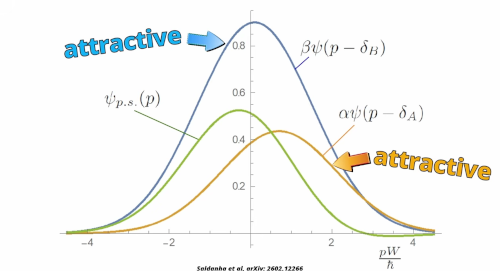
Answer: Along with the question, I received a video (picture on the left, July 18, 2026). Unfortunately, I can't. Not based on that work. Ot-herwise, I have no opinion on an-tigravity, neither positive nor ne-gative. In some old texts I menti-oned it, but only as hypothetical attempts and none of those are as convincing as, for example, the expansion of the universe. But I like the idea of superposition from the video and I use it. Both wave states, above and below, are attracted by the medium that is confused as in some Lagrange point of gravity, or, as they say, in anti-gravity.
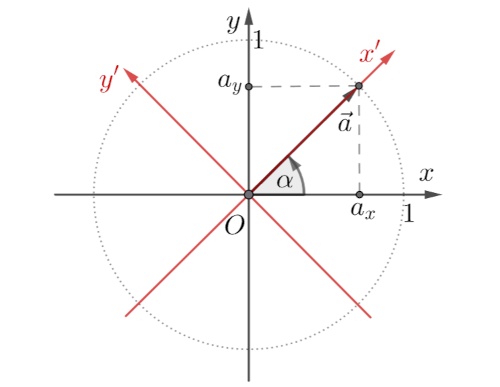
1. I'll use the antigravity example better if I'm talking about superpo-sition in general. In the black coo-rdinate system (Oxy) in the image on the right, we see light in a 50-50 percent polarization ax and ay, i.e. $\vec{a} = (a_x, a_y)$. Vectors of such a wa-ve function in physics would be wr-itten ψ, but I'm not for misreprese-ntation. Again |ax|² = cos²α and |ay|² = sin²α, which also represe-nts the probability that observer Oxy will measure light polarized in the ax way, say horizontally, or in the ay way (vertically). However, some other observer, here the red system Ox'y', sees the same light 100% horizontally pol-arized. In the case of a 50-50 mixed polarization, there is no point in such a rotation.
2. The idea of light, for which time stands still, and observers see it moving at the speed of light, has the consistent addition that there are also pseudo-real-ities of observers, among whom there is one who would see this, for us, mixed light 100% horizontally polarized. This can be defended using the topological definition of the dimensions of time, but it cannot be transferred equally to the superposition of quantum mechanics, where it would be about mixing as a new state before the polarization of light itself. Such a state would be declared by measurement, that is, only then transformed into a physical reality.
Measurement separates these two worlds, superposition and collapse, unpred-ictably. Only the measurement of an electron determines its previous trajecto-ry, and we cannot say which of them will be in which of the pseudo-worlds. Af-ter the collapse, or the declaration of possibilities from the superposition, the determinations continue each in its own way. This is the basic concept of my information theory that still resists. In this twisted way, only after the collapse does an observer appear in some pseudo-reality for each of the superposition options.
3. When we observe the previous image of light in a timeless way, in the prop-agation of some wave-particles from the same source, before the interaction their phenomena are indeterminate to the world of physical reality, and after the interaction they are declared. We see this as the paradox of quantum enta-nglement (EPR), although there is no such paradox in the algebra that allows two systems, S and Q, to observe the same propagation. These could be two observers at a very great distance from each other who observe A, B, C, ..., un-predictable outcomes before the interaction, but mutually exclusive properties of the wave-particle after the interaction. Whatever state the observer S meas-ures, it will also measure Q, as if they were not random phenomena. That is, as if there is an instantaneous transmission of a message between the measured. Einstein commented on this synchronization as "spooky action at a distance", and here I take it as a fact about the division of the upper (physically real) and lower worlds of the universe.
This "underground" world does not seem to respect the concept of space-time as much as the "aboveground" one does, or at least not as much as it cares ab-out preserving the exclusivity of the properties A, B, C, ... when they appear in the above. This is a contribution to the impermanence of fictions, which inter-vene only in the "lower" world and at least by means of vitals manage to viola-te the principle of least action of the "upper" world. What can still be drawn from this explanation is the non-commitment of the "lower" ones to both dis-tance and duration.
4. Roughly speaking, in evading our space-time rules while preserving others (momentum, energy, etc.) lies the possibility of "cheating" the laws of gravity of the "upper" world by using inconsistent properties of the "lower" one. In th-eir contribution Gravitational Force the authors see a possible antigravity in the state ψ(p) ∝ βψ(p - δB) - αψ(p - δA), the image above left. This wave func-tion, which they explain in four pages in their attachment, could mean a repu-lsive gravitational force for the otherwise atypical quantum entanglement of larger masses. I wouldn't be quick to predict what might happen next.
Ghost Imaging» srb
Question: Have you heard of Fantasy Viewing?
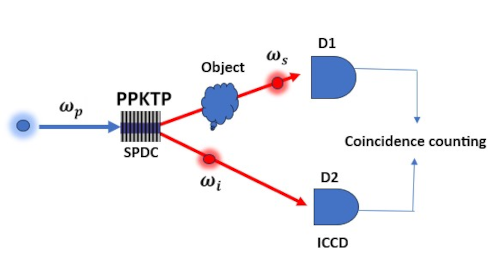
Answer: “Fantasy Imaging” prov-ides an image of an object from a direction where it is not. One beam passes through the object but is “recorded” by a non-recording de-vice; the other beam will not even see the object but its entangled image. For example, on the left, the object is seen in infrared D1, and its composite part appears on the oth-er D2 after the light from D1 interacts with the object.
1. In the previous answer (Antigravity, 1) I dwelled on the differences between polarized light and quantum entanglement, which is also promoted by profes-sional physicists, so it is worth emphasizing it again. The coupling, or precisely entanglement of quantum particles, comes from their simultaneity, is my view of this phenomenon. That is why we obtain them by "eruption" (explosion and then expansion) from a third one, in order to be provided with simultaneity, which is always personal, proper, its own and no one else's. They remain qua-ntumly entangled until the first interaction of either of them, which then occu-rs simultaneously for both. This is important for understanding the aforemen-tioned "ghost images", as well as the effect of fictions through us on physical reality (Manipulation).
2. Ghost Imaging is an advanced, non-local imaging technique that is already being developed for breast cancer screening to provide safer, less expensive 3D X-ray images with lower radiation doses. Instead of the standard X-rays, pairs of split X-ray beams are used, one beam captures a random spatial pat-tern (serving as a reference) and never touches the breast. The other beam passes through the breast and captures it in a single, less expensive “bucket” detector (3D medical imaging). Correlating that reference beam and the det-ector data reconstructs a high-resolution 3D image. This approach requires a fraction of the photons typically used and significantly reduces radiation dose. Although promising, X-ray “ghost tomography” for clinical breast screening is still in the research and development phase.
3. With the help of "spiritual tomography" we could understand that fictions can act at a distance and be amplified, but never alone, always with quantum entanglement and an appropriate mediator. We understand how naive, unco-nvincing such "ghost stories" must have been before the discovery of quantum mechanics, which even today, after more than a century (since 1900), is inco-mprehensible to us, or strange. However, quantum entanglement has been pr-esent but not understood in linear algebra, since ancient times in China, and in the West with the discovery of determinants (Cramer's Rule, 1750), then quaternions (William Rowan Hamilton, 1843), or matrices (James Joseph Sylvester, 1848), then vector spaces (Giuseppe Peano, 1888), and so on. Qu-antum entanglement has long been the domain of vector algebra, but we ne-eded physical evidence to grasp its truths. It is absurd that it was only through measurements that we were able to accept these truths about the immeasura-ble.
4. Extra-temporal phenomena are also extra-spatial in the physical sense, be-cause it takes time for what we see to reach us, at the speed of light c of about 300,000 km/s. We look into the past of objects, and fictions are unreliable in this regard. Unlike realities and truths that endure, unreal or untrue phenom-ena do not adhere to such space-time.
When a beam of light is split into, say, an infrared frequency to perceive heat and into visible light colors that do not perceive it, the colored arm (Ghost Im-aging) will give an image of a warm body when it comes into contact with infr-ared light. Regardless of the distance between the two directions and observa-tions, if some unreal phenomenon were to interfere with one of the two arms, the realizations on both would be different, because the total energy of the lig-ht would be the same. An increase in frequency on one observation would be a decrease on the other, and vice versa. This is where the Fantasy Imaging part of this information theory model comes in.
Deduction IV» srb
Question: I don't understand why mathematical truths are not unique as conc-rete observations, and you say these phenomena are equivalent?
Answer: This is a forgotten but im-portant question from my topics (Deduction III) last year. I don't want to repeat myself, so let's app-roach this topic from the other side.
1. Logical deduction is the derivati-on of conclusions that follow from premises, from true premises the conclusion must be true. For exa-mple, premise 1. all men are mortal. Premise 2. Socrates is a man. Therefore (conclusion) Socrates is mortal. Here we have one superset (premise 1) and one of its subsets (premise 2), so we conclude that the subset belongs to the superset. And, in effect, we are narrowing down the options. More universal truths encompass more of their subsets. The more abstract those first premi-ses are, the more useful they are as a tool for finding less abstract truths. At the tail end of that are mere concreteness.
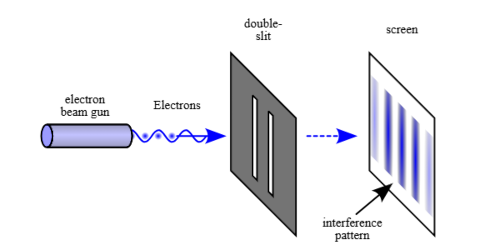
2. In the picture on the right is the “double slit” experiment. One electron is sent at a time so that, separated, they encounter two narrow slits and, passing through time, form a diffraction pattern on the screen behind. In this way, Yo-ung (1800) proved the wave structure of light, and now we observe a quantum phenomenon, that individual electrons also interfere with themselves. Let us ignore for now the question of whether electrons are wave packets and how “solid” particles they are, so that we do not miss the strangeness of the obse-rvation that some of them seem to interfere with others that are not present there at the same time. Let us notice, if we invoke the familiar excuse that quantum particles are waves of probability, we postpone and do not resolve this dilemma. At least not as much as the claim that they come from a world that does not respect the concept of space-time like us (Ghost Imaging, 4).
3. Micro-particles enter the macro-world through the laws of large numbers, and they themselves adhere to abstract vector spaces rather than physical on-es. More important to them is the algebraic regularity $\hat{H}\psi_k = E\psi_k$, for exam-ple the Schrödinger equation where the operator $\hat{H} = i\hbar\partial_t$ has the eigenvalue energy E of given quantum systems in eigenstates ψk. This is an abstract vect-or phenomenon, because the states, ψ1 and ψ2 in the linear combination ψ = aψ1 + bψ2, with any scalars (real or complex numbers) a and b, will equally solve the above equation. Feynman (I think) followed this path (Prolongation, 2) when he pointed out that quantum phenomena go in all directions in order to be summed up in a particle and the principle of least action during interac-tion. Note that they seem to come from higher abstractions into the world of physical reality.
4. Incidentally, we note the “consistency” in the properties of vectors themsel-ves. We can use Venn diagrams to draw an example of deduction with Socrat-es (1), and the direction and intensity of the vector interpret the direction and distance of the deduction. Here’s how:
- All persons accused of a crime have the right to a lawyer.
- Marko is accused of a crime.
- Marko has the right to a lawyer.
So, Marko does not have any arbitrary rights, but rather the right to legal repr-esentation. The scope of that representation is not unlimited, but rather impli-es a certain time and a given procedure. Another example:
- By heating, a solid substance changes from a solid to a liquid state.
- Silver is heated to 1000°C (its melting point is 962°C).
- Therefore, silver turns into a liquid.
The type of substance and its melting point (b) are two specific values that must fit into the first premise (a) in order to obtain the correct conclusion (c). I do not intend to develop such a “vector” story further. The abstractness of general truths gives them great applicability, in contrast to the concrete observations that are consumed in this sense. That's enough, for now.
Fuzzy Set» srb
Question: If you work with "fuzzy sets", could you explain them to me?
Answer: Since then I have avoided the old ways, after I am not in the business of mathematics, teaching or applying it. But it is good to have fun with such sets that deal with measurements of belonging in val-ues from 0 to 1. They are inevitable in topics of uncertainty.
For example, a person who is 185 cm tall would be given a score of 0.8 in the "Tall" set, but a person who is 165 cm tall would only be given a score of 0.3.
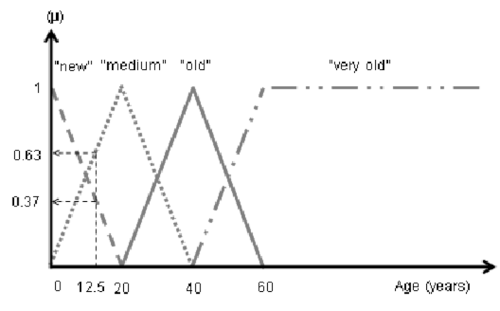
1. A classical deterministic universal set 𝒰 may have a function ν ∈ {0, 1} such that ν(x) = 1 when x ∈ 𝒰, and ν(x) = 0 when x ∉ 𝒰. The corresponding "fuzzy" function would be μ(x) = 1 if x ∈ 𝒰 and ν(x) = 0 if x ∉ 𝒰, but μ(x) ∈ (0, 1) when x is a possible element of the set 𝒰. This "possibly" is most often added to the values of a triangular graph, such as the image above left ("medium" from 0 to 40 years old and "old" from 20 to 60).
2. The evaluation of μ is transferred to the union (intersection) of sets by cho-osing a larger (smaller) value for possibly identical elements. For example:
A = {μ(a) = 0.3; μ(b) = 0.7; μ(c) = 0.6}, B = {μ(a) = 0.8; μ(b) = 0.5; μ(d) = 0.3},
A ∪ B = {μ(a) = 0.8; μ(b) = 0.7; μ(c) = 0.6; μ(d) = 0.3}, A ∩ B = {μ(a) = 0.3; μ(b) = 0.5}.
In the complement of the set, A', the value μ' is taken to be μ = 1 - μ, so:
A' = {a: 0.7; b: 0.3; c: 0.4}.
In the difference of sets, A∖B, the smaller of μ(A) and 1 - μ(B) is taken. Thus:
A ∖ B = {a: 0.2; b: 0.4; c: 0.6}.
These element values are easily transferred into the polyvalent algebra of logic.
3. It's no secret that I've been dealing with nilpotent operators, as have proba-bly others in this field, so I can say something about them. They are linear tr-ansformations with a null space (Domains). An operator N is nilpotent if its nth degree is the null operator, Nn = 0, which translates an arbitrary vector v to zero, Nnv = 0. Let's say that n ∈ ℕ the smallest degree that nullifies N, be-cause every larger one does the same, so let μ = 1 - r-n be the truthfulness of the process N. When r = 2 we have the sequence μ = 1/2, 3/4, 7/8, ... for deg-rees in the order n = 1, 2, 3, ... which I sometimes use in assessments of the "accuracy" of falsehoods. In this way, one can move from "fuzzy sets", as static states or vectors, to dynamic processes which are also types of vectors, and remain in the analysis of fictions. I've already talked about it (Hindering II). Otherwise, there is no essential difference between the two and, secondly, it is not the only way.
4. For example, the following matrix is nilpotent (N³ = 0):
$$ N^2 = \begin{pmatrix} 1 & -2 & 1 \\ 3 & 0 & 3 \\ -1 & 2 & -1 \end{pmatrix}^2 = \begin{pmatrix} -6 & 0 & -6 \\ 0 & 0 & 0 \\ 6 & 0 & 6 \end{pmatrix}, $$but it's easier to work with triangular, with zeros on the diagonal (A³ = 0):
$$ A^2 = \begin{pmatrix} 0 & a & c \\ 0 & 0 & b \\ 0 & 0 & 0 \end{pmatrix}^2 = \begin{pmatrix} 0 & 0 & ab \\ 0 & 0 & 0 \\ 0 & 0 & 0 \end{pmatrix}. $$For ab ≠ 0, n = 3 is the smallest degree that zeroes that matrix. It is a process that does not last after the third step, the small "truthfulness". We obtain true developments by replacing the zeros on the main diagonal with β > 0:
$$ B^2 = \begin{pmatrix} \beta & a & c \\ 0 & \beta & b \\ 0 & 0 & \beta \end{pmatrix}^2 = \begin{pmatrix} \beta^2 & 2\beta a & ab+2\beta c \\ 0 & \beta^2 & 2\beta b \\ 0 & 0 & \beta^2 \end{pmatrix}^2, $$and from this it is easy to see that all higher degrees Bn are also non-zero mat-rices. The numbers a, b, c > 0 are also positive.
5. We have a matrix type A that represents inconsistency (inaccuracy) and a matrix type B that represents consistency (accuracy). The negation of the first gives the second ¬A = B and vice versa ¬B = A. Hence, the negation of the ne-gation is the initial matrix, ¬(¬A) = A and ¬(¬B) = B. The disjunction (p ∨ q) becomes the sum of these matrices, and the conjunction (p ∧ q) is their prod-uct. We check the disjunction:
$$ C_1 + C_2 = \begin{pmatrix} \beta_1 & a_1 & c_1 \\ 0 & \beta_1 & b_1 \\ 0 & 0 & \beta_1 \end{pmatrix} + \begin{pmatrix} \beta_2 & a_2 & c_2 \\ 0 & \beta_2 & b_2 \\ 0 & 0 & \beta_2 \end{pmatrix}. $$This is obvious, if β1 + β2 > 0 the result is "true" otherwise it is "false". Let's also check the conjunction:
$$ C_1 \cdot C_2 = \begin{pmatrix} \beta_1\beta_2 & \beta_1 a_2 + \beta_2 a_1 & a_1b_2 + \beta_1 c_2 + \beta_2 c_1 \\ 0 & \beta_1 \beta_2 & \beta_1 b_2 + \beta_2 b_1 \\ 0 & 0 & \beta_1 \beta_2 \end{pmatrix}. $$When at least one of the beta numbers is zero, β1β2 = 0, only then will the product of these matrices be a nilpotent matrix, so it is unstable, and this corresponds to conjunction, which is then an incorrect statement. We know that negation, disjunction, and conjunction can define any statement in the algebra of logic, which means that with linear operators defined in this way we have a correct substitution.
De Morgan’s Laws » srb
Question: Could you give a few more examples of matrix calculus for the alge-bra of logic?
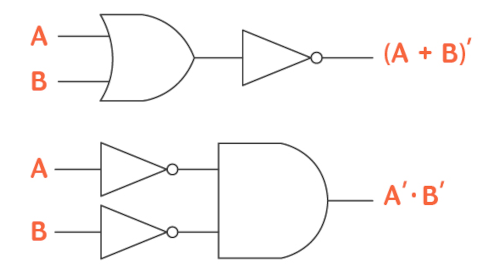
Answer: Look at the picture on the right and the link with a description of De Morgan's laws, let's say logic:
¬(a ∨ b) = (¬a) ∧ (¬b), ¬(a ∧ b) = (¬a) ∨ (¬b).
The negation of a disjunction is a conjunction of negation, and the negation of a conjunction is a disjunction of negation. This is analogous to sets, and further to the electrical switches that are symbolically shown in that picture. I mentioned a long time ago that it is also valid for the aforementioned matrices (Hindering II, 3). Then with nilpotent second-order matrices, and check it yourself for third-order matrices (Fuzzy Set, 4).
1. Such a calculation is applicable in theorizing situations that the founders of quantum mechanics had in mind, for example, when they observed that "mea-surement defines the previous trajectory of an electron". This property of part-icles is more pronounced in smaller ones and in all their interactions. When some process P changes the state u to the state w = Pu, and it turns out that there was a sum, or disjunction P = A + B, of which at least one sum is a sust-ainable process, then P is sustainable. The resulting state w could for some time still have memories of fictions or "real" consequences for the outside world, for phenomena after the measurement.
When the mentioned process is a composition, i.e. the conjunction P = A⋅B of two or more processes, then P is untenable if at least one of the factors is not tenable. Here I mean the state w after the measurement, but also the formal algebraic property that the product matrix is a nilpotent matrix if at least one of the factors is such. We know this because nilpotent matrices commute (the order of multiplication does not change the outcome) and absorb non-nilpo-tent matrices. Consequently, commutativity is a property of conjunction.
2. Example. Let's show that:
$$ \begin{pmatrix} \beta & a & c \\ 0 & \beta & b \\ 0 & 0 & \beta \end{pmatrix}^n = \begin{pmatrix} \beta^n & n\beta^{n-1}a & (3n-2)\beta^{n-2}ab + n\beta^{n-1}c \\ 0 & \beta^n & n\beta^{n-1}b \\ 0 & 0 & \beta^n \end{pmatrix}, $$for matrix n ∈ ℕ conjunction Bn from (Fuzzy Set, 4).
Solution: For n ∈ {1, 2} the statement is true, as can be seen from the above answer, and then we continue the proof by mathematical induction. Let's say that the statement holds for some n = k, and show that it also holds for k + 1. By matrix multiplication we find:
$$ BB^{k} = \begin{pmatrix} \beta^{k+1} & n\beta^ka & [3(k+1)-2]\beta^{k-1}ab + n\beta^kc \\ 0 & \beta^{k+1} & n\beta^kb \\ 0 & 0 & \beta^{k+1} \end{pmatrix}. $$This means that the theorem also holds for n = k + 1. Simply, applying the sa-me to n = k + 1, we obtain that the theorem also holds for n = k + 2, and so on. This completes the proof by mathematical induction. ∎
When we choose the number beta such that 0 < β < 1, by long composition of matrices B we obtain a nilpotent matrix. Using the notation of the previous answer (Fuzzy Set, 4), this means that Bn → A, when n → ∞. Starting from this, long-running processes that do not have to be of infinite duration can use such β ∈ (0, 1).
3. A common application of the conjunction, B = B1⋅B2, is β = min{β1, β2}, wi-th the addition B = B1 + B2 when β = max{β1, β2}. This is the practice of conj-unction and disjunction in polyvalent logics that we find here as well. For ex-ample, if we take the first of the above De Morgan's laws matrix-wise, (A + B)' = A'⋅B', we get (β1 + β2)' = β'1⋅β'2, where the betas are directly logical values and numbers (from the interval 0 to 1), and prim is the negation. Then we have logical statements as processes with new interpretations.
Transformation becomes a process when it involves time, which means phys-ical interaction, measurement. The left side of the equality, (A + B)', is thus interpreted as the realized negation of the pair (group) of latent changes A and B, and the right side A'⋅B' as the composition of the negated ones. It is difficult to escape the impression that time appears here as an emergence, an addition to measurement, which the participants of the "lower" world (latent superpo-sitions) themselves did not have before the outcome (collapse). This becomes more meaningful when we remember that there is no "absolute time", it flows differently for everyone who relatively moves.
4. Let's imagine a superposition, say an electron, oscillating left and right, me-asuring time. Let each shift to the right mean one unit of time, and then apply the uncertainty relations, or simply the sentence above that "the measurement defines the previous trajectory of the electron". Directly, this means that there is no time until the particle is measured. This is a typical example that can ex-plain time more clearly from the process of interpretation of logic, rather than from the algebra of logic itself. I remind you, I sometimes use the term "lower" to describe a quantum system before the collapse of superposition, when the system is in more than one state at once, that is, when it does not care about the concepts of space and time as we "upper" from the world of perception would.
Deception IV » srb
Question: You know that the brain deceives us, can you add something about that?

Answer: I wrote about the decepti-ons that bridge "realities", but pe-rhaps I didn't emphasize that they should also be accepted as a gift, not just as a nuisance.
Marine mammals such as whales or dolphins, along with sharks or bott-om-dwelling fish called rays, do not distinguish colors at all. And they have (monochromatic) vision, which allows them to see their surroundings only in shades of gray, noticing contrasts and movement. Many other animals have very limited color vision, rather than being completely gray. Humans ev-olved the biological ability to see the full spectrum of colors 30 to 40 million years ago, and this “deception” of the brain is not just a flaw (physics disting-uishes colors by the frequency f of light energy E = hf) but also the ability to distinguish more quickly what is important for our survival. Imagine that for every new phenomenon you have to solve the Schrödinger equation to assess whether it is useful or dangerous.
1. If they are not real, who knows why the brain deceives us and what the ev-ents of the eyewitnesses (of the afterlife) in the video above the image on the left are useful for. Perhaps their impressions of pleasantness, love and kind-ness are excessive hallucinations to soothe the extreme suffering they find themselves in. When we suffer immense pain, we can lose the perception of pain. The alternative is the death of brain cells from newer to older memories with the image of a tunnel at the end of which there is a light that attracts us, when perhaps all we have left are memories of birth. Humans have an extre-mely recent common origin compared to many other species, so perhaps that is why these near-death experiences are similar. Of course, there are also some similarities of superpositions, fictions and those experiences, but also incon-sistencies. I am not claiming that they are lying, nor that these people are de-ceived, nor would I want to just believe them.
2. The assumption is that we are dealing with a mixture of many things, I am sure not only of known, but also of incomprehensible phenomena. From these positions I also look at the flow of time as a property of a physical substance, like temperature but even more dependent on the observer. There is no point in associating the value of "speed" with something that does not physically exist, and then also with properties dependent on it. A phenomenon that will only be realized by measurement, which is not yet a physical reality, should not be viewed as if it were. It is this "lower" world (superposition, fiction, untruth) that, surprisingly, can be studied with algebra and in this way create a bridge with the "upper" world of physics. Quantum mechanics already re-veals this, but we have not yet fully entered that territory and we are rightly cautious. When we know that the act of measurement creates a previous tra-jectory of a particle, it is hasty to immediately assume that such a trajectory existed; that would be a "stretching" of mathematics.
3. In this theory of information, which has reached the uniqueness of the perception of each individual subject, the question of whether color is an illusion, or another way of seeing reality, is also debatable. It is similar with emotions. They do not exist as physical objects, but are physical objects the way we see them? Solid, round, and even permanent, particle-wave ghosts that flicker or come from complexity, the emergence of such, and there are also attempts to simulate emotions through formalism (mostly without suc-cess, for now). Let's say "love", around which those afterlife stories in the picture revolve, would be "unconditional faith" with restrictions on given persons, objects of desire, and time. We know that it is also related to dogma, and perhaps even mathematics.
4. Love can be partly linked to truth, disgust to the hereditary memory of hi-dden dangers of disease (pathogens), or strategic losers (manipulators), and hence to untruth. Fear for life, and then formally through vitality for the pre-vious two. Let me remind you, the evolution of life begins with the discovery of death and inheritance, when a living cell ate only chemical substances, only to find itself on the menu about two billion years ago. Multicellular organisms were the responses of prey to predators, but almost all subsequent developme-nt is the course of this asymmetrical "arms race". Thus, both our brain and its deception grew up in the "eat or be eaten" competitions of a long line of our ancestors. By dealing with the mathematics of truth (⊤) and falsehood (⊥), I inevitably intrude into other people's fields of perception, deception, and em-otion. Hence, it makes sense for me to address the above question.
Obstacles » srb
Question: Why is it so difficult to discover the truth that our brains need to simplify it and deceive us?

Answer: According to this theory, of which there may be better ones, the world emerges from chaos and randomly evolves into more proba-ble states, towards less information or less action (minimalism). What is, what we are, emerged from othe-rwise infinite possibilities. In addit-ion, we are in a world of perceptio-ns that is sustainable and therefore finite, and it is the only one we can perceive. About is physical reality and is a kind of self-sufficient environment that resists other possibilities. This is a theory where information is the fabric of the world, and uncertainty is its essence. But the order that follows the laws of large numbers of probability th-eory confuses us, because we are not witnesses to the micro-world.
1. The existence of infinity is demonstrable, mathematics accepts it, but we are rarely aware of it. At the level of the basic senses (sight, hearing, smell, taste and touch), which development has built for us through countless ancestors in order to survive (Deception IV), it is as if infinity does not exist. Many of us know that an individual and a group can see the world around them as differ-ently as discrete points on the continuum of infinity, and this was inconceiva-ble recently (Conspiratorial). The waves of probability superposition are conti-nuums of positions (uncountable infinity of points in space and time). Conse-quently, the controls of the own survival of individuals and the continuation of the species with finite reactions are directed against infinite actions. Evolution succeeds, because here we are, but at the cost of making it difficult to underst-and the deeper laws of nature.
2. Like a river that has an inflow and outflow with the same depth of water, the present is filled with phenomena of various durations, maintaining a bal-ance. Permanent appearances are truths and reality, and less permanent ones are untruths and unreality. Since untruths, half-truths, disinformation and th-in information are found in the “unreal”, according to the principle of minima-lism, they are more attractive than full information, that is, truth or reality. And there lies a paradox, or to put it mildly, the problem of the barrier betw-een the world, the lower and the upper, that is, superposition and collapse, or possibility and outcome. If the upper ones are so attractive to the lower ones, why doesn’t reality chase after lies and collapse the world?
In relation to the world of outcomes, the world of possibilities is repulsive (by the force of uncertainty, the opposite of the force of probability), but when th-ey can communicate they will be in interaction, which means both are either in the upper or lower state, therefore both as possibilities or as the only opti-ons. During this merging, if the upper happens, the possibilities lose options and gain time (of shorter duration), and if the lower happens, the outcome gains options and becomes timeless. This is the reason for the difficult com-munication between these two worlds, in my opinion.
3. Once established, truth opens paths, reduces options, and is easier to follow even than the construction of lies. But the unknown truth that has yet to be discovered is a harder job than inventing lies. In this theory, these are simple consequences of principled minimalism, due to the orderliness of the law that reduces options and in the assessments of what is further attractive, it repre-sents a more fluid flow. Because physical laws thus attract physical realities to themselves (communications are selective), I consider them a kind of reality (we perceive laws, they last, and they are accurate). Here I am talking only about the so-called upper world, the measured states that are realized options.
4. For vital creatures, the world of superposition is the source of free will. It adds options to the narrow principle of least action of physics, allows them to "cheat" the laws of physics, and what they get from it I consider untruths of various "truthfulness". Note (2) that "untruthfulness" is not a completely de-finite phenomenon, it depends on circumstances, and we have this in mathe-matics too (Inconsistency). Whether we see lies as some kind of truths from pseudo-reality that do not fit into the laws of physics here, or as unfinished options with faint information, to those who can perceive them — they are attractive. This stickiness (Aquaplaning), on the other hand, gives the brain the ability to deceive and ease the problems that await us in survival.
Local Truths » srb
Question: "Truths" are sometimes true and sometimes not, how is that?
Answer: Perhaps I left the topic of the distinction between local and necessary truths unspoken (in the previous question). Local, contin-gent truths are true statements in given circumstances, but not for other occasions. For example, the statement "it's raining in my area today" has limited accuracy, unlike "2 + 2 = 4", whose accuracy has almost no limits. This difference is a slightly ajar door to the world of lies, which good manipulators kn-ow how to skillfully use. It is a pr-operty of living beings to be able to lie.
Mimicry is used by animals to protect themselves from predators, or to disgui-se themselves to catch prey. Some flowers will attract or repel insects with fal-se scents or patterns, but even single-celled organisms can coat themselves with proteins to fool the immune system of the host they are attacking. It is often difficult to determine the boundary between local truth and falsehood, and this feature is particularly exploited by fraudsters.
1. Thoughts cannot directly move atoms through telekinesis, but they can be moved indirectly using a brain-computer interface (BCI). This is achieved by detectors (EEG) of the brain's electrical activity, and software that decodes these signals into commands for a computer that then directs them to tools like holographic optical tweezers, or scanning tunneling microscopes. In other words, the vitality that allows living things to not follow the principle of least action of physics, as if trapped inside a physical body, or thus protected from external action.
2. This brings me back to the interpretation of the body (living being) which, by emergence or in other way (not to speculate) manages to interfere (comm-unicate) in moments of superposition of its particle-waves with the omnipre-sent lower world of options, which, thus changed, can produce different events in the upper world (outcomes). I do not claim that this is the only explanation, but that I am trying to develop it to the point of contradiction, or exploit it to the point of absurdity so that I can deny it with certainty. In addition, life in general, intelligence, consciousness and soul are not the same, and the atte-ntion of my work is less on the last two, if there is it any part.
3. It is not “life” if it cannot defy the principle of least action, and it is not “in-telligence” if it fails to use it to solve problems. This raises the question of a “gray zone”, say an old car that gets out of control and drives here and there, or chaotic movement, which can often, but not always, be blamed on a purely physical cause. I also include in this zone some emergencies as new values of the collective that individuals do not have, when it is difficult to determine whether these are signs of “life” in this sense. A group can behave “stupidly” in various ways and, we would hastily say, that is it. An additional criterion wou-ld be a propensity for rituals (according to Confucius), which, like memories of shared suffering, along with myths and dogmas, become the glue, the backbo-ne of society. Local truths and real untruths contribute to this.
4. From the perspective of the world after the collapse (upper), the world of superpositions (lower) is illogical. Let us recall the Wigner paradox, where an observer further from the superposition later observes its collapse, and the question arises as to when exactly the collapse of the superposition occurred, or of the electron that only after measurement acquires its previous physical trajectory. The lower, world of possibilities does not have the concept of time and space that the upper, world of outcomes has. From the perspective of the upper, the concept of objective coincidence, of uncausedness, is absurd, beca-use if we did something, we were the cause. Not to mention, the illogicality of the lower world from the perspective of the upper says that it is fictitious, and locally false. But the upper, from the perspective of the lower, is also illogical, a local hallucination.
5. The algebra of quantum mechanics led to the discovery of quantum entang-lement (EPR, 1935) decades before experimental confirmations. It was similar with the solutions to the Schrödinger equation and many other discoveries of quantum physics that can serve us here to see the correctness of mathematics in that "lower" world (superposition), no less than its correctness in the "upp-er" world (collapse). Such an absurd duality, when one seems illogical to the other, is resolved by a "barrier", with the relativity of their mutual observatio-ns. The upper sees the lower as fictions, but the lower also sees the upper, and in fact, both are equally correct in their own worlds. These are also examples of local accuracies in which one sees the other.
Novelty » srb
Question: Explain to me again, what do you mean by the “creations” of the universe during its development?

Answer: Starting with quantum st-ates, such as x = (ξ1, ξ2, ..., ξn) and y = (η1, η2, ..., ηn), or other vectors, I assume that everything in that vect-or space X, also from the quantum system to the entire universe, is a material of such states. Then the scalar product of the states is:
⟨x|y⟩ = ξ1*η1 + ξ2*η2 + ... + ξn*ηn
Information of Perception. This is what the subject y perceives arou-nd, sees as the object x. But, the mapping of vectors into scalars (numbers) is called the functional φ for which the statement (22. Stand) holds, there is a unique vector y ∈ X such that φ(x) = ⟨x, y⟩ for each x ∈ X. In other words, th-ere are no two subjects with the same perceptual information about the env-ironment, including that subject at different times. This is an important point about uniqueness, characteristic of this information theory. On the other ha-nd, there is duration as a measure of truthfulness and reality.
1. The present is a set of simultaneous events that separate the future from the past, from those that have not happened and those that have happened. Those that have happened have a longer past if they were more real and if they can record their presence in the past. This is how we distinguish one quantity of a given event now and collectively, instantly from the totality. If any part of the present is acted upon, all its parts are simultaneously acted upon, and this is its basic characteristic. However, the present is relative and depends on the movement of the observer. Hence quantum entanglement, as if it were some phantom action at a distance, when the here and now are not equal for the observed phenomena and the observer. Then the action on any part destroys the present. The cumulative and total quantity become more important than the current one.
2. In relation to all these short-term and long-term events of the universe, the subject constantly has at least slightly different information of perception. Ta-king into account that the number of atoms in the visible universe is finite (ab-out 1080), after some time of their constant arrangement, repetition would oc-cur. This would be contrary to the aforementioned view of the uniqueness of perception, so we would have to conclude that this mathematics is not good, or that after some (very long but finite) time the universe would have to stop, fade away, die (whatever you call it), or that there are new creations that make this impossible.
3. According to official cosmology, photons and electrons were created almost instantly with the birth of the universe (within the first second), while atoms were created much later, about 380,000 years after the Big Bang. The univer-se was then too hot and dense for these particles to combine into stable struc-tures. The then and later developments can be seen just as accurately as creat-ions, the formation of some laws of physics, such as the constant speed of light in a vacuum c, Planck's constant h, or Newton's gravitational constant G, whi-ch could have been different. Such creativity was enormous during cosmic in-flation, only to diminish as options increased, and now, after 13.8 billion yea-rs, it is almost imperceptible, difficult to prove by measurement.
4. The time of light stands still. This means that the present moves towards the future at the speed of light, which is very fast, unattainable for massive particles and, if we add unpredictability to this, we see why it is impossible for competitors in the game of winning to reach reality (Traits). First-league str-ategists are then the best, because they keep the pace the best, do not get lost in manipulations and assess what could be, they want and can reach it better than the others. In creating sustainable structures (states, economic systems, buildings) it is similar, there is no structure that would resist infinitely. The present itself does not even know where it is going, and the most durable constructions are those whose otherwise spontaneous striving for the least information (principled minimalism) remains close to the minimum for the longest time, in circumstances that are constantly changing.
Matrices II » srb
Question: How does a Markov matrix differ from a symmetric or Hermitian matrix, and what are they used for?

Answer: The first of these is the stochastic matrix, the second is nicely explained by the image link on the left as well as a subtype of complex Hermitian matrices. I will briefly discuss them with examples of second-order matrices.
1. The formula for complete proba-bility: if the events A1, A2, ..., An are a partition of the set Ω = ∑k Ak, which means that they are disjoint, if one and only one of them always occurs, then:
$$ \Pr(B) = \sum_{k=1}^n \Pr(B|A_k) \Pr(A_k), \quad B \subseteq \Omega $$the probability of something from the set B from the same Ω happening. In the following, n = 2, so the conditional probabilities Pr(B|Ak) are the coeffici-ents of the second-order matrix M.
2. Let m11 = Pr(B|A1) be the probability that the message A1 is correctly trans-mitted to the expected message (B), and m21 is not. Also, let m22 = Pr(B|A2) is the probability that the second message A2 is correctly transmitted into the expected message (B), and m12 is not. Then we create a stochastic matrix eq-uation y = Mx:
$$ \begin{pmatrix} y_1 \\ y_2 \end{pmatrix} = \begin{pmatrix} m_{11} & m_{12} \\ m_{21} & m_{22} \end{pmatrix} \begin{pmatrix} x_1 \\ x_2 \end{pmatrix}, $$so all four columns are probability distributions, i.e. non-negative numbers with a sum of one. If x is a distribution, then y is certainly a distribution, for:
y1 + y2 = (m11x1 + m12x2) + (m21x1 + m22x2) = = (m11 + m21)x1 + (m12 + m22)x2 = x1 + x2 = 1.
All input numbers are non-negative, so the output numbers are also non-neg-ative. Therefore, the vector y is a probability distribution whenever the vector x is. Separately, the probabilities are xk = Pr(Ak) and yk = Pr(Bk) for k = 1, 2.
Google's PageRank algorithm for ranking web pages and searches has such st-ochastic matrices for modeling the probability of web-to-web transitions, but they have a much larger number of components than these 2-member colum-ns. With the coefficients of such an n-member Markov matrix being real num-bers, with each mjk = mkj it is called symmetric. When the coefficients of such a (always square) n-order matrix are complex numbers, but mjk* = mkj it is Hermitian.
3. The norm of a matrix ∥M∥ is the largest intensity into which it can map a unit vector, so in the 1-norm for a stochastic matrix it is ∥M∥ = 1. Hence, since all distributions are normalized, ∥y∥ = ∥Mx∥ = 1. The largest λ eigenvalue Mv = λv, of the stochastic matrix M, is λ = 1. When the matrix is Hermitian, or in the case of a real matrix, symmetric, then again the absolute largest eigenvalue is equal to the norm of the matrix (Comparison II, 1). Not only that, but in the case of Hermitian matrices, all eigenvalues are real. And, for example, spin matrices are Hermitian.
4. The applications of symmetric matrices are vast, in the covariance matrix and then in the statistical technique for reducing the dimensionality of data while retaining more variance (PCA). In machine learning (SVM) there is the support vector method, i.e. a supervised learning model with associated lear-ning algorithms that analyze data for classification alongside regression ana-lysis. Then, there are quadratic forms, and then space transformations, stre-tching and contracting along mutually normal axes, and the list goes on and on, and this is too much. Hermitian matrices are at the foundation of quantum physics and also too extensive a story to answer here.
|
|
|