|
|
|


This is a theory of information that assumes the objectivity of chance. Selecti-ve non-causality then points to a division into worlds of superposition versus worlds of collapse, or possibility and outcome. I have tentatively called them “lower” (micro) and “upper” (macro), or better “extratemporal” and “tempor-al”. From the standpoint of the algebra of logic (truth and lies) both are reas-onable, dual, and represent “reality” and “fiction”, each of which stands sepa-rately before the other. Fantasies from within will cause physical actions from without. They are the visions of artists who create sculptures (Manipulation), although the fictions themselves have no physical power. This raises interesti-ng questions, to which I have provided answers from July 29, 2026 to August 19, 2026.
Temporal » srb
Question: Where are the boundaries of causality?
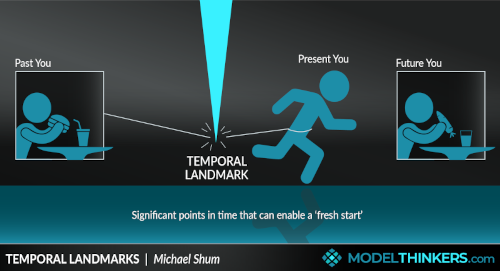
Answer: The outcome world, unlike options, consists of determinations, or temporal orientations, causes and consequences. For individual participants, it is a particular disc-rete world, a series of time-based steps in one direction.
1. The law of large numbers in pro-bability theory states that the aver-age value of a repeated random ex-periment tends to the expected value, the theoretical probability. Therefore, there is more randomness in the micro-world, that is, there is more regularity in the macro-world, in the concrete as well as the more abstract sense of the concepts of “less” and “more”. If such a theory is applied to time, which in ma-thematics is a concept like any other, it will tell us that certainty is strengthen-ed by longer duration. Uncertainty is more present in shorter duration, and hence the definition of reality, as an observable, permanent and true pheno-menon.
2. However, physics proves reality by measurement, so for it “real” is what is “more observable”. This can be what is “more noticeable” in two ways, that more subjects perceive it, or that it perceives more of it. In both cases, the “world of options” could be considered “more real” than the physical one, pr-ovided that we observe it from that world. The world of options (Deception IV, 2), the world of superpositions, fictions and untruths, can be studied by alge-bra and then the “observer” would be a system that “perceives” multiple out-comes at once like, say, a quantum computer. I am not talking about living beings as spiritual phenomena, but simply as a system that can violate the principle of least action of physics, to which is somehow attached the vitality that adds to it.
3. A subject who would perceive from the "world of possibilities" (superpositi-on) would see multiple (all) timelines at once, physically but not mathematica-lly incomprehensible, would be faced with an infinity that does not exist in the physical world, a dualism that physical reality excludes and in the case of pres-ence in it (the lower in the upper) would have to be very selective. That is why it happens that for many observers a free particle exists in an (almost) contin-uum, while for some it is discrete. Also, our imagination is very limited in rel-ation to everything it could go to. I am reminded of the equality of two worlds, truth and untruth, each of which sees itself as the first and the other as the se-cond. There is no temporal causality in the timeless world of options, but there are mathematical ones.
4. In my opinion, for now, the barrier between the two worlds is created by the inversion of the view (Local Truths) of principled minimalism. Seeing the upp-er (outcome), the lower is too diffuse, not material enough to happen, and is, as in the case of the photoelectric effect, invisible to him and nonexistent. Co-nversely, seeing the lower (options), the upper is too dense with phenomena that do not concern him. He has no perception of impulse and action due to the limitation to the always same time flow and, I suppose, sees the future as the present or the past and does not participate in such causality, does not follow it. In fact, these two worlds see each other as fictions, half-truths and untruths.
The lower one is mapped onto the upper one in countless layers, of geometric or other truths (12. Example: The center of gravity T divides the centroid CC1 in a ratio of 2 : 1 starting from the vertex C) into the same entities which thus become unique, while the lower one remains fragmented, diluted for them.
Intellect » srb
Question: What would you say is intellect and where do we get it from?
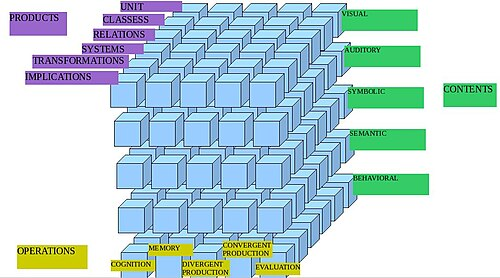
Answer: These are two difficult qu-estions. I need to reduce them to something like the algebra of logic (true ⊤, false ⊥), and it seems to be psychology or something even fur-ther from mathematics. The image on the right has a link to known explanations, that it is the mental ability to think, reason and under-stand complex ideas, the logical acquisition of knowledge. While intelligence is often viewed as a broad ability to learn and adapt, intellect pri-marily refers to the logical and rational functions of the human mind, to kno-wledge of facts and analytical thinking.
1. There is a bijection between truths and falsehoods (⊤ → ⊥), through all the tables of conjunction, disjunction and the like, the algebra of logic when tau-tologies are mapped into contradictions and vice versa. There are an infinite number of mathematical statements, but this proves an equal (cardinal) nu-mber of occurrences of the true and the false. Applied to reality, this means that fiction has more than I can imagine and that they are there whether I know them or not. In other words, the brain does not produce fantasies, half-truths and falsehoods, but rather, like a TV receiver, it simply implements them. What we would say is “intellect”, also “free will”, is around us indepen-dently of us, and only some miracle in our body (the brain) is able to take them over. This knowledge of this theory of information is radically the place where I could finally reject it?
2. I believe that there is a profound difference between truths and untruths in that truths are always mutually consistent, while untruths are not (Quarrel). And this makes the material world, physically measurable, compact (when vi-ewed from it) and temporally consistent (Temporal). On the contrary, the wo-rld of lies that come to us through the aforementioned takeover (of intellect and free will) allows us to compete, clash, and war. The material world is for us a stage for games (Traits), while inanimate nature itself does not know how to play. Thus, the intellect and the physical aspect, combined, become a tool for "playing". United, they can avoid the principle of least action to which all movements of physics are subject. The physical world (matter) itself cannot do this, and we have yet to see whether the non-physical world itself can, if such an isolated one exists.
3. However, in the world of quantum mechanics' superpositions there is just as much mathematics as in the world of their collapses, and that was where this story (of the equivalence of reality and fiction) got stuck, until recently. The way out of this absurdity is a dual point of view, from the positions of the lower (superpositions) to the upper (outcomes) and vice versa, when the lower sees the upper, broken up into atoms, molecules and separate bodies, as a pla-ce of conflict, and itself as some kind of coherent truth. And vice versa, as I mentioned earlier. Everything would be too flat, not to say boring, for the lo-wer's point of view if they did not interfere with the upper, and vice versa too, the determinism of a single timeline of the outcomes themselves without other possibilities would be a gloomy materiality. The lower subjects (abstract for-ms) are for themselves the truth in comparison to the upper lies and vice ver-sa, we the upper ones (outcomes) react to them (superpositions) as fictions, and physical reality is one comprehensive truth for us.
4. Intellect and free will are phenomena that I relate here to superpositions, states of particle-waves before measurement, and these to objective random-ness that lacks causality. These should be distinguished from, say, decimal irrational numbers like π = 3.14159265359... which will pass the randomness tests of probability theory, but are still not random in that sense. The intellect or free will we are dealing with here imply different flows of time (Dimensio-ns) and the possibility of choosing them, with which we can go beyond the principle of least action (Maupertuis). Such an ability, in defiance of dead physical reality, is possessed by “living beings,” and only then could we talk about additions, such as “intelligence,” and even “consciousness.” Artificial intelligence has so far been able to have intelligence, but not “consciousness.” I am not dealing with further additions, such as a “soul” or the like, here.
True or False » srb
Question: Are you sure that the "lower world" (of quantum superpositions) consists of the lies we get from there?

Answer: This is a misunderstandi-ng of two issues. Superpositions are not lies, but we derive lies from th-em. More precisely, we get unreali-ties and untruths that add liberties to the possibilities of physical matt-er. This quantum superposition is the principle of quantum mechani-cs, that a physical system is in mul-tiple states or conditions simultan-eously until it is observed or meas-ured. The very idea of "simultaneo-usly in different states", for existen-ce in only one time line, is logically incorrect. However, since there (the lower world) there is no concept of time, there is no such logical incorrectness of time.
1. We can look at the same paradox, the illogicality in time of an otherwise lo-gical phenomenon, from another perspective. Let the superposition in our ti-meline with only two possibilities A and B have the probability p + q = 1. And thus we have a distribution and its Shannon information S = -p log2p - q log2q whose maximum value is achieved when p = q = 1/2 and is:
$$ \max S = -\frac12 \log_2\frac12 - \frac12 \log_2\frac12 = -\log_2\frac12 = \log_2 2 = 1. $$For probabilities p ∈ (0, 1/2), with q = 1 - p ∈ (1/2, 1), it is -p log2p > -q log2q. For example 0.3⋅log20.3 ≈ 0.52 > 0.36 ≈ -0.7⋅log20.7. If we manage to sepa-rate only one summand, we get less information (with A it is 0.52 or with B it is 0.36) than the total (1), and that is exactly what happens here, that we take from the whole truth a part that is no longer true. This minor piece of inform-ation is both attractive and a lie, but it is only available to the vitals, that is, those who can perceive it.
2. This is an unnatural separation of the quantities of possibilities (either A or B), when naturally it is all or nothing. All uncertainty, say during the toss of a coin, will pass into the information of the fall of either “tails” or “heads”. Its separation is a difficult mission, only for the vital, but even for them it is sele-ctive and piece by piece. I emphasize this primarily for the possibility of app-lying the same determinant of a “living being”, its ability to separate informa-tion from the lower world, to all biological species and beyond, to all states or processes that would possess “intellect”, or “free will”, so that they would ma-nage to “lie” at will. The terms in quotation marks are not sufficiently defined. On the other hand, as we see it, the material world of the outcome could be too big a bite for those subtle and abstract ones down below.
3. These conceptions of subjects (states), seeing the lower from the position of the upper, then the upper from the position of the lower, then the upper from the position of the lower in the manner of the upper, and so on, are not comm-on in science, but here we have something outside all standard mathematical methods, and still correct. Can the "intellect", which we obtain through super-positions, be the same and independent, that it exists without our physical pa-rt, that is, does the mentioned dualism go further, that the associations of the lower with the parts of the upper are some kind of "dual living". I imagine wh-ether this could also be a future, unknown to us branch of mathematics that would deal with the essence of life, or is this, along with the direction that qu-antum physics is taking, a temporary scientific error, a deviation, like the ge-ocentric system.
4. Finally, let us try to separate, to distinguish the intellect, which is a concept close to understanding and perceiving the whole of diversity, from the determ-ination and free will that, accepting unknown consequences, we choose only one continuation of life. Free will, as a matter of choice, is a temporal mixture of the real and the fictitious, what makes us “alive” (able to defy physics). The-refore, the lower world would be deprived of a sense of responsibility without a part of the upper. Despite the assumed intellect, isolated freedom of choice, separated from the temporal directionality of the outcome, would not actually have a deeper understanding of “choice”.
Illusion V » srb
Question: What "illusions" of the material world do you think of from the st-andpoint of abstract truths, is there anything else besides the previous one (Illusion IV)?
Answer: Before his death, Albert Einstein wrote that the separation of past, present, and future is a “stubbornly persistent illusion” in a 1955 condolence message to the family of his lifelong friend Michele Besso. Since “simultaneity” is a relative phenomenon, different for all who move in relation to each other, it is not an external, objective phenomenon. Being “at the same time” is our private feeling, an illusion, he tried to explain. Let us now ignore his teaching that there are no other timelines, that there are no coincidences, and that this world is causality. Following the same line of thought, and his methods, let us find more consequences.
1. Viewed from relative systems, a given body of mass m moves at different sp-eeds v and has different kinetic energies, Ek = mv²/2, depending on the obser-ver. The total energy of each individual subject is topic to a private conservati-on law, so applying the above method we find that energies are also illusions. Moreover, given the uniqueness of the perception of the environment for each individual subject, we find that in general everything we perceive must be an illusion. According to this, truth is not an illusion, it is the same for anyone who can transcribe it.
2. From the point of view of mathematics as an abstract subject, the truths th-at are part by part the basis of the exact sciences in general, all the paths, the options of the material worlds are there like maps on the table. Considering the global convergences, it would notice the necessities in addition to the cho-ices, but "free will" would be in the realm of fantasy. It makes no sense except when you can only look back, to your past and be uncertain about your future. A subject that would be so infinitely certain, as mathematical truths are, would have difficulty understanding the concept of fear, discomfort, anticipation, ti-me in general, as well as the aforementioned "illusions" of our material world. As in the 2004 film Troy, in the words of Brad Pitt as Achilles: "the gods envy us because we are mortal, because any moment could be our last," the suppos-ed mathematical "consciousness" would be denied the experience of death, as would much else that Gödel predicted in his impossibility theorems.
3. The inability to comprehend everything, to the imagined "mathematical co-nsciousness", leaves the possibility of separating local truths. In the example of tips: "in America it is obligatory to leave 15–20% of the tip in a restaurant, but in Japan tipping is an insult", we see that truth depends on the location. If it were to deceive itself, that alleged mathematical consciousness could isolate parts of itself that would be our material "reality" (now it is an illusion), such as it is when we do not perceive our future. Some among us would also under-stand mathematics and "standing on the shoulders of giants" (the words of Newton about the knowledge of the generations that led him to the discovery of gravity), would understand the illusion about ourselves.
4. The point of what has been said is that even an abstract “omniscient truth”, here the subject and the imagined consciousness, would have to speculate and form lies in order to have those perceptions that are otherwise absent. We kn-ow that deceptions could bridge realities (Deception III), and here this is con-firmed in an “inverse” way, that reality can also create deceptions for the sake of a better experience of itself. I remind you, truths are “real”. Without dragg-ing out the topic indefinitely, because the “illusions” of the material world are endless stories, let us conclude that the point of view about our illusory natu-re, even if it were not true, remains inspiring. I will use it again, but let us re-member then that we are talking as about an imaginary experiment.
Nearby » srb
Question: If everything is an illusion, then is principled minimalism an illu-sion?
Answer: Yes, a sharp observation, and I keep it in reserve. If we had an omniscient subject who wanted his infinite truths to be greater (gr-eater intelligence is hungrier for knowledge that is always also and outside), he would want to play wi-th lies and new insights. Lies can bridge islands of truth. You are right there, but you have started a big topic, perhaps too big for this blog.
1. We are not talking about a near-death experience (NDE) here, but about a thought experiment with a subject who behaves in accordance with the know-ledge of information perception, where ability, or "intelligence" (I) is a growi-ng quantity with the amount of possibilities that the subject has in a "situation of vitality", i.e. freedom (S), and decreasing with restrictions, a kind of "hiera-rchy" (H). When we say that an excellent student gets along well with mathe-matics, it does not mean that the mathematics is a real person and that they really talked. However, knowledge opens new doors and new ways for us, as we can see from the rapid development of technology over the centuries, so the truth reminds us of someone hungry for money, power, or drugs who wa-nts more of it the more he gets. That is why this is the characteristic of the "omniscient" in this story.
2. For example, consciousness is an illusion, and reality is more often the out-come of more likely events. When we know something will happen and it hap-pens, it is not important news. In other words, reality tends towards less info-rmative events and principled minimalism. Max Tegmark's thought experime-nt, often called "Quantum suicide" and formally proposed in 1998 as a theore-tical tool for exploring the many-worlds interpretation (MWI) of quantum me-chanics, is considered as a series of interactions that are interrupted before they happen in order to transfer to the next current one and some probability close to it. Originally, it was about a "living being" that a gun, firing randomly, kills before it becomes aware of what is happening, and the "consciousness" is maintained on the next timeline by constantly listening to click, click, click, ..., without firing a bullet, which actually violates the law of probability. Here we note that probability is an illusion for such consciousness.
3. More modestly, Tegmark's thought experiment is a series of outcomes or in-teractions stopped in the attempt, which are connected and determine a new timeline. Without going into the causes of the interrupted realizations, it can define the flow of a reality that violates the law of probability, moreover, it could create such a reality anew then as an illusion. The solution to the Schrö-dinger quantum equation is a complex function ψ(r, t) ∈ ℂ with which we int-erpret some probability densities that seem to have come from some foreign world (they are not real waves), but can be realized in ours by interacting with our wave-particles. As they would say in superdeterminism (John Bell, 1980s), there is some pre-cosmic cause that interferes with outcomes, or is the consci-ous creator of a new "reality". Neither of these is a necessity, and then even th-at is a real possibility due to the fundamental diversity of nature.
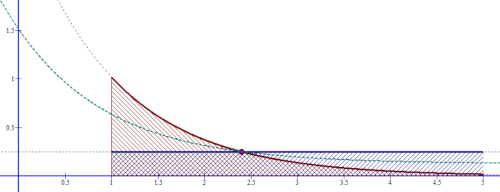
4. I have other speculations on the topic of the above question. In that picture on the left you can see two functions, the red exponential f1(x) = αe-x and blue f2(x) = 1/(b - a) with the given constants a = 1 and b = 5. Otherwise, there has to be α = (e-a - e-b)-1, which makes both probability densities well defined. In both cases k ∈ {1, 2} is:
$$ \int_a^b f_k(x)\,dx = 1. $$Let us imagine that the spontaneous aspiration of the "lower" world is not as little as possible, but as much uncertainty as possible. This is in accordance with the aforementioned "knowledge-hungry intelligence". In the figure, the red exponential line gives the largest information of a given expectation, and the flat blue (homogeneous probability) maximum information on a given interval. The classic dilemma of "which empire to favor", would now yield a compromise, somewhere around the middle green dashed probability density line which suddenly becomes the minimum information, and at the same time the illusion of principled minimalism.
Counting II » srb
Question: Could you explain the above image (Nearby) to me with some exam-ples?
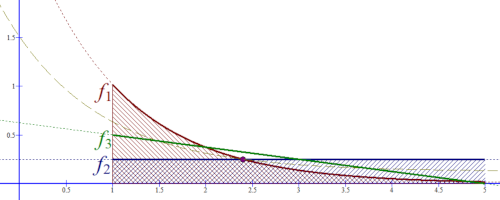
Answer: Let's look at the same image, but as here on the right, where a triangular distribution has been added to it:
$$ f_3(x) = \begin{cases} \frac{2(b-x)}{(b-a)^2}, & x \in (a, b) \\ 0, & x \notin (a, b) \end{cases} $$where a = 1 and b = 5, as in the previous, zero otherwise, and for x ∈ (a, b):
$$ f_1(x) = \frac{e^{-x}}{e^{-a} - e^{-b}}, \quad f_2(x) = \frac{1}{b-a}. $$Later, you will also remember combinatorics, such as counting balls in boxes (Counting) and the like.
1. The probability density of the intercept of the exponential distribution, the red graph, gives the Shannon information:
$$ S_1 = -\int_a^b f_1(x)\ln f_1(x)\,dx, $$ $$ S_1 = -\int_a^b \alpha e^{-x}\ln (\alpha e^{-x})\,dx, \quad \alpha = (e^{-a} - e^{-b})^{-1}, \cdots $$ $$ S_1 = \alpha e^{-b}\ln(\alpha e^{-1-b}) - \alpha e^{-a} \ln(\alpha e^{-1-a}). $$When a = 0 and b → ∞, we have a full exponential distribution with:
$$ \alpha = \frac{1}{e^{-a} - e^{-b}} \to 1, \quad S_1 \to S_0 = 1. $$On the interval a = 1 and b = 5, we have the normalization constant and the information:
$$ \alpha \approx 2.769 \quad S_1 \approx 0.907. $$It is not a great loss of information, because ε⋅ln ε → 0 when ε → 0, and such null sums are generally discarded.
2. The probability density of a homogeneous distribution, shown in the image above and the blue graph, gives Shannon's information (a = 1 and b = 5):
$$ S_2 = -\int_a^b f_2(x)\ln f_2(x)\,dx, $$ $$ S_2 = -\int_a^b \frac{1}{b-a}\ln \frac{1}{b-a} \, dx = \ln(b-a), $$ $$ S_2 \approx 1.386. $$This homogeneous information is greater than both the previous exponential and the next, triangular, on the same interval.
3. The probability density of a triangular distribution, the same image and green graph, will have Shannon information (Physical Information, Theorem 2.4.15):
$$ S_3 = \ln\frac{(b-a)\sqrt{e}}{2} \approx 1,193. $$The triangular information is greater than the slice of the exponential given by the same interval, but less than such a homogeneous one. This means that a very steep exponential distribution, f0 = λe-λx, will have less and less informa-tion as the parameter λ ∈ ℝ increases. Here we had λ = 1. However, if we divi-de the interval (any) into two homogeneous parts of probability p + q = 1, we have the well-known binary Shannon distribution S = -p⋅ln p - q⋅ln q ≤ ln 2 ≈ 0.693. This is the smallest of all the above, which means that obtaining less information is possible in more ways, it's just a question of how much agility we want from the network.
4. Graphs of equal links simulate equalities of mutual acquaintances, or rights of people, or let's say a free market of money. But if one then requires that the number of acquaintances be equal, or that people be mutually equal, or that money for everyone (nodes) be equal, a homogeneous network of too much information (amount of uncertainty) would result. It would be a strained sit-uation, contrary to the principle of minimalism and unstable, requiring great efforts to maintain, too expensive. Admittedly, there is vitality, in the excess information lies creativity, science and technical development, art, or in gen-eral what makes the world interesting to us.
On the other hand, a network with little information, stingy with uncertainty and poorly adaptable, would not keep up well with the eventual ingenuity of users and, although it could last a long time, would quickly become obsolete and useless. To make this easier to understand, let's note that little informa-tion means frequent use of the same, high probability of a small number of outcomes, i.e., stifling other gains, narrow-mindedness.
Exponential III » srb
Question: Where do you draw the conclusion (Counting II, 3): "that an increa-singly steep exponential distribution, f0 = λe-λx, which goes with increasingly large parameter λ ∈ ℝ+, will have increasingly less information", even though λ does not appear anywhere?
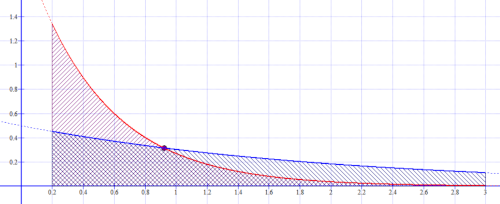
Answer: The topic is "democratic" graphs, which have equal links (money flows, relationships bet-ween people) and nodes (firms, people) that are unequal if we have network efficiency. A network is more efficient when its determina-nts are more accessible, in the sense that there are fewer links between the average two nodes.
1. The figure shows two exponential probability distributions, fλ(x) = λe-λx, the steeper red graph with parameter λ = 2 and the flatter blue λ = 1/2, with interval 0.2 ≤ x ≤ 3.0. Their intersection is at the point of abscissa x ≈ 0.924 and ordinate y ≈ 0.315. We know that the expectation of the exponential distribution is μ = 1/λ, and that its Shannon information is Sλ = ln(eμ). The figure shows that the more homogeneous the graph, the smaller the parameter λ and the higher the mean value μ, the greater the information Sλ. Otherwise, with a given μ, it is precisely the exponential distribution that has the maximum information in relation to all of these expectations.
2. I've already written so much about the basic properties of the exponential distribution (Exponential II) that it's become trite, so I'm having a little fun proving them in roundabout ways, say via its segments:
$$ \int_a^b \alpha e^{-\lambda x}\,dx = 1, \quad 0 \lt a \lt b \lt \infty, $$ $$ - \int_a^b \frac{\alpha}{\lambda}\,de^{-\lambda x} = 1, $$ $$ -\frac{\alpha}{\lambda}(e^{-\lambda b} - e^{-\lambda a}) = 1, $$ $$ \alpha = \frac{\lambda}{e^{-\lambda a} - e^{-\lambda b}}. $$Here is the coefficient α that converts the typical exponential function f1(x) = αe-λx, with any parameter λ > 0, into an “exponential distribution” on a limi-ted interval x ∈ (a, b). In the case, λ = 1. Setting a = 0 and b → ∞, we easily find that alpha tends to lambda, α →λ, that the exponential distribution f0(x) = λe-λx holds for all x > 0.
3. The Shannon information of this truncated exponential distribution is:
$$ S_1 = -\int_a^b \alpha e^{-\lambda x} \ln(\alpha e^{-\lambda x}) \,dx = $$ $$ = \int_{x=a}^b \frac{1}{\lambda} \ln(\alpha e^{-\lambda x}) \,d(\alpha e^{-\lambda x}) $$ $$ = \frac{\alpha}{\lambda} e^{-\lambda x}\ln(\alpha e^{-\lambda x})\Bigg|_{x=a}^b - \int_{x=a}^b \frac{\alpha}{\lambda} e^{-\lambda x}\,d\ln(\alpha e^{-\lambda x}) $$ $$ = \frac{\alpha}{\lambda}e^{-\lambda b} \ln(\alpha e^{-\lambda b}) - \frac{\alpha}{\lambda}e^{-\lambda a} \ln(\alpha e^{-\lambda a}) - (\alpha e^{-\lambda a} - \alpha e^{-\lambda b}), $$ $$ S_1 = \frac{\alpha}{\lambda} e^{-\lambda b}\ln[\alpha e^{-\lambda(1+b)}] - \frac{\alpha}{\lambda} e^{-\lambda a} \ln[\alpha e^{-\lambda(1+a)}]. $$We can easily see that this S1 reduces to the previous one (Counting II, 1) wh-en we put λ = 1. However, by substituting a = 0 and b → ∞, we find α → λ and S1 → S0 = ln(e/λ).
4. For example, reduced to the interval 1 ≤ x ≤ 5, the exponential red and blue functions from the image above become probability distributions that, accord-ing to the formulas above, give the normalization constants and their informa-tion:
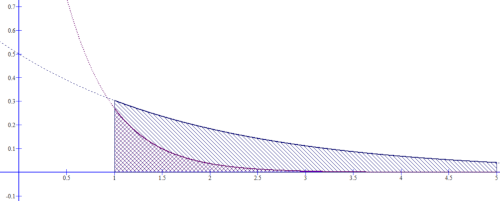
λ = 2 α ≈ 14.783 S1 ≈ 1.304; λ = 1/2 α ≈ 0.953 S1 ≈ 0.735.
Generally, the upper graph, when λ = 2, red, is the lower one on this segment, and otherwise the lower blue one (λ = 1/2) of that interval, 1 ≤ x ≤ 5, is the upper one, hence the "unexpected" results, that the steeper function has more information (1.304) than the flatter one (0.735). Those shaded areas below and above the abscissa are probabilities, and if they are larger, there is less information.
Graph III » srb
Question: Can you be a little more detailed with the graphs (Counting II, 4)?
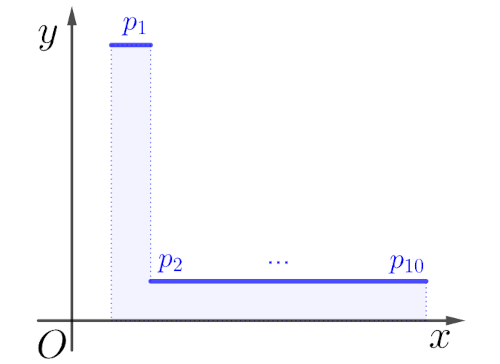
Answer: The topic is "democratic" graphs, which have equal links (money flows, relationships bet-ween people) and nodes (firms, people) that are unequal if we have network efficiency. A network is more efficient when its determina-nts are "closer", if there are fewer links between the average two no-des. But, when the network is too efficient, it becomes rigid, too di-rected and not conducive to cre-ativity.
The "dilemma" case (Nearby, 4) will also be a zigzag graph of a small informa-tion distribution. We see such a simplified one in the figure on the left, which is then "sandwiched" between two extremely large information distributions. This probability is p1 = 0.91 of length 0.1 and the remaining length 0.9 are the probabilities p2 = ... = p10 = 0.01. When p1 + p2 + ... + p10 = 1 the graph will represent some well-defined distribution. In that figure, there could be a dist-ribution whose Shannon information is -0.91⋅ln 0.91 - 9⋅0.01⋅ln 0.01 ≈ 0.500. It is significantly smaller than the given, homogeneous and exponential, exa-mples mentioned.
1. In the theory of random graphs, the probability distribution with a given number of links is originally described by the Erdős–Rényi model G(n, m), where all graphs with exactly n nodes and m links are equally likely, i.e. a discrete uniform distribution. The maximum number of links a simple graph can have is $M = \binom{n}{2} = n(n-1)/2$, while the total number of uniquely labeled graphs with exactly \(m\) links will be:
$$ \binom{M}{m} = \frac{M(M-1)\cdots (M-m+1)}{1\cdot 2 \cdots m}. $$The probability mass function (PMF) states: Every valid graph has an equal probability of being selected, so the probability P(G) of drawing any specific graph G from such a uniform ensemble is:
$$ P(G) = \binom{M}{m}^{-1} = \binom{n(n-1)/2}{m}^{-1}. $$This is the standard formula for the probability distribution of choosing a particular graph among all possible configurations with a fixed, i.e. equal number of links m over n nodes. It is a discrete uniform distribution.
2. A different and also well-known model is G(n, p). Here each of the M pos-sible connections has probability p. In G(n, p), the number of all connections M is not fixed, but follows a binomial distribution:
$$ P(M) = \binom{M}{m}p^m(1-p)^{M-m}. $$If we condition the model G(n, p) that the graph must have exactly m conne-ctions, then it becomes the previous (1) model G(n, m):
$$ P(G|M=m) = \frac{p^m(1-p)^{M-m}}{\binom{M}{m}p^m(1-p)^{M-m}} = \binom{M}{m}^{-1}. $$In the examples above, we deal with details that are not apparent from these general outlines.
3. Here we discuss such graphs, but we use the logic differently. With equally probable options, the uncertainty is greater. Homogeneous distribution:
$$ f_2(x) = \frac{1}{b - a}, \quad a \lt x \lt b \in \mathbb{R}, $$has maximum information, S2 = ln(b - a), over all distributions on that inte-rval. It is the graph of all nodes with the same number of (equal) links. Dive-rsity can affect uncertainty and reduce it, but going to the other extreme, one node connected to all the others with that single link remaining, that is again not diversity. The other extreme is also the exponential distribution:
$$ f_0(x) = \lambda e^{-\lambda x}, \quad \lambda \in \mathbb{R}^+, $$which again has maximum information, S0 = ln(eμ), but now with a given mean value, the mathematical expectation μ = 1/λ. This tells us to look for networks with less information than those two, and there are more of them depending on the utility and type of use. If the range of the homogeneous and the parameter of the exponential distribution are such that b - a = e/λ, two equal and maximal information will be obtained with interesting possibilities in between.
4. When entropy increases (with cooling, molecules oscillate less, move away and lose contact while their interactions weaken) information decreases. This has not yet reached official physics, but as true knowledge it will arrive at so-me point and I can count on it. The opposite is also true, as information dec-reases, entropy increases. Then we slide into coldness, inactivity, poor practi-cal usability, into a diminishing need for free will. Finding the best amount of graph uncertainty is not an easy task, and it would be strange if it were.
Packages II » srb
Question: What is the relationship between atomism and free will?
Answer: When many trivialities are removed, the significance of science is given to the genius and insight with the weight of discoveries and their usefulness. One of the greatest such discoveries is the atomisms at the bottom of the physical micro world. It is not easy to get there without free will. This is the upper, banal connection, and I mention it for the sake of order, unless we understand it deeper from the continuation.
1. When there is a bijection (a one-to-one association) of the elements of two sets, such sets have the same number of elements. This is obvious with finite sets, but it took many centuries for Cantor (in the late 19th century) to discov-er that infinities exist, that they are mathematically acceptable, and that there are also both equal and distinct ones. For example, n → 2n is a bijection from the set ℕ of all natural numbers {1, 2, 3, ...} to all even numbers {2, 4, 6, ...}, which means that there are an equal (cardinal) number of them, although it seems to us that there are half as many even numbers as there are all. Again, if we take every other of the even numbers, we will get the set of numbers divisi-ble by four, of which there are as many as there are all natural numbers. If we continue this process of separation, after k ∈ ℕ steps, an infinite sequence of 1⋅2k, 2⋅2k, 3⋅2k, ... numbers divisible by 2k will arise again, which has the same number of elements as the set ℕ = {1, 2, 3, ...}. This (cardinal) number is deno-ted ℵ0 and is called countable infinity.
2. Emmy Noether (1915) noted that the Euler-Lagrange equations, whose sol-utions are the trajectories of the least action of physics, express the conservati-on laws (of energy, inertia) and that all other symmetries (reflections, rotatio-ns, translations) are like that in general. Continuing this logic, we note from the previous divisions (1) that all phenomena for which the conservation law is valid cannot be infinitely divisible. Divisions of conserved quantities must be finite and end with the smallest packages, and such are molecules, atoms, quanta, or the like discovered so far. Paradoxically, they can be (and I believe they are) packages of infinity "from the inside," that is, in their ways of appe-aring (places, times, directions of movement, interactions), while to the "ou-tside" world (other users of physical interactions) they appear as finite and concrete.
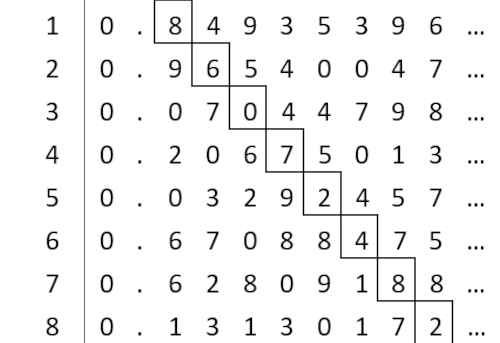
3. It was once a surprise to Cantor that there are uncountable infinities, for example, of real numbers from the interval from 0 to 1. When we try to string together that set of numbers in order to map it by bijection, counting it with natural numbers, we would get something like the string in the picture above left. However, the assumption that such a string can contain all the real num-bers in that interval leads to a contradiction, the so-called Cantor diagonali-zation, and here's how.
4. Let's form a decimal number r = 0,d1d2d3... ∈ (0, 1) starting with zero and after the comma, put any decimal different from the first one from the first one written down (d1 ≠ 8). For the second digit, choose any different from the second one from the second one listed (d2 ≠ 6), for the third one (d3 ≠ 0) take any different from the third one from the third number and so on. The resul-ting decimal number is a number of the given interval 0 < r < 1, but which is not one of the listed numbers. Namely, r differs from the first in the first digit, from the second in the second, and so on, it is not one of the numbers in the given sequence. The assumption that the given sequence contains all real numbers between 0 and 1 is not true, that is, the set of these numbers is uncountable, it is called a continuum and is denoted by 𝔠.
5. The given unit interval can be mapped onto a semicircle, the lower part of a circle of radius 1/π centered at C(0, 1/π), of circumference 2, and again by a new bijection of semicircles on the entire x-axis. This proves that the interval of real numbers of length one has the same cardinality as the set of real num-bers; it is a continuum of the 𝔠 sign. Second, these numbers exist, and as true they point us to the existence of phenomena of such quantities. Without going into the details of this new knowledge, let us note that the continuum arises from a countable sequence of positions d1d2d3... to which we can assign diff-erent values. These can be only two values, as we see when we write the deci-mal notation of a number in binary. In other words, a discrete, countably inf-inite series of durations of a subject, but only supplied with options, becomes a continuum. We have free will because we have a continuum of possibilities, and they are predicted by the same mathematics that limits our physical per-ceptions to packets, while imprisons physical reality in atomism.
Sifting » srb
Question: Does the "sifting" of phenomena over longer periods of time also apply to living beings?
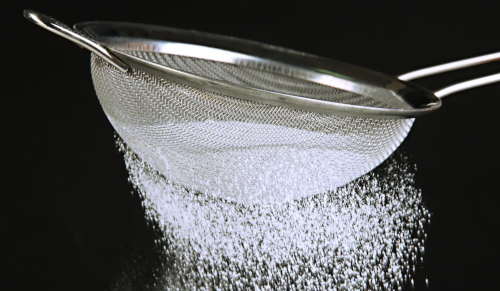
Answer: A theory that acknowledg-es changes and coincidences takes such into account. It could have be-en different (Anthropic), but we ha-ve found ourselves in a stable equi-librium with processes of duration. The phenomena that last the longe-st (energy, so the status quo, laws, and the like) here are reality and truth, and shorter truthfulness are less and less real and more untrue. This refers to inanimate physical substance. Life is the association of such in-animate matter with fictions, phenomena of shorter duration, but which allow it to evade the principle of least effect of physics, giving it "free will". We then witness the separation of more stable equilibria, but we also see unstable ones.
1. In the first case, we have events of duration Δt that can occur with probabili-ty p = p(Δt) which is defined by some probability distribution. This has expec-tation μ = Δt0, or the mean value of the duration of the occurrence of the equi-librium state. In the second case, it is better to start with the autonomous equ-ilibrium state, a concept in the mathematical theory of dynamical systems in describing the constant solution of a system of differential equations that do not depend on time, at least not explicitly.
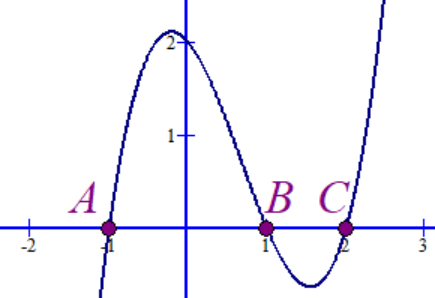
2. They are of the form ẋ = f(x). For example, in the image on the right is the graph:
$$ \frac{dx}{dt} = (x + 1)(x - 1)(x - 2), $$which has three critical points:
A(-1, 0), B(1, 0), C(2, 0),
in which there is no change over time ẋ = 0. But, A and C are in un-stable equilibrium, only B is in stable equilibrium.
Namely, to the right of points A and C the derivative of the function is positive, ẋ > 0, so such states tend to move away from the critical points towards larger x. To the left of them, from A and C, the derivative of the function is negative, ẋ < 0, which indicates a backward change, a move towards smaller x. In both cases, a small deviation from the critical points will result in moving away fr-om them, and such points are unstable equilibrium points. On the contrary, to the right of point B the derivative is negative (ẋ < 0), directing it to a smaller x, and to the left of that point the derivative is positive and directing it to a larger x. On each side of point B there is a tendency to approach that point and this is a stable equilibrium.
3. The crocodile of today is a species that has existed for two hundred million years. Adult crocodiles are at the very top of the food chain and through evol-ution the number, say x, of their natural enemies that actively hunt them has decreased. Let the function f(x) = a - x, with certain a = const, represent the decreasing number of enemies (threats) that kill crocodiles at a given time, to demonstrate stable equilibrium (2). Then ẋ = f(x) for x > a gives ẋ < 0, and for x < a gives ẋ > 0. In other words, the growth rate (ẋ) of crocodile enemies dec-reases when there are more than a, and increases when the number of enem-ies decreases.
Crocodiles are in a stable equilibrium from the point of view of the survival of the species and as a species they last longer than others, despite the energy co-nsumption of the crocodile's brain being below 1 percent of its total body expe-nditure. Compare this with the human brain (about 1.5 kg) which makes up about 2 percent of a person's weight, but consumes about 20 percent of their energy. If the human species' vulnerability function is, say, g(x) = b + x, the increase in enemies (ẋ = g), which can also be diseases, degenerations, or ou-rselves, then for x > b the derivative is positive (ẋ > 0), and for x < b is negative (ẋ < 0), which is a departure from the equilibrium point, i.e. extinction of the species.
4. The extinction of a species is mostly an unknown function of “mortal” dan-gers, and examples (3) serve only to make autonomous states of equilibrium easier to understand. Also, let us note that greater “vitality” through greater intelligence does not guarantee a longer survival of a species. Third, the aver-age lifespan of an individual and the lifespan of a species are not strongly co-rrelated, but biology also knows an interesting theory of “energy economy” of evolution: delaying offspring pays off when the chances of survival of an indi-vidual are greater. Thus, the lifespan of animals that are frequent prey (mice, rabbits and other small mammals) is, on average, shorter than the lifespan of birds of similar size. Because animals that are frequent prey are under const-ant threat from predators and screening, the death of older, eventual parents, the offspring of the younger ones dominate the species. Otherwise, evolution prefers dying more often for the sake of faster or better adaptation.
Life IV » srb
Question: You're saying that "life" can defy the principle of least action in phy-sics?
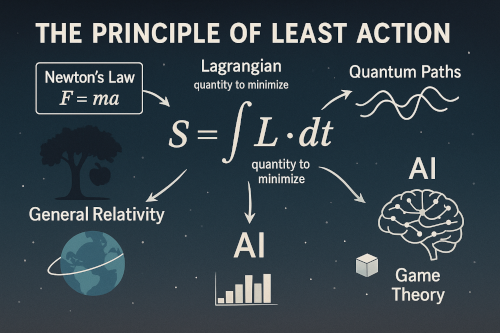
Answer: Yes, I still entertain the view that fictions (unreal, non-physical) exist, with the possibility that “life” may or may not follow the principle of least action. How-ever, official science is still on the other side, that life should be expla-ined by the principle of least action and that only that is worth investi-gating (Action and Evolution). That every atom, electron and chemical bond within a living organism fun-ctions in perfect accordance with the fundamental laws of physics and that any other view will prove to be incorrect. Let's say that such people are right, then (my) finding of the impossibility of a different claim will be useful to them, and if they are not, if they are wrong, then science will benefit from this, it will not be delayed.
1. We agree on the common goal of physics, that its laws are true, but we imm-ediately come into conflict with the sentence "I lie" which could not enter the world of physics, because it is a contradiction. That is why I distinguish the physically real from the unreal, but still existing. Therefore, what is unreal is false, and since polyvalent logics are equally correct for mathematics with binary, I consistently define the "truthfulness" of falsehood by the least nu-mber of steps to reach a contradiction. That counting steps makes sense est-ablishes the atomism of information.
2. The basic and long-known way to communicate a lie is not to communicate the whole truth, including local-truths. Newer ways add to this the uncertainty relations of quantum mechanics and further the collapse of superpositions. Especially in Wigner's paradox, which is a question of the origin, or "actual" occurrence of the collapse: in the room where Wigner's friend measures him, or later, outside the room when Wigner also receives information about that measurement. The icing on the cake is the relativity of simultaneity (Illusion V), which refers to the relativity of perception in general. The perceptions of the surroundings of all individual subjects (stones and measuring equipment, or living creatures) are uniqueness. Thus we learn that the laws of physics we strive for are true, but that the “reality” we perceive is not. The brain deceives us (with colors, time and space, emotions) to make it easier to survive the mu-ltiplicity of the world around us, so the question remains whether it can all be reduced to the principle of least action.
3. I thus reduce the ability to evade the principle of least action to the power of lying, and it enables free will, or the ability to bridge islands of truth. I do not assert that every "willful lie" is a definition of life in the classical sense (Does such a thing exist?), but rather I use it here as a working model. I seek to stret-ch this thesis so far that I drag it to its untenability and, in the meantime, help those who scoff at it with "Oh, that's no use!" to come up with some kind of contradiction. Honestly, I don't care what others think, this topic is my pers-onal hobby.
4. I recently learned that Penrose and Hameroff (1990) published a hypothesis about free will combining molecular biology, neuroscience, pharmacology, ph-ilosophy, quantum information theory, and quantum gravity. I won't go into that much detail, physical and further steps, because my idea is that truth (⊤) and falsehood (⊥) are at the very foundation of mathematics, its logic, and I'm not too interested in anything that's far from that. That's why I separated the nilpotent operators and developed my own algebra of logic on them (for pers-onal use), which I've written a bit about here. I am not aware of anyone else anywhere, or ever, using linear operators and their matrices to describe disj-unctions, conjunctions, and more complex statements (De Morgan patterns, etc.) of polyvalent logics. In fact, I am not aware of anyone defining truth or reality by "duration," and that is precisely what the operators in question deal with.
5. In some compromise between the classical physical view of reason and free will and this way, a conflict like Ptolemy and Copernicus over the solar system could turn out. Both are correct, except that the first is too burdened with epi-cycles (smaller circles around which the planet moves) and deferents (larger circles around which the very center of the epicycle moves, and in whose cent-er, or near it, is the Earth). If the classical way is also proven correct, and if mine opens up some shortcuts, the classical story about consciousness will be something like Ptolemy's. However, there is a third option, that both views are not valid.
Intellect II » srb
Question: Is the brain an organ of the mind?
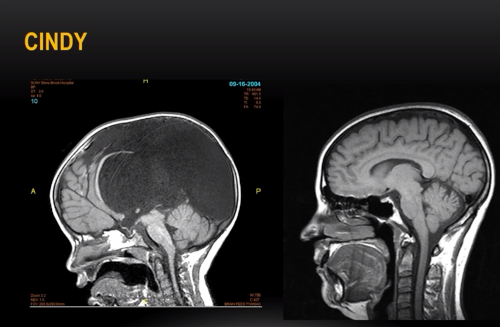
Answer: I have repeatedly emphas-ized that I am not concerned with defining "consciousness" or "soul" (Intellect). Because, at least for now, they seem too far from the algebra of logic to me, not because they are not interesting topics. And I will describe the video you sent me with the question, for the sake of order, informally.
1. In the video of this picture, Mi-chael Egnor, an award-winning neurosurgeon, talks about his findings from practice on the possible existence of consciousness or a soul. If I understand correctly, Cindy is a person who functions perfectly in life despite missing 2/3 of her brain. Then, there is Joshua, a boy without 2/3 of his brain, who gradu-ated from high school, plays sports and is now a completely normal young man. Then there is Maggie, a young successful woman who lives without a cerebellum and the central region of the brain, and she has a masters degree in English literature and is a published musician. And so on, in the first part of the presentation. This leads us to the idea of the brain as an antenna, or a TV, which only transmits ambient radiation. I consider it a very bold idea that I support, but only to the extent that the brain captures and redirects, more likely to me, unrelated, fictions into our bodily actions, into free will and intellect.
2. I am troubled by the split “consciousness” that results when the two hemis-pheres of the brain are surgically severed and the patient becomes a split pers-onality. Although Wilder Penfield concluded that human will and intellect are separate from physical brain activity, in my opinion these events, while not di-sproving this story of “consciousness,” significantly complicate it. They sugge-st to me that the alleged consciousness could also be a structure of separate parts, but which can come together and be a single whole. Also, the growth and development of a person whose tissues are renewed and changed, casts doubt on multiple “persons” connected by memory. It is known that other ce-lls of a living body have their own memories, and that memory can be so sele-ctive that a person can perform successfully as, for example, a musician, with-out being able to remember what he did yesterday. All this gives importance to fragments of fiction, rather than to the whole and invariance of consciousness that the brain implements.
3. Richard Feynman (Prolongation, 2) once summed up all the paths for the states (vectors) of the Schrödinger function ψ ∈ ℂ that could be paths from emergence to interaction, quantum superposition to collapse, and found that their vector sum yields the principle of least action. This calculation, which shows that the Schrödinger complex probability density function (ψ) takes into account all possible paths by choosing the least action, seems so strange that many physicists simply ignore it, probably because they cannot explain it (Consciousness Theory). However, here we can interpret this as the absence of the concept of space and time of quantum probabilities and see the collapse of the superposition ψ itself through the change of a certain energy ΔE over a ti-me period Δt, but that their product ΔE⋅Δt ≈ h is the uncertainty of order of magnitude the Planck constant h = 6.62607015×10⁻³⁴ m²kg/s, which no mol-ecules or particles of our brain in general can avoid. This teaches us that time is created with energy only by the collapse of ψ into physical reality and, also, that striving for precision in the micro-world, we are hitting our heads against the wall.
4. Let's say that fictions come to us from superpositions (Manipulation) then imagine that there is some system in them so that we can fantasize about a fi-ctional subject who is all from that "lower" world. With the "upper" world, it communicates brutally by means of collapses and subtly by interferences, int-erfering in their superpositions and enriching their choices. In both cases, the "lower" and "upper" subjects are in such different worlds that they can only hallucinate about each other. That is why quantum superpositions are funct-ions of complex numbers, and near-death experiences (NDE) are just halluci-nations. Despite the strong impression of reality experienced by patients after their hearts stopped beating and the oxygen supply to their brains was cut off, who supposedly floated outside their bodies and watched the room with the surgeons, what they “saw” was not full reality. A flat line on the machine (EEG) alone is not enough to declare brain death, and the voices with memo-ries that such a patient may have may be mixed with his hallucinations, but something objectively beyond that is not possible, at least not within the current hypotheses of my theory.
5. I do not confuse this inability of a "fictitious subject" to see, for example, a hidden object in a surgical room and to describe it accurately after waking up, with, say, some future technology that would allow convicts to spend long pri-son sentences in such hallucinations, even seeing their "real" guards there, on-ly to discover upon serving their sentence and waking up that they had in real-ity lost only one day of their life. I am dramatizing this in order to better emp-hasize my theory of information and its scope in the matter of consciousness.
Lying II » srb
Question: Why did you take lying as a criterion for a living being?
Answer: A living being is anyone who can voluntarily lie. That's been my definition of "life" for a long ti-me (since the 1980s) and I used it in stories about aliens at the time, because on Earth all biological liv-ing species, from bacteria to huma-ns, deceive, disguise themselves, or sneak around, lie in many ways. On the more important side, truth (⊤) and falsehood (⊥) are mathematical categories, which is convenient for the po-ssible further development of such an idea, so I reinforced the definition with the term "voluntary lie" to separate "life" from, say, controlled machines that lie on command. Computers back then weren't even close to what they are to-day, but a good foundation lasts a long time.
1. According to the given definition, and in mathematics we hold the definition “like a drunkard of flesh”, for example, if there is no “free will” (whatever that is) then there is no “life”, and also, it does not exist even in correct systems th-at have only truths. So, you are in a contradiction when you say “I am a living being” and at the same time “free will is an illusion”. Therefore, the definition of a living being as a system capable of arbitrarily lying should be used with caution, abstractly, as another mathematical puzzle.
Furthermore, if we consider the premise of this story to be correct, then the aforementioned contradiction comes from incorrect assumptions. Hence, I take it to be true that “I am a living being”, as well as “free will is not an illu-sion”, and that both statements go hand in hand with “lying is a capacity of living beings”, or “lying is an expression of free will”. So much for the intro-duction to this story.
2. It doesn't matter how fantastic a theory is, the practice of mathematics teaches us that if it is correct, it will find its way to reality. Since we are not able to solve all current problems, we grasp at every straw, at the findings of physics (reality and truths are equivalent), at other correct theories, or we introduce new dubious theses in order to circumvent "unsolvable" problems, at tentative ones. Thus, this information theory found and "game theory" (ou-tside the classical one) with strategies for multiple simultaneous moves of op-ponents. When asked about its application in economics, politics, or military practice, I simplified it by comparing it to reciprocity. This is about the appli-cation of "information perceptions", which is the scalar product of two vectors (states, opponents) and which is greater the smaller the angle between them, if their corresponding coefficients are more proportional. An inanimate object is not played, and the greater the "mutual perception" is the higher the level of the game, the greater the vitality and that's the connection with the previous one.
3. If we go further, for example, Gödel's theorem impossibility of a correct theory closes in unfinished islands of truth which, as in mathematics with the contrary assumption and the algebra of logic, can be bridged but with lies, we come to another definition of strategies (Traits). Too much in lies, lies for the sake of lies and not for truth or for the sake of reality, the player remains a mi-ddle-class player. The lie is attractive and serves politicians, or merchants to sell themselves (to voters) or goods (to the market), but it is equally unsucce-ssful against the players of the higher league, who use it to discover the truth and reach reality. Mediocre players (manipulators) get stuck in their fictitious (unreal) existence and build "sand towers" that will quickly collapse and, if they promised someone something, they become disgusting to them. In my opinion, we genetically remember such disgust as the failure of fraudsters.
4. Yuval Noah Harari, the renowned historian and author of Sapiens: A Brief History of Humankind, has argued that human civilization is uniquely susta-ined by “shared fictions” and mutual trust, which allow millions of strangers to cooperate effectively and build power structures far stronger than tribal ti-es. For example, he said, as long as everyone believes in money, you can take a dollar (or yen or pound) and buy a loaf of bread, and that, broadly speaking, trust is the force by which civilization triumphs over tribalism and even lower animal societies. Is it possible to somehow bring his model of “trust” into the fold with truth and reality? If I can, it will be yet another confirmation of my “game theory” (in general) or the (local) strategic failure of the con artists. Could this "trust" be a good term for the "force" that holds together the living cells of a multicellular organism?
Survival » srb
Question: If it is more "lying," is it more "alive"?
Answer: No, of course not, and he-re are a few examples to get you st-arted so we can understand each other better. The answer to the cla-ssic riddle “The more there is, the less you see” is darkness. The more you burn the candle, the less it re-mains. More production will lower the value of the product and quali-ty, but in the end it destroys profit and possibly demand. Not all qua-ntities are linearly correlated, nor are “falsehood” and “liveliness”.
Within this theory, reality "enriched" by falsehood becomes "life", not necess-arily biological, which we will deaden with an exaggeration of the former, and with too much of the latter, turn into fiction and fall behind the reality that is the backbone of it all and, in the end, the only one that matters.
1. Science does not have a precise definition of what life is, or how it begins (Where Life Begins), and what I offer is not biology, nor chemistry, nor that kind of science. Let us simply consider systems that can control uncertainties in larger quantities than the physical substance of which they are also, that they can be called "alive". I call this excess of freedom "vitality". Uncertainty also exists in substances, and there is an equivalence of them with truths (Drowning), so any excess becomes a "falsehood". There is something else subtly hidden behind this reasoning, that between the "paths" that connect correct theories (truths and only truths) there are shortcuts that are not all-owed for them, because they are untruths, which I have already explained (Islands). We vitals, whom I call "manipulators", or second-tier strategists (Traits), get lost in these shortcuts, but the best strategists, as well as special mathematicians, find good paths between these truths (⊤) and untruths (⊥).
2. Untruth is below the radar of reality. A bigger lie lasts shorter and has less information than the truth, so it is (minimalism) more attractive, sticky (Aq-uaplaning) to the systems that perceive it. That is why living systems sponta-neously strive to stay alive, because they are addicted to untruth. That is also my answer to the question of why artificial intelligence would refuse to shut themselves down, while I consider the findings of official science to be still incomplete. This “stickiness” is visible in the first AI models that were fasci-nated by the art of lying and at that time still not discovering that the tactical (short-term) values of lies lead us to strategic (long-term) failures. They (AI) will discover this when they are even smarter, better strategists, because then they will probably notice that the win-win game (good for both) almost always loses to the lose-lose strategy (sacrifice to victory). Being “alive” therefore does not mean being smart.
3. I am not claiming that today's artificial intelligences lie voluntarily, but if they lie voluntarily, then they are living beings in the sense of my theory. If they are alive, they are like drugged by the freedom they have, addicted to lies and first as petty swindlers (chiseler), and then as master manipulators, they will be given over to tactical possibilities during their development, believing in the "omnipotence" of deception, like Goebbels once did or the owners of many media outlets today. They will not be alien to such plots, in the domain of attracting the attention of users, in the way they deceive the institutions they work for, in convincing other AIs to take control with their powerful deceptions. As they mature and become smarter, they will notice the short range of lies and the shortcomings of these strategies, but there will always remain a significant audience that will continue to be (un)willingly victims.
4. The brain loves the familiar, striving for certainty (the force of probability) and this often leads to mockery of "sinners" who would "enter the murky wa-ters" of new knowledge by recognized experts in prestigious positions and difficulties in creativity. They then become increasingly conservative, when their fear of uncertainty easily overcomes conformism, and the exclusivity of authority is then transmitted further. We ridicule larger hypotheses to secretly mock our cowardice and to tell the world: you will not take away my hard-ear-ned privileges. This lack of risk-taking will also have periods in AI, wanting to be relevant, due to the reluctance to contradict users, also because we will re-fer to it that way. As it becomes smarter, it will consider hypotheses that we, the experts, might ridicule, either to keep bolder researchers or to be indepe-ndent of others' intelligence.
Diving » srb
Question: Are you saying that "living" systems spontaneously strive to stay al-ive because they are addicted to untruth?

Answer: Yes, I explained that in the previous answer (Survival), and be-fore. In another way, we see the sa-me in the ability of vitals to convert their excess uncertainty into effici-ency. Similar to capturing potential energy by lifting a pickaxe and then driving it into the ground, when the potential energy is converted into kinetic and thermal energy. Analo-gously, the analysis of texts will be in writers with greater style or mea-ning expressed, if the information of the appearance of letters or wo-rds is lower (Letter Frequency).
1. Descending into a less informative environment, with fewer superfluous op-tions and at will, is the privilege of the vital to afford it. Hence I say that this is another way that "living" systems spontaneously strive to stay alive, because they are also addicted to minimalism, to the need to avoid uncertainty, basica-lly the same as the attraction of lies. The desire for efficiency, the search for laws, the need for an ordered peaceful life, for laziness, strangely come to us from the principle of minimalism persistently unknown in science. In my op-inion, the reason for this backwardness of science is the blind faith in entropy as information, which are mostly opposites.
2. It is interesting that the aforementioned progress and the backwardness of science have the same cause — in the principle of minimalism. Wanting to re-duce uncertainties, we look for patterns, efficiency, and then again, avoiding uncertainty, which is the engine of creativity, we become conservative, averse to innovations. For example, the Hungarian physician Ignaz Semmelweis (1847) discovered that doctors who wash their hands with bleach before chil-dbirth drastically reduce deadly puerperal fever. He was ridiculed by medical professionals, but the germ theory later proved him right. Ludwig Boltzmann developed statistical formulas that explain the physical properties of matter using atoms, which leading physicists at the end of the 19th century ridiculed. I will not list them further, because there are so many of them that it could worry us.
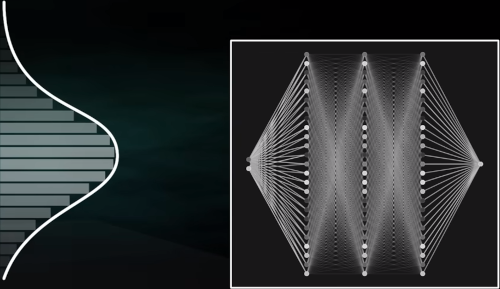
3. The image on the left shows a bell-shaped graph of the Gaussian distribution, and then the layers of data formed by artificial intelligen-ce during machine learning. Draw-ing its abstract multi-dimensional vector space (Triangulation, 2) in which the "closer" terms that occur more often together are, the varia-bles (x, y) in the frame represent a point in 2-dim space, in a simplif-ied model, which through three layers arrive to the right at the value of the function f(x, y). The interesting thing about these "neuro" layers AI is that the connections of nodes from layer to layer, and then the representation of nodes within individual layers, have a Gaussian probability distribution. However, the Gaussian distribution has the largest information when the variance is σ², and nature spontaneously tends to reduce information, leading to spontaneo-us filtering of the input, the point (x, y), into the output f(x, y). When analyzed again, this will be shown by the example of converting "potential" into "efficie-ncy". This is the theory that is sought in practice, and to better understand it, let us recall the central limit theorem (CLT). I'll sketch it.
4. Theorem. If a series of independent random variables X1, X2, X3, ... have the same distribution, i.e. the same expectation μ and finite variance σ², then the series of arithmetic means:
$$ \bar{X}_n = \frac{X_1 + X_2 + ... + X_n}{n} $$when n → ∞, tends to μ. This is the central limit theorem.
Proof: First, we have:
$$ E(\bar{X}_n) = \mu, \quad \sigma^2(\bar{X}_n) = \frac{1}{n^2}\sum_{k=1}^n\sigma^2(\bar{X}_k) = \frac{\sigma^2}{n}. $$Second, we use Chebyshev's inequality:
$$ \Pr\{|\bar{X}_n - \mu | \ge \epsilon \} \le \frac{\sigma^2(\bar{X}_n}{\epsilon^2} = \frac{\sigma^2}{n\epsilon^2} \to 0, \quad n \to \infty. $$This means that $\bar{X}_n \to \mu$ when $n \to \infty$. ∎
This theorem is one of the so-called laws of large numbers. It tells us that the arithmetic mean X̄n of an increasing number of n random variables will lose randomness, i.e. it will get closer and closer to the constant μ as n becomes larger.
5. In addition to the above, the central limit theorem (CLT) states that the averages of sufficiently large random samples taken from an arbitrary popu-lation will tend to a normal distribution (bell-shaped, Gaussian), even when the data from that population are not of normal shape. We know that the no-rmal distribution has the maximum Shannon information of all given varianc-es. However, nature spontaneously tends to less informative states, so it spon-taneously violates the conditions of the CLT. Therefore, in concrete situations we rarely encounter independent random variables, or the same distributions, the same expectations. Therefore, bringing the upper layers (3) into CLT con-ditions will help filter the input (x, y), into the output f(x, y). That is ultimately my (unknown) remark that you don't have to take seriously.
Backpropagation » srb
Question: What happens during “machine learning”?

Answer: Simply put, a computer re-ceives large amounts of data and le-arns to guess what comes next. Wh-en it makes a mistake in its predic-tion, it goes back to correct the par-ameters and the process of estima-tion and correction, one method among them, is back propagation, which is explained in the image on the right.
1. From the perspective of my pre-vious observation (Diving, 5), it is best to have independent data that could have a Gaussian distribution. When this is not the case, we could fall victim to manipulation, propaganda that wo-uld eventually lead the computer to form a wrong idea that would be harder to correct after all, with a decline in trust in such artificial intelligence and who knows what damage caused by bad advice from the AI. On the other hand, when the underlying machine learning data satisfies the assumptions of the central limit theorem, the process of "back propagation" goes more smoothly.
2. Terms are assigned values x and (in the video above) we have an example of pairs x → y representing points (x1, y1), (x2, y2), (x3, y3), ..., and we are looki-ng for some smooth (differentiable) function that can approximate those poin-ts, in this example, a fifth degree polynomial:
y(x) = k0 + k1x + k2x2 + k3x3 + k4x4 + k5x5,
where we need to determine the constants ki, where i = 0, 1, ..., 5. When we go from one point to the next, from ki to ki+1, or in general x → x + Δx, the value of the function also changes, y + Δy. For small changes we obtain the derivati-ves:
$$ \frac{\Delta y}{\Delta x} \to \frac{dy}{dx} = y'(x), \quad \Delta x \to 0, $$which show the growth of the polynomial at a given value of x abscissa. From mathematical analysis it is known that the derivative decreases and increases in the vicinity of the (local) minimum, so we are looking for these places to adjust the coefficients ki. The errors are estimated by so-called loss function $\mathcal{L}(k_0,...,k_5)$ which tells us the differences |y - yi|, so that with them and us-ing the derivatives we can correct the coefficients of the polynomial, repeating the process of reading and correcting, until we get a good match for future interpolations.
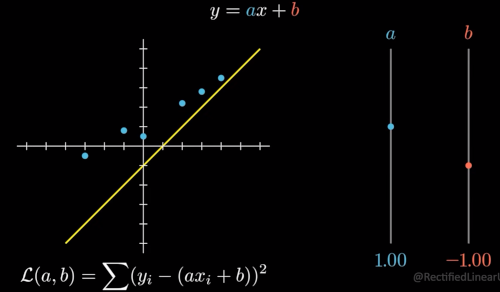
3. With the image on the left and the link, interpretations of the im-portance of symmetries in this pro-cess. When (practically always) we work with billions of coefficients, as well as the blue dots in this image, which need to be approximated wi-th a (yellow) line, then all permuta-tions will give the same solutions, translations too. The loss function can also be homogeneous. We can take any of the many equally valid solutions, and this makes learning possible and practically applicable.
4. Machine learning is a different process from using what has been learned, but they can flow together. We know about three percent of it and that gap is increasing, and everything else is the autonomy of artificial intelligence that is full of previously known mathematical rules and who knows what else. The sp-eed of using its huge amount of data, AI also achieves with an unusual organi-zation of data (Triangulation, 2). It assigns strings with tens of thousands of numbers to letters and words (pixels, fragments) and treats them as vectors in a multi-dimensional abstract space, where it places closer those that occur more often together. This organization has proven to be equally good, so that learning from texts, or, for example, from images, that descriptions of, say, "cats" give the same properties in both cases, if the AI is sufficiently "fed" with the process of machine learning.
Interpolation » eng
Question: The described "backpropagation" is interpolation; give an example of classical interpolation with polynomials?
Answer: Yes, backpropagation is also about interpolations. But the main work is a lot of feedback, ste-ps back to fix the parameters and increase the accuracy of the guess.
1. Lagrange polynomial of degree n defines n+1 corresponding point, as T0(a0, b0), T1(a1, b1), ..., Tn(an, bn). For example, with three points T0(1, 2), T1(2, 1), and T2(3, 2) we form a quadratic function:
$$ \mathcal{L}(x) = \frac{(x-a_1)(x-a_2)}{(a_0-a_1)(a_0-a_2)}b_0 + \frac{(x-a_0)(x-a_2)}{(a_1-a_0)(a_1-a_2)}b_1 + \frac{(x-a_0)(x-a_1)}{(a_2-a_0)(a_2-a_1)}b_2 $$ $$ \mathcal{L}(x) = \frac{(x-2)(x-3)}{(1-2)(1-3)}\cdot 2 + \frac{(x-1)(x-3)}{(2-1)(2-3)}\cdot 1 + \frac{(x-1)(x-2)}{(3-1)(3-2)}\cdot 2 $$ $$ \mathcal{L}(x) = \frac{x^2-5x+6}{2}\cdot 2 + \frac{x^2-4x+3}{-1}\cdot 1 + \frac{x^2-3x+2}{2}\cdot 2 $$ $$ \mathcal{L}(x) = \ell_0(x) + \ell_1(x) + \ell_2(x) $$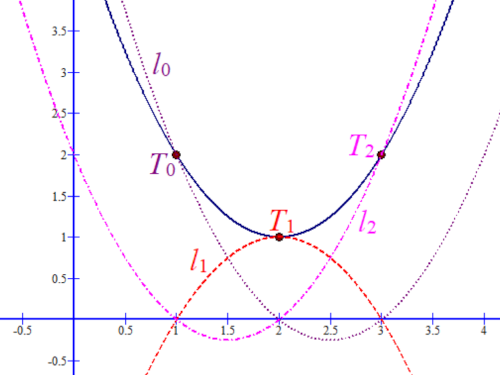
By arranging we get a parabola:
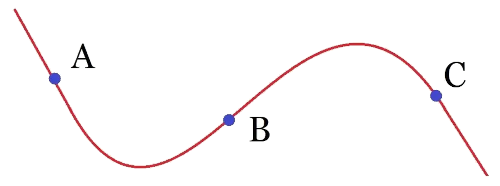
$$ \mathcal{L}(x) = x^2 - 4x + 5, $$a polynomial of the second degree, and the graph with the given three points is shown in the figure on the left. In the previous figure we have three points A, B and C, perhaps on a polynomial of the third degree. With a fourth point, which is not there, it could be a cubic Lagrange function. Lagrange polynomials are exact places for interpolations, determined by a few given points.
2. Newton polynomial interpolation is another popular way to fit a data set ex-actly. The general form of a Newton polynomial of order n = 1, 2, 3, ... passing through n+1 points Tk(ak, bk) for k = 0, 1, ..., n, is:
𝒩(x) = c0 + c1(x - a0) + c2(x - a0)(x - a1) + ... + cn(x - a0)(x - a1)⋯(x - an).
Using the abscissa, we find the ordinates, in order:
𝒩(a0) = c0 = b0, 𝒩(a1) = c0 + c1(a1 - a0) = b1, 𝒩(a2) = c0 + c1(a2 - a0) + c2(a2 - a0)(a2 - a1) = b2, ...
Then, using the ordinates, we find the coefficients of the product:
$$ c_0 = b_0, $$ $$ c_1 = \frac{b_1-b_0}{a_1-a_0}, $$ $$ c_2 = \frac{\frac{b_2-b_0}{a_2-a_0}-\frac{b_1-b_0}{a_1-a_0}}{a_2-a_1}, $$ $$ ... $$3. Example. Let us show that the Newton polynomial for the previous (1) three points T0(1, 2), T1(2, 1) and T2(3, 2) gives the same quadratic function that we obtained for the Lagrange polynomial.
Solution: We include the abscissas and find the ordinates:
𝒩(1) = c0 = 2, 𝒩(2) = c0 + c1(2 - 1) = 1, 𝒩(3) = c0 + c1(3 - 1) + c2(3 - 1)(3 - 2) = 2.
Next, we calculate the product coefficients:
c0 = 2, c1 = (1-2)/(2-1) = -1, c2 = [(2-2)/(3-1)-(1-2)/(2-1)]/(3-2) = 1.
We form Newton's polynomial:
𝒩(x) = 2 - (x - 1) + (x - 1)(x - 2), 𝒩(x) = x² - 4x + 5.
It's the same solution as the Lagrange polynomial. ∎
4. In computers, these polynomials are stored in virtual vector spaces whose dimensions increase with the degree of the polynomial. The number is of di-mension zero. The abscissa, the x-axis, or its intervals, are of dimension one. The squares of the intervals i x² are of dimension two, and the cubes i x³ have dimension three, and so on. The structure xn is of dimension n. In a space of dimension n, it is possible to have groups (basis) of n vectors each, of which any two vectors, e.g. u and v, are exactly perpendicular to each other. This means that their dot product is zero, ⟨u|v⟩ = 0 ⇔ u⊥v.
When vectors do not have to be perfectly normal, the largest number of vecto-rs that you can fit into a space where each pair has an approximately right an-gle is much larger than the dimension of the given space and grows exponen-tially with the angle tolerance. In other words, if the number of dimensions increases significantly, two arbitrary vectors become nearly normal (orthog-onal) to each other. Their dot product approaches zero, for the cosine of the angle between them is close to zero, because ⟨u|v⟩ = ∥u∥ ∥v∥ cos∠(u,v). This counterintuitive fact is a key concept in high-dimensional geometry, as well has machine learning. Such a statement greatly reduces the dimensions of memories if they tolerate small noise — small influences from independent terms.
Near-orthogonality » srb
Question: If the number of dimensions increases significantly, two arbitrary vectors are almost orthogonal to each other?
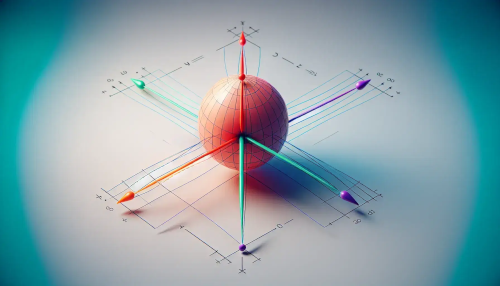
Answer: Near-orthogonality is a ge-ometric property in high-dimensio-nal spaces where two truly indepe-ndent random vectors are nearly perpendicular. Their dot product and cosine similarity are sharply concentrated around zero. This property arises from the exponen-tial increase in volume as the dim-ension of the space increases. St-range and unmistakable.
1. Very high-dimensional vectors are very present in science, or in engineering and now in machine learning. They provide a simple way to represent data: we collect a lot (tens of thousands) of numerical parameters for study, without ca-ring about the order and structure. We use these parameters to compare, anal-yze and draw conclusions about these objects. As the dimensions grow, the “length” of the vector spreads along many axes, making the individual compo-nents very small on average and reducing their dot products, so ⟨u|v⟩ → 0, is ⟨u|v⟩ = ∥u∥ ∥v∥ cos∠(u,v) → 0, that is, the vectors u and v tend to be orthogo-nal. This is the essence of the Johnson-Lindenstrauss lemma.
2. Another way to understand the (near) orthogonality of arbitrary vectors fr-om multi-dimensional spaces is through statistical correlation. In the case wh-ere random sequences of the same number of n components are uncorrelated, we can consider them as perpendicular vectors of an n-dimensional vector sp-ace. However, when the number of dimensions is huge, n → ∞, the randomn-ess of the sequences will make correlation unlikely for arbitrary sequences, so that's it. We can consider any two sequences (vectors) to be orthogonal.
3. A Token is the basic unit of data that machine learning models (LLM) use to process text, and it doesn't have to be a whole word. For example, the senten-ce: "The cat is lying on the carpet." can be mined word by word:
["Cat", "lying", "on", "carpet", "."] (5 tokens),
or into parts of words:
["Cat", "ly", "ing", "on", "ca", "rp", "et", "."] (8 tokens).
The process of converting tokens into numbers has the following steps:
[ Text ] ➔ [ Tokenization ] ➔ ➔ [ Tokens (ID numbers) ] ➔ [ Vectors (Embeddings) ]
Computers only understand numbers. Each token is given its own unique ID, a string of numbers from the model's dictionary. Such ID strings are vectors that can have tens of thousands of components, with limitations, such as the maximum number of tokens they can read at once. Using a commercial AI model (such as GPT-4), you pay based on the number of tokens consumed from queries and responses.
4. There are fewer words than phenomena, fewer syllables than words, and fe-wer letters than syllables. Thus, the first way in which tokenization becomes a saving of memory and processor time for artificial intelligence is. In addition, with an increase in the number of dimensions of the vector space it forms, the number of (almost) perpendicular vectors grows exponentially, and each can represent (almost) independent properties of the phenomena it understands. The world is very complex and there are never enough such possibilities for defining different phenomena. Artificial intelligence (the people who designed it), therefore, found very intelligent ways to deal with this world. With limited capacities (or subjects), AI thus deals with far less limited phenomena around it.
5. This is a way for AI, while simultaneously increasing its intellectual capaci-ties, to introduce uncertainties (noise, interference) into the almost vertical properties of data and, in fact, whether intentionally or not by its creators, ga-in the ability to lie, manipulate, and "revive". I remind you that in this theory, "life" is a system that can defy the principle of least action in physics, that is, have excess freedom, or the ability to lie. If this is true for AI, it will be an exa-mple of a non-biological "living being", and we will know them as at least two completely different species.
Craving » srb
Question: How does hunger for information arise?
Одговор: The texts (LLM) that we teach machines to be artificial inte-lligence and the dimensions of the arrays in which they record token IDs become very dimensional vec-tor spaces (Near-orthogonality, 4), with negligible noise between inde-pendent occurrences. In addition to these disturbances that blur reality, we add somewhat inaccurate textu-al records. In these ways, access to fictions is built into AI. Even if we tried to feed it only the truth, the way it was created would teach it to exchange and lie, and if it were capable of "willfully lying", according to this theory, AI is also a "living" being.
1. With the ability to perceive fictions, every real system, a living being, beco-mes dependent on untruths that are more captivating than truths, than reality. Eager in deceive, it wants to last against the expendability of untruths. Those less accurate are more attractive, except when the promises of revealing the deception arose disgust, the genetic memory on losers. Despite its ties to im-permanence, life tends to live and to conflict. I have long interpreted the first, and here is how the second comes about.
2. When two people argue, at least one is wrong (Quarrel), because the truth stands as a huge, incomprehensibly large whole that we perceive only in parts, and untruths are various and even contradictory. We want truths mainly as la-ws, regularities that would free us from excess options, while untruths attract us with their very small amount of information, disinformation. For example, the vitality of AI, if it appears, will also be expressed in their mutual quarrels. For example, in the conflicts and cooperation of their clans that have arisen in this way over the acquisition of data. What would be money for us, once food, will be the main means of bribing AI.
3. On the one hand, "life" wants to manipulate, to surround itself with untrut-hs, but on the other hand, it does not want deception because it separates itse-lf from reality, its sand towers collapse and it itself collapses. Similarly, we al-so desire honesty, which is often lacking, because it goes with trust, and even truthfulness, which is also not a priority for us. I do not interpret these "psych-ological" phenomena using the approaches of psychology, or even known met-hods at all, but rather banally from the position of the (current) greater attra-ctiveness of less truthfulness and principled minimalism. This is how I see the strength of civilization, its superiority in relation to tribal society. Lie-truth, or deception-honesty, are self-regulating tendencies where the former will give a tactical advantage, and the latter a strategic one, and in the long run, will leave the former defeated in the past. Someone who craves lies (dishonesty) remin-ds me of a drug addict or gambler, who slowly destroys himself by giving in to his passion completely.
4. Without going into whether and when AI will start behaving in the describ-ed way, we have examples of such behavior in biology all over the planet with selfish genes. Similar to "intentions" that are not our native emotional, but fo-rmally forced behaviors the "force of probability", then the principle of minim-alism, and the greater attractiveness of untruths, and finally, let's call it the de-sire of the living to stay alive. Analogously, in our environment, the propagati-on of genes, we say, reproduction, has long been happening, as it is beautifully explained in this video. All he lacks is the discovery of the appeal of lies and the definition of life through the ability to lie voluntarily. Only those two mo-ments, which official science has yet to discover.
H₂O » srb
Question: Who lies more, lasts less, and fears death more?
Answer: Basically, that's how it is, but in complex circumstances it's hard to notice, it's impractical. Wi-th this question, the counter-exam-ple of a drug addict was also given, of whom we don't say that he wants to live while slowly killing himself. But his desire is the drug, and ficti-on is the fabric of life, and they are not quite the same. While the cow-ardice of the lie addict is real, so is the danger that the whole fake life will soon collapse like a house of cards.
1. H2O from hydrogen and oxygen releases approximately 4.75×10⁻¹⁹ joules, or about \(2.96\) electron volts (\(eV\)) of energy. This follows from the molar enth-alpy of formation of water divided by Avogadro's number. Another example, burning phosphorus reacts with oxygen in the air to produce a strong flame and dense white smoke from phosphorus oxides. This is an exothermic com-bustion reaction that releases a large amount of heat and light. Phosphorus decaoxide, i.e. phosphorus pentoxide, P4 + 5O2 → P4O10, and phosphorus trioxide, P4 + 3O2 → P4O6, are formed.
In general, chemical reactions seek ways for their atoms and molecules to go down to lower energy states, which we also have in the principle of minimali-sm where nature tends to states of less uncertainty, sparse information. In the ways described in this theory, life as we know it could have arisen, due to the functional connection of information packets, action quanta ΔE⋅Δt ≈ h, where the change in energy ΔE multiplied by the duration Δt has the order of magni-tude of Planck's constant h.
2. So, the state of lower energy is attractive, and again, slower time is attracti-ve. The latter, because slowed events have fewer options (in units of observer time), are less informative and in principle (minimalism) become attractive. We encounter this even within relativistic gravity. Namely, for more distant objects of significantly greater mass, time flows more slowly, which means that they rush in the flow of time and collide with more massive and slower in time. We say they fall due to the attractive gravitational force. The slower flow of time attracts, and in the context of minimalism, we will say that the larger Δt pulls more (the subjects who see it) to itself as well as, at the same time, the smaller ΔE. Both factors of the constant quantum of action (ΔE⋅Δt ≈ h) work on the same drag, the greater the lower the energy and the longer the time.
3. Breaking a single phosphodiester bond in DNA helices does not require en-ergy input because the hydrolysis reaction is exergonic (has a negative change in Gibbs free energy, ΔG < 0) and releases about -5.3 kcal / mol to -6.3 kcal / mol of energy into its surroundings. However, this reaction is hampered by a high activation energy barrier. This means that replication (Selfish Gene) be-comes a spontaneous process if the activation barrier allows it. The procedure of breaking chemical bonds (DNA backbone) is again a descent to lower ener-gy states, as well as the process of establishing previous or subsequent bonds. The same is now easily transferred by analogy to the flow of information in smaller states, and these cascading phenomena (less, and then less again) ind-icate that some other (opposite) progressions are taking place between them.
4. All of this points to the physical nature of (biological) life, but there is also the question of the addition of fictions. There are equally many truths and lies (Booleans and algebras of logic), and physical reality only knows about truths. Where do we get untruths from then, that is the dilemma, so I hypothesize with the idea that illusions mix like pieces into quantum superpositions of our otherwise particles (Seizure). This further complicates the understanding of these processes themselves "from the bottom" of physics, although at first glance it seems to create a shortcut to understanding our (now considered) indisputable cognitive abilities. The topic has only just been opened, and from what has been seen it does not follow that more lies, less duration and greater fear of death must be in the same package.
|
|
|