|
|
|


Pover Sum III » srb
Question:Why don't we simply express the sum of the degrees of the roots of polynomials in Power Sum II in Vieta coefficients, instead of calculating so much?

Answer: Quadratic equation:
x² + e1x + e2 = 0
is easily solved by squaring:
$$ \alpha_{1,2} = \frac{-e_1 \pm\sqrt{e_1^2 - 4e_2}}{2} $$where for the so-called Vieta coefficients the equalities e1 = - α1 - α2 and e2 = α1⋅α2 hold. The solutions, ro-ots or radix of the equations are also denoted by α1,2, or r1,2 instead of x1,2, to avoid confusion in a longer text.
However, the solution of the cubic equation x³ + e1x² + e2x + e3 = 0 by quad-ratures are a bit more computationally intensive (Vieta). Quartic (fourth deg-ree) equations have even more complex solutions by quadratures, and quintic, fifth and higher degrees are not always solvable by quadratures. They are not always expressible in the same way by Vieta coefficients — although there are bijections (mutually unique images) between them. That's why.
1. Let's look at a general third-degree polynomial and its cubic equation:
p3(x) = x³ + e1x² + e2x + e3 = 0,
with currently unknown solutions x ∈ {α1, α2, α3}. There are three such (not always different) according to the fundamental theorem of algebra, which means that we can write it as:
p3(x) = (x - α1)(x - α2)(x - α3) = 0,
so by multiplying and comparing we find the so-called Vieta coefficients of the cubic equation:
e1 = -α1 - α2 - α3, e2 = α1α2 + α1α3 + α2α3, e3 = α1α2α3.
These relationships exist even if we do not know the solutions αi, nor ej, for i, j ∈ {1, 2, 3}. Is this math that weird? Let's include each of the solutions, then add all three equations, we get:
S3 + e1S2 + e2S1 + e3 = 0
where Sk = α1k + α2k + α3k, for k ∈ {1, 2, 3}. Here are the one-to-one relation-ships between the roots αi = 1, 2, ..., n, the coefficients ej and the sum of the powers Sk, for i, j, k ∈ {1, 2, ..., n} polynomial equations of arbitrary degree n ∈ ℕ, as well as for n = 3. We note that "exist" here does not mean knowing its details, nor "knowing" it in the usual sense.
2. Newton's (1666) identities give the relationships between two types of sym-metric polynomials, sums of degrees Sk and elementary symmetric ej polyno-mials, without actually finding the root αi. Later, an earlier work by Girard (1629) was discovered on the same subject, which only becomes more intere-sting over time. Their content is in the recursions that we have already proven by multiplying the polynomial equation by its roots and adding, but in a way that is easy to extend to all integer indices-exponents, even rational ones. Here is an easier example and, I hope, an explanation of what was said.
3. For example, in the case of a quadratic equation, the Newton-Girard calcul-ation is:
S0 = α10 + α20 = 2, S1 = α11 + α21 = - e1, S2 = α12 + α12 = (α11 + α21)(α11 + α21) - 2α1α2 = -e1S1 - e2S0, S3 = α13 + α13 = (α1 + α2)(α12 + α22) - α1α2(α1 + α2) = -e1S2 - e2S1, ... Sk = α1k + α2k = (α1 + α2)(α1k-1 + α2k-1) - α1α2(α1k-2 + α2k-2) = -e1Sk-1 - e2Sk-2
and further for all k ∈ ℕ, as in the recursion we have, Sk + e1Sk-1 + e2Sk-2 = 0. However, from the previous derivation of this recursion, we easily find its for-ms and general for all integer exponents, k ∈ ℤ, and then for k ∈ ℚ.
For example, the equation corresponding to the quadratic function in the pre-vious image is p2 = x² - 3x + 2, with Vieta numbers e1 = -3 and e2 = 2. The Newton-Girard method, without knowing the values of the roots themselves (α1 = 1 and α2 = 2), gives:
S0 = α10 + α20 = 2, S1 = α11 + α21 = 3, S2 = -e1S1 - e2S0 = 3⋅3 + 2⋅2 = 5, S3 = -e1S2 - e2S1 = 3⋅5 + 2⋅3 = 9, ...
further we get S4 = 17, S5 = 33, S6 = 65, S7 = 129 , S8 = 257, S9 = 513, ...
4. However, working in the previous way, we can easily formulate the forms of Sk for negative indices and exponents k. Namely, dividing the quadratic equat-ion x² + e1x + e2 = 0 by the roots (α1⋅α2 ≠ 0) we find:
$$ \begin{cases} \alpha_1 + e_1 + e_2 \alpha_1^{-1} = 0 \\ \alpha_2 + e_1 + e_2 \alpha_2^{-1} = 0 \end{cases} $$then adding gives S1 + 2e1 + e2S-1 = 0. Dividing the data by squares:
$$ \begin{cases} 1 + e_1\alpha_1^{-1} + e_2 \alpha_1^{-2} = 0 \\ 1 + e_1\alpha_2^{-1} + e_2 \alpha_2^{-2} = 0 \end{cases} $$hence by adding 2 + e1S-1 + e2S-2 = 0. Dividing the same by cubes and higher powers, the result becomes formally equivalent:
S-1 + e1S-2 + e2S-3 = 0, ... Sk + e1Sk-1 + e2Sk-2 = 0,
respectively for k = -1, -2, -3, ... In a more specific case, x² - 3x + 2 = 0, these will be the formulas:
S1 - 6 + 2S-1 = 0, 2 - 3S-1 + 2S-2 = 0, S-1 - 3S-2 + 2S-3 = 0, ...
from which we find specific values:
S-1 = (S1 - 6)/2 = 3/2, S-2 = (3S-1 - 2)/2 = 5/4, S-3 = (3S-2 - S-1)/2 = 9/8, ...
We check this by calculating the sum of the degrees of the roots:
S-1 = α1-1 + α2-1 = 1 + 1/2 = 3/2, S-2 = α1-2 + α2-2 = 1 + 1/4 = 5/4, S-3 = α1-3 + α2-3 = 1 + 1/8 = 9/8, ...
The results agree.
Processes III » srb
Question: Is there a connection between process and the sum of the degrees of the roots of a polynomial?
Answer: Yes, of course sums of degrees of roots of polynomials, such as:
Sk = λ1k + λ2k + ... + λnk,
have to do with "processes". It is actually too broad an area to fit into the small framework of this answer, so I will describe only one of its domains.
1. The great discovery of the 20th century was quantum mechanics, especially because of the previously unprecedented agreement in physics of its mathem-atical basis, theoretical predictions with the results of measurements, and the extraordinary incomprehensibility, indeed inexplicability, of these coinciden-ces, and the "unreasonable effectiveness of mathematics" (Wigner, 1960) became proverbial in circles of connoisseurs. Let us take the discovery that every quantum state, every process, or every particle can be specified as a vector (operators and matrices are also vectors), so that we, people and envi-ronments, are not just sets of particles or physical phenomena, but are also vectors. Every subject or object is a unique vector with a huge number of components.
2. Linear operators, for example $\hat{A}$, define processes by which they change the directions and intensities of the vector $\vec{x}$, then the states of natural phenome-na that they reverse to $\vec{y} = \hat{A}\vec{x}$, but there are also so-called eigenstates $\vec{v}$ for which the given process does not change direction but only the intensity λ of path. We call this λ the eigenvalue of its eigenvector $\vec{v}$ of their process if the characteristic equation $\hat{A}\vec{v} = \lambda\vec{v}$ holds. Such direction is an unusually import-ant part of the algebraic understanding of nature. For example:
$$ A\mathbf{v}_1 = \mathbf{v}_1, \quad A\mathbf{v}_2 = 2\mathbf{v}_2, $$ $$ \begin{pmatrix} 1 & N \\ 0 & 2 \end{pmatrix} \begin{pmatrix} a \\ 0 \end{pmatrix} = \begin{pmatrix} a \\ 0 \end{pmatrix}, \quad \begin{pmatrix} 1 & N \\ 0 & 2 \end{pmatrix} \begin{pmatrix} N \\ 1 \end{pmatrix} = 2\begin{pmatrix} N \\ 1 \end{pmatrix}. $$The chosen matrix A of an operator $\hat{A}$ has two eigenvectors v1 and v2 corresp-onding to the eigenvalues λ1 = 1 and λ2 = 2, respectively. In a different basis of the same vector space, this matrix could be B = S-1AS, when S-1S = SS-1 = I. However, the sum of its diagonal values, the so-called The trace would remain the same, tr(B) = tr(A). This trace is the sum of the eigenvalues λ1 + λ2 to whi-ch, obviously from arbitrary a and N, various (not any) eigenvectors can be assigned. We are close to the answer to the above question.
3. When D[λ1, λ2] is a diagonal matrix containing the eigenvalues of A, then the auxiliary matrix P[v1, v2] column of eigenvectors gives:
$$ A = P\cdot D\cdot P^{-1}, $$ $$ \begin{pmatrix} 1 & N \\ 0 & 2 \end{pmatrix} = \begin{pmatrix} a & N \\ 0 & 1 \end{pmatrix}\cdot \begin{pmatrix} 1 & 0 \\ 0 & 2 \end{pmatrix} \cdot \frac{1}{a} \begin{pmatrix} 1 & -N \\ 0 & a \end{pmatrix}. $$Then tr(A) = tr(D) = λ1 + λ2, while tr(A²) = tr(D²) = λ1² + λ2², then further tr(Ak) = tr(Dk) = λ1k + λ2k and that is the sum of the degrees of the roots of the polynomial. This is a polynomial of operator, i.e. a minimal matrix polynomi-al, or an eigenvalue polynomial. For example:
$$ \det(A - \lambda I) = 0, $$ $$ \begin{vmatrix} 1 - \lambda & N \\ 0 & 2 - \lambda \end{vmatrix} = 0, $$ $$ \lambda^2 - 3\lambda + 2 = 0. $$A regular (column-independent) matrix of the third order will be of dimension three (n = 3) and will have a cubic equation for its polynomial. It is further val-id that such a matrix of n-th order has a polynomial equation of n-th order th-at defines its eigenvalues λ1, λ1, ..., λn by its solutions and has Vieta coefficien-ts:
e1 = -λ1 - λ1 - ... - λn, e2 = λ1λ2 + λ1λ3 +... + λn-1λn, ..., en = (-1)nλ1λ2...λn.
Then what we know about symmetric polynomials comes into play, especially from previous answers here.
4. In particular, this means that the space of the process A is spanned by its eigenvectors (it sees nothing outside that world), so the arbitrary state it can act on is represented by x = ξ1v1 + ξ2v2 + ... + ξnvn, so that when the process acts and is acted upon such k = 1, 2, 3, ... times, it will be:
Akx = Ak(ξ1v1 + ξ2v2 + ... + ξnvn) = = ξ1Ak(v1) + ξ2Ak(v2) + ... + ξnAk(vn) = ξ1λ1k + ξ2λ2k + ... + ξnλnk.
So if there is a leading, we say dominant eigenvalue λμ, larger in modulus than all the others, ∥λμ∥ > ∥λν∥ for all μ ≠ ν, then when k → ∞, the direction of an arbitrary vector will tend towards the direction of the dominant eigenvalue. For some scalars ξ, it will be x → ξvμ. It is global convergence which, along with local divergence, is an important point of this information theory.
Inflation » srb
Question: Why would this sum (Processes III, 4) k-th powers converge to the largest lambda, when k → ∞?

Answer: Therefore, since (λν/λμ)k → 0 when |λν/λμ| < 1 and when k → ∞, all sums of power sums tend to zero when the factor λμ is taken in front of the sum, when |λμ| < |λν| if there is some μ for all ν from index {1, 2, ..., n}. But that's not all.
1. Sometime in the 1980s, I was an "information systems designer and programmer" at a bank that was then wor-king with "large" Honeywell business computers, with the Gecos operating sy-stem and Cobol programming. Occasionally, there would be a major inflation of the domestic currencies of the user countries, when a hundred million mon-etary units would barely be enough for a loaf of bread, and tomorrow that mo-ney would be worth even less. The first solution was for banks to revalue these amounts by multiplying them by the inflation rate coefficient and thus having some "real" value of money. In practice, this revaluation would be carried out monthly or more often, and after a k period, this coefficient r < 1 would beco-me rk which tends to zero, but due to the finite number of decimals of the no-te, it would also become zero. By de-revaluation later, multiplying that zero by 1/rk, regardless of the fact that such an inverse coefficient would then be a hu-ge number, the old monetary value would remain zero. That problem was so difficult that big companies were happy to collaborate with us small develope-rs.
2. Reducing a number, say π ≈ 3.141 592 653 589 793, by multiplying it by the coefficient 0.110, we get the number 0.000 000 000 314 159 which again has 15 decimal places, so multiplying it by the inverse coefficient 1010 will return the number 3.141 590 000 000 000 which is no longer exactly equal to the previous one. In the continuation of the steps k = 10, 11, 12, ... the coefficient 0.1k becomes smaller and smaller and it is increasingly inaccurate to restore the old record. Reality has such a difficulty everywhere, because all natural phenomena are finitely divisible. There is no conservation of quantity with infinite divisibility, because infinity can be its own proper part, so the previous "banking difficulty" is actually a problem of observable physical reality in general. It is an important point of this (my) theory of information.
3. I see an analogy with this in the "packaging" of a plant's genetic code into a seed that, when planted, can grow into a wonderfully complex tree. Just as a number loses less significant decimals by decreasing and regains them by in-creasing, reviving only the more significant ones, so too life filters values by inheriting them through descendants, adapting to the environment. In this I see the principle of minimalism, spontaneous development to less informative states, that is, more probable ones. The same "escape" from uncertainty (force of probability) is reminiscent of the development of the universe, from which anything could have emerged 13.8 billion years ago, but what happens to us is what we see as the remnants of that "filtering". The general convergence of natural phenomena, on the other hand, is a consequence of local divergence, which is compounded by the law of large numbers.
4. The law of large numbers in probability theory (Chebyshev) also tells us ab-out the influence of the past on the present. It talks about the elimination of worse cause-and-effect relationships, that is, the elimination of less likely outcomes in the sifting of events over time. If we view this as a "struggle" for duration, then nature strives for conservation, because it avoids uncertainty. Like us, our universe seems to have a "fear" of the unknown. This is certainly an interesting topic, but it goes beyond the scope of the current question.
Absurd » srb
Question: What do you say is absurd about the law of large numbers?
Answer: Objective randomness is based on non-causality, which does not exist in the true sense, because we have the laws of large numbers in probability theory (Chebyshev). And further, if non-causality itself leads us to some causality, we are parts of a wider context of that co-nnection that is not capable of jud-ging its own truth. A strange, but not entirely unfounded, nor unknown paradox that you are urging me to explain.
1. The statement “I am lying” is a contradiction (Three-valued, 3), because if I am honest then I am lying and if I am dishonest then I am telling the truth. A more complex structure is also contradictory: “Ana says that Boban is telling the truth, and Boban says that Ana is lying”. To go on, the conclusions would be that systems do not have valid truths about themselves. What connected entities can say about themselves as a whole is not relevant from the point of view of truth, even if it were mathematics itself, which we know from Gödel cannot prove its own correctness. We talked about it, but we didn't understa-nd each other, that causality as a whole cannot be judged by itself as somethi-ng to believe or not believe.
2. In a relaxed gathering, someone supposedly quoted Einstein as saying, "If you can't explain it simply, then you don't understand it," so my interlocutor challenged me with the question: "Come on, dude, just prove Gödel's theorem to us." Therefore, the previous argument, which was somewhat frivolous given the cheerful context, went unnoticed. The second reason I used it (1) somewh-at more "seriously" was in explaining (my) definition of a "living being": if it really knows how to lie, then it is "alive," or if it can "willfully" lie. That also went unnoticed because of the remark that I (the others) just said, for examp-le, "white is white" or a similar useless tautology. Otherwise, I don't use that argument except when someone tells me flatly, "I know that I am..." and continues to brag, when I think, "If this guy knew anything about logic, he would know how much he has no idea what he's talking about."
3. If an inanimate physical substance can hallucinate about itself, then it is not inanimate. In addition, we assume that inanimate nature does not lie, because if we can really prove that something cannot happen, it will not happen either in reality or in an experiment. Such is theoretical physics and all its practice, so the “liveliness”, say of a stone, would be inconsistent with the above defini-tion of “life” (which can lie at will). On the other hand, if we call “alive” somet-hing that can lie at will, it will be consistent with (1) the unreliability of what it can express about itself. If it cannot lie, it is dead and has no statements about itself, so that this circle is closed and consistent. We also note the interesting thing about the possible connection of artificial intelligences. If several of th-em, smaller ones, can be connected into larger “persons”, then although intel-ligent they do not achieve the status of persons in the sense of self-awareness, self-esteem. That is a separate topic.
4. Realities of the same time stream are of different present with histories, but they form one cause-and-effect system. According to the above, within the sa-me 4-dimension space-time, alone without new dimensions of time, there are no accurate statements about the reality (accuracy) of the whole and hence the subjective idealism of George Berkeley (1710), that the material world itself does not exist independently of the mind (esse est percipi: to be is to be perc-eived). Hence the persuasiveness of such or similar teachings about illusions about reality. They are logical, deductively irrefutable, but incorrect from the point of view of other time streams, when the objectivity of chance, i.e. the existence of non-causality, is assumed. The not-mentioned one of the above Gödel's two theorems states that a consistent system (true and only true) is incomplete, which agrees with this.
Existence III » srb
Question: You say, if there are no accurate statements about the reality (vera-city) of a whole, then its environment also exists?
Answer: It's neither an official nor a primarily philosophical view of reality, but I'm holding onto it the-re, in my information theory, until it's proven wrong. Here's how it's maintained.
1. According to Nietzsche, “there are no facts, only interpretations,” here we say it more mildly, “we hallucinate by thinking.” Any tr-anslation of mathematical truths is necessarily approximate, somewhat unt-rue, for the nature of our communication, starting from inheritance through evolution due to the needs of survival, and even more so, is a mirroring with-out symmetry. Such does not reflect duration, truthfulness, or immediate pe-rceptibility by inanimate nature that pursues truth and only truth.
2. We can see what kind of contradiction we are talking about by looking at the example of the quadratic equation x² -2x + 2 = 0, which contains only ra-tional coefficients, but whose solutions are the conjugate complex numbers x1,2 = 1 ± i, where i² = -1, if we know the theory of Galois groups (Field). Due to the interchangeability of these roots, without changing the form of the equ-ation, its solutions cannot be written in terms of rational coefficients. It is an-alogous to the equation x² - 2 = 0, whose solutions x1,2 = ±√2, again are not rational numbers. The third example is now the story, if we have a single wh-oleness that must then be both true and false, which is actually false since we consider the “material” (dead physical matter) to be only true. It is not a pro-blem that has occurred to me alone, I suppose, but I see the solution in that there is something beyond such wholeness, an inner materiality.
3. This is consistent with Gödel's impossibility theorem (a consistent theory is incomplete), that a system of truths and only truths, no matter how expanded, always remains without some truths that it cannot reach. However, this is not about interpreting Gödel's theorem, but about approaching and verifying it fr-om a completely new angle, hence why I speak of bridging. Truths are islands which, for example, when investigating them in mathematics, we also overco-me lies using tables of operations with statements true ⊤ and false ⊥. When there is no such retrospective, calculation or thinking, only an inanimate obje-ct remains, that is, truth and only truth. Then I say a contradiction remains, not implying that a dead object is actually alive, but that there is something outside it. That part is Gödel's theorem, which then relies on the addition of false lives to truths. On the other hand, in the living there is also the non-living (Existence II).
4. If that were the end of everything, the cessation of the possibility of reality outside the totality of given reality, this contradiction would still not be able to be eliminated. I know that this is difficult to understand, so I will end with an example that may be of some help to us. It is known that equations of the fifth degree and higher cannot be solved in the general case by quadrature (Abel-Ruffini theorem). Such is, for example, xn - ax - b = 0 with arbitrary a, b ∈ ℂ, whose solution can be written using infinitely nested roots:
$$ x = \sqrt[n]{b + a\sqrt[n]{b + a\sqrt[n]{b + ...}}} $$and which, say, for the quintic n = 5, for a = b = 1, cannot be written in finite quadratures. Then we say that it is “unsolvable”. This is just the beginning of the topic.
Swap » srb
Question: What kind of substitution of the roots of a quadratic equation are you talking about from Galois group theory?
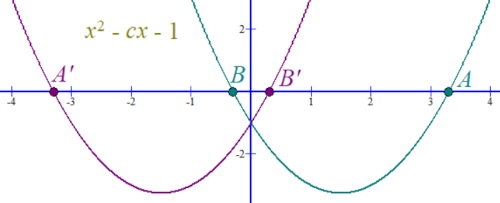
Answer: Let me explain again. The-se parabolas of the graph on the right are:
y(x) = x² - 3x - 1, y'(x) = x² + 3x - 1,
green and red, right and left. Together they are f(x) = x² - cx - 1 when we say that they are created by trave-rsing the coefficient c ∈ ℂ some closed, circular line, so that it passes through the real values c = ±3. With one such traversal, the roots A, B = (-3 ± √13)/2 become A', B' = (+3 ∓ √13)/2. They are mapped axially symmetrically around the ordinate while c passes through a circle inside the complex plane. After mapping y → y' → y by circling the coefficient c, after which the parabola remains the same, its roots swap places. This is not possible to write using the algebraic operations +, -, ×, ÷ alone, without a root. Hence the root is in the solution notation of the quadratic equation.
Unlike a quadratic equation, say, the linear equation x + c = 0 has only one root x1 = -c of the opposite sign to the coefficient, which means that they are mapped in the complex plane by central symmetry. If c ∈ ℂ circulates in the positive direction, for example in the first quadrant, its solutions x1 ∈ ℂ circ-ulate in the negative direction in the third quadrant and it is possible to write them all using only simple algebraic operations (and coefficients).
For example, the cubic equation x³ - cx - 1 = 0 will replace its three roots in pairs, while c ∈ ℂ then also makes two circles (figure eight) around the pair of critical points. Therefore, the general solution of the cubic equation will also have roots in the root (Cardano). It is still possible to write a fourth-degree equation with a finite number of roots, but this notation is so complicated that it is not given. General equations of the fifth and higher degrees do not have such notations either, with a finite number of roots nested under the root.
To be continued ...
|
|
|