|
|
|


Boolean » srb
Quesion: In which branch of mathematics do variables have only two values, true (1) and false (0)?
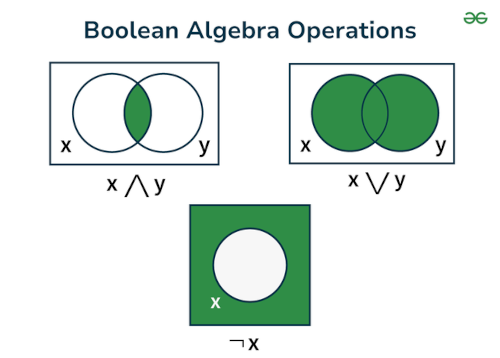
Answer: Boolean algebra is a bran-ch of mathematics in which variab-les have only two values: true (1) or false (0). It uses three basic operati-ons — conjunction (∧, AND, times), disjunction (∨, OR, addition), and negation (¬, NOT, inversion) — to form binary logic, the basis of com-puter programming as well as digi-tal electronic circuits.
1. George Boole (1815–1864) was the first mathematician to think of, and even manage to calculate, the truth (⊤) and falsehood (⊥) of "statements", as we call sentences in mathematics, that is, expressions that can only be eith-er true (1, or the symbols ⊤) or false (0, or ⊥). Conjunction is an operation (A ∧ B ∧ C ∧ ...) that is true iff (and only if) each operand is true (A = B = C = ... = ⊤), while disjunction (A ∨ B ∨ C ∨ ...) is the opposite, an operation that is false iff all are false (A = B = C = ... = ⊥). Negation (¬A) changes the value of a stat-ement, ⊤ → ⊥ and vice versa ⊥ → ⊤.
2. In Boolean algebra, it is possible to write any statement using conjunctions, disjunctions, and negations, for example, using the normal disjunctive form, or sum of products. Take, for example, the ⊕ or XOR operation, which is cal-led “explicit or”:
| A | B | A ⊕ B |
| 0 | 0 | 0 |
| 0 | 1 | 1 |
| 1 | 0 | 1 |
| 1 | 1 | 0 |
We can also define it in the following way:
A ⊕ B = (¬A ∧ B) ∨ (A ∧ ¬B).
This is easily verified by listing each of the four pairs of values A and B. In the third column of this table, instead of A ⊕ B, you can write any sequence of fo-ur zeros or ones, out of 24 = 16 possible arrangements, and define this operat-ion using a disjunctive form, similar to the one above. The above proves that conjunction, disjunction, and negation are sufficient to represent every state-ment in the Boolean algebra of logic. The following example demonstrates the previous (2) possibilities in combination with these patterns. Equality (=) or equivalence (≡) is irrelevant here.
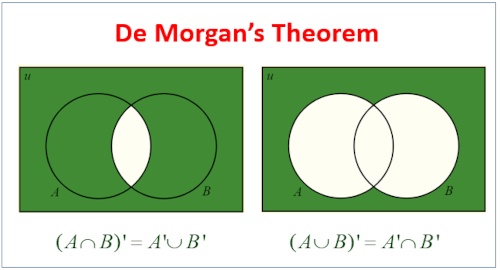
3. Venn diagrams of sets, attached to the image on the left, explain De Morgan's laws:
¬(A ∧ B) = (¬A) ∨ (¬B), ¬(A ∨ B) = (¬A) ∧ (¬B).
The negation of a conjunction is the disjunction of the negations, and the negation of a disjunction is the conjunction of the negations. These are easily checked by listing the pairs of values of the variables, but we can also see the same from the picture. This is a demonstration of the analogy of Boolean algebra and Cantor sets. The followi-ng examples demonstrates the previous (2) possibilities in combination with these patterns. Equality (=) or matching (≡), it doesn't matter for now.
4. The implication, A ⇒ B ≡ ¬A ∨ B, if A then B is equal to the disjunction of the negation of A and B. Namely, the implication is false if the premise (A) is true and the consequence (B) is false, and this is exactly what we have with the disjunction on the right-hand side of this equality. The negation of the impli-cation is the following example:
¬(A ⇒ B) ≡ ¬(¬A ∨ B) ≡ A ∧ ¬B.
In plain words, the opposite of "if A, then B" is "A is true, but B is false". Here is another example, contraposition:
A ⇒ B ≡ ¬A ∨ B ≡ B ∨ ¬A = ¬B ⇒ ¬A, A ⇒ B ≡ ¬B ⇒ ¬A.
If it's a cat then it's a mammal, so if it's not a mammal then it's not a cat.
5. The possibility that only three operations define all statements of Boolean algebra is an advantage for computers that was quickly noticed and used. I wrote about it recently in a series of such answers (Gates). However, every convenience, even this one, has a downside, because, according to Gödel's impossibility theorem, the world of truths is not limited (Deduction II). A correct (truth-only) theory, no matter how great, is necessarily incomplete (there is always truth outside). There is also the problem of transmission speed and errors, and some optimum, between errors and the speed of info-rmation transmission in processors, is ternary logic. Then, there is also a qu-alitative leap in computing with quantum computers that do not work with individual numbers, but with strings.
Łukasiewicz » srb
Question: What motivates us to use ternary logic?
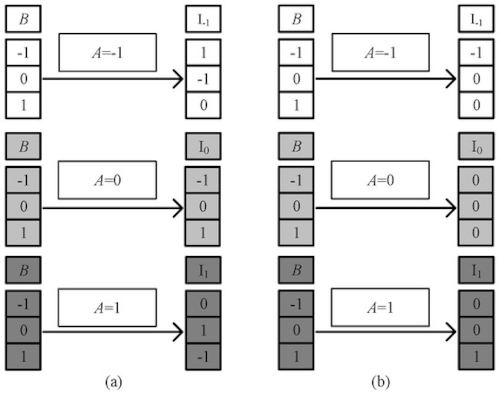
Answer: Lukašević's logic was mot-ivated by Aristotle's proposition th-at bivalent logic was not applicable to future contingent events, e.g. the statement "There will be a naval ba-ttle tomorrow". In other words, st-atements about the future were nei-ther true nor false, but they could be assigned an intermediate value, which represented their possibility of becoming true in the future.
Recently, we have also known abo-ut the "Schrödinger's cat" which is both alive and dead before the box is opened, i.e. we know that the trajectory of a particle (electron, Heisenberg 1927) is indeterminate until measurement, or interaction by which the quantum superposition collapses, i.e. when both the particle and its previous trajectory are defined. Quantum physics has cle-arly indicated the need to have "intermediately probable" states that are left somewhere between "correct" and "incorrect" (Ternary Computer). This is especially true because ternary and binary logic are just as mathematically accurate as the mathematics of quantum physics, despite the fact that the micro-mechanics themselves seem absurd to us.
1. Ternary logic statements can take on three truth values A, B, C ∈ {1, 0, -1}, in the words "true" (1), "maybe" (0), and "false" (-1). Negation is a sign chan-ge, ¬A = -A, which means:
¬1 = -1, ¬0 = 0, ¬(-1) = 1.
The conjunction gives the smallest of the values, A ∧ B ∧ C = min{A, B, C}, so:
1 ∧ 1 = 1, 1 ∧ 0 = 0, 1 ∧ (-1) = -1, 0 ∧ 1 = 0, 0 ∧ 0 = 0, 0 ∧ (-1) = -1, (-1) ∧ 1 = -1, (-1) ∧ 0 = -1, (-1) ∧ (-1) = -1.
The disjunction gives the largest of the values, A ∨ B ∨ C = max{A, B, C}, so:
1 ∨ 1 = 1, 1 ∨ 0 = 1, 1 ∨ (-1) = 1, 0 ∨ 1 = 1, 0 ∨ 0 = 0, 0 ∨ (-1) = 0, (-1) ∨ 1 = 1, (-1) ∨ 0 = 0, (-1) ∨ (-1) = -1.
The operation table of a pair of these variables has 3×3 = 9 fields and each can take on three values, which is 39 = 19683 possibilities. Compare this to only 24 = 16 possibilities of Boolean algebra to see the speed of ternary computers. As expected, the law of exclusion of the third (A ∨ ¬A) does not apply in this logic, it is not a tautology, for 0 ∨ ¬ 0 = 0. Accordingly, the law of non-contradiction (¬(A ∧ ¬A)) is not true either, nor is it a tautology, because ¬(0 ∧ ¬0) = 0.
2. We can easily verify that De Morgan's laws also apply in this logic:
¬(A ∧ B) = (¬A) ∨ (¬B), ¬(A ∨ B) = (¬A) ∧ (¬B).
Namely, we have in order:
¬(1 ∧ 1) = -1 = (¬1) ∨ (¬1), ¬(1 ∨ 1) = -1 = (¬1) ∧ (¬1), ¬(1 ∧ 0) = 0 = (¬1) ∨ (¬0), ¬(1 ∨ 0) = -1 = (¬1) ∧ (¬0), ¬(1 ∧ -1) = 1 = (¬1) ∨ (¬-1), ¬(1 ∨ -1) = -1 = (¬1) ∧ (¬-1),
¬(0 ∧ 1) = 0 = (¬0) ∨ (¬1), ¬(0 ∨ 1) = -1 = (¬0) ∧ (¬1), ¬(0 ∧ 0) = 0 = (¬0) ∨ (¬0), ¬(0 ∨ 0) = 0 = (¬0) ∧ (¬0), ¬(0 ∧ -1) = 1 = (¬0) ∨ (¬-1), ¬(0 ∨ -1) = 0 = (¬0) ∧ (¬-1),
¬(-1 ∧ 1) = 1 = (¬-1) ∨ (¬1), ¬(-1 ∨ 1) = -1 = (¬-1) ∧ (¬1), ¬(-1 ∧ 0) = 1 = (¬-1) ∨ (¬0), ¬(-1 ∨ 0) = 0 = (¬-1) ∧ (¬0), ¬(-1 ∧ -1) = 1 = (¬-1) ∨ (¬-1), ¬(-1 ∨ -1) = 1 = (¬-1) ∧ (¬-1).
Therefore, De Morgan's patterns are also valid in this (ternary) logic.
3. The implication of A ⇒ B is the guidance, or direction, of the statement A to B. There is only one truth, while there can be many half-truths, and especially untruths. Hence, anything comes out of "false", and only "true" comes out of "true". So we understand the following results, A ⇒ B ≡ min{1, 1 - A + B}:
| ⇒ | 1 | 0 | -1 |
| 1 | 1 | 0 | -1 |
| 0 | 1 | 1 | 0 |
| -1 | 1 | 1 | 1 |
From "maybe" we get "true", but "maybe" from "maybe" we get "true" and "maybe". Although De Morgan's laws are valid, the implication differs from the classical one, because 0 ⇒ 0 = 1, not ¬0 ∨ 0 = 0. But, A ⇒ A is a tautology. This distinguishes Łukasiewicz's implication from some other non-classical logics (like Kleene's) in which "unknown implies unknown" yields unknown.
4. A larger range of truthfulness fits this theory, but with three values {1, 0, -1} instead of the binary two {1, 0}, at the same voltage range, the computer will make a little more mistakes, but it will work much faster and that pays off. And when the range of values increases, even greater speed with a greater pr-esence of errors does not prove to be as favorable as in the case of ternary lo-gic. While, the accuracies of all (mathematical) polyvalent logics are equal.
Noether » srb
Quesion: When we equate duration with reality, and both with truth, then what about the "only" 13.8 billion years of the universe?
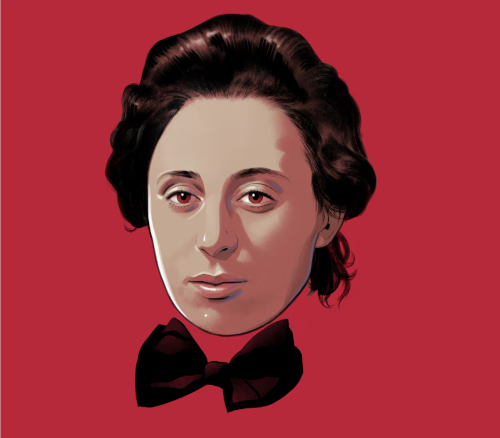
Answer: I will understand such a question as a disbelief in the limi-tations of truth and reality, includi-ng the laws of conservation. I have talked about this on several occasi-ons, but perhaps too implicitly, so the impression was left that it could be either way. We usually say “may-be” colloquially, and this is the way it is in art or philosophy, or in scie-ntific speculation. Real science be-gins where these hesitations disa-ppear. The essence of expressing scientific truths is prohibitions. So to seem scientific, I say that the law of conservation is local. When we observe it for a long time, it will not be valid. We are talking about the law of conservation of energy and similar things, and in general about the laws of physics, and even the application of mathematics in other sciences.
1. Bianchi identities are geometric relations via differential calculus, and are also relevant to general relativity when they express the vanishing covariant divergence of the Riemann curvature tensor, leading to an interpretation of conservation laws, for example the energy-momentum tensor of Einstein.
General relativity derives the local conservation of energy and momentum fr-om the Second Bianchi Identity. It states that the covariant divergence of the Einstein tensor is zero (\(\nabla_\mu G^{\mu\nu} = 0\)), and since Einstein's field equations rel-ate this tensor to the stress energy tensor, one obtains the conservation of ma-tter and energy (\(\nabla_\mu T^{\mu\nu} = 0\)). However, a true global conservation of total energy is impossible to define in the dynamical spacetime of gravity because there is no global time vector necessary for this identity.
2. If we were in deep space between galaxies and threw a stone as far away fr-om us as possible, it would move uniformly in a straight line for a long, long ti-me and over time it would gradually move out of our local environment until it stopped. For example, the universe is expanding and its galaxies are (on aver-age) moving away from it at an ever-increasing speed, and that stone would gradually move towards another local environment in which it would be at re-st. Compared to that distant environment, the stone lags behind. We know this from astronomy.
If we ignore the expansion of the universe and observe the only two bodies in the distant universe, the thrower and the stone moving away, we are left with gravity and its constant and persistent attraction. It takes away their speed of movement and the outcome is similar to the previous one, the stone stops and returns. We are not adding anything here that physics does not already know. However, if we also ignore the thrower, and we have only the stone moving for a very long time in a nearly empty space, I refer to the "memory of gravity" (AGC 114905), an unknown property outside of this (my) information theory. The stone leaves an attractive trace that gravitationally acts on it and also stops it.
3. Emma Noether (previous image on the left) studied the connection between symmetries and conservation laws. It's a long story that I'll try to make short. Maupertuis (1747) was the first to discover the principle of least action in phy-sics. He defined the action as S = mvs, as the product of the mass m, the velo-city v and the distance s of the body.
Energy changes forms (not total quantity), going from potential V to kinetic T = mv²/2 and vice versa, and Lagrange introduced the function L = T - V, kin-etic minus potential energy, in his 1788 treatise "Analytical Mechanics" form-ulating the equations of motion. Before that, the law of conservation of energy T + V = const. had been established by 18th-century mechanics such as Daniel Bernoulli and Leonard Euler. The difference and sum (L = T - V, H = T + V) of kinetic and potential energy are today called the Lagrangian and Hamiltonian after the authors who studied them the most (Hamilton, 19th century).
A very important second-order differential equation:
$$ \frac{\partial L}{\partial x} = \frac{d}{dt}\left(\frac{\partial L}{\partial v}\right), $$is the Euler-Lagrange equation (1750s) and its solutions are energy-conservi-ng motions of the Lagrangian. Emma noticed that the changes in L depend only on the path x on the left-hand side of this equation, and the change in ti-me t on the right-hand side, and this gave her the idea of the conservation of kinetic energy from potential (status quo) energy on the path over time. She then discovered the following.
4. Let's start with the Lagrangian L = T - V with the derivative with respect to time t as a complex function of position x and velocity v:
$$ \frac{dL}{dt} = \frac{\partial L}{\partial x}\frac{\partial x}{\partial t} + \frac{\partial L}{\partial v}\frac{\partial v}{\partial t}, $$so let's swap the left and right sides of the Euler-Lagrange equality in the first fraction:
$$ \frac{dL}{dt} = \frac{d}{dt}\left(\frac{\partial L}{\partial v}\right)\frac{\partial x}{\partial t} + \frac{\partial L}{\partial v}\frac{\partial v}{\partial t}, $$ $$ \frac{dL}{dt} = \frac{d}{dt}\left(\frac{\partial L}{\partial v}\right)v + \frac{\partial L}{\partial v}\frac{\partial v}{\partial t}, $$because the derivative of distance with respect to time is velocity, dx/dt = v. We apply the derivative of the complex function, f'g + fg' = (fg)', to form:
$$ \frac{d}{dt}\left(\frac{\partial L}{\partial v}v - L\right) = 0. $$The expression in parentheses does not change with time. Given the Lagrangi-an, it will be:
$$ \frac{d}{dt}\left(\frac{\partial (\frac12mv^2 - V)}{\partial v}v - (\frac12mv^2 - V)\right) = 0, $$ $$ \frac{d}{dt}\left(mv^2 - \frac12mv^2 + V\right) = 0, $$ $$ \frac{d}{dt}\left(\frac12mv^2 + V\right) = 0, $$ $$ \frac{dH}{dt} = 0, \quad H = \frac12mv^2 + V. $$The Hamiltonian H = T + V, which represents the total energy of the system, does not change with time t. Therefore, the conservation of the Lagrangian L = T - V, the difference of the kinetic T and potential V energies, in the solution of the Euler-Lagrange equations (3), is equivalent to the conservation of the Ha-miltonian, the sum of these two energies. We conclude that the O-L equations give stationary trajectories (status quo), i.e. the motion of the observed physi-cal system along paths without changes in energy, and that this is equivalent to the conservation of the total energy of that system. As in the case of symm-etries in general, the intersection of the given in the same, noted by Emmy Noether.
5. There are such derivations for relativistic energies, also known as Noether's, from which we find the same conclusion that physical phenomena that are so-lutions of the O-L equations are always in a state of equilibrium, no matter how agitated they may seem to us, and that their total energy is constant. Fr-om this, Bianchi's equations (1) follow. All three of these tell us about the local conservation of energy, not the global one. And that's the thing about the du-ration of reality, it is local, not global. Therefore, the duration of the universe of "all" 13.8 billion years is actually consistent with the local duration of the laws of conservation, of physical laws in general, true.
See Truth » srb
Question: By lying, when we become masters of deception, do we lose the ability to perceive the truth?
Answer: Yes, frequent lying will di-rectly reduce your ability to percei-ve the truth, primarily because the ever-improving external deception turns into internal self-deception. Finally, I quote Dostoevsky, “A man who lies to himself loses the ability to see the truth.” It is a special and short statement that even the uni-nitiated can easily test, so to speak, on a daily basis. Here, in writing about logic, it is a practical “litmus test” for quickly determining with whom to argue, and with whom it would be a waste of time. A person who loves to lie is revealed even in small things, for example when he lies to no avail, or with difficulty understands semi-obvious truths.
1. Whenever we make up an event, our brain will sometimes alter some of our true memories, creating a memory distortion. Over time, the neural pathways for false narratives become stronger, causing the true memory to fade or beco-me inaccessible. Honesty is the brain’s natural “balance state,” because telling the truth requires no cognitive maintenance, but lying is cognitive fatigue bec-ause it requires more mental energy to keep track of what we’ve said, to wh-om, and how it matches reality, while leaving less and less mental bandwidth for objective observation. Neurological research shows that the amygdala—the emotional center of the brain—reacts less with each subsequent lie. The nega-tive emotional sting of lying numbs us, and our boundaries between what’s true and what’s convenient begin to blur. It is desensitization, the gradual reduction of an emotional, mental, or physical response to a particular stim-ulus, allergen, or event through repeated exposure. The illusion bias is rein-forced. In order to keep the external lie believable, we change our environ-ment and our beliefs to support it. We then actively ignore or minimize facts that challenge our narrative (Learned to Lie). These are known scientific facts, an introduction to the topic.
2. On the other hand, history is full of brilliant minds who made revolutionary discoveries but failed to convey them to the world due to sloppy communicati-on, data formatting shortcomings, and generally poor presentation style. Alth-ough they were ahead of their time, their inability to effectively package their ideas meant that their work remained ignored for decades.
3. For example, Gregor Mendel (the father of modern genetics) discovered the laws of genetic inheritance by breeding pea plants, but his work was not redis-covered until 16 years after his death. Ignaz Semmelweis, who observed that the mortality rate in hospitals fell from 10% to 1% if doctors washed their han-ds in a chlorinated solution before delivering babies, but pathogenic germs were not discovered at the time and his explanation was rejected, and he died in an insane asylum (Diving, 2).
4. Psychology has many more interesting examples of the difficulty of unders-tanding truth, but I will only mention one case from my domain to avoid the is-or-is-not ones. Russell's paradox is actually a contradiction that proves that there is no "set of all sets", here's how. If such a thing existed, then it would have to have sets that do not contain themselves. And that's it, a contradiction, because if it does not contain itself, it means that it is and is not in that set of sets. When he discovered the paradox named after him (Bertrand Russell, May 1901), he had to come up with an equivalent with a barber who shaves everyone in a village who does not shave themselves, with the question of whether that barber shaves himself. His lack of understanding of things that were unimportant to him led him to ridicule them. He wrote mocking the dogmas of the Catholic Church, as well as politicians (Russell's Tribunal) and, imagine, won the Nobel Prize for literature and humanitarian work (1950), but alas, he lost out on cognitive and remained without further discoveries.
5. There are three themes touched upon by the above question. The first con-cerns our vitality which we have thanks to the "unreal" part of ourselves and from which we gain excess freedom (free will), but also limitations on durati-on. The second concerns the same excess with which we become players (Tr-aits) of a higher league than inanimate nature in a way that we can change it, but again with a limitation on the duration of the structures after our disap-pearance. The third is the way of evaluating, the strength or weight, of differ-ent levels of truth when considering polyvalent logics. This also includes the direct relations of "untruths" with physical phenomena.
Unreal » srb
Question: Vitality is an addition of the "unreal" to us, with which we have exc-ess freedoms, but also limitations on duration?
Answer: That's right, at least as far as this information theory is conce-rned. We have a physical body that can receive fictions, I suppose from below, by influences on superposi-tions before collapse, which give us the ability to manipulation. Thoug-hts cannot move atoms directly via telekinesis, but they can do so ind-irectly using a brain-computer in-terface (BCI). The relativity of truth then comes into play (Local Truths), thr-ough the realities of quantum physics and the unrealities of the parts we per-sonally receive from them.
1. Like a medicine that becomes poison in larger quantities, the perceptions of fictions that we have should be used sparingly, wisely and usefully in order to be for the benefit of life. Without them, there is no what I call life, and the inc-rease of those freedoms is like becoming cowards (H₂O) suspecting and regre-tting that we have a shorter way. If this is so, then excessive manipulators, ar-tists or fraudsters, love life more and have less of it. However, not everything is in the individual, life stops and evolves. It multiplies, is inherited, is trans-mitted to cultures and civilizations. Everything it touches, however, enriches, condenses and limits.
2. I also consider the emergence of the cognitive from "nothing", that we must explain life by the principle of least action, but I see it as Ptolemy's complica-tion (Life IV, 5) and, perhaps, I underestimate it. The durations that fictions lack would cause the disappearance of the phenomena created by those ficti-ons, so that, say, all human inventions and constructions, from the wheel to artificial intelligence, would disintegrate and cease to exist with the mere ev-entual disappearance of humans. Moreover, our very existence is questionable with the disappearance of some of the species from which we originated. But since there are us, and also life besides us, so that I do not have to enter into discussions about the accepted evolution of species, I don't hold that idea se-riously. Otherwise, many people actively work on it.
3. We know from political scientists that “the mafia cannot build a state”, to give a better explanation, because “it cannot see the bigger picture”. I will add to this the consequences of truth-lies. Namely, we define criminal behavior as fraudulent, when it becomes a matter of honesty. Reality is constantly fleeing at the speed of light, at a pace maintained by simple physical reality, which it-self does not know where it is going. This march of the present into the future also contains within itself the tone of creation, material and the laws of physi-cs, which reinforces our inability to follow it completely accurately. Every lie throws us off that train, makes us lose the race with reality, which in the end is the only one who asks. When our state (vector) has a greater deviation from the state of reality, the smaller the information perceptions among us, the weaker our game strategy (Win Lose) and we lose the game. That is why the best criminal organization is more unsuccessful than the average normal state. Manipulators are mediocre players because they lose sight of reality, deprived of its bigger picture and the depth of the game.
4. In its purest form, truth is one, and lies are diverse and sticky, attractive to those who can perceive them. Inanimate nature is everywhere in equilibrium (Noether, 4), like a calm surface of water or the fiercest storm, but the enviro-nment of fraudsters is constantly threatened by imbalances, the fight to defe-nd their lies, and the breakdown of trust. Criminal gangs are local groups, and compared to (normal) states, even the mafia is a weak organization. The succ-ess of civilization's domination over animal species through trust was well ex-plained by Harari. Trust in state administration, or banking and money, is also a story about "duration" spans. These are considered metrics of more or less similar characters around common ideas, and even between those false ideas themselves. We talked about the truthfulness of falsehoods earlier.
Processes II » srb
Question: Can processes be viewed as degrees of truthfulness?
Answer: Yes, it's an old topic here, nilpotent operators, and yet a new one. Such a square matrix N of order n = 2, 3, 4, ... when Nn = O, is a zero-matrix whose elements are all zero, but Nk ≠ O for each k = 1, 2, ..., n-1. Let N be a false process in the n-th step, and T = I + N a true process, which never resets to zero, where I is an identical process (of the identity matrix) of order n.
1. For example, I used the third-order nilpotent matrix to answer about Fuzzy sets, or directly explaining them (Hindering II) on the example of the second-order nilpotent matrix. In quantum mechanics, we recognize them as ladder operators that change micro-levels of energy, which come to us from the con-sideration of harmonic operators (Ladder). Therefore, I can only mention so-me of their general properties here. We determine operations with numbers according to the rules of the algebra of logic (it is optional). Addition is a dis-junction 1 + 1 = 1, 1 + 0 = 0 + 1 = 1, 0 + 0 = 0. Multiplication is a conjunction 1⋅1 = 1, 1⋅0 = 0⋅1 = 0, 0⋅0 = 0. The negation of a true statement remains false, e.g. ¬T = N, the negation of a false statement is true, ¬N = T, and a half-truth negation ¬Nk = ¬Nn-k.
2. It is easy to check that for disjunction and conjunction the following holds:
T + T = T, T + N = N + T = N, N + N = N, T ⋅ T = T, T ⋅ N = N ⋅ T = T, N ⋅ N = N.
These are equivalents of familiar statements, now as processes. If we apply negations to them, we easily find:
¬(A + B) = ¬A ⋅ ¬B, ¬(A ⋅ B) = ¬A + ¬B,
when we include one by one the pair A, B ∈ {T, N}. This means that the De Morgan laws (Boolean, 3) also apply to these processes.
3. Implication, inclusion, and process are naturally related phenomena. Hen-ce, there must be, and are, the following well-known relations (Boolean, 4) for these processes:
A ⇒ B = ¬A + B, ¬(A ⇒ B) = A ∧ ¬B, ¬(A ⇒ B) = ¬B ⇒ ¬A,
when we take A, B ∈ {T, N}. Check! From the incorrect (N) follows anything (T, or N), as in the case of the distant past, we can read some information, but we must also make guesses, and from these assumptions, we can draw many conclusions (Guidance). On the other hand, from the current reality (accura-cy) the prese-nt can only develop into a future reality.
It is similar with the origin of the universe, something else could have eme-rged from the Big Bang (13.8 billion years ago), besides these present times, but they are still “creations” (of an ever-smaller scale), just like “recreations”. You don’t have to take this peculiarity of my theory seriously, but it is intere-sting if you use it further because it can lead the idea of the assumed objective coincidence to absurdity, or reveal to us something we didn’t dare to look at.
4.When a process A or B occurred and a process C followed it, this is the same as appending CA or CB. Equivalent to the distribution of conjunction by disju-nction:
C ⋅ (A + B) = (C ⋅ A) + (C ⋅ B),
for all A, B, C ∈ {T, N}. It is easy to check, as well as the following, the distribu-tion of disjunction by conjunction:
C + (A ⋅ B) = (C + A) ⋅ (C + B).
For example, if C or the composition A ⋅ B occurred, it would be the same as if we had a composition of someone from C or B with someone from C or A. The-se are also formulas of the algebra of logic.
Distribution III » srb
Question: Do you benefit from this matrix algebra logic?
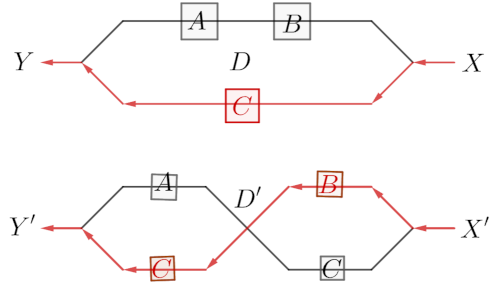
Answer: Yes, for example, pay atte-ntion to the product of sums, or the conjunction of disjunctions in the lower part of the image left:
D' = (C + A) ⋅ (C + B).
This is a statement (Processes II, 4) of the right-hand side of the distrib-ution of disjunction on conjunction, where the upper part is:
D = C + (A ⋅ B)
left side of the equality. A typical picture of the flow of current X' → Y' through the gates, where switch B is open, then in the next C. By checking all the paths, combinations, we find that D = D'. Apply Skolem's theorem, that if a countable first-order theory has an infinite model, then it has models of every infinite ca-rdinal number, and even without my examples, derive the matrix algebra of logic. I just mention that the continuation of what follows is the dual observa-tions (Distribution II).
1. In the gate model, what matters is whether or not the current passed throu-gh the switch, and for the process model of the algebra of logic, what is more important is what happens next at these turning points A, B and C. Here there is also a bypassing of the micro particle-wave through another reality that is not accessible to most, perhaps soon some confirmations by experiments like solenoid. Events can develop in various ways and lead to equal outcomes. An-other thing in this distribution is the confirmation of the logical possibility of objective randomness, or options.
A countably infinite sequence of steps, analogous to the set of natural numbe-rs ℕ, has cardinality ℵ0. It can have countably infinite subsequences, such as the even numbers in the set of natural numbers, so if each subsequence has at least two options, we will have a continuum of options, of cardinality 𝔠. Infini-ty 𝔠 is so much larger than ℵ0 that the continuum cannot be chained. In other words, processes in the round are not accessible to many.
2. The difference between process logic and switch logic is also emphasized by the definition of reality. What does not happen or did not happen is not real and the domain is fantasy. That is, in part (3) of the previous answer, that the logic of the implication of the process, A ⇒ B, in addition to the usual A ⊂ B, if we see the domains of these processes as sets of states, we understand that the consequence B can be a real superset of the cause A. The physical interpreta-tion is that the past can go into excess outcomes from the present. This is in accordance with the principle of minimalism, that states spontaneously tend to be less informative, to a smaller amount of options. Hence the extension of the total information of reality into the past, which is consistent with the du-ration of reality, its ability to have a history. Note that such a view agrees well with the previous one (1), even without introducing the matrix algebra of logic.
Otherwise, I wrote that the past of reality is getting longer, that all its parts, including the present, are slowly fading. They are losing information so that it is overall constant, that due to the decreasing number of events in the present, the flow of time slows down for us. This is still a working hypothesis for me.
3. Every linear operator on a finite-dimensional complex vector space can be written as a linear combination of the unitary operator and nilpotent opera-tors. We write a given operator in the form A = cI + B, where I is the unitary operator, and the trace of the operator B is zero, tr(B) = 0.
For example, a second-order matrix (n = 2):
$$ A = \begin{pmatrix} 1 & 4 \\ 2 & 3 \end{pmatrix}. $$Траг tr(A) = 3 + 1 = 4, па је c = 4/2 = 2, затим:
$$ B = A - 2I = \begin{pmatrix} 1 & 4 \\ 2 & 3 \end{pmatrix} - \begin{pmatrix} 2 & 0 \\ 0 & 2 \end{pmatrix} = \begin{pmatrix} -1 & 4 \\ 2 & 1 \end{pmatrix}. $$Nullpotent matrices N have a trace of zero and a determinant of zero. We find B = N1 + N2 in the form:
$$ \begin{pmatrix} -1 & 4 \\ 2 & 1 \end{pmatrix} = \begin{pmatrix} -x & y \\ 0 & x \end{pmatrix} + \begin{pmatrix} -(1 - x) & 4 - y \\ 2 & 1 - x \end{pmatrix}, $$where tr(N1) = tr(N2) = 0 and we look for det(N1) = det(N2) = 0. We find x = 0 and y = 9/2, so the nilpotent operators:
$$ N_1 = \begin{pmatrix} 0 & \frac92 \\ 0 & 0 \end{pmatrix}, \quad N_2 = \begin{pmatrix} -1 & -\frac12 \\ 2 & 1 \end{pmatrix}. $$Check by squaring that it is indeed N1² = N2² = O, the zero matrix. So:
$$ A = 2I + B, $$ $$ A = 2I + N_1 + N_2, $$ $$ \begin{pmatrix} 1 & 4 \\ 2 & 3 \end{pmatrix} = 2\begin{pmatrix} 1 & 0 \\ 0 & 1 \end{pmatrix} + \begin{pmatrix} 0 & \frac92 \\ 0 & 0 \end{pmatrix} + \begin{pmatrix} 1 & -\frac12 \\ 2 & -1 \end{pmatrix}. $$Every process can be decomposed into a disjunction of correct and incorrect (maybe-type) processes. We are talking about the matrix algebra of logic.
4. This well-known result is important for understanding its application. The true after an untrue process remains true, that is, the unreal after which the real comes gives the real. For example, quantum superpositions become rea-lity by interacting with real measuring devices. Another example:
$$ MN = \begin{pmatrix} a & d \\ b & c \end{pmatrix} \begin{pmatrix} 0 & 1 \\ 0 & 0 \end{pmatrix} = \begin{pmatrix} 0 & a \\ 0 & b \end{pmatrix} = A. $$In a 2-dimensional space, the niloperator A is iff it has a trace and a determi-nant of zero. Here det(A) = 0, so it must be tr(A) = b ≠ 0, for A to be so-called real. That is:
$$ \begin{pmatrix} 0 & a \\ 0 & b \end{pmatrix} = \begin{pmatrix} 0 & 0 \\ 0 & b \end{pmatrix} + \begin{pmatrix} 0 & a \\ 0 & 0 \end{pmatrix}, $$where each power of the first sum is a matrix of the same form, and the second sum is a nilpotent matrix. Therefore A is a "true" process that hides a "false" process in the second sum. Hence the question "Is the brain an organ of the mind?" (Intellect II) has no simple answer.
Atypical » srb
Question: Can that which endures (reality, truth) exist in states without a past?
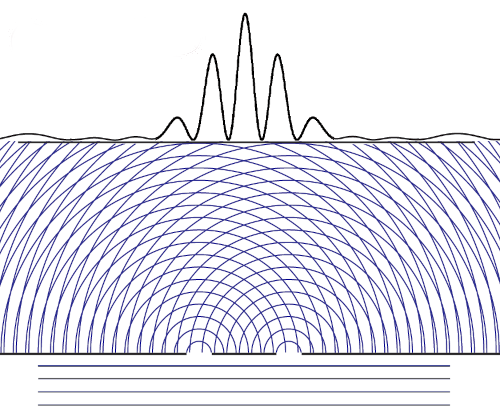
Answer: Yes, what lasts is both cre-ated and reproduced. When a parti-cle-wave is passed through a doub-le-slit (Crumbling, 4) diffractions occur (link on the right) on the sc-reen that catches the waves. The co-llapse of superposition occurs. The state before the particle, which has no space and time, builds physical time, space and reality.
The previous example (Distribution III, 4) in its own way establishes th-at such a "creation" also has suppo-rt from matrix logic. A particle-wa-ve, neither a particle nor a wave in the classical sense, is a physically permane-nt phenomenon in the sense that it itself can disappear, but the total amount of its energy (momentum, information) will be maintained in some other fo-rm. It will last as something third to which these were transitional forms.
1. From the truly permanent creations of the universe, which gradually and over billions of years diminish, to the aforementioned less creative but turb-ulent and abundant ones, everywhere we see the true essence of uncertainty and impermanence of information (the familiar "news" is no longer news). The consequence of this impermanence are all other periodicities, because information is a body of matter, space and time, and uncertainty is its essence. There are constant emergences and disappearances through the repetition of the quantity of what we consider reality in these phenomena, and this also leads us to the conclusion that "reality" is not what changes in this way, but the change itself and something more permanent that it conveys.
2. Transpose of a matrix is its rotation across the diagonal, i.e., the exchange of rows with columns of the matrix. The transposed sum is equal to the sum of the transposes, (A + B)τ = Aτ + Bτ, and the transposed product is the product of the transposes in reverse order, (AB)τ = BτAτ. Thus the previous (4) becom-es:
$$ (MN)^\tau = \begin{pmatrix} 0 & 0 \\ 1 & 0 \end{pmatrix} \begin{pmatrix} a & b \\ d & c \end{pmatrix} = \begin{pmatrix} 0 & 0 \\ a & b \end{pmatrix} = A^\tau. $$By exponentiation with k = 1, 2, 3, ... we find:
$$ (A^\tau)^k = \begin{pmatrix} 0 & 0 \\ ab^{k-1} & b^k \end{pmatrix}, \quad A^k = \begin{pmatrix} 0 & ab^{k-1} \\ 0 & b^k \end{pmatrix}, $$Since (Aτ)τ = A, then ((Aτ)k)τ = Ak. When b ≠ 0, then each of these powers is a non-zero matrix. Because Ak ≠ O for every k = 1, 2, 3, ..., this A is not an unreal process, but it is atypical real.
3. Other examples of atypical real processes are the ladder decrease operator:
$$ \hat{a}^- = \begin{pmatrix} 0 & \sqrt{1} & 0 & 0 & ... \\ 0 & 0 & \sqrt{2} & 0 & ... \\ 0 & 0 & 0 & \sqrt{3} & ... \\ 0 & 0 & 0 & 0 & ... \\ ... & ... & ... & ... & ... \end{pmatrix} $$and its transpose is the increase operator $\hat{a}^+ = (\hat{a}^-)^\tau$. These are infinite mat-rices, so for each k = 1, 2, 3, ... $(\hat{a}^-)^k \ne 0$. When an electron moves from the kth to the k+1 orbit of the atom, the energy state becomes $|k+1\rangle = \hat{a}^+|k\rangle$. Its energy moves from the state |k⟩ to the higher |k+1⟩. Again, $\hat{a}^-|k\rangle = |k-1\rangle$, the electron then loses energy by returning to the lower orbit. The change in energy is not in the status quo, it is an atypical real phenomenon without an upper limit, and therefore these matrices are infinite.
4. We define infinite sets as sets that can be proper subsets of themselves. For example, the set of odd numbers is a subset of all integers, both of which are countably infinite and of cardinality ℵ0. Hence, if infinite divisibility of infor-mation were possible, there would be no smallest packages of them, nor would the conservation law apply to them. In other words, the quantization or atomi-sm of physical reality is a consequence of the finiteness in the divisibility of its communications, or interactions, so we have an analogy with states without a "past", now with a limited internal structure. However, just as the collapse in-to a particle-wave does not come from nowhere, neither are information pack-ets without content, although their composition is not immediately accessible to the "upper" world of physics.
Typical » srb
Question: Can you give a simple general example of breaking down a typical process into "true" and "false"?
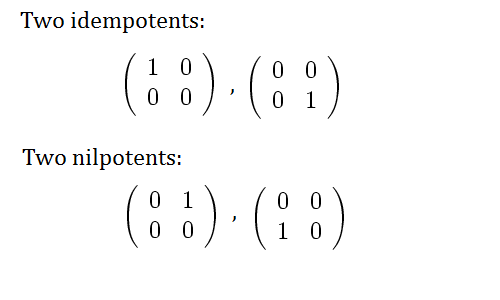
Answer: Simple such matrices will be square matrices of the second order. I have already solved their specific case (Distribution III, 3), but in general we will better notice the exceptions. The peculiarity of square matrices is that every nilpo-tent one has both a trace and a det-erminant of zero. As a reminder, a matrix is involute when its degree is the unit matrix, idempotent if its degree is equal to itself, and nilpotent when its degree is zero.
1. A general square matrix of second order (n = 2) is:
$$ A = \begin{pmatrix} a_{11} & a_{12} \\ a_{21} & a_{22} \end{pmatrix}, \quad a_{ij} \in \mathbb{C}. $$Its trace and determinant are tr(A) = a11 + a22 and det(A) = a11a22 - a21a12. And we decompose it in two steps, first:
$$ A = \frac{\text{tr}}{n}I + B, \quad \text{tr}(B) = 0. $$Hence we find:
$$ B = A - \frac{\text{tr}}{n}I = \begin{pmatrix} a_{11} & a_{12} \\ a_{21} & a_{22} \end{pmatrix} - \frac{a_{11}+a_{22}}{2}\begin{pmatrix} 1 & 0 \\ 0 & 1 \end{pmatrix}, $$ $$ B = \begin{pmatrix} \frac{a_{11}-a_{22}}{2} & a_{12} \\ a_{21} & \frac{-a_{11}+a_{22}}{2} \end{pmatrix} = \begin{pmatrix} b_{11} & b_{12} \\ b_{21} & b_{22} \end{pmatrix}. $$The sum of the diagonal elements, the trace of this matrix tr(B) = 0.
2. We move on to the second step, decomposing the matrix B into nilpotents:
$$ B = N_1 + N_2, \quad N_1^2 = N_2^2 = 0, $$ $$ \begin{pmatrix} b_{11} & b_{12} \\ b_{21} & b_{22} \end{pmatrix} = \begin{pmatrix} x & y \\ 0 & -x \end{pmatrix} + \begin{pmatrix} b_{11}-x & b_{12}-y \\ b_{21} & b_{22}+x \end{pmatrix}, $$The trace and determinant of these nilpotents are zero, so x = 0 and:
$$ (b_{11}-x)(b_{22}+x) - b_{21}(b_{12}-y) = 0, $$ $$ b_{21}y = -(b_{11}b_{22} - b_{21}b_{12}) = -\det(B). $$When b21 ≠ 0 we have a typical situation (Distribution III, 3) with y = 9/2, and in the case b21 = 0 an atypical one (Distribution III, 4).
3. In a typical case:
$$ N_1 = \begin{pmatrix} 0 & -\frac{\det(B)}{b_{21}} \\ 0 & 0 \end{pmatrix}, \quad N_2 = \begin{pmatrix} b_{11} & \frac{b_{11}b_{22}}{b_{21}} \\ b_{21} & b_{22} \end{pmatrix}, \quad b_{21} \ne 0, $$ $$ A = \frac{a_{11}+a_{22}}{2}I + N_1 + N_2. $$In the atypical case, when b21 = 0, i.e. a21 = 0, it will be:
$$ A = \begin{pmatrix} a_{11} & a_{12} \\ 0 & a_{22} \end{pmatrix} = \begin{pmatrix} a_{11} & 0 \\ 0 & a_{22} \end{pmatrix} + \begin{pmatrix} 0 & a_{12} \\ 0 & 0 \end{pmatrix}. $$In a particularly "atypical" previous answer, there was also a11 = 0.
4. It is instructive to consider these situations, with various coefficients aij, to draw conclusions about the truthfulness of the process. However, we make a huge deviation in the analogy with Boolean algebra, which does not work with matrices. It adds numbers in matrices in the following way: 1 + 1 = 1, 1 + 0 = 0 + 1 = 1, 0 + 0 = 0, multiplies in the following way 1 ⋅ 1 = 1, 1 ⋅ 0 = 0 ⋅ 1 = 0, 0 ⋅ 0 = 0. There are no other numbers, and there are no negative ones. That makes the other differences.
5. For example, if here nilpotent matrices are the representatives of falsehood, their sum, such as B = N1 + N2, need not be a nilpotent matrix. As when in a true text we ignore parts and get falsehoods. Such falsehoods taken out of con-text are actually known to us by manipulators who deliberately do not give us their "summary" whole that can be true. This is a peculiarity of matrix logic that has no analogue in Boolean algebra.
6. As another example, let's look at the decomposition of a zero matrix into ni-lmatrices:
$$ O = N_1 + N_2, $$ $$ \begin{pmatrix} 0 & 0 \\ 0 & 0 \end{pmatrix} = \begin{pmatrix} 1 & -1 \\ 1 & -1 \end{pmatrix} + \begin{pmatrix} -1 & 1 \\ -1 & 1 \end{pmatrix}. $$There are as many such separations as we want, but also meanings. The inte-resting thing is the separation of nothingness into untruths, and then in a way similar to the above (5) we can go further, into the formation of truths from untruths, from nothingness. This is exactly what happens, for example, with energy, which in total in the universe is zero, but analogously with other phy-sical phenomena. We can talk about that another time.
Nothingness » srb
Question: Explain to me this idea of a zero-energy universe?
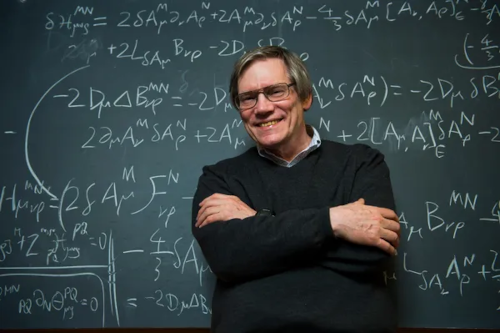
Answer: Alan Gut, the founder of the theory of cosmic inflation 1979, pictured right, also considered the concept that the total energy of the universe could be zero. I have only dragged this and similar ideas to the point of absurdity (Typical, 6).
1. First, the potential energy of gra-vity is negative, and when two bodi-es are separated, they acquire the energy of separation, just as the ends of a spring are stretched, so that their tendency to rejoin each other beco-mes a force. In this way, force and energy are created from nothing. Continui-ng, the formula E = mc² tells us about mass as a very dense package of energy. Then there are consequences that go well with the following, and which of co-urse also correspond to the principle of minimalism.
2. In addition, Max Tegmark (2014) proposed the hypothesis of the mathema-tical universe, which claims that our physical reality is not only described by mathematics, but that it is a mathematical structure. His popular science book inspires the idea of "nothingness", more precisely, abstractions from mathem-atics that in more or less familiar ways create space, time and matter, in short, everything that is studied by physics, chemistry and other sciences including biology, psychology, and still more or less unknown to us today. An example in this (my) theory of information is already largely in the emergence of order from disorder, for example, through the law of large numbers from objective uncertainty (non-causality) certainty arises. However, diversity reduces info-rmation (the amount of uncertainty) and physical reality has found itself in a kind of trap — wanting to have more of everything so there is less of it.
3. A third way to view the null universe is from the superpositions of quantum mechanics. These are mathematical abstractions, vectors and probability wav-es, that collapse into physical reality with energy ranges ΔE and durations Δt forming quanta of action, the product ΔE⋅Δt = h. Note that these time interva-ls are assigned from the point of view of external observers, for the world of physical reality (upper) and that the world of superpositions (lower) has no defined space and time. Hence, for example, observers moving towards and away from a light source will see on average increased photon energies ΔE = hf and higher frequencies f = 1/Δt the Doppler effect.
4. We come to the idea of zero energy of the universe here from the matrix algebra of logic, the upper triangular matrices, when the conjunction of a correct and incorrect process is always an incorrect process, T⋅N = N, which was then extended to matrices in general and further and became even more hypothetical. Regardless of the possible correctness of the idea of "zero ener-gy", I consider the path to it through these "extended" matrices of logic to be debatable. However, this does not have to be a reason not to discuss the same concept on another occasion.
Collapse IV » srb
Question: Can you add anything more about the collapse of the wave function from the perspective of a "zero energy" universe?

Answer: Here's an interesting atte-mpt. Wave function:
Ψ = Aei(kx - ωt),
explained in the image link on the left, is a probability distribution, which is the chance |A|², where A(x, t) ∈ ℂ changes depending on the position x and time t in the "upper" world (physically real) while the "lo-wer" (superposition) does not know about space and time, to become a physi-cally real particle-wave. The total uncertainty of the Ψ distribution will beco-me information if a collapse occurs, and vice versa, the information after the collapse will become the uncertainty of the distribution in the case of a return to the "lower" world. This uncertainty of the multitude of options is transferr-ed into the information of at least two options of the particle-wave that, during its duration, titrates for the content of its options.
1. The distribution information is transformed into the outcome information, the uncertainties of the same quantities change roles, but the resulting physi-cal phenomenon must maintain its assigned range of oscillations and the per-mitted conserved physical properties (energy, momentum, spin, charge, mass) within the physical space-time in which it appeared. The basic form of the wa-ve function:
Ψ = A[cos(kx - ωt) + i sin(kx - ωt)]
are made up of space x and time t. These are the first carriers of uncertainty, the information into which the superposition collapses. Hence the oscillation which is also coordinated with, say, the energy E = hf of the quantum, where we see how the frequency f connects the law of conservation of energy. The collapse occurs because there was room in the physically real world, that is, because something from the "above" will descend into the "below" world.
2. Oscillations are, therefore, an expression of the amount of uncertainty (inf-ormation) and it is independent of, say, energy. I mention this because the pu-blic often confuses the concepts of information with energy, and in their own way with entropy and the like. The particles of light waves are photons, a type of bosons of which more than one can be in the same place at the same time. That is why interference exists.
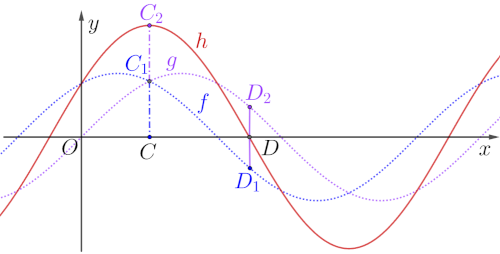
On the graph on the right are three sinusoids:
f = f(x), g = g(x), h = f + g.
Point C is the constructive interfe-rence finesse, and destructive is at point D. This is a mathematical pr-operty of wave functions as vectors, which is fundamental to quantum mechanics and helps determine the probabilities of measuring, finding a given observable in given circumstances. This is what “positive” and “negative” inte-rference tell us, that the cancellation of the amplitudes at point D of the sum wave h is compensated by an increase at point C.
At a very "extended" point D, when the photon waves completely annihilate into darkness (Destructive), their energies will still persist, returning to the source, or not leaving it at all, or remaining somewhere in the medium thro-ugh which the wave (at all) passes. The vibration information is also stored even when we do not see it, as energy separately. If the thus "annihilated" photons were separated, they would be the old ones again.
3. Energy is the work of a force on a path and as such here is something that is constantly changing, the range of energy changes ΔE which is maintained by particle-wave vibrations. It has been said that ΔE is not independent of infor-mation, although this is not entirely true, because we are talking about infor-mation that exists thanks to physical space, and yet, space is what defines en-ergy. If there is no space, there is no energy, nor is there any realized informa-tion. In this sense, energy is fabricated, inflated like a balloon that can deflate and cease to exist in its own form. In this sense, quantum particles are the "ze-ro energy" of the universe, and then so is everything else they do.
4. The principle of minimalism underlies these considerations: a preference for greater probability, less uncertainty, less information, and less action. If nothingness really existed, it would have to resemble a black hole (Prolonga-tion, 3), so strongly attracting everything that light would stick to it, as would the multitude of information that would surround it spherically, completely attached as if to some of its surface. When information stands before everyth-ing (space, energy, charge), extremes, dualisms, positive and negative values are inevitable. Differences are the essence of uncertainty, and when they appe-ar, the very desire for them to be absent leads to their increase, because hom-ogeneity has maximum information. Once a cosmos of information occurs, it has fallen into a trap from which it can no longer escape.
Repel » srb
Question: Do electrons in superposition repel each other?
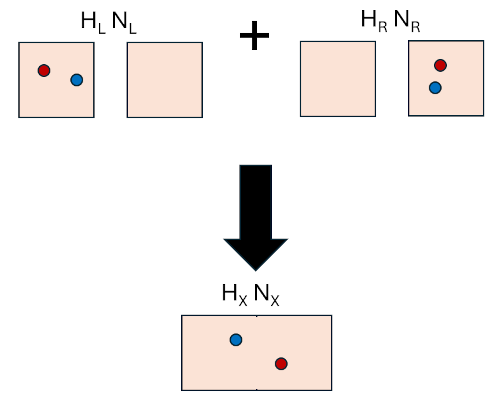
Answer: Yes is the generally accep-ted answer. Separate electrons in a quantum superposition are repelled by the electromagnetic (Coulomb) force, although their repulsion is calculated in terms of all the positi-ons or states they occupy at the sa-me time. But, in detail, this questi-on becomes increasingly interesti-ng, and instructive.
1. Electromagnetic "induction", as a consequence of something that pre-ceded it, can be treated as "short-term memory". From fields, electric or magnetic, which do not change in the direction of motion but only perpendicular to the velocity, in the emergence of the latter we see the significance of the motion then of space and time. In oth-er words, they are in the world of collapse "above" (physically real) rather than in the states of superposition "below" that precede them. In the image on the left is a link that discusses "Is superposition a disjunction or a conjunction?", where I would add that superposition is a conjunction (a∧b) which by collapse becomes a disjunction (a∨b).
2. A single electron in a superposition does not bounce off itself. Individual electrons will not completely cancel out or be destroyed by quantum super-position, but the electron waves can produce their own destructive interfe-rence, which is compensated by constructive amplitudes. This destructive interference moves the electron to where it is more likely to be detected and does not destroy the particle itself, so the overall probability remains 1. The basic properties, charge and number of electrons, are also preserved, thus resembling photons which are bosons, although electrons are fermions.
3. This (2) I refer to as a property, indivisibility or elementaryity. It comes to us from the finiteness of our perceptions (the upper world) and leads to cons-ervation laws, in contrast to the world of quantum superpositions, the lower one, which may also be a continuum. In general, elementary properties are packages that can be unpacked from another point of view, just as an axiom in one formal system can appear as a theorem in another system of axioms. In this sense, the property, or elementaryity, is held together by some "force".
4. This (3) was an idea I once mentioned (Current) but which I avoid talking about because it is easy to misunderstand. Two electrons, like two currents flowing in the same direction, would attract each other, they would be a cu-mulative charge together. However, even the slightest deviation from this parallelism would mean movements in different directions, the electrons approaching or moving away, and thus their repulsion. Then there would be constant repulsion. Particles with the property of "charge", attractive at rest but otherwise repulsive, seem to have fallen into a trap that makes them ap-pear constantly repulsive. Electrons also repel each other in interference, be-cause exact parallelism is an extremely unstable state for them.
Intelligence IV » srb
Question: You said what intelligence is otherwise, but what would it be in this context?
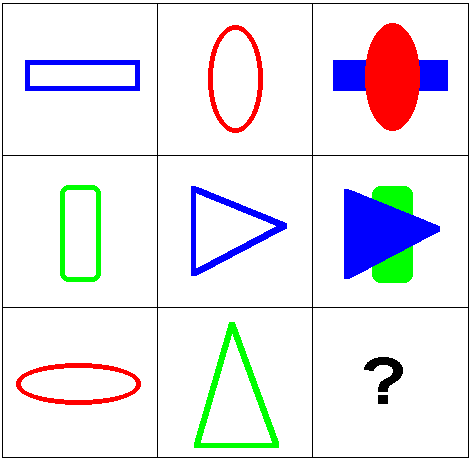
Answer: Intelligence here is the in-tellectual ability with which we red-uce the information of a given top-ic. This interpretation arises from the analysis of the letter frequency and their information in smart te-xts. Also from the observation of the excess information of "life" in relation to "inanimate" bodies that behaves as a potential ready to be converted into kinetic energy and work. Like a pickaxe with the swing of which we drive it deeper into the ground. It defines intelligence con-sistently with information theory and otherwise by the way we look for "logical" solutions in tests as in the picture on the left.
1. The implication, a ⇒ b is an order relation, ∀a, b, c ∈ {⊤, ⊥}:
- Reflexivity: a ⇒ a,
- Antisymmetry: ((a ⇒ b) ∧ (b ⇒ a)) ⇒ (a = b),
- Transitivity: ((a ⇒ b) ∧ (b ⇒ c)) ⇒ (a ⇒ c).
Such statements are usually proven in three ways. The first is by trying all co-mbinations of "true" (⊤) and "false" (⊥). For example, the reflexivity implicat-ions ⊤ ⇒ ⊤ and ⊥ ⇒ ⊥ are true, and these are the only possibilities. When we check everything, it is enough to check whether there are any false statements, and this is then the third way. The only false implication is ⊤ ⇒ ⊥. This gives an incorrect consequence in the case of antisymmetry (a ≠ b). That gives a = ⊤ and b = ⊥, or a = ⊥ and b = ⊤, which in the assumption gives:
((⊤ ⇒ ⊥) ∧ (⊥ ⇒ ⊤)) ∨ ((⊥ ⇒ ⊤) ∧ (⊤ ⇒ ⊥)), (⊥ ∧ ⊤) ∨ (⊤ ∧ ⊥), ⊥ ∨ ⊥, ⊥.
So, a contradiction. It is not true that the assumption that antisymmetry can be false is false. For transitivity to be false, the consequence (a = c) must be false, which means that a = ⊤ and c = ⊥, which is in the assumption:
((⊤ ⇒ b) ∧ (b ⇒ ⊥)), ((⊤ ⇒ ⊤) ∧ (⊤ ⇒ ⊥)) = ⊥ ∨ ((⊤ ⇒ ⊥) ∧ (⊥ ⇒ ⊥)) = ⊥.
Both choices b ∈ {⊤, ⊥} lead to falsehood and a contradiction, the assumption that the transitivity of an implication can be false. Here's why this is importa-nt.
2. The implication is a relation of the same form as the inequality 7 ≥ 6 ≥ 5, also a superset A ⊇ B ⊇ C, that is:
{1, 2, 3, 4, 5} ⊇ {2, 3, 4, 5} ⊇ {2, 3, 4}.
We note that the consequences in the implications are "less" than the assum-ptions. We take this here in the sense of narrowing down the options, that by excluding an outcome the probabilities of the remaining events increase, with decreasing information of the distribution. For example:
-p1 ln p1 - p2 ln p2 - p3 ln p3 ≥ -q1 ln q1 - q2 ln q2,
$$ -\frac13 \ln \frac13 - \frac13 \ln \frac13 - \frac13 \ln \frac13 \ge \frac12 \ln \frac12 - \frac12 \ln \frac12, $$1.09861 ≥ 0.69315.
The probability distributions (pi and qk) are positive numbers with a unit sum. In general, information will decrease as the number of possibilities decreases, as more certain news is less news.
3. According to the above, it turns out that intelligence is the ability to exclude the unimportant. In other words, it is the separation of the false from the true. Thus, we are again in the field of logic, and now also on the absurd understan-ding that the greater vitality, with which we have more opportunities to choo-se than inanimate matter, the more it can control the choices, thus gives inte-lligence. Intelligence controls its inevitable lies. We find the same strange co-nclusion from the "stickiness" of lies to those who perceive them and the losi-ng nature of lying. Similarly, a mathematician uses ⊤ and ⊥, or the method of contradiction (false assumption) to arrive at a theorem.
4. Intelligence is the ability to reduce the information of a given topic, but it does not imply exclusively the search for truth. Untruth is in itself less inform-ative. It is attractive to the listener, but it requires an effort of vitality to create, so we have other types of intelligence: artistic, storytelling, socializing and the like. Building is more difficult than using, finding than remembering, due to the principle of minimalism, because the first defies uncertainty, and the seco-nd bypasses it. Intelligence requires an effort of creativity to solve problems, but it also feeds on anxiety. In the simple formula information perception, the ranges of intelligence I = S : H are directly proportional to the freedoms S and inversely proportional to the restrictions H, the hierarchy. And this highlights the power of curiosity and the ability to avoid obstacles.
Three-valued » srb
Question: Łukasiewicz's logic is not the only trivalent one?
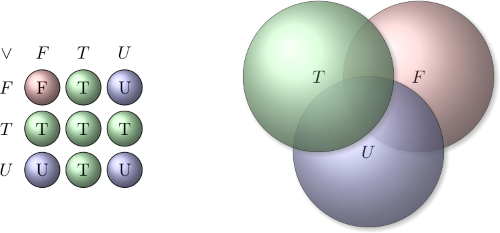
Answer: In the attachment on the right you have 3-D Venn diagrams. In the picture, “True” is at the top, then “Unknown” and “False”. When we give them decreasing values 1, 0 and -1, disjunction becomes a max-imum, conjunction is a minimum, and negation is a change of sign. This is common to the two leading logics, Strong Kleene (K3) and Łukasiewicz (Ł). The implication of the first is A ⇒ B = ¬A ∨ B, and the implication of the second is distinguished from first (0 ⇒ 0 ≡ 0) only by 0 ⇒ 0 ≡ 1. In addition to these two and the examples given in the link, the books also mention the Logic of Paradox.
1. The statement "it may rain tomorrow" is true in Ł logic, and it may be true in K3 logic. The Polish logician Jan Łukaszewicz (1920), who developed this three-valued logical system, believed that the statement "if there are naval ba-ttles tomorrow, then there will be naval battles tomorrow" must be absolutely true, even if the battle itself is only possible at this moment. Because of such an implication, in Łukaszewicz's logic the formula A ⇒ A always has the value 1 (it is a tautology), while in some other multivalued logics this is not the case.
2. The classical equivalence A ⇔ B = (A ⇒ B) ∧ (B ⇒ A) is also interesting, be-cause for B = ¬A it gives (A ⇒ ¬A) ∧ (¬A ⇒ A), which becomes the “incorrect” statement A ⇔ ¬A for A ∈ {1, -1} and “maybe” for A = 0. Łukasiewicz A = 0 is the only value that is equivalent to its negation. According to the Kleene equi-valence (the same to the Kleene implication), this is not true, since A = 0 is not equivalent even to itself. According to Kleene logic, a statement with the truth value 0 may (or may not) express opposite views and we cannot assert in adv-ance that their equivalence is true. According to Łukasiewicz’s logic, all truth values of 0 are equivalent. These differences between Kleene and Łukasiewicz logic come from the different meaning of the truth value 0 (unknown, maybe).
K3 logic treats the implication as the classical A ⇒ B = ¬A ∨ B for each truth value {1, 0, -1}, so it has difficulty with “maybe”, because 0 ⇒ 0 = ¬0 ∨ 0 = 0, and the same consequence as the assumption “would” give the true implicati-on. Ł3 solves this problem by abandoning the classical one with 0 ⇒ 0 = 1 on-ly, without changing the other values of the implication. In conjunction, disju-nction and negation both K3 and Ł3 logics agree, but we have seen how this little thing, with the addition of “maybe”, further complicates things.
3. The liar's paradox is: "This sentence is not true". The following is similar: "Ana says that Boban is telling the truth, and Boban says that Ana is lying". The logic in such paradoxes reveals to us that something is wrong with our view of reality, because reality is true and cannot lie. Moreover, the universe and everything around it may be mathematics itself (Nothingness, 2). Let's consider another example (Hangman's Paradox), and draw conclusions.
The judge told the condemned man, Marko, you will be hanged one of the next seven days and it will be a surprise for you. But Marko is a logician and knows how to think. Tomorrow is Monday and, if I am not hanged by Saturday, there will be no surprise on Sunday. So, I will not be hanged on Sunday. But then there will be no hanging on Saturday either, because Sunday is out of the que-stion. Hence Marko, day by day, comes to the conclusion that he will not be hanged on any of the days of that week. Hurray, Marko rejoiced. However, he was still hanged on Wednesday and that was a real surprise to him.
4. The "liar's paradox" and variations of such contradictions are thought to ha-ve not yet been explained, but I believe that Tarski was close to a solution and I find this idea in the hierarchy H = S : I, where S is freedom and information of perception, then in the duality and especially of the subject and object of perception, and in the uniqueness of that perception. Originally, there are le-vels L0, L1, L2, ..., Ln of language so that each level cannot judge itself, say as "a fool who doesn't know he's a fool", but the kth level (0 < k ≤ n) can judge lower than itself. So in the above "This sentence is not true" is not true. Also, at most one of Ana and Boban can be right. So quantum superposition colla-pses into some physical reality giving it time, therefore order and hierarchy. Incidentally and space, and therefore the relativity of motion, when mutual observers do not see each other equally, or in general, we have dual always unequal perceptions of subjects.
Hierarchy III » srb
Question: What is hierarchy?
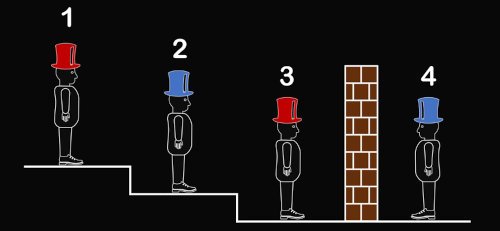
Answer: Hierarchy is a system in which persons, their groups, then objects and concepts are arranged in different levels based on their importance, or value. This is an ac-cepted interpretation, to which we add here that hierarchy is also a relationship between subjects and objects. That is consistent with inf-ormation theory in which communication is the backbone of events. We see it in the example of the puzzle in the image on the left.
1. The facilitator showed the participants the picture on the left with four peo-ple who cannot see their hats, while 1 can see the backs and hats of people 2 and 3, person 2 can see 3, and 3 and 4 are looking at the wall and do not know what is happening around them. They were told that two red and two blue ha-ts were standing on their heads, one on each of them, and one of them was ex-pected to logically discover which of the hats they had. The facilitator asked the participants which of the four in the picture could find out and how.
Similar questionnaires are used to measure the ability to perceive the truth of a subject, say, before and after a period of lying training, to assess the decline in cognitive abilities (See Truth), or to find future logician competitors. There are two levels of the questionnaire, the harder the answer to the question just given, and the easier it is to understand the solution that will follow. Namely, by losing the ability to extract the truth, the power to recognize it also decreas-es. Here is the solution, so compare.
2. In the given arrangement in the picture, only person 2 can infer the color (blue) of his hat. Namely, 3 and 4 have no chance, because they only see the wall. Person 1 sees a blue (2) and a red (3) hat, with the conclusion that he can have both, blue and red. However, due to person 1's hesitation and with the red hat (3), person 2 can discern that he has a blue hat.
In this example, we also see the meaning of hierarchy in relations. I previously emphasized the importance of hierarchy (Three-valued, 4) in resolving the "li-ar paradox", that we cannot judge ourselves correctly, but we can by referring to the opinion of another (1) about us (2).
3. It should be noted that the tests that measure intelligence, at least to this day, do not measure the ability to understand the truth of the test taker. They also measure the skill of lying, and additionally "situational" ability, depende-nt on past knowledge. For example, continue the series 29, 31, 30, ... with 32 and you will be wrong, because the correct answer is 31, i.e. the number of da-ys in the month. Another example, how is it possible to add 5 to 9 and get 2? These are the numbers on a clock, and more and more of us are becoming less and less able to read those old clocks. In the example above with the hats, we see that many participants are not even given the opportunity to see the truth. Hierarchy does not have to be a relation of order, nor does everything we kn-ow have to be included in it.
4. Regardless of their intelligence, persons 1, 3 and 4 in the picture are not gi-ven the ability to make a correct conclusion about the color of their own hat, and neither is person 2 able to do so without the help of person 1's indecision. We also find this in dual observations of physical phenomena (Conjugated), especially in the inability of a dead physical object to understand itself and which cannot lie, compared to our ability to understand but also to lie. It wou-ld be as if the legislative, judicial and executive branches of government, for example, were in the jurisdiction of positions, oppositions and randomly sel-ected groups of citizens, which would change cyclically, without the right to choose themselves. Societies can do whatever they want, but nature, which cannot lie, is not allowed to contradict itself, to cease to exist.
Liar! » srb
Question: Strangely enough, nature cannot judge itself?
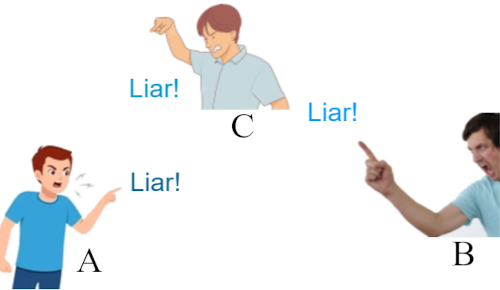
Answer: That's right, otherwise it would fall into contradictions. Ma-thematics would not be valid in physics, and physical phenomena would be unreliable, lies. I proved the uniqueness of the perceptions of subjects a long time ago from linear algebra, and you will notice that as basic in the following consi-deration of the same from logic.
1. The liar's paradox arises when one person (Three-valued, 3) says "I am lyi-ng" about themselves. If he is telling the truth, he is lying, and if he is lying, he is telling the truth. This is a contradiction. We have a similar situation with th-ree people A, B, and C, as in the picture on the right, when the first (A) says th-at the second (B) is lying, the second says the same about the third (C), and the third says the same about the first. Namely, if A is telling the truth, then B is lying, so C is telling the truth, that A is lying. Contradiction. Again, if A is ly-ing, then B is telling the truth that C is lying, which means that A is telling the truth. Again, a contradiction. The on-off switches, or plus-minus, indicate that any odd number of people who would cyclically claim that the next person is lying would build a contradictory circle, and that in the case of an even numb-er of such people, they would have agreement.
2. Nature avoids these situations, for example, as we know, by the relativity of motion. If body B moves with speed v relative to A, and in the same direction C moves with speed v relative to B, then C moves with speed:
$$ u = \frac{2v}{1 + \frac{v^2}{c^2}} \lt 2v, $$with respect to A, where c = 300,000 km/s is the speed of light. The mass of the part that would be m0 in each of these three systems at rest, for the first (A) body, in the second (B) and third (C) would be, respectively:
$$ m_B = \frac{m_0}{\sqrt{1 - \frac{v^2}{c^2}}}, \quad m_C = \frac{m_0}{\sqrt{1 - \frac{u^2}{c^2}}}. $$The observations of the "same" mass m0 at the place of the second and third observer, by the first one, are different, mB ≠ mC and both are different from m0. The relativity of motion and the independence of the speed of light in a vacuum from the speed of the source, are enough to understand how nature defends itself against contradictions, such as the liar's paradox. Simply, my view of myself and the views of others about me are not the same, so a cont-radiction like the "liar's paradox" fails.
3. We do not need the relativity of motion to notice the differences in the faces of objects viewed from different places. Even if they were the same from all si-des, symmetrical, such objects are in different environments and we perceive them differently. These perceptions may be approximately equal, but any atte-mpt to reduce them to exactly equal, microscopically observed, is impossible. Every perception of the environment of every subject in the universe is uniq-ue, also by the same subject at different times. Hence all cyclic statements as in the previous picture, whether of even or odd estimators, can be consistent. This uniqueness is a consequence of Riesz's Lemma through perceptual infor-mation as a scalar product of the state of the subject and the object. Although, at least at first glance, it has nothing in common with the algebra of logic, it comes to the same conclusion with this one, that nature delicately avoids contradictions.
4. Finally, if we assume that physics is mathematics itself (Nothingness, 2), th-is also becomes consistent with Gödel's second theorem, that mathematics will not prove itself, especially when it is a whole that (in realities) we can only pe-rceive in parts with finite perceptions. If our reality has a formal abstract root in that whole, the impossibility of its evaluating itself, behold the absurdity, comes as a protection against contradiction.
Four-valued » srb
Question: Can truth in logic be neither true nor false, as well as both, pair true and false, in addition to true and false?
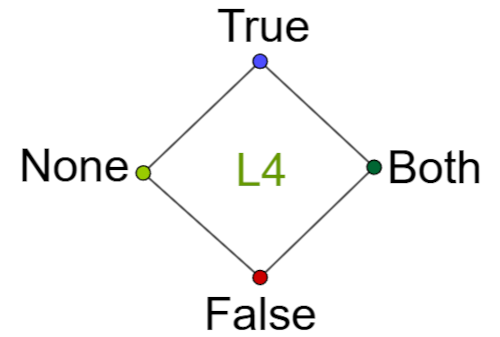
Answer: Four-valued logic system is like this. Boolean "true" and "fa-lse" are supplemented by "both" (true and false) and "neither" (not either true or false). Between this and Boolean there is paraconsistent logic which has "both" which allows contradictory statements. Accordi-ng to it, there is only one trivial th-eory, the one that has every senten-ce as a theorem. The further additi-on of "none", in 4-valent logic, allo-ws for empty "statements", without content or information. This is not possib-le in my information theory, but a "truth" of a proposition that is "neither true nor false" could be a technically useful implication, although it is fundament-ally unacceptable according to this information theory.
1. In the notations N, F, T, B meaning none, false, true, both, Nuel Belnap in 1975 considered the answers to questions by computers and listed the negati-ons ¬N = N and ¬B = B, in addition to the Booleans ¬F = T and ¬T = F. In ad-dition, he gave the following table of conjunctions:
| ∧ | None | False | True | Both |
|---|---|---|---|---|
| N | N | F | N | F |
| F | F | F | F | F |
| T | N | F | T | B |
| B | F | F | B | B |
The idea of the given table is that x ∧ y is true (T) if x is true and y is true, and that x ∧ y is false (F) if x is false or y is false. When x ∈ {T, B} is “x is true” and “x is false” with x ∈ {F, B}, from this we find the truth table for the conjuncti-on.
2. The disjunction table of this 4-logic is:
| ∨ | None | False | True | Both |
|---|---|---|---|---|
| N | N | N | T | T |
| F | N | F | T | B |
| T | T | T | T | T |
| B | T | B | T | B |
Using the image above on the left as a Hasse diagram, conjunction becomes the largest lower bound, and disjunction is the smallest upper bound, of the truth values x and y within a partial order.
3. Thanks to the negations ¬N = N and ¬B = B added to the classical (Boolean, 3) ¬F = T and ¬T = F, the De Morgan laws hold for this 4-valent logic:
¬(x ∧ y) = (¬x) ∨ (¬y), ¬(x ∨ y) = (¬x) ∧ (¬y).
Check, the table of negation of conjunctions:
| ¬(x ∧ y) | None | False | True | Both |
|---|---|---|---|---|
| N | N | T | N | T |
| F | T | T | T | T |
| T | N | T | F | B |
| B | T | T | B | B |
is equal to the table of disjunctions of negations. The second, the negation of disjunctions:
| ¬(x ∨ y) | None | False | True | Both |
|---|---|---|---|---|
| N | N | N | F | F |
| F | N | T | F | B |
| T | F | F | F | F |
| B | F | B | F | B |
is equal to the table of conjunctions of negations.
4. In Nuel Belnap's original four-valued logic, known as First-Degree Entailm-ent (FDE), implication is not defined as an internal truth-functional connecti-ve within the system.
Vitali » srb
Question: When information is the foundation of everything, is everything th-en measurable?
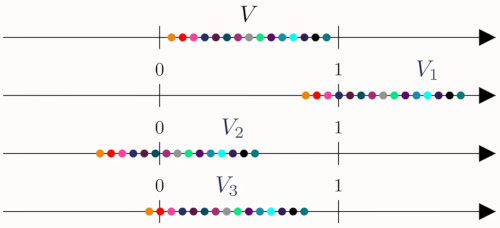
Answer: No, the concepts "measur-able" and "to exist" do not have the same meaning. In a context like th-is, I do not link information to som-ething fixed, nor to a specific value. The history of mathematics is repl-ete with examples of phenomena of imprecise origin. I will point out another one—this time regarding Zermelo's Axiom of Choice—which I bypassed while attempting to explain the Banach-Tarski paradox.
1. A totally ordered set S, together with a total ordering relation ρ (usually ≤), is one that possesses the following properties (∀a, b, c ∈ S):
- Reflexivity: a ρ a.
- Symmetry: if a ρ b, then b ρ a;
- Antisymmetry: a ρ b and b ρ a implies a = b.
- Transitivity: a ρ b and b ρ c implies a ρ c.
- Comparability (trichotomy): ∀a, b ∈ S, either a ≤ b or b ≤ a holds.
RST properties define an equivalence, while RAT defines a "partial ordering." Adding trichotomy to RAT results in a "total ordering." A totally ordered set (S, ≤) is "well-ordered" if and only if every non-empty subset of S has a least element.
2. We know that finite, totally ordered sets are always well-ordered. The nat-ural numbers 1, 2, 3, ... are also of this type, having a least element (1) and any two elements being comparable. However, infinite sets—and the real numbers in particular—present difficulties regarding total orderings; they require the Axiom of Choice.
It is uncontroversial that one element can be selected from each of a finite number of non-empty sets. The Axiom of Choice establishes this for infinite collections and uncountable sets, such as intervals of real numbers. If a single element is singled out from such sets (without explicitly defining it) and desi-gnated as the first, then a second can be taken from the remainder, followed by a third, and so on, resulting in a well-ordered sequence. This sequence need not have its numbers arranged according to numerical value. For instance, the sequence r1 = 7, r2 = -3, r3 = 25, ..., rk ∈ ℝ, ... is well-ordered. This indicates that the Axiom of Choice and the Well-ordering Theorem (all sets can be well-ordered) are mathematically equivalent statements in standard set theory.
3. That was a simple example compared to the following one involving the Vitali set. Let us take a real number r ∈ [0, 1) and consider all numbers x in that interval. When the difference r − x is a rational number (r − x ∈ ℚ), we place x in set A; if the difference is not rational (r − x ∉ ℚ), we place x in set B. The first set contains all rational numbers (A ⊂ ℚ), along with some irrational ones if r is irrational. For instance, if r = π/4, then any number x = r + q belo-ngs to A whenever q ∈ ℚ. Sets A and B share no elements (A ∩ B = ∅); we say they are disjoint. We further partition the elements of set B into sets Bi index-ed by irrational numbers, such that b1 and b2 belong to the same set Bi whene-ver b1 − b2 ∈ ℚ. These sets are disjoint—Bi ∩ Bj = ∅ if and only if i ≠ j—where-as Bi = Bj if i = j. Please also refer to the explanation linked to the image above. The union of all these sets is one way to form a Vitali set:
$$ V = A \bigcup_{i\in \mathbb{Q}} B_i $$which contains all real numbers from the interval [0, 1).
4. We can construct a Vitali set by selecting a representative—specifically, one element—from each set A and all the sets Bi. This is possible thanks to the Axi-om of Choice; even if we do not know exactly which numbers they are, they fo-rm a set C. The set of rational numbers is countable, as is the set of rational numbers within the interval from -1 to +1; this means they can be arranged into a countable sequence q1, q2, q3, ... ∈ [-1, 1). We then add the k-th term of this sequence to every number in set C to define a sequence of sets Ck. By ta-king k = 1, 2, 3, ... in turn, we obtain a sequence of Vitali sets C1, C2, C3, ..., which are disjoint.
Namely, if ck and cn belong to different sets in that sequence, and if ck − cn = q for some rational q, we would have a contradiction, because the k-th and n-th numbers belong to different Vitali sets, which differ by an irrational number. Next, we again find the union:
$$ S = \bigcup_{k=1}^\infty C_k $$of all real numbers from the interval [-1, 1).
5. In the most general mathematical sense, there is the Lebesgue measure of sets, μ(S), applicable to lengths, areas, and volumes, as well as velocities, mo-menta, energies, and the like. A point T has a length of zero—μ(T) = 0—and the sum of an infinite sequence of zeros is zero. The interval [0, 1) has unit measure: μ([0, 1)) = 1. When an interval is translated, its length remains unc-hanged; for instance, μ([2, 3]) = μ([5, 6]). The lengths of disjoint intervals are additive. These are the three properties that define the Lebesgue measure.
Applied to Vitali sets, say (4), this yields:
$$ \mu(S) = \mu(\bigcup_{k=1}^\infty C_k) = \sum_{k=1}^\infty \mu(C_k). $$We do not know the measure of the interval μ(Ck), but we know that they all have the same measure—μ(Ck) = μ(Cn) = m—so the given union consists of infinitely many terms equal to m. Thus, if m = 0, then μ(S) = 0, whereas if m > 0, then S = ∞. This is impossible, because the set S consists of real numbers from the interval [-1, 1], which has a length of no more than 3. Therefore, the Vitali set S is not measurable.
6. One of the (hypo)theses of my information theory—which persistently with-stands rigorous testing—is the equivalence between physical reality (observab-le, permanent, and true) and theorems. Unlike those singular, finite physical observations, their abstract truths recur and lie hidden in layers in countless ways that are irrelevant to our survival. We are generally unaware of such ma-thematical truths inherent in physical reality—such as the fact that "the mid-points of the sides of any quadrilateral form the vertices of a parallelogram" (Example 8).
Given that time effectively organizes physical phenomena, we would say that the Axiom of Choice holds (2) in that world; thus, it makes no sense to claim that absolutely everything within it is measurable—at least not for the time being. Consistently, since information is the foundation of everything, it, too, would be immeasurable within those phenomena.
Finite » srb
Question: The Axiom of Choice is equivalent to the Well-Ordering Theorem—and, as you say by times flow, to the paradox of ball duplication. Where, then, do conservation laws come from?
Answer: The previous answer des-cribes the Axiom of Choice and its consequences—well-ordering and non-measurability—while the ima-ge on the left links to descriptions of the Banach-Tarski paradox, wh-ich I have written about before. In short, it relies on the irrationality of the number π—whereby a sequence of rotations by a rational angle alw-ays yields new points on the circle—and the subsequent isolation of the rema-ining points, which converge to form complete circles. That is something we are familiar with, let's say.
1. First of all, we transfer the mathematical concept of infinity to the foundti-on of physical reality. Almost everything in mathematics can be represented by sets—with the notable exception of a hypothetical "set of all sets." Specific-ally, if we were to have a maximally universal set possessing all properties, it would also possess the property of "not belonging to itself." This is the usual case, as it is very difficult to find a set that belongs to itself. However, if A is the set of objects satisfying this property, and if it belongs to itself, then it cannot belong to itself; conversely, if it does not belong to itself, it ought to belong to itself. This is a contradiction—Russell's paradox. Therefore, the assumption that there exists a set containing all properties is incorrect.
Similarly, we can prove that the empty set ∅ is a subset of every set B. Indeed, if we assume the contrary—that ∅ is not a subset of B—it implies the existence of at least one element x such that x ∈ ∅ and x ∉ B. However, the empty set co-ntains no elements; thus, the statement x ∈ ∅ is false, and the assertion ∅ ⊆ B must be true. We complement the condition arising from Russell's paradox—where A = {x | x ∉ x} demonstrates that not every "property" belongs to the universal set A—with the fact that "nothing" belongs to every set B. Then, we interpret these two extremes conditionally: the "universal" set is limited to one that is merely large enough to encompass everything required for a given task, while the "empty" set represents a lower bound beyond which we cannot desc-end.
2. I believe that infinities "exist," but they are not realities in this context due to the ease with which conservation laws can be violated. I have written more extensively about the atomism of information and its packaging into quanta of action, as the issue of infinite divisibility is easier to describe than, say, the Ba-nach-Tarski ball being replicated into multiple identical copies. Infinity is de-fined by the property of being able to be its own proper subset; this very char-acteristic violates the conservation laws—such as those governing charge, mo-mentum, and energy—that define physical reality. Therefore, the world of ph-ysical interactions—and indeed of perception and communication—must be finite in every respect to exist as it does for us.
When quantum superposition collapses, it forms a particle-wave entity—endo-wing it with a presence in space-time—and integrates into physical reality wit-hout violating conservation laws. Superposition transitions from the infinite to the finite—moving, as I put it, from the "lower" realm to the "upper" realm of our physical reality. Whenever a superposition collapse occurs, a reciprocal process—a reversion of reality—takes place elsewhere; given the ease of the physical interactions we witness daily, reality constantly flickers between such states, possibilities, and outcomes.
3. The persistence of a state implies the possession of a past; this constitutes a form of mediation—a third category of phenomena, situated between superpo-sition and collapse, which I attribute to this information theory. The possibili-ties of physical reality come and go, yet their totality—spanning both the pre-sent and their past—endures. The densest among these is the information of reality itself; in accordance with the principle of minimalism, it holds the least attraction for itself, yet is all the more strongly drawn to the other two. Hence the constant need for "flickering"—the alternation of reality with fiction, or the seeking of validation from a past that is being consumed by this very process. The history of reality both depletes and expands, at the expense of an increas-ingly scarce reality—a state marked by a lower concentration of options, or respectively, growing certainty.
The reality of the present advances toward the future at the speed of light—I presume—encountering fragments of phenomena that might have a longer or shorter "duration." The concept of "duration" does not exist as such in the wo-rld of quantum superposition; rather, I am referring to the state that emerges following the collapse. Those with a longer duration would persist longer, and this is, perhaps, an alternative or supplementary form of this theory. I am kee-ping that possibility in reserve, but I simply do not have the time to consider it—or others like it—at the moment.
4. The Axiom of Choice—which posits that one can select a single element fr-om each set within a collection of non-empty sets—is obviously acceptable for finite collections of sets, and even for countably infinite ones (such as the sets of natural numbers $\mathbb{N}$, integers $\mathbb{Z}$, or rational numbers $\mathbb{Q}$); however, its appli-cation to uncountable collections (such as the real numbers $\mathbb{R}$) is far from ob-vious. In those cases, it leads to consequences that are—to put it mildly—stra-nge (including well-ordering, non-measurability, and the violation of conser-vation principles). These "strange" consequences belong to the realm of quan-tum superpositions—phenomena that strike us as odd, despite being mathe-matically sound and discovered through rigorous logical formalism. Transla-ting this into our everyday reality makes the consequences of the Axiom of Choice seem "unacceptable" to us, yet with the passage of time and the adva-ncement of science, we will eventually grow accustomed to them.
Crumble » srb
Question: Why do empires fall?
Answer: The usual answer would be that empires collapse because the rising costs of vast territories eventually overwhelm their resou-rces, with internal unity breaking down. That is a start, or a rough estimate, but by no means deep enough from the standpoint of this theory, for its formalism.
1. A slightly deeper approach to the topic would be a step forward in the analysis of "honesty", not only in the colloquial sense but also in a slightly mo-re abstract one. When there is no honest relationship between the ruler and the people, or all of them towards reality, that community loses the race with the physical environment. With the accumulation of fictions, it becomes a ho-use of cards that, at some level, is irresistibly collapsing on its own. My point of view is that such moments of unstoppability are ignored in social theories of this problem. An even deeper cause is the "truth" that quietly lies beneath "trust".
2. By "truth" and "falsehood" here I mean the constants from the algebra of logic, ⊤ and ⊥, which I am trying to apply to information theory, and in this way to even more concrete phenomena. An important observation is that the world of living beings knows untruths, fictions, biogenic phenomena such as oxygen (O₂), as well as human discoveries (from the wheel to artificial intell-igence). Most of these physical reality does not recognize, does not react to, and excessive manipulation leaves us in the ditch while the train of reality mo-ves away. The basic problem with lies is that they are a long-term (strategic) recipe for ruin, and reality does not respect them and moves away from them. In the end, the inanimate physical world is the only one that asks questions, which is then cruel and unforgiving.
3. Behind this “unnatural” quality of lies is the effort involved in their creation. It is known that lying requires more mental and physical effort than telling the truth, because the brain must suppress real memories and invent false narrati-ves. In contrast, there is the appeal of a lie, whether it is artistic, leading us to the truth, or deceptive, which is followed by repulsion after the discovery of the false expectation. I have often compared this appeal of lies to the flash of a match that then leaves us in the dark, or to a salesman who will impatiently reach for sweet lies and become a fraud, but also to politicians who have to lie in the race for popularity, which makes it increasingly difficult for them to un-derstand the truth (See Truth) and fall behind reality. The lie is adhesive, it sticks like an intoxicating drug and increasingly entrenches organized comm-unities that could lag even further behind reality if they were better anchored.
4. Truth and reality thus filter all living beings, the one that defines the possi-bility of willful lying, then their organizations, and even non-living ones. Na-mely, the assumption of objective randomness implies the development of the world in multiple options, multiple dimensions of time, which means the di-sappearance of some of the options from current events. Various unrealized choices thus remain "untruths", that is, the present, developing alongside re-ality, also creates truth. This is part of the story of my information theory, but it is beyond the given question.
|
|
|