|
|
|


Elements » srb
Question: Every part has to fit, you say, why?

Answer: That conversation was ab-out mathematics in general, when only one contradiction is needed to destroy the current concept. If you find that, for example, a certain (some bar story) situation "destro-ys" mathematics, then you are actu-ally "proving" that you are outside its concept of logic, which is not unusual for most. Hence many mi-sconceptions of science itself (Top 10), and then the fantasy that mat-hematics is all there is (Tegmark), this from the "unreasonable effect-iveness of mathematics in the natural sciences" (Wigner). However, the reality of living beings is also outside of that inevitable logic of physical reality, it is also in a sea of lies.
1. The first book of Euclid's Elements has five postulates, five fundamental assumptions for plane geometry:
- A straight line segment can be drawn joining any two points.
- Any straight line segment can be extended indefinitely in a straight line.
- Given any straight lines segment, a circle can be drawn having the segment as radius and one endpoint as center.
- All Right Angles are congruent.
- If two lines are drawn which intersect a third in such a way that the sum of the inner angles on one side is less than two Right Angles, then the two lines inevitably must intersect each other on that side if extended far enough.
The fifth of the items is equivalent to the famous postulate of parallelism, whi-ch has puzzled mathematicians for centuries due to its length and the impossi-bility of proving it from the previous four. Otherwise, two lines are parallel when they lie in the same plane and have no common points. Breakthroughs into a deeper understanding of geometry were made around the same time by Gauss, Bolyai and Lobachevsky (1823), and Hilbert (1899) put an end to these debates with his axiomatics of Euclidean geometry.
2. For example, in the first of the eight axioms of incidence (before the four axioms of arrangement, the six axioms of congruence, the one axiom of para-llelism, and the two axioms of continuity), Hilbert states: For every two points A and B there exists a line a that contains them both. And then trying not to leave the possibility of the axioms being (universally) false, that is, that they can turn into their opposites which would again be axioms of some other geo-metry, so to speak. Their independence and our logic hold the construction of such mathematics.
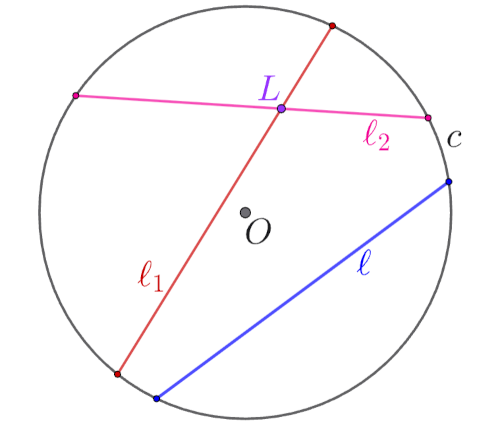
In accordance with Hilbert's idea, Lobachevsky, who was once remov-ed from geometry teaching due to his crazy ideas in mathematics, was subsequently understood. In the image on the right, we can unders-tand the concept of Lobachevsky's proof that the fifth Euclidean post-ulate cannot be obtained using the previous four.
Let the “points” also be points in a circle with center O and boundary circle c which we treat as “infinity”. Let the “length” also be the distance inside of that circle, but let the (infinite) lines be the chords of that circle; whi-ch connect the “infinite” points of the given circle c. The first four Euclidean postulates are there, but the fifth is: through a given point L outside a given li-ne ℓ it is possible to draw at least two lines ℓ1 and ℓ2 and both parallel to it. The modest Lobachevsky did not go beyond exactly two parallels, left and right, on which he built his hyperbolic geometry. Today, after the contributions to this topic by Gauss, Riemann, Hilbert, and Einstein, we better understand Lobach-evsky's genius.
3. Understanding reality is very close to understanding truth, which, as we see in the cases of mathematicians, is very demanding. Nature did not endow us with the skills of direct reading of the laws of nature through evolution, but ra-ther with their interpretations and illusions. She equipped us with the abilities of survival, adaptation and inheritance, because the infinities of truth are too big a bite for us of finite observations. The discovery of first estimation, then of willful lies, then of death and inheritance are the foundations of the emer-gence and development of life on Earth. Its exclusively single-celled forms lasted approximately the first 2.5 to 3 billion years, and then the “arms race” of predators and prey began, when the first discovered that it was easier for them to digest other organisms than dead minerals. In this sense, the dying of cells for the survival of the species is a necessity for successfully following the flow of reality, which otherwise eludes even itself. While life dies in order to continue, this loss is not important to indestructible dead nature.
4. Unlike physical reality, we also perceive its parts from which we derive fan-tasies and the possibility of deliberately lying. A life of deception can be a path of art, a tool for discovering truths, and to some extent a substitute for reality, but when it becomes our "real" reality or the need for others to have a differe-nt one, then reality will abandon us ugliness, the one that ultimately matters. This is the problem of people who lie too much, not only because they build houses of cards and become losers, but because they increasingly lose the art of perceiving reality and understanding the truth (See Truth). It is harder for them to grasp and harder to fit into reality. So, we live because we do not quite fit into the facts, but when we go too far in this, our world collapses.
Trigonometry » srb
Question: What are the differences between hyperbolic and elementary trigon-ometry?
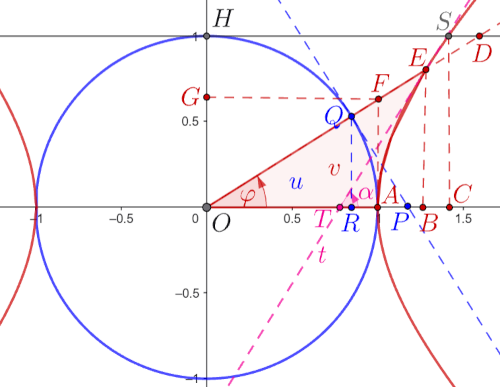
Одговор: In the image on the left in the Oxy plane, the trigonometric circle x² + y² = 1 is drawn in blue, and the hyperbola x² - y² = 1 is drawn in red, both unit. As long as the position of the point Q(x, y) on the circle is its projections in order:
x = cos(φ), y = sin(φ),
on the abscissa and ordinate. It is clear to us, these are the cosine and sine of the polar angle φ = ∠(AOQ), where A(1,0). When from the point Q(cos φ, sin φ) we lower the normal to the abscissa QR ⊥ Ox and draw a tang-ent to the circle, the segment of that tangent to the abscissa is the tangent of the angle QP = tan φ, where R, P ∈ Ox. This follows from the similarity of the triangles QOR ∼ POQ. I wrote about this in more detail in the book Trigonom-etrija (2016).
1. Analogous to the functions of the unit circle are the hyperbolic functions of the unit hyperbola x = cosh(φ) and y = sinh(φ), which are the coordinates of the point E(x, y). So we can write the equations of the circle and hyperbola:
cos²(φ) + sin²(φ) = 1, cosh²(φ) - sinh²(φ) = 1,
where the angle φ defines two tangents, the elementary k = tan(φ) and the hyperbolic k = tanh(φ). I use the same notation k for the two tangents, the quotient of their sines and cosines:
$$ \tan(\varphi) = \frac{\sin(\varphi)}{\cos(\varphi)} = \frac{QR}{RO} = \frac{PQ}{QO} = PQ, \quad QO = 1, $$ $$ \tanh(\varphi) = \frac{\sinh(\varphi)}{\cosh(\varphi)} = \frac{EB}{BO} = \frac{FA}{AO} = FA, \quad AO = 1. $$So the “same” line, y = kx, intersects the circle and the hyperbola respectively at points Q(cos φ, sin φ) and E(cosh φ, sinh φ). It is clear that in these expre-ssions neither angle φ is the same, but this is how we simplify this otherwise dense picture.
In addition to the above notations for elementary and hyperbolic trigonomet-ric functions, with cotangents cot(φ) = 1/tan(φ) and coth(φ) = 1/tanh(ψ), we also have tg(φ) and ctg(φ) = 1/tg(φ), as well as hyperbolic sh(φ), ch(φ), th(φ) and cth(φ). They come to us from the French mathematical school and are found in most of continental Europe and countries that were under French or Soviet scientific influence.
2. For example, in the figure above we see tan(φ) = PQ : QO = FA : AO. Also tanh(φ) = EB : BO = FA : AO, so for different angles φ, we have the same len-gth FA as a representative of both tangents. Reciprocally, cot(φ) = DH is also coth(φ) = DH, due to the similar triangles QRO ∼ PQO ∼ FAO ∼ OHD, with longer HD cotangents.
Another interesting fact is related to the area of a circle of radius r, which we know to be r²π, or r²θ for a full angle θ = 2π in radians, which is in degrees 360°. Hence, proportionally, when the angle is several times smaller, it bec-omes the opening of that angle, the circular section of the area is the same number of times smaller and is r²θ, of course with the angle in radians. The unit circle, also trigonometric, cuts the circle of angle θ span the area θ = 2φ, where the angle φ is seen in the image above and includes only the upper half-plane.
Well, the surface consists of a rectangle Δx⋅Δy, the product of width and heig-ht, so when we swap heights y → iy, where the imaginary unit i² = -1, the equ-ation of a circle (x² + y² = 1) will give the equation of a hyperbola (x² - y² = 1) and vice versa. The area of a circular section u = φ/2 gives the area of a hyper-bola section v = φ/2. The real surfaces Δx⋅Δy first give the imaginary i⋅Δx⋅Δy from which we then extract the real factor. On the other hand, the angles φ become ψ = iφ, or conversely φ = -iψ. Then we also find the transformations:
cos(iψ) = cos(ψ), -i⋅sin(iψ) = sinh(ψ), cos(φ) = cos(φ), i⋅sin(φ) = sinh(φ),
elementary into hyperbolic trigonometric functions and vice versa. This is because of the real cosine axis and the imaginary sine axis.
3. The same image and graph in the complex plane ℂ, on the abscissa and or-dinate, have new coordinates x = Re(z), y = Im(z) ∈ ℝ, which are the real and imaginary parts of the complex number z = x + iy ∈ ℂ. These new coordinates are real numbers with imaginary unit i² = -1. For these numbers, the Euler's equation holds:
z = ρeiφ = ρ[cos(φ) + i⋅sin(φ)], ρ = ∥z∥ = 1,
and otherwise it is in the complex plane, as in polar coordinates ρ ≥ 0. This formula comes from the properties of multiplication of complex numbers:
z1⋅z2 = (ρ1eiφ1)⋅(ρ2eiφ2) = (ρ1⋅ρ2)ei(φ1+φ2).
When multiplying complex numbers, their intensities (moduli) are multiplied, but the angles (arguments) are added. Of course, we get this by multiplying their trigonometric expressions:
[cos(φ1) + i⋅sin(φ1)]⋅[cos(φ2) + i⋅sin(φ)2] = = [cos(φ1)cos(φ2) - sin(φ1)sin(φ2)] + i[sin(φ1)cos(φ2) + cos(φ1)sin(φ2)].
This is also a (unique) complex number, so by comparison we find:
cos(φ1+φ2) = cos(φ1)cos(φ2) - sin(φ1)sin(φ2), sin(φ1+φ2) = sin(φ1)cos(φ2) - cos(φ1)sin(φ2).
These are the well-known additive trigonometric formulas, the sum of (elementary) cosine and sine.
4. Conjugating a complex number, (eiφ)* = e-iφ, will change the signs of the imaginary units, and by subtracting and adding such two units we find:
eψ + e-ψ = 2cos(-iψ), eψ - e-ψ = 2i⋅sin(-iψ).
Hence, by changing iφ = ψ, or φ = -iψ, we get:
eiφ + e-iφ = 2cos(φ), eiφ - e-iφ = 2i⋅sin(φ).
$$ \cos(i\psi) = \frac{e^\psi + e^{-\psi}}{2}, \quad -i\sin(i\psi) = \frac{e^\psi - e^{-\psi}}{2}, $$ $$ \cos(i\psi) = \cosh(\psi), \quad -i\sin(i\psi) = \sinh(\psi), $$ $$ \cos(\varphi) = \cosh(\varphi), \quad i\sin(\varphi) = \sinh(\varphi). $$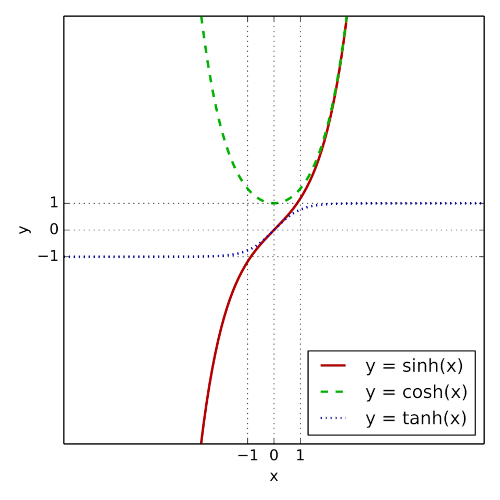
We also found the transformations of elementary cosine and sine into hyperbolic ones. We can put φ, ψ ∈ ℝ, for variables, and then graph the hyperbolic cosine, sine and tangent, quotient:
$$ \tanh(x) = \frac{\sinh(x)}{\cosh(x)}, $$looks like the image on the right. The above elementary additive formulas are now easily transferred to hyperbolic functions, either by changing the angles, or by using exponential notation:
cosh(x+y) = cosh(x)cosh(y) + sinh(x)sinh(y), sinh(x+y) = sinh(x)cosh(y) + cosh(x)sinh(y).
By applying the addition formulas of sine and sine, we calculate the correspo-nding expressions for tangents:
$$ \tan(x+y) = \frac{\tan(x) + \tan(y)}{1 - \tan(x)\tan(y)}, \quad \tanh(x+y) = \frac{\tanh(x) + \tanh(y)}{1 + \tanh(x)\tanh(y)}. $$Note that cos(-x) = cos(x) and sin(-x) = -sin(x), cosine is an even function and sine is an odd function, so also cosh(-x) = cosh(x) and sinh(-x) = -sinh(x).
5. We are looking for the tangents y = kx + n to the curve f(x, y) = 0, to a given circle or hyperbola. The slope, or tangent of the angle φ of the tangent line to the abscissa will be the derivative of the ordinate with respect to the abscissa, k = dy/dx, and n the point where the tangent intersects the ordinate:
(x² + y² - 1)' = 0, (x² - y² - 1)' = 0, 2x + 2yy' = 0, 2x - 2yy' = 0, y' = -x/y, y' = x/y, y' = -x/√(1 - x²), y' = x/√(x² - 1).
The first coefficient k = y' is the slope of the tangent to the circle, and the seco-nd of the hyperbola. Let the first tangent touch the circle at the mentioned po-int Q(cos φ, sin φ) , and the second touch the hyperbola at the point E(cosh φ, sinh φ). The coefficients of the circle and hyperbola are respectively:
$$ k_1 = -\frac{\cos \varphi}{\sqrt{1-\cos^2 \varphi}} = -\cot \varphi, \quad k_2 = \frac{\cosh \varphi}{\sqrt{1-\cosh^2 \varphi}} = \coth \varphi, $$and let the equations of the tangent lines be:
y = k1x + n1, y = k2x + n2.
By inserting the coordinates of points Q and E into the equations of the tangent, we find:
$$ \sin \varphi = -\frac{\cos^2\varphi}{\sin\varphi} + n_1, \quad \sinh \varphi = \frac{\cosh^2\varphi}{\sinh\varphi} + n_2, $$ $$ n_1 = \frac{1}{\sin\varphi}, \quad n_2 = \frac{1}{\sinh\varphi}, $$because cos²φ + sin²φ = 1 and cosh²φ - sinh²φ = 1. Therefore, the angle α of the tangent line to the abscissa is such that its tangent is equal to the cotange-nt of the angle φ.
6. Complex numbers may seem like a secondary concept to this topic, an ove-remphasized or far-fetched story, but it was precisely these that prompted me to (again) consider the proof of the excess dimensions of time in 2016, or rat-her a way to "understand" imaginary numbers as some kind of reality "out th-ere somewhere". Hence those confusing explanations with bypasses and the like, which I am reluctant to mention, about the origin of complex numbers in quantum mechanics. And that is the main reason for including them here, so as not to confuse that (hypo)thesis.
To be continued ...
Comments:
Examples of comments from 20024 to 2025:
2024-12-17 22:07:20 index.html rvukovic: Ово је иницијална порука.
2024-12-17 23:37:21 2502.html Jole: Nije loše, načelno Minimalno :). Zašto samo 200 slova, Twitter?
2024-12-18 14:06:43 2502.html Oliver: What you write about is a real revelation to me. Even if you say it's just "science fiction", those texts are more than inspiration to me. Thanks for the recent clarification!
2024-12-19 08:03:29 2502.html Nathaniel: You got me interested in Parrondo's game mixing.
2024-12-21 10:00:15 2501b.html Marko: Čitao sam Free fall. Preteško je za mene.
2025-02-18 12:19:20 2505.html Elton: Interesting and original Left Turn, interpretation of the Markov chain in Shannon information transfer.
2025-02-20 09:45:15 2505.html Steph: Interesting interpretation of the mapping, Reverse. Unusual. I read it, worth analyzing.
2025-03-08 23:23:40 2506.html James: I left a message at the academia.edu, just to remind you to read and comment, if possible.
2025-03-21 18:54:08 2506b.html William: I like your discussion about deities (Believing).
2025-05-23 12:24:52 2507c.html Liam: This contribution “Importance” is excellent. I will read the others with pleasure.
2025-06-20 21:59:17 2508.html Kang: Your description of dissipative operators is excellent (Rotations), and they finally became clear to me. Thank you.
2025-07-12 13:17:28 2508b.html Aaron: The example you gave (Synergy III, 2) ...+ 3⋅5 + ... < ... + (-1)⋅(-2) + 4⋅7 + ... separates ak = 3 and bk = 5 into components of opposite sign, but what about the case of separation, say 1+2 and 2+3,
2025-08-23 14:17:25 2509.html Мирко: Свиђа ми се Соларни систем.
2025-10-07 09:47:26 2512.html Diego: Excellently explained indicator, thank you.
New Comments:
Add a Comment:
The Parole is the first four numbers; the Comment can have 200 characters.
The comments of the Serbian blog and the English translation have common records. If the entry has "Origin", the submitted "Comment" will be recorded with a view of all others. If the "Origin" field is empty, it will only be a preview.
|
|
|